
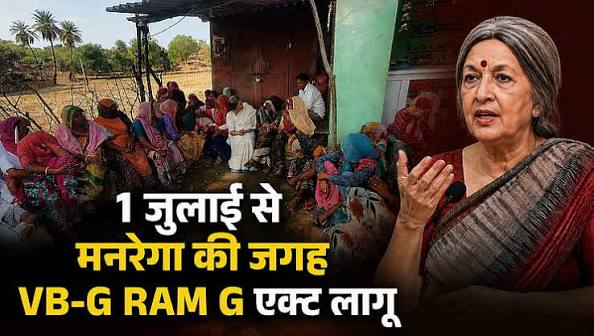
The ‘Vikasit Bharat – Rozgar and Ajeevika Mission (Rural) Act, 2025,’ or VB-GRAMG Act, will come into effect on July 1.
New Delhi/Udaipur—Senior Communist Party of India (Marxist) leader and former Rajya Sabha member Brinda Karat has written a letter to Union Rural Development Minister Shivraj Singh Chouhan, raising serious objections to the rules of the Vikasit Bharat – Rozgar and Ajeevika Mission (Rural) Act (VB-GRAMG Act). This letter, written a day before the new law comes into effect, cites genuine problems faced by rural laborers and demands the immediate withdrawal of the rules and the reinstatement of MNREGA.
Karat begins her letter by referring to Barapala, a tribal village in Rajasthan’s Udaipur district, where she had interacted with laborers at a MNREGA worksite the previous day. He reported that during the summer season, many female workers waited for about four hours from 6:30 am to 10 am for the online attendance site to open, but could not work that day due to a lack of internet connection. This situation was reported to be common.
Indigenous
He reported that after the end of MNREGA in December last year, these workers received only 18 days of work from January to June, despite assurances to Parliament that work would continue until the new law was implemented. In particular, at least 12 elderly women complained that the biometric facial recognition technology was unable to recognize their eyes, resulting in them being excluded from work. Karat said that the end of MNREGA has been devastating for the poor in the village.
During the summer season, many female workers waited for about four hours from 6:30 am to 10 am for the online attendance site to open, but could not work that day due to a lack of internet connection. This situation is common in the tribal areas of Rajasthan.
In light of these very real problems, Karat told the Union Minister that his ministry published eight rules of the VB-Gramji Act on May 22nd without consulting rural and MNREGA workers’ organizations and unions. Had they been consulted, the real problems could have been addressed, but the new rules are more flawed than the law itself and completely ignore the voices of workers.
Internet and Telecom
In the letter, Karat first raises the constitutional question of whether these rules violate Article 258 of the Constitution, which deals with the “conferring or imposing of duties” on states. According to him, the VB-Gramji Act not only imposes financial burdens on state governments but also imposes responsibilities without their consent. While Article 258(3) requires the central government to reimburse states for additional expenditure, the new rules deprive states of any role in decision-making, a direct attack on the federal structure.
Kerala provided an average of 66 days of work a year, which is much higher than the national average, but will receive fewer funds due to its low population. Similarly, Tamil Nadu, which has the highest number of active MNREGA workers despite having a high GSDP, will also receive fewer funds.
Karat also criticized the allocation criteria (Rule 396E). He said that the law already relies on fund allocation rather than demand-based work, but the rules determine allocation based on the recommendations of the 16th Finance Commission, which assigns a 42.5 percent weighting to per capita Gross State Domestic Product (GSDP) and 17.5 percent to population. He said these criteria have nothing to do with rural laborers seeking work.
Politics
Citing an example, he pointed out that Kerala provided an average of 66 days of work a year, which is much higher than the national average, but will receive fewer funds due to its low population. Similarly, Tamil Nadu, which has the highest number of active MNREGA workers despite having a high GSDP, will also receive fewer funds. Karat called this discriminatory and demanded an immediate reconsideration.
Furthermore, Karat viewed the “additional expenditure” (Rule 403E) clause as an insult to state governments. He stated that state governments wish to spend their own funds on work expansion and innovation, but the rules bind them to central financial oversight. He sharply questioned whether the right to work would be held hostage to the efficiency or inefficiency of state governments as dictated by the central government.
Regarding wage payment and worker identification (Rules 397E and 402E), Karat stated that the rules are completely silent on crucial issues such as the actual determination of wage rates, the timeframe for wage increases, or linking them to price indexes. He stated that the excessive emphasis on online registration and attendance is far removed from rural reality. Even with good internet access, registration can take 1-3 hours. Will this time be included in wages?
He questioned why workers should be punished for the dishonesty of officials. Karat said that this approach to the use of technology is based on elitist thinking, while the experience of millions of MNREGA workers shows that this thinking is wrong. He warned that arbitrary and high productivity standards can make it impossible for workers to even earn minimum wages. Therefore, the rules should include a provision for time-use surveys. This is especially important for women workers, as most of the workers in these workplaces are women.
Executive Branch
Karat also described the formation of the National Level Steering Committee (NLSC) (Rule 397E) as a bureaucratic trap. He said that this committee has minimal representation from states (only five members) and no place for workers or other stakeholders. While more than 50 percent of workers are women, 18 percent are Scheduled Tribes, and 17 percent are Scheduled Castes, their ministries have been excluded from this committee. States are bearing 40 percent of the cost, but with only five members, they have been treated unfairly, as if the center is saying, “Share the cost, but the decisions will be ours.” The Central Council has no binding power, and no independent authority has been created for social audits, which are essential for transparency and corruption control.
Finally, Karat said that these rules are completely imposed from above, bureaucratic, and also deny the rights of panchayats. He demanded that all eight rules be immediately withdrawn and MNREGA be restored as is. He warned that canceling MNREGA on July 1, as planned, would be the biggest attack on the hardworking people of the country’s villages.
Geetha Sunil Pillai
Courtesy: Hindi News