
Baghel meets Rahul, Priyanka amid Punjab Congress infighting
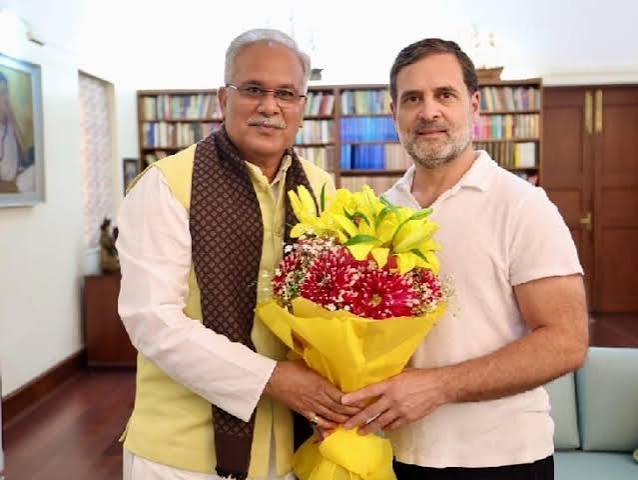
Chandigarh: Bhupesh Baghel, the AICC general secretary and in charge for Punjab, met the leader of the opposition in the Lok Sabha, Rahul Gandhi, and Congress MP Priyanka Gandhi Vadra in Delhi on Monday. During the meeting, issues relating to the continuing differences within the Punjab Congress and Rahul Gandhi’s proposed bus journey in the poll-bound state were discussed. The trio also discussed possible ways of addressing the differences within the state unit. Baghel, however, did not disclose details of the discussions on organisational issues after the meeting. The meeting comes amid continuing differences within the Punjab Congress, particularly between a group of leaders associated with the former chief minister and Congress MP, Charanjit Singh Channi, and the camp led by Punjab Pradesh Congress Committee president Amrinder Singh Raja Warring. The Channi camp has been pressing for the removal of Warring from the post of president. Last week, Baghel ruled out any change in the state unit’s existing organisational structure and said the focus would be on expanding the announced committees and bringing more functionaries into the party’s election preparations. “There will be no changes now. Only expansion will take place,” Baghel had said, indicating that the existing committees would be enlarged by adding more members, and that new committees could also be constituted as part of the party’s organisational preparations. After Monday’s meeting, Baghel said the expansion of the committees would take place shortly. However, he did not give details of the discussions on internal issues in Punjab. He said the primary focus of the meeting was Rahul Gandhi’s proposed bus journey in Punjab and related preparations. “I met both Rahul Gandhi and Priyanka Gandhi. The main topic was the bus journey planned for Punjab. I wanted to seek permission for the tour, specifically regarding the journey Rahul Gandhi is to undertake. They granted me time and asked me to submit a proposal outlining the schedule for the week, after which they will finalise the timing,” Baghel said. The former Chhattisgarh chief minister indicated that the proposed programme would not take place this week. He also hinted at a major tour covering Punjab. Baghel said a detailed programme would be prepared and shared with the party leadership before the schedule and timing were finalised. The proposed bus journey is being planned as part of the Congress’s preparations for the 2027 Punjab assembly elections. According to party sources, Rahul Gandhi is likely to begin the programme from Amritsar after paying obeisance at the Golden Temple. The tentative plan is for the first phase to cover the Amritsar-Hussainiwala stretch. Baghel also indicated that the proposed yatra would involve party functionaries from across Punjab. He said all party representatives would join the yatra, and national leaders would also participate in the programme. The proposed bus journey is likely to bring senior Punjab Congress functionaries together on a common platform as the party intensifies its preparations for the 2027 elections. AICC secretary and Punjab co-in charge Suraj Singh Thakur, who was also present at the meeting, said, “This is our family, and within a family, there has always been a good relationship between the younger and elder brothers. There are discussions over certain issues, and that is a matter within our party. We will resolve it by working together with everyone and taking everyone along, as has always been the Congress party’s approach and our principle. We will contest the Punjab elections together with everyone,” he said. Courtesy : TOI Note: This news is originally published on https:/timesofindia.com/bha and is used purely for non-profit/non-commercial purposes, especially human rights
Surprise protests, GenZ outreach: Rahul Gandhi’s new playbook after CJP’s success
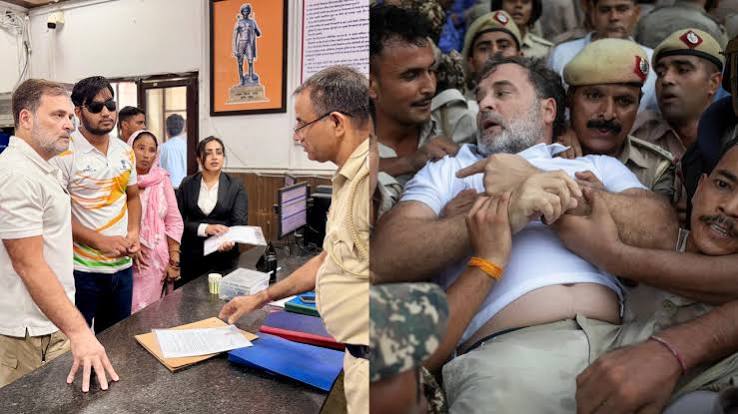
NEW DELHI: “I will not leave till you lodge an FIR. He has pellet injuries on his body, has lost his eye, and we are demanding an FIR for this… I will go outside and sit there until you lodge an FIR. I will sit for 10 days, 20 days, 30 days, 50 days, six months. Your government will have a problem.” There is a visible change in how Rahul Gandhi pushes through issues now. The leader of the opposition in Lok Sabha has a new weapon in his political arsenal: impromptu protests. For the second time in a month, the Congress leader caught the authorities and, to some extent, even his own party, off guard by taking to the streets of the national capital without prior warning. When Rahul reached the DCP office in Delhi on August 21 demanding an FIR for Sahil Lohchab, who sustained pellet injuries during the July 20 student protest, it was Act 2 of his new playbook of street protest politics. When the cops dilly-dallied, Rahul refused to budge and staged a sit-in protest outside the police station. Priyanka Gandhi Vadra joined him. Congress leaders began arriving. Rapid Action Force personnel were deployed outside. A visit to a police office turned into a high-voltage political stand-off and, after six hours of dharna, Delhi Police registered an FIR over the pellet firing. The BJP reacted sharply, calling Rahul’s sit-in the ‘politics of anarchy’. It argued that an FIR relating to the wider July 20 incident already existed, an investigation was under way and the Congress leader was turning police procedure into a political spectacle. For Lohchab, however, there was a sense of relief. His family had been trying to get his complaint registered since August 14, shuttling between police stations. The 19-year-old, who underwent surgery after pellets struck his right eye, finally had an FIR registered after Rahul’s intervention. For years, opponents have labelled Rahul Gandhi a ‘part-time politician’ who would raise an issue and then disappear. But this incident reinforced something that has changed about Rahul’s tactics over the past year. He is no longer content merely to raise an issue. He increasingly wants to enter it, stay with it and, if necessary, physically occupy the space. Rahul’s new playbook The first display of this surprise street-politics instinct had come a month earlier during the NEET student protests. On July 21, a day after police used force to stop thousands of students attempting a ‘Sansad Chalo’ march over exam irregularities, Rahul suddenly headed towards Prime Minister Narendra Modi’s residence and staged a sit-in. Police had reportedly made arrangements anticipating a Congress protest at Vijay Chowk. Rahul went to Lok Kalyan Marg instead. The move caught security officials by surprise. Rahul, Priyanka and several other opposition leaders were later detained. The visual that immediately took over the news was hard to ignore: the leader of opposition physically struggling with police officers, being dragged away and getting a nosebleed in the chaos. It came at a time when the Congress was desperately trying to make its presence felt, with Abhijeet Dipke’s Cockroach Janata Party and climate activist Sonam Wangchuk already leading a massive student protest against the NEET paper leak. Congress had initially kept its distance, preferring to run its own youth outreach campaign, ‘Chhatron Ki Goonj’. But people asked a simple question: If Congress claimed to support student issues, why was it missing from the biggest student movement in Delhi? When the July 20 Jantar Mantar protest took place and massive outrage erupted over police action against the student protesters, Rahul’s approach changed. The very next day, he moved to the front lines. He stood outside the Prime Minister’s house, Congress leaders visited injured students, and police action became a major national debate. Rahul took the issue to Parliament and continued raising the pitch over injuries suffered by students. And when the larger protest began to recede from the headlines, Rahul stayed with one part of it: the use of pellet guns. He has affirmed that his party will keep raising the issue and demand accountability. Rahul’s changing style The first major image makeover was when Rahul Gandhi embarked on the ‘Bharat Jodo Yatra’ from Kanyakumari to Kashmir in 2022. Sceptics and rivals wondered if he would complete the journey. By the time he reached Kashmir months later, after walking thousands of kilometres in his now-signature white T-shirt, one charge had become considerably harder to make: that Rahul was unwilling to put in the physical grind that it takes in politics. The yatra, on its own, did not help the Congress much. What it did was change the way Rahul himself was seen as a politician. For months, people saw him walking with the common public rather than delivering a scripted speech from a podium. He met farmers, labourers and students, stopped for conversations, entered homes and sat and ate with people. The yatra experience also laid the foundation for his growing social media popularity. His online presence today increasingly relies on short, conversational exchanges that can easily travel as reels and clips. The second shift came in 2024, when he became the leader of the opposition. Since then, we have seen a more combative Rahul Gandhi. Whether one agrees with his politics or the issues he raises, he appears considerably more comfortable with confrontation than he once did. Congress’s protests in the Parliament complex have also become more visual and experimental under Rahul. He repeatedly joined opposition MPs at Makar Dwar over the Election Commission’s SIR exercise in Bihar, with MPs carrying ‘vote chori’ placards and demanding its rollback. The protest later moved beyond the Parliament gates, with Rahul and other opposition leaders marching towards the Election Commission before being stopped and detained. Rahul provokes ministers across the aisle and stays for the response. He takes an argument from the street into Parliament and, increasingly, carries it back outside again. This is also a part of his renewed Gen Z outreach. Rahul’s GenZ
Transgender Police Trainee Found Hanging In Bathroom In Bihar

The victim, identified as Avanthika Sindhu, was a resident of West Champaran district. She was among a batch of 500 trainees sent from Patna Police Lines to Jamalpur for training. Transgender Police Trainee Found Hanging In Bathroom In BiharThe body has been sent for postmortem examination.Munger: A transgender woman constable undergoing police training in Bihar’s Munger district was found hanging in a bathroom on Sunday, prompting an investigation into the circumstances surrounding her death. The constable, Avanthika Sindhu, had reportedly been unwell for the past few days and was alone in the barracks when the incident occurred. Sindhu was a resident of West Champaran district. She was among a batch of 500 trainees sent from Patna Police Lines to Jamalpur for training. The batch includes 16 transgender personnel. The incident took place at the BSAP-9 camp in Jamalpur. According to colleagues, Avanthika had been unwell for the past few days and had not been taking part in training activities. On Sunday, the entire batch had gone to the training ground, while Avanthika remained in the barracks due to her poor health. When fellow trainees returned in the evening and began looking for her, they found her hanging in the bathroom. She was immediately taken to a primary health centre, where she was declared dead. Mithilesh Kumar, Commandant, BSAP Camp told the reporters, “It appears to be a case of suicide. The woman was found in the bathroom with a cloth towel tied around her neck.” Soon after receiving information about the incident, BSAP-9 Commandant Mithilesh Kumar, DSP Dr Arjun Kumar Gupta and Jamalpur Station House Officer Pankaj Kumar Paswan reached the camp and began an inquiry. Officials also questioned personnel staying in the barracks. Police are probing the case from multiple angles, including the circumstances inside the camp and the constable’s health condition. Investigators are also examining her personal life and external contacts to determine if any other factors may have contributed to her death. According to police sources, her mobile phone and personal contacts are also being subjected to technical examination to determine whether any pressure, dispute or other factor may have been involved. However, police said no conclusions can be drawn until the investigation is completed. The body has been sent for postmortem examination. Commandant Mithilesh Kumar said the constable’s family had been informed about the incident. Station House Officer Pankaj Kumar Paswan said the exact cause of death would be known only after the postmortem report and technical investigation are completed. Edited by: Anwesha Singh Courtesy : NDTV Note: This news is originally published on https:/ndtv.com/bha and is used purely for non-profit/non-commercial purposes, especially human rights
Free LPGs, expanded free travel for women, transgender persons; Parandur Airport scrapped: TN Vijay

Tamil Nadu Chief Minister C. Joseph Vijay announced that three LPG cylinders would be provided free of cost every year to 1.34 crore families in the State. He also announced the expansion of the free bus travel scheme for women and transgender persons, which is currently limited to ordinary buses. Under the new ‘Vettri Payanam Thittam’, they will be allowed to travel free of cost on mofussil buses operating between districts, as well as express and deluxe buses operated by the MTC in Chennai and by transport corporations in Madurai, Coimbatore, Tiruchy and other cities. The scheme will come into effect on October 2. Making the announcements under Rule 110 in the Assembly, Vijay also said the proposed second airport at Parandur had been dropped and the government was exploring alternative sites for the project. Courtesy : TNIE Note: This news is originally published on https:/thenewindianexpress.com/bha and is used purely for non-profit/non-commercial purposes, especially human rights
Mayawati says, ‘Demand for reservation on economic basis not right’:Dalits have faced casteism for centuries, don’t protect reservation opponents

BSP supremo Mayawati has lashed out at the demand for reservation based on economic criteria at Delhi’s Jantar Mantar. She said on Sunday that Dalits have been victims of casteism for centuries. In such a situation, the demand for reservation based on economic criteria is not right. Targeting Congress MP Rahul Gandhi, Mayawati wrote on ‘X’: Rahul, who sat on dharna outside the police station in Delhi, did not go to get the anti-reservation protest happening at Jantar Mantar right next door stopped. He did not even try to go and explain to the protesters. This clearly exposes Congress’s anti-reservation mentality. The BSP supremo appealed to the central and state governments not to give any kind of shelter or protection to anti-reservation elements. She told political parties that cheap politics should be stopped on sensitive and important issues like reservation. New demand for reservation based on economic grounds is not right at all Mayawati termed the demand for reservation based on economic grounds as anti-national and a blow to the spirit of the Constitution. She made it clear that Scheduled Castes (SC), Scheduled Tribes (ST) and Other Backward Classes (OBC) have been harassed for centuries. Constitutional measures in the form of reservation were created to protect them from this casteist oppression. In such a situation, the new demand to implement reservation based on economic grounds is not appropriate at all. Baba Saheb Dr. Bhimrao Ambedkar had said that ‘renunciation of casteism is the greatest patriotism.’ People not getting benefits is not due to reservation, but a result of corruption BSP supremo said – Every year, huge budgets are spent by governments to eradicate poverty. Not receiving its benefits is the result of government system failure and corruption, not reservation. The real benefit of economic reservation (EWS) implemented for poor families of general category is not reaching them; there is more deception in that too. Attempt to strengthen Dalit and deprived vote bank Political experts say that by opposing reservation on economic basis, Mayawati is trying to strengthen BSP’s traditional Dalit and deprived vote bank. BSP’s politics has long revolved around the issue of social justice and rights of deprived sections. At a time when protests took place at Delhi’s Jantar Mantar demanding changes in the reservation system and reservation on an economic basis, Mayawati is trying to present herself as the strongest advocate of reservation and constitutional rights. Know about the ‘Remove Reservation Movement’… It should be noted that a protest against reservation was held at Jantar Mantar in Delhi on Friday, 21 August. A large number of people gathered in the ‘Remove Reservation Movement’. They demanded the implementation of reservation based on economic criteria while opposing the caste-based reservation system. The protesters also demanded changes in some UGC rules and the reservation system. Keeping the movement in view, Delhi Police made tight security arrangements. Some protesters were also taken into custody. Courtesy : Bhaskar English Note: This news is originally published on https:/bhaskarenglish.com/bha and is used purely for non-profit/non-commercial purposes, especially human rights
Who Is Anagha Sasi, The Dalit Scholar Protesting At Kerala University?

Sasi, a PhD scholar in the Department of Environmental Studies, has been sitting on an indefinite protest demanding action against faculty members and others whom she accuses of caste-based abuse, harassment and obstructing her research Dalit PhD scholar Anagha Sasi is protesting at Kerala’s Malayalam University over alleged caste discrimination and academic harassment. Sasi has accused faculty members of denying research support, assigning non-academic work and obstructing her PhD progress. Student groups, Dalit organisations and activists have extended support and demanded an independent inquiry. A protest by Dalit research scholar Anagha Sasi at Thunchath Ezhuthachan Malayalam University in Kerala has drawn support from student groups, Dalit organisations and activists, after she alleged caste discrimination, academic harassment and denial of research facilities. Sasi, a PhD scholar in the Department of Environmental Studies, has been sitting on an indefinite protest demanding action against faculty members and others whom she accuses of caste-based abuse, harassment and obstructing her research. She has also demanded registration of a case under the Scheduled Castes (SC) and the Scheduled Tribes (ST) (Prevention of Atrocities) Act, along with action on complaints related to alleged ragging and academic retaliation, The Hindu reported Who Is Anagha Sasi? Anagha Sasi, from Kolenchery in Kerala, joined Thunchath Ezhuthachan Malayalam University in 2024 as a research scholar in the Environmental Studies department. She has alleged that despite completing her PhD coursework, she has been unable to progress with her research due to delays in academic support, approval processes and access to facilities. Sasi claimed that her annual progress report was delayed and that the university did not convene her Doctoral Committee, affecting her research work and putting her fellowship from the Kerala State Council for Science, Technology and Environment at risk. ‘Harassment And Denial Of Research Support’ Sasi has alleged that she faced caste-based discrimination from the beginning of her association with the university. She claimed that she was assigned non-academic tasks, including sweeping classrooms, dusting books and files, carrying boxes, cleaning laboratory equipment and arranging materials in classrooms and the department. She also alleged that she was denied research assistance, access to laboratory facilities and support during fieldwork. At times, she claimed, she was made to stand in corridors without seating. According to Sasi, her research guide Arun Babu and faculty member Jaini Varghese were among those named in her complaints. She alleged that Babu told her she would have to follow his instructions to continue her PhD. “I did not come to your house and ask you to come here for a PhD. If you want to do a PhD, you must obey what I say; otherwise, go somewhere else, go to IGNOU,” Sasi alleged he told her. She further claimed that she was told her fellowship was granted because of her caste rather than merit and alleged that she faced threats over the continuation of the fellowship. Complaints And Demand For Independent Probe Sasi said she submitted complaints to the university’s Registrar, Vice-Chancellor, Research Director and the SC/ST Cell in August 2025. She also approached the Higher Education Minister and the Chief Minister but alleged that no effective action was taken. She has disputed the university’s claim that she failed to revise her research synopsis, saying she had submitted multiple revisions but did not receive adequate guidance from her research supervisor. Dalit rights activist Sunny Kappikkad has supported Sasi’s protest, saying the matter reflects wider concerns of caste discrimination in higher education and should not be treated merely as an academic disagreement. Kappikkad also alleged that the university should have informed police after receiving a caste discrimination complaint involving an SC student and demanded an independent inquiry. Student Groups Rally Behind Protest Several student and social organisations have expressed solidarity with Sasi, including the All India Students’ Association (AISA), Ambedkarite Democratic Front, Kerala Students’ Union, Muslim Students’ Federation, Student Islamic Organisation, Kerala Dalit Federation and Fraternity Movement. AISA national president Neha Bora visited the protest site and expressed support. “Let casteism be defeated! Enact Rohith Act!” Bora said in a post on X. P.K. Navas, MLA, also visited the protest site and called for an external inquiry, while Welfare Party of India Kerala president Razak Paleri demanded an independent investigation. However, the widening support for her protest has increased scrutiny over the university’s handling of her complaints and the broader issue of caste discrimination in higher education. Sasi has said she will continue her indefinite protest until action is taken. Courtesy : Outlook India Note: This news is originally published on https:/outlookindia.com/bha and is used purely for non-profit/non-commercial purposes, especially human rights
Rajasthan High Court questions police as probe into attack on Dalit family changes hands six times

High Court seeks affidavits from investigating officers and supervisory committee over delay in probe into alleged land encroachment and attack on Dalit family The police investigation into a case of alleged land encroachment and attack on a Dalit family in Rajasthan’s Bharatpur district changed hands six times in the last two years, prompting the High Court to intervene. There was also a complete absence of supervisory review of the pending probe. The victim, Jitendra Kumar, 24, a resident of Bharatpur’s Bayana block, moved the High Court seeking a fair investigation, completion of the probe and filing of a chargesheet in the case. The first information report (FIR) was registered on May 10, 2024, following an attack on Mr. Kumar and his family members. The “politically influential” people who allegedly attacked the Dalit family in Kair village in a bid to encroach upon its agricultural land also registered an FIR against the victims. Though the police found the counter-case to be frivolous, the original case has been probed by as many as six investigating officers without any conclusion. “Despite the lapse of 26 months and a provision in the Scheduled Castes/Scheduled Tribes (Prevention of Atrocities) Act, 1989, for completion of probe in 60 days, the police have failed to act,” Mr. Kumar said in his writ petition. The investigating officers included a Circle Officer and five Additional Superintendents of Police, including one serving in the civil rights cell. The offences for which 12 accused belonging to the Gujjar community were booked under the Indian Penal Code and the SC/ST (PoA) Act included rioting, attempt to commit culpable homicide, causing grievous hurt, unlawful assembly, criminal trespass and criminal intimidation. The present investigating officer, Dinesh Kumar Meena, stated in the High Court that the offences against the accused had been proved and the result of the probe would be submitted in the trial court within two weeks. Justice Shubha Mehta at the High Court’s Jaipur Bench observed earlier this week that the failure to complete the investigation in time was “concerning” and no satisfactory reason had been given for the delay. The petitioner also stated that calling him to join the probe every time after the change of hands amounted to his harassment. The court directed the Public Prosecutor to obtain affidavits from all investigating officers named in the factual report, “explaining why the probe was not completed in 60 days and reasons for the subsequent delay”. Similar affidavits were also sought from the officers forming the supervisory committee under Rule 7(3) of the SC/ST (PoA) Act. Welcoming the High Court’s order, the Centre for Dalit Rights (CDR) said here on Sunday (August 23, 2026) that the investigation could have been completed and the accused arrested if the authorities had complied with the statutory review mechanism. The matter will come up in the court for further hearing on September 7. The members of the supervisory committee include the Home Secretary, Director General of Police, Social Justice & Empowerment Secretary, and Director of Prosecution. CDR Director Satish Kumar said though the committee was required to review pending cases under the SC/ST (PoA) Act once every quarter, the meetings were not held regularly and no relief was granted to Dalit victims. The Hindu Bureau Courtesy : The Hindu Note: This news is originally published on https:/thehindu.com/bha and is used purely for non-profit/non-commercial purposes, especially human rights
Outrage in UP’s Muzaffarnagar over minor Dalit girl’s gang rape; two arrested, govt assures strict action

The police have registered a case against both accused under Sections 64(1) and 70(1) of the Bharatiya Nyaya Sanhita (BNS), along with relevant provisions of the Protection of Children from Sexual Offences (POCSO) Act and the Scheduled Castes and Scheduled Tribes (Prevention of Atrocities) Act. In a shocking case in Uttar Pradesh, a Dalit minor girl was allegedly abducted and gang-raped in Muzaffarnagar, triggering massive public outrage. According to the police, the minor victim, 17, was recovered following a three-day search operation. Two accused, including a doctor, have been arrested in connection with the alleged abduction and gang rape. The accused have been identified as Nazim and Mohammad Adil. According to the police, the girl was allegedly abducted by Nazim. Mohammad Adil is accused of assisting Nazim in the crime. After receiving information regarding the girl’s disappearance and the suspected offence, the police launched an extensive search operation to trace her whereabouts and identify those allegedly involved in the incident. The investigation was intensified as teams searched multiple locations and examined CCTV footage from across the area. Investigators reportedly scrutinised footage from around 600 CCTV cameras to establish the movements of the accused and trace the missing girl. Speaking to reporters, the victim’s mother described the incident as a serious atrocity against her daughter and demanded the strictest punishment for those responsible. “This was a very serious atrocity against a Dalit girl. It is an extremely grave injustice against girls and our community and the entire society. We do not want anything except the death penalty. We want justice. We want bulldozers to be used against all the accused’s properties, including the house and the college,” she said. Uttar Pradesh Minister Kapil Dev Agarwal said the victim had been missing for several days and that the police action was being pursued seriously. Speaking to reporters, Agarwal said, “A young girl had been missing for four days; she is a minor belonging to the SC community. When she was recovered, according to the statement given by the child as conveyed to me by her family members, multiple individuals gang-raped her. Not once or twice, but repeatedly, three to four times.” “Individuals from a specific community were found involved in this. Police shot one of them in the leg while he was trying to flee, and two have been arrested and sent to jail,” he added. The Minister further said that the strictest possible action would be taken against those found responsible and that clear instructions had been issued to the district police leadership to ensure there was no compromise in the investigation. “The strictest possible action will be taken, and instructions have been issued to the Police Captain (SSP) that there will be no compromise under any circumstances,” Agarwal said. He further said that the names of a school and a hospital had emerged during the investigation and that action would be taken against them if their involvement or complicity was established. “Furthermore, since the names of a school and a hospital have surfaced, if they are found complicit during the investigation, the strictest action will be taken against them as well. The perpetrator, anyone who commits such an act, clearly has a depraved, sickening mindset. And the government is dealing strictly with such elements,” the minister said. Agarwal also said that provisions of the Gangsters Act and the Protection of Children from Sexual Offences (POCSO) Act would be invoked in the case. According to investigators, police teams worked extensively to trace the girl and establish the movements of the accused. CCTV footage from approximately 600 cameras was examined as part of the operation, helping investigators narrow down the locations and movements linked to the case. After the recovery of minor on Friday, the police confronted accused Nazim later that night, during which he was injured in the leg. His accomplice, Doctor Mohammad Adil, was also arrested. The police have registered a case against both accused under Sections 64(1) and 70(1) of the Bharatiya Nyaya Sanhita (BNS), along with relevant provisions of the Protection of Children from Sexual Offences (POCSO) Act and the Scheduled Castes and Scheduled Tribes (Prevention of Atrocities) Act. After being produced before a court, both accused were sent to judicial custody on Saturday, officials said. Courtesy : The Statesman Note: This news is originally published on https:/thestatesman.com/bha and is used purely for non-profit/non-commercial purposes, especially human rights
Four Sirwar cops suspended after Dalit woman’s rape and murder

Raichur: Four personnel attached to Sirwar police station have been suspended for alleged dereliction of duty in connection with the rape and murder of a Dalit woman from Hokrani village in Sirwar taluk. Raichur SP Arunangshu Giri issued suspension orders against sub-inspectors Bheemareddy and Veeresh, and constables Devaraj and Nagaraj, following allegations that they failed to respond appropriately after the woman was reported missing. According to the SP, the victim’s parents informed the police on the evening of Aug 19 that she had gone missing. However, when family members approached the police station to lodge a complaint, the personnel allegedly failed to act promptly and did not visit the village for spot verification. The alleged negligence sparked protests on Aug 22 by the victim’s relatives and members of Dalit organisations. They submitted a complaint to Ballari IGP Dr Harsha PS, the Raichur deputy commissioner and the SP, demanding strict action against the police personnel accused of failing in their duty. Following the allegations and the public outcry, the SP ordered the suspension of the four personnel pending further inquiry into the matter. Courtesy : TOI Note: This news is originally published on https:/timesofindia.com/bha and is used purely for non-profit/non-commercial purposes, especially human rights
Dalit violence cases face bias wall as conviction rate remains low under SC/ST Act
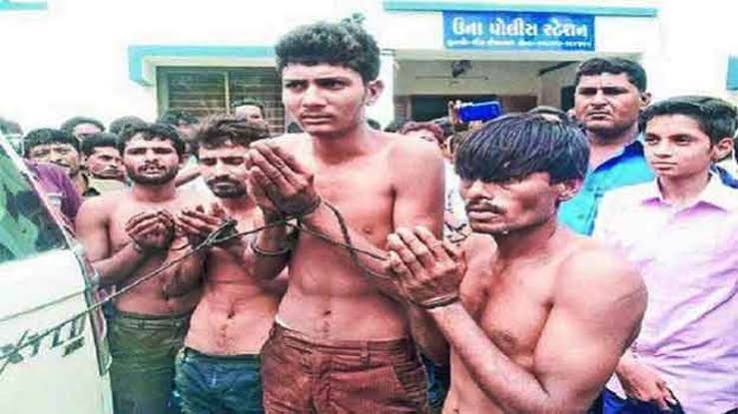
Odisha records a 10.8 per cent conviction rate for SC cases, while one Puri family says its trial is yet to begin eight years after the alleged attack Ashok Sethi, 48, and his family have been assaulted, ostracised and forced out of their native village in Odisha because of their Dalit identity. The family’s ordeal points to a deeper malaise that subjects members of the Scheduled Caste community to social and institutional discrimination, resulting in delayed justice and low conviction rates in caste-based violence. The conviction rate in cases registered under the SC/ST (Prevention of Atrocities) Act hovers at 34 per cent, much below the overall conviction rate of 53 per cent in criminal cases. Sethi, who hails from Nuagaon village under the Satapada gram panchayat in Puri district, said the majority of the 150 families residing there belonged to general and OBC categories. Sethi’s family used to wash villagers’ clothes and got around 10kg of paddy per year from each family as part of a barter system prevalent in the village. In 2000, Sethi’s family demanded payment in cash instead of kind, which the villagers refused. A penalty was imposed on the family, and they were ostracised. “I got married in 2000. The villagers did not allow us to put up a marquee in the village for the wedding because we did not agree to work under the barter system. They said it was below their dignity to walk under the canopy as we are Dalits. My sister’s marriage could not be held in the village in 2007,” Sethi, who now lives in Kathuaredi village under Brahmagiri block, around 26km away, told The Telegraph. In 2017, some villagers cut down trees from a plot of land belonging to Sethi’s family. The situation worsened in July next year when the villagers attacked the family, took away their cows and belongings, injured female members and destroyed their house. The family had no option but to move out. They stayed at a cyclone shelter near Chhotapur village, about 20km from Nuagaon, before shifting to Kathuaredi. On Sethi’s complaint, an FIR was registered at Brahmagiri police station under the SC/ST Act for caste-based violence. Sethi said the FIR did not mention Section 307 of the IPC (attempt to murder), although the family had specified it in their written complaint. “The discrimination was not limited to the villagers. We faced institutional bias from the police. The seven accused were arrested and granted bail within 10 days. Most importantly, the trial has not started even though eight years have passed,” Sethi said. “We have not visited our village since 2018. The villagers have taken over our land. We are living on rent at Kathuaredi,” he said. Baghambar Patnaik, a human rights activist, has filed a case with the Odisha Human Rights Commission seeking a direction to the police to expedite adjudication of the case and rehabilitation of the victims. A public interest litigation was filed in Orissa High Court, which in 2020 directed the rehabilitation of the family in Nuagaon village. Patnaik said the state government would have to recover the family’s land from the villagers and build a house for them before they could return. “They are unable to go back because the government machinery is not taking any steps to recover the land and construct a house. It shows that the government is not sincere about delivering justice to the victims,” Patnaik said. Rashmita Samantaray, the sarpanch of the Satapada panchayat, declined to comment on the issue. “I do not know much about this case,” she said. Last month, Congress Rajya Sabha member Chandrakant Damodar Handore sought information about the number of cases pending investigation under the SC/ST Act and the conviction rate. In a written reply on July 22, minister of state for social justice Ramdas Athawale furnished data, which showed that the national conviction rate stood at a mere 33.9 per cent for SCs in 2024. In Odisha, the conviction rate was 10.8 per cent. “The responsibility of maintaining law and order, investigation, protection of life and property of the citizens, including crime against members of SC and ST communities, rest with the respective state governments,” Athawale had said. CM on Ravidas, Phule Haryana chief minister Nayab Singh Saini on Sunday said Guru Ravidas envisioned a society with no place for any form of discrimination, fear or injustice while Dr B.R. Ambedkar considered education the most powerful tool for social transformation. Saini spoke about how Jyotiba Phule and Savitribai Phule challenged social orthodoxies, opened the doors of education for all, and made historic contributions, especially towards women’s education. Ambedkar regarded education as the most powerful instrument of social transformation and fought for the rights of deprived sections and equal opportunities, he said. Basant Kumar Mohanty Courtesy : The Telegraph Note: This news is originally published on https:/thetelegraph.com/bha and is used purely for non-profit/non-commercial purposes, especially human rights