
Poll violence in West Bengal: Crude bombs hurled in Murshidabad, several injured

MURSHIDABAD: Tension gripped Nowda in Murshidabad district during polling in the West Bengal assembly election after unidentified persons allegedly hurled a crude bomb, leaving several people injured, as reported by news agency PTI. According to initial reports, the explosion occurred amid voting activity, triggering panic among residents and voters in the area. The injured have reportedly been shifted to nearby medical facilities, though the exact number of casualties and their condition are yet to be officially confirmed. Security forces rushed to the spot soon after the incident and have begun combing operations to trace those behind the attack. Courtesy : TOI Note: This news is originally published on https:/timesofindia.com/bha and is used purely for non-profit/non-commercial purposes, especially human rights
Congress gets nod for Rahul Gandhi’s rallies in West Bengal
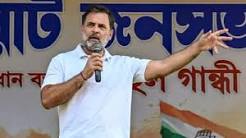
Kolkata: A day after police denied clearance for his planned April 23 appearances, Congress on Wednesday secured permission for Rahul Gandhi to hold three rallies in West Bengal on Saturday. The LoP in Lok Sabha will address rallies in Serampore, Metiaburuz and at Shaheed Minar in central Kolkata, in that order, said Congress member Amitabha Chakraborty. State Congress chief Subhankar Sarkar is contesting from Serampore. Rahul had earlier held three public meetings in Raiganj, Chanchal and Samsherganj on April 14, while his last Kolkata rally was in 2016. On Wednesday, Rahul also posted a video outlining Congress’s poll guarantees for Bengal: Rs 2,000 per month for women, health insurance up to Rs 10 lakh, free cancer treatment and dialysis at district hospitals, free education until graduation, filling of vacant govt posts within a year, and Rs 15,000 annually for farmers. Courtesy : TOI Note: This news is originally published on https:/timesofindia.com/bha and is used purely for non-profit/non-commercial purposes, especially human rights
THE UNION OF INDIA VS. MY UNDERWEAR

On the eve of International Trans Day of Visibility, March 30th 2026, the Indian Government formally Gazetted the amendments to the THE TRANSGENDER PERSONS (PROTECTION OF RIGHTS) ACT. The Indian transgender community has for ages been fighting for its rights. Since the British Raj, trans people have been labelled as criminals and condemned into poverty, homelessness, begging, and forced sex work. Only as recently as 2014 did the Supreme Court of India, with the National Legal Services Authority (NALSA) vs. the Union of India judgement, recognise transgender people as a separate third gender. In 2019, the Transgender Persons (Protection of Rights) Act adopted a broader and more inclusive recognition of trans people—explicitly including trans men, trans women (irrespective of medical transition), and genderqueer persons—by self identification. It upheld the “right to dignity,” a core value of the Indian constitution. But seven years later, the ruling nationalist government suddenly decided that they weren’t ‘protecting trans people enough.’ So they took it all away in under two weeks. On March 13, 2026, Union Minister Virendra Kumar introduced the Transgender Persons (Protection of Rights) Amendment Bill 2026 in the Lok Sabha (lower house of the Indian Parliament). Less than two weeks later, the bill cleared both houses of Parliament, despite drawing widespread criticism, and without consulting statutory bodies like the National Council for Transgender Persons. The Parliament passed it by voice vote because they didn’t even have the nerve to put it to a proper count—why would they when the entire opposition spoke against this draconian bill? Multiple members and activists resigned from their positions from the Council in retaliation. President Droupadi Murmu assented to the bill, thereby completing the rollback one day before the International Transgender Day of Visibility. THE NERVE ! So what exactly got passed? The official Gazette of India, No. 3 of 2026: The 2019 Act defined a transgender person as someone “whose gender does not match the gender assigned at birth, a broad, self-determined definition”. This amendment guts it. The new definition of “transgender person” under the amended clause (k) lists only: Persons with socio-cultural identities such as kinner, hijra, aravani, jogta, or eunuchs; persons with specific intersex variations or congenital differences in primary sexual characteristics, external genitalia, chromosomal patterns, gonadal development, or hormonal response; Any person who has been “by force, allurement, inducement, deceit or undue influence, either with or without consent, compelled to assume, adopt, or outwardly present a transgender identity.” It shall not include, nor shall ever have been so included, persons with different sexual orientations and self-perceived sexual identities. While the new definition includes intersex people who underwent forced genital mutilation as children, the government clearly rejects all self-identification, confusing sexual with gender identity, intersex people with transgender. This bill strips away the dignity of transgender individuals, characterising the individuals of the community either as (1) members of a religious caste and biological deviants, (2) unfortunate, and underprivileged by nature of being transgender, or (3) condemned sexual criminals. This separation of traditional communities from non-conforming criminals explains the broader character of the ruling government. In order to avail the government’s ‘protection’ under the new amendment, we trans people have to undergo pain, insult, exploitation, and dehumanization only to prove to the state that we fit their traditional and orthodox boxes. That we’re the ‘correct kind of transgender,’ that we’re pure and sanctioned, sanctioned by the casteist, misogynist, and transphobic traditions of orthodoxy. This is the expression of the growing Elite-Hindu Nationalism, which ties itself to all the identities that stand by, support, and bow down to the religious and cultural elite. The ‘Protection of Rights’ amendment is only for those trans people that choose to uphold traditions of deep-rooted misogyny, casteism, and cultural hegemony. As for the rest, it is an excuse for erasure. Using these identities as tokens, the government is illegalising everyone who chooses their reality. The state is after everyone who speaks their own voice. And they will check and ensure that we are the ‘correct kind’ themselves. Under the amended Section 6, a transgender identity card can now only be issued by the District Magistrate “after examining the recommendation of the authority and, if he considers either necessary or desirable, after taking the assistance of other medical experts.” Your surgery (if you get one), your hormones, your hairstyle – all of this, reported to and authorised by the government. Your body, logged in an official registry. This is not protection. This is surveillance. This is the government trying to invade our bodies. Imagine having to take off your clothes and presenting yourself in front of socially unconscious government-appointed doctors. They will judge you, sneer at you, perform all the ‘necessary examining’ that they want to, and then approve whether you are ‘considered’ transgender or not. Describing their personal experience, VJ writes: Let me be very clear about what this gazette means. I, a non-Hindu, disabled, queer, non-binary trans person, have been written out of existence. In the eyes of the Indian government, I do not exist. My identity has been legislated away. I am a trans-masculine student who, until now, hadn’t had to worry about what was in my fucking pants. Yes, there had been instances where I’d been stopped outside public bathrooms, looked up and down, told I was in the wrong place based on how I looked. But if I said “I am trans,” “I am a woman,” or “I am a boy,” no one could legally stop me. That liberty existed. That small, hard-won protection was real. It wasn’t perfect, but it was enough to breathe. I fought tooth and nail to pursue my Bachelor’s thesis on Architecture of Queer spaces, facing humiliation through every jury, in rooms where even my existence was up for debate. If educators couldn’t find it in themselves to respect my identity even when the law was on my side, what chance do any of us have now that it isn’t? What happens to my research, to all of us who
Petition in Supreme Court flags ‘erasure’ of trans men in new law

NEW DELHI: A petition in the Supreme Court challenging the Transgender Persons (Protection of Rights) Amendment Act, 2026 — likely to come before a CJI-led bench on April 27 — highlights the “complete legislative erasure of trans men and trans masculine identities and other gender-diverse identities from the definition of transgender person”. Steered by transgender rights activists Manveer Yadav and Vishwanath Maithil — who identify as transmen — the petition states the 2026 amendment law introduces sweeping changes to the 2019 law and is in “complete derogation of principles” laid by SC in its landmark 2014 ‘National Legal Services Authority v. Union of India’ case that recognised “transgender” as an umbrella term encompassing wide and diverse range of identities, including trans men and trans masculine identities, trans women, non-binary persons, genderqueer individuals, and socio-cultural groups including hijras, kinnars, aravanis, and jogtas, and held that the criterion for recognition must be the ‘Psychological Test’, not the ‘Biological Test.’ The two other petitioners are transgender rights activists and trans women Abhina Aher and Vinshi Shahi. The petitioners said the 2026 law replaces an identity-based, self-determination framework with a categorical list of externally verifiable biological markers and named trans-feminine socio-cultural communities, none of which encompasses trans men. Highlighting that the Trans Rights Act, 2019, before the amendments, defined “transgender person” to include trans men and trans women irrespective of medical intervention, persons with intersex variations, genderqueer persons, and named socio-cultural communities. Also, it guaranteed the right to self-perceived gender identity. “Together, this framework operationalised the constitutional mandate of NALSA. The 2026 amendment law systematically dismantles it,” they emphasised. The petition goes on to cite that the 2026 Amendment Act, firstly, replaces the open, identity-based definition of “transgender person” under the 2019 Act with a categorical and exhaustive list confined to: persons with named socio-cultural identities (kinner, hijra, aravani, jogta, & eunuch); persons with intersex variations defined through biological and chromosomal criteria; and persons forcibly compelled to assume a transgender identity through bodily modification.” Further, a proviso declares that the definition shall “not include, nor shall ever have been so included, persons with different sexual orientations and self-perceived sexual identities.” Besides this, the petitioners express concern as they highlight that “the right to self-perceived gender identity that is constitutionally protected, has been entirely omitted without any legitimate rationale”. “The combined effect of such an amendment is to strip trans men and trans masculine identities of all statutory recognition and protection,” they add. “Furthermore, every named socio-cultural community in the definition is, without exception, a trans-feminine community of persons assigned as male at birth. Trans men and trans masculine identities have no equivalent named community formation in India; their structural invisibility is itself a defining feature of their experience,” the petition states It is further highlighted that the “legislature’s privileging of community-visible, trans-feminine identities over self-perceived identities is not a neutral classification, it is a prejudice of visibility encoded in statute.” Raising various issues, the petitioners also draw attention to how the 2026 Amendment Act restructures the certificate regime under the Trans Rights Act 2019, “converting a facilitative, self-declaration-based process into one of administrative adjudication and compulsory State surveillance over gender transition”. “Under the 2026 Amendment Act, the district magistrate is now required to examine the recommendation of a medical board and, where considered “necessary or desirable,” to seek the assistance of other medical experts before issuing a certificate of identity. This directly reintroduces the Corbett Biological Test expressly rejected in the NALSA case and produces a chilling effect on gender expression,” the petitioners state. They further highlight a Parliamentary Standing Committee report that cautioned against precisely this kind of “medical gatekeeping” and seek the intervention of the top court to protect the rights of the community, and urge the SC to declare the right to self-perceived gender identity a fundamental right protected under the Constitution of India. “The medical institutions are mandated to furnish details of any person who has undergone gender-affirming surgery to the district magistrate and the designated authority, without consent, purpose limitation, or data protection safeguard. This violates the right to informational privacy, decisional autonomy, and bodily autonomy under Article 21; breaches doctor-patient confidentiality; conflicts with the Digital Personal Data Protection Act, 2023; and creates a state-controlled surveillance architecture over gender transition that is manifestly arbitrary and disproportionate under Article 14,” the petition states. “The protection that a change in gender shall not affect existing rights and entitlements under the Act has been omitted, removing a critical statutory safeguard and leaving transitioning persons without protection of their entitlements,” it further states. In this backdrop, the petitioners seek the intervention of the top court to protect the rights of the community and urge the SC to declare the right to self-perceived gender identity a fundamental right protected under the Constitution of India. Courtesy : TOI Note: This news is originally published on https:/timesofindia.com/bha and is used purely for non-profit/non-commercial purposes, especially human rights
Ambedkar Jayanti Controversy: Dalit Professor at CURaj Held in Police Custody for 4 Hours; Had Written in Email: ‘I Will Not Attend the Political Gathering’
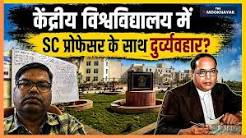
Professor States: ‘We Are Not for Sale’ Ajmer—A serious incident has come to light at the Central University of Rajasthan (CURaj), where Dr. Rakesh Kumar, an Associate Professor in the Department of Physics, was forcibly removed from his own office by the police and detained for approximately four hours. It is alleged that this action was taken without any FIR or formal complaint, solely because he had expressed his intention not to attend an event featuring the Deputy Chief Minister. Dr. Kumar has termed this a conspiracy to stifle his voice and has alleged that the university administration, in collusion with the police, subjected him to communal and discriminatory treatment. Professor Dr. Rakesh Kumar—who himself belongs to the Scheduled Caste (SC) community—was accused of conspiring to disrupt the Deputy Chief Minister’s event on April 15. However, according to his written complaint, the reality is quite different. The police allegedly barged into his office, snatched his mobile phone, threw aside his laptop bag, issued threats, and held him in custody within the university administration building for four hours. Is this the appropriate way to celebrate Ambedkar Jayanti, or is it a conspiracy to crush the voices of the SC/ST community? In a detailed written complaint, Dr. Rakesh Kumar has leveled serious allegations against ten individuals. These include Ajmer SP Harsh Vardhan Agarwal, Inspector Dayaram Chaudhary, Constables Ram Gopal, Bajrang Lal Morya, and Anil Kumar; as well as University Vice-Chancellor Prof. Anand Bhalerao, Registrar Amardeep Sharma, Dr. Pramod Kamble, Dr. Anand Kumar, and PRO Anuradha Mittal. According to the professor, on the morning of April 15 at 9:30 AM—just as he stepped off the university bus and reached his office—four police personnel barged in. They alleged that the professor was planning to disrupt the Deputy Chief Minister’s event. Dr. Rakesh Kumar immediately demanded to know which specific email contained such a statement. The police responded by saying that the email was written in English and that they were unable to read it. The professor showed his email, in which it was clearly stated: “I can’t be a part of a crowd, especially for a political gathering. Sorry!” In other words, he did not wish to be part of the crowd at a political event. Nevertheless, the police created a commotion inside his office. Inspector Dayaram Chaudhary threw aside the bag containing his expensive laptop, pulled up a chair to sit right next to him, and completely hemmed him in. He threatened to send him to jail. The professor responded that if he were indeed a criminal, they should go ahead and send him to jail—but only after first showing him a copy of the complaint or the FIR. Despite this, the police snatched away his mobile phone, denied him the opportunity to close his office door, and dragged him out in full view of the students and faculty members. Once he had been placed inside the police vehicle, Inspector Dayaram Chaudhary spoke with SP Harsh Vardhan Agarwal and Registrar Amardeep Sharma. Dr. Rakesh Kumar overheard Amardeep Sharma praising Dayaram Chaudhary. Subsequently, he was held in custody for four hours—until 1:30 PM—in a room located near the offices of the University’s Vice-Chancellor and Registrar. Upon regaining access to his mobile phone, he discovered that the media had already covered the incident. However, the University’s PRO, Anuradha Mittal, falsely told the media that the University had not sent any email to the police. Dr. Rakesh Kumar alleges that he had sent the email to only 34 individuals (32 SC/ST faculty members, the Vice-Chancellor, and the Registrar). Who, then, forwarded it to the police? He has accused Prof. Anand Bhalerao, Amardeep Sharma, Dr. Pramod Kamble, and Dr. Anand Kumar of conspiring against him. Is Raising Questions the Real Reason for the Harassment? Dr. Rakesh Kumar has long been raising questions regarding students, faculty members, and academic scandals within the university. He told *The Mooknayak* that Prof. Anand Bhalerao and Amardeep Sharma never respond to his emails. Amardeep Sharma’s emails frequently contain serious grammatical and typing errors—an issue about which Dr. Kumar has complained on multiple occasions. Recently, he raised the issue of academic scandals within the university. Prior to this, a professor in the Department of Biotechnology faced allegations of sexual harassment involving several female students (including those from SC/ST backgrounds). This matter dragged on for months, but Prof. Anand Bhalerao allegedly suppressed it because the accused faculty member was a close associate of his. Despite the allegations leveled against him, the said professor was appointed as the Dean of Student Welfare and, subsequently, as the Head of the Department. “As a symbolic gesture of protest, I refused to participate in this event. This stance was clearly articulated in my email correspondence. Consequently, the Vice-Chancellor and the Registrar conspired to stifle my voice and subject me to indirect harassment.” — Dr. Rakesh Kumar The email read: “The SC/ST community is not for sale.” On April 12, Dr. Anand Kumar, the Convener of the SC/ST Cell, sent an email stating that Ambedkar Jayanti would be celebrated on April 15, and that every SC/ST faculty member was expected to bring at least five students to the event attended by the Deputy Chief Minister. Dr. Rakesh Kumar argued that since Babasaheb was born on April 14, there was no justification for holding the commemorative event a day late. He replied to the email stating that the SC/ST community is not for sale. He questioned how they could expect him to mobilize students for a political event when they had failed to stand up for SC/ST female students in cases involving harassment allegations. He explicitly stated that he would not participate in a political event. Four other SC/ST faculty members voiced similar concerns, but neither Dr. Anand Kumar nor Dr. Pramod Kamble (the SC/ST Liaison Officer) offered any response. Dr. Rakesh Kumar alleges that this was, in fact, the real reason behind the harassment. Vice-Chancellor Prof. Anand Bhalerao and Registrar Amardeep Sharma attempted to stifle their voices by
“This Ritual Is Not for People Like You”: In Damoh, a Differently-Abled Dalit Groom Was Pulled Off His Horse During the ‘Rachwai’ Ceremony and Subjected to Such Treatment That…!

Wedding guests captured a video of this brutality, which has now gone viral on social media, becoming a source of shame for the entire society. Damoh—In Bijori Pathak village, located within the jurisdiction of the Hatta police station in Madhya Pradesh’s Damoh district, a heartbreaking and reprehensible incident has come to light. This event has exposed the deep fissures of caste-based discrimination that, despite official claims of social equality, remain a stark reality in rural India. Golu Ahirwar—a 23-year-old differently-abled Dalit groom—was subjected to such brutal physical assault during the pre-wedding ritual known as ‘Rachwai’ that it sent a wave of outrage across the entire state. The casteist thugs showed absolutely no mercy, not even sparing the groom due to his physical disability. The incident occurred on Tuesday evening as Golu, mounted on a mare, was passing through the village accompanied by his family and the wedding procession. At that moment, certain self-proclaimed strongmen of the village objected to the procession and launched an attack. According to the victim, individuals identified as Guddu Singh, Krishna, Hakam, and Paltu Lodhi not only forcibly dragged him off the mare but also beat him so severely with sticks and clubs that the festive atmosphere of the wedding was instantly transformed into one of mourning. The wedding guests managed to record this act of brutality on video; the footage has since gone viral on social media, bringing shame upon the entire society. Humiliating and inflicting violence upon an individual based on their caste during a significant social and cultural occasion like a wedding reflects the narrow-minded mentality prevalent in society; furthermore, subjecting a differently-abled person to such treatment is an act of extreme inhumanity. Recounting that heart-stopping moment, the victim’s sister, Manisha Ahirwar, stated that as the procession was moving forward, the accused deliberately blocked their path by parking their vehicle in the narrow lane. When they were requested to move the vehicle, they rushed forward aggressively, shoved Golu off the mare, and knocked him to the ground. He recounted that four individuals collectively attacked him, explicitly stating that a mare could not enter this lane, nor could a procession of “people like them” be taken out here. They further made it clear that this ritual was not meant for people of their kind. An even more shocking fact is that, despite the groom being differently-abled, the attackers showed absolutely no mercy. Golu’s mother, Vidya Ahirwar, stated that her son was dragged off the mare and brutally beaten; when her daughter attempted to intervene, she too was assaulted. Amidst the chaos of the attack, some of her daughter’s gold jewelry also went missing. Following the assault, the entire family and the wedding guests proceeded directly to the Hatta Police Station to seek justice. Confirming the incident, Station In-charge Sudhir Kumar Begi stated that during Golu Ahirwar’s *Rachwai* (pre-wedding procession), as the entourage approached the village’s shrine, Vishwanath Lodhi, Chintu Lodhi, and others raised objections to the groom riding a mare and launched an attack. The police have registered a case under relevant sections of the law, including the SC/ST Act. However, this is not the first instance of such an incident occurring in this village. Locals recall that on a previous occasion, when a *Dalit* groom’s procession was being taken out, members of the upper castes had raised objections; subsequently, social organizations had to intervene to somehow ensure the procession could proceed. The police have deployed security forces in the village, and following a medical examination, the groom’s family has departed for Budhi Semra village in the Chhatarpur district to complete the wedding rituals. Expressing deep concern over this entire episode, social activist and Bhim Army leader Sunil Astey stated that the incident of assault is extremely grave and condemnable. He asserted that this event constitutes not merely a criminal act, but a blatant violation of the rights to equality, dignity, and liberty enshrined in the Constitution. Asteya stated that humiliating an individual and resorting to violence against them on the basis of their caste during a social and cultural occasion—such as a wedding—reflects the narrow-minded mentality prevalent in society; such treatment is particularly inhumane when directed at a person with disabilities. He has urged the administration to ensure the swift arrest of all accused individuals, conduct an impartial investigation to initiate strict punitive action against the culprits, and take action under the National Security Act (NSA) against elements that seek to sow fear and unrest within society. Furthermore, he emphasized the need to formulate a “Special Protection Framework” to safeguard Dalit grooms and social gatherings, thereby preventing the recurrence of such incidents in the future. It is imperative that the rule of law be upheld and that every citizen be granted the freedom to exercise their social and cultural rights without any discrimination, as maintaining harmony, dignity, and equality within society is a shared responsibility of the administration, civil society, and all sections of the community. Geetha Sunil Pillai Courtesy: Hindi News
Babasaheb had said—’The educated have betrayed us’; the meeting between former CJI Gavai and Dhirendra Shastri has rubbed salt into the wounds of the Bahujan community!
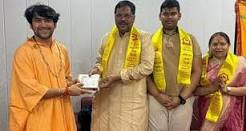
Users have termed this meeting an insult to the ideals of Babasaheb Ambedkar. Many users also recalled that historic statement by Babasaheb in which he had issued a warning regarding a ‘Hindu Rashtra’ (Hindu Nation). New Delhi—A recent meeting between former Supreme Court Chief Justice B.R. Gavai and Dhirendra Shastri, the head priest (Peethadhishwar) of Bageshwar Dham, has sparked a storm on social media. Following this meeting, outrage has erupted across the spectrum—from the Bahujan community to constitutionalists. On social media, users are condemning the former CJI for meeting with a staunch Hindu spiritual guru, despite being a Buddhist and an Ambedkarite himself. Many are also recalling Gavai’s infamous ‘shoe incident,’ when a lawyer attempted to throw a shoe at the former CJI right inside the courtroom. Recently, photographs of the meeting between former Chief Justice B.R. Gavai and Bageshwar Dham’s head priest, Dhirendra Shastri, went viral on social media. Dhirendra Shastri—popularly known as ‘Bageshwar Baba’—has openly advocated for the establishment of a ‘Hindu Rashtra’ and championed the *Manusmriti*. Consequently, when an individual who once held the country’s highest constitutional office went to meet him, it triggered widespread outrage within the Bahujan community. Public interest lawyer Prashant Bhushan posted on his X account: “I can’t believe my eyes! Former CJI Gavai with a hate-mongering charlatan! What kind of message is he sending to the judiciary? Shocking!” Dr. Babasaheb Ambedkar had issued a stern warning regarding a ‘Hindu Rashtra,’ describing it as the “greatest calamity” and a “terrible disaster” for the country. He asserted that such a state would pose a threat to democracy, liberty, equality, and fraternity, and must be prevented at all costs, as it could be detrimental to the interests of Dalits, women, and minorities. Users have characterized this meeting as an affront to the ideals and vision of Babasaheb Ambedkar. Many users also recalled that historic statement by Babasaheb in which he issued a warning regarding the concept of a ‘Hindu Rashtra’ (Hindu Nation). Journalist Nadeem Ahmed Sheikh stated, “The visit of former Chief Justice B.R. Gavai to Bageshwar Dham—and his meeting with Dhirendra Shastri—is a matter of concern. India is a pluralistic and constitutional nation; it does not seem appropriate for an individual holding a position of such dignity as a former Chief Justice to meet with a speaker who repeatedly advocates for a ‘Hindu Rashwar’ and makes scathing remarks against other religions. The judiciary must appear impartial and equal in its treatment of all; when a former Chief Justice openly visits such a platform, it raises the question: have constitutional values and secularism been confined merely to the pages of books? Faith is a personal matter, but the responsibilities of an individual who has held a constitutional office are not merely personal. India must proceed along the path of ‘Sabka Saath, Sabka Vikas’ (Support of All, Development for All), rather than engaging with platforms that espouse the language of division.” Journalist Shakeel Akhtar observes, “Until the Dalit community realizes who, from within their own ranks, is actually tightening their chains, outsiders like Rahul Gandhi will be unable to offer them much assistance. Bageshwar Dham—or Dhirendra Shastri—has faced numerous allegations of making anti-Dalit statements. His own brother, in fact, stands accused of threatening a Dalit family while brandishing a country-made pistol. In such a context, Justice Gavai’s visit to the site serves only to encourage ordinary Dalits to visit there as well. Perhaps that is precisely why Bageshwar Dham itself tweeted the news of this visit, complete with accompanying photographs.” One user wrote, “Bhim Jayanti has just passed—the very ‘Bhim’ who ensured that justice was delivered to us. And yet, thanks to that very justice—which enabled individuals to ascend to high offices—we now see such a person visiting a place steeped in superstition.” Journalist Avesh Tiwari writes, “This is former CJI B.R. Gavai, being honored by the number-one fraud, charlatan, and loudmouth, Dhirendra Shastri. I recall the time when a lawyer threw a shoe at him; back then, I completely shredded the haters who mocked him. When Gavai was elevated to the bench, it was hailed as a victory for Ambedkarism and a major achievement for Dalits. Looking at this photograph fills me with shame. I have no hesitation in stating that, to this day, Ambedkarites have failed to find honest leadership—an honest hero—for themselves. Of all those they have found, not a single one possesses a strong moral spine. This is a truly obscene image.” Ambedkarite activist Rohit Raj writes, “It was this very judge who, because of his Dalit identity, once had a shoe thrown at him. Seeing this saddens me—yes, it truly saddens me—that such a highly educated man, a former Chief Justice no less, would seek out a charlatan. What compulsion drives this? On one hand, you chant ‘Jai Bhim,’ yet on the other, you succumb to blind superstition. It is truly baffling.” One user wrote, “Babasaheb Ambedkar once said, ‘It is the educated people who have betrayed me.’ Former CJI Gavai belongs to that very category. To this day, he has not delivered a single verdict that truly upholds social justice.” **Why the Meeting with Shastri Recalled the ‘Shoe-Throwing Incident’** This meeting takes on even greater significance when we look back at the events that led to the infamous ‘shoe-throwing incident’ involving former CJI Gavai and lawyer Rakesh Kishore. The entire controversy revolved around an idol of Lord Vishnu located in Khajuraho. The head of an ancient, 7-foot-tall idol of Lord Vishnu within the temple premises had been damaged. A Public Interest Litigation (PIL) was filed in the Supreme Court demanding the restoration of this idol. On September 16, 2025, the then-CJI B.R. A bench presided over by Justice Gavai was hearing this matter; during the proceedings, Justice Gavai remarked to the petitioner: “You claim to be a devout devotee of Lord Vishnu. In that case, go now and pray directly to the Lord.” This comment was taken in great offense by advocate Rakesh Kishore. On the morning of October
Lodhi community men assault physically challenged Dalit groom during pre-wedding procession in MP

Four Lodhi community men, identified as Vishwanath Lodhi, Bicchu, Chinnu and Paltu Lodhi, pulled the groom from the horse and assauled him with sticks. BHOPAL: A 23-year-old physically challenged scheduled caste (SC) groom, Golu Ahirwar, was brutally assaulted and pulled down from a horse allegedly by members of the OBC Lodhi community in Damoh district of MP’s Bundelkhand region during his pre-wedding procession. The incident happened in Bijori Pathak village under Hatta police station area on Tuesday evening, when the Rachwai (a customary pre-wedding ritual) of the groom was underway. As the pre-wedding procession of the Dalit groom passed through the village, powerful Lodhi community men overtook the procession and parked their vehicle to block the passage. Four Lodhi community men, identified as Vishwanath Lodhi, Bicchu, Chinnu and Paltu Lodhi, pulled the groom from the horse and started assaulting him with sticks. The video of the alleged incident was recorded by the Dalit family. The groom’s mother, Vidya Ahirwar, alleged that the attackers showed no mercy, despite her son being physically challenged. “They beat him mercilessly. They didn’t even spare my daughter, Manisha. They assaulted her when she tried to resist the attack on her brother.” After the incident, the Dalit family rushed to the Hatta police station and reported the entire matter. While confirming the incident, Hatta police station in-charge Sudhir Kumar said, a case has been registered under IPC Sections 126(2), 296(b), 115(2), 351(2), 3(5) and relevant Sections of the SC/ST (Prevention of Atrocities) Act, and investigations are underway. The police force has been deployed in the village to prevent further escalation and ensure that the wedding rituals proceed without disruption. As per reports, after undergoing a medical examination, the groom and his family left for Budhi Semra village in the adjoining Chhatarpur district to complete the wedding rituals. Courtesy : TNIE Note: This news is originally published on https:/thenewindianexpress.com/bha and is used purely for non-profit/non-commercial purposes, especially human rights
Why Congress faces a ‘no-win’ situation in West Bengal
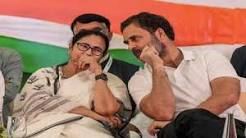
On May 2, 2021, Rahul Gandhi congratulated Mamata Banerjee and the people of West Bengal for “soundly defeating the BJP.” “I’m happy to congratulate Mamata ji and the people of West Bengal for soundly defeating the BJP,” he wrote on Twitter (now called X). — RahulGandhi (@RahulGandhi) However, the irony was hard to miss. While the BJP had indeed been kept out of power, it recorded its strongest-ever performance in the state — winning 77 seats, up from just three in 2016 — and firmly established itself as the principal challenger to the TMC. West Bengal assembly elections 2021 results Congress, by contrast, failed to open its account. Five years later, as Banerjee seeks a fourth consecutive term and the BJP eyes its maiden government in West Bengal, Congress finds itself out of the race and staring at a no-win situation: a Mamata victory could position her as a frontrunner for the joint opposition’s prime ministerial face in 2029, while a BJP triumph would add a major state to its kitty and further strengthen its momentum ahead of the general election. Which of the two outcomes would the grand old party “prefer?” Mamata Banerjee’s rise A former Congress leader, Banerjee founded the TMC in January 1998, and the party has since been part of governments at the Centre led by both the Congress and the BJP. Now an on-and-off ally of the Congress, she ended the Left Front’s 34-year rule in West Bengal in 2011 and secured two further terms, firmly establishing herself as one of India’s most formidable regional leaders. West Bengal CMs in last 50 years After a setback in the 2019 Lok Sabha polls, when the BJP won 18 of West Bengal’s 42 constituencies, Banerjee staged a strong comeback just two years later, leading the Trinamool to a third consecutive term. The optics of TMC’s victory, despite an aggressive BJP campaign led by Prime Minister Narendra Modi and Union home minister Amit Shah, combined with Banerjee’s move to challenge her former aide Suvendu Adhikari in his stronghold Nandigram — where she lost narrowly — burnished her credentials. Mamata Banerjee Quote A fourth term would all but put her firmly in contention to be the national opposition’s face in the 2029 contest. BJP’s emergence as principal challenger to TMC The BJP did not find immediate success in West Bengal after Modi became prime minister in May 2014, winning just two Lok Sabha seats that year and only three constituencies in the assembly polls two years later. That changed in 2019, when it won 303 Lok Sabha seats, including 18 from West Bengal. In 2021, though the BJP fell far short of its 200-seat target, it decisively recast the state’s politics as a two-horse race. BJP's seat surge in Bengal Nationally, too, despite no longer enjoying a majority of its own, the saffron party, with 240 Lok Sabha MPs—more than the combined opposition—remains on favourite to secure a fourth term, reinforcing the perception of sustained national dominance. Congress’ decline in West Bengal—and beyond In February, Congress unilaterally ended its alliance with the Left Front and announced it would go it alone in West Bengal. This, in a state where, despite its rich political history, the party has not had a chief minister since 1977, when its three-decade run in power came to an end. Congress' declining arc in Bengal Its dominance in the Lok Sabha from West Bengal has been far more limited. The last time Congress reached double digits in the state was in 1984, when it won 16 seats as part of its nationwide sweep of 414 seats. Since then, Congress has not secured a majority on its own at the Centre. In the previous three Lok Sabha elections, it failed to cross the 100-seat mark. It is currently in power in just three states—Karnataka, Telangana, and Himachal Pradesh. The removal of Adhir Ranjan Chowdhury, a staunch Mamata critic, by the Congress as its Bengal unit chief, was also seen by many as the party “capitulating” to the TMC supremo. Chowdhury had held the Baharampur Lok Sabha seat—where Muslims make up roughly half the electorate—since 1999. In the 2024 general elections, Banerjee nominated former cricketer Yusuf Pathan, a Gujarat native, who went on to unseat Chowdhury. Adhir Ranjan Chowdhury Congress’ Rahul dilemma: Can’t win with him, can’t do without him Congress contested the 2014, 2019, and 2024 general elections under Rahul Gandhi’s leadership, albeit without formally projecting him as its prime ministerial candidate. The 2019 defeat was chastening in both magnitude and context, coming under his direct leadership as party president and soon after he oversaw assembly victories in three Hindi heartland states in December 2018. Although he resigned as party chief in July 2019, Gandhi has continued to be the party’s most prominent face and principal decision-maker. Rahul Gandhi career Congress’ 2024 resurgence—along with that of the broader opposition—was widely credited to Gandhi’s two “Bharat Jodo” pan-India marches, which many believe contributed to a noticeable shift in public perception of him. With numners on Congress’ side, he was subsequently made leader of the opposition, the first since 2014. Rahul Gandhi career However, what followed was a series of electoral reverses in the state assembly elections. He subsequently alleged irregularities by the Election Commission, accusing it of bias towards the BJP and holding multiple press conferences on the issue, but the setbacks continued. According to political observers, what hurts Gandhi is that he has never held public office—even when his own party was in power from 2004 to 2014—along with the Congress’ poor electoral record under his leadership, his frequent foreign trips, and a tendency to raise issues that often fail to resonate with voters and persist with them despite their lack of traction on the ground—raising persistent questions about his effectiveness as a national challenger. Leadership question within INDIA bloc The INDIA bloc, formed in July 2023, brought together Congress and several regional parties opposed to the BJP under one umbrella. With the grand old
MP: Attack on Dalit Groom’s Pre-Wedding Procession in Damoh; Pulled Off Horse and Assaulted; Family Reaches Police Station with Wedding Procession

A case has come to light in the Hatta police station area of Damoh, where a Dalit groom with a disability was pulled off his horse and assaulted by local strongmen during his *Rachwai* (pre-wedding procession). The police have registered a case under the SC/ST Act and have initiated an investigation. On Tuesday evening, a dispute erupted during the *Rachwai* of a disabled groom belonging to the Dalit community in Bijori Pathak village, located within the Hatta police station jurisdiction of Damoh district. It is alleged that certain influential individuals (strongmen) from the village pulled the groom down from his horse and assaulted him using sticks and clubs. The incident caused chaos and panic at the scene. Members of the groom’s side, accompanied by the entire wedding procession, proceeded to the Hatta police station and lodged a formal complaint. The police have registered a case under various sections, including the SC/ST Act, and have deployed a police force in the village to maintain order. **Wedding Procession Bound for Chhatarpur; Pre-Wedding Procession Being Held First** According to reports, the wedding procession of Golu Ahirwar (23)—son of Bhagirath Ahirwar and a resident of Bijori Pathak village—was scheduled to travel on Tuesday to Budhi Semra village in the Buxwaha region of Chhatarpur district. Before the main wedding procession departed, the groom’s *Rachwai* was being carried out within the village around 5:00 PM. Golu was seated on a horse, while his family members and fellow community members were celebrating. During this time, as the *Rachwai* reached the ‘Lodhi Mohalla’ (neighborhood) of the village, certain individuals raised objections. It is alleged that they demanded the groom dismount from his horse. When he resisted, the physical assault began. **Groom Levels Serious Allegations** The victim, groom Golu Ahirwar, stated that as soon as the *Rachwai* reached the front of a particular house, some people present there pulled him down from his horse and attacked him with sticks and clubs. He alleged that Guddu Singh, Krishna, Hakam, Paltu, and others were involved in assaulting him. Golu further mentioned that despite his disability, the accused beat him mercilessly. **Allegations of Assault Against Sister and Mother as Well** The groom’s mother, Vidya Ahirwar, stated that when family members announced that the groom’s wedding procession (Baraat) was about to depart and the traditional pre-procession ritual (Rachhwai) was being observed, the accused launched an attack. She further reported that her daughter—the groom’s sister, Manisha—who intervened to mediate the situation, was also physically assaulted. A complaint has also been lodged regarding the disappearance of some of her gold jewelry during the altercation. **Entire Wedding Procession Reaches Police Station; Police Conduct Medical Examination** Following the incident, members of the groom’s side, outraged by the events, took the groom and the entire wedding procession to the Hatta Police Station. A formal complaint was registered there. The police subsequently arranged for a medical examination of the groom. Thereafter, the wedding procession was allowed to proceed under police protection. **Case Registered Under SC/ST Act and Other Provisions** Late at night, following the registration of the case, Hatta Police Station In-charge Sudhir Kumar Begi stated that, based on the complaint filed by the aggrieved party—Gariba Ahirwar—a case has been registered against local villagers Vishwanath Lodhi, Bichchhu Lodhi, Paltu, and other accused individuals under various sections of the law, including the SC/ST Act. He added that, in view of the prevailing tension in the village, an adequate police force has been deployed to ensure that the wedding rituals can be conducted peacefully. **Outrage Within the Dalit Community; Preparations Underway for a Major Protest** The incident has sparked widespread outrage within the local Dalit community. Community members have demanded the immediate arrest of the accused and strict punitive action against them. Several social organizations have also condemned the incident, issuing a warning to the administration that if strict action is not taken against the culprits, a framework for a large-scale protest movement will be devised. **Questions Raised Regarding Social Responsibility and the Spirit of the Constitution** This incident is not merely a criminal matter; it serves as a test of social consciousness and constitutional values. The Constitution of India guarantees every citizen the right to live with equality, respect, and dignity. Preventing any individual from participating in weddings, festivities, or social traditions on the basis of caste is not only a legally punishable offense but also a violation of fundamental human values. **Similar Disputes Have Occurred in the Past** For years, the government, social welfare organizations, and conscientious citizens have been striving to strengthen social harmony by propagating messages of equality, brotherhood, and mutual respect. Such efforts are having a visible positive impact on society, with people in numerous villages and cities setting aside caste distinctions to celebrate festivals and ceremonies together. However, incidents of this nature indicate that the narrow-minded and casteist mentality of certain individuals continues to act as a hindrance to social progress. Such individuals must respect the law, understand the rights and duties enshrined in the Constitution, and convey a message of equality and harmony—rather than discrimination—to the younger generation. According to villagers, disputes regarding the wedding procession (*rachwai*) of a young man from the Dalit community have arisen in the village on previous occasions as well. Even at that time, the procession was eventually carried out only after the intervention of social organizations. The recurrence of such an incident has once again created an atmosphere of tension within the village. **Here, for the First Time, a Dalit Groom Rode a Horse** On Saturday evening, in the village of Patna Durga—located adjacent to Damoh city—a wedding procession featuring a Dalit groom riding a horse was carried out for the very first time. The event concluded peacefully. Deepraj Jatav, the District President of the Azad Samaj Party (Kanshiram), along with his team, had proactively requested police protection in advance. In recent times, several incidents involving attempts to prevent Dalit grooms from riding horses—often accompanied by physical assault—have come to light within the district. The case involving