
Plates Apart: Junagadh Temple Feast Exposes Gujarat’s Caste Fault Lines

In Gujarat, a 3% conviction rate means that most accused of caste-based crimes walk free; the Bhutdi case is headed into the same odds. Junagadh: Five men walked into Bhutdi village, Junagadh district, on the evening of April 27, 2026. They had an invitation to deliver to the consecration feast of a newly built Ram temple, two days later. However, the Patostav invitation came with conditions. Residents belonging to the Dalit community were told to arrive only after members of other castes had eaten. They were to bring their own plates and bowls and food and water arranged for them would be kept separately. Lastly, they were to stay out of the temple itself. Ajay Chatur Boricha, 25, filed a formal complaint at the Visavadar police station the next morning. By the time the temple was consecrated on April 29, the community feast had been cancelled, five organisers were facing First Information Reports (FIRs) under the Scheduled Caste (SC)/Scheduled Tribe (ST) Prevention of Atrocities Act, and the case had gained the attention of Deputy Superintendent of Police (DySP) Ravirajsinh Parmar of the Junagadh SC/ST Cell, who confirmed that statements had been recorded and notices issued to all accused under Bharatiya Nagarik Suraksha Sanhita (BNSS) 35(3). As we file this news report, investigators are also looking for digital evidence. The fact that a complaint was filed before any violence occurred and the Dalit community chose legal redress over participation on humiliating terms, marks a small but significant assertion of dignity. What happens to that complaint in the Gujarat’s courts is another matter entirely. The temple in Bhutdi where people belonging to the Dalit community were asked to bring their own plates to eat, Photo: By special arrangement, Vibes of India. A grammar of exclusion The conditions imposed on people belonging to the Dalit community in Bhutdi — separate vessels, a later sitting, barred entry to the sanctum — are not inventions of rural backwardness. Dalit manual scavengers in Ahmedabad district, whose testimonies have been documented by civil society organisations, describe the same logic at work in a city setting. Not only are members of SC/ST communities made to clean their own utensils and use separate tea tumblers in canteens, they also struggle to access basic amenities such as water, barred from using “upper-caste” water taps and forced to walk long distances for drinking water. A Dalit man engaged in manual scavenging said that when he and his colleagues demanded their rights from the municipality, officials threatened to fire them. In most so-called “posh” and “high caste” houses in Gujarat, there are two separate sets of utensils, especially tea cups and drinking glasses, which even the non-Dalit domestic workers refuse to touch. In March last year, a Dalit man from the Vadol village in Sabarkantha district was beaten, stripped, and paraded naked through the streets for an alleged extramarital affair with an upper-caste woman. Two Dalit men in Mandal village were assaulted by cow vigilantes for refusing to dispose off a dead animal, a task that caste hierarchy has historically forced upon SC communities. During Navratri, a young Dalit girl was dragged out by her hair as she was participating in a public garba event. Shailesh Solanki, a 38-year-old Dalit labourer, was assaulted and abused with casteist slurs at a crossroads in Sabarkantha, simply for wishing to visit the Kal Bhairav temple in Himatnagar. As recently as February 2026, a Dalit groom’s wedding procession in Patan district was stopped at sword-point by upper-caste men who objected to his riding a horse, a ritual they considered their exclusive right. The video circulated widely. In Banaskantha, a Dalit lawyer named Mukesh Parecha who wanted to arrive at his own wedding on horseback requested police protection. A team of 145 policemen arrived in Gadalvada village to escort him. Although the wedding passed without incident, the spectacle of state force required for a man to exercise a social custom that others take for granted was, in itself, evidence of the distance between constitutional guarantee and ground reality. The conviction rate The Bhutdi FIR, once it travels the familiar path of Gujarat’s criminal justice machinery, will encounter a set of odds that are well-documented. Between 2018 and 2021, the conviction rate in cases reporting atrocities against SCs in Gujarat was 3.06%. Of the 5,369 cases registered during that period, only 32 held the accused guilty. In 1,012 cases, including murder and rape charges registered under the SC/ST Act, the accused were quickly acquitted. A further 1,044 cases were settled out of court. Martin Macwan, veteran activist and founder of the Navsarjan Trust, noted that in the rare cases where conviction has been achieved, it is because non-governmental organisations (NGOs) looking after Dalit rights sustained the case despite the social pressure and threats the complainant and witnesses usually face. Ahmedabad alone recorded 189 cases of atrocities against SC persons in 2022, the highest of any district in the state, out of a state total of 1,425 registered cases. In March 2019, Gujarat’s then-minister for social justice told the state assembly that crimes against Dalit people had risen 32% between 2013 and 2017. The national conviction rate under the Atrocities Act stands at 3-4%. Advocates working in the space have offered a structural explanation: a prejudiced or compromised police officer at the investigation stage, or a biased judge at trial, can ensure that justice is never served while simultaneously encouraging the accused to file counter-complaints against the victim. The acquittal, in this reading, is not a failure of the law but of its gatekeepers. The prosperity paradox Gujarat’s governance record is frequently cited as evidence that development and social order can coexist. The state’s per capita income is among the highest in the country. Its industrial corridors, port infrastructure and export numbers are points of pride in every budget speech. The ‘Gujarat Model’ has been exported as a national template. Against this backdrop, the persistence of caste atrocity is not incidental. Instead it is, as researchers and activists
SC nixes Odisha’s ‘odious’ bail conditions to Adivasi, Dalit accused to clean police stations
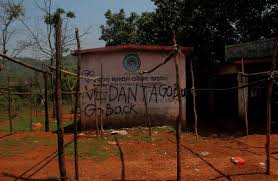
Such “abhorrent” bail conditions, issued by both HC and trial courts, reflect the “regressive mindset”, caste-based biases of Odisha judiciary, says SC; sends warning against such bail conditions to all HCs When the Odisha judiciary set “odious” bail conditions, like cleaning police stations for two months, for members of Adivasi and Dalit communities, it suggested that judges had a “regressive mindset” and caste-based biases, the Supreme Court said on Monday (May 4, 2026). “Assuming that such conditions were imposed inadvertently or without any premeditated bias, the nature of the condition is so abhorrent, degrading, and unknown to law that it carries the potential to cast a serious aspersion, suggesting that the Odisha Judiciary is afflicted by a caste-based bias,” a Bench of Chief Justice of India Surya Kant and Justice Joymalya Bagchi observed in a seven-page order. Odisha mining project protest: Congress seeks independent probe; alleges PESA, FRA violations Indigenous protesters The subjects of these bail conditions are a group of indigenous people facing criminal charges after their three-year-old protest against the acquisition of their land for a Vedanta Group bauxite mining project in Rayagada and Kalahandi districts allegedly turned violent. Around 40 protesters were arrested and cases registered against them. Some of them were subsequently allowed bail by various courts in the State. However, a range of bail conditions, some of which the top court found extremely humiliating, were thrust upon the accused in return for exercising their fundamental right to personal liberty. New railway line proposed to connect ‘controversial’ bauxite hills in Odisha ‘Obnoxious, unpalatable’ Chief Justice Kant, who had taken suo motu cognisance of the orders imposing “obnoxious” and “unprecedented” bail conditions, said they had brought a bad name to the judicial institution itself. The Bench noted that, between May 2025 and January 2026, six such bail orders were issued by a local trial court, all imposing similar conditions. The court said it was both unfortunate and disheartening to see that the State High Court and the trial courts were on the same plane, both passing “unpalatable” bail conditions. ‘Underlying caste bias’ “Such conditions reflect the underlying, albeit unarticulated, bias of the Odisha State judiciary premised on the perception that the accused individuals belonged to the marginalised Adivasi community,” the Supreme Court observed. The court said the promise of a casteless society was one of the greatest gifts the people of India gave themselves through the Constitution. The judiciary, in its role as the sentinel on the qui vive, had to stand guard on the Constitutional guarantees and protect the most vulnerable in the society, the Supreme Court observed. The court noted that every Constitutional doctrine or philosophy in a diverse country like India stood up for substantive equality, the individual dignity of all people, and an end to caste barriers. Mining push meets tribal resistance Directive sent to all HCs “We declare such conditions and any other similarly worded condition imposed by the State judiciary as null and void. Let the petitioners approach the High Court to forthwith delete such conditions and not substitute it with any other analogous condition,” the court ordered, clarifying that the accused persons would continue on bail. The court directed that all State judiciaries should refrain from imposing conditions that carry caste implications, which could lead to social discord. “Thus, let this order be made available to all judicial officers across the country, not to impose such conditions,” the Bench said. It also directed the Supreme Court registry to circulate the order to all High Courts across the country. “Each High Court shall ensure that a copy of this order is sent to each judicial officer in its jurisdiction, accompanied by a communication that such conditions shall not be imposed while granting bail,” it said. The court directed the Registrar General of the Orissa High Court to file a compliance report in four weeks. Krishnadas Rajagopal Courtesy : The Hindu Note: This news is originally published on https:/thehindu.com/bha and is used purely for non-profit/non-commercial purposes, especially human rights
SC notice to UOI, states & UTs on pleas challenging Transgender Amendment Act 2026

The amendment was passed by the Parliament recently in March, taking away the right to self-determination of gender, the plea claimed. The law had received presidential assent on March 31. NEW DELHI: The Supreme Court on Monday issued notice to the Centre, all states and Union Territories on a batch of petitions challenging the Transgender Persons (Protection of Rights) Amendment Act, 2026, which allegedly violates the right to self-determination by mandating medical procedures for gender identity certification. A two-judge bench od the apex court, headed by the CJI Surya Kant and also comprising Justice Joymalya Bagchi has constituted a three-judge bench headed by the Chief Justice of India himself to examine the matter. The batch of writ petitions were filed in the top court, including that of noted transgender, Laxmi Narayan Tripathi, and others, challenging the Transgender Amendment Act 2026. Tripathi, the Chairperson of National Council for Transgender Persons (NCTP), and its member Zainab Patel have moved the Supreme Court and filed a petition challenging the Constitutional validity of the Transgender Persons (Protection of Rights) Amendment Act, 2026 which introduced many changes to the legal framework governing the recognition, rights and protection of transgender persons. The amendment was passed by the Parliament recently in March, taking away the right to self-determination of gender, the plea claimed. The law had received presidential assent on March 31. The petition challenged the Amendment Act, as causing “irreparable constitutional injury” to the fundamental rights of transgender persons guaranteed under Articles 14, 15, 19 and 21 of the Constitution. “Section 4(2) provided, in express terms, that a transgender person shall have a right to self-perceived gender identity. It was the direct statutory embodiment of the NALSA mandate. Parliament has simply deleted it. A legislature cannot repeal a provision that gives concrete form to a fundamental right recognised by this Hon’ble Court without violating Article 21. The unconstitutionality is in the act of deletion itself,” the plea stated. Criticizing the role of the state that it could not impose medical, psychiatric, or bureaucratic gatekeeping as a condition for the recognition of gender identity, the plea further added, this court held that informational privacy, including the right to control the disclosure of one’s own sensitive personal and medical information, is a fundamental right. The deletion of Section 7(3)’s protective Proviso strips certificate-holders of guarantees that their existing entitlements will not be disturbed. The drafting of Sections 18(e)-(h) stigmatises transgender presentation by making it the object of criminal offences rather than targeting coercion alone, the petition said. “The failure to enhance the maximum sentence for sexual and physical abuse of transgender persons under Sections 18(a)-(d), while introducing life imprisonment for trafficking offences, reflects an arbitrary legislative hierarchy that continues to undervalue the bodily integrity of transgender persons. The continued failure to implement the reservation directions issued in NALSA for transgender persons under Articles 15(4) and 16(4) compounds this constitutional default. No legitimate state objective can justify this cumulative regression from the constitutional standard set by this Hon’ble Court over a decade ago,” it added. The plea further submitted that the deepest constitutional wound inflicted by the Impugned Amendment Act is the substitution of the definition of “transgender person” in Section 2(k) of the Principal Act. The original definition, which identified a transgender person as “a person whose gender does not match with the gender assigned to that person at birth,” faithfully reflected what this Court held in NALSA: that gender identity is determined by the person herself/himself, not by biology, birth assignment, or state verification, the petition claimed. After the new legislation was made, it was being severely criticised by oposition parties and LGBTQIA+ (Lesbian, Gay, Bisexual, Transgender, Queer, Intersex and Agender etc) communities. Those who opposed the legislation have argued that they were not consulted at all prior to the introduction of the Bill in parliament. Two members of the NCTP, Kalki Subramanium and Rituparna Neog, resigned from their posts the day the Rajya Sabha passed the Bill. Suchitra Kalyan Mohanty Courtesy : TNIE Note: This news is originally published on https:/thenewindianexpress.com/bha and is used purely for non-profit/non-commercial purposes, especially human rights
SC issues notice on pleas against Transgender Amendment Act, declines interim stay
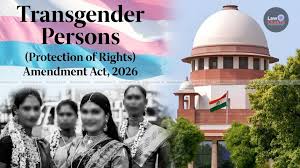
The Supreme Court of India on Monday issued notice to the Centre and all States on a batch of petitions challenging the constitutional validity of the Transgender (Protection of Rights) Amendment Act, 2026, but declined to grant any interim stay, noting that the law has not yet been notified. The Supreme Court of India on Monday issued notice to the Centre and all States on a batch of petitions challenging the constitutional validity of the Transgender (Protection of Rights) Amendment Act, 2026, but declined to grant any interim stay, noting that the law has not yet been notified. Refusing to put the amended law on hold at this stage, a Bench of Chief Justice Surya Kant and Justice Joymalya Bagchi directed that notice be issued to the States through their Advocates General and said the matter would be placed before a three-judge Bench to be constituted by the Chief Justice. The amendment, which received Presidential assent on March 31, introduces wide-ranging changes to the legal framework governing the recognition, rights, and protection of transgender persons. It revises the definition of a “transgender person” to make it more precise and strengthens penal provisions to deal with serious offences such as abduction of adults and children and the infliction of reversible or irreversible bodily harm through mutilation, emasculation, castration, hormone therapies or other similar interventions, or chemical alteration, including forced gender identity. During the hearing, senior advocate Abhishek Manu Singhvi, appearing for some of the petitioners, raised concerns over the removal of self-identification as a basis for recognising gender identity. He submitted that the amended law effectively bars individuals from asserting their gender identity without medical certification and could disrupt ongoing gender-affirming treatments. The Bench, however, expressed concern about possible misuse if self-identification alone were accepted, including the risk of individuals falsely claiming such status to avail reservations and other benefits. Singhvi responded that such apprehensions were unfounded and reiterated that the amendment runs contrary to the principles laid down by the Supreme Court in its April 15, 2014 judgment in National Legal Services Authority v. Union of India. “You cannot nullify the judgment. The basis can be removed. The NALSA judgment is nullified, and no attempt has been made to remove its basis,” Singhvi told the Bench. The Supreme Court, in its April 15, 2014 judgment, had issued a series of directions, including upholding the right of transgender persons to self-identify their gender. The ruling stated: “Transgender persons’ right to decide their self-identified gender is also upheld, and the Centre and State Governments are directed to grant legal recognition of their gender identity, such as male, female, or as third gender.” Questioning Singhvi’s submissions, Justice Bagchi observed, “When you say NALSA recognises self-identification as a matter of dignity, we can examine the amendment in the light of Article 21. This amendment changes the substratum of the law on which NALSA examined it. So, instead of self-determination, there is a medical evaluation.” “This amendment changes the substratum of the law under which NALSA was examined. Self-identification is replaced with medical evaluation,” the Bench added. Singhvi pressed for an interim stay of the amendment, pointing to its immediate impact on transgender persons undergoing treatment, but the Court was not inclined to intervene. It reiterated that the validity of the law would be examined in due course and refused to halt its operation at this stage. The amendment to the Transgender (Protection of Rights) Act, 2026 has also been challenged before the High Courts of Delhi, Kerala, and Karnataka. The amended law seeks to make the definition of a “transgender person” more precise, addressing concerns that the earlier definition under the 2019 Act was overly broad and created practical difficulties in identification and implementation. The revised framework aims to ensure that protections are targeted at individuals facing genuine social exclusion due to biological factors, rather than extending benefits based on self-perceived or acquired identities. The Act also introduces institutional and procedural reforms, including the designation of competent authorities for implementation and provisions for seeking expert inputs where required. It enables transgender persons to make consequential changes in official documents and restructures the National Council for Transgender Persons to ensure more effective representation from States and Union Territories through a region-based rotational mechanism. A key feature of the amendment is the strengthening of penal provisions. While the earlier law provided limited punishment for general offences, the amended provisions create specific offences with graded punishments, particularly addressing grave acts such as abduction, forced bodily harm (including mutilation or chemical alteration), and coercion into a transgender identity for exploitation. These provisions are designed to operate alongside existing criminal laws while recognising the unique vulnerability of victims. Parmod Kumar Courtesy : The Statesman Note: This news is originally published on https:/thestatesman.com/bha and is used purely for non-profit/non-commercial purposes, especially human rights
Rahul Gandhi Congratulates Vijay After TVK Party Sweeps Tamil Nadu Assembly Elections
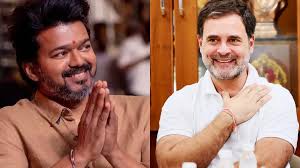
Rahul Gandhi speaks to Vijay after TVK victory in Tamil Nadu elections praising rising youth voice and reaffirming Congress commitment to public issues across Tamil Nadu and Puducherry. In a notable political development following the Tamil Nadu Assembly elections, senior Congress leader Rahul Gandhi personally reached out to actor turned politician Vijay to congratulate him on the impressive performance of the Tamilaga Vettri Kazhagam. Sharing the update on social media platform X, Rahul Gandhi said he had spoken directly with Vijay and appreciated the scale of the party’s victory. Describing the results as a reflection of changing political energy, Rahul Gandhi remarked that the growing influence of youth voices is clearly visible through this election outcome. He emphasized that such a shift indicates a new phase in regional politics where younger leadership and fresh narratives are gaining ground. The TVK party, under Vijay’s leadership, secured victory in more than 100 constituencies, marking a significant breakthrough in Tamil Nadu’s political landscape. In comparison, the Dravida Munnetra Kazhagam won over 70 seats, while the All India Anna Dravida Munnetra Kazhagam managed to cross the 50 seat mark. Rahul Gandhi also took a moment to acknowledge Congress workers who contributed to the party’s efforts in Tamil Nadu and Puducherry. He thanked them for their dedication and assured that the Congress party would continue to raise and fight for public issues in the region. Looking beyond Tamil Nadu, the elections also saw varied outcomes across states. The Bharatiya Janata Party and its allies performed strongly in states like West Bengal and Assam, while in Kerala, the Congress led United Democratic Front succeeded in forming the government. Reiterating his party’s stance, Rahul Gandhi affirmed that Congress remains committed to serving the people and addressing their concerns, particularly in Tamil Nadu and Puducherry, in the days ahead. Courtesy : The South India Times Note: This news is originally published on https:/thesouthindiatimes.com/bha and is used purely for non-profit/non-commercial purposes, especially human rights
West Bengal election results 2026: BJP surges past majority as TMC loses edge

TMC supremo and Chief Minister Mamata Banerjee, who was initially trailing in her Bhabanipur turf, regained the lead over BJP’s Suvendu Adhikari by 898 votes after the third round of counting. With more than four hours into vote counting, the BJP-led NDA has crossed the majority mark of 148 seats in West Bengal, securing a lead in over 180 seats. The incumbent Trinamool Congress (TMC) was restricted to 109 seats, while the CPI(M) led in just one seat. TMC supremo and Chief Minister Mamata Banerjee, who was initially trailing in her Bhabanipur turf, regained the lead over BJP’s Suvendu Adhikari by 898 votes after the third round of counting. However, several TMC leaders, including ministers Udayan Guha and Sashi Panja, were trailing, initial trends showed. In Cooch Behar district’s Dinhata, minister Udayan Guha was trailing by 6,259 votes against BJP’s Ajay Ray after four of the 24 rounds of counting. In Kolkata’s Shyampukur, minister Sashi Panja was trailing BJP’s Purnima Chakraborty by 934 votes after two rounds of counting, with another 19 rounds left. Aam Janata Unnayan Party (AJUP) chief Humayun Kabir was leading in the Nowda seat in Murshidabad district over his nearest TMC rival after the first round of counting, according to the Election Commission. Kabir was leading by a margin of 2,890 votes over TMC’s Sahina Momtaz Khan after the first round of counting. The polls are seen as a crucial test for Chief Minister Mamata Banerjee and her TMC’s bid for a fourth consecutive term, amid a stiff challenge mounted by the BJP. The CPI(M)-led Left Front and the Congress are also hoping to improve their tally after successive electoral setbacks. Exit polls present a sharply divided picture, with some projecting a BJP edge while others forecast a comfortable return for the All India Trinamool Congress, underlining an uncertain and closely fought contest. West Bengal BJP president Samik Bhattacharya said he was confident of a landslide victory, as counting of votes for the assembly elections began on Monday morning. “People of the state have already rejected the Trinamool Congress government, and in a few hours, the overwhelming majority of the seats will confirm that in the fight between Mamata Banerjee and the people, people have rejected Mamata Banerjee,” Bhattacharya said outside a counting centre in Kolkata. The counting of votes for the state’s 293 Assembly constituencies began at 8 am, with postal ballots taken up first in keeping with Election Commission norms. Follow live updates on results and trends: Tamil Nadu Results, West Bengal Results, Kerala Resuts, Assam Results, Puducherry Results Courtesy : TNIE Note: This news is originally published on https:/thenewindianexpress.com/bha and is used purely for non-profit/non-commercial purposes, especially human rights
VD Satheesan says Congress high command will soon decide on next CM
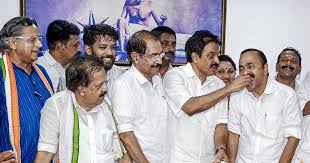
Satheesan said he was happy to have delivered on his promise given to Congress leader Sonia Gandhi while assuming the post of the Opposition Leader that he would guide the party to win. THIRUVANANTHAPURAM: Congress leader and potential chief minister candidate V D Satheesan on Monday said the party high command will soon take a decision on who will lead the state after consulting with various coalition partners of the UDF. Addressing the media after the UDF delivered a landslide victory in Kerala, elbowing out the CPI(M)-led LDF government, which ruled the state for two consecutive terms, Satheesan said it reflected the people’s strong decleration about the triumph of secular forces. Satheesan said he was happy to have delivered on his promise given to Congress leader Sonia Gandhi while assuming the post of the Opposition Leader that he would guide the party to win. The Congress leader said all communities and regions voted for the UDF, including traditional left voters and some party workers, letting the front breach several CPIM bastions. “We had told them that we are the ones upholding Nehruvian leftist view and the LDF has become the far right. The left sympathisers as well as some of their leaders accepted our perspective,” he said. Satheesan also said that the women and the youth have contributed to UDF’s win and assured to work towards fulfilling the front’s poll promises. Speaking on the UDF’s poll strategy that facilitated the historical win, Satheesan said, “In 2011, we came to power, but had won only 72 seats. Many social groups had veered off from the UDF, but we brought them back. We had planned several surprises, including in Ambalappuzha and Taliparamba. We had proudly welcomed G Sudhakaran to our fold.” G Sudhakaran, a veteran Communist leader, had resigned from the party and contested as an independent with UDF support in his traditional bastion, Ambalappuzha. He won by a margin of over 25,900 votes. Satheesan also reiterated the Congress’s allegation that the BJP and CPM leaders had entered into an electoral pact. The LDF suffered a major setback as results were declared for the crucial Assembly elections on Monday. The CPIM-led front was reduced to just 35 seats, while the UDF passed the majority mark with over 90 seats. The BJP, which has struggled to make a mark in the state politics for several years, delivered a surprising performance, winning three seats. Courtesy : TNIE Note: This news is originally published on https:/thenewindianexpress.com/bha and is used purely for non-profit/non-commercial purposes, especially human rights
Ganesh Kumar faces shock defeat in Pathanapuram after 25-year winning streak
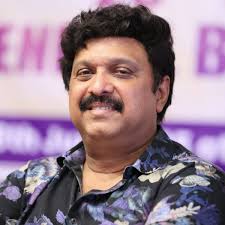
The Kerala Congress (B) chief is trailing Congress candidate Jyothikumar Chamakkala by more than 5,000 votes. Keralam’s Transport Minister and actor K B Ganesh Kumar, who has remained unbeaten in electoral politics for over two-and-a-half decades, is on the brink of defeat in the Pathanapuram constituency as vote counting in the Kerala Assembly elections enters its final stages, according to Election Commission figures. The Kerala Congress (B) chief is trailing Congress candidate Jyothikumar Chamakkala by more than 5,000 votes. In the 2021 Assembly polls, Kumar had defeated Chamakkala by nearly 15,000 votes. However, Chamakkala has continued his constituency-level work in Pathanapuram over the past five years, which appears to have translated into significant gains in the 2026 election. Kerala Congress (B), traditionally aligned with the UDF, joined the LDF ahead of the 2021 election following the death of party founder R Balakrishna Pillai, with the shift led by his son, Ganesh Kumar. During the campaign, controversy erupted after Congress leaders targeted Kumar over allegations related to his purported role in defaming former Chief Minister Oommen Chandy in a sexual assault case that was later closed by the CBI. Kumar had expressed confidence during the campaign that he would retain the seat with a record margin. The election is being closely watched as a high-stakes contest between the ruling LDF, which is seeking a rare third consecutive term, and the UDF, which is aiming to return to power after nearly a decade. The NDA, though not considered a frontrunner for power, is hoping to improve its presence and vote share in the state. Courtesy : TNIE Note: This news is originally published on https:/thenewindianexpress.com/bha and is used purely for non-profit/non-commercial purposes, especially human rights
Dalit Groups Seek Judicial Probe Into Akiveedu Temple Demolition
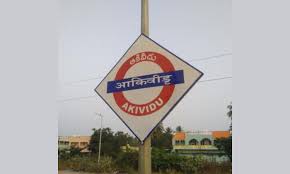
Srinivasa Rao demanded that the government immediately withdraw the restrictions and reconstruct the temple with the participation of local residents VIJAYAWADA: Dalit and civil rights organisations on Saturday staged a protest near Ambedkar Smriti Vanam in Vijayawada, demanding a judicial probe into the alleged repression of Dalits in Pedapeta of Akiveedu in West Godavari district following the demolition of the Hindu Gonthenamma temple. Dalit Soshan Mukthi Manch national leader V. Srinivasa Rao alleged that the temple was demolished illegally at midnight without conducting a proper panchanama, despite constitutional provisions that disputed religious structures should not be disturbed. He demanded a judicial inquiry into the incident. The protesters further alleged that severe restrictions had been imposed in the Dalit locality, with surveillance cameras installed and youth being harassed by police seeking Aadhaar details of residents and visitors. They claimed that outsiders were being prevented from entering the colony, creating fear among Dalits. Srinivasa Rao demanded that the government immediately withdraw the restrictions and reconstruct the temple with the participation of local residents. He also accused RSS and Vishwa Hindu Parishad activists of creating tension in the area with police support. KVPS state general secretary Andra Malyadri termed the demolition “a blow to democracy” and warned of intensified protests if action was not taken. Courtesy : Deccan Chronicle Note: This news is originally published on https:/deccanchronicle.com/bha and is used purely for non-profit/non-commercial purposes, especially human rights
‘Farming for 30 Years’: Dalit Families Claim Forced Land Takeover Near Temple in Mathura Village
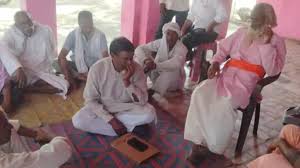
A land dispute near the Dauji Maharaj Temple in Aicha village, Mathura, Uttar Pradesh, has sparked tension, with Dalit families alleging that their agricultural land is being forcibly taken over by people linked to a local religious figure. Two Dalit families, including Kewal Singh and Suresh Chandra, have accused individuals allegedly associated with Mahant Baba Shyam Das of trying to encroach on their land located behind the temple. “We have been farming this land for years, but now some people are trying to take it away forcefully,” one of the victims said. The families claim that the land is still recorded in their names in official revenue records. “Farming This Land for 30 Years” According to the families and villagers, they have been cultivating the disputed land for nearly three decades. “This land has been in our possession for the last 30 years. It is our only source of livelihood,” a family member said, adding that the sudden dispute has left them distressed. Allegations Against Mahant’s Supporters Villagers alleged that some individuals are attempting to take control of the land by using the name of Mahant Baba Shyam Das. “Some anti-social elements are trying to grab the land by misleading the Mahant. This has created tension in the village,” a local resident said. Administration Steps In, Orders Status Quo Following the complaints, revenue officials visited the site and conducted a measurement of the land. An official said, “Both parties have been instructed not to carry out any activity on the land for now. Status quo must be maintained until further orders.” Authorities said a detailed report will be submitted to higher officials before any final decision is taken. Victims Seek Justice, Allege Threats The affected families said they have approached multiple authorities but are yet to receive concrete relief. “We are going from office to office seeking justice, but no action has been taken so far,” Kewal Singh alleged. “We are also being threatened and not being heard.” Local residents have urged the administration to ensure a fair investigation and restore the land to the rightful owners. Courtesy : TOP Note: This news is originally published on https:/theobserverpost.com/bha and is used purely for non-profit/non-commercial purposes, especially human rights