
Lost in translation: When Kinnaur became ‘transgender’ in Himachal Class 6 textbook

The Hindi text is translated into English using some AI tool, which appears to have mistaken ‘Kinnaur’ for ‘Kinnar’ and changed it to ‘transgender’ The Himachal Pradesh Board of School Education has landed in an awkward situation due to the careless use of Artificial Intelligence (AI). In a Class 6 book, ‘Folk Culture of Himachal and Yoga’, district Kinnaur has been mentioned as ‘transgender’ in the English version. However, the Hindi version mentions the correct name. Apparently, the Hindi text was translated into English using some AI tool, which appears to have mistaken ‘Kinnaur’ for ‘Kinnar’ and changed it to ‘transgender’. The state government has introduced English as a medium of instruction in the government schools, and the Hindi version was translated into English. “It’s alright to use AI for translations but one should at least have seen the final text. AI is helpful but it can lead to embarrassing errors, as seen in this case,” said a teacher. Meanwhile, the education board has decided to issue a corrigendum stating that the word ‘transgender’ in the book should be read as ‘Kinnaur’. “We have noticed the error, and a corrigendum will be issued in a few days,” said Board secretary Vishal Sharma. The error will be corrected when the book is reprinted for the next academic session. Article_Author Subhash Rajta Courtesy : The Tribune Note: This news is originally published on https:/thetribune.com/bha and is used purely for non-profit/non-commercial purposes, especially human rights
Supreme Court to hear plea against Transgender Amendment Act on May 4
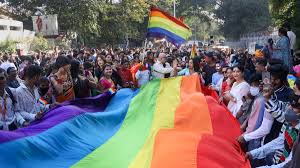
The petition argues that the Act amended the Transgender Persons (Protection of Rights) Act, 2019, in its structure, object, and affect, and thus violated the fundamental rights of transgender persons. New Delhi: The Supreme Court is scheduled to hear on Monday a plea challenging the constitutional validity of the Transgender Persons (Protection of Rights) Amendment Act, 2026 for replacing the individual’s own understanding of their gender or identity with a biological or socio-medical category of the State’s choosing. A bench of Chief Justice of India Surya Kant and Justice Joymalya Bagchi would take up on May 4, 2026 the petition filed by Laxmi Narayan Tripathi, the chairperson of National Council for Transgender Persons (NCTP), and its member Zainab Patel. The petition contended the Amendment Act amended the Transgender Persons (Protection of Rights) Act, 2019, in its structure, object, and affect, and thus violated the fundamental rights of transgender persons guaranteed under Articles 14, 15, 19, and 21 of the Constitution. The plea pointed out in National Legal Services Authority Vs Union of India, (2014), the Supreme Court, recognised for the first time that transgender persons have a fundamental right to be identified as a third gender, distinct from the male-female binary It highlighted that the court then directed that transgender persons would be treated as socially and educationally backward classes for the purposes of reservation under Articles 15 (4) and 16 (4), and called upon the State to take affirmative steps to address the marginalisation they face. Above all, NALSA judgment established that the right to self-identification of gender is a fundamental right under Article 21, not a privilege to be conferred by a certificate, not a status to be earned through surgery and not a conclusion to be reached by a medical board, the plea said. The 2019 Act preserved the core of what NALSA required. However, the Amendment Act arbitrarily removed the provision, which stated that a transgender person is someone whose gender does not match their birth assignment, and that they have the right to self-identify, the plea contended. “The deepest constitutional wound inflicted by the Amendment Act is the substitution of the definition of “transgender person” in Section 2(k) of the Principal Act,”‘ it stated. The plea emphasised in NALSA judgment, the Supreme Court explicitly and unequivocally repudiated the requirement of surgical intervention as a precondition for legal gender recognition. This court further held that each person’s self-identification of gender must be accepted as the foundation of their legal gender identity, without the State imposing medical, psychiatric, or bureaucratic gatekeeping. The right to determine one’s own gender, free from coerced bodily alteration, was held to flow directly from the right to privacy and dignity under Article 21, it pointed out. The plea contended a legislature cannot repeal a provision that gives concrete form to a fundamental right recognised by this court without violating Article 21. Ashish Tripathi Courtesy : DH Note: This news is originally published on https:/deccanherald.com/bha and is used purely for non-profit/non-commercial purposes, especially human rights
Dr G Parameshwara meets Hariprasad, says no leadership issue discussed
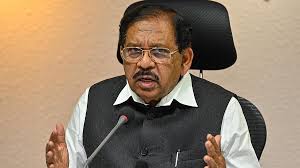
Minister BZ Zameer Ahmed Khan, another close confidant of Siddaramaiah, was also present in the meeting that lasted over 90 minutes. BENGALURU: Even as All-India Congress Committee (AICC) president Mallikarjun Kharge has clarified that the party high command has not taken any decision on change in leadership in Karnataka, the Siddaramaiah camp is continuing its efforts to project the state’s Home Minister Dr G Parameshwara as the next CM. Senior Congress MLC BK Hariprasad, a permanent invitee of the Congress Working Committee and who is said to be close to Congress Parliamentary Party chief Sonia Gandhi, seems to have entered the scene. After meeting Chief Minister Siddaramaiah on Friday evening, Hariprasad held separate confabulations with Parameshwara and asked the latter to be ready to throw his hat into the ring for the CM’s post if the party top brass decides to change the leadership, sources told The New Sunday Express. Minister BZ Zameer Ahmed Khan, another close confidant of Siddaramaiah, was also present in the meeting that lasted over 90 minutes. They chalked out a plan to pitch Parameshwara for the top post under the Dalit quota if the option of making Kharge CM and Deputy CM DK Shivakumar staking claim is ruled out. Hariprasad has information that Kharge is hesitating to take up the Chief Minister post for various reasons, sources said. Parameshwara, however, on Saturday said that the discussion among the trio revolved around the outcome of the West Bengal, Kerala and Tamil Nadu Assembly polls with a little bit of Karnataka politics. “We had a good meal together. Naturally, since we are politicians, we had to discuss politics. There is nothing to hide. Since election results will be declared on Monday, we analysed the situation. We discussed what is happening in West Bengal, Kerala, Tamil Nadu, and the status of our party there. We did not discuss state politics much,” he told reporters. On internal quota for SCs, he said the entire political dynamics has changed in Karnataka and Congress is assessing how things pan out. “For the past 25 years, we have adhered to a specific ideology. Initially, the Congress included all major, minor, and backward communities. But when the Ahinda movement began, the entire dynamics changed. We are seeing developments regarding internal reservations for SC communities and adjustments in ST percentages. Many things are currently unfolding in Karnataka, and we will see what happens next,” he added. Dr G Parameshwara Courtesy : TNIE Note: This news is originally published on https:/thenewindianexpress.com/bha and is used purely for non-profit/non-commercial purposes, especially human rights
Her Last Stand

Mamata Banerjee is conducting, in her own phrase, ajibaner lorai—a fight for life, against her most formidable foe, the BJP. A Mamata loss will end her career, and a saffron victory will decide the shape of a Hindu Bengal The woman in white buying vegetables does not look like a chief minister. That, of course, is precisely the point. It is past nine on a warm April evening in Bhabanipur, the south Kolkata neighbourhood where Mamata Banerjee was born, and lives in a two-room house, and has now come to fight, for the third consecutive time, for her political birthright. The crowd surrounding her is not the choreographed kind. You can tell. The faces are too excited, too lit from within. The vegetable seller, a local woman of indeterminate middle age, grins at Mamata Banerjee like a teenager. In the allegorical theatre of Indian electoral politics, symbolism is the only currency that never inflates. A fruit seller presses a box of mangoes into Didi’s hands. She refuses, then relents and accepts one. One mango. The detail is so perfectly calibrated, so exquisitely Bengali in its domestic frugality that you have to remind yourself it is happening on a campaign trail, not in a kitchen. “This is the difference between her and Modi,” says Hiran Majumdar, who manages the constituency, with the serene confidence of a man who believes Bengal has already endorsed his argument. “Narendra Modi eats jhalmuri in a fully stuffed shop for a pre-arranged photo op. Didi buys vegetables from a roadside stall.” Mamata Banerjee is not merely campaigning here. She is claiming ground. Bhabanipur is also where Suvendu Adhikari—her former protégé, now her most implacable tormentor—held a rally the previous evening. He is the man who bested her in Nandigram in 2021, the wound she has never publicly acknowledged and cannot stop picking at. This time, he has come for her on her own street, in her own constituency, with the easy confidence of a man who believes he has both God and Amit Shah on his side. Nandigram is where Mamata’s political career was reborn, and Bhabanipur is where she was born and lives, even after becoming the CM. Suvendu looks every inch a man at war. Going by the warmth of the greeting he receives on stage—“Swagatha, swagatham, Suvenduda swagatham”—and the composition of the men on stage, there is a certain resonant quality about him. Bhabanipur is a small constituency with a big chunk of different faiths: Bengali Hindus, Muslims, Sikhs, Marwaris, and also migrants from Odisha, Jharkhand, and Bihar; the stage is representative of the place except for the absence of Muslims. Suvendu’s speech emphasises on one of the BJP’s main planks—protect women, end TMC rule, and bring Sanatan Dharma to Bengal. It is a no-holds-barred war in which Suvendu could maybe come close to winning. The crowd at Suvendu’s rally that night was worked up by a speaker named Mohan Patel, a tall, athletic, conspicuously bearded figure, who rolled up his sleeves and delivered his warning—“Hindus would become a persecuted minority at the mercy of Muslims.” The speech was entirely in Hindi, in a city that has composed its most important thoughts in Bengali for three centuries. The assembly roared, “Bharat Mata ki jai,” and “Jai Shri Ram” in response. Nobody seemed to notice his language. That same evening a Mamata rally was going on in a parallel street; it was disrupted by BJP volunteers turning the blaring loudspeakers in her direction. The CM left, calling her walk-out an act of resistance. Those two nights at Bhabanipur brought in the essential difference between TMC’s Bengal-ism and BJP’s idea of Bharat. This is the essential grammar of the 2026 Bengal Assembly elections: the BJP’s Shri Ram taking on the TMC’s Joi Bangla—pan-Indian Hindu nationalism versus exclusive Bengali cultural identity. Delhi’s idea of what India should be versus a three-term chief minister’s insistence that Bengal is not a province of India so much as a civilisation that has graciously agreed to share a border with it. Modi speaks at Bengal. Mamata speaks from it. The distinction is not rhetorical. It is everything. This is the difference between Mamata Banerjee and Modi. Narendra Modi eats jhalmuri in a fully stuffed shop for a pre-arranged photo op. Didi buys vegetables from a roadside stall. Hiran Majumdar, who manages the Bhabanipur constituency To understand Bengali politics, you must first understand the bohiragato—the outsider. Bengal’s relationship with the rest of India has always been marked by a proud, sometimes ferociously prickly sense of cultural distinction. This is, after all, the land of Tagore and Nazrul Islam, of Satyajit Ray and Subhas Chandra Bose, of a Renaissance that preceded Indian independence and in many ways made it imaginable. Bengalis believe, not without evidence, that they invented modern Indian intellectual life and a cuisine so precisely regional that the distinction between ilish and chital is not a food preference, but a declaration of who you are and where you come from. The consequence of this pride is a deep, instinctive suspicion of the outsider who arrives, however well-intentioned, to tell Bengal what Bengal should be. The Left understood this and draped its ideology in Bengali cultural attire for 34 years. Mamata Banerjee understood it even better and weaponised it into something more raw and personal. The BJP, relatively new to the state’s complicated emotional weather, has repeatedly underestimated it and paid the price. The TMC masterstroke in 2021 was not any single policy or personality. It was a slogan ‘Bangla Nijer Meyekei Chai’—Bengal Wants Its Own Daughter. The BJP campaign that year was led largely by leaders parachuted in from Delhi and Uttar Pradesh, whose sloganeering about Ram and borders landed in Bengal like a foreigner’s mispronunciation—technically legible, tonally catastrophic. The result was 213 seats for the TMC, 77 for the BJP: a rout so complete it prompted, by all accounts, a brutally honest internal post-mortem. The BJP is not an organisation that repeats its mistakes without attempting, at minimum,
Great Nicobar project faces fresh questions on ecology, tribal consent and feasibility: Jairam Ramesh
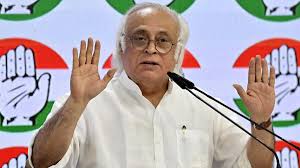
Congress party general secretary (communications) Jairam Ramesh says the press note, issued three days after Rahul Gandhi’s April 28 visit to Great Nicobar, is part of ‘damage control’ The Congress on Sunday questioned the Centre’s response on the Great Nicobar Island Development Project, saying the Government’s clarification, issued after the recent visit of Leader of the Opposition Rahul Gandhi, does not address the serious concerns raised over ecology, tribal rights, environmental clearances and financial viability. Senior Congress leader and party general secretary (communications) Jairam Ramesh said the press note, issued three days after Rahul Gandhi’s April 28 visit to Great Nicobar, was part of “damage control” and ignored detailed objections already submitted to the Environment Ministry in 2024. He said the issues raised related to the ecological sensitivity of the island, legality of approvals and the economic assumptions behind the project. “The Government’s press note does not address any of the serious concerns that have been raised,” Ramesh said. The Great Nicobar Island Development Project includes a transshipment port, airport, township and tourism infrastructure in the Andaman and Nicobar Islands. Ramesh said the claim that only 1.82 per cent of island land is being used was misleading as it ignored the ecological value of Great Nicobar as a distinct and fragile ecosystem. He said nearly 50 new species of birds, reptiles, crabs and other fauna had been recorded from the island in recent years, underlining its biodiversity. On Galathea Bay, the proposed site of the port, Ramesh said it fell under Coastal Regulation Zone-1A where such construction is not permitted. He said the area had over 20,000 coral colonies and was a major nesting site of the endangered Giant Leatherback turtle. He also questioned the environmental clearance process, alleging conflict of interest involving institutions such as the Wildlife Institute of India and the Zoological Survey of India, which were part of the clearance process and later involved in monitoring roles. Ramesh said compensatory afforestation proposed in Haryana could not replace forest loss in Nicobar. “A forest ecosystem cannot be substituted by plantation in a completely different ecological zone,” he said. He pointed to inconsistent official figures on tree felling, saying estimates had ranged from 8.52 lakh to 9.64 lakh and now 7.11 lakh trees. He said this raised questions over the accuracy of baseline assessments, adding that ANIIDCO had also invited tenders for enumeration and felling, indicating the absence of a final verified count. On tribal rights, Ramesh said the Nicobarese community withdrew consent in 2022, alleging they were pressured during the clearance process. He also raised concerns over the Shompen tribe, a Particularly Vulnerable Tribal Group, saying there is no clarity on how informed consent was obtained. He said Forest Rights Act procedures were completed in less than 20 days and without mandatory tribal representation, raising concerns over legality. On financial viability, Ramesh said projections of 10 million passengers annually at the proposed airport appeared unrealistic compared to Port Blair’s current traffic of around 1.8 million. He also referred to internal Government discussions that have flagged concerns over the viability of the transshipment port, which would need to compete with established regional hubs without a strong industrial base. Ramesh said key documents related to the project, including environmental management plans and committee reports, had not been made public. He also cited concerns raised by former Navy Chief Admiral Arun Prakash, who said security requirements should not be linked to the development project. Ramesh said security considerations should not be used to restrict scrutiny of a project with major ecological and social implications in one of India’s most sensitive island regions. Article_Author Shekhar Singh Courtesy : The Tribune Note: This news is originally published on https:/thetribune.com/bha and is used purely for non-profit/non-commercial purposes, especially human rights
Obscenity against Dalit girl in Kannauj: Accused sentenced to 5 years in prison, fined ₹10,000 under the POCSO Act

The court has sentenced the accused to 5 years in prison for sexually assaulting a Dalit girl in Kannauj district. A fine of ₹10,000 has also been imposed on the accused, which will be given to the victim as compensation. This incident occurred in Rooppur village, under the jurisdiction of the Saurikh police station. On September 10, 2020, Pappu Sharma, a resident of the village, lured a Dalit girl to his home. The accused stripped naked in front of the girl and sexually assaulted her. When the girl screamed, her mother arrived and managed to rescue him. When she protested, the accused also abused her mother. Subsequently, the victim’s mother filed a complaint against Pappu Sharma at the Saurikh police station under sections of the POCSO and SC/ST Acts. During the court hearing, accused Pappu Sharma defended himself, saying that he had not stripped naked in front of the girl, but that his towel had come loose. Government advocate Brijesh Shukla stated that based on the evidence and witness statements, Special Judge Ram Gopal Singh sentenced Pappu Sharma to five years’ imprisonment and a fine of 10,000 rupees. However, due to lack of evidence, he was acquitted under the SC/ST Act. Vikas Awasthi | Kannauj Courtesy : Hindi News
In Morena, goons brutally beat a Dalit laborer, accused of making him wear a garland of shoes and parade him half-naked.
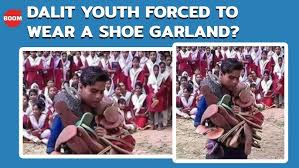
Goons in Morena a Dalit was allegedly abducted from a tractor-trolley, beaten with sticks, and paraded half-naked while wearing a garland of shoes. Police took action. Morena: The land of Chambal, once associated with tales of rebellion, is once again in the headlines, but this time it’s for violence. The Civil Lines police station area of Morena witnessed a brutal assault by goons that has raised many questions. A Dalit e-rickshaw driver, who was returning to his village on Saturday evening after picking up passengers for his livelihood, was kidnapped in a film-like manner on National Highway 44. He was then taken to Janakpur village, where he was not only beaten, but also made to wear a garland of shoes and paraded half-naked through the village. Bullies block e-rickshaw driver’s path 40-year-old Mohanlal (name changed), a resident of Jatawar village in the Civil Lines police station area, supports his family by driving an e-rickshaw along with his daily wages. As usual, on Saturday evening, he was returning to his village after picking up passengers from the bus stand. When his e-rickshaw arrived in front of Chambaldeep Hotel near the Sikroda Canal on National Highway 44, more than 24 bullies riding a tractor-trolley blocked his path. Kicked and beaten, garlanded with shoes, paraded half-naked through the village As soon as the tractor stopped, Dilip Gurjar, Bhura Gurjar, and Surendra Gurjar got off and forcibly pulled the laborer from the rickshaw and threw him on the road. The bullies then brutally beat him with kicks, punches, and sticks. Their rampage didn’t stop there; they put him in a tractor-trolley and took him to Gangapur, where they stripped him half-naked, and tied a garland of shoes around his neck. After this, they took him to Janakpur village, made him sit in the middle of the village, beat him up, and paraded him around the village. According to the victim, “The bullies held him hostage for about half an hour and humiliated him at gunpoint.” Police freed the laborer from the clutches of the bullies. Passengers in the e-rickshaw informed the police about the incident. Upon receiving the information, the Civil Lines police station arrived at the scene and freed the victim from the clutches of the accused. Based on the complaint of the victim, the police registered a case last night against Bhura Gurjar, Surendra Gurjar, Mahendra Gurjar, Dilip Gurjar, and Karua Gurjar. One of the accused has been arrested and jailed, while the search for the others is ongoing. Pressure for a settlement in an old case The victim has revealed a shocking reason behind this entire incident. He claims that he had a dispute with Dilip Gurjar, Bhura Gurjar, and Sheru Gurjar of Janakpur village during Diwali last year. The accused assaulted him at that time, after which he filed an FIR at the police station. According to the victim, they were continuously pressuring him to settle the old case. When he refused to compromise, the miscreants conspired and targeted him. The victim alleges that the entire incident, from kidnapping to parading him around the village, was a result of that pressure, designed to intimidate him into withdrawing the case. Police Reported a Dispute Between Two Parties Civil Lines Police Station Officer Udaybhan Singh Yadav has initially described the case as a simple scuffle. He said, “An old dispute has emerged between the two parties.” Police Station Officer Udaybhan Singh Yadav stated that the laborer’s family described the entire incident as an e-rickshaw driver. He was carrying a passenger, in which the same bullies were present. He dropped the passenger off near a canal. When the laborer asked for his money, they refused to pay. The people in the rickshaw assaulted him. Afterward, the laborer was left wandering around. Upon receiving the information, we brought the laborer here and filed a case against the accused. The station in-charge said, “It could be an old dispute, but if that were true, why would they get into his rickshaw? He told us they were pressuring him to compromise.” However, police have filed a case against five named accused involved in the incident, and one has been arrested. The search for the other accused is ongoing. Leaders of the Bhim Army, BSP, and Azad Samaj Party reached the police station. Officials and workers of the Bhim Army, Bahujan Samaj Party, and Azad Samaj Party reached the Civil Lines police station upon learning of the incident. They issued a stern warning to the police, demanding strict action against the accused. They also called for a fair investigation and justice for the victim, threatening to launch a protest otherwise. Courtesy: Hindi News
Three tombs demolished at the Balmiki community crematorium in Aligarh: Police file case against four people, including two women, for illegal encroachment.
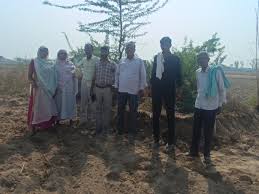
A case of illegal encroachment has come to light at the Balmiki community crematorium in Dhori village, Akrabad, Aligarh. It is alleged that on the intervening night of Friday and Saturday, a neighboring farm owner demolished three tombs with a JCB machine and annexed the crematorium land to his own. Police have filed a case against four people, including two women. Surendra Kumar Balmiki, a resident of Akrabad town, and his colleagues filed a complaint with the police. He explained that the Balmiki community has a centuries-old crematorium behind the Indian Gas warehouse in Dhori village. Previously, there were five permanent and two temporary tombs. According to Surendra Kumar, the neighboring farm owner took advantage of the darkness of the night and demolished the three tombs using a JCB machine. Subsequently, the cremation ground land was merged with their farm. Acting on a complaint from the Balmiki community, the police have registered a case number 201/2026 under sections 329(3), 301, and 324(4) against Ajay and Akhilesh (sons of Vinod Kumar), residents of village Dhori, Tulsi Devi (wife of Vinod Kumar), and Mithlesh Devi (wife of Tulsidas, resident of Badhari Khurd, Manaina Ummedpur, Aligarh). Station in-charge Vinod Kumar stated that it has been confirmed that a neighboring farm owner operated a JCB machine at the Balmiki community cremation ground. He added that a complaint was received against four people for demolishing three tombs, based on which a case has been registered and an investigation has been initiated. Zainul Abedin Khan | Akrabad (Kol), Aligarh Courtesy: Hindi News
Call to bring in law to end caste bias on campuses gets louder in Kerala

Higher Education Minister R Bindu said that a legal solution for all these issues was part of the University Laws Amendment Bill brought in by the LDF government, which had not been signed by the Governor. THIRUVANANTHAPURAM: One hartal and 19 days after the suicide of Nithin Raj, the BDS student from Anjarakandy Dental College, discussions seem to revolve around the incident alone, rather than the repeated incidents of caste-slurs and discrimination being faced by students in the higher education sector. Calling caste discrimination in higher education institutions a problem with multiple aspects involved, Kerala State Higher Education Council member secretary Rajan Varughese said that there is a critical legislative vacuum to prevent atrocities against students coming from marginalised communities inside college campuses. “The Rohith Vemula Act, which could have been a one-stop solution to all such issues, has been stayed by the Supreme Court after protests by people with supposed vested interests. Even though Kerala has a gross enrolment ratio of SC/ST students way higher than the national average, we cannot be certain that discriminatory practices do not exist in our higher education institutions — be it private or public,” he said. Pointing out that the Karnataka government passed the Rohith Vemula Prevention of Discrimination, Exclusion or Injustice) (Right to Education and Dignity) Bill, less than two weeks ago, Dalit activist K Santhosh Kumar questioned what is stopping Kerala from implementing such a legal framework in the state. “A legislative reform is the immediate solution, but it cannot be a silver bullet to eradicate the issue. But beyond that, the system needs to democratise higher education institutions by ensuring proper representation of people from all communities, which should not just be limited to students, but extended to teachers, non-teaching staff, and even those in the administration. If we are able to bring this to the aided sector as well, the representation itself can ensure justice,” he said. Santhosh also added that the number of SC/ST suicides in Kerala’s campuses may not be an alarming figure, but the number of dropouts from these communities, particularly from professional colleges, is a matter of concern. However, Higher Education Minister R Bindu said that a legal solution for all these issues was part of the University Laws Amendment Bill brought in by the LDF government, which had not been signed by the Governor. “The bill had put forward key suggestions, which also carry the spirit of addressing issues of students from marginalised communities. It suggested the mandatory formation of a Students’ Grievance Redressal Cell at both the university and institution levels, including self-financing colleges. Along with this, a Students’ Charter of Rights was also part of the bill presented in the legislative assembly,” Despite the emergence of multiple cases and allegations at different points in time, conclusive data on discriminatory incidents against students from SC/ST groups are not available. Officials from the SC/ST welfare departments said consolidated data is not available about atrocities against college students. “Even at the national level, we just monitor the number of campus suicides. No separate provision has been allocated to monitor the caste-based deaths,” a top official working in the higher education department said. However, some Dalit organisations claim that at least 12 students from backward communities were found dead in the state’s colleges in the last 10 years. Aswin Asok Kumar Courtesy : TNIE Note: This news is originally published on https:/thenewindianexpress.com/bha and is used purely for non-profit/non-commercial purposes, especially human rights
Rajasthan: Dalit bride forced off horse, wedding attacked with stones

One of the accused, Takhat Singh, the family claimed, used a sword during the attack. Udaipur: Yet another Dalit wedding procession was attacked, this time in Rajasthan’s Udaipur, where the bride was forced off the horse and the family was abused using casteist slurs. The incident is from April 29 night in the Hariyav village as Pooja Meghwal’s procession was moving along the main road at around 10 pm when the attackers blocked their path and hurled casteist remarks. According to the complaint filed by Pooja’s father, Bhairulal Meghwal, the accused Laxman Singh, Madhu Singh, Kishan Singh, Uday Singh, Arjun Singh, Takhat Singh, Fateh Singh, Vikram Singh, and others, including women, were involved in the act. The accused reportedly grabbed one of the relative’s turban and said, “Chamar Meghwalo, do not take the procession ahead of my house, otherwise there will be bloodshed,” The Mooknayak reported. They stopped the DJ, forced the bride off the horse and turned violently on the wedding guests. The group allegedly used sticks, stones, rods, and swords even, to attack the relatives in the procession. Several people from the wedding party were left injured, including women and children. One of the accused, Takhat Singh, the family claimed, used a sword during the attack. The attackers reportedly looted the baraat as some people reported missing mangalsutras and wrist watches. A first information report was registered on April 30 at the Dabok police station under Sections 189(2) (unlawful assembly), 115(2) (voluntarily causing hurt), and 126(2) (wrongful restraint) of the Bharatiya Nyaya Sanhita (BNS). The case was also booked under relevant sections of the Scheduled Castes and Scheduled Tribes (Prevention of Atrocities) Act. The bride’s family said the same group of attackers allegedly obstructed a different Dalit family’s wedding previously in the village. The Bhim Army on Friday, May 1, gathered in large numbers near the police station and demanded strict action against the accused. They warned of a larger protest if action under the SC/ST Act was delayed. Courtesy : TSD Note: This news is originally published on https:/thesiasatdaily.com/bha and is used purely for non-profit/non-commercial purposes, especially human rights