
Supreme Court cancels bail of expelled JD(U) leader Anant Singh in Dularchand Yadav murder case
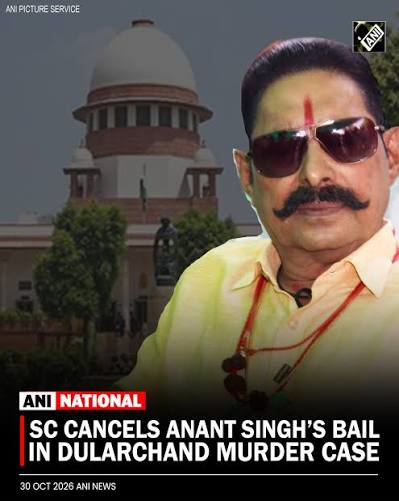
NEW DELHI: The Supreme Court on Friday cancelled the bail granted to expelled JD(U) leader Anant Singh in the murder case of Dularchand Yadav and directed him to surrender before the authorities on or before December 1, 2026. A bench of Justices MM Sundresh and PV Varale observed that the Patna high court had erred in granting bail to Singh without considering the nature of the offence and his criminal antecedents. The Supreme Court suspended the high court’s order and cancelled the bail granted to Singh, directing him to surrender within the stipulated deadline. Courtesy : TOI Note: This news is originally published on https:/timesofindia.com/bha and is used purely for non-profit/non-commercial purposes, especially human rights
In SC, biological women oppose equal rights for transgender women

NEW DELHI: Striking a discordant note among a clutch of petitions challenging the Transgender Amendment Act for denying right to gender self-determination, an all-women NGO Wednesday appealed to the Supreme Court not to confer trans-women, biological males identifying as females, the spectrum of constitutional rights guaranteed to biological women. ‘Women’s Declaration International India’ through senior advocate Amit Sibal told a bench of CJI Surya Kant and Justices Joymalya Bagchi and V Mohana that “self-professed or socio-cultural gender identity or certificate or document cannot change a person’s biological sex or enable a biological male to access the entire spectrum of rights, protections and entitlements created specifically for biological females.” Differentiating between sex and gender, the petitioner said, “Sex and gender identity are distinct; gender identity concerns a person’s deeply felt internal experience, while sex is the stable immutable biological category on which numerous constitutional and statutory protections for women are premised.” SC asked Centre to respond to the petition with a comprehensive affidavit that also dealt with the other petitions challenging the Transgender Persons (Protection of Rights) Amendment Act, 2026. SG Tushar Mehta said a comprehensive affidavit is being drafted but gave an indication of what would be govt’s stand in defence of the erasure of gender self-determination clause, which was replaced by medically determined gender. He asked: “Can a transwoman be permitted to compete in a sporting event for women? Should a policewoman conduct physical search of a person with male genitals but perceives himself to be a woman? If a biologically male criminal perceives himself to be a woman, should police be barred from arresting him after sunset?” Drawing the court’s attention to a recent incident in the US relating to a transgender inmate, who perceives himself to be a woman but impregnated two women inmates, Mehta said several aspects needed to be kept in mind while adjudicating the petitions. A male becoming a trans-woman will violate affirmative measures for women under the Constitution, equal opportunity to women in employment, women’s bodily privacy and personal security in sex-segregated spaces and criminal law safeguards, the petitioner said. Courtesy : TOI Note: This news is originally published on https:/timesofindia.com/bha and is used purely for non-profit/non-commercial purposes, especially human rights
Coimbatore: CB-CID begins probe in Dalit student’s death
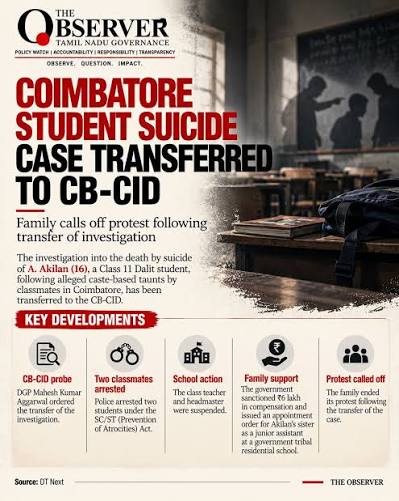
The Peelamedu police initially arrested two of his classmates under the SC/ST (Prevention of Atrocities) Act COIMBATORE: The CB-CID has commenced a probe into the death of A Akilan, a Dalit student who had ended his life over caste-based taunts from his classmates. The Peelamedu police initially arrested two of his classmates under the SC/ST (Prevention of Atrocities) Act. Akilan was in Class 11 at a government-aided school in Coimbatore. The class teacher and headmaster were suspended. The CB-CID registered a case and initiated a preliminary inquiry. A team led by SP Sri Devi questioned Akilan’s parents at their house regarding the circumstances of his death. The team also inspected the school and records of the Peelamedu police’s probe. The arrested students are likely to be questioned. Courtesy : DT Next Note: This news is originally published on https:/dtnext.com/bha and is used purely for non-profit/non-commercial purposes, especially human rights
Dalit Man Allegedly Killed by Wife’s Family in UP’s Muzaffarnagar Over Inter-Caste Marriage
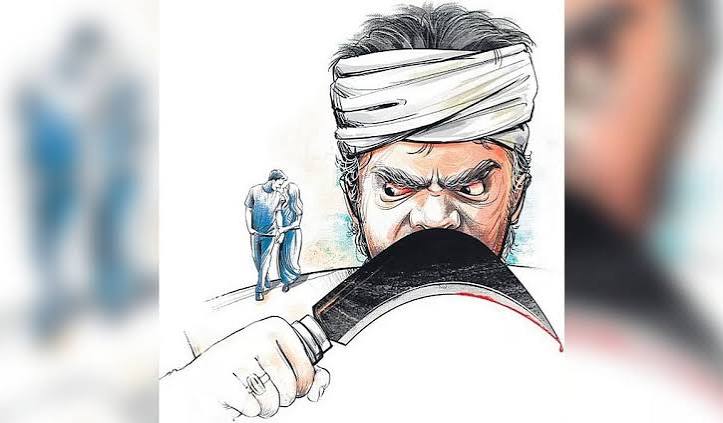
A 23-year-old Dalit man was allegedly beaten to death with bricks in Uttar Pradesh’s Muzaffarnagar, more than a year after he eloped with and married a woman against her family’s wishes. ExploreDiversity Akshay and his 20-year-old wife, Ridhima, had been living in Noida since their marriage. Akshay returned to Muzaffarnagar on Monday and was attacked that evening. He died in hospital on Tuesday. Police arrested two people on Wednesday in connection with the killing, including Ridhima’s elder brother, Vasu, said Dinesh Baghel, Station House Officer of Khatauli police station. Police suspect the murder was premeditated and are investigating whether several people were involved in planning the attack. Police Suspect Akshay’s Movements Were Shared With Attackers According to police, Akshay, a resident of Biharipur village, returned to Muzaffarnagar on Monday morning. Later that evening, he left home on his motorcycle with a man identified as Akash, telling his family that he was going to buy medicines. The two stopped at a shop on Jansath Road in the Khatauli area. Police said three masked men arrived on a motorcycle and confronted Akshay. One of them allegedly struck him with a brick, knocking him to the ground, before the attackers repeatedly hit him on the head with bricks. Akshay’s family alleged that he was left bleeding heavily as the assailants fled. Police suspect that Akash, who was with Akshay during the attack, shared information about his movements with the assailants. He is among those detained as investigators examine the circumstances leading up to the killing. Couple Had Moved to Noida After Marriage Akshay first met Ridhima while visiting his uncle, who lived in Sarai village, around six kilometres from his home. The two developed a relationship, but their families opposed it, according to the police account. About a year and a half ago, the couple eloped. Ridhima’s family subsequently filed a kidnapping complaint, police said. The couple later married in court and moved to Noida, where Akshay found work. A police officer said Ridhima’s family allegedly continued to resent Akshay despite the marriage and the couple’s move away from Muzaffarnagar. Courtesy : TOP Note: This news is originally published on https:/theobserverpost.com/bha and is used purely for non-profit/non-commercial purposes, especially human rights
A dead body on the road, a wooden pyre, and a six-hour traffic jam… Why did anger erupt after the death of a Dalit youth in Chhatarpur?
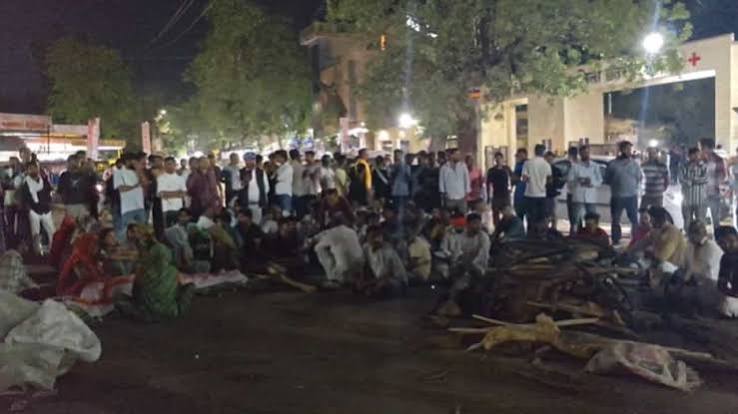
Following the death of a Dalit youth in Chhatarpur, his family members blocked the Tehsil intersection by placing his body there. The protesters created a pyre by placing wood on the road and demanded the arrest of the accused. Chhatarpur News: A massive uproar erupted in Naugaon town of Chhatarpur district after the death of a Dalit youth under suspicious circumstances. Angry family members and locals protested by placing his body at the Tehsil intersection on Wednesday evening. The protesters created a pyre by placing wood on the road and blocked the road. This disrupted traffic on the main road and caused long queues of vehicles on both sides. The traffic jam continued for more than six hours, causing inconvenience to the public. The family members of the deceased have accused some people of beating him and forcibly administering a poisonous substance to him. They demand that the accused be immediately arrested and a murder case be registered against them. There was a dispute over wages. The deceased has been identified as Dharampal Ahirwar. He was a resident of Naya Mohalla, Ward No. 18, Naugaon, and worked as a laborer in the local vegetable market. His wife, Usha Ahirwar, stated in a police complaint that a dispute arose on October 22, 2026, over wages. According to the complaint, when Dharampal asked Jitu, alias Jitendra Sahu, and his parents for his wages, they refused. It is alleged that Dharampal was subsequently assaulted with sticks and rods, sustaining serious injuries. Dharampal then went to the Naugaon police station and filed a complaint against the accused for assault. Allegations of Pressure to Withdraw the Case According to family members, after the assault case was filed, the accused party was pressuring Dharampal to reach a compromise. On October 27, Dharampal was called to a shop under the pretext of a discussion. There, he was asked to withdraw the case. The family claims that Dharampal refused to withdraw the case. He was then again abused and beaten. It is alleged that he was forcibly administered a poisonous substance during this time. Death during hospital treatment After being administered the poisonous substance, Dharampal’s health deteriorated. He was taken to the Naugaon Community Health Center in critical condition. Doctors there, finding his condition critical, referred him to the Chhatarpur District Hospital. Dharampal died while undergoing treatment at the district hospital on the night of October 27th. Upon receiving the news of his death, the family was plunged into mourning. Upon the arrival of his body in Naugaon, anger spread among the family and local residents. They launched a protest demanding strict action against the accused. Blockade at Tehsil Square On Wednesday evening, family members, residents of the neighborhood, and other members of the community arrived at the Tehsil Square with Dharampal’s body. They placed the body in the middle of the road and protested. The angry people also built a pyre by placing wood on the road. The protesters demanded the immediate arrest of the main accused, Jeetu Sahu, and his associates and the registration of a murder case. The traffic jam disrupted traffic on the Jhansi-Khajuraho route and other connecting roads. Long queues of vehicles caused significant inconvenience to pedestrians and other travelers. Given the seriousness of the situation, Naugaon police station and additional police force were deployed to the scene. Administrative and police officials continuously engaged with the protesting family members, attempting to pacify them. Officials assured a fair investigation and action based on available evidence. Further legal action was stated to be taken based on the post-mortem report and investigation findings. However, the family members remained adamant on their demand for immediate arrest and the registration of a murder case. Pawan Bidua | Edited By: Ashish Kumar Mishra | Pawan Bidua’s journalistic journey began in 2018 with V News Cable Network in Chhatarpur. He subsequently held consecutive positions as a district bureau chief for India News National and MP-CG. He covered the sensitive and risky reporting of the COVID period on the ground. Pawan Bidua completed his B.J.M.C. from Dr. Harisingh Gour University and his LLB from Pt. Motilal Nehru Law College. Courtesy: Hindi News
Man sentenced to life imprisonment for raping Dalit minor in Barabanki

Lucknow: A special Pocso court in Barabanki sentenced a man to life imprisonment for raping a 13-year-old Dalit girl who later became pregnant. The judgment was delivered on Wednesday, nearly five years and 11 months after the case was registered. Special Judge Pran Vijay Singh convicted Lallu alias Wasim, also imposing a fine of Rs 60,000 and directing that the full amount be paid to the survivor. According to the prosecution, the girl’s mother, a resident of a village under Asandra police station limits, filed a complaint on Nov 18, 2020. She alleged the assault occurred around 10 months earlier when her daughter had gone out to graze goats. The accused, a resident of the same village, allegedly raped the minor and threatened her into silence, preventing disclosure to family members. The case surfaced after the girl became pregnant. The prosecution said the accused later gave her medication to terminate the pregnancy. Her health reportedly worsened at home, after which the family came to know about the alleged assault. Police investigated the complaint and filed a charge sheetunder relevant provisions of the Protection of Children from Sexual Offences (Pocso) Act and the Scheduled Castes and Scheduled Tribes (Prevention of Atrocities) Act. During trial, the court recorded the victim’s statement and heard testimony from seven prosecution witnesses. After hearing both sides and examining evidence, the court held the accused guilty and ordered life imprisonment along with the compensation fine forame to the survivor. Courtesy : TOI Note: This news is originally published on https:/timesofindia.com/bha and is used purely for non-profit/non-commercial purposes, especially human rights
On Dalit representation, joy, and lived experiences: ‘My Joy’ author Shreeja

Shreeja Rao’s ‘My Joy’ is an invitation into a colourful world through the lens of a Dalit child who finds joy in the little moments of her life Narrating her story in first person, a little girl belonging to the Dalit community talks about the joy she feels when she sees her mother dress in blue, when she relishes bhakri and amti, when her ajji tells her a story. There is also a sense of pride both in her own dreams of becoming the first lawyer in her family and in learning that someone like her is soaring in the Olympics and in academics. She also touches upon the grief of lost lives from the community due to systemic inequality. And, despite the nasty remarks thrown at her, of being too loud and not good enough, the little girl goes on to live her life to the fullest. “…Because anti-caste resistance is in my defiance. It is in my smile, in my laugh. It is in my world-changing joy,” the author Shreeja Rao, who tells the child’s stories, writes. In the picture book for young readers — My Joy, illustrated by Shrujana N Shridhar — Shreeja ensures that each leaf reflects the reality of Dalit lives. With mostly happy accounts emanating from the smallest things in life, the author reminds us to correct the myopic understanding of the community, because for years, we have only been exposed to a fragment of the community’s experiences — oppression, pain, struggles. Perhaps, what is forgotten is seeing every shade of their lives with equal attention. This book, as the author asserts, is for every child who looks for themselves in books.Excerpts from a conversation with Shreeja Rao: How does My Joy subvert how the experiences of the Dalit community are represented, and how does it become a strong symbol of resistance? All literature, old or new, depicts Dalit communities in endless pain. While it is vital to show the consequences of inequality, I wrote My Joy to celebrate the full humanity of Dalit children. The book refutes the popular notion that Dalit people are mere vessels of suffering. It is about a Dalit child’s identity and assertion. This assertion, whether quiet or loud, is joyful. In the book — the Preamble, the books, and the colour blue — are all symbolic. Do you want young readers to understand the individual symbols of the community and historical movements? The flags, the Preamble, and the writers in the book are all from my childhood. Many Dalit children grow up seeing these symbols in their homes and at family occasions. Rather than teaching children something new, My Joy invites them to relate to their own lives. It also shows them the importance and value of our history. How do you think books like these can help avoid the gaze of pity and sympathy, and make a strong statement that one can experience joy and pride irrespective of what their identity is? As a journalist, I know all too well that rampant inequality and violence invite a gaze of pity for our community in the headlines. However, books like My Joy must exist to show children that their identity is not limited to suffering or stories of suffering. This book helps children take the autonomy and freedom to experience joy without anyone else’s permission. You specifically mentioned some books and writers in the book. Could you tell how they influence the way you view the world? As a child, my grandmothers and aunts told me bedtime stories about how Savitribai Phule brought accessible education to India. She faced stones, dung, and violent attacks to stand for equality. She introduced me to this radical act of assertion. Alongside figures in the book like Mukta Salve, the women from my life taught me to fight inequality while embracing my own life. You have celebrated small wins and little joys — coming first in an elocution competition, raising a hand in the classroom, warm hugs — in this book. How important is it to tell children to find joy in the smallest wins and moments in life, and most importantly, that they deserve to experience joy? The distinction between “small” or “big” moments of joy is something we perform as adults. However, raising my hand in the classroom or winning a competition was not a small moment for me. These are the big moments that shape a child’s life. Joy is not a privilege to deserve; it is a human emotion that you experience simply by being you. It is important to tell children that they are special in their own way, and human like everyone else. Representation matters, and it is important to read and learn stories with which readers can relate. How do you see this lack of relatable literature for readers? In my childhood, the flags, symbols, and writers in this book were never on any pages. They came from celebrating Ambedkar Jayanti at home and the stories my grandmothers and aunts told me. “Representation” feels like an ill-fitting word for the culture and history of a quarter of the population. When children experience something in their community, they deserve to read about it. Culture evolves when young readers can stitch parts of their lives with the books they read. That is how they become who they are. Anusree PV Courtesy : TNIE Note: This news is originally published on https:/thenewindianexpress.com/bha and is used purely for non-profit/non-commercial purposes, especially human rights
Yet to test legality of logical discrepancy in SIR: Supreme Court
NEW DELHI: The Supreme Court on Wednesday said that even though the validity of SIR in Bihar was upheld, the court had no occasion to test the legality of the ‘logical discrepancy’ criterion as it was not used during the Bihar exercise. When EC’s counsel referred to smooth conduct of Bihar and West Bengal elections after SIR, the bench said, “Logical discrepancy (mode for deletion) was first resorted to in West Bengal. We are yet to examine its validity. We will go into logical discrepancy in detail later.” When petitioner Anjali Bhardwaj’s counsel claimed that lakhs of voters were deleted from the draft Delhi rolls on grounds of ‘logical discrepancy’, the bench asked how EC could reopen entries in the 2003 voter list and issue notices for logical discrepancy.“In a voter enumeration exercise like SIR, EC has taken the 2003 voter list as the base. If that is so, how could it classify those whose names figured in that list as ineligible on grounds of logical discrepancy? Can EC go beyond the list and reopen it?” the bench asked. During the last hearing, the bench had suggested that EC examine putting additional filters to avoid mechanical issuance of notices under ‘logical discrepancy’. SC: Can EC go beyond 2003 list to scrutinise logical discrepancy? In a voter enumeration exercise like SIR, EC has taken the 2003 voter list as the base. If that is so, how could it classify those whose names figured in that list as ineligible on grounds of logical discrepancy? Can EC go beyond the list and reopen it?” the bench asked. During the last hearing, the bench had suggested that EC examine putting additional filters to avoid mechanical issuance of notices under ‘logical discrepancy’. Opposition INDIA bloc functionaries, led by Rahul Gandhi, have filed a joint petition challenging many issues, including the SIR process, and questioned the allegedly arbitrary non-inclusion of names because of ‘logical discrepancy’. In its May 27 judgment, SC had examined the following questions — whether EC had the power to conduct SIR; whether SIR had a legitimate purpose and the process was proportionate to the object to be achieved; and whether the SIR procedure was contrary to Representation of the People Act, 1951, and Registration of Electors Act, 1960 — and found that there was nothing amiss in the conduct of SIR or the process adopted to achieve the object of weeding out voters who had died, shifted house or had duplicate entries. SC had categorically ruled that the SIR exercise “neither stands in direct conflict with RP Act and 1960 Rules, nor does it detract from the constitutional imperative of free and fair elections”. It had said, “The impugned SIR exercise, as conducted, satisfies the requirements of proportionality. The measures adopted bear a rational nexus to the objective sought to be achieved, are not manifestly excessive, and are accompanied by sufficient procedural safeguards to prevent arbitrary exclusion. “We are equally satisfied that, in its object and design, the impugned SIR bears a direct nexus to the constitutional goal of free and fair elections. Free and fair elections do not rest merely upon the mechanics of polling. They equally depend upon the integrity, accuracy and purity of the electoral roll which forms the foundation of the democratic process.” Courtesy : TOI Note: This news is originally published on https:/timesofindia.com/bha and is used purely for non-profit/non-commercial purposes, especially human rights
‘Already hate all of you’: Rahul Gandhi’s 4-point reply to Nirmala Sitharaman’s advice
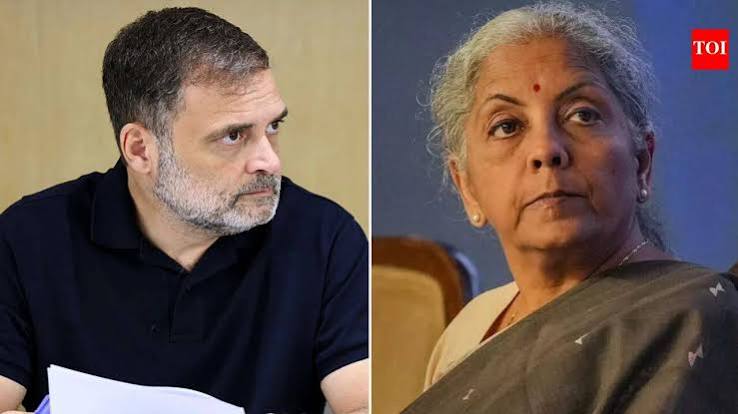
NEW DELHI: Leader of opposition in the Lok Sabha Rahul Gandhi on Wednesday hit back at finance minister Nirmala Sitharaman over the Tata Group controversy, questioning the alleged meeting between Tata Trusts and Tata Sons representatives and Union home minister Amit Shah. In a post on X, Rahul asked when “crony number 1” would enter the picture and which parts of the Tata Group he would get. “Dear Mrs Sitarama. 1. Which “legal and commercial matter” required Tata Trusts and Tata Sons to be hosted at Amit Shah’s residence?” “2. When is crony number 1 going to appear in the game and which pieces of Tata is he going to get?” he said. “Finally, all India’s businesses except 3-4 of your cronies, already hate all of you and don’t need any incitement,” he added. His remarks came after Sitharaman accused the Congress leader of politicising the Tata Group dispute and urged him to “refrain from seeing ghosts everywhere”. The exchange followed Rahul’s earlier post accusing the government of “criminally destroying” the Tata Group and questioning business leaders’ silence over the matter. “Being the LoP RahulGandhi, I suggest you refrain from politicising every issue. Also, casually labelling commercial and legal matters as criminal is unacceptable,” Sitharaman wrote on X. The finance minister alleged that Rahul had “repeatedly decried” the achievements of Indian industry and its entrepreneurs. She also accused him of trying to “incite” business leaders to join him in “spreading distrust and toxicity”. Sitharaman contrasted the Congress’s economic record with the BJP-led government’s approach, accusing the former of suppressing entrepreneurs through its “stifling Licence-Quota Raj”. “For decades, your party had smothered the spirit of Indian entrepreneurs under the stifling ‘Licence-Quota Raj’ and inflicted poverty on crores of Indians. On the other hand, our government led by PM Narendramodi values Indian industry as a creator of jobs and a driver of economic growth. Our policies have been tailored to enable enterprise, support industry and encourage investment,” she added. She urged Rahul to engage constructively with the government rather than make allegations for what she described as “narrow political motives”. “The Constitution of India ensures justice to all its citizens and our Honourable Courts are entrusted with upholding it. History is witness to the shoddy manner in which you, your party and the PMs belonging to your party have demeaned the judiciary. So Rahul ji, refrain from seeing ghosts everywhere,” Sitharaman said. Earlier, Rahul had targeted Prime Minister Narendra Modi and home minister Amit Shah over the dispute, alleging that the Tata Group was being undermined and that business leaders were reluctant to speak out. “Tata is being criminally destroyed, and no business leader dares say a word. How long will you stay silent? Until they own you? Indian business is not Modi and Shah’s plaything. You lack courage. We don’t. We will ensure justice for these crimes,” he wrote on X. The remarks came amid a dispute over the reappointment of N Chandrasekaran as executive chairman of Tata Sons, the holding company of the Tata Group. Tata Trusts chairman Noel Tata has challenged the decision to reappoint Chandrasekaran, alleging procedural irregularities and questioning the validity of the resolution. In a letter dated October 26 to Tata Sons’ company secretary, Noel Tata argued that the reappointment was invalid because it lacked a recommendation from the Selection Committee and did not meet requirements under the company’s Articles of Association. He also sought recordings and minutes of the board meeting, along with voting details, and asked the company to inform regulators that the resolution’s validity was disputed. Courtesy : TOI Note: This news is originally published on https:/timesofindia.com/bha and is used purely for non-profit/non-commercial purposes, especially human rights
SC Seeks Centre’s Response on PIL Over Transgender Law, Women’s Rights
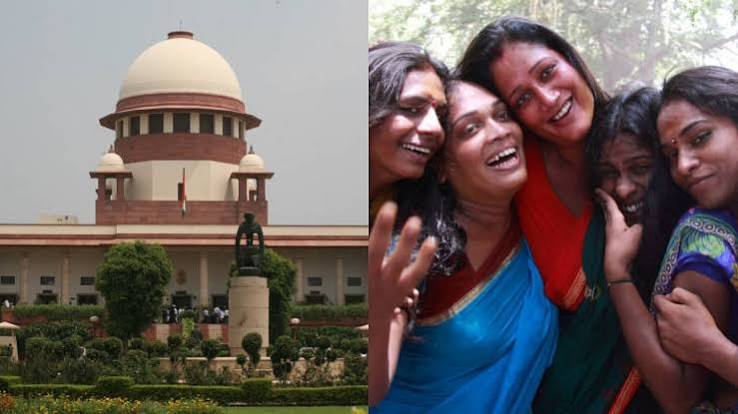
The Supreme Court on Wednesday sought the Centre’s response to a PIL by Women’s Declaration International India questioning the potential impact of the Transgender Persons (Protection of Rights) Amendment Act, 2026, on constitutional and statutory protections reserved for biological women. Women’s Declaration International India raises concerns over women’s reservations, prison accommodation, sports participation and legal safeguards under the amended transgender rights law. The Supreme Court on Wednesday sought the response of the Centre on a PIL filed by a women’s organisation, raising concerns over the potential impact of transgender rights legislation on constitutional and statutory protections and benefits reserved for biological women. A bench comprising Chief Justice of India Surya Kant and Justices Joymalya Bagchi and V Mohana issued notices to the Union Ministries of Social Justice and Empowerment, Law and Justice, and Health and Family Welfare on the PIL. The plea, filed by Women’s Declaration International India, raises questions relating to women’s reservations in local bodies, accommodation of transgender persons in prisons, participation in women’s sporting competitions, and safeguards available to women during arrest, searches and criminal investigations. The petition was tagged with the batch of cases challenging provisions of the Transgender Persons (Protection of Rights) Amendment Act, 2026, including changes concerning the recognition of transgender identity. Senior advocate Akhil Sibal, appearing for the petitioner organisation, said the plea raised a distinct perspective because it was brought by a women’s organisation and addressed the potential implications of the legislation for women’s rights. “Our concern is the impact on constitutional and statutory benefits exclusive to biological females. Those protections must remain and cannot be interfered with. Transgender persons must have equal rights and privileges, but the question is whether those rights can encroach upon protections reserved for biological women,” Sibal said. The bench noted the issues were already under consideration in a batch of petitions challenging the validity of provisions of the legislation. Justice Bagchi cautioned that filing other similar petitions could delay the proceedings, particularly as the existing batch was nearly ready for hearing. Sibal, however, maintained the petition was not a repetition of the pending challenges and raised a separate cause concerning women’s rights. The CJI said the petitioner might have a point but noted that the matter was already sub judice, adding the plea would introduce another perspective into the ongoing proceedings. Solicitor General Tushar Mehta, appearing for the Centre, said the government was preparing its response in the connected batch of cases and would address the concerns raised in the present petition as well. During the hearing, the solicitor general highlighted questions concerning gender identity and access to sex-specific facilities and protection. These included participation in women’s sporting events, accommodation in women’s prisons, access to women’s toilets, and statutory safeguards requiring women to be searched or have their statements recorded by women police officers in specified circumstances, the top law officer said. He also raised a hypothetical question concerning the application of restrictions on the arrest of women after sunset where a person accused of an offence identifies as a woman. He said the issue was not the right to identify as transgender, but the implications of the legal rights and protections attached to that identification. Sibal reiterated that the petitioner did not oppose the right to identify as transgender and said the right should be respected, with appropriate amenities provided. He also raised questions about whether transgender persons should have separate reservations or be eligible to claim seats reserved for women in panchayats. Courtesy : DC Note: This news is originally published on https:/deccanchronicle.com/bha and is used purely for non-profit/non-commercial purposes, especially human rights