
Kodaikanal: 26-year-old Dalit youth allegedly hacked to death; TNUEF issues condemnation

Police have registered a case under the Scheduled Castes and Scheduled Tribes (Prevention of Atrocities) Act. According to TNUEF, one accused has been arrested so far, while the remaining suspects are yet to be taken into custody. Synopsis: TNUEF alleged that Ramar was then attacked by a group of five men armed with sickles. Ramar sustained multiple cut injuries and died, while Prasanth, who accompanied him, suffered serious injuries and is undergoing treatment at Theni Government Medical College Hospital. A 26-year-old Dalit youth was allegedly hacked to death in the Kodaikanal taluk on Wednesday night, 30 July. According to a statement issued by Tamil Nadu Untouchability Eradication Front (TNUEF), the deceased, Ramar (26), and injured Prasanth (20), both from Poombarai village in Kodaikanal taluk, were engaged in transporting vegetables from the hills using horses before loading them into vehicles. The organisation alleged that on the night of July 30, Raghu, a man belonging to a dominant caste community, came to Ramar’s house claiming that their horse had grazed on his land and took him to the spot. TNUEF alleged that Ramar was then attacked by a group of five men armed with sickles. Ramar sustained multiple cut injuries and died, while Prasanth, who accompanied him, suffered serious injuries and is undergoing treatment at Theni Government Medical College Hospital. Police have registered a case under the Scheduled Castes and Scheduled Tribes (Prevention of Atrocities) Act. According to TNUEF, one accused has been arrested so far, while the remaining suspects are yet to be taken into custody. The organisation demanded the immediate arrest of all those involved, advanced medical treatment for the injured Prasanth, statutory compensation for Ramar’s family, a government job for his wife, and government support for the education of his two children. TNUEF state secretary Se. Muthurani, Dindigul district secretary K.T. Kalaichelvan, state committee member Vanaja, and CPI(M) district executive committee member Ajay Ghosh visited Ramar’s family at Dindigul Government Hospital and assured them of support in their pursuit of justice. In the statement, TNUEF state president T. Sellakkannu and general secretary P. Sugandhi strongly condemned the alleged caste-based murder and said the organisation would continue its legal and democratic struggle until justice is secured for the victim’s family. Courtesy : TSF Note: This news is originally published on https:/thesouthfirst.com/bha and is used purely for non-profit/non-commercial purposes, especially human rights
19 yrs on, 5 get life for abducting Dalit girl to stop her testifying; girl still ‘untraceable’

Agra: A special SC/ST court in Aligarh has sentenced five people to life imprisonment for kidnapping a 19-year-old Dalit girl in Sept 2007 to prevent her from testifying in her own rape case — a crime the UP court ruled was a “deliberate ploy to eliminate a key witness and derail the trial”. Despite almost two decades of search and investigation, she remains “untraceable”. The convicts — now aged between 40 and 50 years — were punished under IPC section 364 (kidnapping or abducting a person with the intent to murder them or put them in danger of murder) and section 3(2)(v) of SC/ST (Prevention of Atrocities) Act. Delivering the verdict, the court of special judge-II (SC/ST Act) Pratibha Saxena on Thursday observed that “the kidnapped girl has not been recovered even after 19 years” and held that “showing undue sympathy would embolden criminals and discourage victims and witnesses from coming forward”. On Sept 28, 2007, the girl’s father, filing the police complaint, claimed the accused — Amar Singh, Lekhraj, Babulal, Suresh (Hathras residents) and Usha Devi from Aligarh — armed with country-made pistols, barged into his house at a village in Aligarh district. The complaint stated: “They took away my daughter, who was a complainant in her rape case registered against some of the same accused. She was kidnapped to stop her from testifying in that case…” During trial in the kidnapping case, the prosecution examined seven witnesses and argued that the accused targeted the Dalit family to intimidate them and obstruct justice in the other case. “In the separate rape case which was being simultaneously heard before court, the accused were acquitted earlier this year. Sadly, the girl couldn’t appear and witnesses turned hostile. The kidnapping case was filed by her father six months after the rape case,” special public prosecutor Chaman Kumar Sharma said on Friday. Each convict has been awarded life sentences under IPC 364 and the SC/ST Act along with Rs 10,000 fine in each offence. Co-accused Satish Pandey was acquitted due to “lack of sufficient evidence”. Rejecting the leniency plea, the court said that “the justice system must reassure vulnerable sections of society that crimes against them, regardless of the accused’s influence, will invite stringent punishment”. Courtesy : TOI Note: This news is originally published on https:/timesofindia.com/bha and is used purely for non-profit/non-commercial purposes, especially human rights
Opposition parties up in arms against CM Vijay’s Karnataka visit plan
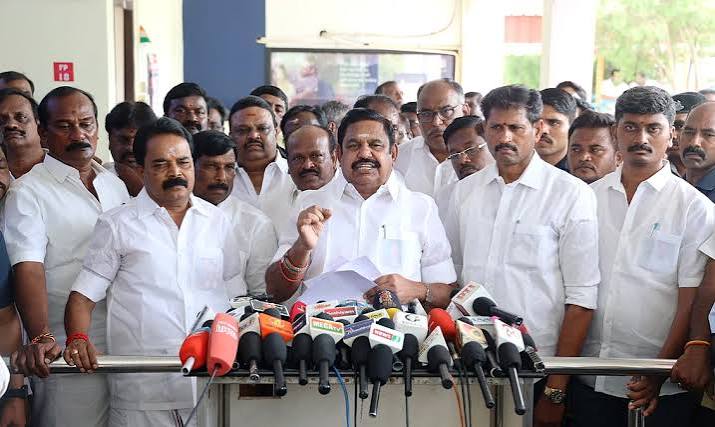
AMMK general secretary T T V Dhinakaran also opposed the reported visit, saying it would serve no purpose as Karnataka had openly rejected the CWMA’s direction. CHENNAI: The ‘proposed visit’ of Chief Minister C Joseph Vijay to Karnataka to discuss the Cauvery water dispute has come under criticism from opposition parties in Tamil Nadu. Leaders of the AIADMK, PMK, AMMK and the NTK said the visit, if it happens, would not help Tamil Nadu secure its share of Cauvery water, and urged the CM to drop the plan. AIADMK general secretary Edappadi K Palaniswami criticised the CM for not convening an all-party meeting on the Cauvery and Mekedatu issues. He also questioned the government’s silence over the union minister’s recent statement on the Mekedatu project and Karnataka Chief Minister D K Shivakumar’s refusal to release water despite the Cauvery Water Management Authority’s (CWMA) order. In a statement, he demanded that an all-party meeting be held immediately to discuss the issues affecting TN farmers. PMK president Anbumani Ramadoss said Karnataka has decided to challenge the CWMA order to release water to TN and has called an all-party meeting on August 2. He questioned how the talks, if any, between the two CMs could succeed when Karnataka had already refused to follow the CWMA order, and warned that such a meeting could weaken Tamil Nadu’s stand against the proposed Mekedatu dam. Similarly, AMMK general secretary T T V Dhinakaran also opposed the reported visit, saying it would serve no purpose as Karnataka had openly rejected the CWMA’s direction. In a statement, he urged the state to focus on legal action, consult farmers’ associations and raise the Cauvery and Mekedatu issues with Congress leader Rahul Gandhi to put political pressure on the Congress government in Karnataka. The politcal leaders had made the remarks ahead of the Karnataka CM deferring the bilateral talks with Vijay. Following Shivakumar’s announcement, NTK chief coordinator Seeman said Tamil Nadu was handling the Cauvery issue in a slow and careless manner. In a statement, he said it would be a “historic mistake” for the CM to visit Karnataka for talks. He argued that TN should instead continue its legal and political fight to protect its water rights. Courtesy : TNIE Note: This news is originally published on https:/thenewindianexpress.com/bha and is used purely for non-profit/non-commercial purposes, especially human rights
Rahul Gandhi leaves for Tamil Nadu tour, will meet the families of three students who committed suicide over the NEET controversy.
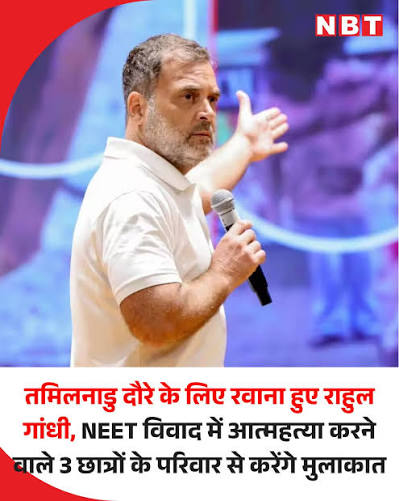
Rahul Gandhi left for Tamil Nadu on Saturday morning. He will meet the families of three students who committed suicide in Chennai over the NEET controversy. Tamil Nadu unit president B. Manickam Tagore stated that there is no plan to meet with Chief Minister Vijay. New Delhi: Leader of the Opposition in the Lok Sabha, Rahul Gandhi, left for Tamil Nadu on Saturday from his residence in New Delhi. Today in Chennai, he will meet with three families whose children allegedly committed suicide during the NEET paper leak controversy. Rahul Gandhi will also discuss with party officials under the “Sangthan Srujan Abhiyaan,” an initiative to strengthen the party at the grassroots level in Tamil Nadu. However, no meeting with Tamil Nadu Chief Minister Thalapathy Vijay is currently planned. According to reports, Rahul Gandhi will meet with three families in Chennai whose children committed suicide due to irregularities in the NEET UG exam regarding the NEET paper leak. Regarding Rahul Gandhi’s meeting with Tamil Nadu Chief Minister Vijay Thalapathy, the party stated that “there is no plan for Rahul Gandhi to meet Chief Minister C. Joseph Vijay during his visit to Tamil Nadu.” Will Address Officials Congress General Secretary and Tamil Nadu in-charge Ghulam Ahmed Mir and the party’s Tamil Nadu unit president B. Manickam Tagore told reporters in Chennai that Rahul will address officials on Saturday at the closing ceremony of the 10-day training camp for District Congress Committee presidents held from July 23 to August 1 in Mamallapuram. Initiative to Strengthen the Party at the Grassroots Level Rahul is expected to arrive in Chennai at 11 a.m. on August 1, where he will preside over a party event held there, and then depart for Delhi at 6 p.m. The training camp for the Chennai Congress Committee presidents is an initiative to strengthen the party at the grassroots level under the “Organization Creation Campaign.” When asked about the possibility of Rahul Gandhi meeting Chief Minister Vijay, Tagore said that the top leader’s Chennai program is related to party organization. Congress is part of the Tamil Nadu coalition government led by the Tamil Nadu Vetri Kazhagam (TVK). Curated by: Abhishek Pandey About the Author Abhishek Pandey is a digital journalist at Navbharat Times. He joined Navbharat Times, the digital wing of the Times of India Group, in July 2025. He currently covers news for the National and Delhi desks. Courtesy: Hindi News
Hate speech case: Suvarna appears before probe officer

Udupi: Udupi MLA Yashpal Anand Suvarna, booked for alleged derogatory remarks and hate speech against leader of opposition Rahul Gandhi, appeared before the investigating officer Friday. Responding to a police notice, the MLA answered questions posed by the investigating officer. The probe will proceed based on his responses, Udupi SP Hariram Shankar said. Udupi Town police had registered an FIR against Suvarna under sections 57, 192, 196(2), 352, 353(2) and 351(2) of BNS for allegedly making inflammatory statements against the Congress leader during a protest Tuesday. Meanwhile, the Udupi District Congress staged a protest in the town Friday against Suvarna’s alleged hate speech and threats against Rahul Gandhi, as well as his remarks on the NEET students’ movement. Former minister Vinay Kumar Sorake demanded the MLA’s immediate arrest. Congress leader Niketh Raj Maurya said the younger generation was exposing the Centre’s actions through social media and would respond democratically in the 2029 elections. In a press release, Dakshina Kannada BJP spokesperson Arun G Shet accused the Karnataka govt of using the administrative machinery to further “politics of hatred” instead of functioning in an accountable and democratic manner. Courtesy : TOI Note: This news is originally published on https:/timesofindia.com/bha and is used purely for non-profit/non-commercial purposes, especially human rights
Nestlé India Expands LGBTQ+ Inclusion With ‘Kaabil’ Culinary Internship

The programme will provide culinary training, mentorship and industry exposure to improve employability in the food and hospitality sector Nestlé India has launched Kaabil, its flagship culinary internship programme for the transgender community, aimed at building industry-relevant skills and improving employability in the food and hospitality sector. The initiative is being delivered through Nestlé Professional and driven by BEACON, the company’s LGBTQ+ Employee Resource Group. It seeks to create greater access to livelihood opportunities by equipping participants with practical culinary skills and professional exposure. The 15-day programme will cover kitchen fundamentals, regional and international cuisines, recipe development, live cooking, professional readiness and career guidance. Participants will receive hands-on training from Nestlé chefs, mentorship and industry exposure through a partnership with the Indian School of Hospitality. Kaabil is being implemented in collaboration with the Sahodari Foundation and TWEET Foundation across three regional kitchens in Delhi, Mumbai and Bengaluru, enabling participants to develop the skills and confidence required for careers in the hospitality industry. Commenting on the initiative, Saurabh Makhija, Director – Nestlé Professional, Nestlé South Asia, said the programme combines structured mentorship, culinary expertise and real-world industry exposure to equip participants with skills valued by the food service industry while encouraging a more inclusive future for the sector. Nitu Bhushan, Director – Human Resources, Nestlé South Asia, said meaningful inclusion is achieved by creating opportunities to learn, grow and thrive. She added that the initiative aims to empower members of the transgender community with industry-relevant skills and exposure while fostering an environment where talent is recognised regardless of background or identity. Kaabil was first introduced as a pilot programme in 2025 in partnership with the Sahodari Foundation. During the pilot, two transgender women entrepreneurs from Tamil Nadu received culinary training and mentorship from Nestlé chefs to strengthen their catering businesses. Building on those outcomes, the 2026 edition expands the programme’s reach to support more individuals through structured skill development and career opportunities. Courtesy : BW People Note: This news is originally published on https:/bwpeople.com/bha and is used purely for non-profit/non-commercial purposes, especially human rights
Meerut: Attempted kidnapping of Dalit girl; police find her using drone in 3 hours; search for the accused continues

The girl’s family said they suspect the accused are from the same village, and the police are currently investigating. Meerut: A case of kidnapping of an 11th-grade Dalit girl has come to light in the district. Some unidentified youths forcibly dragged her into a field. Acting on information from local residents, police launched a search operation using drone cameras. After approximately three hours of effort, the girl was recovered safely, while the police are continuing to search for the absconding accused. SP City Vinayak Gopal Bhosale stated that the incident occurred in the Partapur police station area, where a Dalit minor girl was forcibly taken into the fields by some men. Local villagers became suspicious and informed the police. Upon receiving the information, the SSP arrived at the scene with his team and began a search using drone cameras. After approximately three hours of effort, the girl was recovered. The villagers also provided considerable support during this time. The SP stated that drone cameras are now being used to monitor the area. The accused youths will be identified and arrested soon. Efforts are also being made to interrogate the student so that the accused can be identified quickly. Meanwhile, the student’s family stated that they suspect the accused are from the village. Currently, the police are investigating from every angle. Courtesy: Hindi News
Eyewitness to Dalit youth murder case in Tehri arrested on rape charges

New Tehri, Diwakar Dimri, an eyewitness to the murder of Dalit youth Ketan Lal in Uttarakhand’s Tehri district, has been arrested on rape charges. Police announced this on Thursday. Police said Dimri was arrested on Tuesday evening on charges of raping a minor girl involved in the case. According to a police complaint filed by Dhanpal Lal, father of Ketan (18), a resident of Dewal village, at 11 pm on June 7, his son, along with his friend Dimri, arrived at the minor girl’s house in Kholgarh village at her call, where the girl’s family locked them in a room and severely beat them. The next morning, the minor girl’s father called Ketan’s family and asked them to take his son away. According to the complaint, when they reached Kholgarh, Ketan was found bleeding and died on the way to be taken for treatment. The injured Dimri was admitted to the district hospital for treatment. Now, with Dimri’s arrest, the incident that occurred last month in Kholgarh village in the Pratapnagar area has once again gained momentum, where the family members of the deceased staged a protest at the Collectorate on Thursday demanding the release of Dimri and the arrest of his alleged co-accused. However, Ketan’s family and villagers later ended the protest after District Magistrate Nitika Khandelwal assured them of a fair investigation. Earlier, the family members of the minor girl and the people of the area, who had long threatened to protest after Dimri’s arrest, postponed a planned protest and siege of the District Magistrate’s office on Wednesday. According to the police, a case of alleged rape was registered against Dimri on July 11 at the Lambgaon police station under various sections, including the Protection of Children from Sexual Offences (POCSO) Act, based on the complaint of the minor girl’s mother. During the investigation, he was arrested based on the victim’s statement and other evidence. Meanwhile, the deceased’s father, Dhanpal Lal, mother, Rukma Devi, along with other family members and villagers staged a sit-in protest at the Collectorate on Thursday, demanding the arrest of alleged co-accused in the Ketan murder case. The protesters alleged that other individuals were also involved in Ketan’s murder, against whom no action has yet been taken. They also claimed that the minor girl’s mother and others also played a role in Ketan’s beating. The protesters demanded that the case be heard in a fast-track court, all co-accused be arrested, the Forensic Science Laboratory (FSL) report be made public, and the arrest of arrested eyewitness Dimri. Investigating officer and Police Circle Officer Chandramohan Singh stated that the investigation is ongoing and four individuals have been arrested so far in connection with Ketan’s murder. He added that further action will be taken based on whatever facts and evidence emerge from the investigation. Deepti Shafiq This story has been auto-fed from Bhasha news agency. ThePrint is not responsible for its content. Courtesy: Hindi News
MP: Teacher brutally beats 8-year-old Dalit student for touching water bottle, FIR filed

A case of alleged untouchability and caste discrimination has come to light at a government school in Shivpuri district, Madhya Pradesh. The teacher allegedly beat an eight-year-old student with a stick and used casteist slurs for touching his water bottle. A shocking incident has come to light in Shivpuri district, Madhya Pradesh, raising serious questions about both the education system and society. It is alleged that an 8-year-old student studying in a government school drank water from a teacher’s water bottle. Angered by this, the teacher allegedly beat the child and used casteist slurs against him. Following the incident, the family filed a police complaint. According to an NDTV report, the incident occurred at the government primary school in Ukawal village, Kolaras tehsil, Shivpuri district. According to reports, the 8-year-old student, a Class 4 student, arrived at school as usual. While studying, he felt thirsty and drank water from the teacher’s water bottle in the classroom. It is reported that this sparked a dispute, and the teacher’s anger was directed at the innocent student. Family members and local residents allege that teacher Lokesh Sharma became angry when the student touched his water bottle. They say the teacher first scolded the student and allegedly used casteist slurs against him. It is alleged that the teacher then brutally beat the student with a stick, saying, “How dare you touch my bottle?” The child returned home crying. When the student returned home after the beating, he was terrified. He informed his family about the incident. The family was shocked to hear his story. The family says that treating a young child in this manner simply for drinking water is a very serious matter. Following this, the family decided to take legal action and filed a complaint at the police station. FIR Registered On the complaint of the victim’s family, the Lukwasa police station in the Kolaras police station area has registered a case against the accused teacher, Lokesh Sharma. The police have registered a case under sections 296(A) and 115(2) of the Indian Penal Code (IPC). They have also taken action against the accused under sections 3(1)(d), 3(1)(d), and 3(2)(v) of the Scheduled Castes and Scheduled Tribes (Prevention of Atrocities) Act. Police Engaged in Investigation According to police officials, an investigation has been initiated into the case. Further action will be taken based on the complaint, witness statements, and other available evidence. Officials say that necessary legal action will be taken as per the law after the investigation is complete. Meanwhile, there is an atmosphere of anger in the village and surrounding areas following the incident. Locals say that schools are places to impart the message of education, equality, and respect to children. In such a context, the emergence of such allegations is extremely serious and worrying. Such incidents have happened before. It should be noted that similar incidents have occurred before. In April of last year, a 15-year-old Dalit student in Agra suffered fractures to two fingers and serious injuries to his thigh, shoulder, and jaw. It was alleged that a teacher beat him for touching a water bottle. This incident occurred at a private higher secondary school in Haripur. The student told the English newspaper TOI, “I was thirsty, and when I saw a water bottle on the table, I picked it up. As soon as I touched the bottle, my teacher, Mangal Singh Shakya, became angry and said, ‘How dare you touch the bottle? It’s no longer fit to be touched. Who will drink from it?’” The boy said that Shakya locked him in a room after school and beat him severely. A similar incident also occurred in Rajasthan in July 2022. A nine-year-old Dalit student died after being allegedly beaten by a teacher for drinking water from a water pot at a private school in Jalore district, Rajasthan. The victim was a student at a private school in Surana village, Jalore district. He was beaten on July 20 and later died at a hospital in Ahmedabad, Gujarat. Courtesy: Hindi News
Life imprisonment for raping a Dalit girl: POCSO court in Ambedkar Nagar also imposed a fine of 40,000 rupees, ruling in a 6-year-old case.

In the case of rape of a Dalit girl in the Jaitpur area of Ambedkar Nagar, Special Judge under the POCSO Act, Mohan Kumar, convicted the accused, Anand Singh alias Jhinak Singh, and sentenced him to life imprisonment. The court also imposed a fine of 40,000 rupees. According to the prosecution, the incident occurred on September 11, 2020. The accused, Anand Singh alias Jhinak Singh, a resident of Bhitaura South, gagged a Dalit girl who was outside her house, dragged her into the bushes, and raped her. When she resisted, the accused beat her and threatened to kill her. Charge sheet filed after investigation Following the incident, the police registered a case based on the complaint of the victim’s family. After the investigation was completed, the charge sheet was filed in the court. During the hearing, statements and evidence from the victim and other witnesses were presented before the court. The court delivered its verdict based on the evidence. The prosecution demanded a harsh punishment for the accused. Despite the defense’s arguments, the court deemed the available evidence and witness statements sufficient and convicted the accused. Sentence under the SC-ST Act and rape sections The special judge sentenced the accused to life imprisonment and a fine of ₹10,000 under the SC-ST Act. He also imposed various sentences under other sections, including 20 years of rigorous imprisonment for the crime of rape. The court also ordered a copy of the verdict be sent to the District Legal Services Authority to provide compensation to the victim. Arunesh Pratap Singh | Ambedkar Nagar Courtesy: Hindi News