
Parliament passes Transgender Persons Amendment Bill, 2026 with Rajya Sabha approving it today
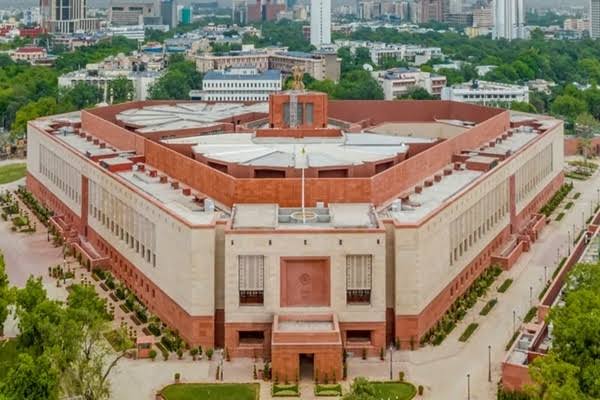
Parliament has passed the Transgender Persons (Protection of Rights) Amendment Bill, 2026, with the Rajya Sabha approving it today. The bill was passed by the Lok Sabha yesterday by a voice vote amid an Opposition-led walkout. The bill seeks to redefine the category of transgender, removes the provision of self-perceived gender identity and excludes several socio-cultural identities as well as transmasculine individuals from its ambit. It also further defines transgender persons within a biological framework, based on intersex variations and differences in sexual development. Replying to the discussion on the Bill in the Rajya Sabha, Social Justice and Empowerment Minister Dr Virendra Kumar said the government is compassionate towards the well-being of the transgender community. He said the Bill has provisions to empower the transgenders and give them dignity. The Minister said that the NDA government has taken several initiatives to bring transgender people to the mainstream and stop discrimination against them. Starting the discussion in the Upper House, Congress MP Renuka Chowdhury said this bill dilutes the privacy of an individual provided under the Constitution. Opposing the Bill, Ms Chowdhury said self-identification cannot be taken away through bureaucratic certification. Criticizing the government, she said that the proposed bill undermines the fundamental rights and dignity of transgender persons. Calling such a move wrong and illegal, she argued that forcing transgender persons to provide their identity through official certificates is against the spirit of equality and dignity guaranteed by the constitution. She also questioned the government’s approach for not properly consulting with the transgender community before bringing the Bill. She also referred to the Supreme Court’s landmark NALSA judgement of 2014, which recognized the right of transgender persons to self-identify their gender. Ms Chowdhury said the proposed Bill violates the principles laid down in that judgement and fails to respect an already established legal framework. DMK MP Tiruchi Shiva also opposed the Bill, saying that even if the Bill is passed in Parliament with a majority, it will be struck down by the Supreme Court. He further added that the Bill violates Articles 14, 15, 19 and 21 of the Constitution and it deprives the community of the right to freedom, dignity and self-determination. Supporting the Bill, BJP MP Medha Vishram Kulkarni said, ” This Bill ensures justice, dignity, protection from criminalisation and legal safeguards for transgender persons. She also thanked Prime Minister Narendra Modi for bringing this bill with certain amendments in order to ensure that the benefits reach the deserving people in a proper manner. She said there is a need for a law that brings justice to real transgender individuals and punishes fake ones. Mrs Kulkarni said the benefits should be extended to those who are transgender by birth. She said that the amendment to extend punishment will bring down the rate of crime and forced identities. TMC’s Saket Gokhale said that 31% of Transgender people in India have attempted suicide because of the discrimination that they are facing. He alleged that now the government is going to start discriminating against them as though social discrimination were not enough. He called it unacceptable. Mr Gokhale expressed concern that gender is going to be decided by the Chief Medical Officer and a District Magistrate, and the bill does not prescribe any qualifications for the Chief Medical Officer. Sanjay Singh of AAP said the Bill is a big let-down for the transgender community. He accused the government of not doing anything for the community. RJD’s Manoj Kr Jha said that prejudices against transgender people should stop, and they should be able to live with dignity. He added that self-determination of gender should not be taken away. CPI(M)’s John Brittas said it is a black-letter day and the Bill is taking India a century back. He pleaded with the government to either withdraw the Bill or refer it to a Select Committee. Jaya Bachchan of the Samajwadi Party also questioned the government over the legislation. She sought to know what the urgency was in bringing the Bill, without examining it with the depth and care that it deserved. Courtesy : NOA Note: This news is originally published on https:/newsonair.com/bha and is used purely for non-profit/non-commercial purposes, especially human rights
Bengaluru’s LGBTQIA+ athletes return from Gay Games
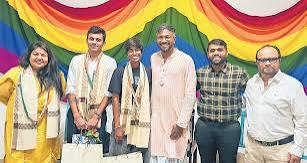
The athletes also highlighted the lack of inclusive sports policies in India, particularly for transgender and non-binary sportspersons. BENGALURU: Fresh from representing India at the Gay Games 2026 in Valencia, Spain, Bengaluru’s LGBTQIA+ athletes on Wednesday called for greater institutional recognition, financial assistance and inclusive sports policies, saying the country’s queer athletes continue to overcome significant barriers to compete internationally. The athletes were felicitated at Celebrating Queer Excellence, organised by the All India Professionals’ Congress (AIPC) LGBTQIA+ and Sports Domain in collaboration with Queer Nilayam and Dark Vibe Society. Among those felicitated was Gowthami Kandhasami (Goaty), who emerged as one of India’s top performers at the Gay Games. Competing in the women’s 25-29 years category, she won gold in high jump, 5-km run, 10,000-metre indoor run and 42-km marathon, besides securing silver in the 10-km run. She also bagged silver in the women’s overall 42-km marathon and was part of the mixed 4×400-metre relay team that won silver. Sumit Pawar, competing in the 35-39 years category, won the gold medal in the javelin throw and called for greater recognition and support for LGBTQIA+ athletes representing India. However, they said reaching the games itself was a struggle. Months of rigorous training had to be accompanied by fundraising, personal savings and support from friends, mentors and community members to cover travel and participation expenses. They urged governments and sport bodies to introduce scholarships and financial assistance for athletes representing India internationally, regardless of whether they win medals. The athletes also highlighted the lack of inclusive sports policies in India, particularly for transgender and non-binary sportspersons. Courtesy : TNIE Note: This news is originally published on https:/thenewindianexpress.com/bha and is used purely for non-profit/non-commercial purposes, especially human rights
Parliament passes Transgender Persons Amendment Bill, 2026 with Rajya Sabha approving it today
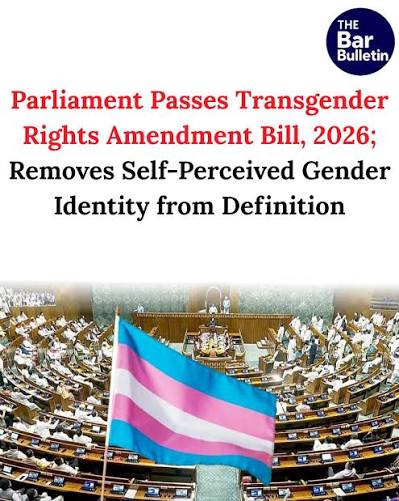
Parliament has passed the Transgender Persons (Protection of Rights) Amendment Bill, 2026, with the Rajya Sabha approving it today. The bill was passed by the Lok Sabha yesterday by a voice vote amid an Opposition-led walkout. The bill seeks to redefine the category of transgender, removes the provision of self-perceived gender identity and excludes several socio-cultural identities as well as transmasculine individuals from its ambit. It also further defines transgender persons within a biological framework, based on intersex variations and differences in sexual development. Replying to the discussion on the Bill in the Rajya Sabha, Social Justice and Empowerment Minister Dr Virendra Kumar said the government is compassionate towards the well-being of the transgender community. He said the Bill has provisions to empower the transgenders and give them dignity. The Minister said that the NDA government has taken several initiatives to bring transgender people to the mainstream and stop discrimination against them. Starting the discussion in the Upper House, Congress MP Renuka Chowdhury said this bill dilutes the privacy of an individual provided under the Constitution. Opposing the Bill, Ms Chowdhury said self-identification cannot be taken away through bureaucratic certification. Criticizing the government, she said that the proposed bill undermines the fundamental rights and dignity of transgender persons. Calling such a move wrong and illegal, she argued that forcing transgender persons to provide their identity through official certificates is against the spirit of equality and dignity guaranteed by the constitution. She also questioned the government’s approach for not properly consulting with the transgender community before bringing the Bill. She also referred to the Supreme Court’s landmark NALSA judgement of 2014, which recognized the right of transgender persons to self-identify their gender. Ms Chowdhury said the proposed Bill violates the principles laid down in that judgement and fails to respect an already established legal framework. DMK MP Tiruchi Shiva also opposed the Bill, saying that even if the Bill is passed in Parliament with a majority, it will be struck down by the Supreme Court. He further added that the Bill violates Articles 14, 15, 19 and 21 of the Constitution and it deprives the community of the right to freedom, dignity and self-determination. Supporting the Bill, BJP MP Medha Vishram Kulkarni said, ” This Bill ensures justice, dignity, protection from criminalisation and legal safeguards for transgender persons. She also thanked Prime Minister Narendra Modi for bringing this bill with certain amendments in order to ensure that the benefits reach the deserving people in a proper manner. She said there is a need for a law that brings justice to real transgender individuals and punishes fake ones. Mrs Kulkarni said the benefits should be extended to those who are transgender by birth. She said that the amendment to extend punishment will bring down the rate of crime and forced identities. TMC’s Saket Gokhale said that 31% of Transgender people in India have attempted suicide because of the discrimination that they are facing. He alleged that now the government is going to start discriminating against them as though social discrimination were not enough. He called it unacceptable. Mr Gokhale expressed concern that gender is going to be decided by the Chief Medical Officer and a District Magistrate, and the bill does not prescribe any qualifications for the Chief Medical Officer. Sanjay Singh of AAP said the Bill is a big let-down for the transgender community. He accused the government of not doing anything for the community. RJD’s Manoj Kr Jha said that prejudices against transgender people should stop, and they should be able to live with dignity. He added that self-determination of gender should not be taken away. CPI(M)’s John Brittas said it is a black-letter day and the Bill is taking India a century back. He pleaded with the government to either withdraw the Bill or refer it to a Select Committee. Jaya Bachchan of the Samajwadi Party also questioned the government over the legislation. She sought to know what the urgency was in bringing the Bill, without examining it with the depth and care that it deserved. Courtesy : NOA Note: This news is originally published on https:/newsonair.com/bha and is used purely for non-profit/non-commercial purposes, especially human rights
Parliament passes Transgender Persons Amendment Bill, 2026 with Rajya Sabha approving it today
Parliament has passed the Transgender Persons (Protection of Rights) Amendment Bill, 2026, with the Rajya Sabha approving it today. The bill was passed by the Lok Sabha yesterday by a voice vote amid an Opposition-led walkout. The bill seeks to redefine the category of transgender, removes the provision of self-perceived gender identity and excludes several socio-cultural identities as well as transmasculine individuals from its ambit. It also further defines transgender persons within a biological framework, based on intersex variations and differences in sexual development. Replying to the discussion on the Bill in the Rajya Sabha, Social Justice and Empowerment Minister Dr Virendra Kumar said the government is compassionate towards the well-being of the transgender community. He said the Bill has provisions to empower the transgenders and give them dignity. The Minister said that the NDA government has taken several initiatives to bring transgender people to the mainstream and stop discrimination against them. Starting the discussion in the Upper House, Congress MP Renuka Chowdhury said this bill dilutes the privacy of an individual provided under the Constitution. Opposing the Bill, Ms Chowdhury said self-identification cannot be taken away through bureaucratic certification. Criticizing the government, she said that the proposed bill undermines the fundamental rights and dignity of transgender persons. Calling such a move wrong and illegal, she argued that forcing transgender persons to provide their identity through official certificates is against the spirit of equality and dignity guaranteed by the constitution. She also questioned the government’s approach for not properly consulting with the transgender community before bringing the Bill. She also referred to the Supreme Court’s landmark NALSA judgement of 2014, which recognized the right of transgender persons to self-identify their gender. Ms Chowdhury said the proposed Bill violates the principles laid down in that judgement and fails to respect an already established legal framework. DMK MP Tiruchi Shiva also opposed the Bill, saying that even if the Bill is passed in Parliament with a majority, it will be struck down by the Supreme Court. He further added that the Bill violates Articles 14, 15, 19 and 21 of the Constitution and it deprives the community of the right to freedom, dignity and self-determination. Supporting the Bill, BJP MP Medha Vishram Kulkarni said, ” This Bill ensures justice, dignity, protection from criminalisation and legal safeguards for transgender persons. She also thanked Prime Minister Narendra Modi for bringing this bill with certain amendments in order to ensure that the benefits reach the deserving people in a proper manner. She said there is a need for a law that brings justice to real transgender individuals and punishes fake ones. Mrs Kulkarni said the benefits should be extended to those who are transgender by birth. She said that the amendment to extend punishment will bring down the rate of crime and forced identities. TMC’s Saket Gokhale said that 31% of Transgender people in India have attempted suicide because of the discrimination that they are facing. He alleged that now the government is going to start discriminating against them as though social discrimination were not enough. He called it unacceptable. Mr Gokhale expressed concern that gender is going to be decided by the Chief Medical Officer and a District Magistrate, and the bill does not prescribe any qualifications for the Chief Medical Officer. Sanjay Singh of AAP said the Bill is a big let-down for the transgender community. He accused the government of not doing anything for the community. RJD’s Manoj Kr Jha said that prejudices against transgender people should stop, and they should be able to live with dignity. He added that self-determination of gender should not be taken away. CPI(M)’s John Brittas said it is a black-letter day and the Bill is taking India a century back. He pleaded with the government to either withdraw the Bill or refer it to a Select Committee. Jaya Bachchan of the Samajwadi Party also questioned the government over the legislation. She sought to know what the urgency was in bringing the Bill, without examining it with the depth and care that it deserved. Courtesy : NOA Note: This news is originally published on https:/newsonair.com/bha and is used purely for non-profit/non-commercial purposes, especially human rights
The Regressive Turn in India’s Transgender Law
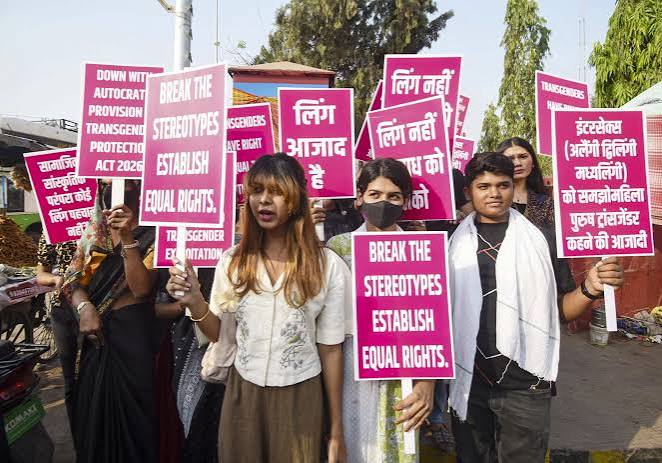
Woes of a transgender person begin at birth. Cursed, cussed, and ostracised, transgender people live on the margins of society. The spectre of hopelessness and despondency looms over them from cradle to their grave. They find safe harbour and joy not within but outside the society. My recent participation in a congregation organised by Vikalp and Gujarat Queer People’s Alliance brought this reality vividly to the forefront. Their struggle in getting a place under the sun exemplified what is wrong with the Transgender Amendment Act, 2026. Every testimonial that was presented at the jan sunvai (people’s hearing) revealed egregious flaws in the Act. The amendment seeks to alter the fundamental principle of self-identification governing laws related to transgender persons. Gender self-identification allows a person to alter their legal gender marker on official documents by making a self declaration without having to go through the excruciating process of a medical exam, psychological evaluation or gender affirming surgeries. The 2026 amendment has overturned this fundamental principle by necessitating a medical exam to determine gender identity, thereby hollowing out the agency conferred on an individual without regard to the havoc brought by it. The rationale provided by the state is “fakery”; the constant refrain one hears is that a section of persons could avail of benefits that are meant for transgender persons. Why the state’s reasoning is flawed First, is this not the same problem the state is confronted with when configuring benefits for minority communities like Scheduled Castes, Scheduled Tribes, Other Backward Castes and others. Therefore, would the state deny benefits to a vast majority who fall under these groups only because of the possibility of a fraudulent claim being made? It is evident that this logic is often employed by the state to strip that section of the citizenry of their rights which is not electorally significant, requiring courts to intervene. Sadly, courts, instead of the beneficent state, are called upon to make the course correction which invariably drains the transgender community of their time and resources. This pattern is familiar to most marginalised groups. A case in point is horizontal reservations which were fructified after hard-fought court battles. Good examples of those who received benefits of horizontal reservation, among others, are persons with disabilities and former servicemen. Second, is the state’s failure to recognise transgender persons’ right of self-identification. Self-identification received the imprimatur of the Supreme Court via its NALSA judgment (2014), followed by the legislature with the enactment of the 2019 Transgender Act until the roll out of the 2026 Transgender Amendment Act. The United Nations too has passed several resolutions urging nation states to align their domestic laws with the aforementioned principle. Of the many problems that have sprung up with the enactment of the 2026 amendment, the core grievance is the state’s inability to appreciate that a transgender person is a one whose mind is not in tune with the body the person is born with. Third, what is the benefit that a person will secure who, purportedly, falsely claims to belong to the trans community. Presently, apart from insurance, there is no substantial benefit available to a transgender individual. There are no safe houses or shelters; there is no provision for reservation despite the NALSA judgment observing that transgender persons should be categorised as “Socially and Economically backward class”; there is no provision for financing gender affirming surgeries for those who wish to adopt that route. Empirical data would show that many do not go through surgery because of the expense involved, paucity of doctors who specialise in this field, and more importantly the low success rate of such surgeries and the long after care period involved post the surgery. Stigma attached with being declared a transgender disincentivises persons not belonging to this group from registering as transgenders. Pejorative slurs such as ‘chakka’, ‘hijra’, and ‘bhand’ chase transgender people all their lives, rehabilitated or not. Fourth, the 2026 amendments are founded on mistrust and invasion of privacy. Medical exams and certification by an official who is untrained and unexposed in the field of gender-affirmation or therapy is a recipe for disaster. At the jan sunvai, the testimony of Ramesh, who said, “mein alag hoon magar galat nahin hoon (I am different but I am not wrong)” struck me. Another transman, Yogesh, said that while his family of origin accepted him for who he was, his neighbours stripped him naked to know what lay below the waistline. He also spoke of the builder’s refusal to allow a “kinnar” from occupying a flat, which they had bought with their own legitimate funds, because of opposition from other residents in the society. These testimonies brought to the fore the deep sense of hurt that transgenders carry and the flawed understanding of a vast section of the society. Some of us are, perhaps, unable to fathom the future, i.e., what if our children or grandchildren have the same dilemmas or challenges. What left me speechless was Maria’s retort to a bystander who ridiculed her for begging and not working because she was otherwise able-bodied: “Agar kaam nahi deh sakte ho , Aap koh koi adhikar nahi hai yeh kehna ka ki mein apni aajivika kaise kammah hoon” What needs to be done Plainly, the 2026 amendment is regressive for a variety of reasons. It moves away, as indicated above, from self-identification, to medical examination; it does nothing for providing shelter to those in distress, has no provision for employment, funding gender-affirming care, or for ensuring that specialised public facilities are setup in sufficient number which are run and managed by domain experts; and significantly, there is no attempt bring about legislative and administrative changes to increase awareness about issues concerning transgender persons, within the society at large, in particular, among those who manage institutions, i.e., police, doctors, judges and lawyers. Lack of awareness and sensitivity to what affects the lives of transgender people begins at the elementary level. Transgender persons, as wrongly understood, are not a “Third Gender”, an
SC: How can transgender ID cards be rendered invalid?
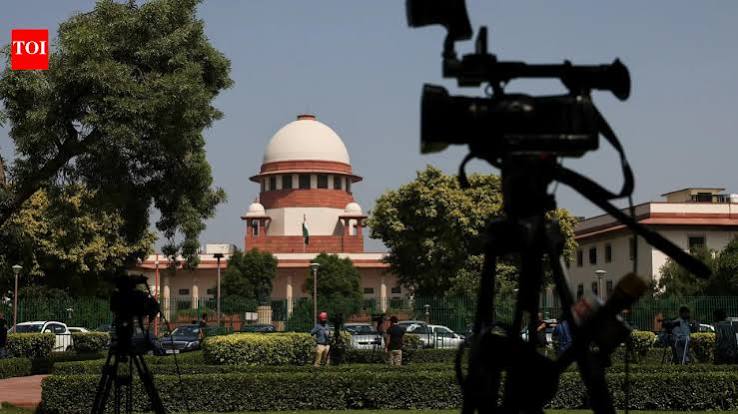
NEW DELHI: SC Monday sought govt’s response on pleas alleging Transgender Persons (Protection of Rights) Amendment Act, attempts to erase benefits accruing to transgenders under the old law and impinge on their right to receive hormone treatment for bringing their bodies in sync with self-identified genders. A bench of CJI Surya Kant, and Justices Joymalya Bagchi and V Mohana asked if the amendments are to be implemented prospectively, how could the transgender identity cards, issued under the earlier provisions of the law, be rendered invalid? Senior advocates complained those who were midway through their hormone treatment are being denied the same as doctors are not ready to provide such treatment fearing prosecution under the new law. “The national portal for transgenders has been discontinued denying them many benefits,” they alleged. Dhananjay Mahapatra Courtesy : TOI Note: This news is originally published on https:/timesofindia.com/bha and is used purely for non-profit/non-commercial purposes, especially human rights
Parliament passes Transgender Persons Amendment Bill, 2026 with Rajya Sabha approving it today
Parliament has passed the Transgender Persons (Protection of Rights) Amendment Bill, 2026, with the Rajya Sabha approving it today. The bill was passed by the Lok Sabha yesterday by a voice vote amid an Opposition-led walkout. The bill seeks to redefine the category of transgender, removes the provision of self-perceived gender identity and excludes several socio-cultural identities as well as transmasculine individuals from its ambit. It also further defines transgender persons within a biological framework, based on intersex variations and differences in sexual development. Replying to the discussion on the Bill in the Rajya Sabha, Social Justice and Empowerment Minister Dr Virendra Kumar said the government is compassionate towards the well-being of the transgender community. He said the Bill has provisions to empower the transgenders and give them dignity. The Minister said that the NDA government has taken several initiatives to bring transgender people to the mainstream and stop discrimination against them. Starting the discussion in the Upper House, Congress MP Renuka Chowdhury said this bill dilutes the privacy of an individual provided under the Constitution. Opposing the Bill, Ms Chowdhury said self-identification cannot be taken away through bureaucratic certification. Criticizing the government, she said that the proposed bill undermines the fundamental rights and dignity of transgender persons. Calling such a move wrong and illegal, she argued that forcing transgender persons to provide their identity through official certificates is against the spirit of equality and dignity guaranteed by the constitution. She also questioned the government’s approach for not properly consulting with the transgender community before bringing the Bill. She also referred to the Supreme Court’s landmark NALSA judgement of 2014, which recognized the right of transgender persons to self-identify their gender. Ms Chowdhury said the proposed Bill violates the principles laid down in that judgement and fails to respect an already established legal framework. DMK MP Tiruchi Shiva also opposed the Bill, saying that even if the Bill is passed in Parliament with a majority, it will be struck down by the Supreme Court. He further added that the Bill violates Articles 14, 15, 19 and 21 of the Constitution and it deprives the community of the right to freedom, dignity and self-determination. Supporting the Bill, BJP MP Medha Vishram Kulkarni said, ” This Bill ensures justice, dignity, protection from criminalisation and legal safeguards for transgender persons. She also thanked Prime Minister Narendra Modi for bringing this bill with certain amendments in order to ensure that the benefits reach the deserving people in a proper manner. She said there is a need for a law that brings justice to real transgender individuals and punishes fake ones. Mrs Kulkarni said the benefits should be extended to those who are transgender by birth. She said that the amendment to extend punishment will bring down the rate of crime and forced identities. TMC’s Saket Gokhale said that 31% of Transgender people in India have attempted suicide because of the discrimination that they are facing. He alleged that now the government is going to start discriminating against them as though social discrimination were not enough. He called it unacceptable. Mr Gokhale expressed concern that gender is going to be decided by the Chief Medical Officer and a District Magistrate, and the bill does not prescribe any qualifications for the Chief Medical Officer. Sanjay Singh of AAP said the Bill is a big let-down for the transgender community. He accused the government of not doing anything for the community. RJD’s Manoj Kr Jha said that prejudices against transgender people should stop, and they should be able to live with dignity. He added that self-determination of gender should not be taken away. CPI(M)’s John Brittas said it is a black-letter day and the Bill is taking India a century back. He pleaded with the government to either withdraw the Bill or refer it to a Select Committee. Jaya Bachchan of the Samajwadi Party also questioned the government over the legislation. She sought to know what the urgency was in bringing the Bill, without examining it with the depth and care that it deserved. Courtesy : NOA Note: This news is originally published on https:/newsonair.com/bha and is used purely for non-profit/non-commercial purposes, especially human rights
A rollback of rights, or an imperfect step forward? India amends transgender rights act.
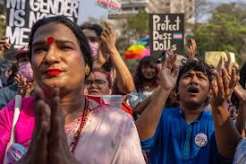
Activists and members of the transgender community shout slogans during a protest against a transgender rights amendment bill passed in the lower house of Parliament, in Mumbai, India, March 25, 2026. On a hot evening at Jawaharlal Nehru University in south Delhi, students sit painting protest banners beneath rainbow flags. Verses of the Urdu poets Faiz Ahmed Faiz and Habib Jalib – long associated with protest movements across South Asia – play from a speaker nearby. They have gathered to oppose a new law that has ignited a debate that echoes in many parts of the world: Who has the authority to determine a person’s gender identity? The individual, a doctor, or the state? Since 2014, India has granted transgender people legal recognition by grounding their self-identification in constitutional rights. That changed in March when the Parliament passed the Transgender Persons (Protection of Rights) Amendment Act, which requires medical evaluation and state certification of gender. Why We Wrote This India has changed the process for how individuals identify their gender, sparking protests and court challenges. The government says this amendment is about ensuring that benefits reach the right people, while LGBTQ+ rights activists call the law regressive. India’s new law comes in the context of wider debates about identity in India under the leadership of Prime Minister Narendra Modi. Supporters say the change is necessary to prevent misuse of welfare programs intended for transgender individuals. Critics say it reverses a decade of legal gains. The amendment is currently being challenged at the Supreme Court, where trans rights advocates are arguing that it violates Indians’ constitutional rights. “There is nothing wrong with a simple verification process,” says Arvind Sharma, a master’s student, outside the Jawaharlal Nehru University protest. “This law will help the actual transgender community and expose the fake ones.” Despite its strength, US military faces a reputational crisis over Iran Students gather beneath rainbow flags during a protest against India’s Transgender Persons (Protection of Rights) Amendment Act at Jawaharlal Nehru University in New Delhi, April 11, 2026. Supporters of the law say it creates a more accountable system for legal recognition, while critics argue it rolls back transgender rights. Aakash Hassan The debate is deeply personal for Bhumi, a transgender undergraduate from Lucknow in northern India who, like many in India, uses a single name. Raised as a girl and recognized as such in her official documents, she worries the new law could place her identity under state scrutiny. “I don’t want someone else deciding whether I am transgender enough,” she says. “That feels invasive and humiliating.” Get the Monitor Stories you care about delivered to your inbox. Your e-mail address Sign up By signing up, you agree to our Privacy Policy. “I hope the courts will intervene,” she adds. How this fits into the history of trans rights in India South Asia has a long, unique history of gender diversity. For centuries before modern LGBTQ+ rights movements emerged, the region recognized there were communities that existed outside biological designations of gender. Most famous are the hijras, who traditionally attended weddings, births, and religious ceremonies across the subcontinent, offering blessings and receiving gifts or alms in return. In southern India, two other groups, the Aravanis and jogtas, uphold local Hindu traditions. America’s debt is skyrocketing. Why isn’t Congress doing anything about it? Visibility has not translated into social acceptance. The term hijra has long carried social stigma, and transgender Indians face high levels of discrimination, family rejection, and economic exclusion. Yet the existence of these third-gender communities has helped shape the LGBTQ+ rights movement in India. While Western countries debated whether trans people existed, in India, that was a widely accepted fact. It made it harder to argue that LGBTQ+ rights are a foreign import. On the contrary, activists in India say that anti-LGBTQ+ discrimination is a colonial holdover. But this history brings unique challenges, too. For years, terms like “transgender” and “third gender” were largely treated as synonymous with belonging to one of these traditional communities, which left many Indians in a legal gray area. That changed in 2014, when India’s Supreme Court recognized transgender people and affirmed their right to determine their own legal gender markers – no government or medical sign-off required. Nazariya Kutty gets ready in a parlor to participate in the Koovagam transgender festival in Villupuram, in the southern Indian state of Tamil Nadu, April 28, 2026. Mahesh Kumar A./AP The unanimous ruling was seen by supporters of self-identification as a watershed moment, pushing India ahead of much of South Asia on transgender rights. Yet the ruling itself did little to outline how benefits and protections would be delivered to India’s trans population, which researchers estimate is between 2 million and 6 million people. (India’s 2011 census recorded 487,803 transgender people, but that is broadly considered a vast undercount due to a reluctance to self-report.) A 2019 law called the Transgender Persons (Protection of Rights) Act prohibited discrimination against trans Indians, retained a broad definition of transgender identity, and outlined a process for trans Indians to obtain official recognition through district authorities. Many LGBTQ+ activists criticized the 2019 act for creating bureaucratic barriers, but welcomed the reaffirmation of the right to self-identification. The new law signed in March “erases all of that,” says Arundhati Katju, a senior advocate challenging the amendment before the Supreme Court. The new law narrows the definition of transgender people to recognized sociocultural communities or those meeting specific biological criteria, and grants the state the authority to determine who qualifies. The debate today Medha Vishram Kulkarni, a member of Parliament from the ruling Bharatiya Janata Party (BJP) and a primary supporter of the new act, says the government has “no intention of undermining” Indians’ constitutional rights. “Self-identification is central to an individual’s dignity and lived experience,” she says, in a written interview with the Monitor. “However, where legal entitlements, welfare benefits, or official records are involved, the State also has a responsibility to ensure transparency, consistency, and accountability.” When
Nestlé India Expands LGBTQ+ Inclusion With ‘Kaabil’ Culinary Internship

The programme will provide culinary training, mentorship and industry exposure to improve employability in the food and hospitality sector Nestlé India has launched Kaabil, its flagship culinary internship programme for the transgender community, aimed at building industry-relevant skills and improving employability in the food and hospitality sector. The initiative is being delivered through Nestlé Professional and driven by BEACON, the company’s LGBTQ+ Employee Resource Group. It seeks to create greater access to livelihood opportunities by equipping participants with practical culinary skills and professional exposure. The 15-day programme will cover kitchen fundamentals, regional and international cuisines, recipe development, live cooking, professional readiness and career guidance. Participants will receive hands-on training from Nestlé chefs, mentorship and industry exposure through a partnership with the Indian School of Hospitality. Kaabil is being implemented in collaboration with the Sahodari Foundation and TWEET Foundation across three regional kitchens in Delhi, Mumbai and Bengaluru, enabling participants to develop the skills and confidence required for careers in the hospitality industry. Commenting on the initiative, Saurabh Makhija, Director – Nestlé Professional, Nestlé South Asia, said the programme combines structured mentorship, culinary expertise and real-world industry exposure to equip participants with skills valued by the food service industry while encouraging a more inclusive future for the sector. Nitu Bhushan, Director – Human Resources, Nestlé South Asia, said meaningful inclusion is achieved by creating opportunities to learn, grow and thrive. She added that the initiative aims to empower members of the transgender community with industry-relevant skills and exposure while fostering an environment where talent is recognised regardless of background or identity. Kaabil was first introduced as a pilot programme in 2025 in partnership with the Sahodari Foundation. During the pilot, two transgender women entrepreneurs from Tamil Nadu received culinary training and mentorship from Nestlé chefs to strengthen their catering businesses. Building on those outcomes, the 2026 edition expands the programme’s reach to support more individuals through structured skill development and career opportunities. Courtesy : BW People Note: This news is originally published on https:/bwpeople.com/bha and is used purely for non-profit/non-commercial purposes, especially human rights
Why are transgenders building a PM Modi temple in Bihar?

A proposal to build a temple dedicated to Prime Minister Narendra Modi has been approved by Bihar’s State Transgender Welfare Board. The board described the Transgender law passed by the PM Modi-led government as a milestone that gave the community institutional representation in the state. The Bihar State Transgender Welfare Board has approved a proposal to build a temple dedicated to Prime Minister Narendra Modi, saying the move is meant to honour him for giving the transgender community “respect and rights”. According to the news agency PTI, the proposal to build the temple was moved by the board member Ranjan Singh during the maiden meeting of the board under the Bihar Social Welfare Department. The proposal reportedly received unanimous support. Singh, who moved the proposal, said that the idea was brought by the fact that the transgender community in Bihar does not have a temple of its own and described the Transgender Persons (Protection of Rights) Act, 2019, passed by the PM Modi-led government as a milestone that gave the community institutional representation in the stat The temple proposal is less about religion than recognition. Members of the Bihar State Transgender Welfare Board say Prime Minister Narendra Modi is the first national leader who gave the community legal recognition and a formal place in governance. For the board, the temple is therefore a symbolic expression of gratitude rather than simply a place of worship. Its members see the proposal as an acknowledgement of what they consider the Centre’s role in bringing transgender rights into India’s legal and policy framework. WHAT CHANGED AFTER THE 2019 ACT? The Transgender Persons (Protection of Rights) Act, 2019, was the first central legislation dedicated to protecting the rights of transgender persons in India. Enacted by the central government, the law prohibits discrimination against transgender people in education, employment, healthcare, housing and access to public services. It also provides for the issuance of identity certificates, directs governments to frame welfare measures and calls for the establishment of institutional mechanisms to safeguard the community’s rights. The law also paved the way for the creation of bodies such as the National Council for Transgender Persons and prompted states to set up their own welfare mechanisms. In Bihar, the state government constituted the Bihar State Transgender Welfare Board in August last year under the Social Welfare Department to work towards the community’s social development and empowerment. It was this board that approved the proposal to build a temple dedicated to PM Modi, with its members describing the law as a milestone that gave the community greater institutional recognition. THE PROPOSAL TO BUILD TEMPLE FACES BACKLASH While the Bihar State Transgender Welfare Board has credited the central government for bringing legal recognition to the community, the Transgender Persons (Protection of Rights) Act, 2019, has also faced criticism from transgender rights activists across the country. Several organisations had opposed the law, arguing that its process for obtaining a transgender identity certificate placed unnecessary bureaucratic hurdles in the path of self-identification. Others criticised the absence of provisions for reservations in education and public employment, saying the legislation fell short of addressing the community’s long-standing demand for affirmative action. The differing reactions highlight that the transgender community is not monolithic. While the Bihar board sees the 2019 law as a milestone worthy of symbolic recognition, many activists continue to argue that the fight for equal rights and representation remains unfinished. For now, the temple remains a proposal. The Bihar State Transgender Welfare Board has approved the plan, but construction can begin only after the state government allots land and the necessary administrative approvals are in place. The proposal was unanimously backed by the board’s members during its maiden meeting, according to PTI. If it moves forward, the temple would be one of the rare instances in India of a place of worship being dedicated to a sitting Prime Minister. Written By: Gaurika Gulati Courtesy : India Today Note: This news is originally published on https:/indiatoday.com/bha and is used purely for non-profit/non-commercial purposes, especially human rights