
PRIDE AND PREJUDICE: Tamil Cinema Evolves, ‘Dorothy’ Marks Breakthrough for Transgender Representation

For a long time in Tamil cinema, transgender people were denied their humanity. From ‘Eeramana Rojave’ (1991) to ‘Darbar’ (2020), movies reduced them to tired tropes, letting them exist only as objects of pity and ridicule. They were called slurs such as ‘ajak’ and ‘ombodhu’ and used as plot devices to underline male superiority. When a transgender character enters the scene in a Tamil movie, the audience knows what to expect: They would clap loudly, speak in a sarcastic tone, often in innuendo. If the script is kind, they would bless the protagonist and walk away. If not, they would get humiliated. Karthik Subbaraj’s ‘Dorothy’, which released a couple of weeks ago, has disrupted this pattern by centering a transwoman’s self-discovery, and ends with her finding love. This sea change reflects the elevation that the trans community has achieved in society over the years. Kombai Anwar, an academic and filmmaker, says, “TN and Kerala govts have made efforts to improve the lives of marginalised communities. Parallelly, cinema has evolved to represent them better. First came dalit films by directors such as Vetrimaaran and Pa Ranjith, then we had movies such as ‘Habeebi’ (2026), which told the story of a small-town Muslim family. And now, we have ‘Dorothy’.” Director Subbaraj gives his leading woman grace and dignity in grief, hardship and threat to life. She comes out as trans to her family men who habitually kill off the women for refusing to toe the line, wears her identity proudly and walks her path fearlessly. “Sovereignty, the ability to make one’s own decisions, has been denied to trans characters in films. They have been kept in suffering, in a state of dependency on the mercy of others,” says Agni Pradeep, a transwoman writer. Thiagarajan Kumararaja’s ‘Super Deluxe’ (2019) fell into this trap. Vijay Sethupathi’s Shilpa returns home after gender-affirming surgery and is left to grapple with sexual violation, social stigma and anxiety as she attempts to reintegrate into the system. “Supreme Court has ruled that a transwoman can marry either a straight man or a transman. But the former is still not accepted by society,” says Jaya, general manager of Saho Daran, a city-based NGO for transpeople. This is echoed in the backlash that ‘Dorothy’ has received from a section of the audience that does not accept trans identity. Today, there are more than 500 active trans activists in Tamil Nadu, says Jaya. “You wouldn’t see as many in other states. They help members of the community access opportunities, get documentation and solve legal issues.” Though the Dravidian govts brought many schemes to improve the lives of transpeople, without acceptance from people in the education and employment sectors, they cannot “stay on the path to a better life”, Jaya says. “Even simple things like finding a house on rent is an uphill battle for transwomen, as not all people consider us ‘normal’. This is where positive representation in films matters,” she says. “We have come a long way since the infamous ‘Oororam Puliyamaram’ number in ‘Paruthiveeran’ (2007), where a group of transwomen dance to a folk song signalling sexual vulnerability among a group of drunken men,” says Kombai. The song became a pop culture reference for years thereafter. “We just want to be seen as regular people with regular lives. More than being portrayed as minstrels or ‘ardhanariswara’ or fortune tellers, we want to be accepted as people first,” says N Jency, the first transwoman in the state to get a PhD, and lecturer at Quaid-E-Millath Government College For Women, Chennai. One step forward, two steps back? How trans characters are shown in cinema Step back | Eeramana Rojave (1991) Hero and friends try to go to a movie with girls, but end up with transwomen. Slapstick comedy ensues Step forward | Kanchana (2011) A trans character is thrown out by her family, later, adopts a trans child and raises her to become a doctor Step back | I (2015) Osma, played by trans makeup artist Ojas Rajani, is infatuated with the hero, who humiliates her Step back | Darbar (2020) Rajinikanth’s character pays a group of trans women on a railway platform to sing while he beats up bad guys, reducing them to a tired stereotype Step forward | Neela Nira Sooriyan (2024) Trans filmmaker Samyuktha Vijayan plays a schoolteacher who identifies as a woman and transitions Dignity in a name In 2006, chief minister M Karunanidhi coined the terms ‘thirunangai’ (transwoman) and ‘thirunambi’ (transman), ‘thiru’- respectable; ‘nangai’ – woman and nambi – man. The intention was to remove stigma that came from words previously used to refer to them such as ‘aravani’. Today, the term is shortened to ‘thirunar’ to refer to a transperson of either orientation The shift in nomenclature led to a gradual social elevation that brought them ID cards, voting rights and access to govt schemes. In 2008, the DMK govt established the Transgender Persons Welfare Board Govt schemes: Subsidized loans for self-help groups; free sewing machines; 1 reserved seat in govt colleges; pension for transwomen over 40; ARAN shelter; special clinic at RGGGH & dist govt hospitals Courtesy : TOI Note: This news is originally published on https:/timesofindia.com/bha and is used purely for non-profit/non-commercial purposes, especially human rights
Nestlé India launches transgender culinary internship

Nestlé India has launched a new culinary internship called Kaabil, giving transgender people the chance to learn professional cooking skills and explore careers in the food and hospitality industry. The 15-day programme is designed to help participants build confidence in the kitchen while picking up practical skills that employers are looking for. Training covers everything from kitchen basics and regional dishes to international cuisine, recipe development, live cooking, and workplace readiness. Participants will also receive career guidance to help them take the next step into the industry. Kaabil is led by Nestlé Professional with support from the company’s LGBTQ+ employee resource group, BEACON. The programme is being delivered in partnership with the Sahodari Foundation and the Tweet Foundation, with training taking place in Delhi, Mumbai, and Bengaluru. As part of the internship, participants will also be mentored by Nestlé chefs and get a closer look at the hospitality industry through the Indian School of Hospitality. By focusing on hands-on training and real career opportunities, Kaabil aims to open more doors for transgender people looking to build a future in one of India’s fastest-growing industries. Korina Estrada A writer and an advocate of self-love and body positivity. She loves baking cookies, practicing her calligraphy, and creating short stories of local folklore. Courtesy : Transgenderfeed Note: This news is originally published on https:/transgenderfeed.com/bha and is used purely for non-profit/non-commercial purposes, especially human rights
Transgender activist dies following vehicle crash

Chitradurga: Transgender activist Arundhati, 45, who worked for the rights and social security of transgender persons in Karnataka, died following a road accident near Bharamasagara in Chitradurga on Saturday night. Arundhati was riding her scooter on a service road along the national highway when the accident occurred. Its cause was not immediately known. She was taken to Basaveshwara Medical College Hospital in Chitradurga and later shifted to a govt hospital in Davanagere. She died while being moved to a medical college hospital in Hubballi for further treatment. Bharamasagara police registered a case. A postgraduate and Mandya native, Arundhati had participated in several social movements and campaigns against violence against women. She had settled near Kasavanahalli village, where she farmed leased land and reared sheep, goats and poultry. She played a prominent role in movements seeking dignity and social security for transgender persons, and helped community members become self-reliant by providing them with livestock and poultry. During the Covid-19 pandemic, she set up a drinking-water kiosk along the national highway for travellers. Several organisations had honoured her social work. Dharwad-based Navilugari organisation was scheduled to confer its state-level award on her on Oct 11. Women’s organisations condoled her death. Writer Sabita Bannadi said Arundhati had overcome social challenges and built an independent life through farming and social work. Courtesy : TOI Note: This news is originally published on https:/timesofindia.com/bha and is used purely for non-profit/non-commercial purposes, especially human rights
Transgender men dressed as sari were extorting money from a BMW owner; police arrested four after scanning CCTV.
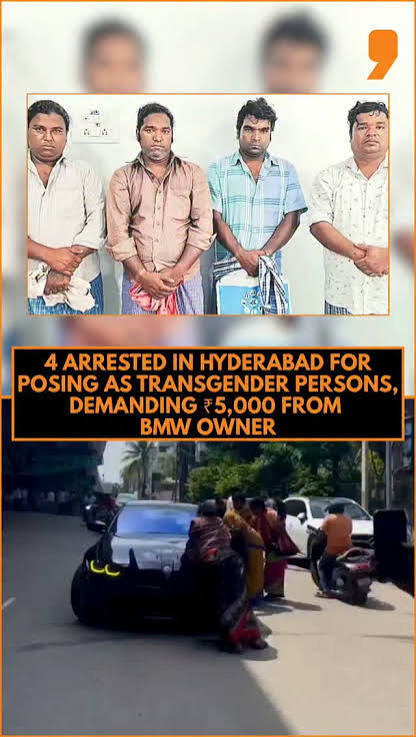
Four men, dressed as eunuchs, were threatening a BMW owner and demanding 5,000 rupees. After the video surfaced, police scanned CCTV footage and arrested the four men. Hyderabad: In India, you’re likely to encounter transgressors at red lights. They often appear in groups of 4-6. As soon as the light turns red, they approach stopped vehicles and demand money from people. Believing that a transgressor’s blessings will never go unanswered, people often give them money. Sometimes, they refuse to pay and move on. This often leads to a fight. However, it’s not necessary that the person you’re giving money to is a transgressor. Sometimes, men are also disguised as transgressors. One such case has come to light in Hyderabad, where police have arrested four men dressed as sari men disguised as transgressors. On August 21st, they demanded money and threatened a BMW owner. These four men are accused of dressing up as women and threatening a BMW owner, demanding ₹5,000 from him. Jubilee Hills police in Hyderabad have arrested four men. They are accused of stopping a BMW owner near True Black Coffee on Road No. 45 on August 21st and demanding ₹5,000 from him. The incident came to light after a video of the confrontation was posted on social media. Following instructions from senior police officers, investigators examined nearly 500 CCTV cameras and traced the suspects’ movements from Jubilee Hills to Boduppal. The four accused have been arrested. The accused have been identified as Ramesh (40), Satyanarayana (41), Ramesh (42), and Yadagiri (44); all residents of Boduppal, Hyderabad. Investigators allege that the four men would masquerade as transgender individuals and stop drivers and extort money. Police also reported that they would visit housewarming ceremonies and newly opened shops to demand money. With the help of a task force, the four were arrested and later remanded to judicial custody. The investigation is ongoing. Reported by: Ashish Pandey, Edited by: Prabhanshu Ranjan Courtesy: Hindi News
4 men pose as transgender persons, try to extort BMW owner at Hyderabad’s Jubilee Hills, held
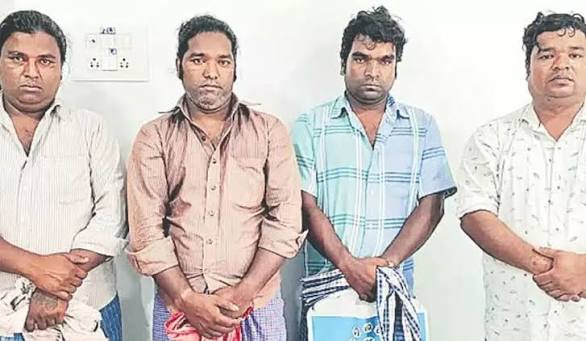
HYDERABAD: Four men who had extorted money from a BMW car owner while posing as transgender persons were arrested by the Jubilee Hills police on Friday. The accused are Yadagiri, 44, Satyanarayana, 41, K Ramesh, 40, and S Ramesh, 42, from Boduppal. An extortion case was registered against the unknown accused posing as transgender persons after they had extorted Rs 5,000 from a BMW car owner at Road Number 45 in Jubilee Hills on August 21. “The incident took place near True Black Coffee Shop in Jubilee Hills. Four fraudsters posing as transgender persons intercepted a BMW car as its owner was leaving the place after having coffee. They forcibly demanded money and took it from him. We have registered an extortion case against the accused,” Jubilee Hills inspector D Ashok said. Subsequently, in the first week of September, DGP CV Anand instructed police commissioners to curb the extortion incidents involving members of the transgender community. Jubilee Hills police verified footage from hundreds of CCTV cameras in the area and with the help of West Zone Task Force sleuths, the accused were arrested from Boduppal on Thursday. “We have produced the four accused men before the court and they were sent to judicial remand,” the inspector said. Courtesy : TOI Note: This news is originally published on https:/timesofindia.com/bha and is used purely for non-profit/non-commercial purposes, especially human rights
Bags, mosaics and more: Transgender artisans bring their craft to Pune fair

Pune: Eighteen transgender artisans are turning their craft into livelihood and offering a different outlook on life at the 19th Yellow Ribbon NGO fair in Pune. At their stall, palm-leaf baskets have been reimagined in wire, strips, and woven forms, while shards of coloured glass are cut, shaped, and pieced together into mosaics. Family rejection, discrimination, and difficulty finding housing and the barriers to finding formal employment have shaped their lives, but haven’t defined them. The artisans are part of PeriFerry Foundation all over India and at this fair organised between Oct 1 and 5 at Creaticity, Yerawada, they are displaying bags, baskets, coasters, keychains, mosaic artworks and decorative frames made by them. At PeriFerry’s Pune workshop, in-house teams of experienced artisans and workers teach and help newer members learn the techniques. Among them are two transgender women who have taken on leadership roles, with one overseeing the artisan team and another who is an artisan and in charge of quality control. “One of the craft traditions is kudai, a form of basketry associated with Tamil Nadu. Traditionally, women made these baskets by weaving and shaping palm leaves into containers used for everyday purposes. As materials and consumer preferences changed, the craft evolved, with contemporary makers experimenting with wire and other materials while retaining the basic woven structure and forms,” said Neelam Jain, founder of the NGO. Artisans use the traditional idea as a starting point for bags and baskets that have a more contemporary finish. “The other major craft is mosaic. Small pieces of glass are cut and shaped before being assembled into patterns, images and decorative works. The practice draws on traditions found across Europe and the Middle East, where mosaic has been used for centuries in architecture and art. At the workshop, the painstaking process can take a day or more for more intricate pieces,” said Jain. Artisans are paid a monthly salary rather than being dependent on individual sales. “We don’t think livelihood should depend on whether something sells that month,” Jain said. Accommodation and basic food are also provided, an important consideration for workers who can struggle to find housing. “The people who join us are those who genuinely need a job, whether because they are not accepted by their families or because of the other challenges transgender people face. We identify where they need support and train them in-house,” said Jain. For the 18 transgender artisans this is not just a skill or steady income but perhaps most importantly, a measure of independence. Courtesy : TOI Note: This news is originally published on https:/timesofindia.com/bha and is used purely for non-profit/non-commercial purposes, especially human rights
Riley Gaines vows appeal after judge dismisses NCAA lawsuit over transgender athletes and Title IX claims

Riley Gaines has suffered a legal setback in her lawsuit against the NCAA after a federal judge dismissed the remaining Title IX claims in the case. US District Judge Tiffany R. Johnson ruled that the NCAA could not be treated as a recipient of federal financial assistance, which meant Title IX could not be used against the organisation in this lawsuit. Gaines and the other plaintiffs said they will appeal the decision to the 11th US Circuit Court of Appeals. The ruling did not decide whether the NCAA’s former transgender-athlete policy amounted to sex discrimination. Riley Gaines and Tiffany R. Johnson: Why the NCAA lawsuit was dismissed The lawsuit was filed in March 2024 by Gaines and more than a dozen current and former female college athletes. It focused on the 2022 NCAA Division I Women’s Swimming and Diving Championships at Georgia Tech. At that meet, Lia Thomas won the 500-yard freestyle and tied Gaines for fifth place in the 200-yard freestyle. Gaines and the other plaintiffs argued that the NCAA violated their Title IX rights by allowing transgender athletes to compete in women’s events and by allowing them to use women’s locker rooms. The case had already been narrowed before Monday’s ruling. Judge Johnson had dismissed several other claims involving Georgia Tech and state officials, while the Title IX claims against the NCAA were allowed to continue. The latest dispute was about federal funding. Gaines and the other athletes argued that the NCAA received federal financial assistance through research work linked to the organisation and the US Department of Defense. Judge Johnson rejected that argument after reviewing the evidence. “Here, there is no evidence that the NCAA ever received, or could have received, federal funds,” Johnson wrote in her order. “Thus, Plaintiffs’ Title IX claims cannot proceed.” The ruling therefore ended the remaining claims at the district court level. It did not decide whether the NCAA’s former policy was discriminatory under Title IX. Riley Gaines plans appeal as Independent Council on Women’s Sports backs case Gaines said the decision would not end her legal challenge. She and her co-plaintiffs have 30 days to file a notice of appeal with the 11th Circuit. “This momentary setback will not deter me or other women athletes in the least,” Gaines said in a statement following the ruling. “Rest assured, we will be appealing this decision. We are on the side of truth. I am confident Americans will rally to our side to fight the NCAA,” she continued. “Working together, we will defeat the NCAA’s continuing efforts to trample women’s rights in sports.” The Independent Council on Women’s Sports (ICONS), which is funding the case, also said it plans to support the appeal. “We believe the district judge erred and that the Court of Appeals will find that the NCAA… is subject to Title IX,” ICONS co-founder Kim Jones said. “We will not give up our fight for women and girls’ rights in sports,” Jones added. The next stage will now move to the 11th Circuit, where Gaines and the other plaintiffs will challenge Judge Johnson’s decision. Courtesy : TOI Note: This news is originally published on https:/timesofindia.com/bha and is used purely for non-profit/non-commercial purposes, especially human rights
NYT exec gunned down by in-laws was transgender, faced child cruelty charges

According to court records, 40-year-old Jonathan McKinsey had been in fierce legal battles with his estranged wife and her parents. While she accused him of child cruelty and domestic violence, he countered with a tit-for-tat filing wherein he claimed that she and her parents were in fact abusive. new york times executive killed chinese in laws transgender sex change daughter medical tubes child cruelty restraining order united states Jonathan McKinsey headed the New York Times Games and was killed by Shouyong Zhang and Shili Chen at a parking lot in California. (Photo: Social media) The 40-year-old New York Times executive, Jonathan McKinsey, who was gunned down by his 77-year-old in-laws in California, had been involved in a bitter dispute with them and his estranged wife over his transgender identity and child cruelty charges, according to court documents. Shouyong Zhang and Shili Chen killed McKinsey at a parking lot in the middle of the day before a passing cop caught and arrested them. Police received multiple 911 calls from residents after several gunshots were heard and while first responders tried to save the tech executive, he was declared dead on the scene. Now, court records obtained by The Mercury News have revealed that his estranged wife and the accused’s daughter, Candice Jang, had filed for a restraining order against McKinsey in October 2025. She claimed that McKinsey struck their six-year-old son in the face during a fight over LEGO, leaving the child with a “handprint” shaped bruise. She also alleged that in 2018 he had been violent with her when he grabbed her wrist hard enough to leave bruises. At the time, deputies arrived at their home to check on the allegations and found the couple’s two-year-old child left unattended in a bedroom upstairs while he was away shopping. McKinsey was eventually charged with cruelty and corporal injury to a child, and was released on a USD 50,000 bail. Then, in December last year, McKinsey countered by filing a protection order against his wife, alleging that she was the one who had been abusive to him for 15 years. He claimed that in 2013, she thrashed him with a frying pan and, prior to that, in 2010, she attempted to pull medical tubes out of his body when he was undergoing a sex transition process. He also alleged that Jang’s father, who was not named in the filing, punched him in the chest while he was recovering from a double mastectomy. He alleged that his mother-in-law called him a “disgusting queer” and a “pervert” after they had a fallout over one of McKinsey’s children’s clothing choices. The New York Times tech executive also filed for a divorce the same month. He and Jang married in 2011. The estranged couple remained embroiled in a child custody battle, with a court hearing scheduled for Friday, October 2, Mercury News reported. Despite these revelations, it is not yet clear if arguments between McKinsey and his in-laws over gender identity and child cruelty charges were the motivations behind them killing the tech executive. Jonathan McKinsey was at the parking lot of the Dublin Sports Grounds in Dublin, California, when reportedly two masked people approached him before opening fire. The accused couple allegedly took turns shooting their son-in-law before a police officer who happened to be in the area arrested them. Courtesy : India Today Note: This news is originally published on https:/indiatoday.com/bha and is used purely for non-profit/non-commercial purposes, especially human rights
‘Took turns shooting’: Trans NYT executive killed by in-laws amid anti-LGBTQ+ allegations

A trans New York Times engineering executive was shot dead in broad daylight at a California sports complex, allegedly by his elderly in-laws, with witnesses saying the couple took turns shooting him before calmly walking away from the scene. Jonathan McKinsey, 40, director of engineering for New York Times Games and Player Experience, was found with multiple gunshot wounds at Dublin Sports Grounds in Dublin, California, shortly after 3pm Saturday. He was pronounced dead at the scene. Police arrested his in-laws, Shouyong Zhang and Shili Chen, both 77, near the scene and booked them into Santa Rita Jail on suspicion of murder and other charges. Witnesses had alerted police after seeing the shooting, and the couple remained in the area when officers arrived. Police have not publicly established a motive. Man Killed In-Laws Arrested Transgender identity at centre of family dispute McKinsey was transgender, and court filings show that his gender identity became part of the wider conflict with his wife and her family. In a petition seeking a domestic violence protection order, McKinsey alleged that his mother-in-law, Chen, had directed anti-LGBTQ+ slurs at him and one of their children, according to court records cited by The Mercury News and AP. He also made allegations against his wife involving medical procedures related to his transition. The court-document-based report reviewed also stated McKinsey transitioned from female to male in 2010. It also describes a bitter dispute between him and his in-laws over his being transgender. The allegations were part of a much broader legal battle between McKinsey and his wife, Candice Jang. They had three young children and were involved in divorce and custody proceedings when he was killed. Jang had sought a domestic violence protection order against McKinsey, while McKinsey later sought one against her and filed for divorce. Custody fight turned increasingly bitter Court records show that Jang had accused McKinsey of physically disciplining their children. He was charged with misdemeanor child abuse and was out on bail while seeking entry into a mental-health diversion programme, according to AP. He had been limited to supervised visits with his children and was seeking greater access to them. Jang’s court filings also alleged that McKinsey had threatened to kill her and her parents. In one filing, she described a children’s book about a mother dying as frightening because of those alleged threats. Those claims remain allegations contained in the family’s legal proceedings. The couple’s legal battle was still active when McKinsey was killed, with a court hearing scheduled shortly afterward. His death therefore came against the backdrop of an increasingly bitter dispute over their children, allegations of domestic and child abuse, and McKinsey’s claims of anti-LGBTQ+ hostility within the family. Police have not said that McKinsey’s transgender identity or the allegations surrounding it were the motive for the shooting. Zhang and Chen are due to appear in court Wednesday, where the charges against them are expected to be formally addressed. Courtesy : TOI Note: This news is originally published on https:/timesofindia.com/bha and is used purely for non-profit/non-commercial purposes, especially human rights
Aishwarya Rutuparna Pradhan: From School Struggles To India’s First Transgender Civil Servant

Aishwarya Rutuparna Pradhan, from Odisha, overcame family and social challenges to become a recognised transgender civil servant. Aishwarya publicly embraced her identity after the 2014 Supreme Court ruling. Aishwarya Rutuparna Pradhan’s journey from a small village in Odisha to public service has been shaped by education, hard work and the courage to live by her identity. Aishwarya was born as Ratikant Pradhan in Kanabagiri village of Kandhamal district. She has spoken about facing questions and discrimination over her gender identity from a young age. During her school years, comments from teachers and people around her made her education difficult at times. However, she continued to focus on her studies and her goals. From a village to higher education After school, Aishwarya moved to Bhubaneswar for higher education. She completed her postgraduate studies in Public Administration and later studied English Journalism at the Indian Institute of Mass Communication (IIMC). Her college and hostel years also came with challenges. She has spoken about facing jokes, discrimination and difficult situations because of her identity. Despite these experiences, she continued her education and worked towards building a career in public service. Her mother and sister also supported her as she came to terms with her identity and pursued her ambitions. April 2014 became an important turning point in Aishwarya’s life. She began publicly expressing her identity and started wearing sarees. The decision brought questions and reactions from people around her, but she continued to stand by who she was. She later worked as a Commercial Tax Officer after clearing the Odisha Financial Service examination in 2010. Aishwarya’s story has since received attention for increasing the visibility of transgender people in government service. Media reports have described her as the first transgender IAS officer in the country. Her journey from a village in Odisha to public service highlights the role of education and determination in overcoming social barriers. It is also a story of someone who continued to pursue her goals despite facing discrimination because of her gender identity. Edited by: Priyanka Negi Courtesy : NDTV Note: This news is originally published on https:/ndtv.com/bha and is used purely for non-profit/non-commercial purposes, especially human rights