
Who Is Anagha Sasi, The Dalit Scholar Protesting At Kerala University?

Sasi, a PhD scholar in the Department of Environmental Studies, has been sitting on an indefinite protest demanding action against faculty members and others whom she accuses of caste-based abuse, harassment and obstructing her research Dalit PhD scholar Anagha Sasi is protesting at Kerala’s Malayalam University over alleged caste discrimination and academic harassment. Sasi has accused faculty members of denying research support, assigning non-academic work and obstructing her PhD progress. Student groups, Dalit organisations and activists have extended support and demanded an independent inquiry. A protest by Dalit research scholar Anagha Sasi at Thunchath Ezhuthachan Malayalam University in Kerala has drawn support from student groups, Dalit organisations and activists, after she alleged caste discrimination, academic harassment and denial of research facilities. Sasi, a PhD scholar in the Department of Environmental Studies, has been sitting on an indefinite protest demanding action against faculty members and others whom she accuses of caste-based abuse, harassment and obstructing her research. She has also demanded registration of a case under the Scheduled Castes (SC) and the Scheduled Tribes (ST) (Prevention of Atrocities) Act, along with action on complaints related to alleged ragging and academic retaliation, The Hindu reported Who Is Anagha Sasi? Anagha Sasi, from Kolenchery in Kerala, joined Thunchath Ezhuthachan Malayalam University in 2024 as a research scholar in the Environmental Studies department. She has alleged that despite completing her PhD coursework, she has been unable to progress with her research due to delays in academic support, approval processes and access to facilities. Sasi claimed that her annual progress report was delayed and that the university did not convene her Doctoral Committee, affecting her research work and putting her fellowship from the Kerala State Council for Science, Technology and Environment at risk. ‘Harassment And Denial Of Research Support’ Sasi has alleged that she faced caste-based discrimination from the beginning of her association with the university. She claimed that she was assigned non-academic tasks, including sweeping classrooms, dusting books and files, carrying boxes, cleaning laboratory equipment and arranging materials in classrooms and the department. She also alleged that she was denied research assistance, access to laboratory facilities and support during fieldwork. At times, she claimed, she was made to stand in corridors without seating. According to Sasi, her research guide Arun Babu and faculty member Jaini Varghese were among those named in her complaints. She alleged that Babu told her she would have to follow his instructions to continue her PhD. “I did not come to your house and ask you to come here for a PhD. If you want to do a PhD, you must obey what I say; otherwise, go somewhere else, go to IGNOU,” Sasi alleged he told her. She further claimed that she was told her fellowship was granted because of her caste rather than merit and alleged that she faced threats over the continuation of the fellowship. Complaints And Demand For Independent Probe Sasi said she submitted complaints to the university’s Registrar, Vice-Chancellor, Research Director and the SC/ST Cell in August 2025. She also approached the Higher Education Minister and the Chief Minister but alleged that no effective action was taken. She has disputed the university’s claim that she failed to revise her research synopsis, saying she had submitted multiple revisions but did not receive adequate guidance from her research supervisor. Dalit rights activist Sunny Kappikkad has supported Sasi’s protest, saying the matter reflects wider concerns of caste discrimination in higher education and should not be treated merely as an academic disagreement. Kappikkad also alleged that the university should have informed police after receiving a caste discrimination complaint involving an SC student and demanded an independent inquiry. Student Groups Rally Behind Protest Several student and social organisations have expressed solidarity with Sasi, including the All India Students’ Association (AISA), Ambedkarite Democratic Front, Kerala Students’ Union, Muslim Students’ Federation, Student Islamic Organisation, Kerala Dalit Federation and Fraternity Movement. AISA national president Neha Bora visited the protest site and expressed support. “Let casteism be defeated! Enact Rohith Act!” Bora said in a post on X. P.K. Navas, MLA, also visited the protest site and called for an external inquiry, while Welfare Party of India Kerala president Razak Paleri demanded an independent investigation. However, the widening support for her protest has increased scrutiny over the university’s handling of her complaints and the broader issue of caste discrimination in higher education. Sasi has said she will continue her indefinite protest until action is taken. Courtesy : Outlook India Note: This news is originally published on https:/outlookindia.com/bha and is used purely for non-profit/non-commercial purposes, especially human rights
Rajasthan High Court questions police as probe into attack on Dalit family changes hands six times

High Court seeks affidavits from investigating officers and supervisory committee over delay in probe into alleged land encroachment and attack on Dalit family The police investigation into a case of alleged land encroachment and attack on a Dalit family in Rajasthan’s Bharatpur district changed hands six times in the last two years, prompting the High Court to intervene. There was also a complete absence of supervisory review of the pending probe. The victim, Jitendra Kumar, 24, a resident of Bharatpur’s Bayana block, moved the High Court seeking a fair investigation, completion of the probe and filing of a chargesheet in the case. The first information report (FIR) was registered on May 10, 2024, following an attack on Mr. Kumar and his family members. The “politically influential” people who allegedly attacked the Dalit family in Kair village in a bid to encroach upon its agricultural land also registered an FIR against the victims. Though the police found the counter-case to be frivolous, the original case has been probed by as many as six investigating officers without any conclusion. “Despite the lapse of 26 months and a provision in the Scheduled Castes/Scheduled Tribes (Prevention of Atrocities) Act, 1989, for completion of probe in 60 days, the police have failed to act,” Mr. Kumar said in his writ petition. The investigating officers included a Circle Officer and five Additional Superintendents of Police, including one serving in the civil rights cell. The offences for which 12 accused belonging to the Gujjar community were booked under the Indian Penal Code and the SC/ST (PoA) Act included rioting, attempt to commit culpable homicide, causing grievous hurt, unlawful assembly, criminal trespass and criminal intimidation. The present investigating officer, Dinesh Kumar Meena, stated in the High Court that the offences against the accused had been proved and the result of the probe would be submitted in the trial court within two weeks. Justice Shubha Mehta at the High Court’s Jaipur Bench observed earlier this week that the failure to complete the investigation in time was “concerning” and no satisfactory reason had been given for the delay. The petitioner also stated that calling him to join the probe every time after the change of hands amounted to his harassment. The court directed the Public Prosecutor to obtain affidavits from all investigating officers named in the factual report, “explaining why the probe was not completed in 60 days and reasons for the subsequent delay”. Similar affidavits were also sought from the officers forming the supervisory committee under Rule 7(3) of the SC/ST (PoA) Act. Welcoming the High Court’s order, the Centre for Dalit Rights (CDR) said here on Sunday (August 23, 2026) that the investigation could have been completed and the accused arrested if the authorities had complied with the statutory review mechanism. The matter will come up in the court for further hearing on September 7. The members of the supervisory committee include the Home Secretary, Director General of Police, Social Justice & Empowerment Secretary, and Director of Prosecution. CDR Director Satish Kumar said though the committee was required to review pending cases under the SC/ST (PoA) Act once every quarter, the meetings were not held regularly and no relief was granted to Dalit victims. The Hindu Bureau Courtesy : The Hindu Note: This news is originally published on https:/thehindu.com/bha and is used purely for non-profit/non-commercial purposes, especially human rights
Outrage in UP’s Muzaffarnagar over minor Dalit girl’s gang rape; two arrested, govt assures strict action

The police have registered a case against both accused under Sections 64(1) and 70(1) of the Bharatiya Nyaya Sanhita (BNS), along with relevant provisions of the Protection of Children from Sexual Offences (POCSO) Act and the Scheduled Castes and Scheduled Tribes (Prevention of Atrocities) Act. In a shocking case in Uttar Pradesh, a Dalit minor girl was allegedly abducted and gang-raped in Muzaffarnagar, triggering massive public outrage. According to the police, the minor victim, 17, was recovered following a three-day search operation. Two accused, including a doctor, have been arrested in connection with the alleged abduction and gang rape. The accused have been identified as Nazim and Mohammad Adil. According to the police, the girl was allegedly abducted by Nazim. Mohammad Adil is accused of assisting Nazim in the crime. After receiving information regarding the girl’s disappearance and the suspected offence, the police launched an extensive search operation to trace her whereabouts and identify those allegedly involved in the incident. The investigation was intensified as teams searched multiple locations and examined CCTV footage from across the area. Investigators reportedly scrutinised footage from around 600 CCTV cameras to establish the movements of the accused and trace the missing girl. Speaking to reporters, the victim’s mother described the incident as a serious atrocity against her daughter and demanded the strictest punishment for those responsible. “This was a very serious atrocity against a Dalit girl. It is an extremely grave injustice against girls and our community and the entire society. We do not want anything except the death penalty. We want justice. We want bulldozers to be used against all the accused’s properties, including the house and the college,” she said. Uttar Pradesh Minister Kapil Dev Agarwal said the victim had been missing for several days and that the police action was being pursued seriously. Speaking to reporters, Agarwal said, “A young girl had been missing for four days; she is a minor belonging to the SC community. When she was recovered, according to the statement given by the child as conveyed to me by her family members, multiple individuals gang-raped her. Not once or twice, but repeatedly, three to four times.” “Individuals from a specific community were found involved in this. Police shot one of them in the leg while he was trying to flee, and two have been arrested and sent to jail,” he added. The Minister further said that the strictest possible action would be taken against those found responsible and that clear instructions had been issued to the district police leadership to ensure there was no compromise in the investigation. “The strictest possible action will be taken, and instructions have been issued to the Police Captain (SSP) that there will be no compromise under any circumstances,” Agarwal said. He further said that the names of a school and a hospital had emerged during the investigation and that action would be taken against them if their involvement or complicity was established. “Furthermore, since the names of a school and a hospital have surfaced, if they are found complicit during the investigation, the strictest action will be taken against them as well. The perpetrator, anyone who commits such an act, clearly has a depraved, sickening mindset. And the government is dealing strictly with such elements,” the minister said. Agarwal also said that provisions of the Gangsters Act and the Protection of Children from Sexual Offences (POCSO) Act would be invoked in the case. According to investigators, police teams worked extensively to trace the girl and establish the movements of the accused. CCTV footage from approximately 600 cameras was examined as part of the operation, helping investigators narrow down the locations and movements linked to the case. After the recovery of minor on Friday, the police confronted accused Nazim later that night, during which he was injured in the leg. His accomplice, Doctor Mohammad Adil, was also arrested. The police have registered a case against both accused under Sections 64(1) and 70(1) of the Bharatiya Nyaya Sanhita (BNS), along with relevant provisions of the Protection of Children from Sexual Offences (POCSO) Act and the Scheduled Castes and Scheduled Tribes (Prevention of Atrocities) Act. After being produced before a court, both accused were sent to judicial custody on Saturday, officials said. Courtesy : The Statesman Note: This news is originally published on https:/thestatesman.com/bha and is used purely for non-profit/non-commercial purposes, especially human rights
Four Sirwar cops suspended after Dalit woman’s rape and murder

Raichur: Four personnel attached to Sirwar police station have been suspended for alleged dereliction of duty in connection with the rape and murder of a Dalit woman from Hokrani village in Sirwar taluk. Raichur SP Arunangshu Giri issued suspension orders against sub-inspectors Bheemareddy and Veeresh, and constables Devaraj and Nagaraj, following allegations that they failed to respond appropriately after the woman was reported missing. According to the SP, the victim’s parents informed the police on the evening of Aug 19 that she had gone missing. However, when family members approached the police station to lodge a complaint, the personnel allegedly failed to act promptly and did not visit the village for spot verification. The alleged negligence sparked protests on Aug 22 by the victim’s relatives and members of Dalit organisations. They submitted a complaint to Ballari IGP Dr Harsha PS, the Raichur deputy commissioner and the SP, demanding strict action against the police personnel accused of failing in their duty. Following the allegations and the public outcry, the SP ordered the suspension of the four personnel pending further inquiry into the matter. Courtesy : TOI Note: This news is originally published on https:/timesofindia.com/bha and is used purely for non-profit/non-commercial purposes, especially human rights
Dalit violence cases face bias wall as conviction rate remains low under SC/ST Act
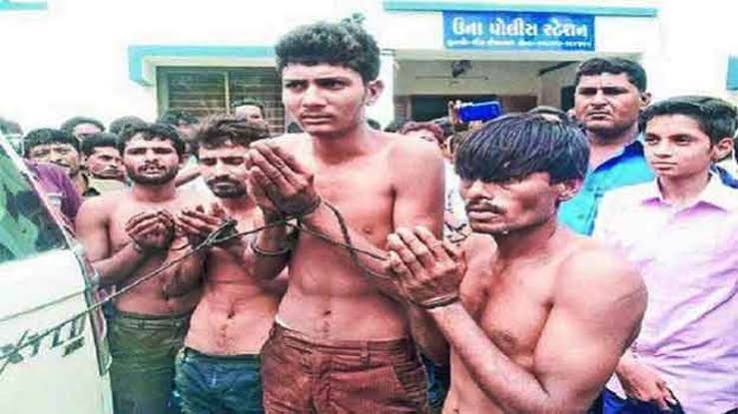
Odisha records a 10.8 per cent conviction rate for SC cases, while one Puri family says its trial is yet to begin eight years after the alleged attack Ashok Sethi, 48, and his family have been assaulted, ostracised and forced out of their native village in Odisha because of their Dalit identity. The family’s ordeal points to a deeper malaise that subjects members of the Scheduled Caste community to social and institutional discrimination, resulting in delayed justice and low conviction rates in caste-based violence. The conviction rate in cases registered under the SC/ST (Prevention of Atrocities) Act hovers at 34 per cent, much below the overall conviction rate of 53 per cent in criminal cases. Sethi, who hails from Nuagaon village under the Satapada gram panchayat in Puri district, said the majority of the 150 families residing there belonged to general and OBC categories. Sethi’s family used to wash villagers’ clothes and got around 10kg of paddy per year from each family as part of a barter system prevalent in the village. In 2000, Sethi’s family demanded payment in cash instead of kind, which the villagers refused. A penalty was imposed on the family, and they were ostracised. “I got married in 2000. The villagers did not allow us to put up a marquee in the village for the wedding because we did not agree to work under the barter system. They said it was below their dignity to walk under the canopy as we are Dalits. My sister’s marriage could not be held in the village in 2007,” Sethi, who now lives in Kathuaredi village under Brahmagiri block, around 26km away, told The Telegraph. In 2017, some villagers cut down trees from a plot of land belonging to Sethi’s family. The situation worsened in July next year when the villagers attacked the family, took away their cows and belongings, injured female members and destroyed their house. The family had no option but to move out. They stayed at a cyclone shelter near Chhotapur village, about 20km from Nuagaon, before shifting to Kathuaredi. On Sethi’s complaint, an FIR was registered at Brahmagiri police station under the SC/ST Act for caste-based violence. Sethi said the FIR did not mention Section 307 of the IPC (attempt to murder), although the family had specified it in their written complaint. “The discrimination was not limited to the villagers. We faced institutional bias from the police. The seven accused were arrested and granted bail within 10 days. Most importantly, the trial has not started even though eight years have passed,” Sethi said. “We have not visited our village since 2018. The villagers have taken over our land. We are living on rent at Kathuaredi,” he said. Baghambar Patnaik, a human rights activist, has filed a case with the Odisha Human Rights Commission seeking a direction to the police to expedite adjudication of the case and rehabilitation of the victims. A public interest litigation was filed in Orissa High Court, which in 2020 directed the rehabilitation of the family in Nuagaon village. Patnaik said the state government would have to recover the family’s land from the villagers and build a house for them before they could return. “They are unable to go back because the government machinery is not taking any steps to recover the land and construct a house. It shows that the government is not sincere about delivering justice to the victims,” Patnaik said. Rashmita Samantaray, the sarpanch of the Satapada panchayat, declined to comment on the issue. “I do not know much about this case,” she said. Last month, Congress Rajya Sabha member Chandrakant Damodar Handore sought information about the number of cases pending investigation under the SC/ST Act and the conviction rate. In a written reply on July 22, minister of state for social justice Ramdas Athawale furnished data, which showed that the national conviction rate stood at a mere 33.9 per cent for SCs in 2024. In Odisha, the conviction rate was 10.8 per cent. “The responsibility of maintaining law and order, investigation, protection of life and property of the citizens, including crime against members of SC and ST communities, rest with the respective state governments,” Athawale had said. CM on Ravidas, Phule Haryana chief minister Nayab Singh Saini on Sunday said Guru Ravidas envisioned a society with no place for any form of discrimination, fear or injustice while Dr B.R. Ambedkar considered education the most powerful tool for social transformation. Saini spoke about how Jyotiba Phule and Savitribai Phule challenged social orthodoxies, opened the doors of education for all, and made historic contributions, especially towards women’s education. Ambedkar regarded education as the most powerful instrument of social transformation and fought for the rights of deprived sections and equal opportunities, he said. Basant Kumar Mohanty Courtesy : The Telegraph Note: This news is originally published on https:/thetelegraph.com/bha and is used purely for non-profit/non-commercial purposes, especially human rights
22-year-old Dalit man shot dead, friend injured in Roorkee

Roorkee: A 22-year-old Dalit man was shot dead and his friend injured after two unidentified bike-borne assailants opened fire at them in Dhandera, Roorkee, late Friday night, police said. The victim, Aman Kumar, a liquor canteen operator and Dhandera resident, was returning home with his friend Prashant after closing the canteen when the assailants intercepted them and opened fire. Aman sustained a bullet injury to his abdomen and collapsed on the road, while Prashant was shot in the foot. The assailants fled the spot on their motorcycle immediately after the shooting, which took place around 11:30pm. Hearing the gunshots, residents rushed to the spot and alerted police. The two men were taken to a hospital, where doctors declared Aman dead. Prashant was admitted for treatment and is stated to be out of danger. Aman’s father lodged a complaint against the unidentified assailants, following which police registered a case under BNS section 103 (murder). “Aman belonged to a Dalit family in our locality. His father runs a small motorcycle repair shop in Roorkee. Aman and his family were known to be very decent and peaceful people,” said Anil Pundir, a Dhandera resident. Police teams are examining CCTV footage from the area and questioning people who may have witnessed the incident. Preliminary investigation suggests that the killing could be linked to an old enmity stemming from a possible love angle, though police said the exact motive was yet to be established. “We have questioned several people in connection with the case and efforts are underway to identify the attackers. We will crack the case soon,” said SP (rural) Shekhar Chandra Suyal. Courtesy : TOI Note: This news is originally published on https:/timesofindia.com/bha and is used purely for non-profit/non-commercial purposes, especially human rights
The inherited burden in Dalitality
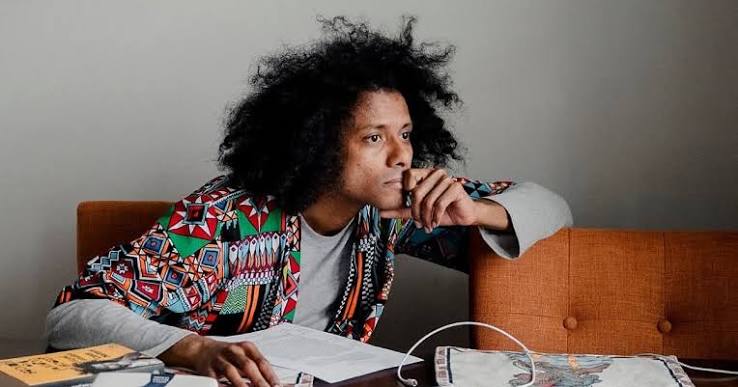
In 1969, John Fogerty of Creedence Clearwater Revival wrote Fortunate Son as an indictment of inherited advantage: some are born protected, others are born exposed. “Some folks are born silver spoon in hand/ Lord, don’t they help themselves” Suraj Yengde’s Caste: A Global Story reasserts the same indictment, but with a different ethnographic ground and a wider comparative reach. Ranked inequality of a caste-like kind appears in many places, even if India’s version carries what Amartya Sen, in his foreword to the book, calls a “shameful uniqueness”. Yengde’s narrative follows that ranking system as it moves across oceans, archives, and generations. “It ain’t me, it ain’t me I ain’t no senator’s son/ It ain’t me, it ain’t me I ain’t no fortunate one” Readers of Yengde’s earlier Caste Matters will recognise the same auto-ethnographic impulse. That earlier book was driven by the lived experience of what he calls ‘Dalitality’ – a term he uses to name the accumulated weight on the being of those born into the lowest rung of the caste ladder. The new book keeps the personal current but then travels with it. The introduction and Chapter 1, ‘Colonial Dalitality’, examine how the British census and official reports first gave administrative shape to Dalit groups by recording their subjection, occupations, and socio-spiritual separateness. Yengde insists that Dalits were never merely passive subjects in these classifications; they also claimed, refused, or reworked the labels imposed upon them. Chapters 2 and 4 stage the book’s central claim: that caste is not a fixed Indian inheritance but a system of ranking that crosses borders and takes new forms. In Chapter 2, ‘Affairs of Letters: Dalit Responses to Black Literature’, Yengde shows that the conversation between Dalits and Black Americans did not begin with the Dalit Panthers or in the 1970s. Ambedkar himself was the first major Dalit thinker to engage African American experience systematically, notably in his reply to Lala Lajpat Rai’s comparison of untouchability and American slavery. Later, M N Wankhede, principal of Milind College and founder of the journal Asmita, became the central mediator, introducing Black literature to a generation of Marathi Dalit writers. Janardhan Waghmare, writing from rural Marathwada, pushed the comparison further, treating slave narratives as directly analogous to Dalit conditions and reading the American Dream against Malcolm X’s American nightmare. What Yengde captures well is both the depth of this one-directional literary solidarity and its limits: after the 1960s, the Black American side remained largely unaware of Dalit developments, language barriers slowed translation, and the relationship stayed more inspirational than reciprocal. The chapter is innovative precisely because it refuses easy romance; it documents a real intellectual genealogy while remaining honest about its asymmetries. “It ain’t me, it ain’t me I ain’t no millionaire’s son/ It ain’t me, it ain’t me I ain’t no fortunate one” Chapter 4, ‘The Dalit Republic of Diaspora: A Case Study of Trinidad’, is the book’s most vivid demonstration that caste does not simply dissolve when it crosses the ocean. Drawing on earlier ethnographers and his own fieldwork, Yengde shows that while many lower-caste indentured labourers arrived in Trinidad, hierarchy reasserted itself in new forms. Colin Clarke’s 1964 survey found that only a small fraction of Hindus still knew their caste by name, yet Brahmanical prestige had actually increased rather than faded. Outcastes were still marked – food served on a leaf instead of a plate, subtle exclusions at religious gatherings. Caste survived as a code of identity, prestige, ritual, and endogamy. It underwent what Yengde calls a kind of creolisation: mixed with other groups, reshaped across generations, and kept alive inside Hindu organisations such as the Sanatan Dharma Maha Sabha, where pandit superiority could still surface in the order of the food line. The chapter makes Yengde’s global claim concrete: caste moves, mutates, and finds new institutional homes rather than dissolving. The book concludes by returning to the author’s notes as archivist and activist. The result is a more ambitious book than Caste Matters. It demonstrates the same urgency of voice, but now, it’s stretched across a larger map. “Some folks inherit star-spangled eyes/ Ooh, they send you down to war/ And when you ask them, ‘How much should we give?’/ Ooh, they only answer, ‘More, more, more’” This song still cuts because the structure it named has not disappeared. Yengde’s book demonstrates this on a larger map. In the conclusion, he turns the question back onto the dominant castes themselves: it is we, more than the caste-oppressed, who need to confront the social and religious creeds that cannot tolerate human equality. Some are born protected by the system; others inherit its weight. Yengde, like Fogerty, asks who gets to remain the fortunate one, and at whose expense the protection is maintained. The writer, as Dr Jekyll, is a Professor of Philosophy, Politics and Law, author and editor of over 20 books and counting, and as Mr Hyde, one of India’s top-ranking Ironman triathletes. Aakash Singh Rathore (Disclaimer: The views expressed above are the author’s own. They do not necessarily reflect the views of DH). Courtesy : DH Note: This news is originally published on https:/deccanherald.com/bha and is used purely for non-profit/non-commercial purposes, especially human rights
Anti-Reservation Protest: What Is The Stand Of Dalit Leaders In NDA?
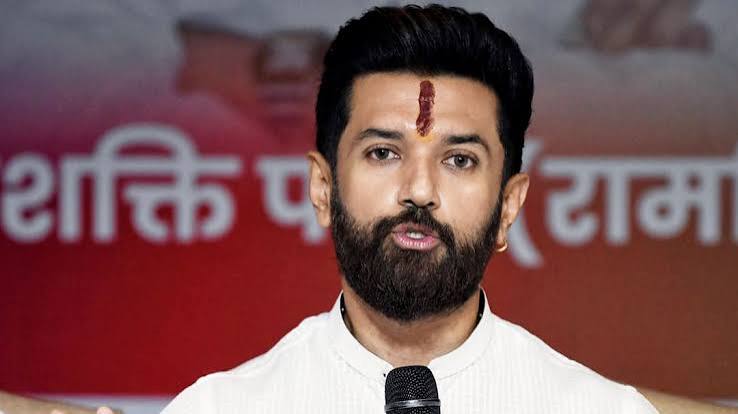
The protesters are demanding that economic criteria, rather than caste, should be given priority in determining eligibility for government assistance and reservation. Paswan said any misunderstanding over reservation could create resentment among a large section of the country’s population. Union Minister Chirag Paswan on Saturday said the government would engage with protesters opposing reservation if their demands were presented in a systematic manner. Union Minister Ramdas Athawale, meanwhile, said reservation is a constitutional right and termed the demand to abolish it unconstitutional. The protesters are demanding that economic criteria, rather than caste, should be given priority in determining eligibility for government assistance and reservation. Speaking to reporters in Patna, Paswan said any misunderstanding over reservation could create resentment among a large section of the country’s population. On the demand for reservation based on economic criteria, he pointed out that the NDA government has already implemented 10 per cent reservation for Economically Weaker Sections (EWS). What Paswan Said About Tejashwi Yadav Asked about RJD leader Tejashwi Yadav extending support to the students’ protest in Patna, Paswan said it was a good thing and was in line with his responsibility as the Leader of the Opposition in the Bihar Assembly. “It would have been better if Tejashwi Yadav had also been present during the proceedings of the House and raised these issues there,” he said. Paswan said that although belatedly, Yadav was fulfilling his responsibilities as the Leader of the Opposition, which was a positive development. He added that despite being part of the government, he had tried to act as a bridge to ensure that people’s voices reached the government and no one remained unheard. Athawale Says Reservation Cannot Be Abolished At a press conference on Saturday, Union Minister Ramdas Athawale said some people were demanding the abolition of reservation, while others were running social media campaigns calling for its removal. He said reservation could not be abolished as it is a constitutional right. Referring to the extension of reservation from Scheduled Castes (SCs) and Scheduled Tribes (STs) to Economically Weaker Sections (EWS), Athawale said there was no merit in demands to scrap the system as it benefits various groups in need. He noted that while untouchability has been prohibited under Article 17 of the Constitution, caste-based discrimination and atrocities against SC communities continue in rural India. “Our stand is very clear. Those who want to abolish reservation should first ensure that the caste system is abolished,” he said. Demand Over Bodh Gaya Temple Management Committee Athawale also demanded that the Bodh Gaya Temple Management Committee should have eight Buddhist trustees instead of the existing arrangement of four Hindus and four Buddhists, with the Gaya district magistrate serving as its ex-officio chairman. The committee functions under the Bodh Gaya Temple Act, 1949, which predates the Constitution of India. “We are not against Hindus or any other religious community, but our demand is that Buddhist places of worship should be managed by Buddhists themselves,” he said. Athawale said he had sought time from Bihar Chief Minister Samrat Choudhary to discuss the issue and would also meet the governor over the matter. Several Buddhist monks present at the press conference announced that they would observe a five-day hunger strike in Patna’s Gardanibagh area to press for their demands. Courtesy : ABP Live News Note: This news is originally published on https:/abplivenews.com/bha and is used purely for non-profit/non-commercial purposes, especially human rights
Four arrested in Rajasthan for lifting Dalits from chairs; villagers, angered by police action, have socially boycotted the victim families.
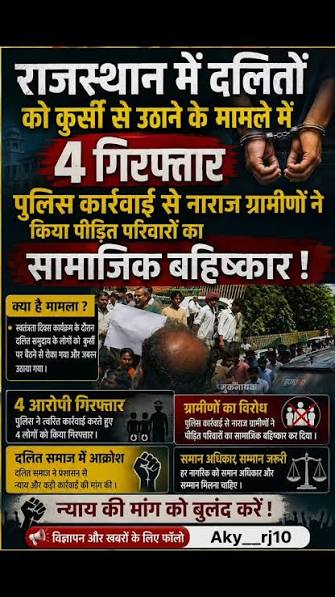
The community says that merely filing an FIR and arresting the accused is not enough. The administration also has a responsibility to ensure normal social interaction with the victim families in the village and prevent any kind of pressure or intimidation. Bhilwara: Police have arrested four of the five named accused in the case of allegedly lifting members of the Dalit community from chairs, using casteist slurs, and threatening them during Independence Day celebrations at a government school in Bhakliya village, Bhilwara. One accused, Narayan Jat, is still pending arrest. The case is being investigated under FIR number 131/2026 registered at the Bagor police station and is being investigated by Deputy Superintendent of Police Rahul Joshi. Meanwhile, the victim families have alleged that they are being socially boycotted and isolated in the village following the incident. The community claims that the families face the threat of potential attacks from the accused and their supporters. In response, a large number of people held a protest rally on Tuesday under the banner of the Dr. Ambedkar Memorial Welfare Society, Bhilwara district, and submitted a memorandum to the administration, demanding the arrest of the accused and protection of the victim families. Four accused arrested, search underway for one On August 15th, a case of alleged caste-based abuse against two Dalit community members, Rameshwarlal Bairwa and Gopilal Bairwa, surfaced during the Independence Day celebrations at the government school in Bhakalia village. Based on the victims’ complaint, the police named five individuals, including Balu Vaishnav, Hiralal Sharma, Narayan Jat, and Prakash Jat. Another named accused, Narayan, is still pending arrest. According to the community, the arrested accused are scheduled to appear in court around 4 pm on Wednesday. The community is also pressuring the police to expedite action to arrest the remaining accused. Police, led by Deputy Superintendent of Police Rahul Joshi, who is investigating the case, have moved forward with the investigation. Badrilal Bairwa, a young man who recorded the video of the incident, told The Mooknayak that the police have recorded the statements of the victims. A police team has also visited the scene and conducted an investigation, recording the statements of two witnesses, including his. Digital evidence of the mobile recording of the incident has also been provided to the police. According to Badrilal, the community is now pushing for the arrest of the remaining accused. The Mooknayak first reported on the incident on August 16th. Following the report, the victims’ families received widespread support from members of the Dalit and Bahujan communities. According to Badrilal Bairwa, a community meeting was held on Sunday evening after the news was published. The nearly two-hour meeting discussed whether the matter should be dismissed as a village dispute or whether legal action should be taken. Some elders at the meeting advocated for a village-level resolution. However, most community members expressed the view that silence would be inappropriate, given the years of alleged caste-based humiliation and discrimination. Following this, a decision was made to file a police complaint, and an FIR was registered late Sunday night. Even after the FIR was filed and the accused were arrested, the matter did not end there. On Tuesday, the community held a protest rally under the banner of the Dr. Ambedkar Memorial Welfare Society, Bhilwara district. A large number of community members participated in the rally. The protesters submitted a memorandum to the administration demanding the arrest of all named accused in the case, protection for the victim families, and an end to the alleged social boycott. The memorandum alleged social boycott of the victim families and demanded immediate intervention from the administration. The community alleged that the victim families were being isolated in the village following the incident. The memorandum also stated that the victim families feared a possible deadly attack by the accused and their supporters. The protesters’ key demands are: All accused named in FIR No. 131/2026 should be arrested and sent to judicial custody. Adequate police protection should be provided to the victim families in Bhakalia village immediately. The administration should take necessary steps to end the alleged social boycott of the victim families. Ensure prompt and fair action in the case. If strict action is not taken against the accused and the victim families are not provided security, the community will be forced to launch a democratic movement. The memorandum warns that if such a situation arises, the police and administration will be responsible. Sohanlal Regar, District President of Dr. Ambedkar Memorial Welfare Society, said that along with the arrest of the accused, the safety of the victim families should also be the primary responsibility of the administration. The community says that simply filing an FIR and arresting the accused is not enough. It is also the administration’s responsibility to ensure normal social interaction with the victim families in the village and prevent any form of pressure or intimidation. A dispute that began over a chair has now become a question of social justice. The dispute that began over two Dalit members sitting on chairs during the August 15th ceremony has now become a question of social equality, respect, and security. The Dalit community alleges that caste discrimination and untouchability have long existed in the village. They say that maintaining silence in such cases perpetuates this system of discrimination. The police investigation is progressing in this case. Statements from victims and witnesses have been recorded, and the scene has also been inspected. The actual circumstances of the case and the substantiation of the allegations will become clear after examining the available video recordings and other evidence. Currently, four named accused are in police custody, while one is still under arrest. The community’s next priority is ensuring the safety of the victim families and ending the alleged social boycott. Geetha Sunil Pillai Courtesy: Hindi News
Lucknow: Rapido lifts 100-year ban on Dalit cab driver, Ankit Kumar says, “The world bows down…”
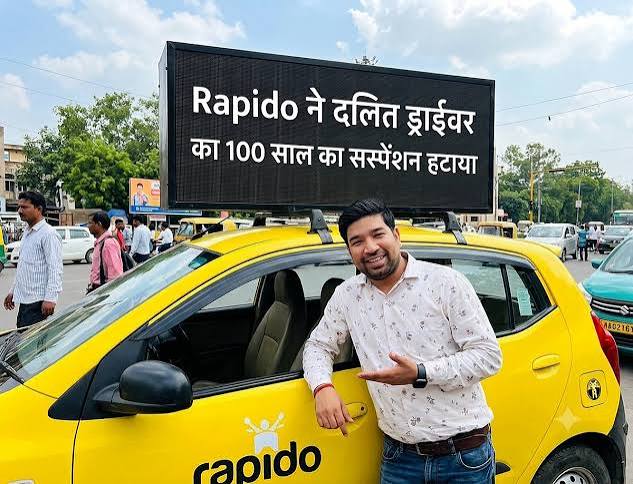
Ankit had allegedly reprimanded passengers in his cab for using casteist slurs against his officer. After the argument escalated, he stopped the cab near Telibagh Market and made all four of them get off. Following a complaint from passengers, his account was suspended for life. Lucknow – Ankit Kumar, a Dalit cab driver who was suspended from Rapido for nearly 100 years after protesting against caste-based insults in Lucknow, the capital of Uttar Pradesh, has now been reinstated by the company. Ankit released a video announcing this. Previously, his Rapido account showed a suspension of 99 years and 11 months, which was stated to last until July 19, 2026. This matter sparked a sharp reaction on social media. People associated with the Bahujan community and civil society organizations questioned Rapido’s action, and the #BoycottRapido campaign also trended on social media. Following this, reports emerged of increased pressure on the company’s decision. In this entire controversy, BSP National Coordinator Akash Anand also strongly supported Ankit. He questioned companies like Rapido, saying that they exhibit the same mentality that the Bahujan Samaj has long struggled against. The dispute began in the Telibagh area of Lucknow. 30-year-old Ankit Kumar had picked up four passengers from Uttarhatiya Railway Station and was headed to Charbagh Railway Station. According to Ankit, the four passengers were Indian Railways employees and were discussing a senior officer during the journey. Ankit alleges that the conversation gradually escalated into caste-based remarks, and the passengers began using derogatory and casteist slurs, linking the officer’s abilities to his caste. Ankit said that initially he did not intervene, but when the alleged caste-based remarks continued, he objected. Ankit reportedly told the passengers that if they questioned someone’s abilities, they should speak by name, and why was an entire caste being insulted. When the passengers allegedly refused to change their language, Ankit stopped the vehicle near Telibagh Market and asked the four to disembark. After disembarking, an argument broke out between Ankit and the passengers. People gathered at the scene. Ankit alleges that he was verbally abused. A video of the incident went viral on social media. What happened after the video went viral? After the video went viral, Ankit alleged that he began receiving abusive and threatening messages on social media. He said people were questioning why he dropped passengers off the vehicle. Meanwhile, following complaints from passengers, Rapido took action on Ankit’s driver account. The screenshot Ankit shared showed his account suspended for 99 years and 11 months, with the last date being July 19, 2026. The reason cited by the company was “abusive/double-meaning/use of abusive language.” Ankit claimed that the company didn’t even attempt to hear his side of the story before taking action. He said they should have at least asked him what happened. Ankit holds a diploma in mechanical engineering. He couldn’t find a government job commensurate with his qualifications, so he drives a cab to support his family. His father is a daily wage laborer and his mother is a homemaker. Therefore, a nearly 100-year suspension was like permanently closing his employment opportunities. For this reason, this case not only raised the issue of caste discrimination, but also sparked debate about the livelihoods of gig workers and the accountability of app-based companies. Legal experts have highlighted two distinct aspects of this matter. On the one hand, under the platform’s terms of service, the company has the right to take action against its driver upon any complaint. On the other hand, a suspension of nearly 100 years is extremely harsh and practically amounts to a permanent ban. Legal experts also questioned whether the driver’s side should have been heard before taking such drastic action. Unilateral action taken without notice or an opportunity for explanation could raise questions regarding the principles of natural justice. What did Akash Anand say? BSP National Coordinator Akash Anand gave a detailed response to this matter on August 17. He said that Ankit’s viral video raises serious questions about India’s social system. According to him, Ankit had only protested against the alleged casteist comments to protect his and his community’s dignity, but Rapido instead suspended his account for 99 years and 11 months. Akash Anand said: “Companies like Rapido suffer from the same mentality that we have been fighting to eradicate for a century.” Aakash Anand also said that Ankit’s suspension was tantamount to snatching away the livelihood of a person who stood up for his honor and the dignity of his community. He also linked this incident to the broader debate on reservation and social change. He stated that even nearly eight decades after independence, casteist mentality remains deeply rooted in society. According to him, reservation is not only a means of economic empowerment but also a means of social change. Aakash Anand also referred to RSS chief Mohan Bhagwat’s views on reservation and asked him to answer the questions of millions of Dalits like Ankit. He quoted Mayawati as saying that respect for the Constitution and the ideas of Babasaheb Dr. Bhimrao Ambedkar. Geetha Sunil Pillai Courtesy: Hindi News