
UP Elections 2027: BSP’s focus will be on employment and reservation
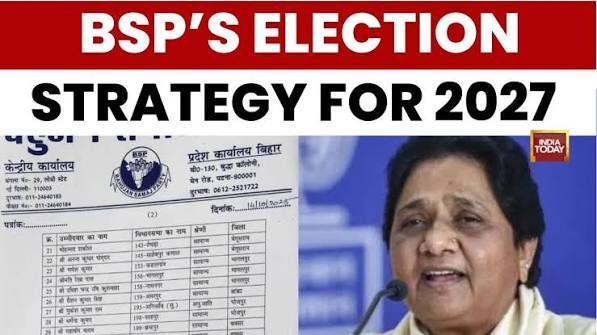
Ahead of the 2027 UP Assembly elections, the BSP has prepared to make Dalit self-respect, reservation, and employment its primary issues. Akash Anand is actively involved in the campaign to connect with the youth. Lucknow. In view of the 2027 Uttar Pradesh Assembly elections, the Bahujan Samaj Party (BSP) has intensified its political activities. The party is preparing to contest the elections by focusing on issues such as Dalit self-respect, reservation, and employment. Through this, the BSP aims to reunify its traditional Dalit voters and strengthen its hold among the youth. Akash Anand has been fielded for this purpose. The BSP’s strategy was launched by the party’s National Convenor, Akash Anand, with a workers’ conference held in Bulandshahr’s Anupshahr Assembly constituency. Starting October 28th, Akash Anand launched the party’s campaign with meetings in Bulandshahr. Issues of Dalit self-respect and reservation are being given prominence in the party’s strategy. Additionally, efforts are being made to engage youth by raising the issue of employment. The party is particularly targeting Gen-G (young voters). At the same time, efforts to engage Jat and Gurjar voters in western Uttar Pradesh are also part of the BSP’s strategy. Candidate Selection Based on Caste Equations The BSP is also considering caste-based factors when selecting candidates for the upcoming assembly elections. According to party sources, BSP chief Mayawati is reviewing the names of potential candidates for key constituencies and their winning prospects. Raj Kumar Courtesy: Hindi News
Even before independence and the formation of the Constitution, the Scindia dynasty began the upliftment of Dalits… with provisions for punishment for those who discriminated.
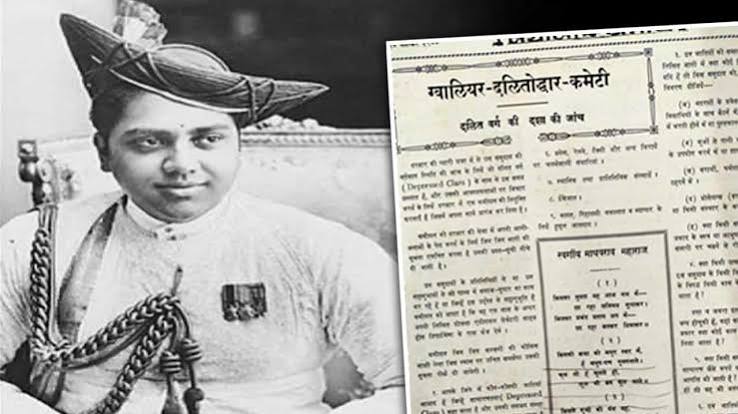
Before independence, the Scindia dynasty of Gwalior granted Dalits equal rights to temples, schools, wells, and public ghats. The 1945 order provided for action against those who discriminated. Before India’s independence and the formation of the Constitution, many princely states across the country undertook social reform initiatives that transcended their time and laid the foundation for equality and social justice. Among these, the Scindia dynasty of Gwalior’s contribution is particularly noteworthy. The Scindia dynasty not only took important decisions to free the Dalit community from social discrimination, but also took steps to ensure equal rights in education, entry to religious sites, and the use of public facilities. Dalits were granted equal access to temples, schools, wells, and public ghats, including the right to ride horses and palanquins, and to wear whatever clothing they desired. 11 schools and three free hostels were established for the education of tribal children, and special schemes were also launched for the upliftment of the Bhil and Bhilala communities. On May 4, 1945, the then Maharaja of Gwalior State, Jivajirao Madhavrao Scindia, issued a historic declaration explicitly recognizing the rights of the Dalit community. This declaration stated that those considered untouchables or Harijans in the then social system, like other citizens, were entitled to all the fundamental rights to which they were born. The significance of this decree is further enhanced because at that time, in many parts of the country, the Dalit community was denied basic social rights such as entry into temples, drawing water from public wells, studying in schools, and even riding a horse or palanquin. Equal rights from temples to schools, with penalties for discriminators Maharaja Jivajirao Scindia’s May 4, 1945, proclamation granted the Dalit community the freedom to wear clothing and jewelry, use modes of transportation of their choice, follow marriage customs, and access public spaces. The proclamation clarified that Dalits would be able to use wells, canals, river ghats, and state-run educational institutions. Furthermore, they were also granted the right to enter and worship in state-owned or state-managed temples, like other Hindus. The most significant aspect of this proclamation was that it provided for punitive action under existing state laws against those who obstructed the exercise of these rights. This meant that social equality was not limited to mere ideals or preaching, but rather an attempt was made to link it with administrative orders and legal action. 11 schools and three free hostels for the education of tribal children The contribution of the Scindia dynasty was not limited to Dalit upliftment. Significant efforts were also made for the education and social development of tribal communities. According to available historical records, by 1938, 11 schools and three free hostels operated for Bhil and Bhilala tribal children in the Gwalior State. In the Sheopur region, there were also schools and three free hostels for children from the Sahariya community. In addition to connecting tribal children to education, plans were also developed to teach them practical and employable skills. Initiatives were taken to train Bhil and Bhilala children in handicrafts and crafts that would improve their daily lives and livelihoods. Hostels were built for tribal children in Tanda and Bagh. A model school for tribal children was established on Pandav Gufa mountain in the Bagh area of Manawar Pargana under the supervision of the Forest Department. Scholarships were also provided to students. Furthermore, efforts were made to understand the problems of communities through tribal conferences and to establish a Panchayat system in villages. Formation of a Commission for Social Reform There is also historical mention of the formation of a commission to study the conditions of backward and disadvantaged communities in the Gwalior State. Its objective was to assess the actual circumstances, problems, and needs of these communities. The commission sought suggestions from representatives of the concerned communities and those involved in social reform work. They were invited to submit their written proposals to the Additional Secretary of the Home Department. This initiative demonstrates an effort to advance social reform at an institutional and administrative level, rather than solely through individual efforts. The Gaekwad Maharaja of Baroda assisted Baba Saheb Ambedkar in higher education. While discussing the social reforms of the Scindia dynasty, the contributions of other Maratha princely states are also noteworthy. Maharaja Sayajirao Gaekwad of Baroda provided significant support to social reform pioneers like Mahatma Jyotiba Phule and Dr. Bhimrao Ambedkar. On April 4, 1913, Maharaja Sayajirao Gaekwad and the young Bhimrao Ambedkar had a very close relationship. Ambedkar was provided financial assistance and scholarships for higher education. With this support, he pursued further studies at Columbia University in the United States. This support is an important example for understanding the importance of social justice and education in Indian history. The Legacy of the Maratha Princely States in the Advancement of Social Equality At various times, the princely states of Maratha rulers such as the Scindias of Gwalior, the Gaekwads of Baroda, and the Bhonsles of Kolhapur spearheaded efforts for social reform and the upliftment of marginalized communities. These initiatives must be viewed in the context of the prevailing social conditions, when caste discrimination was a significant challenge in Indian society. The 1945 declaration of the Gwalior princely state is particularly significant because it explicitly recognized the rights of Dalits in religious, educational, and public life. The provision of schools, hostels, and scholarships for tribal children also paved the way for social empowerment through education. The Indian Constitution later established equality, freedom, and social justice as the foundation of the country’s democratic structure. However, such initiatives undertaken in various princely states before independence bear witness to the growing awareness of social change even before the Constitution was enacted. This historical chapter of the Scindia dynasty not only chronicles the achievements of a dynasty, but also commemorates the efforts made during that period for social equality, education, and human dignity. Edited By: Varun Chauhan Courtesy: Scindia Research Centre
RIMS- Adilabad doctor, nurse, two constables booked for abetment of Dalit youngster’s suicide
A doctor, nurse and police constable were booked in Adilabad following the death by suicide of 26-year-old Rahul Kamble. His family alleged harassment and caste-based abuse, while a suicide note reportedly accused RIMS doctors and police of torture. Adilabad: A doctor, and nurse from RIMS and a constable were booked on charges of abetting a youngster from the town to die by suicide and abusing him using his caste name here on Thursday. Adilabad DSP L Jeevan Reddy said that a case was registered against Dr Sourabh, staff nurse Mamatha, II town head constable Fateh Singh under the Section 108 (abetment of suicide) of BNSS and relevant sections of the SC, ST Prevention of Atrocities Act, based on a complaint received from the father of Rahul Kamble (26) father on Thursday evening. Earlier in the morning on Thursday, Rahul died allegedly by suicide by hanging after feeling humiliated when he was allegedly reprimanded and harassed by doctors and police for video-recording negligence of staffers in providing treatment to him at RIMS on his mobile phone. He was admitted to RIMS after being bitten by a scorpion on Wednesday. A suicide note purportedly written by Rahul was recovered. In the suicide note, Rahul alleged that he was subjected to torture by police as per instructions of doctors from RIMS. Following his suicide, his family members and Dalit organizations staged a protest seeking justice and demanding action against the staffers and police at RIMS on Thursday. This protest prompted to register a case against those who allegedly drove the youngster to die by suicide. Courtesy : Telangana Today Note: This news is originally published on https:/telanganatoday.com/bha and is used purely for non-profit/non-commercial purposes, especially human rights
Coimbatore: CB-CID begins probe in Dalit student’s death
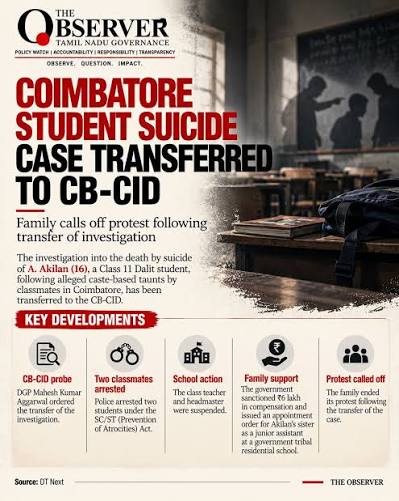
The Peelamedu police initially arrested two of his classmates under the SC/ST (Prevention of Atrocities) Act COIMBATORE: The CB-CID has commenced a probe into the death of A Akilan, a Dalit student who had ended his life over caste-based taunts from his classmates. The Peelamedu police initially arrested two of his classmates under the SC/ST (Prevention of Atrocities) Act. Akilan was in Class 11 at a government-aided school in Coimbatore. The class teacher and headmaster were suspended. The CB-CID registered a case and initiated a preliminary inquiry. A team led by SP Sri Devi questioned Akilan’s parents at their house regarding the circumstances of his death. The team also inspected the school and records of the Peelamedu police’s probe. The arrested students are likely to be questioned. Courtesy : DT Next Note: This news is originally published on https:/dtnext.com/bha and is used purely for non-profit/non-commercial purposes, especially human rights
Dalit Man Allegedly Killed by Wife’s Family in UP’s Muzaffarnagar Over Inter-Caste Marriage
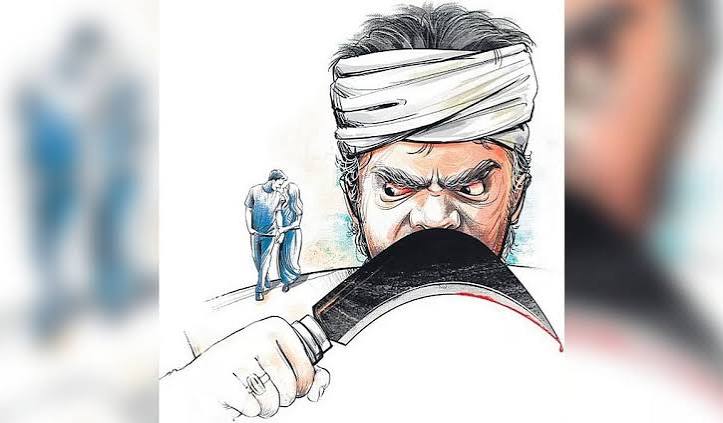
A 23-year-old Dalit man was allegedly beaten to death with bricks in Uttar Pradesh’s Muzaffarnagar, more than a year after he eloped with and married a woman against her family’s wishes. ExploreDiversity Akshay and his 20-year-old wife, Ridhima, had been living in Noida since their marriage. Akshay returned to Muzaffarnagar on Monday and was attacked that evening. He died in hospital on Tuesday. Police arrested two people on Wednesday in connection with the killing, including Ridhima’s elder brother, Vasu, said Dinesh Baghel, Station House Officer of Khatauli police station. Police suspect the murder was premeditated and are investigating whether several people were involved in planning the attack. Police Suspect Akshay’s Movements Were Shared With Attackers According to police, Akshay, a resident of Biharipur village, returned to Muzaffarnagar on Monday morning. Later that evening, he left home on his motorcycle with a man identified as Akash, telling his family that he was going to buy medicines. The two stopped at a shop on Jansath Road in the Khatauli area. Police said three masked men arrived on a motorcycle and confronted Akshay. One of them allegedly struck him with a brick, knocking him to the ground, before the attackers repeatedly hit him on the head with bricks. Akshay’s family alleged that he was left bleeding heavily as the assailants fled. Police suspect that Akash, who was with Akshay during the attack, shared information about his movements with the assailants. He is among those detained as investigators examine the circumstances leading up to the killing. Couple Had Moved to Noida After Marriage Akshay first met Ridhima while visiting his uncle, who lived in Sarai village, around six kilometres from his home. The two developed a relationship, but their families opposed it, according to the police account. About a year and a half ago, the couple eloped. Ridhima’s family subsequently filed a kidnapping complaint, police said. The couple later married in court and moved to Noida, where Akshay found work. A police officer said Ridhima’s family allegedly continued to resent Akshay despite the marriage and the couple’s move away from Muzaffarnagar. Courtesy : TOP Note: This news is originally published on https:/theobserverpost.com/bha and is used purely for non-profit/non-commercial purposes, especially human rights
A dead body on the road, a wooden pyre, and a six-hour traffic jam… Why did anger erupt after the death of a Dalit youth in Chhatarpur?
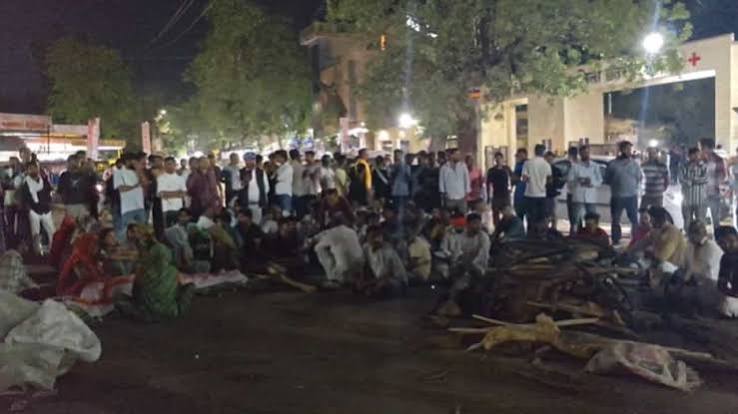
Following the death of a Dalit youth in Chhatarpur, his family members blocked the Tehsil intersection by placing his body there. The protesters created a pyre by placing wood on the road and demanded the arrest of the accused. Chhatarpur News: A massive uproar erupted in Naugaon town of Chhatarpur district after the death of a Dalit youth under suspicious circumstances. Angry family members and locals protested by placing his body at the Tehsil intersection on Wednesday evening. The protesters created a pyre by placing wood on the road and blocked the road. This disrupted traffic on the main road and caused long queues of vehicles on both sides. The traffic jam continued for more than six hours, causing inconvenience to the public. The family members of the deceased have accused some people of beating him and forcibly administering a poisonous substance to him. They demand that the accused be immediately arrested and a murder case be registered against them. There was a dispute over wages. The deceased has been identified as Dharampal Ahirwar. He was a resident of Naya Mohalla, Ward No. 18, Naugaon, and worked as a laborer in the local vegetable market. His wife, Usha Ahirwar, stated in a police complaint that a dispute arose on October 22, 2026, over wages. According to the complaint, when Dharampal asked Jitu, alias Jitendra Sahu, and his parents for his wages, they refused. It is alleged that Dharampal was subsequently assaulted with sticks and rods, sustaining serious injuries. Dharampal then went to the Naugaon police station and filed a complaint against the accused for assault. Allegations of Pressure to Withdraw the Case According to family members, after the assault case was filed, the accused party was pressuring Dharampal to reach a compromise. On October 27, Dharampal was called to a shop under the pretext of a discussion. There, he was asked to withdraw the case. The family claims that Dharampal refused to withdraw the case. He was then again abused and beaten. It is alleged that he was forcibly administered a poisonous substance during this time. Death during hospital treatment After being administered the poisonous substance, Dharampal’s health deteriorated. He was taken to the Naugaon Community Health Center in critical condition. Doctors there, finding his condition critical, referred him to the Chhatarpur District Hospital. Dharampal died while undergoing treatment at the district hospital on the night of October 27th. Upon receiving the news of his death, the family was plunged into mourning. Upon the arrival of his body in Naugaon, anger spread among the family and local residents. They launched a protest demanding strict action against the accused. Blockade at Tehsil Square On Wednesday evening, family members, residents of the neighborhood, and other members of the community arrived at the Tehsil Square with Dharampal’s body. They placed the body in the middle of the road and protested. The angry people also built a pyre by placing wood on the road. The protesters demanded the immediate arrest of the main accused, Jeetu Sahu, and his associates and the registration of a murder case. The traffic jam disrupted traffic on the Jhansi-Khajuraho route and other connecting roads. Long queues of vehicles caused significant inconvenience to pedestrians and other travelers. Given the seriousness of the situation, Naugaon police station and additional police force were deployed to the scene. Administrative and police officials continuously engaged with the protesting family members, attempting to pacify them. Officials assured a fair investigation and action based on available evidence. Further legal action was stated to be taken based on the post-mortem report and investigation findings. However, the family members remained adamant on their demand for immediate arrest and the registration of a murder case. Pawan Bidua | Edited By: Ashish Kumar Mishra | Pawan Bidua’s journalistic journey began in 2018 with V News Cable Network in Chhatarpur. He subsequently held consecutive positions as a district bureau chief for India News National and MP-CG. He covered the sensitive and risky reporting of the COVID period on the ground. Pawan Bidua completed his B.J.M.C. from Dr. Harisingh Gour University and his LLB from Pt. Motilal Nehru Law College. Courtesy: Hindi News
Man sentenced to life imprisonment for raping Dalit minor in Barabanki

Lucknow: A special Pocso court in Barabanki sentenced a man to life imprisonment for raping a 13-year-old Dalit girl who later became pregnant. The judgment was delivered on Wednesday, nearly five years and 11 months after the case was registered. Special Judge Pran Vijay Singh convicted Lallu alias Wasim, also imposing a fine of Rs 60,000 and directing that the full amount be paid to the survivor. According to the prosecution, the girl’s mother, a resident of a village under Asandra police station limits, filed a complaint on Nov 18, 2020. She alleged the assault occurred around 10 months earlier when her daughter had gone out to graze goats. The accused, a resident of the same village, allegedly raped the minor and threatened her into silence, preventing disclosure to family members. The case surfaced after the girl became pregnant. The prosecution said the accused later gave her medication to terminate the pregnancy. Her health reportedly worsened at home, after which the family came to know about the alleged assault. Police investigated the complaint and filed a charge sheetunder relevant provisions of the Protection of Children from Sexual Offences (Pocso) Act and the Scheduled Castes and Scheduled Tribes (Prevention of Atrocities) Act. During trial, the court recorded the victim’s statement and heard testimony from seven prosecution witnesses. After hearing both sides and examining evidence, the court held the accused guilty and ordered life imprisonment along with the compensation fine forame to the survivor. Courtesy : TOI Note: This news is originally published on https:/timesofindia.com/bha and is used purely for non-profit/non-commercial purposes, especially human rights
On Dalit representation, joy, and lived experiences: ‘My Joy’ author Shreeja

Shreeja Rao’s ‘My Joy’ is an invitation into a colourful world through the lens of a Dalit child who finds joy in the little moments of her life Narrating her story in first person, a little girl belonging to the Dalit community talks about the joy she feels when she sees her mother dress in blue, when she relishes bhakri and amti, when her ajji tells her a story. There is also a sense of pride both in her own dreams of becoming the first lawyer in her family and in learning that someone like her is soaring in the Olympics and in academics. She also touches upon the grief of lost lives from the community due to systemic inequality. And, despite the nasty remarks thrown at her, of being too loud and not good enough, the little girl goes on to live her life to the fullest. “…Because anti-caste resistance is in my defiance. It is in my smile, in my laugh. It is in my world-changing joy,” the author Shreeja Rao, who tells the child’s stories, writes. In the picture book for young readers — My Joy, illustrated by Shrujana N Shridhar — Shreeja ensures that each leaf reflects the reality of Dalit lives. With mostly happy accounts emanating from the smallest things in life, the author reminds us to correct the myopic understanding of the community, because for years, we have only been exposed to a fragment of the community’s experiences — oppression, pain, struggles. Perhaps, what is forgotten is seeing every shade of their lives with equal attention. This book, as the author asserts, is for every child who looks for themselves in books.Excerpts from a conversation with Shreeja Rao: How does My Joy subvert how the experiences of the Dalit community are represented, and how does it become a strong symbol of resistance? All literature, old or new, depicts Dalit communities in endless pain. While it is vital to show the consequences of inequality, I wrote My Joy to celebrate the full humanity of Dalit children. The book refutes the popular notion that Dalit people are mere vessels of suffering. It is about a Dalit child’s identity and assertion. This assertion, whether quiet or loud, is joyful. In the book — the Preamble, the books, and the colour blue — are all symbolic. Do you want young readers to understand the individual symbols of the community and historical movements? The flags, the Preamble, and the writers in the book are all from my childhood. Many Dalit children grow up seeing these symbols in their homes and at family occasions. Rather than teaching children something new, My Joy invites them to relate to their own lives. It also shows them the importance and value of our history. How do you think books like these can help avoid the gaze of pity and sympathy, and make a strong statement that one can experience joy and pride irrespective of what their identity is? As a journalist, I know all too well that rampant inequality and violence invite a gaze of pity for our community in the headlines. However, books like My Joy must exist to show children that their identity is not limited to suffering or stories of suffering. This book helps children take the autonomy and freedom to experience joy without anyone else’s permission. You specifically mentioned some books and writers in the book. Could you tell how they influence the way you view the world? As a child, my grandmothers and aunts told me bedtime stories about how Savitribai Phule brought accessible education to India. She faced stones, dung, and violent attacks to stand for equality. She introduced me to this radical act of assertion. Alongside figures in the book like Mukta Salve, the women from my life taught me to fight inequality while embracing my own life. You have celebrated small wins and little joys — coming first in an elocution competition, raising a hand in the classroom, warm hugs — in this book. How important is it to tell children to find joy in the smallest wins and moments in life, and most importantly, that they deserve to experience joy? The distinction between “small” or “big” moments of joy is something we perform as adults. However, raising my hand in the classroom or winning a competition was not a small moment for me. These are the big moments that shape a child’s life. Joy is not a privilege to deserve; it is a human emotion that you experience simply by being you. It is important to tell children that they are special in their own way, and human like everyone else. Representation matters, and it is important to read and learn stories with which readers can relate. How do you see this lack of relatable literature for readers? In my childhood, the flags, symbols, and writers in this book were never on any pages. They came from celebrating Ambedkar Jayanti at home and the stories my grandmothers and aunts told me. “Representation” feels like an ill-fitting word for the culture and history of a quarter of the population. When children experience something in their community, they deserve to read about it. Culture evolves when young readers can stitch parts of their lives with the books they read. That is how they become who they are. Anusree PV Courtesy : TNIE Note: This news is originally published on https:/thenewindianexpress.com/bha and is used purely for non-profit/non-commercial purposes, especially human rights
A New Faith Cannot Guarantee Equality – OpEd
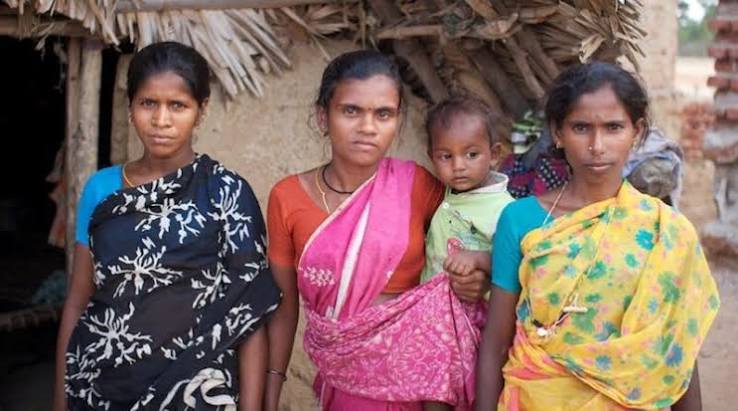
Tamil Nadu’s April 2023 Assembly resolution seeking Scheduled Caste protections for Dalit Christians did not alter eligibility, as only Parliament can amend the existing restriction and a state cannot unilaterally set it aside. Effective progress requires a sustained legal and legislative strategy rather than repeated political declarations that leave the statutory barrier unchanged. The Church’s role is to surface neglected experiences, insist on reliable evidence and practice the equality it seeks from the state, while distinguishing religious freedom to change faith from the persistence of caste-based burdens that a new religious identity does not automatically erase. (UCA News) — A baptism can mark a new beginning. It cannot make neighbors forget a family’s caste or guarantee children the opportunities denied to their parents. That distance between religious belonging and social acceptance lies at the heart of India’s latest controversy over affirmative action. For the Church, the question reaches beyond whether Christians qualify for particular benefits. It concerns how a society committed to equality should respond when inherited disadvantage survives a change of faith. The immediate dispute concerns Tamil Nadu, a southern Indian state, and its reservation category for specified disadvantaged Muslim communities. India’s reservation system sets aside places in education and public employment for designated disadvantaged groups. The Supreme Court held that conversion to Islam, together with a person’s previous caste status, does not automatically establish membership of a notified Muslim backward community. That distinction matters. A ruling on eligibility within a particular classification should not be mistaken for evidence that conversion eliminates social disadvantage. Nor does the judgment mean that Christians and Muslims are excluded from every reservation category. A persuasive response must address the legal distinctions accurately while asking whether the existing framework adequately serves the people it is meant to protect. The court also reiterated a restriction with direct consequences for Christians. Paragraph 3 of the Constitution (Scheduled Castes) Order, 1950 confines Scheduled Caste recognition to people professing Hinduism, Sikhism or Buddhism. Scheduled Castes, or SCs, are communities officially recognized as having suffered historic caste exclusion, including untouchability. Many people from these backgrounds identify as Dalits. Christians and Muslims remain outside this category, regardless of their ancestral caste. This boundary has a history, and that history shows it can change. The 1950 presidential order drew substantially on a colonial classification that excluded Indian Christians. It generally limited recognition to Hindus, with a narrow exception for specified Sikh communities. Parliament widened Sikh eligibility in 1956 and included Buddhists in 1990. These changes did not make every Sikh or Buddhist eligible. They removed religious barriers for otherwise qualifying members of listed communities. The question, then, is not whether every convert should automatically receive a reservation benefit. Governments need evidence, defensible classifications and safeguards against misuse. Existing beneficiaries deserve protection from arbitrary decisions. But a religion’s teaching about equality cannot substitute for examining its followers’ circumstances. Christianity’s affirmation of equal dignity does not demonstrate that a Christian family has escaped caste prejudice. The same distinction applies to Muslims. Religious ideals and social realities are not interchangeable. The Church should pay particular attention to the evidentiary question. In 1985, the Supreme Court dismissed a challenge brought by Soosai, a Christian cobbler from a Scheduled Caste background in Tamil Nadu. The court did not establish that caste necessarily disappears after conversion. It found insufficient evidence of comparable continuing disabilities to sustain the constitutional challenge. An unsuccessful petition was not proof that discrimination had ended. There is a practical lesson here. Advocacy needs more than declarations of solidarity. Church institutions should support rigorous research, accessible legal assistance and careful documentation of exclusion. Dalit Christians must help determine what is studied, whose experiences are recorded, and which remedies are sought. They should not be invited merely to endorse arguments prepared on their behalf. Their knowledge is essential to getting those arguments right. That work must begin close to home. The Church cannot credibly argue that caste survives conversion while dismissing questions about caste within Christian institutions as inconvenient or divisive. Parishes, schools, religious communities and leadership bodies should examine who receives opportunities, who exercises authority and who remains unheard. A defense of equality becomes convincing when it includes a willingness to listen, admit failure and change. Christian solidarity must also reach beyond Christians. The immediate Tamil Nadu dispute concerns Muslims, making it a test of whether the Church’s concern rests on principle or institutional interest. Supporting fair assessment does not require endorsing every application or promising automatic eligibility. It means insisting that disadvantage be examined rather than assumed away. Justice requires scrutiny, not shortcuts, and concern for people who do not share our faith. Tamil Nadu should carefully assess grounds for judicial review while renewing the legislative effort concerning Dalit Christians. In April 2023, its Assembly adopted a resolution seeking Scheduled Caste protections and benefits for them. That expression of support did not change eligibility. Parliament can amend the existing restriction; a state government cannot simply set it aside. Political promises need a sustained legal and legislative strategy, not another cycle of declarations. The Church’s task is neither to denounce courts nor to defend its members alone. It is to bring neglected experiences into public view; insist on reliable evidence and practice the equality it asks the state to uphold. Religious freedom protects the right to change one’s faith. Social justice asks what burdens remain afterwards. The law must distinguish between categories, but public debate must not lose sight of people. A new religious identity should not be mistaken for proof that an old injustice has ended. By Dr. Fr. John Singarayar The views expressed in this article are those of the author and do not necessarily reflect the official editorial position of UCA News. About Dr. Fr. John Singarayar, SVD, is a member of the Society of the Divine Word, India Mumbai Province, and holds a doctorate in Anthropology. He is the author of seven books and a regular contributor to academic conferences and scholarly publications in the fields of sociology, anthropology,
Life imprisonment for raping a Dalit girl

Barabanki. The special POCSO court on Tuesday concluded its hearing in the rape case of a Dalit girl in the Asandra area and sentenced the accused to life imprisonment. A fine of ₹60,000 was also imposed. This entire amount will be given to the victim. According to the prosecution, a woman from a village in Asandra filed a report on November 18, 2020, stating that about 10 months ago, her 13-year-old daughter had gone to graze goats when she was raped by Lallu, also known as Wasim, from the same village. The accused threatened the girl so much that she did not even tell her family. When the girl became pregnant, Lallu administered an abortion medication. The incident came to light after the girl’s condition deteriorated at home. The investigating officer filed a charge sheet against Lallu in court under the POCSO Act and the SC/ST Act. The girl’s statement was recorded during the hearing. The prosecution presented seven witnesses in this case. After hearing arguments from both sides, Special Judge Pran Vijay Singh sentenced Lallu alias Wasim. Courtesy: Hindi News