
Allahabad High Court refuses to allow hijab in schools, says uniform rules must be followed

The petitioner argued that wearing a hijab was linked to her religious belief. Wearing it granted her fundamental rights such as privacy, personal liberty, and freedom of speech. LUCKNOW: The Allahabad High Court, on Monday, refused to allow students to wear hijab in schools. The court said that following the school uniform rules was mandatory as it helped promote a sense of equality among children and also gave the school its own identity. The High Court said uniforms helped maintain an environment free from religious discrimination. Therefore, no student could insist on changing the dress code prescribed by the school. “Permission to wear a hijab on an individual basis cannot be granted. This would be against the very concept of a uniform. It would shift the authority to determine school discipline from the institution to individual students,” observed the court. A division bench, comprising Justice JJ Munir and Justice Inderjeet Singh, made those remarks while dismissing the petition of a minor student, Sukaina Rizvi, who had sought permission to attend classes wearing a hijab along with the school’s prescribed dress code. Petitioner Sukaina Rizvi is an 11th-grade student at Tagore Public School in Attarsuiya, Prayagraj. She filed a petition in the High Court through her mother. The student argued that she had been attending school wearing a hijab from classes 6 to 10, and no objections were ever raised. The student also attached her old identity card and a group photo from the school with the petition. The student stated that she now wanted to attend school in the 11th grade wearing a hijab, but was not being granted permission. “We also complained to the DM, upon which the District Inspector of Schools (DIOS) sought a report. The school principal clarified that this is an educational institution where there is a uniform dress code for all students. Granting a special exemption to one student would disrupt the school’s system,” the petitioner told the court. The petitioner argued that wearing a hijab was linked to her religious belief. Wearing it granted her fundamental rights such as privacy, personal liberty, and freedom of speech. In such a situation, the school should be directed not to stop her from wearing a hijab. The court said: “Only the school administration has the complete right to decide the dress code.” The court stated that as long as the school’s dress code for all children was framed with the right intent and did not discriminate against anyone, the school administration had the absolute right to decide what the dress would be. The bench added that even if the school had previously allowed the scarf (hijab), it did not mean that it had become a permanent right of the students forever. The school administration was free to change its rules. It was not compelled to continue with old exemptions, observed the bench. The court stated: “Wearing hijab is not an essential part of the Islamic religion. Wherever this issue has been raised, the High Court’s opinion has been consistent that wearing a headscarf (hijab) for women is not an essential part of the Islamic religion.” It is not as if the religion would be in danger without it, or that a woman would be excluded from the religion if she did not wear it. No facts or evidence had been presented to prove this either, said the court. In its verdict, the Allahabad High Court referred to an old judgment of the Kerala, Bombay, and Karnataka High Courts. In the case of ‘Fatima Tasneem vs State of Kerala’, the court had stated that while on the one hand, a student had the right to wear clothes of their choice, on the other hand, a school or institution had the right to enforce its own rules and regulations. It added that when there was a conflict or dispute between these two rights, the larger interest and discipline of the institution would be given more importance than individual preference. The court stated that the school was not imposing any restrictions on the student’s faith, but was merely expecting adherence to institutional discipline and uniforms. Following this, the court dismissed the petition. Namita Bajpai Courtesy : TNIE Note: This news is originally published on https:/thenewindianexpress.com/bha and is used purely for non-profit/non-commercial purposes, especially human rights
Transgender Police Trainee Found Hanging In Bathroom In Bihar

The victim, identified as Avanthika Sindhu, was a resident of West Champaran district. She was among a batch of 500 trainees sent from Patna Police Lines to Jamalpur for training. Transgender Police Trainee Found Hanging In Bathroom In BiharThe body has been sent for postmortem examination.Munger: A transgender woman constable undergoing police training in Bihar’s Munger district was found hanging in a bathroom on Sunday, prompting an investigation into the circumstances surrounding her death. The constable, Avanthika Sindhu, had reportedly been unwell for the past few days and was alone in the barracks when the incident occurred. Sindhu was a resident of West Champaran district. She was among a batch of 500 trainees sent from Patna Police Lines to Jamalpur for training. The batch includes 16 transgender personnel. The incident took place at the BSAP-9 camp in Jamalpur. According to colleagues, Avanthika had been unwell for the past few days and had not been taking part in training activities. On Sunday, the entire batch had gone to the training ground, while Avanthika remained in the barracks due to her poor health. When fellow trainees returned in the evening and began looking for her, they found her hanging in the bathroom. She was immediately taken to a primary health centre, where she was declared dead. Mithilesh Kumar, Commandant, BSAP Camp told the reporters, “It appears to be a case of suicide. The woman was found in the bathroom with a cloth towel tied around her neck.” Soon after receiving information about the incident, BSAP-9 Commandant Mithilesh Kumar, DSP Dr Arjun Kumar Gupta and Jamalpur Station House Officer Pankaj Kumar Paswan reached the camp and began an inquiry. Officials also questioned personnel staying in the barracks. Police are probing the case from multiple angles, including the circumstances inside the camp and the constable’s health condition. Investigators are also examining her personal life and external contacts to determine if any other factors may have contributed to her death. According to police sources, her mobile phone and personal contacts are also being subjected to technical examination to determine whether any pressure, dispute or other factor may have been involved. However, police said no conclusions can be drawn until the investigation is completed. The body has been sent for postmortem examination. Commandant Mithilesh Kumar said the constable’s family had been informed about the incident. Station House Officer Pankaj Kumar Paswan said the exact cause of death would be known only after the postmortem report and technical investigation are completed. Edited by: Anwesha Singh Courtesy : NDTV Note: This news is originally published on https:/ndtv.com/bha and is used purely for non-profit/non-commercial purposes, especially human rights
Rajasthan High Court questions police as probe into attack on Dalit family changes hands six times

High Court seeks affidavits from investigating officers and supervisory committee over delay in probe into alleged land encroachment and attack on Dalit family The police investigation into a case of alleged land encroachment and attack on a Dalit family in Rajasthan’s Bharatpur district changed hands six times in the last two years, prompting the High Court to intervene. There was also a complete absence of supervisory review of the pending probe. The victim, Jitendra Kumar, 24, a resident of Bharatpur’s Bayana block, moved the High Court seeking a fair investigation, completion of the probe and filing of a chargesheet in the case. The first information report (FIR) was registered on May 10, 2024, following an attack on Mr. Kumar and his family members. The “politically influential” people who allegedly attacked the Dalit family in Kair village in a bid to encroach upon its agricultural land also registered an FIR against the victims. Though the police found the counter-case to be frivolous, the original case has been probed by as many as six investigating officers without any conclusion. “Despite the lapse of 26 months and a provision in the Scheduled Castes/Scheduled Tribes (Prevention of Atrocities) Act, 1989, for completion of probe in 60 days, the police have failed to act,” Mr. Kumar said in his writ petition. The investigating officers included a Circle Officer and five Additional Superintendents of Police, including one serving in the civil rights cell. The offences for which 12 accused belonging to the Gujjar community were booked under the Indian Penal Code and the SC/ST (PoA) Act included rioting, attempt to commit culpable homicide, causing grievous hurt, unlawful assembly, criminal trespass and criminal intimidation. The present investigating officer, Dinesh Kumar Meena, stated in the High Court that the offences against the accused had been proved and the result of the probe would be submitted in the trial court within two weeks. Justice Shubha Mehta at the High Court’s Jaipur Bench observed earlier this week that the failure to complete the investigation in time was “concerning” and no satisfactory reason had been given for the delay. The petitioner also stated that calling him to join the probe every time after the change of hands amounted to his harassment. The court directed the Public Prosecutor to obtain affidavits from all investigating officers named in the factual report, “explaining why the probe was not completed in 60 days and reasons for the subsequent delay”. Similar affidavits were also sought from the officers forming the supervisory committee under Rule 7(3) of the SC/ST (PoA) Act. Welcoming the High Court’s order, the Centre for Dalit Rights (CDR) said here on Sunday (August 23, 2026) that the investigation could have been completed and the accused arrested if the authorities had complied with the statutory review mechanism. The matter will come up in the court for further hearing on September 7. The members of the supervisory committee include the Home Secretary, Director General of Police, Social Justice & Empowerment Secretary, and Director of Prosecution. CDR Director Satish Kumar said though the committee was required to review pending cases under the SC/ST (PoA) Act once every quarter, the meetings were not held regularly and no relief was granted to Dalit victims. The Hindu Bureau Courtesy : The Hindu Note: This news is originally published on https:/thehindu.com/bha and is used purely for non-profit/non-commercial purposes, especially human rights
Dalit violence cases face bias wall as conviction rate remains low under SC/ST Act
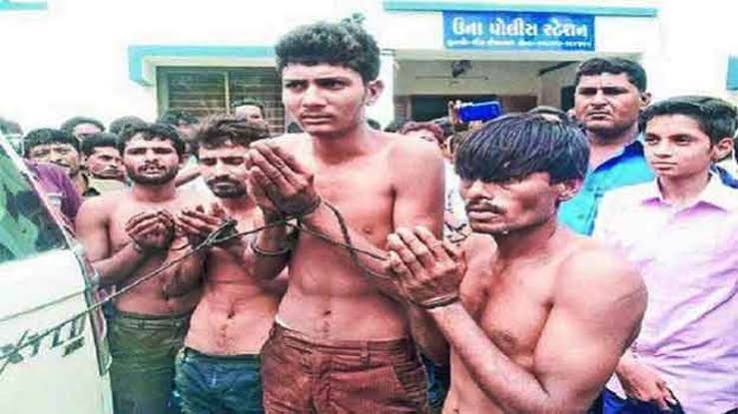
Odisha records a 10.8 per cent conviction rate for SC cases, while one Puri family says its trial is yet to begin eight years after the alleged attack Ashok Sethi, 48, and his family have been assaulted, ostracised and forced out of their native village in Odisha because of their Dalit identity. The family’s ordeal points to a deeper malaise that subjects members of the Scheduled Caste community to social and institutional discrimination, resulting in delayed justice and low conviction rates in caste-based violence. The conviction rate in cases registered under the SC/ST (Prevention of Atrocities) Act hovers at 34 per cent, much below the overall conviction rate of 53 per cent in criminal cases. Sethi, who hails from Nuagaon village under the Satapada gram panchayat in Puri district, said the majority of the 150 families residing there belonged to general and OBC categories. Sethi’s family used to wash villagers’ clothes and got around 10kg of paddy per year from each family as part of a barter system prevalent in the village. In 2000, Sethi’s family demanded payment in cash instead of kind, which the villagers refused. A penalty was imposed on the family, and they were ostracised. “I got married in 2000. The villagers did not allow us to put up a marquee in the village for the wedding because we did not agree to work under the barter system. They said it was below their dignity to walk under the canopy as we are Dalits. My sister’s marriage could not be held in the village in 2007,” Sethi, who now lives in Kathuaredi village under Brahmagiri block, around 26km away, told The Telegraph. In 2017, some villagers cut down trees from a plot of land belonging to Sethi’s family. The situation worsened in July next year when the villagers attacked the family, took away their cows and belongings, injured female members and destroyed their house. The family had no option but to move out. They stayed at a cyclone shelter near Chhotapur village, about 20km from Nuagaon, before shifting to Kathuaredi. On Sethi’s complaint, an FIR was registered at Brahmagiri police station under the SC/ST Act for caste-based violence. Sethi said the FIR did not mention Section 307 of the IPC (attempt to murder), although the family had specified it in their written complaint. “The discrimination was not limited to the villagers. We faced institutional bias from the police. The seven accused were arrested and granted bail within 10 days. Most importantly, the trial has not started even though eight years have passed,” Sethi said. “We have not visited our village since 2018. The villagers have taken over our land. We are living on rent at Kathuaredi,” he said. Baghambar Patnaik, a human rights activist, has filed a case with the Odisha Human Rights Commission seeking a direction to the police to expedite adjudication of the case and rehabilitation of the victims. A public interest litigation was filed in Orissa High Court, which in 2020 directed the rehabilitation of the family in Nuagaon village. Patnaik said the state government would have to recover the family’s land from the villagers and build a house for them before they could return. “They are unable to go back because the government machinery is not taking any steps to recover the land and construct a house. It shows that the government is not sincere about delivering justice to the victims,” Patnaik said. Rashmita Samantaray, the sarpanch of the Satapada panchayat, declined to comment on the issue. “I do not know much about this case,” she said. Last month, Congress Rajya Sabha member Chandrakant Damodar Handore sought information about the number of cases pending investigation under the SC/ST Act and the conviction rate. In a written reply on July 22, minister of state for social justice Ramdas Athawale furnished data, which showed that the national conviction rate stood at a mere 33.9 per cent for SCs in 2024. In Odisha, the conviction rate was 10.8 per cent. “The responsibility of maintaining law and order, investigation, protection of life and property of the citizens, including crime against members of SC and ST communities, rest with the respective state governments,” Athawale had said. CM on Ravidas, Phule Haryana chief minister Nayab Singh Saini on Sunday said Guru Ravidas envisioned a society with no place for any form of discrimination, fear or injustice while Dr B.R. Ambedkar considered education the most powerful tool for social transformation. Saini spoke about how Jyotiba Phule and Savitribai Phule challenged social orthodoxies, opened the doors of education for all, and made historic contributions, especially towards women’s education. Ambedkar regarded education as the most powerful instrument of social transformation and fought for the rights of deprived sections and equal opportunities, he said. Basant Kumar Mohanty Courtesy : The Telegraph Note: This news is originally published on https:/thetelegraph.com/bha and is used purely for non-profit/non-commercial purposes, especially human rights
The inherited burden in Dalitality
In 1969, John Fogerty of Creedence Clearwater Revival wrote Fortunate Son as an indictment of inherited advantage: some are born protected, others are born exposed. “Some folks are born silver spoon in hand/ Lord, don’t they help themselves” Suraj Yengde’s Caste: A Global Story reasserts the same indictment, but with a different ethnographic ground and a wider comparative reach. Ranked inequality of a caste-like kind appears in many places, even if India’s version carries what Amartya Sen, in his foreword to the book, calls a “shameful uniqueness”. Yengde’s narrative follows that ranking system as it moves across oceans, archives, and generations. “It ain’t me, it ain’t me I ain’t no senator’s son/ It ain’t me, it ain’t me I ain’t no fortunate one” Readers of Yengde’s earlier Caste Matters will recognise the same auto-ethnographic impulse. That earlier book was driven by the lived experience of what he calls ‘Dalitality’ – a term he uses to name the accumulated weight on the being of those born into the lowest rung of the caste ladder. The new book keeps the personal current but then travels with it. The introduction and Chapter 1, ‘Colonial Dalitality’, examine how the British census and official reports first gave administrative shape to Dalit groups by recording their subjection, occupations, and socio-spiritual separateness. Yengde insists that Dalits were never merely passive subjects in these classifications; they also claimed, refused, or reworked the labels imposed upon them. Chapters 2 and 4 stage the book’s central claim: that caste is not a fixed Indian inheritance but a system of ranking that crosses borders and takes new forms. In Chapter 2, ‘Affairs of Letters: Dalit Responses to Black Literature’, Yengde shows that the conversation between Dalits and Black Americans did not begin with the Dalit Panthers or in the 1970s. Ambedkar himself was the first major Dalit thinker to engage African American experience systematically, notably in his reply to Lala Lajpat Rai’s comparison of untouchability and American slavery. Later, M N Wankhede, principal of Milind College and founder of the journal Asmita, became the central mediator, introducing Black literature to a generation of Marathi Dalit writers. Janardhan Waghmare, writing from rural Marathwada, pushed the comparison further, treating slave narratives as directly analogous to Dalit conditions and reading the American Dream against Malcolm X’s American nightmare. What Yengde captures well is both the depth of this one-directional literary solidarity and its limits: after the 1960s, the Black American side remained largely unaware of Dalit developments, language barriers slowed translation, and the relationship stayed more inspirational than reciprocal. The chapter is innovative precisely because it refuses easy romance; it documents a real intellectual genealogy while remaining honest about its asymmetries. “It ain’t me, it ain’t me I ain’t no millionaire’s son/ It ain’t me, it ain’t me I ain’t no fortunate one” Chapter 4, ‘The Dalit Republic of Diaspora: A Case Study of Trinidad’, is the book’s most vivid demonstration that caste does not simply dissolve when it crosses the ocean. Drawing on earlier ethnographers and his own fieldwork, Yengde shows that while many lower-caste indentured labourers arrived in Trinidad, hierarchy reasserted itself in new forms. Colin Clarke’s 1964 survey found that only a small fraction of Hindus still knew their caste by name, yet Brahmanical prestige had actually increased rather than faded. Outcastes were still marked – food served on a leaf instead of a plate, subtle exclusions at religious gatherings. Caste survived as a code of identity, prestige, ritual, and endogamy. It underwent what Yengde calls a kind of creolisation: mixed with other groups, reshaped across generations, and kept alive inside Hindu organisations such as the Sanatan Dharma Maha Sabha, where pandit superiority could still surface in the order of the food line. The chapter makes Yengde’s global claim concrete: caste moves, mutates, and finds new institutional homes rather than dissolving. The book concludes by returning to the author’s notes as archivist and activist. The result is a more ambitious book than Caste Matters. It demonstrates the same urgency of voice, but now, it’s stretched across a larger map. “Some folks inherit star-spangled eyes/ Ooh, they send you down to war/ And when you ask them, ‘How much should we give?’/ Ooh, they only answer, ‘More, more, more’” This song still cuts because the structure it named has not disappeared. Yengde’s book demonstrates this on a larger map. In the conclusion, he turns the question back onto the dominant castes themselves: it is we, more than the caste-oppressed, who need to confront the social and religious creeds that cannot tolerate human equality. Some are born protected by the system; others inherit its weight. Yengde, like Fogerty, asks who gets to remain the fortunate one, and at whose expense the protection is maintained. The writer, as Dr Jekyll, is a Professor of Philosophy, Politics and Law, author and editor of over 20 books and counting, and as Mr Hyde, one of India’s top-ranking Ironman triathletes. Aakash Singh Rathore (Disclaimer: The views expressed above are the author’s own. They do not necessarily reflect the views of DH). Courtesy : DH Note: This news is originally published on https:/deccanherald.com/bha and is used purely for non-profit/non-commercial purposes, especially human rights
Four arrested in Rajasthan for lifting Dalits from chairs; villagers, angered by police action, have socially boycotted the victim families.
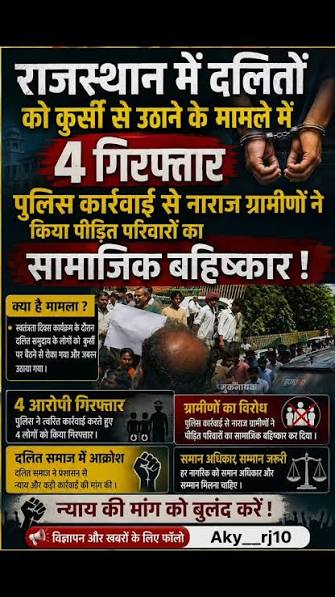
The community says that merely filing an FIR and arresting the accused is not enough. The administration also has a responsibility to ensure normal social interaction with the victim families in the village and prevent any kind of pressure or intimidation. Bhilwara: Police have arrested four of the five named accused in the case of allegedly lifting members of the Dalit community from chairs, using casteist slurs, and threatening them during Independence Day celebrations at a government school in Bhakliya village, Bhilwara. One accused, Narayan Jat, is still pending arrest. The case is being investigated under FIR number 131/2026 registered at the Bagor police station and is being investigated by Deputy Superintendent of Police Rahul Joshi. Meanwhile, the victim families have alleged that they are being socially boycotted and isolated in the village following the incident. The community claims that the families face the threat of potential attacks from the accused and their supporters. In response, a large number of people held a protest rally on Tuesday under the banner of the Dr. Ambedkar Memorial Welfare Society, Bhilwara district, and submitted a memorandum to the administration, demanding the arrest of the accused and protection of the victim families. Four accused arrested, search underway for one On August 15th, a case of alleged caste-based abuse against two Dalit community members, Rameshwarlal Bairwa and Gopilal Bairwa, surfaced during the Independence Day celebrations at the government school in Bhakalia village. Based on the victims’ complaint, the police named five individuals, including Balu Vaishnav, Hiralal Sharma, Narayan Jat, and Prakash Jat. Another named accused, Narayan, is still pending arrest. According to the community, the arrested accused are scheduled to appear in court around 4 pm on Wednesday. The community is also pressuring the police to expedite action to arrest the remaining accused. Police, led by Deputy Superintendent of Police Rahul Joshi, who is investigating the case, have moved forward with the investigation. Badrilal Bairwa, a young man who recorded the video of the incident, told The Mooknayak that the police have recorded the statements of the victims. A police team has also visited the scene and conducted an investigation, recording the statements of two witnesses, including his. Digital evidence of the mobile recording of the incident has also been provided to the police. According to Badrilal, the community is now pushing for the arrest of the remaining accused. The Mooknayak first reported on the incident on August 16th. Following the report, the victims’ families received widespread support from members of the Dalit and Bahujan communities. According to Badrilal Bairwa, a community meeting was held on Sunday evening after the news was published. The nearly two-hour meeting discussed whether the matter should be dismissed as a village dispute or whether legal action should be taken. Some elders at the meeting advocated for a village-level resolution. However, most community members expressed the view that silence would be inappropriate, given the years of alleged caste-based humiliation and discrimination. Following this, a decision was made to file a police complaint, and an FIR was registered late Sunday night. Even after the FIR was filed and the accused were arrested, the matter did not end there. On Tuesday, the community held a protest rally under the banner of the Dr. Ambedkar Memorial Welfare Society, Bhilwara district. A large number of community members participated in the rally. The protesters submitted a memorandum to the administration demanding the arrest of all named accused in the case, protection for the victim families, and an end to the alleged social boycott. The memorandum alleged social boycott of the victim families and demanded immediate intervention from the administration. The community alleged that the victim families were being isolated in the village following the incident. The memorandum also stated that the victim families feared a possible deadly attack by the accused and their supporters. The protesters’ key demands are: All accused named in FIR No. 131/2026 should be arrested and sent to judicial custody. Adequate police protection should be provided to the victim families in Bhakalia village immediately. The administration should take necessary steps to end the alleged social boycott of the victim families. Ensure prompt and fair action in the case. If strict action is not taken against the accused and the victim families are not provided security, the community will be forced to launch a democratic movement. The memorandum warns that if such a situation arises, the police and administration will be responsible. Sohanlal Regar, District President of Dr. Ambedkar Memorial Welfare Society, said that along with the arrest of the accused, the safety of the victim families should also be the primary responsibility of the administration. The community says that simply filing an FIR and arresting the accused is not enough. It is also the administration’s responsibility to ensure normal social interaction with the victim families in the village and prevent any form of pressure or intimidation. A dispute that began over a chair has now become a question of social justice. The dispute that began over two Dalit members sitting on chairs during the August 15th ceremony has now become a question of social equality, respect, and security. The Dalit community alleges that caste discrimination and untouchability have long existed in the village. They say that maintaining silence in such cases perpetuates this system of discrimination. The police investigation is progressing in this case. Statements from victims and witnesses have been recorded, and the scene has also been inspected. The actual circumstances of the case and the substantiation of the allegations will become clear after examining the available video recordings and other evidence. Currently, four named accused are in police custody, while one is still under arrest. The community’s next priority is ensuring the safety of the victim families and ending the alleged social boycott. Geetha Sunil Pillai Courtesy: Hindi News
Lucknow: Rapido lifts 100-year ban on Dalit cab driver, Ankit Kumar says, “The world bows down…”
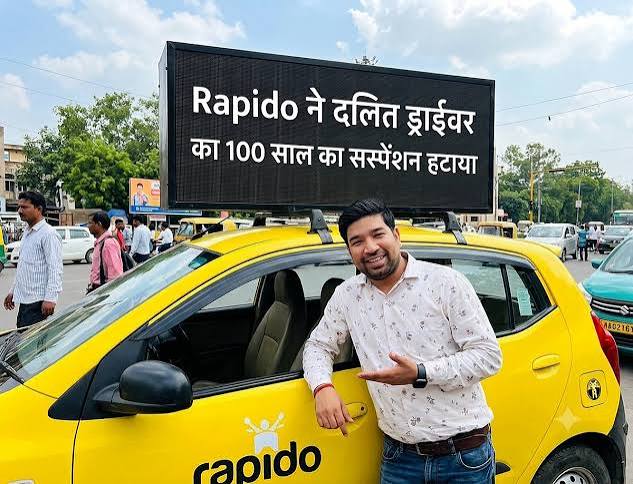
Ankit had allegedly reprimanded passengers in his cab for using casteist slurs against his officer. After the argument escalated, he stopped the cab near Telibagh Market and made all four of them get off. Following a complaint from passengers, his account was suspended for life. Lucknow – Ankit Kumar, a Dalit cab driver who was suspended from Rapido for nearly 100 years after protesting against caste-based insults in Lucknow, the capital of Uttar Pradesh, has now been reinstated by the company. Ankit released a video announcing this. Previously, his Rapido account showed a suspension of 99 years and 11 months, which was stated to last until July 19, 2026. This matter sparked a sharp reaction on social media. People associated with the Bahujan community and civil society organizations questioned Rapido’s action, and the #BoycottRapido campaign also trended on social media. Following this, reports emerged of increased pressure on the company’s decision. In this entire controversy, BSP National Coordinator Akash Anand also strongly supported Ankit. He questioned companies like Rapido, saying that they exhibit the same mentality that the Bahujan Samaj has long struggled against. The dispute began in the Telibagh area of Lucknow. 30-year-old Ankit Kumar had picked up four passengers from Uttarhatiya Railway Station and was headed to Charbagh Railway Station. According to Ankit, the four passengers were Indian Railways employees and were discussing a senior officer during the journey. Ankit alleges that the conversation gradually escalated into caste-based remarks, and the passengers began using derogatory and casteist slurs, linking the officer’s abilities to his caste. Ankit said that initially he did not intervene, but when the alleged caste-based remarks continued, he objected. Ankit reportedly told the passengers that if they questioned someone’s abilities, they should speak by name, and why was an entire caste being insulted. When the passengers allegedly refused to change their language, Ankit stopped the vehicle near Telibagh Market and asked the four to disembark. After disembarking, an argument broke out between Ankit and the passengers. People gathered at the scene. Ankit alleges that he was verbally abused. A video of the incident went viral on social media. What happened after the video went viral? After the video went viral, Ankit alleged that he began receiving abusive and threatening messages on social media. He said people were questioning why he dropped passengers off the vehicle. Meanwhile, following complaints from passengers, Rapido took action on Ankit’s driver account. The screenshot Ankit shared showed his account suspended for 99 years and 11 months, with the last date being July 19, 2026. The reason cited by the company was “abusive/double-meaning/use of abusive language.” Ankit claimed that the company didn’t even attempt to hear his side of the story before taking action. He said they should have at least asked him what happened. Ankit holds a diploma in mechanical engineering. He couldn’t find a government job commensurate with his qualifications, so he drives a cab to support his family. His father is a daily wage laborer and his mother is a homemaker. Therefore, a nearly 100-year suspension was like permanently closing his employment opportunities. For this reason, this case not only raised the issue of caste discrimination, but also sparked debate about the livelihoods of gig workers and the accountability of app-based companies. Legal experts have highlighted two distinct aspects of this matter. On the one hand, under the platform’s terms of service, the company has the right to take action against its driver upon any complaint. On the other hand, a suspension of nearly 100 years is extremely harsh and practically amounts to a permanent ban. Legal experts also questioned whether the driver’s side should have been heard before taking such drastic action. Unilateral action taken without notice or an opportunity for explanation could raise questions regarding the principles of natural justice. What did Akash Anand say? BSP National Coordinator Akash Anand gave a detailed response to this matter on August 17. He said that Ankit’s viral video raises serious questions about India’s social system. According to him, Ankit had only protested against the alleged casteist comments to protect his and his community’s dignity, but Rapido instead suspended his account for 99 years and 11 months. Akash Anand said: “Companies like Rapido suffer from the same mentality that we have been fighting to eradicate for a century.” Aakash Anand also said that Ankit’s suspension was tantamount to snatching away the livelihood of a person who stood up for his honor and the dignity of his community. He also linked this incident to the broader debate on reservation and social change. He stated that even nearly eight decades after independence, casteist mentality remains deeply rooted in society. According to him, reservation is not only a means of economic empowerment but also a means of social change. Aakash Anand also referred to RSS chief Mohan Bhagwat’s views on reservation and asked him to answer the questions of millions of Dalits like Ankit. He quoted Mayawati as saying that respect for the Constitution and the ideas of Babasaheb Dr. Bhimrao Ambedkar. Geetha Sunil Pillai Courtesy: Hindi News
“Giving up casteism is the greatest patriotism”: Mayawati rejects Jantar Mantar’s demand for economic reservation, targets Congress
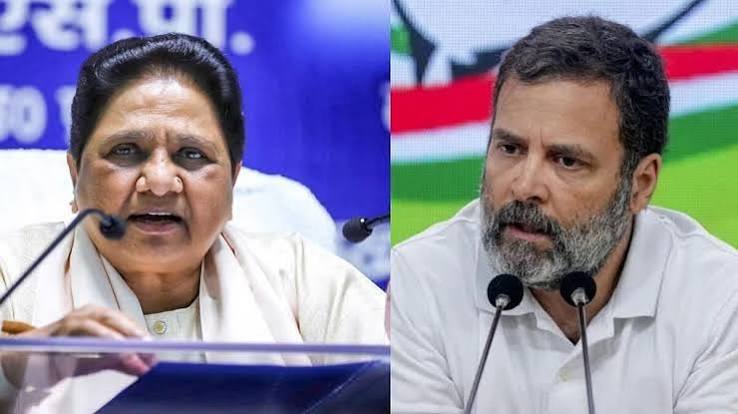
Mayawati says, “Governments should not protect those opposing reservations. Why did Rahul Gandhi remain silent?” Delhi – Bahujan Samaj Party (BSP) national president Mayawati has sharply reacted to the recent protest at Jantar Mantar in Delhi. In a statement issued on Sunday, she said that the demand for implementing reservations based on economic grounds, contrary to the reservations provided to SC, ST, and OBC communities in the Constitution, is completely unjustified and in the national interest. Discrimination and Identity Relationship Mayawati wrote in a post on X, “This new demand for implementing reservation based on economic status, raised by some people who recently gathered at Jantar Mantar in Delhi, in protest against the reservations provided to SC, ST, and OBC communities in the Constitution, is not at all justified or in the national interest. They should not do anything regarding reservation that would undermine the constitutional mandate of building an egalitarian society, a developed, and respected country.” As for providing reservation based on economic status, the central and state governments spend significant public funds every year on not just one but numerous poverty alleviation programs. However, if the people of the country do not receive the full benefits due to rampant corruption, then this is a direct fault of the government system. – Mayawati Quoting Babasaheb Dr. Bhimrao Ambedkar, she said that Babasaheb’s clear opinion regarding the Constitution’s reservation system for SC, ST, and OBC communities, who have been victims of the inhumanity of casteism, was that “renunciation of casteism is the greatest patriotism.” Therefore, people should demonstrate true patriotism. People and Society Questioning the demand for reservation based on economic basis, Mayawati said that the central and state governments spend huge public funds every year on various poverty alleviation programs, but due to corruption, its true benefits do not reach the people. This is a direct fault of the government system. She reminded that the system of reservation based on economic basis is already in place in the country, but even poor families of upper castes are not getting its full benefits and there is a lot of deception in it. Mayawati alleged that the corrupt and casteist government system never allowed the constitutional provision of reservation to be properly implemented on the ground. As a result, even after so long since independence, people from SC, ST, and OBC communities continue to suffer the brunt of poverty, caste hatred, exploitation, oppression, and the poison of casteism every day. She appealed to all governments to deny shelter and protection to anti-reservation elements. This would be in the larger national and public interest. She also requested people not to indulge in cheap politics on an important and sensitive issue like reservation, nor allow it to be. Mayawati also targeted the Congress party and Rahul Gandhi. She said that on the same day, Rahul Gandhi sat on a sit-in for several hours outside the Parliament Police Station to demand the registration of an FIR in the case of a victim, to which the party has no objection. However, next door, at Jantar Mantar, a protest was underway to end the caste-based reservation system for Dalits and the oppressed. Neither he nor any of his Congress colleagues went there to explain. This clearly reflects the Congress party’s anti-reservation mentality towards these classes. Discrimination and Identity Relations It is noteworthy that on Friday, a demonstration was held at Jantar Mantar under the banner of the “Reservation Hatao Andolan,” in which the primary demand was for reservation based on economic status rather than caste-based reservation. On the same day, Rahul Gandhi sat on a dharna outside the Parliament Street police station to demand the registration of an FIR for 19-year-old Sahil Lochab, who was injured in the CJP protest. Mayawati’s statement has once again underscored the Ambedkarite approach to protecting the constitutional right to reservation and against casteism. Geetha Sunil Pillai Courtesy: Hindi News
“I wasn’t even allowed to touch a brick…”: Dalit BJP MLA alleges untouchability at Kakori’s Sheetla Temple, SP attacks party
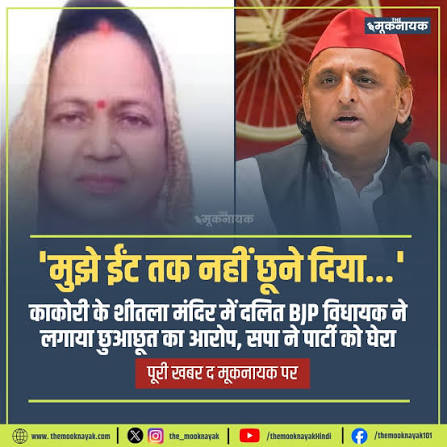
Alleging that a Dalit MLA was not allowed to touch a brick during the puja at Lucknow’s Sheetla Temple, the Samajwadi Party strongly questioned the BJP’s slogan “If we divide, we will be cut.” Lucknow: A major political controversy has erupted in the Kakori area of Lucknow, the capital of Uttar Pradesh. Jai Devi Kaushal, BJP MLA from Malihabad, has made serious allegations of caste discrimination against her during the groundbreaking ceremony held for the renovation of the Sheetla Temple. Discrimination and Identity Relations The MLA, who belongs to the Pasi Dalit community, says she was denied the respect and authority a public representative deserves during this sacred ritual. Expressing her anguish, she said the priest didn’t allow her to touch even a brick or apply roli (red roli). The MLA directly attributed this discrimination to her being a Dalit. She also claims she was made to stand continuously during the puja. They were not even allowed to perform tasks commonly performed in Hindu rituals, such as lighting incense sticks or breaking coconuts. The entire incident occurred around 11 a.m. on Wednesday morning. The MLA had arrived at the temple with several local BJP leaders. Jai Devi explained that she had played a key role in securing government funding for the temple’s renovation. It was through her efforts that nearly one crore rupees were approved for the Sheetla Temple’s renovation. Jai Devi, wife of the late Kaushal Kishore, a former Union Minister and two-time MP, expressed disappointment, saying that despite having been elected MLA from this constituency twice, she had done a great deal for the area and its people, yet she faced such caste discrimination. She also reported that on the same day, she visited another temple in Malihabad, where the rituals were performed normally. According to the MLA, she had visited the Sheetla Devi Temple several times in the past, but had never experienced such mistreatment. The matter gained momentum when the MLA’s son, Vikas Kishore, shared a post on social media about the alleged incident. In his post, he clearly stated that priest Shailendra Bajpai was performing the puja and Ramakant Gupta was chanting the mantras. It is noteworthy that the Tourism Department approved this renovation project only after the MLA’s persistent efforts. Following the controversy, Azad Samaj Party District President Ajay Bharti reached the temple on Thursday with several of his workers and protested vehemently against the alleged caste discrimination. People and Society On the other hand, the temple administration has completely rejected all these allegations. According to media reports, temple manager Ramakant Gupta has refuted the MLA’s claims. He clarified that the temple is always open to people from all sections and castes of society. The Samajwadi Party has also launched a strong attack on the ruling BJP over this matter. The SP says that this treatment of a Dalit MLA exposes the caste discrimination prevalent under the state government’s rule. Rambabu Sudarshan, National General Secretary of the Samajwadi Party’s Baba Saheb Ambedkar Vahini, termed the entire incident as extremely unfortunate. The SP leader sarcastically stated that such an incident in the state capital, nine years after the BJP government’s rule, reveals the true picture of casteism in Uttar Pradesh. He stated that the allegations were not made by any opposition party, but by the BJP’s own sitting Dalit MLA. Sudarshan also stated that if this had happened to an MLA from any other party, the BJP’s troll army would have already labeled it politically motivated. He stated that this incident is not just the suffering of a sitting Dalit MLA, but rather hurts the sentiments of millions of Dalits in the state and the country. The SP leader also sharply criticized the BJP and RSS’s slogan “If we divide, we will be slaughtered.” He questioned whether the BJP intends to unite Hindus in this manner. Sudarshan sternly questioned whether such incidents raise the question whether the BJP even considers Dalits to be Hindus. Rajan Chaudhary Courtesy: Hindi News
Dalit girl murdered and her body thrown into a well in Karnataka; father suspects rape
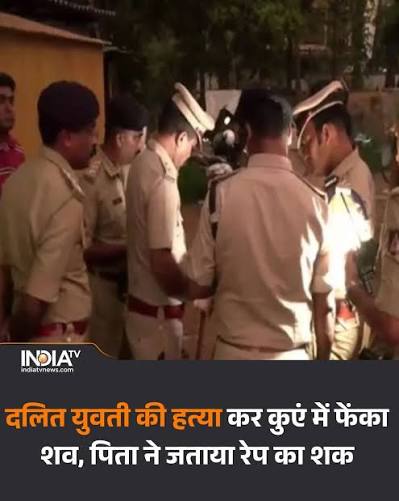
Raichur. The body of a Dalit girl was recovered from a well in Hokrani village, Sirwar taluk, Raichur, Karnataka, last Thursday. It is suspected that she was raped and then murdered. Police have arrested three accused in the case, while one remains at large. The body of the young woman, who had gone to defecate in the open, was found the next day on the steps of a village well. According to the complaint filed by the young woman’s father, the woman was raped and murdered. Gundya and Mahantesh, 22, Veeresh, 23, and Mundaragi Basavaraj are accused of the crime. A case has been registered against them. Circle Police Inspector M. Shashikant stated that three of the men have been detained and sent to judicial custody. The deceased has been identified as a 22-year-old woman from Hokrani village. According to the family, the young woman had gone to relieve herself last Wednesday evening but did not return. After an extensive search, the family found her body in a well on Thursday morning. Police were informed. Upon receiving the news, Sirwar police arrived at the scene and began investigating. Police say they suspect the attackers killed her and threw her body into the well. A case has been registered at the police station. Last month, in July, a shocking murder case emerged from Dharwad, Karnataka. A 45-year-old anesthesiologist was murdered in his apartment. His 8-year-old son was also stabbed and found injured at the scene. The doctor was identified as Dr. Kiran Honnwar, an anesthesiologist at Chirayu Hospital. Dharwad police arrested the doctor’s wife in connection with the case. Police reported that Dr. Priyanka, an ophthalmologist, was also taken into custody. Following the incident, his injured son was admitted to a private hospital. Digvijay Courtesy: Hindi News