
Congress and the Politics of Purification: Rahul Gandhi Is Making a Long-Term Electoral Move Against Mallikarjun Kharge’s ‘Dalit’ Pawn

The Congress party is working tirelessly to capitalize on the Haldwani purification controversy in Uttarakhand. The Congress party sees the primary focus of this issue as the Chief Minister’s seat in Punjab, a position it could hold until 2029. New Delhi: The political underpinnings of the Haldwani incident in Uttarakhand, after a long hibernation, are becoming clear. Congress President Mallikarjun Kharge dropped the alleged ‘purification’ bombshell in Parliament on the final day of the monsoon session. However, Rahul Gandhi hesitated in responding. Now, it appears the party has a strategy in place. On the last day of the monsoon session, Leader of the Opposition in the Rajya Sabha, Mallikarjun Kharge, alleged that after his rally in Haldwani, the venue was allegedly “purified” because he is a Dalit. A week later, Rahul Gandhi raised the issue in a press conference, for which elaborate preparations had been made. Now, with an FIR filed against Rahul Gandhi in this case, the Congress has made it a major part of its political campaign. Congress’s Last Hope in the Punjab Elections If we try to understand the politics behind this late raising of the issue by the Congress, it seems that it sees it as a straw to hold on to in the Punjab Assembly elections. This is because the Dalit or Scheduled Caste population in Punjab is approximately 32 percent. Speculation of a BJP-Akali alliance increases tension Some political pundits, long supporters of the Congress, saw the party as having considerable potential against the Aam Aadmi Party in Punjab. Because, apart from urban areas, the BJP has not been able to achieve much in rural areas. However, in the last few weeks, speculation about an electoral rift between the top leadership of the BJP and the Akali Dal has suddenly intensified. These speculations are pulling the rug from under the feet of Congress strategists. The Dalit CM card failed in 2022. In the 2022 Punjab Assembly elections, a large portion of the Dalit vote bank went to the Aam Aadmi Party. Its unexpected victory speaks for itself. A few months before the elections, after turning its back on Captain Amarinder Singh, the Congress tried Charanjit Singh Channi, but he proved to be a counterproductive for the party. It could not attract enough Dalit votes to Congress to put a brake on AAP. Hoping to capitalize on the ‘Constitution in Danger’ idea Charanjit Singh Channi is already said to be disgruntled in the internal politics of the state Congress. In such a situation, Congress believes that slogans like “Dalits are in danger” can keep its hopes of returning to power alive, even despite a possible BJP-Akali Dal alliance. In the 2024 Lok Sabha elections, Congress and its allies have already tasted the “Constitution is in danger” election slogan. Congress confident of repeating 2024 in UP The “Constitution is in danger” narrative worked most favorably for the India Bloc in Uttar Pradesh. Even Samajwadi Party supporters were surprised to see a large number of Jatavs abandoning the elephant and opting for the paw and cycle. Congress sees the same hope in the “Dalits are in danger” slogan. Assembly elections are also being held in UP along with Punjab, where approximately 20 percent of the population is Dalit. Challenge from BSP, ASP, and BJP However, with the BSP and Chandrashekhar Azad’s Azad Samaj Party (Kanshi Ram), it will not be easy for the Congress and SP to break into the Dalit vote bank in UP in the assembly elections. Furthermore, the BJP has also maintained a strong hold among this community through its governments’ welfare schemes, especially among non-Jatav Dalits. However, the Congress is hopeful that the “Dalits are in danger” slogan, like the “Constitution in danger,” could also work in UP this time. Congress hopes for a slogan for 2029 If leaders like Rahul Gandhi are truly thinking ahead, they may also consider this narrative for the 2029 Lok Sabha elections. The Scheduled Caste population across the country is approximately 16 percent, and the Congress believes that if this strategy works, it could prevent the BJP from achieving an absolute majority in 2024, and this time it could even come close to power. Authored by: Anjan Kumar About the Author Anjan Kumar is an Assistant Editor at Navbharat Times Online and has been a journalist for over 24 years. He joined Navbharat Times Online in April 2025 and has covered politics in digital media for the past 10 years. Courtesy: Hindi News
Dalit woman alleges caste-related abuse and death threats for demanding her son’s wages
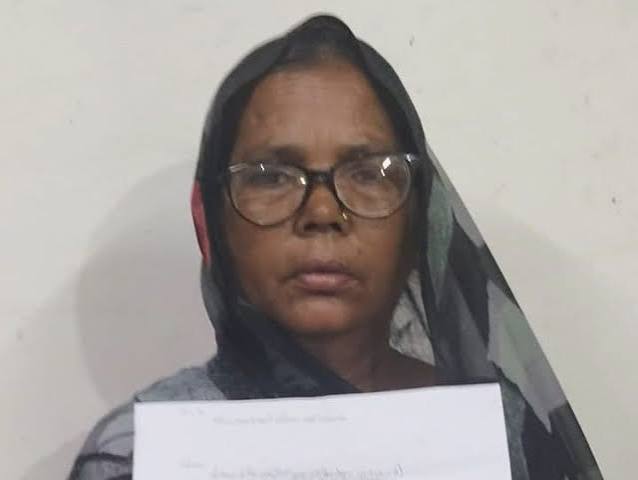
A Dalit woman in the village of Poore Khirodhar, under the Patti police station area, has alleged that she received caste-related abuse and death threats for demanding her son’s wages. The woman has filed a complaint with the Patti police. According to the complainant, Murti Devi, her son, Shivam, alias Chikki, worked as a daily wage laborer for a man in the village. When Shivam went to demand his wages, he was refused payment. It is alleged that during this time, Shivam was subjected to caste-related abuse, abuse, and threats of assault and death. Murti Devi has demanded that the police take cognizance of the matter, register a case against the accused, and take necessary legal action. She has also requested that the police ensure the safety of her and her son’s lives and property. In this regard, Station House Officer (SI) Vijay Yadav stated that he has received the application. The matter is being investigated, and further action will be taken based on the investigation. Amar Jeet Sharma | Patti, Pratapgarh Courtesy: Hindi News
Valmiki youth files FIR against Rahul Gandhi over Kharge remark:BJP eyes Dalit vote base; how the community became politically important
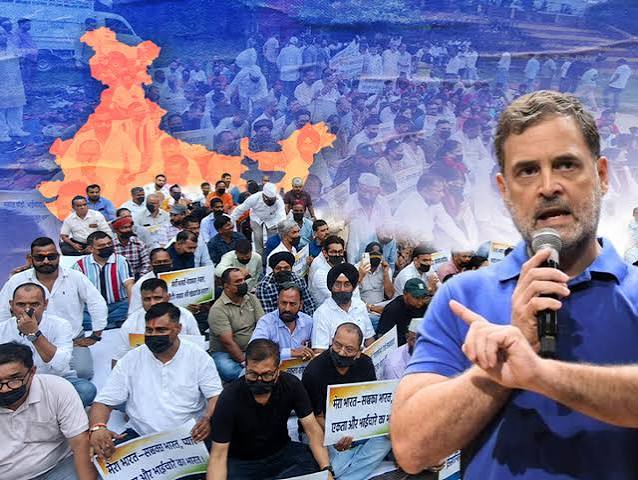
An FIR has been registered against Rahul Gandhi. It was filed on the complaint of Amit Kumar, a Scheduled Caste youth. Congress is opposing the FIR and has accused the BJP of targeting Gandhi. The fight has now moved beyond Haldwani. In Haryana too, Congress has accused the BJP of using Dalit politics to strengthen its support among Dalit communities. Why does caste still shape Indian politics nearly 80 years after Independence? And is the BJP trying to win the Dalit vote once seen as a Congress stronghold? Let’s explore … What is the Rahul Gandhi controversy about? The controversy began after Congress president Mallikarjun Kharge addressed a rally in Haldwani, Uttarakhand. The rally was held at Ramlila Maidan on 8 August. Two days later, a group performed a shuddhikaran havan, or purification ritual, at the same ground. Congress said the ritual targeted Kharge’s Dalit identity. The organisers denied this. They said the ritual was only to clean the venue. Kharge raised the issue in the Rajya Sabha on 13 August. He said he had spoken about public problems at the rally. He also said he had never asked for help by identifying himself as SC or Dalit. But he said being subjected to untouchability was humiliating. BJP president JP Nadda distanced the party from the incident. He said the BJP did not support such activities. The issue became bigger on 29 August Rahul Gandhi called the purification ritual an example of untouchability. He demanded an FIR under the SC/ST Act. Then came another twist. On 30 August, Uttarakhand Police registered an FIR against Rahul Gandhi. A Valmiki community office bearer Amit Kumar filed the complaint. He alleged that Gandhi had wrongly portrayed members of the Scheduled Caste community who took part in the ritual as caste discriminators. The FIR invokes the SC/ST Act and Sections 196 and 299 of the Bharatiya Nyaya Sanhita. Congress says the incident is a double insult: Kharge was disrespected first, and then Rahul Gandhi was booked for raising the issue. Kamal Nath said the BJP first insulted Dalits by carrying out the ritual and then filed an FIR against Gandhi when he spoke about it. A dispute over a ritual has now become a bigger political fight over caste, dignity and who gets to speak for Dalits. BJP has also been accused of strengthening its Dalit vote bank in Haryana, what is the reality? Haryana is witnessing a new phase of Dalit politics. Since 2014, the BJP has worked to expand its support among non-Jat voters and smaller Dalit communities, especially Balmikis. This strategy has continued under Chief Minister Nayab Singh Saini. This politics brings together three identities: Ambedkarite pride represented by “Jai Bhim”, Balmiki community pride, and a broader Hindu identity symbolised by Lord Ram. Political scientist Sanjay Kumar say the BJP is trying to bring smaller Dalit groups into a wider Hindu political coalition. A recent example was the protests following the killing of 25-year-old Biru Balmiki in Karnal. Demonstrators raised slogans such as “Jai Bhim, Jai Balmiki, Jai Shri Ram”. Reservation has become another battleground. After the Supreme Court’s August 2024 ruling on SC sub-classification, Haryana divided its 20% SC quota into two categories. The move could benefit smaller communities but may weaken larger groups such as Jatavs. The debate is also important in Uttar Pradesh, where parties are trying to win over different Dalit communities. The contest is no longer just over a single “Dalit vote bank”, but over representation and reservation.is no longer just over a single “Dalit vote bank”, but over representation and reservation. Are political parties focusing more on Dalit vote-bank politics again? No. Dalit politics has never gone away. It has been part of Indian politics since before Independence. Every generation has produced new leaders, new movements and new demands. B R Ambedkar himself warned in 1932 that social reform had done little to change the lives of Dalits. As he put it: “Mahatmas have come and gone, but untouchables have remained as untouchables.” After Ambedkar came leaders such as Jagjivan Ram. Later came Kanshi Ram, who founded the Bahujan Samaj Party (BSP) in 1984. His protégé Mayawati turned the BSP into one of India’s most successful Dalit-led political movements. The party reached its peak in 2007, when it won 206 of Uttar Pradesh’s 403 Assembly seats and formed the government on its own. Today, however, the BSP is much weaker. In the 2022 Uttar Pradesh Assembly election, it won only one seat and secured 12.88% of the vote. In the 2024 Lok Sabha election, it failed to win a single seat. Its decline has created space for other parties and new Dalit leaders, including figures such as Chandrashekhar Azad, who won the Nagina Lok Sabha seat in 2024. Political scientist Badri Narayan has studied this shift closely. In his book The Making of the Dalit Public in North India, he argues that Dalit political consciousness grew through grassroots movements, local struggles and everyday experiences, not just through elections. In another book, Republic of Hindutva, he explains how the Sangh Parivar expanded its reach among some Dalit communities through welfare outreach and by incorporating Dalit and OBC icons into a broader Hindu narrative. So political parties are not suddenly discovering Dalit politics. What has changed is the political space around Dalit voters. The party that once dominated much of that space has weakened, and more players are now competing to represent different sections of the Dalit community. The Making of a Dalit Public in North India looks at Dalit political consciousness, participation and mobilisation in northern India, based on extensive village-level fieldwork in eastern Uttar Pradesh. The Making of a Dalit Public in North India looks at Dalit political consciousness, participation and mobilisation in northern India, based on extensive village-level fieldwork in eastern Uttar Pradesh. How have Dalit voting patterns changed across elections? Sanjay Kumar and Vibha Attri analysed Hindu Dalit voting patterns in Lok Sabha elections from 1996 to 2024, using Lokniti-CSDS election studies.
“A joyous Dalit is the ultimate threat”: In conversation with Christina Dhanuja, author of Dalit Women and the Fullness of Life
In an interview with Ashikha N for Maktoob, writer and caste-equity strategist Christina Dhanuja discusses her book Dalit Women and the Fullness of Life, challenging reductive representations of Dalit women, the politics of joy and fullness, and the need to centre Dalit authored knowledge in conversations around caste, feminism, and social justice. What does it mean to imagine a full life for Dalit women in a society that has so often reduced their lives to stories of violence, labour, survival and resilience? Christina Dhanuja’s debut book, Dalit Women and the Fullness of Life, takes up this question by turning attention towards the less discussed dimensions of Dalit women’s lives. The book emerges from Dhanuja’s long engagement with questions of caste, gender, faith and justice, including her work as co-founder of the #DalitHistoryMonth project and as a founding member of the Global Campaign for Dalit Women. The book explores resilience, memory and liberation, while imagining what fullness means for Dalit women in a caste-bound world. Blending memoir with political and social analysis, the book explores Dalit women’s desires, contradictions, vulnerabilities, ambitions and joys and not merely as victims to systemic violence. Across ten chapters–-Identity, Movements, Work, Community, Sisterhood, Body, Desire, Trauma, Faith and Joy, the book moves from the political and collective to the intimate and interior. Dhanuja examines caste, gender, work, relationships, the body, faith and desire, gradually building towards her central idea of “fullness”: the right of Dalit women not only to dignity and survival, but to rest, pleasure, love, fragility, freedom and joy. In doing so, the book challenges the impulse to see Dalit women either as victims of oppression or symbols of resilience, making space instead for them to be seen, in Dhanuja’s words, as “wholesome human beings” entitled to the “full spectrum of possibilities that life has to offer.” In an interview with Ashikha N for Maktoob, writer and caste-equity strategist Christina Dhanuja discusses her book Dalit Women and the Fullness of Life, challenging reductive representations of Dalit women, the politics of joy and fullness, and the need to centre Dalit authored knowledge in conversations around caste, feminism, and social justice. Ashikha N: The title of the book itself is striking. What does “fullness of life” mean to you, and why did that phrase become the organizing principle of the book? Christina Dhanuja: Fullness of Life, in the way I see it, and in the way the book articulates it, is essentially the opportunity for Dalit women, at systemic, collective, and individual levels, to experience the full spectrum of possibilities that life has to offer. That needs far more than just symbolic inclusion and tokenistic representation. It is not enough that Dalit women be ‘included’ and ‘represented’ for the sake of having diversity. It is not okay for Dalit women to have only their most urgent priorities met; that is food, clothing, and shelter. Fullness demands a complete reimagination of the social, political, emotional, spiritual, and material realities under which Dalit women live and are expected to endure. It demands a revision of public and academic discourses, which, in turn, determine a host of other things: from policies to organizational dynamics to healthcare practices to how we run movements. Ashikha: The book blends memoir with social analysis. How did you decide on the structure of the book? Did you ever struggle with deciding how much of yourself to reveal? Dhanuja: My political writing has always stemmed from the personal, and, in some instances, the two are quite indistinguishable. At this point, it is more of a habit than a consciously structured process. And I pretty much wrote about everything I wanted to write about. There were a few passages that I edited out, but it was to protect the people I was writing about rather than hide parts of my story. Deciding on the structure of the book was also a pretty straightforward process. I’ve been ruminating on the theme of fullness for a few years now, and I wanted to explore that as a framework for an anti-caste, feminist praxis. So, to talk about the Political (Identity, Movements), the Professional (Work), the Social (Community, Sisterhood), and the Personal (Body, Desire, Trauma, Faith, and Joy) came easily. Ashikha: What were the most difficult narratives to challenge while writing the book? Dhanuja:There are very specific narratives I try to dismantle in each chapter, but generally speaking, this book required that I first peel away layers of existing—and limiting—popular and academic discourses before I could centre Dalit women’s rights to fullness. For example, in the Sisterhood chapter, I had to first critique the hyperfocus on Dalit–savarna relationships before I could discuss sisterhood among and between Dalit women. In the Identity chapter, I had to re-establish what intersectionality is, in the way Crenshaw intended it, and then see how we can apply it to caste contexts. I attribute much of this additional labour to the damage caused by academics, intellectuals, and writers—especially those writing from savarna locations—whose ‘expert views’ have ended up pigeonholing Dalit women Ashikha: What do you think society loses when Dalit women are only seen as symbols of oppression or resilience? Dhanuja: I think it is not just society in general but South Asian society in particular that has somehow ruined what it means to be human. Caste is our biggest fault line. Although my book centers Dalit women and their right to fullness, it also analyses how caste is extremely life-negating for all of us. Take joy, for example. Why should something as simple as joy be rationed based on one’s caste and gender? Or consider how ‘caste minds’ are sustained through so-called preferences in food and love and everything else. Caste societies have already lost so much, with or without Dalit women.. Ashikha: One of the book’s most powerful interventions is the insistence that Dalit women deserve to be understood beyond suffering. Why do you think joy remains such a radical subject when discussing Dalit lives? Dhanuja: I wonder if Dalit joy is
Anaya Bangar finds support from transgender cricketer who knows the battle

Danielle McGahey has backed Anaya Bangar after Cricket Australia cleared a pathway for her to pursue elite women’s cricket from March 2027. Speaking to India Today, McGahey urged people to base the transgender participation debate, on evidence while treating Bangar with dignity and respect. For Danielle McGahey, Anaya Bangar’s fight to keep her cricketing dream alive carries a familiar weight. Nearly three years after becoming the first transgender cricketer to play in an official international match, McGahey saw her own international career brought to an end by an ICC rule change. Now, as Cricket Australia clears a pathway for Bangar to pursue elite women’s cricket from March 2027, McGahey has chosen to stand firmly behind her. “I want to express my full support for Anaya. I’m incredibly proud of her for continuing to pursue the sport she loves while facing an enormous amount of public scrutiny,” McGahey told India Today in an exclusive interview. McGahey represented Canada before the ICC ruling ended her international career. Her experience has given her a personal connection to the scrutiny surrounding Bangar, who can play Premier Cricket in Australia in the interim before becoming eligible for elite cricket, subject to the relevant requirements. A NEW CHAPTER AWAITS IN AUSTRALIA Anaya Bnagr will be eligible to play elite cricket in Australia from March 2027. Courtesy: Anaya Bangar Instagram For Bangar, Cricket Australia’s decision offers something that has been missing for a long time: a pathway back to competitive cricket. Her potential journey could take her from Premier Cricket to elite domestic cricket and, eventually, the Women’s Big Bash League. But eligibility does not guarantee selection or a contract. Her case also highlights the different approaches taken by cricket’s governing bodies. Cricket Australia uses a testosterone-based eligibility framework for domestic competitions, while the ICC has stricter regulations for international cricket. Under the ICC’s current policy, transgender women who have experienced male puberty are not eligible to play international women’s cricket, regardless of surgery or gender reassignment treatment. The policy was approved in November 2023 following a nine-month consultation process. MCGAHEY CHALLENGES THE ASSUMPTIONS Danielle McGahey retired from international cricket in 2023. Courtesy: Danielle McGahey Instagram McGahey believes the discussion around transgender participation should be grounded in research rather than assumptions about transgender athletes. “My position remains very clear: trans women are women, and trans women belong in women’s sport. After years of gender-affirming hormone therapy, the physiological picture is very different from what is often portrayed in public debate. “Research has shown substantial reductions in strength, muscle mass and other performance-related measures following hormone therapy, with a number of measures moving toward or becoming comparable with cisgender female ranges over time. These conversations deserve to be based on evidence rather than assumptions about transgender bodies.” Her comments come as Bangar’s eligibility continues to generate debate among players and supporters of the women’s game. South Africa international Marizanne Kapp has publicly criticised Cricket Australia’s decision, calling it “absolutely ridiculous”. The contrasting positions reflect the wider challenge facing sporting bodies as they navigate questions of inclusion, competitive fairness and eligibility. A CAREER THAT FELL APART ABRUPTLY Danielle McGahey played 6 T20Is for Canada. Courtesy: Instagram For McGahey, the debate is not an abstract one. She has lived through its consequences. The Australian-born cricketer moved to Canada and made history in September 2023 when she became the first transgender player to feature in an official international cricket match, making her T20I debut against Brazil. She went on to play six T20Is for Canada, scoring 118 runs at an average of 19.66, with a highest score of 48. At the time, McGahey had been deemed eligible under the ICC’s existing transgender participation criteria. But on November 21, 2023, the governing body approved new regulations barring transgender women who had experienced male puberty from international women’s cricket. McGahey’s international career was consequently over. “With a very heavy heart, I must say that my international cricketing career is over,” she said at the time. The decision brought a sudden end to the international journey of a player who had made history only months earlier. A PLEA FOR DIGNITY Danielle McGahey said Anaya Bangar doesn’t deserve to be ridiculed. Courtesy: Anaya Instagram That experience has shaped McGahey’s response to the scrutiny surrounding Bangar. “What has been particularly disappointing for me is seeing Anaya subjected to much of the same ridicule, hostility and dehumanising commentary that I experienced three years ago. It is incredibly disheartening to see how little some parts of the public conversation appear to have moved forward, particularly when our medical and scientific understanding of transgender people continues to develop.” McGahey said disagreement over sporting regulations should never become an excuse for personal attacks. “But beyond the sporting and scientific debate, I think it is important to remember that Anaya is a human being who is simply trying to live her life and pursue her career in cricket. Personal attacks, ridicule and dehumanising commentary are completely inappropriate. “Whatever someone’s opinion on sporting regulations may be, there is no justification for attacking someone personally, and those words can have very real consequences for the person on the receiving end of them. “I hope that as this discussion continues, people can remember the human being at the centre of it and treat Anaya with the dignity and respect she deserves.” For Bangar, the immediate focus is on the cricket field — on returning, rebuilding and earning her place through performance. For McGahey, however, Bangar’s journey is also a reminder of a battle she knows all too well: what it means to keep pursuing the sport you love when your eligibility, identity and future are being debated far beyond the boundary. Sabyasachi Chowdhury Courtesy : India Today Note: This news is originally published on https:/indiatoday.com/bha and is used purely for non-profit/non-commercial purposes, especially human rights
Chirag Paswan Jitan Ram Manjhi: They don’t care about the entire Dalit community, Chirag and Manjhi are pursuing their own political interests.

Chirag Paswan Jitan Ram Manjhi: Bihar politics is currently witnessing a heated debate about reservation. Leaders are claiming their rights and constitutional privileges, but no one has seriously considered the welfare of the entire Dalit community. Everyone is busy pursuing their own political interests. Patna: These days, the buzzword “reservation, reservation” is echoing in Bihar’s political circles. Some are saying, “No one can abolish reservation.” Others say, “Reservation is our constitutional right.” But the sad truth is that no political party has considered the entire Dalit community’s thinking. Neither have the Dalit leaders who harp on Dalit politics and reservations suggested a formula for uplifting those at the bottom of the socio-economic ladder. One possibility was raised by Dr. Santosh Suman, National President of Hindustani Awam Morcha Secular, but he too has backed away from the campaign. When he said that the creamy layer should not be deprived of reservation, he did not mention it. What does LJP (R) National President Chirag Paswan want and what does Hindustani Awam Morcha Secular National President Dr. Santosh Suman want? Let’s expose these two leaders. What is Chhote Manjhi’s recent statement? Hindustan Awam Morcha Secular National President Dr. Santosh Suman Manjhi made it clear that he never talked about implementing a ‘creamy layer’ in SC-ST reservations or excluding anyone from reservations. I had said that his real issue was implementing a ‘quota within quota’ (sub-categorization) for the most disadvantaged and backward castes within the Scheduled Castes. He never said that the creamy layer should be deprived of reservations. Yes, I did say it, and I say it with full confidence, that there should be a sub-quota within the reservation quota. ‘Creamy layer’ and ‘sub-quota’ are two completely different concepts. Now, regarding resignations, Union Minister Jitan Ram Manjhi and I, Santosh Kumar Suman, will resign. However, we, the secular party, are a small party, while the LJP(R) is a large party. Chirag Paswan should resign his ministerial post first, and we too are ready to resign. I had said that his real issue is implementing a “quota within quota” (sub-categorization) for the most disadvantaged and backward castes within the Scheduled Castes. He has never talked about implementing a “creamy layer” within SC-ST reservations or excluding anyone from reservations. Why is Chirag Paswan in opposition? Actually, Lok Janshakti Party (Ram Vilas) National President Chirag Paswan is not concerned with Dalit politics; he is concerned with the Paswan caste. He knows that as soon as he advocates for a creamy layer or a quota within a quota, the Paswan community will become angry. And this Paswan community is the main political base of his politics. It’s a different matter that this statement exposes his Dalit politics and Dalit thinking, revealing that his overall Dalit thinking is not concerned with the development of all Dalits. Why is Chirag Paswan shying away from population share? The truth is that Paswan’s total population is just over five percent. However, he is the number one beneficiary of reservation. Regarding government jobs, the situation is such that while his population is between 5 and 6 percent, his share in government jobs, i.e., Dusadhs, is 32.7%. In such a situation, if the government adopts a quota within quota or a policy that the share depends on the population, Chirag Paswan’s political position will be in jeopardy. Accordingly, Paswan’s share in jobs will be reduced to five percent, resulting in a direct loss of 27 to 28 percent of his reputation. What is the principle of Manjhi’s politics? If we talk about central minister Jitan Ram Manjhi and his son, Dr. Santosh Suman Manjhi, a minister in the Bihar government, they play politics of approximately three percent. However, their percentage in government jobs is 0.26 percent, which is quite low. In such a situation, even if there is a quota within a quota, people of their caste will benefit. Even if we accept the existence of a creamy layer, the politics of Union Minister Jitan Ram Manjhi and Bihar Government Minister Dr. Santosh Suman will still be successful. In such a situation, the claim of 3 percent politics will increase, and so will its purpose. Written by: Ramakant Chandan • Edited by: Sunil Pandey About the Author Ramakant Chandan began his journalism career in 1988 as a freelancer with Navbharat Times and Dainik Hindustan. He formally joined Rashtriya Sahara in 1996, starting with Haatsapaksh, Noida. He became a special correspondent in 2012. In 2020, he became the local editor of Rashtriya Sahara Patna, and in 2022, he became the consulting editor of Rashtriya Sahara. Courtesy: Hindi News
‘Each word she said cost my daughter her life’: TN Dalit mother on teen’s suicide

Speaking to TNM, the family of 16-year-old Dalit girl P Nishanthi solely blamed the allegedly casteist treatment she received from Vimala Devi, a government school headmistress, for her death. “I felt very hurt that she asked about my daughter’s character. I continued standing there with my hands folded, requesting them to somehow admit her,” P Thavamani (40) told TNM, recounting the incidents of the day before her 16-year-old daughter P Nishanthi died by suicide. Thavamani had taken Nishanthi to meet Vimala Devi, headmistress of the Government Model Higher Secondary School in Usilampatti, Madurai, on August 24 to apply for admission to class 11. Instead, Vimala Devi allegedly humiliated the girl for leaving her previous school, and her ‘character’ was scrutinised. “Seeing my folded hands, my daughter tapped my hand to ask me to lower it,” Thavamani continued. This triggered a sharp reaction from Vimala Devi, who allegedly asked, “Can’t you fold your hands in front of me? Are you that arrogant?” “She repeatedly shouted at my daughter, calling her arrogant and questioning what she had done at the previous school. Unable to tolerate the berating, my daughter started crying. [Vimala devi] then told her, ‘Get out. Leave the school.’ Those words affected my daughter deeply. She immediately ran out,” Thavamani recounted. Nishanthi’s family alleged that the incident caused her deep distress. Speaking to TNM four days after her death, the family solely blamed the allegedly casteist treatment she received from Vimala Devi for her death. Police have registered a case of abetment of suicide based on her mother’s complaint, naming headmistress Vimala Devi. The headmistress has denied the allegations, including any casteist remarks. ‘Character’ questioned Nishanthi hailed from Usilampatti in Tamil Nadu’s Madurai district and belonged to the Hindu Paraiyar community, which is classified under Scheduled Castes (SC). She was the second of three children born to Thavamani, a tailor in a garments factory, and Palaniswamy, a daily wage labourer. “She was very attached to us and was highly inclined towards studies. She would not even waste time enjoying festivals,” her family remembered. After completing class 10 from a government school in Thottappanayakkanur, she joined the Government Kallar Higher Secondary School (GKHSS) in Poochipatti for class 11 in June this year. Nishanthi had joined the Biology-Mathematics stream with ambitions of becoming a nurse, her sister Nikila told TNM. But when she struggled with some of the subjects, she wished to join the Commerce stream. However, the school refused to let her change the stream. “My daughter went to school unwillingly for some time. After that, she stopped going to school and stayed at home. She kept saying, ‘I don’t like it. I don’t want to go. Please put me in another school’,” Thavamani said. On August 24, Thavamani took Nishanthi to the Government Model Higher Secondary School in Usilampatti, where they met the headmistress Vimala Devi, who belongs to the Hindu Kallar community, which is classified as Other Backward Class. According to Thavamani, the headmistress questioned them over why they had come there after Nishanthi had already joined another school. “She asked, ‘What mistake did you commit there? You come here after having joined another school and we have to admit you? Don’t we have any other job?’” Vimala Devi then allegedly tried to contact the Government Kallar Higher Secondary School that Nishanthi had previously joined, in order to know about her ‘conduct’. When there was no response, she called the Thottappanayakkanur school where Nishanthi studied class 10. “She put the call on speaker phone. The teacher from Thottappanayakkanur said my daughter was a good student,” Thavamani said. Vimala Devi then allegedly asked, “How is her character?” This question about her daughter’s character hurt her deeply, Thavamani said. That was when she requested the headmistress with folded hands to admit her daughter to the school, prompting Nishanthi to gesture to her to not fold her hands. ‘She was emotionally drained’ After Vimala Devi asked her to “get out” of the school, Nishanthi walked for around five kilometres towards Nallamalpatti. When Thavamani found her, she brought her home in an autorickshaw. “When we got home, she lay down. I asked her to eat, but she refused. I don’t know whether she slept properly that night. She was emotionally exhausted,” Thavamani told TNM. The next day, August 25, Thavamani left for work, telling Nishanthi that she would return later to take her to the Kallar school to get her transfer certificate (TC). “I rarely get leave so I managed to get a 10 minute break to go get the TC,” she said. There, she was asked to wait for some more time. “I told the teacher, Manikkyan, that my daughter stopped going to school because he said she couldn’t be reassigned to the Commerce stream and told her to go to another school. He replied that they have to discipline students, and asked if that is reason enough to stop coming to school,” Thavamani alleged. “After some argument, we finally received the TC,” she said. She then returned to work, while Nishanthi went home, where she was alone. When Thavamani reached home that evening, she couldn’t initially find Nishanthi. “I searched the house, only to find her dead,” she said, breaking into tears. “While I was away, my daughter must have been thinking about everything that had happened. There was nobody at home to talk to her. I had gone to work, while she kept thinking about everything, and it caused her tremendous mental distress,” Thavamani said. ‘Each word headmistress said cost my daughter’s life’ For Thavamani, there is grief over losing her daughter, as well as anger over how Nishanthi was treated. She alleged that the headmistress Vimala Devi is solely responsible for her daughter’s death, and demanded legal action against her. “The headmistress is well educated and is in a higher position, administering a school. Wouldn’t she know how to speak to a common person like us?” she asked, adding, “Each word she said cost my daughter her life.
After the Common Man, the Convenient Bahujan: CJP Fails the Litmus Test of Representation

Yogendra Yadav sees in CJP a new Bahujan politics. But a caste mix is not automatically a Bahujan distribution of power. The real test is whether communities historically excluded from power exercise authority across the organisation. After the Common Man, the Convenient Bahujan: CJP Fails the Litmus Test of Representation Cockroach Janta Party (CJP) founder Abhijeet Dipke, left, with team member Ratna Singh, centre, on August 5, 2026. Photo: PTI, via CJP Yogendra Yadav’s account of the July 20 protest at Jantar Mantar is fine political writing. It encapsulates the core of a youth mobilisation that broke through governmental fear and media silence. Nevertheless, its most ambitious claim is that this movement – led by Dalit activist Abhijeet Dipke and inspired by Sonam Wangchuk – could inaugurate a new phase of social-justice politics. “Instead of demanding its share in the nation,” Yadav writes, “Bahujan politics can now define what the nation is.” Can it, though? Or has the liberal intelligentsia simply found its next common man? The first real litmus test of CJP’s potential was not Jantar Mantar, but during a moment that occurred almost two weeks after it declared its national leadership team. According to CJP, its National Working Committee “ratified” the list of eleven leaders. It would appear from the publicly identifiable composition of CJP’s leadership that it is caste heterogeneous. However, it is disproportionately weighted towards upper-caste and regionally dominant caste groups, including Jats and Reddys. In any case, a caste mix is not automatically a Bahujan distribution of power. The relevant test is whether communities historically excluded from power exercise authority across the organisation. Representation is not merely the identity visible at the apex; it is the distribution of power throughout the institution. In the same vein, protests can tell us who is angry, but it is organisations and their composition that tells us who will get to exercise power. The CJP has yet to explain either the social rationale for this organisation or the process by which it was constituted. The importance of a Dalit convenor is undeniable, but that alone does not make it a Bahujan movement either. Representation does not lie in faces at the top; it lies in power structures below. Further, if the CJP derives its politics from the constitution, social justice cannot wait for the moment when it takes up the question with the state. It must begin at home – with who leads and holds power and whose concerns form its agenda. An organisation that cannot practice social justice in the first institution it has created cannot credibly promise to deliver it elsewhere. Yadav, especially, needs to understand this. He was part of the anti-corruption movement and was one of the founding members of the Aam Aadmi Party (AAP), which promised to transcend ordinary politics through the idea of the common man, with a discourse about corruption, education and service delivery that quietly excluded caste, class and social relations from its agenda. The similarities go beyond political ideology: six out of twelve members of CJP’s core team belong to AAP’s political world, either because they worked with the party or publicly supported it. The question that should have been asked of AAP then is the one that matters as CJP takes shape now: who, precisely, was the common man? The answer lies not in the social composition of AAP’s voters, but in the leadership it chose when it had real discretion – its national executive, Cabinet portfolios and Rajya Sabha nominations. The caste imbalance is visible without much excavation. Even after winning Punjab, where Scheduled Castes constitute nearly a third of the population, AAP sent no Dalit to the Rajya Sabha. Its 2022 nominations favoured party insiders, professionals and business figures; no Dalit, Adivasi or OBC candidate made the list. The language of the common man was addressed to lower-caste and marginalised citizens, while institutional power remained concentrated among upper-caste and socially privileged groups. Then there is Rajendra Pal Gautam, who held the position of Minister of Social Justice and Empowerment in AAP governments (2015-2022). He opposed the health department’s notification which excluded mohalla clinic contract workers from reservation policy in 2022. Months later, his presence at an event where Ambedkar’s twenty-two vows were recited was fabricated into a controversy. Being pressured by the BJP and due to the electoral sensitivity of AAP, he resigned. In private, he was questioned for supporting reservation and publicly sacrificed for being an Ambedkarite. It shows the yawning gap between symbolic and substantive representation: a Dalit minister represents inclusiveness; an assertive Dalit minister becomes a liability. The education model of AAP remains fascinating for the Indian liberal community – better classrooms, better exam results, all in the rhetoric of administrative efficiency rather than transformations of social relations. CJP seems to be joining the same league. Paper leaks and recruitment delays are real issues and readily become the agenda of “Indian youth”. Caste discrimination and the deaths of Scheduled Caste and Scheduled Tribe students inside these institutions remain, as ever, a sectional footnote. The Ministry of Education, say reports, recorded 122 student suicides in centrally-funded higher education institutions between 2014 and 2021, 24 of which were of Scheduled Caste scholars, three pf Scheduled Tribes and 41 from the Other Backwards Classes (OBC). Death is only the most brutal end of a longer exclusion. India still has no continuous, caste-wise registry tracking these deaths, dropouts and complaints – and that is not oversight but evasion of accountability. Across 21 IIMs with 1,880 sanctioned faculty posts, government data count only 62 Scheduled Caste, 16 Scheduled Tribe and 109 OBC teachers. The bureaucratic verdict “not found suitable” has refused to die: a parliamentary committee condemned its continued use against Scheduled Caste and Scheduled Tribe academics as recently as in 2025. An education movement that speaks only of paper leaks and examinations, silent on who teaches and who survives inside these institutions, is not confronting India’s educational crisis. It is choosing the part of the crisis liberal
From India to America: How Caste Discrimination Followed the Diaspora

Jana Eid explores how the Indian diaspora brought caste discrimination to the U.S. and highlights the growing legal and social movement to outlaw it. Caste and caste discrimination are no longer limited to India. The system has followed the Indian diaspora across the globe, including to the United States. Today, Indian Americans represent one of the largest and fastest-growing immigrant communities in the country; in 2022, the U.S. Census Bureau recorded more than 6.5 million people of South Asian descent residing in the U.S. Many Dalits who moved to America to escape persecution found that the very system that caused them to leave was also embedded within various domestic institutions, primarily the workforce. Equality Labs, a South Asian civil rights organization, released a report in 2018 titled Caste in the United States, revealing that 67% of Dalit respondents felt they were treated unfairly at an American workplace due to their caste. Approximately 12,000 Dalits responded to the survey, with 41% stating they experienced discrimination in education and 25% reporting they had been physically assaulted in the U.S. because of their caste. While respondents hailed from an extensive range of fields, the tech industry has garnered the most public outcry. Major technology employers, including Cisco Systems, Inc. in Silicon Valley and Google, have come under scrutiny for enabling discrimination by higher-caste employees who predominantly occupy senior-level, higher-paying positions. In July 2020, the California Civil Rights Department filed a lawsuit against Cisco and two of its managers for discriminating against an engineer on the basis of his Dalit identity, denying him both a raise and promotional opportunities. The engineer worked on a team composed entirely of higher-caste employees who had immigrated to the U.S. from India. The Washington Post reported that after the Cisco lawsuit was announced, Equality Labs received roughly 260 complaints from workers in the tech industry concerning caste bias. The executive director of Equality Labs, Thenmozhi Soundararajan, told The Washington Post that complaints detailed “caste-based slurs and jokes, bullying, discriminatory hiring practices, bias in peer reviews, and sexual harassment.” A member of Google’s Alphabet Workers Union (AWU), speaking under a pseudonym due to fear of workplace retaliation, noted that “companies like Alphabet employ a large number of workers of South Asian origin … via contracting, which strongly intersects with caste” (“In These Times: Meet the Activist Coalition That Outlawed Caste Discrimination in Seattle”). She highlighted how lower-caste individuals are particularly vulnerable to losing their immigration status (as many are on work visas) and to being doxxed or harassed online. AWU is urging Google to add an explicit ban on caste discrimination to its U.S. code of conduct, matching its policy in India, given that there are currently no U.S. federal employment laws that explicitly ban caste discrimination. To date, several jurisdictions and institutions have succeeded in banning caste discrimination, including the Seattle City Council and various universities. In February 2023, Seattle became the first American city to explicitly outlaw caste discrimination. The Seattle City Council voted 6,1 to approve an ordinance adding caste to its municipal anti-discrimination laws, officially banning caste-related discrimination and harassment in employment, public accommodations, and housing. Several years prior, in November 2019, Brandeis University updated its non-discrimination policy to include caste, becoming the first higher education institution to do so. A number of universities followed suit over the next several years, including Colby College, California State University, Brown University, and Rutgers University. Different arguments have been made in favor of addressing caste under existing protected class categories. The New Jersey State Bar Foundation defines a protected class as “a person or group of people who are legally protected from discrimination or harm if they possess certain characteristics.” In terms of caste, the most notable established categories are religion and race. California’s Civil Rights Department has argued that the Hindu caste system falls under the protected class of religion. However, this argument rests on the false premise that caste is practiced exclusively by Hindus; in reality, caste cuts across religious boundaries and is frequently observed among Christians, Muslims, and Sikhs as a deeply ingrained sociocultural practice. While caste is historically rooted in the Hindu varna framework, it cannot be comprehensively regulated through religion alone because of its persistent presence across multiple religious communities. The case for interpreting caste discrimination as a form of racial discrimination involves a rich historical precedent, intersecting with the fight against anti-Black racism in the United States. The caste-race analogy has been drawn repeatedly throughout American history because caste is fundamentally a hierarchical system of social stratification. The Chambers Etymological Dictionary of the English Language (1872) defined caste as “a breed or race; one of the classes into which society in India is divided; a tribe or class of society.” To demonstrate that slavery and segregation ran counter to the core principles of American democracy, abolitionists such as Thomas Dalton, Frederick Douglass, William Lloyd Garrison, and Harriet Beecher Stowe routinely equated the treatment of Black Americans to the caste system of South Asia. The author of an 1833 article in The Abolitionist asserted that members of “the African race are essentially a degraded caste, of inferior rank and condition in society.” Charles Sumner, an American lawyer and U.S. senator, drew a similar comparison: “In India, Brahmins and Sudras, from generation to generation, were kept apart. If a Sudra presumed to sit upon a Brahmin’s carpet his punishment was banishment. With similar inhumanity here, the black child, who goes to sit on the same benches with the white child, is banished, not from the country, but from the school. In both cases it is the triumph of Caste. But the offense is greater with us, because, unlike the Hindoos, we acknowledge that men are born equal” (Brown and Thorat 956). Furthermore, in August 1866, the Republican Party circulated bulletins clarifying that the Fourteenth Amendment, which guarantees U.S. citizenship to everyone born in the country, was created in part to prohibit caste, and class-based discrimination. While the historical connection between race and caste
Caste-Based Attack on Dalit Youth in Moradabad: Hit on Head with Sharp Weapon for Watching DJ, Case Filed Against Five
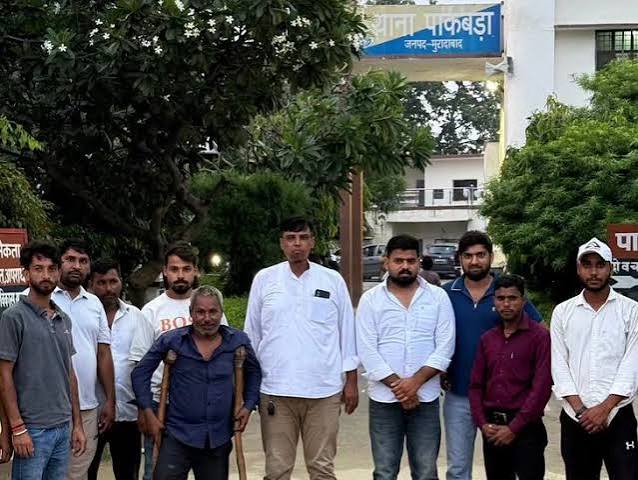
In Sabjipur village, under the Pakbara police station area of Moradabad, a Dalit youth was attacked with a sharp weapon while being hurled caste-based insults. The youth, who had returned from work in Kerala, suffered serious head injuries. Based on the victim’s complaint, police have registered a case against five accused under serious sections and the SC/ST Act. The victim, Ajit Kumar, son of Balram, stated in his complaint to the police that he returned home from Kerala on August 17, 2026, at around 8 p.m. After returning home, he went to a mechanic to pick up his bike, which had been given for service. While returning home, a DJ was playing on the road. Ajit parked his bike to watch the DJ. It is alleged that some boys came from behind the DJ and surrounded him shortly after. According to the victim, the accused used casteist slurs and abused him, saying, “You are a Chamar and a Bhimta, you believe in Bhima, what business do you have here?” They then surrounded him and attacked him with a sharp-edged weapon on his head, causing serious injuries. The accused also said, “Son of a Chamar, what can you do?” In the complaint, the victim named the accused who assaulted him as Bablu, son of Sher Singh, Akash, son of Ramavatar, Akash, son of Prakash, Chandrasen, son of Karan Singh, and Jain, son of Netrapal. Based on Ajit Kumar’s complaint, the Pakbara police station in-charge has registered a case under the SC/ST Act and relevant sections and has begun an investigation. Police say they will investigate the matter and take strict legal action against the culprits. Shrikant Sharma | Moradabad Courtesy: Hindi News