
Gujarat Dalit Youth’s Murder Recalls 1936 Horror: When a Dalit Patwari’s Chair Ignited a Mob’s Fury in Borsad
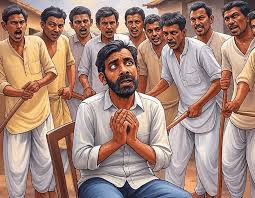
On March 6, 1938, at a meeting of the Bhangi community in Kasarwadi (behind Woollen Mills), Dadar, Bombay, chaired by Indulal Yadnik, Parmar Kalidas Shivram shared his harrowing experience. Gujarat – The brutal murder of 20-year-old Dalit youth Nilesh Rathore in Jarikhiya village, Lathi taluka, Amreli district, on May 22, 2025, has brought back memories of a horrifying incident from 1936 in Borsad, Kheda district, Gujarat. Documented by Dr. B.R. Ambedkar in Writings and Speeches, Chapter 5: Unfit for Association, the 1936 incident reveals the deep-rooted caste discrimination faced by Dalits, a reality that tragically persists today, as seen in Nilesh’s death. On March 6, 1938, at a meeting of the Bhangi community in Kasarwadi (behind Woollen Mills), Dadar, Bombay, chaired by Indulal Yadnik, Parmar Kalidas Shivram shared his harrowing experience. Kalidas, who had passed the Vernacular Final Examination in 1933 and studied English up to the 4th standard, initially applied for a teaching position with the Bombay Municipality but was rejected due to a lack of vacancies. He then applied for the role of a Talati (village patwari) through the Backward Classes Officer in Ahmedabad and succeeded. On February 19, 1936, he was appointed as a Talati in the Mamlatdar’s office in Borsad taluka, Kheda district. Though his family hailed from Gujarat, this was Kalidas’s first visit to the region. Unaware that untouchability extended even to government offices, he mentioned his Harijan (Dalit) identity in his application, expecting his colleagues to be aware of his background. However, upon arriving at the Mamlatdar’s office, the clerk scornfully asked, “Who are you?” When Kalidas replied, “Sir, I am a Harijan,” the clerk retorted, “Go away, stand at a distance. How dare you stand so near me? If this weren’t an office, I would have given you six kicks—what audacity to come here for service!” The clerk then ordered Kalidas to drop his appointment letter and certificates on the ground before picking them up himself, refusing to take them directly. Struggles with Basic Needs Kalidas faced immense challenges in Borsad. At the Mamlatdar’s office, drinking water was kept in cans in the verandah, managed by a waterman who served other clerks. However, Kalidas was barred from touching the cans, as his touch was deemed polluting. He was given a small, rusty pot for his use, which no one else would touch or clean. The waterman, reluctant to serve him, often slipped away when Kalidas approached, leaving him without water for days at a time. Finding a place to live was equally difficult. No caste Hindu in Borsad would rent him a house, and even the local Untouchables refused to offer lodging, fearing backlash from Hindus who disapproved of Kalidas’s attempt to work as a clerk—a position they believed was above his station. Food was another struggle; with no one willing to provide meals, Kalidas bought bhajias morning and evening, eating them in isolation outside the village. At night, he slept on the pavement of the Mamlatdar’s office verandah. After four unbearable days, he moved to his ancestral village, Jentral, six miles from Borsad, requiring him to walk eleven miles daily for a month and a half. The Mamlatdar later sent Kalidas to train under another Talati responsible for Jentral, Khapur, and Saijpur villages, with Jentral as the headquarters. For two months in Jentral, Kalidas learned nothing and was barred from entering the village office. The headman of Jentral was particularly hostile, once threatening him: “You fellow, your father, your brother are sweepers who sweep the village office, and you want to sit in the office as our equal? Take care, better give up this job.” The situation reached a breaking point when Kalidas was sent to Saijpur to prepare the village’s population table. Arriving at the village office, he found the headman and Talati working inside. Standing at the door, Kalidas greeted them with a “good morning,” but they ignored him. After standing outside for about 15 minutes, exhausted and humiliated, Kalidas sat on a chair nearby. Seeing this, the headman and Talati quietly left without a word. A Chair Sparks Mob Fury Within moments, a large crowd gathered around Kalidas, led by the village library’s librarian—an educated man whose involvement shocked Kalidas. It later emerged that the chair belonged to the librarian. Enraged, the librarian shouted at the Ravania (village servant), “Who allowed this dirty dog of a Bhangi to sit on the chair?” The Ravania forcibly removed Kalidas from the chair and took it away. Kalidas sat on the ground as the crowd stormed into the office, surrounding him. The mob, furious, hurled abuses and threatened to cut him to pieces with a dharya (a sharp, sword-like weapon). Kalidas pleaded for mercy, but the crowd remained unmoved. Desperate to save himself, Kalidas had a sudden idea: he asked the Ravania for a piece of paper and, using his fountain pen, wrote a note to the Mamlatdar in bold letters: “To The Mamlatdar, Taluk Borsad. Sir, Be pleased to accept the humble salutations of Parmar Kalidas Shivram. This is to humbly inform you that the hand of death is falling upon me today. It would not have been so if I had listened to the words of my parents. Be so good as to inform my parents of my death.” The librarian read the note and immediately ordered Kalidas to tear it up, which he did. The crowd continued to insult him, saying, “You want us to address you as our Talati? You are a Bhangi and want to sit on the chair?” Kalidas begged for forgiveness, promising not to repeat the act and to resign from his job. The mob held him there until 7 PM before dispersing, with neither the Talati nor the headman returning during that time. Deeply traumatized, Kalidas took 15 days’ leave and returned to his parents in Bombay. His story, shared at the 1938 Kasarwadi meeting, exposes the brutal reality of untouchability and caste violence in 1930s India. Kalidas’s quick thinking—writing the note to
Gujarat: How Dalit women are fighting hard to retain a 36-acre plot in Dholka
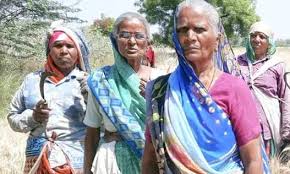
For over three decades, Baluben Makwana and others are battling gender disparity, caste hierarchy and an apathetic administration to retain land they transformed On May 16, a group of young men from the Darbar community, a backward caste, barged into the home of 76-year-old Dalit woman Baluben Makwana, in Vautha village of Ahmedabad’s Dholka taluka and threatened her. Makwana’s crime? Not only is she a Dalit and a woman but she also runs a farmers’ cooperative comprised entirely of Dalit women. For over three decades, they have been fighting against all odds to retain their ownership of a 36-acre plot of agricultural land in Dholka. The Darbars may be categorised as backward castes but in the ‘social order’ they rank several notches higher than Dalits. To the men who threatened Makwana that’s all that matters. Positioned higher in the social order, they see nothing inappropriate, let alone criminal, about demanding that the septuagenarian and her Jai Bheem Mahila Kheti Mandal (JBMKM) vacate the plot they transformed from a wasteland into a fertile agricultural land through 36 years of relentless hard work. Chasing a ‘mad dream’ This caste ‘privilege’ dates back ages. The Darbars have long been the dominant caste group in Vautha because of their large numbers in this village of 2,500-odd families. For generations, Vautha’s 70 Dalit families had lived at one end of the village and earned a livelihood by skinning dead animals and manual scavenging. It was this decades-old ‘system’ that Makwana shook up in 1989 when she mobilised 50 other Dalit women of Vautha to form the JBMKM. Priti Vaghela, a former member of Navsarjan Trust, Gujarat’s oldest Dalit rights organisation, which helped to form the JBMKM told The Federal, “Dalits of Vautha belong to the Valmiki sub-group, which is considered lowest in the social hierarchy even among the Dalits. In Vautha, Dalits are particularly vulnerable as the men are not earning much and are forcing the women into manual scavenging.” Vaghela recalled that prior to 1989, Dalit women of Vautha would be forced to clean open latrines used by upper caste women because the Dalit men didn’t earn enough to run a household. “At first, we thought we should form a collective of Dalit men to cultivate the land but most Dalit men backed off after being attacked by Darbar men. That’s when we encouraged their wives to get into farming. Over the years, sun or rain, they toiled for hours and stood tall against all atrocities by the Darbars,” explained Vaghela. Together, the 51 Dalit women that came together to form the JBMKM took a 36-acre plot, then a notified wasteland, from the local municipal body. Over the next decade, while locals, including their own family members, and the administration scoffed at their mad dream to become self-reliant farmers, Makwana and her comrades quietly toiled away nurturing the ‘wasteland’ they could call their own. By 2000, the JBMKM had achieved what many believed was impossible. The wasteland was now not only cultivable but was producing two crops a year. The yield was not just enough to meet their daily needs but there was also sufficient surplus to sell in the market and earn a modest income for the collective. In many ways, the JBMKM gave Vautha a new identity. The village known to Gujaratis largely for the Vautha Mela, an annual animal fair the village hosts along the Saptsangam, the confluence of the Vatrak and Sabarmati rivers, had become synonymous with this Dalit women’s farming collective. Troubles begin Then the troubles began – threats from castes higher in the social hierarchy, land grab attempts and even pressures from the administration to return the plot the women had ‘acquired’ without any official documentation to establish their ownership. Since then, fending off caste bullies and even government officials who storm in at their whim and fancy demanding that she and the other Dalit women farmers give up the land, has become part of Makwana’s daily chores. “This is not the first time the Darbars have threatened us to vacate the land we have cultivated for years with our blood and sweat. Thankfully, no one was hurt this time. They just swung around some furniture and punctured the tyre of the tractor we own. This happens every time during harvest season. They also try to destroy the crops but we have always managed to ward them off,” Makwana told The Federal. Last month, things had taken a nasty, although not unfamiliar, turn. The Darbars arrived with a posse of policemen from the local thana, shared Makwana. “The police tried to intimidate us and said we will be arrested under the Gujarat Land Grabbing (Prohibition) Act, 2020,” she said. The Act criminalizes land grabbing and involves 10 to 14 years of imprisonment along with a fine in case of a conviction. “We told them that we will give our lives but we won’t give up this land,” added the JBMKM founder. Fruits of hard labour Makwana claimed that it was purely the hard work and determination of the women in her collective that transformed the 36-acre wasteland plot into a sprawling agricultural field that today yields groundnut, castor and cotton crops. The sale of crops helps the JBMKM to register annual earnings of around Rs 8 lakh annually. “I still remember the first time I hit the wasteland with my spade. It was completely infested with gando baval (prosopis julifora, a thorny invasive wild shrub that is difficult to clear out as it regenerates if even a tiny root is left inside the earth; its pods are also toxic for livestock). For the initial few years, we did not have support of our families either. It took us 10 years to make this land cultivable. In the year 2000, we sold our first yield and by 2004 we bought a tractor as the land had started yielding two crops a year. That is when the Darbars began making trouble; now everyone wants a piece of it,” Makwana
MP: Ambedkar statue dispute in Gwalior High Court premises: Bhim Army workers beaten up by lawyers
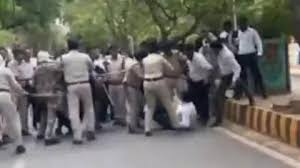
After this entire incident, a situation of caste tension has arisen in Gwalior. On the one hand, Ambedkar followers are calling this entire incident a conspiracy to suppress the voice of Dalits. Bhopal. The dispute that arose in the Gwalior High Court Bench premises over the installation of the statue of Constitution maker Dr. Bhimrao Ambedkar has now turned into caste tension. On Saturday evening, this tension took a violent turn when some lawyers of the Bar Association beat up Bhim Army leader Rupesh Kane and his associates in the presence of police force. This incident took place outside the City Center premises of the High Court, where heavy police force was already deployed. The roots of this entire incident were laid when the news of the plan to install the statue of Baba Saheb Dr. Ambedkar in the High Court premises came to light. A group of Ambedkarite lawyers reached the High Court with the statue and talked about installing the statue on May 14. They claimed that they have received permission for this. A crane was also called for this, but as soon as the installation process started, the Bar Association protested against it and created a ruckus. The Bar Association says that the seven-member building committee of the High Court has not given permission to install the statue. They argue that such activities in the judicial complex affect the dignity of the court. Bheem Army arrived after the lawyers’ warning After the clash on Thursday, a group of lawyers had openly warned that whatever happens in the court premises, Ambedkar’s statue will not be allowed to be installed. They had said that “This is a court, not a street or a locality, let the Bhim Army come and show itself here.” In response to this warning, Bhim Army leader Rupesh Kane reached outside the High Court premises with his team on Saturday evening. Police force was already deployed there, but as soon as the court time ended at 5 pm and the lawyers came out, the situation worsened after seeing Rupesh Kane. Despite the police stopping them, the lawyers surrounded the Bhim Army leaders and attacked them. VIP Road became a battlefield The VIP road outside the High Court turned into a battlefield for some time. Police, lawyers and Bhim Army members were seen all around. As soon as slogans of Jai Bhim were raised, the anger of the lawyers flared up and they beat Rupesh Kane and his companions with kicks and punches. The police tried to control the situation and removed the Bhim Army leaders from there and took them to a safe place. In a conversation with The Mooknayak, Bhim Army leader Rupesh Kane said that he was standing outside the High Court premises, when suddenly a group of lawyers came and attacked him. According to Rupesh Kane, the attacking lawyers had sticks. They beat him badly by throwing him on the ground and allegedly abused him with casteist slurs. Roopesh said that a complaint has been lodged with the police about this incident, but the police say that they are investigating the matter. No FIR has been registered in this case so far. In view of the situation after the uproar, the administration has increased the police force. A large number of police forces are now deployed around the High Court premises. Regarding this entire dispute, Additional SP Krishna Lalchandani said, “A decision was to be taken on when and how the statue would be installed. Before this, a dispute arose between the two parties. The police have brought the situation under control. Now the next hearing will be held on May 19.” Police’s role under question After this incident, questions are also being raised on the role of the police. Eyewitnesses say that the police was present on the spot, but it did not make enough efforts to stop the lawyers. The Bhim Army has expressed displeasure over this and alleged that this attack was pre-planned and the administration remained a mute spectator. Tension in Gwalior After this entire incident, a situation of caste tension has arisen in Gwalior. On the one hand, while Ambedkar followers are calling this entire incident a conspiracy to suppress the voice of Dalits, a section of lawyers is calling it a case of violation of the dignity of the judicial complex. Now the entire matter will be heard on May 19, in which it will be decided whether permission will be given to install Ambedkar’s statue or not. At present, there is tight security in the Gwalior High Court premises and the district administration has intensified preparations to deal with any situation. Courtesy: Ankit Pachauri, Hindi News
MP High Court’s first Dalit Chief Justice Suresh Kumar Kait retires, gets emotional at farewellceremony
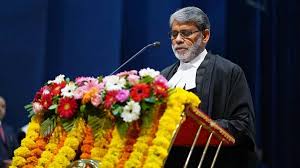
Heared 3810 cases and left a deep mark in the judiciary, took sensitive decisions for the poor and the disabled Bhopal. Madhya Pradesh High Court’s first Dalit Chief Justice Suresh Kumar Kait is retiring on 24 May. On Tuesday, when a farewell ceremony was organized in his honor in the High Court premises, Justice Kait became emotional remembering his life’s struggles. He said that being the son of a laborer father, he himself completed his studies till matriculation by working as a laborer. “I never thought that I would become a judge,” — saying this in the ceremony, he said in an emotional voice that the conditions in which he studied did not even have rooms for the school. “Classes were held under the trees,” he said. Tribute paid to the architect of the Constitution Justice Kait recalled the important moments of his career when he first became a judge of the Delhi High Court in 2008, on the same day Badar Durrez Ahmed, son of former President Fakhruddin Ali Ahmed, was also sworn in. On that historic day, everyone paid tribute to Dr Babasaheb Bhimrao Ambedkar — who drafted the Constitution to provide equal opportunities to the working class and underprivileged community of India. Sharing his experience as Chief Justice, he said that the Madhya Pradesh High Court has a sanctioned strength of 53 judges, but at present only 33 judges are working. This not only slows down the process of justice, but also puts a lot of work pressure on the judges. “I have heard 3810 cases since September 27,” Helping poor students become civil judges During his tenure, Kait abolished the requirement of 70% marks in the recruitment of civil judges. He said, “Most of the poor students studying in government universities are not able to score 70% marks, while students of private universities do. Due to this rule, poor students were out of the civil judge examination.” Initiative to destroy the waste of Bhopal gas tragedy Chief Justice Kait also monitored the process of destroying the dangerous chemical waste of Bhopal gas tragedy. He took the initiative to destroy the waste of Union Carbide, although many petitions were filed against it, but Kait took forward the process of burning the waste with scientific process and government permission. He was sensitive towards the disabled and the victims Kait set an example of sensitivity in the judiciary. In a case, when he saw a disabled person wandering in the court with applications again and again, he ordered his transfer without hearing. The matter of permission for air travel for disabled children also came before him, which he resolved immediately. Ban on construction of temples in police stations During the hearing of a PIL, he questioned the government as to why temples are being built inside police stations and with whose permission. Giving a clear order, he said that permission should not be given to build temples in new police stations. His decision strengthens the constitutional spirit of secularism. Journey of Chief Justice Kait Chief Justice Suresh Kumar Kait was born in a laborer family in Haryana. After his early education, he obtained an LLB degree from the Central University of Delhi. In the field of advocacy, he practiced in Delhi and during this time he was also a junior to former President Ram Nath Kovind. His judicial service started in the year 2008, when he was appointed a judge of the Delhi High Court. After this, in the year 2023, he was made the Chief Justice of Madhya Pradesh High Court. After his contribution to the judiciary, he will retire on 24 May 2025. Courtesy: Ankit Pachauri, Hindi News
MP: Dalit youths in Rajgarh were subjected to inhuman treatment and assault, their faces were blackened and they were paraded in the village
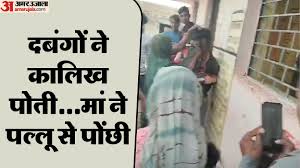
Police registered a case under SC/ST Act after the video of the incident of May 13 surfaced Bhopal. The brutality against two youths of Dalit community in a village in Kurawar police station area of Rajgarh district of Madhya Pradesh has shaken the state. These youths were first beaten up in the field, then their faces were blackened and they were paraded in the entire village wearing a garland of shoes and slippers. This incident is of May 13, but the matter gained momentum after its video surfaced on Thursday. The victim youths lodged a complaint at Kurawar police station, after which the police have registered a case against the accused under the Scheduled Castes and Scheduled Tribes (Prevention of Atrocities) Act (SC/ST Act) and other sections. What is the matter? The victim youth told that his father had borrowed about Rs 6 lakh from some people of the village, which they were preparing to return. But before paying the amount, the goons took over 10 bighas of their ancestral land. The victim said, “We had said that take one bigha of land and adjust the rest of the money, but they got angry and did this atrocity in the name of teaching us a lesson.” Caught in the field, clothes removed, face blackened The victim said that on May 13, the accused reached the field and caught him and his companion there. He said, “Our clothes were removed, face blackened and hands were tied and garlanded with shoes and slippers. After this, we were publicly insulted in the entire village,” After the incident, the victim’s father tried to reach a compromise in the village. At that time, Yagya-Havan was going on in the village, so he did not register a complaint in the police station. But as soon as this video went viral on social media, the police came into action. First the police kept talking about intoxication, then FIR registered Initially, Kurawar police kept saying that the youth had reached the village in a state of intoxication and a dispute had occurred there. But when the video surfaced and the matter heated up, police station in-charge Sangeeta Sharma informed on Thursday night that action has been taken on the complaint of the victim. The police have registered a case in the matter on charges of assault, insulting behavior and cruelty to persons of Scheduled Castes and Tribes. Anger among Dalit organizations, demand for arrest After the incident, Dalit organizations have demanded that the accused be arrested immediately and the victim’s family be given security. The organizations say that this matter is not just about caste insult, but a direct attack on the values of the Constitution, which cannot be tolerated under any circumstances. Speaking to The Mooknayak, Bhim Army leader Vinod Yadav Ambedkar said that atrocities are being continuously committed against Dalits in Madhya Pradesh and the government has completely failed to stop them. He demanded that strict action be taken against the accused and the victims be given security so that they can live without fear. Congress attacks the government Speaking to The Mooknayak, SC Congress President and former member of the State Scheduled Caste Commission Pradeep Ahirwar targeted Chief Minister Mohan Yadav. He said that the government’s silence on the atrocities being committed against Dalits is extremely shameful. Pradeep Ahirwar said that the Chief Minister is only making announcements, but no concrete action is visible at the ground level. He demanded that the government should give strict punishment to the culprits and provide immediate help to the victim’s family. Courtesy: Ankit Pachauri, Hindi News
Called Pakistani firing a big tragedy, assured help to the victims, what did Rahul Gandhi do in Poonch?

Congress leader Rahul Gandhi reached Poonch in Jammu and Kashmir on Saturday to meet the people affected by Pakistani firing after ‘Operation Sindoor’. Gandhi assured the victim families that he is with them in this difficult time. Rahul also met school children and encouraged them by saying that he loves them very much. Rahul met the victims of Pakistani firing in Poonch Jammu: Congress leader Rahul Gandhi reached Poonch in Jammu and Kashmir on Saturday to meet the people affected by Pakistani firing after ‘Operation Sindoor’. Gandhi assured the victim families that he is with them in this difficult time. Rahul also met school children and encouraged them by saying that he loves them very much. He said that this is a very big tragedy. Many people died in this. Resources have also been damaged on a large scale. We met people. Learned about their pain and suffering. We tried to understand the problems of the people. He said that during the meeting, people told me some of their problems and urged me to raise it at the national level. I will definitely raise it at the national level and I will try to solve the problems of these people. Whom did Rahul Gandhi meet? Congress’ Jammu and Kashmir unit president Tariq Hameed Karra had earlier said on Saturday that Gandhi visited structures affected by the shelling, including a gurdwara, a temple, a madrasa and a Christian missionary school. He also met bereaved families and members of civil society. He said Gandhi is the first national leader to reach out to the affected population to express solidarity and share their pain. Gandhi had said in his visit to Jammu and Kashmir last month that the concept behind the terrorist attack was to divide the people of the country and it is necessary that India unites and defeats terrorism forever. Rahul Gandhi’s Poonch visit In fact, Leader of Opposition in Lok Sabha Rahul Gandhi visited Poonch and interacted with the affected people for more than an hour. These included families who lost their members in the shelling between May 7 and May 10. Rahul Gandhi told reporters that this is a big tragedy. Many people have lost their lives. They (Pakistani army) have attacked places of common citizens. I talked to people and tried to understand their problems. They have asked me to raise their issue at the national level, which I will do. Standing strongly with the victim families – Rahul He later wrote on the social media platform ‘X’ that I met the families of those who lost their lives in Pakistan’s shelling in Poonch today. Broken houses, scattered belongings, moist eyes and painful stories of losing loved ones in every corner – these patriotic families bear the biggest burden of war every time with courage and dignity. Salute to their courage. Gandhi said that I stand strongly with the victim families – I will definitely raise their demands and issues at the national level. He was accompanied by the party’s Jammu and Kashmir unit president Tariq Hameed Karra and All India Congress Committee general secretary G A Mir. What did Rahul Gandhi say to school children in Poonch? Rahul Gandhi also met school children in Poonch. He told them that you guys should not panic. I am standing with you in this difficult time. I love you guys very much. You guys do not need to take tension at all. The Congress leader told the school children that to get out of this difficult time, you guys should study diligently and make a lot of friends. I assure all of you that one day everything will be fine. Rahul Gandhi shared the video Rahul had also gone after the Pahalgam attack This is the second visit of the Leader of Opposition in the Lok Sabha to the Union Territory since the brutal terrorist attack in Pahalgam on April 22. 26 people lost their lives in that terrorist attack, most of whom were tourists. Gandhi had visited Srinagar on April 25 to meet the people injured in the terrorist attack. He had met the Lieutenant Governor, Chief Minister and many others of Jammu and Kashmir during that time. Rahul reached Jammu on Saturday morning A Congress leader said on Saturday morning that Gandhi arrived at Jammu airport on Saturday morning and left for Poonch by helicopter to visit the areas affected by the cross-border shelling and meet the bereaved families. In response to the Pahalgam terror attack, India carried out precision strikes on nine terrorist hideouts in Pakistan and its occupied Kashmir late on May 6 under ‘Operation Sindoor’. Since then, shelling had increased in the Poonch sector. 13 people killed in Pakistani shelling in Poonch district alone 28 people were killed in artillery fire and missile and drone attacks by Pakistan in Jammu and Kashmir between May 7 and 10, of which 13 were killed in Poonch district alone and more than 70 were injured. Thousands of people living in areas near the Line of Control and International Border areas left their homes and took shelter in government relief camps. India and Pakistan agreed to end the military confrontation on May 10 after four days of continued drone and missile attacks across the border. Curated by: Sujeet Upadhyay Courtesy : Hindi News
UP: Dalit youth burnt alive in Prayagraj after being called on the pretext of work, public outraged; former chief ministers cornered the government over rising crime graph
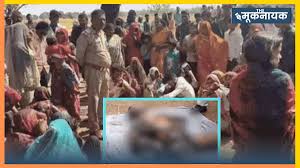
The police have registered an FIR under murder and attempt to destroy evidence, while forensic teams are collecting evidence. Meanwhile, Bahujan Samaj Party chief Mayawati has termed the incident as “extremely sad and worrisome” and demanded strict action from the government. Prayagraj- A heart-wrenching incident on the night of April 12 in Itaura village of Karchana police station area of Prayagraj district of Uttar Pradesh created a sensation in the entire area. 30-year-old Dalit youth Devi Shankar was allegedly murdered in a planned manner, after which his body was burnt to destroy evidence. His burnt body was found in a Mahua orchard located east of the village at 5:30 am on Sunday. Azad Samaj Party leader and Nagina MP Chandrashekhar Azad claimed that this murder was motivated by caste hatred and that some people called Devi Shankar from his house on the pretext of carrying a load and burnt him alive by pouring petrol on him. According to Dainik Bhaskar’s report, 30-year-old Devi Shankar, son of Dalit Ashok Kumar, who lives in Isota village, used to work as a labourer. He has 3 children. A daughter Kajal and two sons Suraj, Akash. His wife has died. He was the only son of his parents. Devi Shankar had left home on Saturday evening. Some people had taken the youth from home on the pretext of threshing wheat. When he did not return home the whole night, the family started looking for Devi Shankar in the morning. Meanwhile, the villagers came to know that the half-burnt body of a youth was lying in the garden. When the family reached there, they started crying and shouting. Father Ashok Kumar said – 4 youths from the village had called and taken away his son Devi Shankar. He was told that he had to do the work of threshing wheat. We saw my son accompanying them. MP Chandrashekhar also alleged that the killers hurled caste-related abuses at the deceased’s family and threatened to “burn them to death in turns like this.” According to a report in The Indian Express, Yamunanagar Deputy Commissioner of Police Vivek Chandra Yadav said that initial investigations suspect the murder to be due to an old rivalry, and six people—Dilip Singh, Vinay Singh, Ajay Singh, Manoj Singh, Sonu Singh, Shekhar Singh, and Monu—have been detained. The police have registered an FIR under sections of murder and attempt to destroy evidence, while forensic teams are collecting evidence. Meanwhile, Bahujan Samaj Party chief Mayawati has called the incident “extremely sad and worrisome” and demanded strict action from the government. Chandrashekhar demanded the immediate arrest of the killers, strict action under the SC/ST Act, trial in a fast-track court, and security, compensation and employment to the victim’s family. Amidst the atmosphere of fear and anger in the village, the police have deployed additional forces, and a thorough investigation of the case is underway. Former Chief Minister and BSP supremo Mayawati posted on x regarding the incident. She wrote, “The incident of the brutal murder of a Dalit by feudal elements in Karchana, Prayagraj, UP is extremely sad and worrying. The government must take strict action against such criminal, anti-social and feudal elements running amok in the state and establish the rule of law. Also, the government should take the incidents of disrespect to the statue of the Constitution maker Bharat Ratna Param Pujya Baba Saheb Dr. Bhimrao Ambedkar very seriously and take strict action against such criminals who create tension and violence in the society so that the recurrence of such incidents can be stopped”. National President of Samajwadi Party (SP) and former Chief Minister of Uttar Pradesh Akhilesh Yadav linked this incident to misuse of power and caste violence. Posting on X, he said, “The heinous crime of burning alive a Dalit youth in Prayagraj by a dominant party has proved that the unwanted patronage and arrogance of the power to its people is now making people commit murders openly. By carrying out such an incident before Baba Saheb’s birth anniversary, some powerful people want to give a message of their power to the society. They are negative and tyrannical people with a sick mindset. Let’s see if anyone has the moral strength and energy left to send a bulldozer to the house of these domineering criminal elements or they have surrendered before the criminals and have become cold. If there can be a word lower than ‘reprehensible’ then it should be used to condemn this misdeed. Courtesy : Geetha Sunil Pillai, Hindi News
UP: Bulldozers run on the possession of the accused who burnt a Dalit youth alive in Prayagraj, this is how the painful incident was carried out.
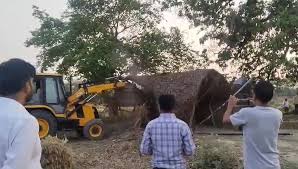
The accused beat the Dalit youth half to death. They prepared to bury him alive, even dug a pit. But then the attackers changed the plan. They collected straw and set it on fire to burn Devi Shankar. Uttar Pradesh: A 35-year-old Dalit youth was murdered in Prayagraj on April 12. The accused burnt him alive. It is being told that the only fault of the youth was that he refused to harvest wheat. On Tuesday, the administration ran a bulldozer on the illegal construction of the accused involved in the murder. This action was taken under the ‘Zero Tolerance’ policy of the Yogi government, in which strict steps are being taken against the criminals. According to the report of Dainik Bhaskar, the family members were enraged after finding his half-burnt body on the morning of April 13. They not only vandalised the house of the accused, but also did not allow the police to lift the body for 2 hours for postmortem. Later, after the postmortem, on the night of 13 April, the police forcibly cremated the Dalit youth. After this, people’s anger increased. People gathered on the road and started creating a ruckus. On Monday, Congress MP Ujjwal Raman Singh and Congress State President Ajay Rai reached to meet the victim’s family. Angry villagers also stopped their vehicles. They blocked Hanuman Mori Road. After being persuaded by the police and the MP, the villagers agreed after about 2.30 hours and moved away from the road. This entire matter is of Karchana area of Yamunapar. At around 6 pm, a bulldozer was run on the land occupied by the accused. What was the whole matter? Dalit Ashok Kumar, who lives in Isota village, has a 35-year-old son Devi Shankar who used to work as a labourer. He has 3 children. One daughter is Kajal and two sons are Suraj and Akash. His wife has died. He was the only son of his parents. On 12th April, some people took Devi Shankar to harvest wheat. When he refused to harvest wheat, the accused beat the Dalit youth half to death. They prepared to bury him alive and even dug a pit. But then the attackers changed their plan. They collected straw and set it on fire to burn Devi Shankar. This incident happened on 13th April at 6 am. Then seeing the villagers coming towards the fields, the accused ran away. After the half-burnt body of the Dalit youth was found, a ruckus started. The father gave a statement to the police that 7 people including Chhuttan Singh of the village killed my son because he was not going to harvest wheat. The dead body was not allowed to be lifted for 2 hours When the police reached the village after getting the information about the murder, the people did not allow the body to be lifted. They started protesting by keeping the dead body in front of the police. During this time, the police kept explaining to the villagers for about 2 hours. People demanded compensation of Rs 7 crore, security of license and allotment of house. Meanwhile, some people also attacked the house of the main accused Chhuttan Singh. However, the police pacified the people by explaining. The police have arrested 6 accused. Now the main accused Chhuttan Singh is still out of the reach of the police. ACP Karchana Varun Kumar said, 4 youths of the village took Devi Shankar at night on the pretext of work. His body was found in the morning. The family members say that the same people killed him where he went to work. Looking at the body, it seems that he was burnt after killing him. The matter of burning him alive is not clear. The family members allege that he was burnt alive. 6 people have been arrested and are being questioned. Due to contradictions in their statements, investigation is going on from many angles. Nephew Rahul said that some people came in the evening and took his uncle away. Those people had said that there was work to harvest wheat. What happened there, nothing is known. Dalit Ashok Kumar’s 30-year-old son Devi Shankar, who lives in Isota village, used to work as a labourer. He has 3 children. One daughter Kajal and two sons Suraj, Akash. His wife has died. He was the only son of his parents. According to the Patrika report, investigation has revealed that the deceased Devi Shankar had relations with a girl from the accused family, due to which the accused got angry and hatched a conspiracy. He was called on some pretext, made to drink alcohol and then strangled to death. After this, an attempt was made to burn the body to destroy the evidence. The accused arrested and sent to jail by the police include Dilip Singh alias Chhuttan, Ajay Singh, Manoj Singh, Sanjay Singh alias Sonu, Shekhar Singh, Mohit Singh, Awadhesh Singh alias DM and Vimlesh Gupta alias Baba Don. The main accused Vinay Singh is still absconding. This incident once again shows that the administration is no longer shying away from taking a tough stand against crime and criminals. Courtesy: Rajan Chaudhary, Hindi News
Dalits’ rights on 927 acres of land! Hundreds arrested, hunger strike in jail… Anger erupted against Punjab government
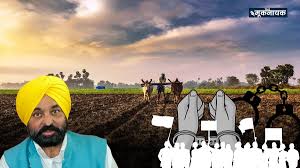
Workers of the Jamin Prapti Sangharsh Committee went on hunger strike in jail demanding Dalit rights on 927 acres of land, hundreds arrested, serious allegations against the administration. Sangrur – The ongoing movement for land rights in Punjab took a new turn when more than 125 workers of the Jamin Prapti Sangharsh Committee (ZPSC), who were arrested during a demonstration in Sangrur on May 20, started an indefinite hunger strike in the jail premises. The protesters demand that 927 acres of land of Jind Riyasat be distributed among landless Dalit families and the proposed ‘Begumpura’ be settled on it. This demand arose after the death of Satbir Singh, the last ruler of Jind Riyasat, in August 2023. ZPSC says that this land is located in Beed Iswan village of Sangrur district and under the Land Ceiling Act, no person can own more than 17 acres of land. Therefore, this land should come under the government and be given to landless Dalits. ZPSC president Mukesh Maloud and treasurer Bakkar Singh Hathoa alleged that on May 20, when the activists were peacefully marching towards Beed Iswan village, they were forcibly stopped and arrested. Some people were released late night, but more than 400 protesters are still in custody, of which about 300 have been lodged in various jails. According to a report published in the Indian Express, Pendu Khet Mazdoor Union (PKMU) president Tarsem Peter said that 70 women are lodged in Sangrur jail, 35 in Malerkotla, 66 in Patiala, 85 in Nabha and about 100 in Bathinda jail. The location of many other activists has not been made public by the administration so far. Peter said, “This is a violation of every principle of democracy.” The ZPSC has alleged that the activists lodged in jail are being treated inhumanly. They are kept in overcrowded barracks, denied clean drinking water, poor food arrangements and even essential items sent by their families are being snatched away. Several student activists are also involved in the agitation, including Sukhdeep Kaur of the Punjab Students Union. They have reportedly not even been allowed to take their exams in jail. The ZPSC has called it “dictatorship and murder of democracy”. Following the development, the Pendu Mazdoor Union has launched a statewide campaign against the Aam Aadmi Party (AAP) government. “More than 400 Dalit labourers — men and women — have been arrested and many are still missing. This entire action is unjust and undemocratic,” said Avtar Singh Rasoolpur, general secretary of the union. Kashmir Singh Ghugashor, the press secretary of the union, said, “The government is standing with the landlords and corporate houses and is preventing the settlement of Begumpura, a proposed colony for landless labourers on 927 acres of land. We demand the unconditional release of all the arrested activists.” On this issue, Sangrur Deputy Commissioner Sandeep Rishi said, “Out of 927 acres, about 800 acres is forest land, while 125 acres of cultivable land is in the possession of some private individuals who are related to the late ruler of Jind state, Satbir Singh. The ownership of this land has not yet been handed over to the government, and the matter is pending in the Punjab and Haryana High Court. The court has ordered to maintain status quo, so the government or any organization cannot claim it right now.” Meanwhile, Satpal Virdhi, former general secretary of Sant Sarvan Das Ji Sachkhand Balan, the largest dera of Ravidasiya community from Jalandhar, has written a letter to Punjab Chief Minister Bhagwant Mann condemning this action. He wrote, “This arrest is injustice to the Dalits of Punjab. It is against the spirit of the Constitution and an attack on the entire concept of justice.” Virdhi has demanded a fair investigation of all the arrests, immediate release and transparent dialogue with grassroots organizations. He said, “This demand of the landless people is not alms, it is their constitutional right. The land reform law was implemented in 1972, but till date it is only on paper and in reality there is repression.” This ongoing struggle for land rights is now giving a new direction to the questions of human rights and social justice in the entire state and the country. Courtesy : Rajan Chaudhary, Hindi News
Bihar: Patna Municipal Corporation is getting sewage cleaned before the monsoons—Safai Karamchari Commission took suo motu cognizance of the complaint of manual scavenging by a 23-year-old Dalit engineering student!
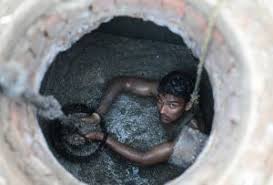
NCSK has directed Patna District Magistrate Dr. Chandrashekhar Singh to immediately investigate the incident. The Commission has asked to submit a detailed action report (ATR) in the prescribed format within 15 days. New Delhi/Patna- The National Commission for Safai Karamcharis (NCSK) has taken suo motu cognizance of a serious complaint of manual scavenging in Patna, Bihar, which highlights violations of the Prohibition of Employment as Manual Scavengers and Their Rehabilitation Act, 2013 and the Scheduled Castes and Scheduled Tribes (Prevention of Atrocities) Act, 1989. The complainant Shubham Kumar filed a complaint through NCSK’s online portal on May 10, 2025 (Complaint No. 102574), mentioning the incident that took place on April 28 at Chandmari Road, Kankarbagh, Mithapur, Patna. The complaint alleges that persons possibly belonging to the Scheduled Caste community were forced to do manual cleaning of sewage and manholes without any safety equipment or mechanical aid. This act is a clear violation of the 2013 Act, which The Act prohibits manual scavenging and makes mechanised cleaning of sewers and septic tanks compulsory, and is violative of Articles 17 (Abolition of Untouchability) and 21 (Protection of Life and Personal Liberty) of the Constitution of India. The complainant has sought the following reliefs: 1. Immediate investigation of the violation of caste-based discrimination under the 2013 Act and Article 17. 2. Registration of a First Information Report (FIR) under the 2013 Act, the SC/ST Atrocities Act, and relevant sections of the Indian Penal Code (IPC) for endangering human life. 3. Identification of the names, social category and employment status of the victims. 4. Compensation of Rs 10,00,000 to each victim as per the 2014 Supreme Court judgment Safai Karamchari Andolan vs Union of India. 5. Prosecution against responsible officials of the Patna Municipal Corporation (PMC) and supervisory officials who failed to prevent the incident. 6. If an FIR is not registered, So proper written reasons for this. The complainant has warned that if no action is taken, he will file a contempt petition against NCSK, Bihar State and PMC, as well as approach the Patna High Court under Articles 226 and 215 of the Constitution. Giving more details of the case, Shubham told The Mooknayak that the incident of April 28 happened in front of his eyes. In his colony, the employees of the cleaning contractor were cleaning the manholes naked, they did not have any safety equipment nor were they given any kit to wear during cleaning. Shubham told that the work of cleaning and maintenance of manholes and sewer lines is going on in the entire city before the rains and the safety of the employees and their rights are being grossly ignored. Along with the complaint, four time-stamped, geo-tagged photographs have also been sent which show workers cleaning human excreta and opening manholes without protective equipment, which underlines the dangerous and inhuman nature of this work. After Shubham’s complaint, a committee of the National Safai Karamchari Commission was formed. The NCSK has initiated an inquiry into the matter exercising its authority under the Rules of Procedure, 2019 and Section 31 of the 2013 Act, which empowers the Commission to monitor the implementation of the Act and inquire into complaints of non-compliance. In a letter dated May 2025 (DO No. 11059/50/7/13/20-RAD), the District Magistrate of Patna, Dr Chandrashekhar Singh has been directed to conduct an immediate inquiry into the incident. The Commission has requested to submit a detailed action taken report (ATR) in the prescribed format within 15 days, seeking information on compensation provided to the victims as per the Manual Scavengers Rehabilitation Rules, 2013 and SC/ST (Prevention of Atrocities) Rules, 2016. A copy of the letter has also been sent to the Chief Secretary of Bihar for action. Courtesy : Geetha Sunil Pillai, Hindi News