
Dalit basti stuck between two gram sabhas: 500 people from 60 houses deprived of government schemes in Azamgarh
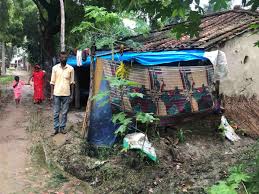
A Dalit basti located between Mohammadpur and Rani ki Sarai blocks in Nizamabad area of Azamgarh is deprived of development. Located between Aseelpur and Fariha gram sabhas, this basti has 500 people living in about 60 houses. Local people know it as Aseelpur Dalit basti. Being between two different gram sabhas, this basti is unable to avail the benefits of government schemes. Aseelpur gram sabha has 40 houses and Fariha gram sabha has 20 houses. The biggest problem of the basti is the lack of drains. Due to the absence of drains, people have made arrangements for the drainage of dirty water by digging pits in front of their houses. Aseelpur Pradhan Rajinder Yadav has constructed only twenty meters of drain. This drain is completely blocked and due to the absence of drains ahead, water accumulates on the road. The one kilometre long Khadanja from Lucknow-Ballia road to Sharda Sahayak Khand 32 was built 20 years ago. Now it has become dilapidated and it is difficult to walk on it. Village residents Suresh, Tilak, Rajkumar Ram, Sharda Devi, Saroji, Rajesh, Ram Milan, Santosh and Akhilesh said that due to lack of drainage during the rainy season, they have to stay awake all night and remove the water accumulated in the houses. They also told that only a few rich people have got the benefit of the housing scheme. Villagers have applied online several times for the construction of toilets. They also met the Pradhan and requested, but no action has been taken so far. Thus, this Dalit colony is deprived of development work by being trapped between two blocks and two Gram Sabhas. Shah Alam Courtesy: Hindi News
Raksha Bandhan celebrated with 100 families of Dalit community: Youth Congress District President tied Rakhi to sisters in Amethi
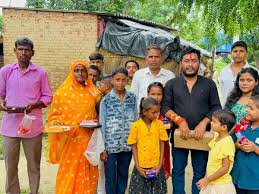
Youth Congress District President Shubham Singh celebrated this festival with more than 100 sisters of Dalit community in Amethi on Saturday. He assured all the sisters that he will stand with them in every situation in their happiness and sorrow. Shubham said that it is his resolution to reach the person standing in the last row of the society and understand their feelings. Youth Congress District President said that Raksha Bandhan is not just a thread. It is a symbol of trust, love and security. He said that the belongingness and blessings received by celebrating this festival among the deprived class is the biggest honor for him. Many workers including Rinku Kumar, Pawan Verma, Dinesh Kori, Ravi Maurya were present in the program. Everyone together made this special day memorable. Arun Kumar Gupta Courtesy : Hindi News
Dalit woman rape case: Police arrested the accused in Etah, sections increased after the statement of the victim
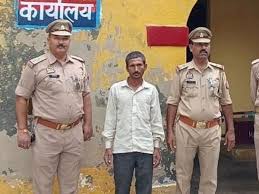
Awagarh police station of Etah district has arrested a person and sent him to jail on the charge of raping a 48-year-old Dalit woman. Earlier, a case of molestation was registered against the accused in Awagarh Kotwali. The victim had accused the accused of forcefully raping her and biting her face. After the statement of the victim was recorded before the magistrate, the section of rape was added in the case. The incident took place on Wednesday when the victim was returning home with grass. During this time, the accused Hanif, who was already naked, raped the woman. When the victim informed her family about the incident, they caught the accused and admitted him to the hospital. The police arrested the accused Hanif on August 9 at around 12:10 pm. The accused has been charged under sections 64(1), 352, 351(3), 115(2) B.N.S. And a case is registered under 3(2)va SC ST Act. 42-year-old Hanif son of Noor Mohammad is a resident of Jinawali village. After the arrest, necessary legal action is being taken at the police station. Etah Police Captain Shyam Narayan Singh has issued strict instructions to maintain law and order. Continuous action is being taken against the criminals. The police team that made the arrest included Sub-Inspector Vijay Singh, Head Constable Omveer Singh and Head Constable Ramtej Singh. According to police officials, such action against criminals will continue so that law and order is maintained in the area. Nand Kumar Courtesy : Hindi News
In The Salt Pans Of Thoothukudi, A Rs-10 Patriarchal Tax On Dalit Women Speaks To Enduring National Discrimination
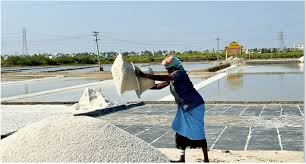
A mural beneath an overpass in Thoothukudi, Tamil Nadu, depicts a woman salt worker, highlighting the role of women in the region’s salt economy/ MANIDEEP GUDELA Decades after equal pay laws, Dalit women in the Thoothukudi salt pans of Tamil Nadu still earn Rs 10 less daily or Rs 300 less monthly than men. They carry 25-kg baskets under the scorching sun, yet tradition justifies the gap and serves as a reminder that men are still regarded as superior. Despite court rulings and hard labour, gender—and caste—discrimination persists across generations. Thoothukudi, Tamil Nadu: At sunrise, the salt pans in this southeastern district shimmer like glass and, by noon, feel like a furnace, with temperatures soaring to 40 deg C. The feet of the women workers—mostly Dalits—are cracked from years of standing in saline water. Their backs are bent under the weight of 25-kg salt sacks, carried from drying plots to storage sheds. For this exhausting, debilitating work, they earn Rs 590 a day—less than the Rs 679 daily state minimum wage paid to skilled workers at a nearby power plant. That wage is barely enough to live on—but what galls the women most is that they earn Rs 10 less than the men. Not because they work less. Not because the industry cannot afford to pay them equally. But simply, they say, because tradition demands it. The Rs 10 missing from a woman’s wage is so small it can almost go unnoticed. But that invisibility makes it a daily, invisible denial of dignity. The patriarchal tax is compounded across generations. “The mother accepted Rs 1 less—a supervisor recalls that was the gap in his parents’ time. Today, the daughter accepts Rs 10 less. If the pattern continues, a few decades from now, the granddaughter will take home Rs 100 less for the same work.” The Tax That Preserves Power It is clear that the Rs-10 patriarchal tax in Thoothukudi is not about profit. It appears to be a tool to preserve a social hierarchy that reinforces and reminds women of their place in power structures. At the end of the month, a woman would have earned Rs 300 less than a man, less than half a day’s wage. The underpaying is not because the owner needs the savings, but because underpaying women is a societal tradition that goes unchallenged. In a 20-acre salt pan, where 25 people work, 20 of them women, the Rs-10 wage gap—you could call it a patriarchal tax on women—amounts to a savings of no more than Rs 6,000 for the employer. That is a negligible sum for the industry, yet it is a calculated reminder of who holds power and who is subservient. R (name changed), a salt pan supervisor in his fifties, overseeing the day’s work. Supervisors, mostly men, manage operations, monitor tasks on site, and keep track of the workers/ MANIDEEP GUDELA Such stories are common in India’s informal economy, which employs about 85% of India’s workforce of about 440 million, with marginalised communities constituting approximately 70% of this workforce: this is also where more than 81% of Indian women work. This is where the most pervasive forms of gendered labour exploitation occur, deeply rooted in caste and patriarchal structures within the production system, with women in the informal sector earning 34% less than their male counterparts. This was evident in Thoothukudi, home to one of India’s major salt-producing belts. The Paraiyars: Bottom Of The Heap Tamil Nadu ranks second in salt production in India, with Thoothukudi district at the heart of the state’s salt industry. Spread over 25,000 acres, the industry in Thoothukudi contributes 70% of the state’s salt output, playing a crucial role in the local economy, directly employing 30,000 workers. A 45-year-old woman, who says she has worked for over two decades in the salt pan, pours dried salt into heaps using an aluminium basket/ MANIDEEP GUDELA Dalit women, primarily from the Paraiyar community, form the backbone of this labour-intensive industry. Known locally as uppalaththu kooli (salt pan labourers), their families have worked in the salt pans for generations. Historically landless, Paraiyars are concentrated in Tamil Nadu’s central and southern districts. The salt pans, mostly leased from the government, are controlled by the Nadars—a powerful, dominant caste in the region. That Dalit women make up the majority of the workforce is no coincidence. Caste has long dictated who performs the most gruelling and degrading labour; gender only deepens this entrenched hierarchy. Dalit men are slightly better off, often working in supervisory or processing roles. It is the women who remain trapped in the most physically demanding tasks. “Our work is more tedious than theirs,” said G*, who is in her 50s and has worked at the pans for over 40 years. “We have to draw pan lines, refill the plots with brine, and sometimes collect the salt too. The men only collect salt—we largely have to do everything.” Salt work is seasonal and closely tied to rainfall. The season typically begins in February and continues until August or September, depending on the monsoon. Workers are paid a daily wage. “There’s no salary on days when there’s no work,” said G. “During the monsoon, we have no income. Even if we’re injured and return home midway through the day, we lose the entire day’s wage.” A Microcosm Of A National, Global System The wage gap in Thoothukudi’s salt pans isn’t an exception. It’s a microcosm of the global system that devalues women’s labour, a pattern of exploitation rooted in patriarchal and capitalist structures. Even though 43% of Tamil Nadu women participated in the workforce (vs 32.5% nationally), according to Periodic Labour Force Survey (PLFS) data for 2020-21, the latest available, the state has one of India’s widest gender pay gaps with women earning just 74 paise for every rupee men earn in regular salaried jobs. This is not limited to Tamil Nadu. According to the ministry of agriculture’s data for 2020-21, a woman agriculture field labourer earns Rs 88 per
Manuvadis built a wall of untouchability
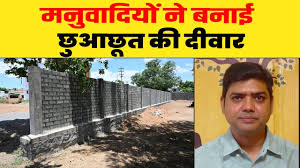
People of Arunthathiyar community, which comes under Scheduled Caste, have alleged that Manuvadis of Thottiya Nayakkar caste have built this wall. They allege that this wall has been built to stop the movement of Dalits. Dalit society has called it ‘wall of untouchability’. The question is also whether any community can build a wall on any government land? The silence of the local administration on this question has put it under question. Karur, Tamil Nadu. Manuvadis have built a 200 feet long and 10 feet high wall in a village. It is alleged that this wall has been built so that Dalits of the village can be stopped from going to the areas of Thottiya Nayakkar. People of Dalit society are calling this wall a wall of untouchability. The matter is of Karur district of Tamil Nadu. The matter has heated up due to this wall built in Muthuladampatti village of the district. People of the Arunthathiyar community, which comes under the Scheduled Caste, have alleged that Hindus of the Thottiya Nayakar caste have built this wall. They allege that this wall has been built to stop the movement of Dalits. The Dalit community has called it a ‘wall of untouchability’. The special thing is that this wall has been built on government-owned public land and it is located just one kilometer away from the Karur Collector’s office. According to the report of “The Hindu”, Dalits say that when they came to know about the construction of the wall, they complained about it to the revenue officials. The village administrative officer of Thanthoni village inspected the spot and verbally asked the Thottiya community to stop the work, but they ignored these instructions and completed the construction of the wall quickly. Seeing the matter escalating and after the protest of the Dalit community, officials of the Revenue and Police Department had to intervene. However, despite two meetings held on July 13 and July 29, no solution has been found. 57-year-old P. Marudhai, who belongs to the Dalit community, said, “This wall is a symbol of isolating us in our own village. This is outright caste discrimination and a way to humiliate us.” They allege that the Manuvadi people do not allow them to use the public ‘drama stage’ during temple festivals, even when they want to build a separate stage or toilet for themselves, they are stopped. According to the report, 50-year-old S. Duraiasamy said, “We are forced to go to the Manuvadi areas without slippers. If we go wearing slippers, they abuse and shout at us.” However, on the other hand, people of the Thottiya Nayakar community are denying this and giving some other reason for building the wall. According to the report, 62-year-old R. Kandasamy completely denied the allegations and said, “We built the wall so that drunk outsiders do not disturb us in our area. This place has been in our use for years.” On the other hand, the administration is beating around the bush in this matter. Karur Collector M. Thangavel told The Hindu, “I cannot say right now whether this is a wall of untouchability or not. I have ordered the Revenue Department officer to investigate and am waiting for his report. The situation can be clarified only after receiving the report.” But the big question here is, can any person build a wall on any government land without any permission? That too on the land where people come and go. Whatever this wall has been built for, it is clear that it is unconstitutional and illegal. Now the question is, why is the administration trying to complicate the matter instead of immediately demolishing this illegal wall? Siddharth Gautam Siddharth Gautam, who has an interest in journalism and writing, is a graduate from Delhi University. There he has been the winner of many university-level writing competitions. He has been associated with Dalit Dastak for the last two years and is working as a sub-editor. Courtesy : Hindi News
When a Dalit man refused quota: ‘You are blocking an open category seat of an upper caste’

In ‘Scum of the Earth’, Rakshit Sonawane traces one man’s journey from the margins to the mainstream. What happened?’ Dagadoo asked as soon as Avinash came up the stairs of their house. Godavari and he had been waiting anxiously for a long while for their son to return home. ‘What will happen?’ Godavari asked with a smile. ‘He must have got the job.’ Avinash looked at her. ‘How do you know?’ he asked. ‘I know,’ she said. ‘I prayed to God. He knows our plight, and he will hear my prayer.’ Avinash laughed. ‘In fact, I’ve not been selected,’ he said. ‘And the irony is that I’m among the top three candidates in the merit list.’ ‘Oh! Then why not?’ she asked, her smile fading quickly. ‘I thought you would be easily selected,’ Dagadoo said. ‘What went wrong?’ ‘They have asked me to submit a caste certificate,’ Avinash said. ‘Caste certificate? But you’ve not applied for a reserved seat.’ ‘I told them that—they are going to seek legal advice and then decide.’ ‘Oh,’ Dagadoo sighed. ‘But I think that if they seek a legal opinion, they’ll be told to appoint you.’ ‘I hope so,’ Avinash said. ‘Dagadoo, are you home?’ someone hollered from outside the house. Avinash went to the door. It was Hari. ‘Yes, Hari kaka, he’s at home.’ Hari smiled and began ascending the steps slowly. On reaching the door, he removed his footwear and came inside, panting heavily. Dagadoo rose to greet him while Godavari brought him a glass of water, which he gulped down thirstily. ‘It’s good that you are all at home,’ he said, wiping his face with a handkerchief. ‘Have you applied for a job at the port?’ Hari asked Avinash. ‘There are some vacancies right now.’ ‘Yes,’ Avinash said. ‘They interviewed me today.’ ‘That’s great! Don’t worry, I’ll ensure that you are selected,’ Hari exclaimed. Then, turning to Dagadoo, he said, ‘Your son has hit a jackpot. Your life is going to change for the better.’ Dagadoo smiled. ‘But they have put his appointment on hold,’ Godavari said. ‘They are asking for a caste certificate.’ ‘Then submit it,’ Hari said. ‘We don’t have a caste certificate,’ Dagadoo said. ‘No problem! I’ll help you; I have connections. I’ve told you this before as well!’ Hari said. ‘The only thing is you’ll have to spend some money.’ ‘But I’ve applied in the general category, Hari kaka, where no caste certificate is required,’ Avinash said. Hari laughed. ‘Why do you need to go in the general category?’ he asked. ‘Get a caste certificate—it’s our right. Just come to my house tomorrow with all your documents.’ ‘Hari, stay out of it,’ Dagadoo said. ‘Avinash will get his appointment letter without a caste certificate and without spending money.’ Hari shook his head and stared at Dagadoo. ‘Brother, don’t ruin your son’s future. Listen to me,’ he said. ‘I can get it done.’ Then, turning to Avinash, he said, ‘Don’t pay me anything right now. Pay me later. After all, I can do at least this much for my nephew.’ ‘No, Hari,’ Dagadoo said curtly. ‘Please don’t bother.’ ‘You are so strange, Dagadoo,’ Hari said. ‘You’ve made your own life miserable because of your impractical thoughts. Don’t do the same to your son’s life, too.’ Dagadoo stared at Hari. ‘You will never understand,’ he said. ‘You were the first person from our village to migrate to this city and what have you earned?’ Hari asked. ‘Look at me—I own two apartments, two vehicles and I’ve recently bought some land near our village. I’m earning a lot of money, while you’re still languishing in a slum.’ Dagadoo nodded. ‘Yes, you are certainly wealthy, but what is the colour of your money?’ he asked. ‘The colour of my money?’ Hari laughed mockingly. ‘Nobody is bothered about the colour of money in this world. It may be white or black or any other colour—the only thing that matters is whether you have it or not.’ ‘It all depends on your values, Hari. I’m happy with mine, and you are free to choose yours.’ Hari shook his head in despair and sipped the tea Godavari had served him in silence. Then he slowly got up, balancing his obese body on his hands as he rose to his feet. The gold chain around his neck flashed. ‘So, shall I expect you tomorrow, if you change your mind, that is?’ he asked Avinash with a sheepish smile. ‘No, Hari, we don’t need your help,’ Dagadoo said. ‘All right,’ Hari said. He went out of the door, slipped his feet into his footwear and slowly descended the steps. After he left, Godavari said, ‘You should’ve taken his help—he knows a lot of people.’ ‘You know he’s mixed up with crooks,’ Dagadoo said. ‘But what will happen to Avinash’s appointment?’ ‘Don’t worry—just be patient.’ ‘But we’re abandoning the easy way out and making his life difficult,’ Godavari said. ‘He’s just a young boy.’ Dagadoo glanced at her and then at Avinash. ‘Don’t you realize that he’s among the toppers in the merit list?’ he asked. ‘Have faith in the Constitution. Instead of overprotecting him and making his life easier, let him face difficulties and overcome them. Remember the difficulties faced by Babasaheb. He’s our guiding light.’ Avinash felt dejected and unwanted. Brooding over his plight, he sat on the threshold of the house and thought about his father, his community and Babasaheb. Perhaps his father was right. If he had merit, there was no need to seek a reserved seat. Some other needy candidate could use it. There were enough people who were in worse conditions than him. Avinash eagerly awaited the decision of the port authorities. A fortnight passed and just as he was beginning to lose hope, a letter arrived, informing him that his appointment had been confirmed, subject to a medical examination at the port hospital. His parents were both relieved and elated at the development. ‘I knew he would be appointed,’ Dagadoo
Gang rape of a Dalit: Boyfriend killed and girlfriend taken away, girl kept screaming in the forest; beasts kept looting her honour

A case of gang rape of a girl has come to light in Sidhi district of Madhya Pradesh. When the girl went for a walk in the forest with her lover, four youths raped her. Police have arrested three accused. A heart-wrenching case has come to light in Sidhi district of Madhya Pradesh. Four youths have committed brutality on a Dalit girl. The girl’s friend was beaten with sticks and the girl was kidnapped and her dignity was looted. Police have registered a case against the accused. Three of the four accused have been arrested, search for one is on. According to the information, the case is of Barigwa village of Churhat police station area of Sidhi district. It is said that a lover couple had gone to take photos after seeing the beauty of the forest. Then four youths already present there attacked them. The youth was hit with sticks on the head, due to which he became unconscious. Then two accused picked up the girl and took her to the forest, two accused held the lover. All four raped the girl in turns and ran away into the forest. The girl somehow reached the village and asked for help from a villager. Police have registered a case against the four accused. After investigation, the police have arrested three accused. One is absconding. A story of endless pain, in the words of the victim In the case, the victim girl said that I had gone to Barigwa village with my friend at around 2 pm on Tuesday afternoon, where both of us left for the forest to get a photo taken. After this, four people were sitting in ambush and as soon as we started coming down, they covered my mouth. My friend was hit with a stick on the head, due to which he fell on the ground. After this, two people picked me up and took me to the top of the forest and two people were holding my friend. All of them together raped me. I kept crying, pleading, kept falling at their feet, but no one showed mercy on me. After this, they threatened me that if I tell anyone, they will kill both of you. Then everyone ran away with my and my friend’s phone. After this, I and my friend ran down from the forest and informed the villagers about it. The villager whom the victim met first and asked for help. That villager Dalveer Singh Gond said that I was doing building construction work in my village, when between 2 and 2:30 a girl came crying and stumbling. She told me that she has been raped, after which she informed the police. Then the police reached the spot. Where I went towards the forest with the police. Where the police took my statement and then kept on questioning me rapidly. The police kept roaming in my village and the surrounding villages the whole night, after which there was an atmosphere of panic in the whole village. SDOP Churhat Ashutosh Dwivedi said that we received information about the case from Semaria police station. The area of the incident seems to be Churhat police station, but due to being close, the victim first reached Semaria police station. There the station in-charge got her first aid, then a case was registered late night at Churhat police station. The suspects are being searched and some people have been detained and interrogation is going on. Sidhi SP Dr. Ravindra Verma said that this is a heinous crime. The first priority of our team was to get the victim treated, who has been admitted to a safe hospital. The accused had fled towards the dense forest and there are no CCTV cameras in that area. Due to this it is taking some time, but soon the remaining accused will be arrested. Published by: Dinesh Sharma Courtesy : Hindi News
Death of Dalit woman in Ayodhya: There was no money even for the last rites, social worker took responsibility of the children
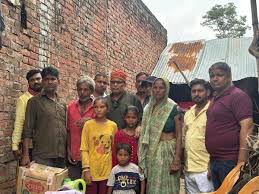
A Dalit family in Bakchuna village of Milkipur tehsil area of Ayodhya was devastated when the female member of the family, Deepanjali Pasi, died suddenly. The poverty was such that the woman’s last rites could not be performed for a day. When this news reached social worker Rajan Pandey, he not only helped financially, but also took the responsibility of the four orphaned children on his shoulders. Deepanjali Pasi’s husband Vijay Pasi is very poor and this family has only an 8×8 feet tin shed room in the name of livelihood. After Deepanjali’s death, four innocent children became helpless. According to the neighbors, the entire family had no ration, no clothes and no one to come forward for help. Social worker extended a helping hand As soon as social worker Rajan Pandey got this information, he sent his three sons to the village and immediately arranged for the last rites. After this, he himself reached the village and brought with him two cots, mattress, carpet, blanket and five sets of clothes. He also provided three months’ ration – which included pulses, rice, flour, refined oil and vegetables. He also gave immediate financial help of Rs 5,000 Rajan Pandey became emotional and said – These children are my children now. As long as I breathe, it is my responsibility to raise them. Expressing displeasure at the administration, he said that so many poor people are living in the village, yet they neither got housing nor any government assistance. Targeting the administration and leaders, Rajan Pandey questioned the inaction of the village head and village panchayat officer and demanded immediate action from the Sub-District Magistrate Milkipur and Block Development Officer Amaniganj. He alleged that there are queues of leaders during elections, but no one comes to look after the families suffering like this. Vijay Pathak Courtesy: Hindi News
62 Dalit families ordered to vacate their houses: Given time of one week, villagers demonstrated at the Sub-Divisional Magistrate’s office
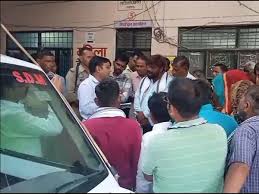
A worrying case has come to light from Gokulpura village of Jalaun tehsil area. The administration has issued a notice to 62 Dalit families of the village to vacate their houses within a week. The village has 100 percent Dalit population and more than 75 percent of these people have been given this notice. Gokulpura village was established 95 years ago by Seth Gokuldas Maheshwari. Since then this village has been the permanent residence of the Dalit community. The villagers are terrified by the sudden order to vacate the house. It has been made clear in the notice that legal action will be taken if the house is not vacated within the stipulated time. More than 50 villagers reached Jalaun tehsil in protest against this action. They submitted a memorandum to the Sub-Divisional Magistrate. The villagers appealed to the officials to stop the process of demolishing their houses settled for years. The villagers allege that they have been suddenly ordered to vacate without any hearing or alternative arrangement. They say that this action is completely unjust. Sub-district magistrate Vinay Kumar Maurya has assured the villagers. He said that considering the seriousness of the matter, it will be investigated by higher officials. He also said that injustice will not be allowed to happen to anyone. At present, there is an atmosphere of panic and worry in the entire village. The villagers are hoping for the administration to save their homes. Anuj Kaushik Courtesy: Hindi News
Dalit youth beaten to death in Hardoi: Two parties clash over water drainage, police on the lookout for 3 accused

A Dalit youth was beaten to death in Hardoi. There was a quarrel between the two parties over water drainage. After this, the fight started. Police is on the lookout for 3 absconding accused. The body has been sent for postmortem and investigation has been started. The entire case is of Ohadpur village of Lonar police station area. The incident took place on the east road of the village. During the dispute, a youth of one side, Ram Sachche (son of Ramnivas) was badly beaten with sticks. Seriously injured Ram Sachche was taken to the hospital for treatment, where he died. CO reached the spot As soon as the information of the incident was received, CO Harpalpur Satyendra Kumar Singh reached the spot. He told that the body of the deceased has been taken into custody and sent for postmortem. Police has started further legal action. A case has been registered on the basis of the complaint of the family members. Police started investigation The family members allege that Ram Sachche was from the Dalit community. He was killed by three youths of Brahmin community- Vikas, Vivek and Anup by beating him with sticks. There is an atmosphere of tension in the village after the incident. In view of this, police force has been deployed. Police has registered a case and started searching for the accused. The administration says that strict action will be taken against the culprits. Faizi Khan Courtesy: Hindi News