
Opinion: We must talk about Savarna women’s complicity in caste violence

Dominant caste women are not a monolithic entity. Their engagement with caste may not be uniform. Some might be victims of it. Some are complicit in it. Some resist only the misogyny. But true liberation is possible only if they dismantle both caste and patriarchy. There appears to be a marked shift in the caste discourse after the brutal murder of Kavin Selvaganesh, a 27-year-old Dalit IT professional. Onus was placed on Subhashini, and suspicions were raised about her culpability. Her video, defending her parents’ innocence, garnered severe criticism. And she was chastised for her appeals to “drop” the issue, whitewashing the crime and failing to take a stance against the perpetrators. Many also questioned the Dravida Munnetra Kazhagam-led (DMK) state government’s ineffectual anti-caste politics and its general apathy towards Dalits. People shared their anxieties regarding the increase in violent caste pride among intermediate castes. On July 27, Kavin was brutally hacked to death in Tirunelveli for his relationship with Subhashini, a woman from the dominant Maravar caste. Kavin was an IT employee based in Chennai and was killed in broad daylight at KTC Nagar in Tirunelveli. Both victim and perpetrator The criticism of Subhashini deviated from how public narratives largely frame dominant caste women as victims of so-called honour killings. The murders of Dalit individuals who are in intercaste relationships are often referred to as ‘honour’ killings. The caste-supremacist view dictates that such relationships are a threat to the maanam (honour) of dominant communities. In a caste-punitive society, murder is wielded as a means to keep intercaste relationships in check and uphold caste endogamy. In many caste killings, the loss of life has been that of a Dalit man, either hacked to death in broad daylight like Shankar in 2016 or found dead on deserted railway tracks like Ilavarasan in 2013. Each of them was punished for being in love with dominant caste women. In 2016, V Shankar, a Dalit man, and his wife Kowsalya, who belongs to the Kallar caste, were brutally attacked in Tiruppur district. While Shankar succumbed to his injuries on the spot, Kowsalya survived despite her wounds. Kowsalya held firm and testified against her family, seeking justice for her husband. Events after the 2013 caste killing of Dalit youth Illavarasan in Dharmapuri district played out differently. Following the suicide of her father, Divya, Illavarasan’s partner, returned home to her mother. Divya is from the Vanniyar community. She succumbed to the pressures of a caste society a few days before Ilavarasan’s death. Kowsalya is now a fierce anti-caste activist, while Divya leads a quiet life, staying out of the limelight. However, both women were considered victims. The reason why Subhashini was held accountable by social media users is the changing perspectives of women’s roles in Tamil caste society. Dominant caste women are no longer regarded solely as victims but as active benefactors of the system. Several critiques even flipped the derogatory narrative of naadaga kaadhal (fake love), using it to describe how Subhashini cost Kavin his life. The term naadaga kaadhal was first used by the Pattali Makkal Katchi (PMK), a Vanniyar-majority party, to falsely accuse Dalit men of ‘luring’ dominant caste women. Vanniyars are categorised as Most Backward Class (MBC). There is no denying that caste, like patriarchy, oppresses all women. Both systems rob women of their autonomy, agency and personhood and fundamentally treat them as mere birthing vessels meant to further male and caste lineage. The practice of endogamous monogamy was institutionalised in order to ensure the idea of ‘purity’ in bloodlines. As a result, a woman’s freedom was curbed, and restrictions were placed to control who she can love and marry. Despite the knowledge that both patriarchy and casteism thrive on women’s subjugation, dominant caste women’s critique and opposition have been uneven. While women from all quarters put up a fierce fight to dismantle patriarchy, the struggle against casteism is largely led by Dalit women. Many dominant caste women content themselves with tepid criticisms. This is because the hierarchical and gradational nature of caste offers them considerable privilege. A privileged caste position provides women with social and cultural capital that their gender identity does not. Caste privilege helps them navigate patriarchal hurdles and even reap some extra benefits along the way. Challenging portrayals of Savarana women in cinema Mari Selvaraj’s portrayal of dominant caste women in his films offers insightful examples of how such caste privilege works. In director Mari Selvaraj’s Maamannan (2023), Rathnavel’s (Fahadh Faasil) wife Jyothi (Raveena Ravi) is docile and subservient. She, quite literally, has a silent presence in the film, as she has no dialogues. Despite being confined to her house for the most part, she ultimately bags a seat at the Legislative Assembly, clearly a fruit of her dominant caste status. One can argue that she stands in the election only at her husband’s bidding and is a puppet in his hands, calling attention to her oppression as a woman. Nevertheless, it is undeniable that her path to power is relatively easier and not as arduous as that of the film’s eponymous Dalit protagonist (Vadivelu). His life and dignity and that of his family’s are perpetually at stake. A reading like this might go against the grain of what the director believes in and wants to convey. Mari, in many of his interviews, maintains the conviction that women are hapless victims and that their victimisation by patriarchy is worse than the caste marginalisation faced by a man. Regardless of his position, due to the realistic tenor of his films, the caste privilege of dominant caste women is apparent in the upper hand they have over Dalit men. Take, for instance, Jo (Anandhi) from Pariyerum Perumal (2018). When the dominant caste Jo falls in love with Pariyan (Kathir), she has the freedom and space to be honest about her feelings and express them boldly. On the other hand, Pariyan, a first-generation Dalit law student, is attacked multiple times to force upon him the realisation that he is forbidden
Why did Rahul Gandhi not attend the Vice President’s oath ceremony? Congress gave Dhankhar’s answer
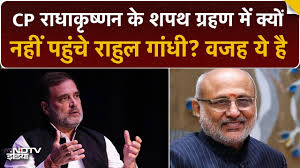
A political controversy has erupted over Rahul Gandhi’s absence at CP Radhakrishnan’s swearing-in ceremony as Vice President. Responding to BJP’s questions on this issue, the Congress said that the issue is not Rahul Gandhi’s presence, but the presence of Jagdeep Dhankhar, who finally got permission to speak. New Delhi: CP Radhakrishnan took oath as the 15th Vice President of the country on Friday. During this, Leader of Opposition in the Lok Sabha Rahul Gandhi was absent, due to which a political uproar has erupted. While BJP is raising questions on one hand, on the other hand, Congress has now responded. Congress said, the issue is not whether Rahul Gandhi was there or not. The issue is that Dhankhar was present there. Finally he got permission to leave his house and come out. What did Pawan Khera say on Rahul Gandhi not attending the swearing-in ceremony Regarding Rahul Gandhi’s absence from CP Radhakrishnan’s swearing-in ceremony, Congress leader Pawan Khera said, the issue is not whether Rahul Gandhi was there or not. The issue is that Dhankhar was present there. After all, he has got permission to leave his house and come out. He questioned, when will Jagdeep Dhankhar be allowed to speak? This is our question. Jagdeep Dhankhar had arrived at the swearing-in ceremony Many leaders including Prime Minister Narendra Modi, Home Minister Amit Shah, Defense Minister Rajnath Singh and Bharatiya Janata Party (BJP) President JP Nadda, Rajasthan Chief Minister Bhajanlal Sharma, Andhra Pradesh Chief Minister N. Chandrababu Naidu were present at Radhakrishnan’s swearing-in ceremony. Former Vice Presidents Hamid Ansari and Venkaiah Naidu also attended the ceremony. Dhankhar also attended the swearing-in ceremony. He was seen in public for the first time after resigning from the post of Vice President. Curated by: Abhishek Pandey About the author Abhishek Pandey is currently a consultant writer at Navbharat Times Online. He has more than three years of experience working on news related to current affairs, politics, crime and public concern. Along with this, he has closely covered the Uttar Pradesh Assembly elections in 2022, Lok Sabha elections 2024. Courtesy: Hindi News
Know the story of the formation of Mauritius, Dalits have the biggest contribution
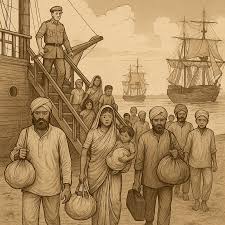
The first ship Atlas reached Mauritius from Calcutta on 2 November 1834. It mainly had people from Bihar, Eastern Uttar Pradesh, Jharkhand and Bengal. In which a large population was of Dalit, backward and deprived castes. The Dalit communities that went from these areas mainly included Chamar, Dhobi, Dom, Pasi, Musahar, Kahar, Nai etc. castes. It is about the year 2021. A man from Mauritius came to India in search of his roots. This search brought him to Purvanchal. This was surprising for him. Then a research started. What came out in this research started bringing out the story of the contribution of Dalits of Purvanchal in making Mauritius layer by layer. BHU’s DN Scientist Professor Gyaneshwar Choubey, who did this research, has collected important information in four years of research. According to research, about 55% of the DNA of the total population of Indians living in Mauritius matches with the Bhojpuri speaking Dalit community of UP’s Purvanchal and Bihar. In this, the DNA of the Dalit community of Purvanchal, especially Buxar, Ara, Bhabua, Chhapra and Sasaram, has been matched. Currently, the population of Mauritius is 12 lakhs. That is, the Dalits have contributed the most in making the beauty of Mauritius, which is discussed all over the world today. Mauritius was discovered in 1502. Africans were settled here in 1670. The British captured Mauritius in 1810. The first time Dalits went here also has its own story. When did Dalits go to Mauritius for the first time? In 1834, the British government abolished slavery, but they needed laborers for sugarcane cultivation. After this, indentured laborers were taken from India. British agents used to take these labourers on a 5-year contract in the name of “Girmit” (agreement). The first ship Atlas reached Mauritius from Calcutta on 2 November 1834. It mainly had people from Bihar, Eastern Uttar Pradesh, Jharkhand and Bengal. In which a large population was of Dalit, backward and deprived castes. The Dalit communities that went from these areas mainly included Chamar, Dhobi, Dom, Pasi, Musahar, Kahar, Nai etc. castes. Role of Dalits in making Mauritius Sugarcane cultivation and sugar industry are the backbone of Mauritius’ economy. Most of the work of building it was done by Indian labourers, a large number of whom were Dalits. Dalit migrants were at the forefront in the construction of all these infrastructures – farms, factories, roads, railways and ports. Although they were assigned the most difficult and humiliating work, this labour became the economic foundation of Mauritius. Those who went to Mauritius included Dalit women, who worked equally with men in the fields, and also faced exploitation as domestic servants. The great novelist William has written that “these Bhojpuri speaking people of the weakest section of UP and Bihar used to cultivate sugarcane and cotton while tied in chains. This work was unbearably painful. But they endured that pain and established themselves in Mauritius. The report shows that among the Indian population present in Mauritius, 55 percent of the people have DNA matching with the Bhojpuri speaking Dalit community. 35 percent of the DNA was of people coming from the Dravidian society while 4 percent of the DNA matches with the Brahmin and Kshatriya society. The special thing is that despite being in Mauritius, this community has not forgotten its language and culture even today. Bhojpuri and Chhath still reside in the veins of the people here. That is, the Dalit community, which the Indian scriptures and society still consider the most incapable and small, has created a country like Mauritius. Ashok Das Ashok Das (Ashok Kumar) is the country’s first person to do journalism by keeping the Dalit-tribal society at the center. He is a well-known journalist. He is the founder and editor of ‘Dalit Dastak Media Sansthan’. His journalism has been appreciated in countries like America, Canada, Sweden and Dubai including India. He has also traveled to these countries. Features about Ashok Das’ journalism have been published in many newspapers and magazines of the country and abroad, including DW (Germany), The Asahi Shimbun (Japan), The Mainichi Newspaper (Japan), The Week Magazine (India) and Hindustan Times (India). Ashok has given a lecture at the world-renowned Harvard University in America in February 2020. He has received a fellowship from the world’s largest organization of investigative journalism, Global Investigation Journalism Network, for the conference organized in Gothenburg, Sweden in 2023. Courtesy: Hindi News
Rape and forced marriage… 17-year-old Dalit minor trapped in the lure of a job, pleaded for justice
A case of rape and forced marriage of a 17-year-old Dalit minor on the pretext of a job has come to light in Churu. The accused Sonu abducted the victim by luring her and molested her. Despite the case being registered, the accused is still absconding and is threatening the victim’s family. The victim has reached the SP office with her family and pleaded for protection and justice. Churu: The incident with a 17-year-old Dalit minor girl in Churu district has shaken the entire area. This student studying in class 12 was kidnapped on the pretext of a job. The victim has alleged that Sonu, a resident of Rajgarh, lured her and with the help of his friends brought her to Churu in a Bolero car. Here she was raped. According to the victim, the accused later took her to Bikaner and raped her several times. It is shocking that the accused was already married, but he hid this fact from the victim. When the minor protested, the accused forced her to marry him. According to the victim, the accused Sonu took her to a temple in Amritsar and forcibly married her. The victim has made another serious allegation that before taking her from the house, Sonu had given sleeping pills to her family members so that no one could stop them. This incident was revealed when the police brought both of them back on 25 August 2025. The girl narrated the entire story in front of her family and the police. A case was registered on the basis of her statement, but the accused Sonu is still out of police custody. Accused’s threat and allegation of inaction on the police The victim’s family is constantly accusing the police of negligence. They say that the accused Sonu is still roaming freely and is constantly threatening the victim’s father. Due to this fear and mental pressure, the victim and her family are extremely upset. On Friday, the victim along with her family reached the Superintendent of Police (SP) office and pleaded for justice. They have demanded that the accused Sonu and his accomplices be arrested as soon as possible and given strict punishment so that the victim can get justice. Police statement and investigation status Police officials say that the case is under investigation and efforts have been intensified to catch the accused. However, the family says that the police have not taken any concrete steps yet. Such incidents make it clear that crimes against the weaker sections of society are increasing and questions are being raised on law and order. This case is not only a criminal incident, but also an example of atrocities against the Dalit community. Reported by : Manoj Kumar Sharma Edited by : Vicky Rathore Courtesy: Hindi News
Ahmedabad: 2 Dalit youths died in sewer, one contractor arrested, now 2 more big names surfaced, who is the real culprit?

The police has started investigation in this tragic incident that took place in Bopal, Ahmedabad. After the labor contractor, now a case has been registered against the site contractor and engineer under the culpable homicide and atrocities act. Ahmedabad: Police has now registered a case against three people in the case of the tragic death of two Dalit youths due to suffocation in the sewer manhole in Bopal area of the city. This incident took place on September 5, in which 20-year-old Vikas Lal Bahadur Kori and 21-year-old Kanhaiyalal Khushiram Kori lost their lives. In this case, earlier only the labor contractor was arrested as an accused. But now Ahmedabad Rural Police has expanded the scope of investigation and has also made the site contractor and site engineer accused and is preparing to arrest them. What is the whole matter? The police have registered an FIR at the Bhopal police station on the complaint of deceased Vikas’s father Lal Bahadur Chhotelal Kori (48). Lal Bahadur, a resident of Amethi in Uttar Pradesh, said that his son Vikas was working as a plumber in Ahmedabad for the last three years. The pain he has expressed in his complaint is heart-wrenching. Lal Bahadur said that on September 6, he received a call from his relative Anish. Anish said that Vikas and his friend Kanhaiyalal were asked to get down into a sewer (gutter) near ‘The Garden Bungalows’ in Bhopal, where Vikas fainted. They were also told that Vikas would be sent home in an ambulance for treatment. But when the next day, on September 7, the ambulance reached his house in Amethi, Vikas’ lifeless body was taken out of it. Pushed to death without safety equipment When Lal Bahadur asked Anish the reason for the death, the truth came out. According to the FIR, on September 5, around 1:30 pm, contractor Mukeshkumar Someshwar Adalat Thakur brought a pressure machine and asked Vikas to get down to clean the gutter. The most serious thing was that Vikas was not given any safety equipment. As soon as Vikas got down into the gutter, he fainted due to the poisonous gas. His friend Kanhaiyalal also went inside to save him, but he also fell unconscious. Others present at the spot immediately called the fire department, who pulled both of them out and took them to a nearby private hospital. At the hospital, doctors declared Kanhaiyalal dead at 3:40 pm and Vikas at 10:40 pm. Police investigation and new revelations Tapsin Dodiya, Deputy Superintendent of Police (DySP) of SC/ST cell of Ahmedabad rural police, said on Thursday that the two youths were called to work on the private sewer line of a construction site. He said, “After finishing that work, they had to connect that line to the main sewer line of the Municipal Corporation, but the line was jammed due to rain. Our investigation has revealed that after this, both the youths were asked to clear the jammed line connecting the private sewer to the main line, and during this time this tragic accident happened.” Action was taken against whom? The police have registered a case against contractor Mukeshkumar Someshwar Adalat Thakur under sections 105 (culpable homicide not amounting to murder) and 125 (endangering human life or personal safety) of the Indian Penal Code (BNS). Apart from this, sections 7 and 9 of the ‘Prohibition of Employment as Manual Scavengers and their Rehabilitation Act’ and section 3 (2) (v) of the ‘Atrocities Act’ have also been imposed on him. DySP Dodiya further said, “We have already arrested labour contractor Thakur, who hails from Bihar. Now two more people, site contractor Saurabh Panchal and site engineer Jaynil, have also been made accused in the case. We will arrest them soon.” The police also said that when they investigated the role of the site builder, it was found that he was not aware of the work being done. Parshottam Vaghela of ‘Manav Garima’ NGO, which works on such incidents, says, “The law is very clear that those responsible for the death of workers, including government officials in charge, should be held accountable.” Rajan Chaudhary Courtesy : Hindi News
MP: Attempt of self-immolation in Bhopal Commissioner’s office, Dalit elder from Vidisha took this step after getting fed up with land dispute
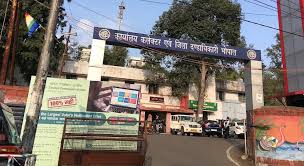
After the incident, anger is being seen among the villagers and people of the society of Ganjbasoda area. They say that if the administration had resolved the land dispute on time, Ram Singh would not have had to take such a step. Bhopal. There was chaos in the Divisional Commissioner’s office located in Kohefiza of the capital on Thursday, when 65-year-old Dalit elder Ram Singh Ahirwar, a resident of Behalot village of Ganjbasoda tehsil of Vidisha district, tried to set himself on fire by pouring petrol on himself in the waiting room. Amidst the suddenly rising flames and smoke, the employees and common citizens present in the office ran away to save their lives. The Nagar Sainiks deployed on the spot showed immediate presence of mind and took him out of the waiting room and controlled the situation. What is the matter? Ram Singh Ahirwar told the officials that 0.897 hectares of land was allotted on lease in Siyari village in the name of his mother Shakkaria. In the year 1999, the administration canceled this lease and in 2001 the same land was registered in the government road category. Since then, Ram Singh has been constantly visiting the offices of the officials. The elderly man says that he applied several times in Ganjbasoda SDM office, but there was no hearing. In the hope of justice, he has lodged a complaint on CM Helpline 12 times so far, but every time the case was closed by calling it “dismissed”. After the uproar, Commissioner Sanjeev Singh immediately handed over Ram Singh to the police. However, no crime was registered against him till late night. After this, the Commissioner called him to the office again in the evening and heard his entire problem and said that the matter will be investigated and an attempt will be made to resolve it. Questions are being raised on the functioning of the administration! This incident not only shows the suffering of an old man, but also raises serious questions on the functioning of the administration. After years of wandering from door to door for justice and making complaints, when there was no solution, he finally had to take the extreme step of self-immolation. Anger among villagers After the incident, anger is being seen among the villagers and people of the society of Ganjbasoda area. They say that if the administration had resolved the land dispute on time, Ram Singh would not have had to take such a step. People have demanded that the victim’s land be returned and action be taken against the guilty officials. Cases that have come to light earlier also Earlier also a sensational case had come to light in Bhopal Collectorate, when a young man from the capital, hurt by the non-hearing of his problem, drank poison in the Collectorate premises. This sudden incident created panic and the employees present on the spot immediately took him to the hospital. This incident also indicates that people get so frustrated with their pain and complaints that they are forced to take extreme steps like consuming poison to draw the attention of the administration. Earlier also, a case of a youth reaching Bhopal Collectorate by bowing down and wrapping a paper in a memorandum had come to light. Even before this, many times people in the state have adopted unique and symbolic methods to convey their problems to the administration. Sometimes citizens have submitted memorandums by walking on their knees, sometimes barefoot or bowing down. The purpose behind these methods is that the administration listens to their problems seriously and resolves them soon. Earlier also in different districts of Madhya Pradesh, farmers, unemployed youth and people from marginalized sections have similarly sent letters or applications to the officials by wrapping them in paper. This tradition has become a non-violent means of expressing protest and anguish. When there is no hearing through normal methods, people raise their voice by adopting extreme symbolic methods like bowing down, so that the echo of their problems reaches the government and administration. Ankit Pachauri Courtesy : Hindi News
Transgender Community Assembled In Agra Sends Help Of ₹25 Lakh To Punjab Flood Victims;

The transgender community from all across the nation assembled in Agra has sent help of over ₹25 lakh to the Punjab flood victims reeling due to the severe rainfall and flash floods. The ‘All India Kinnar Samaj Conference’ is being held on Fatehabad Road in Agra. Around 10 thousand Kinnars from across the country are participating in it. The transgender community from all across the nation assembled in Agra has sent help of over ₹25 lakh to the Punjab flood victims reeling due to the severe rainfall and flash floods. The ‘All India Kinnar Samaj Conference’ is being held on Fatehabad Road in Agra. Around 10 thousand Kinnars from across the country are participating in it. In this conference, the transgender community is collecting donations for the flood victims. The donations from the transgender individuals are said to amount to 25 lakh rupees. These donations will now be used to provide relief to the flood victims of Punjab. On Wednesday, at Havells Garden, transgender community made bids after donating money for the Punjab flood victims. Some donated Rs 50,000, and some donated up to Rs 1 lakh. The highest donation came from Gorakhpur. During this conference, the eunuchs prayed for the people and farmers trapped in the floods in Punjab. Ganesh Puja was performed so that the people of Punjab would get relief from the floods. Guru Mata Sadhna of Haryana said, “Eunuchs from all over the country have gathered in Agra today. A bed has been set up to collect donations for the flood victims in Punjab. Eunuchs from all over the country are donating money there. 30 lakhs have been donated. If needed, we will collect more donations. We are not doing any charitable work. We are eunuchs, we are giving money taken from people to people when needed.” Panch of All India Kinnar Samaj said that they will not give the donation money to politicians and officers as it may lead to the fraud of money. We want to provide help directly to the victims. And we will take along someone who is really helping people. Rutunjay Dole Courtesy : TFPJ Note: This news is originally published on https:/thefreepressjournal.com/bha and is used purely for non-profit/non-commercial purposes, especially human rights
“Find Ambedkar in books, not in statues”: Prof. Ratan Lal asked- Why don’t we have a share in universities?
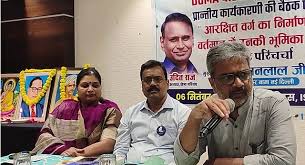
The professor questioned the priorities of the Dalit middle class. He said, “Billions of rupees were spent on our movements, but was any money spent on a serious research, book, article or educating a child abroad? Why are our children not becoming researchers? Why are they not going for PhD, Harvard, Oxford?” Bhopal- In a seminar organized in Bhopal, the capital of Madhya Pradesh, Professor Ratan Lal of Delhi University expressed deep concern over the current political and social situation of the Dalit community. He said that getting reservation was the result of a long struggle, but now the society needs to focus on education, research and intellectual discourse, and not just dream of electoral power. Professor Ratan Lal was speaking on the topic ‘Creation of reserved class, their role in the present’ in the provincial executive meeting of Doma Sangh and a discussion. He discussed in detail the historical journey of the Dalit community, the legacy of Dr. Bhimrao Ambedkar, the foundation of reservation, and the challenges of the Dalit middle class in the present times. Professor Lal warned the society that rights like education and jobs are being snatched away in rich India, and the Dalit society now has to focus on education, research and intellectual discourse instead of only power and electoral politics. He appealed to adopt Ambedkar’s practical philosophy and avoid unrealistic dreams. Professor Rattan Lal drew attention to an important historical fact in his address. He said, “Babasaheb Ambedkar used to constantly say that we are a minority in national life. Just like Muslims and Sikhs are minorities, we are also minorities. That is why constitutional safeguards are needed. Have you got reservation on the basis of the demand for minority status or on the claim of being a majority? This is a matter of thinking.” He further said that now claiming that ‘we will become rulers’ is an unrealistic dream. There are only 131 seats in Parliament and limited seats in Vidhan Sabhas, so why is everything being snatched away, this question is not in the discussion. Creation of Reserved Caste: A Difficult Historical Journey Professor Rattan Lal made it clear at the beginning of his speech that the creation of reserved class was not an easy process. He mentioned Dr. Ambedkar’s first memorandum given to the South Borough Committee in 1919, in which education and employment were described as a matter of life and death for the Dalit society. At that time, there was not a single Scheduled Caste graduate in the entire Bombay Province. Ambedkar repeatedly raised the question of education even during the formation of Simon Commission, Round Table Conference and Independent Labour Party. He presented the data in ‘Grievances of Scheduled Caste’ that out of 1056 ICS officers, only one was from Scheduled Caste, and only one among CPWD contractors. In that era, even getting a job for three constables was a reason for celebration. Professor Lal emphasised that Dalits presented themselves as minorities in national life, as did the Muslim and Sikh communities. There was a demand for minority status till 1942-44, and on this basis constitutional protection and reservation were demanded. He raised the question, “Have you got reservation in the name of minority or in the name of majority? Just think.” Ambedkar’s philosophy is practical; pressure has to be built Professor Lal described Ambedkar’s philosophy as pragmatism, which was influenced by his mentor John Dewey (Columbia University). In 1916, at the age of 24, Ambedkar wrote the first article in the Bombay Chronicle, in which he advocated building a public library instead of the bust of Firozshah Mehta. He took inspiration from Buddha, Kabir and Phule, but did not dream unrealistic dreams. Ambedkar was a supplicant, who kept demanding from the Viceroy, Congress and the government. In his 1948 Lucknow speech, he demanded separate electorate, reservation in the legislature and reservation in government jobs, but got only partial success. The professor said, “Ambedkar repeatedly said that pressure has to be built, rights have to be kept demanding.” He gave the example that there was no debate on reservation in the Constituent Assembly, because everyone including Rajendra Prasad and Jawaharlal Nehru had a consensus of historical injustice. But today the society has turned upside down, where instead of asking, claims are being made to be ‘givers’. He said sarcastically, “What will they give? We don’t have a share in universities, bureaucracy, share market, foreign policy.” Facilities were provided in poor India, rights are being snatched away in rich India Professor Lal called the rise of the Dalit middle class a by-product of modernism, industrialization and colonialism. In the 19th century, the middle class was formed from urban centers and factories, which also included Dalits. He said, “In Marxist terms, one who is not bourgeois, middle class, cannot become anything. Think tanks, bureaucrats, writers, journalists, academicians all come from the middle class.” In poor India, the fees in government schools and colleges were one or two annas, stipends and fellowships were given. In 1973, Indira Gandhi wrote a letter to all CMs to form a cell to stop atrocities on Harijans and make full appointments in the public sector. Dalits became officers through bank nationalization, and got leases through land reform. Rajiv Gandhi started a special recruitment drive, opened Navodaya Vidyalayas where education was free. Crores of rupees were earned from reservation in petrol pumps and gas agencies. Employees in public sector like ONGC increased from 3000 to 21000, out of which 7500 are SC-ST-OBC, and with an average salary of 1 lakh, 100 crore rupees are going to their homes every year. Two generations ago there were huts, now by becoming teachers, families are able to run. But now all this is being snatched away in rich India. Government schools and colleges are closing, quality is deteriorating, and private education is so expensive that it is out of reach. Sale of gas and petrol through private pipelines is ending, and jobs are decreasing due to privatization. Weaknesses
Kanchipuram District Judge had sent DSP to jail for not taking action in SC/ST case, Madras High Court cancelled the order, know what the court said

This is the first case in the country where Section 4 of SC/ST Act was directly used. The High Court said that the judge misused judicial powers by acting with personal malice against his PSO. Gave instructions for judicial investigation Chennai- Madras High Court has cancelled the externment order passed by the Principal District and Sessions Judge of Kanchipuram under Section 10 of the SC/ST (Prevention of Atrocities) Act and the order to send the Deputy Superintendent of Police (DSP) to jail under Section 4 of the same Act. The High Court has described these orders as “clear abuse of the process of law” and “motivated by personal motive”. This case is the first of its kind in the country, where Section 4 of the SC/ST Act was directly used by a judge against a senior police officer and he was sent to jail. What is the root of the controversy? The case began with a simple clash at Walajabad police station in Kancheepuram district. On July 25, 2025, a dispute broke out between two groups at a bakery in Walajabad. One group comprised Lokeshwaran Ravi, the then Personal Security Officer (PSO) of the Principal District Judge of Kancheepuram, his father-in-law and others, while the other group comprised Parvathy and her family members. Following the clash, both parties filed complaints against each other. The police, after hearing both sides and recording statements from the parties, settled the matter on July 28 itself and both CSRs (Complaint Status Reports) were closed. The petitions filed in the High Court alleged that the District Judge felt that his PSO Lokeshwaran Ravi was repeatedly sending anonymous complaints against him. Due to this, the judge approached the Superintendent of Police (SP) and demanded a change of his PSO. Even WhatsApp messages of this conversation were produced in the petition. When the judge learnt that the complaint lodged against his PSO had been closed, he called up the inspector of Walajabad police and verbally ordered him to register a fresh FIR based on the closed CSR. The judge allegedly threatened the inspector that if the FIR was not registered, action would be taken against him under Section 4 of the SC/ST Act. Following this pressure, two fresh FIRs were registered on August 20, 2025. Crime No. 282/2025 was registered against Parvathy’s husband Murugan, while Crime No. 283/2025 was registered against PSO Lokeshwaran Ravi and his family members, with sections of the SC/ST Act also added. On September 4, the Kancheepuram district judge passed a Suo Motu (of his own volition) order using Section 10 of the SC/ST Act. In this order, he ordered all the accused in Crime No. 283/2025, including PSO Lokeshwaran Ravi, to stay out of the limits of Kanchipuram district. The judge said in his order that since the police did not take any action for 15 days, he had to pass this order. However, the High Court quashed this order. DSP arrested – first case in the country The action that followed was even more shocking. On September 8, the judge summoned DSP Kanchipuram, M. Shankar Ganesh to the court and asked him for information about the compliance of the externment order. It is alleged that the DSP was made to sit in the court from morning till evening and in the evening suddenly the judge took cognizance against the DSP under Section 4 of the SC/ST Act and ordered him to be sent to judicial custody. The DSP was immediately sent to Sub-Jail, Kanchipuram in the judge’s own official car. This is perhaps the first case in the country where a judge directly used Section 4 against a senior police officer and sent him to jail. What did the High Court say Justice N. Satish Kumar of Madras High Court expressed serious objection to both these orders. He said that the procedure required to pass the externment order was not followed. The court said, “An order of externment under the SC/ST Act can be passed only when there has actually been an atrocity on the members of the Scheduled Caste/Tribe and there is a possibility of the accused committing such an offence again… In this case, looking at the complaints of both the parties, it is clear that there was only a clash between the parties while purchasing some eatables in a bakery and naturally, one party would not even know the caste of the other party.” The High Court cited an important decision of the Supreme Court (State of GNCT of Delhi vs. Praveen Kumar, 2024) on the arrest of the DSP. The High Court said, “For initiating punitive proceedings against a public servant under Section 4 of the SC/ST Act, the recommendation of an administrative inquiry is a sine qua non.” The court further said, “Only on the ground that the DSP or other police officers did not immediately comply with certain directions issued by the judge in the name of deportation, it cannot be said that the DSP or other police officers have committed any offence under Section 4(2) of the SC/ST Act.” The High Court also took note of the serious allegations levelled against the District Judge. The court said that the serious allegations of “bias, bias and abuse of power” levelled against the judge in the petitions should be independently investigated. The High Court directed the Registrar (Vigilance) of the Madras High Court to investigate all the events, conversations and WhatsApp communications between the judge and the police officers from the filing of the complaints dated July 25, 2025 to the final order of the judge. The court ordered the report to be submitted by September 23. Geetha Sunil Pillai Courtesy : Hindi News
Khadoor Sahib AAP MLA Maninder Singh Lalpura convicted in 12-year-old case of molestation of Dalit girl, sent to jail

Know what was the whole 12-year-old case in which 11 people including the MLA were convicted. The court will now pronounce the sentence on September 12. New Delhi: The troubles of Aam Aadmi Party (AAP) in Punjab are not decreasing. On Wednesday, a local court convicted Khadoor Sahib AAP MLA Maninder Singh Lalpura and 10 others in a 12-year-old molestation and assault case. Additional Sessions Judge Prem Kumar will announce the sentence in this case on September 12. Immediately after the court’s decision, MLA Lalpura and other present convicts were taken into custody by the police and sent to Patti sub-jail. The matter becomes more serious when it is learned that Lalpura is the fifth AAP MLA to be arrested by the police or the Vigilance Bureau in Punjab. His arrest comes just days after a rape case was registered against Sanaur MLA Harmeet Singh Pathanmajra, who has been absconding since September 2. Under which sections were they convicted? The victim’s lawyer Amit Dhawan said, “MLA Lalpura and other accused have been convicted under sections 354 (assault with intent to outrage the modesty of a woman), 148 (rioting while armed with a deadly weapon) and 149 (unlawful assembly) of the Indian Penal Code (IPC) as well as section 4 of the SC/ST Act.” He further said that out of the total accused, seven people—Lalpura, Saraj Singh, Davinder Kumar, Kanwaldeep Singh, Ashwani Kumar, Tarsem Singh and Harjinder Singh—were present in the court and were immediately taken into custody. Gagandeep Singh, Narinderjit Singh and Gurdeep Raj are yet to be arrested. Another accused Harvinder Singh Sushi is already lodged in Tihar Jail. ‘Justice was done, now expect strict punishment’ – Victim After this decision, the victim expressed happiness and said, “Today I am very happy because justice has finally won. I fought a long battle for this and during this time I also received death threats from the culprits. I hope that the court will give the harshest punishment to the culprits.” What was the 12-year-old case? This incident is of March 3, 2013. The victim, who belongs to the Scheduled Caste (SC) community, had come with her family to attend a wedding ceremony at a marriage palace located on Goindwal Road. It is alleged that during this time Lalpura and other accused including some personnel of Tarn Taran Police assaulted and molested her. According to the victim’s lawyer, Maninder Singh Lalpura was a taxi driver at that time. The case was so serious that the Supreme Court took suo motu cognizance of it and directed to provide paramilitary security to the victim, her cousin (who was an eyewitness) and their family. Lalpura defeated Congress’ Ramanjit Singh Sikki from Khadoor Sahib seat by a huge margin of 16,491 votes in the 2022 assembly elections. Opposition cornered AAP government After this verdict, opposition parties have targeted the ruling AAP government. Leader of Opposition Pratap Singh Bajwa said, “An AAP leader being convicted in a molestation and assault case shows a disturbing pattern. Repeatedly, such serious allegations have been leveled against AAP leaders, which shows the open tolerance of the AAP leadership towards unethical and criminal behavior.” Shiromani Akali Dal vice-president and former Khadoor Sahib MLA Ravinder Singh Brahmpura said that Lalpura’s conviction exposes the “true criminal character” of the AAP government. He said, “This verdict has removed the mask of AAP’s ‘hardcore honesty’. After being found guilty of torturing a Dalit family, Lalpura has lost the moral right to sit in the Assembly.” Rajan Chaudhary Courtesy: Hindi News