
Why is Tejashwi Yadav uncomfortable with Rahul Gandhi’s EBC 10 factor? Political fire is simmering within the Grand Alliance, learn more.
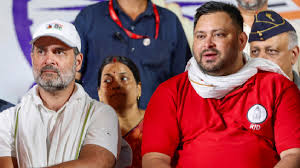
Congress Working Committee: The Bihar Pradesh Congress has begun accelerating its election planning. According to political experts, Congress state president Rajesh Ram is no longer beholden to Lalu Prasad Yadav, unlike former state president Akhilesh Prasad Singh. Akhilesh Prasad Singh used to make decisions after consulting Lalu Yadav. That is no longer the case. The Congress party is batting on its own pitch in Bihar. Patna: The biggest question is this: When Rahul Gandhi launched the Voter Rights Yatra, the Grand Alliance canceled the rally to mark its conclusion. The reason given was that Tejashwi Yadav was merely acting as a charioteer. Rahul Gandhi’s TRP is increasing. This is why, on the advice of Lalu Prasad Yadav, Tejashwi Yadav launched the Bihar Adhikar Yatra. According to experts, a political fire is simmering within the Grand Alliance. The reason for this is Rahul Gandhi’s 10 factors regarding EBCs, which he announced at the Congress Working Committee meeting. What is the resolution letter? The resolution, jointly issued by Rahul Gandhi, Leader of the Opposition in the Lok Sabha, and RJD leader Tejashwi Yadav, outlined social security measures in areas such as education and employment for the state’s EBC communities, which constitute approximately 36% of Bihar’s population. Unveiling the document, Gandhi said, “Today, we are committed to restoring justice and opportunity to the most deprived sections of society. The rights of the extremely backward classes have long been neglected. Our resolution prioritizes their aspirations in the legislature and on the ground.” It is reported that tensions within the RJD stem from the fact that their vote bank is also EBC, which the Congress is eyeing. Congress will cut into RJD’s votes, causing losses for the RJD. The Grand Alliance parties believe that the fire simmering within the Congress and RJD could flare up at any moment. Inside the Proposal The proposal promises a dedicated EBC Atrocities Prevention Act to end discrimination and violence against them through strong legal measures. It proposes increasing the reservation for EBC communities in panchayats and municipal bodies from 20% to 30%, amending the 50% quota limit, and submitting relevant legislation to the central government to withstand legal scrutiny. The resolution also promises to declare the existing “not found suitable” provision in recruitment illegal, citing its alleged misuse against EBC candidates, and to form a committee to review caste lists for inclusion and over-inclusion. A Setback for RJD According to RJD sources, Congress is working on a separate plan despite remaining in the alliance. Congress understands that Lalu Yadav’s era is over and Tejashwi Yadav’s era has arrived. Accordingly, Congress should have the upper hand. Rahul Gandhi is a senior leader, and Tejashwi Yadav is nothing compared to him. Therefore, Congress is making its own moves, targeting EBCs as part of this effort. The proposal promises residential land grants—three decimal places in urban areas and five decimal places in rural areas—to all landless members of the EBC, Scheduled Caste (SC), Scheduled Tribe (ST), and Other Backward Class (OBC) communities. Tejashwi Yadav stated that while we are fighting unemployment and vote theft, land and housing will be guaranteed for the poorest, not as a privilege, but as a right. Bihar Bandh News: Huge uproar in the name of Bihar Bandh, now Rahul Gandhi explains why he is doing this? Rahul Gandhi played a trick In private schools, the proposal proposes to reserve 50% of seats for EBC, OBC, SC, and ST students under the Right to Education (RTE), while mandating all private educational institutions in Bihar to implement reservations in accordance with Article 15(5) of the Constitution. It also provides for reserving 50% of government contracts and procurement worth up to ₹25 crore for members of the EBC, OBC, SC, and ST communities. According to the proposal, a high-powered Reservation Regulatory Authority will be established to oversee quota policies. It also proposes making state legislature approval mandatory before making changes to the list of castes eligible for reservation. Speaking on the occasion, Rahul Gandhi said, “During the Voter Rights Yatra, we have explained to the people of Bihar. This proposal is our answer. It promises legislative reform, education, employment, and respect for the most marginalized sections of society.” Ashutosh Kumar Pandey About the Author Ashutosh Kumar Pandey works for Navbharat Times Online. He has been active in digital, print, and electronic journalism for over 22 years. He specializes in digging into the past and uncovering untold stories of political history. He presents political anecdotes in a witty manner. He has a special grasp on political, cinema, and crime news. He received 12 “Best Story of the Day” awards from ETV Network between 2005 and 2009. He holds a degree in Political Science and Hindi Journalism. He began freelance writing in 2001 for Jansatta, Hindustan, and Dainik Jagran. He has had the privilege of working for ETV, Maurya TV, Focus TV, the Union Ministry of Information and Broadcasting, Prabhat Khabar.com, and Network 18. He has covered reporting and desk work for four Lok Sabha elections and several assembly elections. He is interested in music, theatre, and folk culture. He has a deep love for books. Courtesy : Hindi News
Chhattisgarh and Dalit empowerment: Attacks on Christians are not about conversions
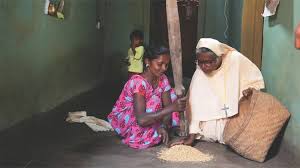
The Sangh Parivar fears the empowerment of Dalits and the spread of education among tribal and poor communities. In September 2019, Thiruvananthapuram MP Shashi Tharoor made a rare blooper. In response to the much-hyped ‘Howdy Modi’ event in Texas, US, the suave parliamentarian posted a “forwarded” photograph on his Twitter (now, X) handle, showing the rousing welcome Jawaharlal Nehru had received without any PR work on a foreign visit. “Nehru & India Gandhi [sic] in the US in 1954. Look at the hugely enthusiastic spontaneous turnout of the American public, without any special PR campaign, NRI crowd management, or hyped-up media publicity,” he tweeted, oblivious of the three apparent mistakes he was committing. Netizens and fact-checkers went on an overdrive on seeing Tharoor misspelling Indira. They went further and dug up more information, which forced the Lok Sabha member to tweet a clarification. Fact-checkers found that the photograph was taken during Nehru’s visit to the USSR, and not the US. They also claimed that the year was 1955. In 1955, a little boy from Kerala, unaware of Nehru’s visit to the USSR’s Magnitogorsk, a geographical anomaly that once consisted almost entirely of iron ore. The boy frolicked with friends on the banks of the River Pampa, now in Kerala’s Pathanamthitta district. Little did he then know that Nehru’s visit to the Soviet Union would soon take him to Durg, now in Chhattisgarh. Related: Religion, prejudice, politics and procedural lapses The migration On 2 March 1955, the USSR and India signed an agreement for an integrated iron and steel works in Bhilai, the twin city of Durg, then in Madhya Pradesh. Three years later, the first furnace roared into life. The Bhilai Steel Plant (BSP) opened up employment opportunities to several skilled and unskilled workers in Tamil Nadu and Kerala. The boy’s father was among those who grabbed the opportunity, and his family shifted from the banks of Pampa to the shores of the Shivnath River, now called a jewel of Chhattisgarh. From Kerala, it was mostly people from central Travancore who went to Bhilai. Having gained the gift of education through the Church Mission Society missionaries, they were prepared for such new opportunities, even when Kerala itself had no industries to speak of. For decades, they lived in the twin cities of Bhilai and Durg, proud contributors to India’s growth story. Their generations grew up there, chose to stay, and built peaceful lives. Today, that peace is frayed. The boy — now all grown up — whose father was an engineer at BSP, now lives in fear because of his Christian identity. They cannot even whisper ‘Hallelujah’ within their four walls. Yes, the Malayali Christian community in Durg, once so rooted and secure, now lives under the shadow of Sangh Parivar forces, especially the Bajrang Dal. Related: Missionaries serving marginalised face criminalisation Bajrang Dal vs house churches In Raipur, Durg, and the surrounding areas of Chhattisgarh, an unofficial directive to close house-churches is reportedly being enforced. These house-churches, mainly run by Pentecostal pastors, are small congregations that meet in private homes rather than formal church buildings. According to a June 2025 ruling by the Madras High Court, private homes in India can generally be used for religious prayer. However, converting a house into a permanent place of worship requires permission from local authorities. ”In Durg, there are fewer than 10 Malayali pastors, but the Christian community is strong, comprising nearly 5,000 families—from Orthodox, Latin Catholic, and Pentecostal denominations such as IPC and Church of God, etc.,” a church council leader from Durg with roots in Kottarakkara, Kollam, told South First. “Most Malayali pastors have registered churches, but some face financial constraints that prevent them from building formal church buildings. So they conduct prayers in their homes,” he said on condition of anonymity. In Bhilai, the plant authorities had allocated acres of land for Christians on lease to build churches. With nearly 30,000 permanent workers in BSP, people from South India, Bengal, and elsewhere were free to live here and practice their faith. Alongside schools and hospitals, religious institutions like churches, mosques, and temples were established. The Orthodox Diocese later built numerous schools, colleges, and professional institutions, while Catholics set up hospitals and schools in Durg. Now, after Vishnu Deo Sai became the Chief Minister of Chhattisgarh, Bajrang Dal members are being forced to stop house prayer meetings. “They come to our prayer centres with police, attack us, and shut down our churches. Police then file cases against pastors for ‘shanti bhang‘ (disturbing peace) and Section 295 (hurting religious sentiments) at the request of Bajrang Dal members. After the arrest of two Malayali nuns, the confidence of Bajrang Dal activists has increased, as the police have not taken action against them,” the church leader said. HC asks Durg to review church rules; no action yet After Bajrang Dal allegedly began shutting down house congregations and prayer meetings through threats and violence, church authorities approached the High Court. Copy of Court Order Copy of the High Court order. The Chhattisgarh High Court has directed the Durg District administration to consider representations from the United Christian Council regarding restrictions on prayer meetings in churches and halls. The petition, filed by the council’s Secretary Obed Das, sought relief against several restrictions, including barring non-Christians, banning prayers in residential or rented halls, limiting prayer duration, and recording attendees. “The administration has been issuing oral instructions restricting who can attend prayer meetings and where they can be held, despite churches being on private land,” a lawyer, who also sought anonymity, told South First. The court ordered the District Magistrate to decide the representations submitted on 6 April and 31 July 2024, after a fair hearing within four weeks. The petition was disposed of with directions to pass an appropriate order. However, the local administration has yet to act. ”Till now, no action has been taken even after the High Court’s direction. So where will we go for justice?” the church leader asked. Rising attacks Article
Dalits were prevented from entering the Durga Puja pandal, and the dominant people brandished sticks and declared they could not worship there.
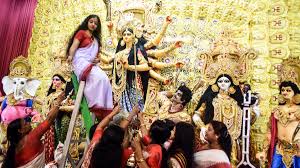
Seoni Durga Puja Pandal: Dalits were prevented from entering the Durga Puja pandal in Seoni. This allegation is being leveled against village strongmen. The victims also filmed the incident. Police have filed a case against three individuals and begun investigating the matter. In Vindhya, dominant individuals prevented Dalits from entering the Durga Puja pandal. Seoni: In Sadak Seoni village, under the Chhapara police station in Seoni district, Madhya Pradesh, members of the Dalit community were prevented from entering the Durga Puja pandal by dominant individuals. The family had come for worship and darshan. Those attempting to visit were abused. Police have filed a case against three individuals in this matter. Case filed against three individuals In fact, this entire incident took place in Sadak Seoni village, under the Chhapara police station. Dalits had come to worship at the Durga Puja pandal. People who had come to visit were abused by the bullies sitting there. A video of this incident has surfaced, showing an elderly man standing with a stick and threatening them. Following the video, a case has been filed against three people. Prevented from Worship According to Chhapara police, Shyamlal Ahirwar stated in his complaint that on Wednesday, he had gone to the public Durga pandal at Durga Chowk with his wife and son to worship. The bullies stopped him from performing the puja, saying, “You cannot perform puja there.” Family works as laborers According to the victim, he earns his living by working as a laborer. While returning from the fields, the accused, Mehrban Singh Thakur, stopped him on the way and said, “I have received numerous complaints against you.” He then objected to his entry into the pandal and threatened to kill him if he spoke too loudly. Shortly after, when he went alone to the pandal to donate, Naresh Thakur and Narayan Yadav insulted him with casteist slurs and refused to accept the donation. After this, when my nephew arrived at the pandal to donate, he was also taken down from the stage. The victim also filmed the incident on his mobile phone. SP Sunil Mehta informed that a case has been registered and arrests will be made soon. Currently, the viral video on social media highlights the caste-based discrimination still evident in society. Edited by: Muneshwar Kumar • Reported by: Jitendra Bhardwaj About the Author Muneshwar Kumar is the Principal Correspondent at Navbharat Times Online. He has 14 years of experience in journalism. He has a special interest in Madhya Pradesh politics, crime, current affairs, and off-beat news. He also has experience in ground reporting for several elections. He has been with Navbharat Times Online since 2020. Courtesy: Hindi News
The plight of a Dalit family in Prayagraj: Two families forced to live under tarpaulin, without housing or toilets
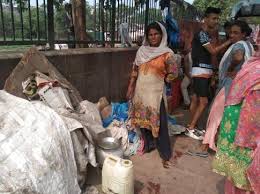
In Kolsara village, Koraon block, Prayagraj, two Dalit families are deprived of basic amenities. The families of Sonia Chauhan and Preeti Chauhan are forced to live under tarpaulin shelters. Both families earn their living through manual labor. The benefits of government schemes have not reached these families. They have neither received housing, a toilet, nor a ration card. The village head and the Panchayat secretary are paying no attention to the plight of these families. Being illiterate, these families are unable to communicate their problems to anyone. Village residents like Rajesh, Urmila, Yogesh, Rajkumar, and Ramashankar say that the government should immediately address the plight of these poor families. Despite government orders, these families are not being provided with basic amenities. Brijlal Courtesy: Hindi News
Villagers oppose free housing plots allotted to transgender persons in Chengalpattu
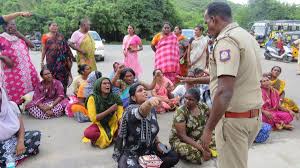
A group of transgender persons who were given free housing plots by the State government, along with pattas, in a village in Chengalpattu district, are facing opposition from an entirely unexpected quarter: opposition from the residents in the village. The transgender persons have gone on a protest, demanding that the district administration allow them to occupy the allotted lands and construct houses. Transwoman activist Negha, who has been protesting along with the allottees of the free housing plots, said the Chief Minister M.K. Stalin had provided free housing plots to 37 transgender persons at Ozhalur in Chengalpattu district, at a function held in May last year. However, when they wanted to construct homes on the land allocated to them, they were faced with stiff opposition from the villagers and panchayat leaders, who have have been continuously obstructing the construction of houses on their land. On Thursday, things came to a head when the affected transgender persons gathered in front of the Chengalpattu Collector’s office. They appealed to the government authorities to provide them security, as they were being threatened by the residents of the village. Ozhalur village panchayat president O.E. Prabhakaran, however, claimed that the village was not opposed to the transgender persons using the land allotted to them. Their quarrel, he claimed, was about the location of the land granted to them. “The alloted vacant plot is the only place that is of flat terrain, which the children of the village have been using to play sports. We are ready to accommodate them in an alternate location,” he added. The Hindu Bureau Courtesy : The Hindu Note: This news is originally published on https:/thehindu.com/bha and is used purely for non-profit/non-commercial purposes, especially human rights
Dalit families in Erode stage protest seeking patta
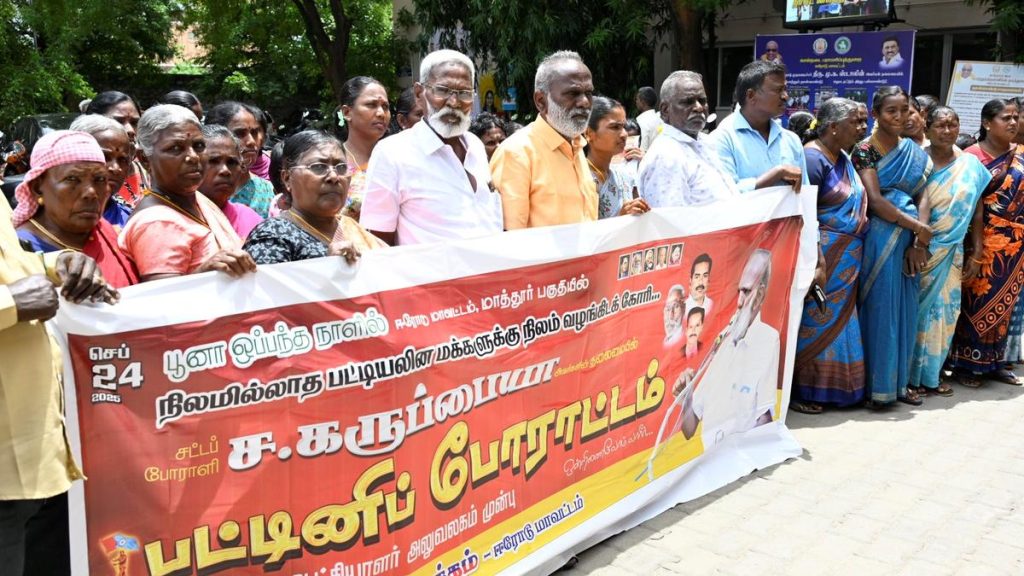
Urging the District Administration to allot 250 acres of land to Dalit families in Mathur village, Anthiyur taluk, as promised three decades ago, residents staged a protest at the Collectorate here on Wednesday (September 24, 2025). Led by S. Karuppaiah, State president of the Dalit Liberation Movement – Tamil Nadu, the families said the State government, in 1956, had earmarked over 1,000 acres for Dalit families in the western districts. However, they claimed that many of the beneficiaries were later evicted, and the land was encroached upon by other communities. According to them, large portions of land that were originally meant for Arunthathiyar and Paraiyar families in Gobichettipalayam and Anthiyur taluks have been occupied by individuals from other communities. They pointed out that the land in Mathur village remains under government control and is classified as forest land. Hence, they demanded to allot it to Dalit families in the village. Later, officials held talks with the protesters. The Hindu Bureau Courtesy : The Hindu Note: This news is originally published on https:/thehindu.com/bha and is used purely for non-profit/non-commercial purposes, especially human rights
HRF demands Collector-led probe into Kaikaluru Dalit attack case
The Human Rights Forum (HRF) has demanded a comprehensive probe, under the leadership of the District Collector, into the Kaikaluru Dalit attack case. A three-member team from the HRF visited Danagudem near Kaikaluru, where a Dalit, P. Ajay, was allegedly attacked with a knife by members of Kapu community. The team learnt that the incident took place on September 5 during the Ganesh idol immersion celebrations, when Ajay, who was on his way to a ration shop on a two-wheeler, honked to alert the revellers. Enraged at this, the revellers, belonging to another community, reportedly attacked Ajay. Casteist slurs were reportedly hurled at his mother and sisters, who tried to help him. They were also reportedly dragged by their hair and beaten up. Despite being present there, the police personnel could not do anything, the activists wrote in a statement issued on Tuesday. HRF condemned the silence of the State government on this subject, and demanded stern action against all the accused. They also demanded a Collector-led probe in the incident and action under the SC/ST (Prevention of Atrocities) Act against officials for threatening the complainant with a rowdy sheet. Ajay is undergoing treatment at the government hospital in Eluru. HRF activists A. Ravi, Md. Iqbal and Mutyala Srinivasa Rao were part of the fact-finding team. The Hindu Bureau Courtesy : The Hindu Note: This news is originally published on https:/thehindu.com/bha and is used purely for non-profit/non-commercial purposes, especially human rights
Caste census: After stiff opposition from CM’s own camp, commission says converted castes axed
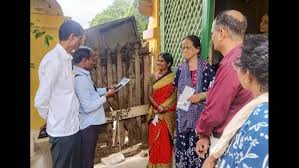
Bengaluru: On a day of much drama, Karnataka State Commission for Backward Classes Tuesday clarified that all Dalit Christian castes have been removed in the final list of castes to be enumerated as part of the socio-economic-educational-political survey, widely known as the caste census. Commission chairman Madhusudan Naik told TOI that the 14 castes were initially included in the draft list but were removed “earlier this month” following public objections. His clarification came late in the day amid intense political drama that unsettled governing Congress, as several Dalit functionaries — including loyalists of chief minister Siddaramaiah such as former ministers H Anjaneya from the Left sect of Scheduled Castes and KN Rajanna from the Valmiki community of Scheduled Tribes — objected to the inclusion of converted castes in the enumeration. While Anjaneya warned of protests, Rajanna criticised both the govt and the commission, saying inclusion of Dalit converted castes would amount to “state-sponsored religious conversion”. However, drama unfolded when a delegation of BJP members led by Chalavadi Narayanaswamy, leader of the opposition in the legislative council, met Naik in the morning demanding that the 14 castes be masked in the enumeration app — just as the commission had done with 34 OBC converted castes last week. This led to a face-off as Naik defended their inclusion, insisting converted castes are eligible for recognition. BJP members strongly objected to the chairman’s assertion and attempted to gherao him. Naik, though, left for a high court hearing on the census. His clarification, that the 14 castes had already been removed, came late in the evening. “The commission’s clarification appears an afterthought to manipulate the situation,” said Narayanaswamy. “The panel is acting as a puppet of the govt.” The census has initially sparked controversy for including 48 converted castes such as ‘Kuruba Christian’ and ‘Kubara Christian’. It included the 14 SC castes as ‘Madiga Christian’, ‘Holeya Christian’and ‘Valmiki Christian’, an ST caste. Last week, the commission said it had masked 34 OBC converted castes following strong opposition. But 14 converted Dalit castes remained. Dalit representatives vehemently protested their inclusion. “It is wrong to include them under the converted category,” said VS Ugrappa, senior Congress functionary and Valmiki leader. “Inclusion of other Dalit converted castes is also wrong since it is a violation of the Anti-conversion Act. Enlisting these castes as converted castes is not just misleading but also mischievous.” He said those from Valmiki community never opted for conversation as they are not untouchable or socially stigmatised or backward like some other Dalits. The developments provided ample ammunition for opposition BJP to attack the govt with. “By ordering a caste census in a tearing hurry, Siddaramaiah has made everybody, including his own party men and cabinet colleagues, unhappy,” said Lahar Singh Siroya, BJP Rajya Sabha member. “As of Tuesday, Vokkaligas, Lingayats, Dalits, OBCs, Brahmins, minorities, tribes, and nomads are all upset with the Congress govt. The CM should ask if his own Kuruba community is with him or if they too are upset.” Courtesy : TOI Note: This news is originally published on https:/timesofindia.com/bha and is used purely for non-profit/non-commercial purposes, especially human rights
Book Review- Caste: a global story by Suraj Milind Yengde
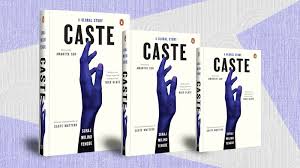
Suraj Milind Yengde in his new book, ‘Caste: a Global story‘ traces global footprint of the anti-caste struggle and how caste and caste-based discrimination become a global phenomenon. Recent cases of caste-based discrimination have been found in top companies like Cisco and higher education institutions in the United States of America. First time, worldwide public discussions are taking place on caste and caste-based discrimination issues. The Cisco and United States university campus incidents were recorded due to the awareness of the global reactions that occurred in the widely publicised case of the institutional murder of Rohith Vemula, a Dalit, in Hyderabad Central University. In this context, the international community endeavours to understand what caste is and caste-based discrimination, and what mechanisms should be developed to address caste-based discrimination in campuses, public institutions, and day-to-day life. The book, “Caste: A Global Story,” attempts to explore, analyse, and observe the Indian caste society from the perspectives of those subjected to it as well as outsiders. This will serve as a prelude to a detailed study of castes globally. The book sets the story on caste centred on India’s hierarchical society and the various forms it takes worldwide (p.21). The author divided his book in six important chapters to explore academic, concepts of caste, caste based discriminations, Dalit response to Black Literature, and caste and race; for the author, it is the prominent voices such as ‘Dalit-Black Live Matters’ along with initiation of the study of caste outside of India like in Trinidad, Cosmopolitan Dalit universalism, and chapter addresses biography of Dalit Agonism- field notes from the Diary of an archivist. There has been various attempt to study caste by many prominent scholars such as Caste: The Origins of Our Discontents By Isabel Wilkerson (2023) Ambedkar in London: William Gould, Santosh Dass, Christophe Jaffrelot (2024), The Evolution of Pragmatism in India by Scott R. Stroud (2023), Becoming Babasaheb: The Life and Times of Bhimrao Ramji Ambedkar (Vol.1): Birth to Mahad (1891-1929) by Aakash Singh-Rathore (2023), and The Trauma of caste by Thenmozhi Soundrarajan (2022). This latest work on the topic by Suraj Yengde explores the historical development of caste and caste-based discrimination beyond time and space. This recent chain of work, based on historical investigation, ethnographic research, and personal story narrations by diaspora, comparative studies of caste and race by social scientists explore and highlight the lived experience of the downtrodden communities and individuals. In this context, Ambedkar’s theoretical writing and his experience during his university days in the United Kingdom and the United State help to understand global inequality and the nexus of caste-race hierarchy. Suraj explores the connection between the anti-caste movement in India and a similar kind of discrimination outside of India. For instance, organisations working on anti-caste connected Dalit lived experiences and experiences of Blacks in the US in order to develop a campaign like Dalit Lives Matter, similar to Black Lives Matter. In the chapter Affairs of Letters: Dalit responses to Black Literature, the author mentions that it is not about literary analysis nor an exercise in comparative literature, but to find out the persistence and map out the history of the one-sided love affair of the Dalit community with Black American literature. And looking critically at the emergence of a literary response to caste and its institutions, and the growing divergence. While mapping it out, he found that the relationship between Dalit and Black literature solidarity has been largely a ‘one-sided’ (p.88) affair. This observation makes sense to a large extent as most of the Dalit literature published in regional languages like Marathi, Hindi, Tamil, and Kannada etc. Despite this limitation, Dalit literature always promotes universal solidarity and an egalitarian society for all oppressed communities by invoking the idea of justice, equality, and freedom. In one of his seminal works, ‘Castes in India: Their Mechanism, Genesis and Development’, Dr. Ambedkar’s observed that, “If Hindus migrate to other regions of earth, Indian caste would become a world problem”. Recently that observation become alive when cases of caste discrimination in UK and USA by the upper caste Indian diaspora were reported similarly, in the year 2021, a federal lawsuit in the USA was filed for caste discrimination in against a Hindu organisation named Bochasanwasi Shri Akshar Purushottam Swaminarayan Sanstha (BAPS). It was alleged the BAPS exploited more than 200 workers (11, Nov, 2021, Aljazeera). In fourth chapter, Suraj also traces caste and caste practice in Trinidad. He observed “Their (Indian origin community) Hindu and caste identity was and continues to be primarily shaped by a brahman-centric form of rituals” (p.141). He also mentioned that caste based occupational category exists among the Indo-Trinidadians. For example, the Pandits Council of Trinidad and Tobago, which is the accredited body of 500 pandits (brahmins), controls the religious aspect of the Hindu community. For a non-Brahman member to obtain membership and become a priest is almost impossible because of caste restrictions. (p.148). Suraj explores how caste practices continue and also their connection with the Indian Hindu fundamental RSS in maintaining such traditions with the upper caste organisation of Trinidad and Tobago. Chapter on ‘Cosmopolitan Dalit Universalism: Dalit Activism and the Promise of an Anti-Caste World’, is a quite interesting one. It presents a fresh look at how the caste system travels not only to the UK and the US, but also to other parts of the world, through the Dalit diaspora, including Malaysia, Kuwait, UAE, Bahrain, etc. It initiated the nurturing of Amebdkarite consciousness by various anti-caste Dalit organisations in particular countries where they get settled (p.207). The Dalit diaspora plays a significant role in galvanizing Ambedkarite consciousness at the international level, with the help of anti-caste thinkers and ideologies such as Buddha, Phule, Periyar, Guru Ravidas, and Kabir. Since most of the Dalit diaspora comprises labourers such as construction workers, supermarket staff, drivers, hotel staff, and cleaning staff, therefore they their life has not been easy. Despite their economic conditions and limited time, they try to develop and maintain Dalit consciousness by
Homebound Director Neeraj Ghaywan Ends Debate On Casting Janhvi Kapoor As Dalit Girl: Has Inner Hunger To Portray A Character
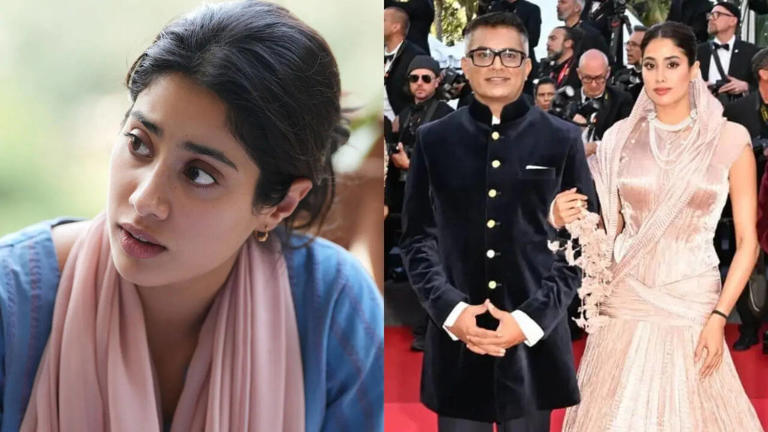
Janhvi Kapoor is one of the top actresses in the industry today and she has been delivering promising performances one after another. The actress who won hearts with her performance in Sidharth Malhotra’s Param Sundari is all set to drench them with emotions now with Homebound, co-starring Ishaan Khatter, Vishal Jethwa. The film is all set to hit the theatres on September 26th and director Neeraj Ghaywan has shared his vision behind casting Janhvi in the role of a dalit girl. Neeraj Ghaywan On Casting Janhvi Kapoor In Homebound At a recent event for Homebound, Ghaywan addressed the conversations around casting Janhvi in a Dalit role, a choice that has sparked questions and debate. The filmmaker said, “In India, we have people from all walks of life. What I was searching for wasn’t just acting skill, but also the inner hunger to portray a character with intensity and truth.” Further, he added, “This character isn’t going to come to you. You have to go to it. You have to step out of your privileged life, confront that reality, and let it settle within you.” He also shared hat casting the right actor wasn’t just about screen presence or line delivery, it was about emotional depth and lived sincerity, especially when telling the stories of historically marginalised communities. For the unversed, Homebound has officially been selected as India’s entry for the Best International Feature Film at the 2026 Oscars. The film marks Ghaywan’s return to direction after nearly a decade and fans are super excited. More about Homebound Homebound had its world premiere on Wednesday in the prestigious Un Certain Regard section at Cannes, where it was met with an enthusiastic audience in a packed hall. The crowd’s excitement was undeniable, culminating in a remarkable 9-minute standing ovation. Homebound, directed by Neeraj Ghaywan, stars Ishaan Khatter, Vishal Jethwa, and Janhvi Kapoor. Backed by Dharma Productions with Martin Scorsese as executive producer, the film follows two best friends, a Muslim and a Dalit, as they chase their dream of becoming cops while navigating caste, religion, love, and survival in a North Indian village. Courtesy : MSN Note: This news is originally published on https:/msn.com/bha and is used purely for non-profit/non-commercial purposes, especially human rights