
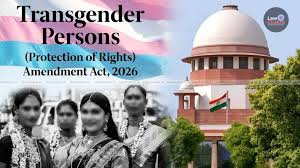
The Supreme Court of India on Monday issued notice to the Centre and all States on a batch of petitions challenging the constitutional validity of the Transgender (Protection of Rights) Amendment Act, 2026, but declined to grant any interim stay, noting that the law has not yet been notified.
The Supreme Court of India on Monday issued notice to the Centre and all States on a batch of petitions challenging the constitutional validity of the Transgender (Protection of Rights) Amendment Act, 2026, but declined to grant any interim stay, noting that the law has not yet been notified.
Refusing to put the amended law on hold at this stage, a Bench of Chief Justice Surya Kant and Justice Joymalya Bagchi directed that notice be issued to the States through their Advocates General and said the matter would be placed before a three-judge Bench to be constituted by the Chief Justice.
The amendment, which received Presidential assent on March 31, introduces wide-ranging changes to the legal framework governing the recognition, rights, and protection of transgender persons.
It revises the definition of a “transgender person” to make it more precise and strengthens penal provisions to deal with serious offences such as abduction of adults and children and the infliction of reversible or irreversible bodily harm through mutilation, emasculation, castration, hormone therapies or other similar interventions, or chemical alteration, including forced gender identity.
During the hearing, senior advocate Abhishek Manu Singhvi, appearing for some of the petitioners, raised concerns over the removal of self-identification as a basis for recognising gender identity. He submitted that the amended law effectively bars individuals from asserting their gender identity without medical certification and could disrupt ongoing gender-affirming treatments.
The Bench, however, expressed concern about possible misuse if self-identification alone were accepted, including the risk of individuals falsely claiming such status to avail reservations and other benefits. Singhvi responded that such apprehensions were unfounded and reiterated that the amendment runs contrary to the principles laid down by the Supreme Court in its April 15, 2014 judgment in National Legal Services Authority v. Union of India.
“You cannot nullify the judgment. The basis can be removed. The NALSA judgment is nullified, and no attempt has been made to remove its basis,” Singhvi told the Bench.
The Supreme Court, in its April 15, 2014 judgment, had issued a series of directions, including upholding the right of transgender persons to self-identify their gender. The ruling stated: “Transgender persons’ right to decide their self-identified gender is also upheld, and the Centre and State Governments are directed to grant legal recognition of their gender identity, such as male, female, or as third gender.”
Questioning Singhvi’s submissions, Justice Bagchi observed, “When you say NALSA recognises self-identification as a matter of dignity, we can examine the amendment in the light of Article 21. This amendment changes the substratum of the law on which NALSA examined it. So, instead of self-determination, there is a medical evaluation.”
“This amendment changes the substratum of the law under which NALSA was examined. Self-identification is replaced with medical evaluation,” the Bench added.
Singhvi pressed for an interim stay of the amendment, pointing to its immediate impact on transgender persons undergoing treatment, but the Court was not inclined to intervene. It reiterated that the validity of the law would be examined in due course and refused to halt its operation at this stage.
The amendment to the Transgender (Protection of Rights) Act, 2026 has also been challenged before the High Courts of Delhi, Kerala, and Karnataka.
The amended law seeks to make the definition of a “transgender person” more precise, addressing concerns that the earlier definition under the 2019 Act was overly broad and created practical difficulties in identification and implementation. The revised framework aims to ensure that protections are targeted at individuals facing genuine social exclusion due to biological factors, rather than extending benefits based on self-perceived or acquired identities.
The Act also introduces institutional and procedural reforms, including the designation of competent authorities for implementation and provisions for seeking expert inputs where required. It enables transgender persons to make consequential changes in official documents and restructures the National Council for Transgender Persons to ensure more effective representation from States and Union Territories through a region-based rotational mechanism.
A key feature of the amendment is the strengthening of penal provisions. While the earlier law provided limited punishment for general offences, the amended provisions create specific offences with graded punishments, particularly addressing grave acts such as abduction, forced bodily harm (including mutilation or chemical alteration), and coercion into a transgender identity for exploitation. These provisions are designed to operate alongside existing criminal laws while recognising the unique vulnerability of victims.
Parmod Kumar
Courtesy : The Statesman
Note: This news is originally published on https:/thestatesman.com/bha and is used purely for non-profit/non-commercial purposes, especially human rights