
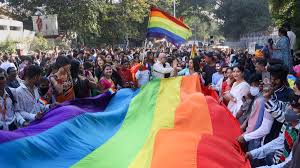
The petition argues that the Act amended the Transgender Persons (Protection of Rights) Act, 2019, in its structure, object, and affect, and thus violated the fundamental rights of transgender persons.
New Delhi: The Supreme Court is scheduled to hear on Monday a plea challenging the constitutional validity of the Transgender Persons (Protection of Rights) Amendment Act, 2026 for replacing the individual’s own understanding of their gender or identity with a biological or socio-medical category of the State’s choosing.
A bench of Chief Justice of India Surya Kant and Justice Joymalya Bagchi would take up on May 4, 2026 the petition filed by Laxmi Narayan Tripathi, the chairperson of National Council for Transgender Persons (NCTP), and its member Zainab Patel.
The petition contended the Amendment Act amended the Transgender Persons (Protection of Rights) Act, 2019, in its structure, object, and affect, and thus violated the fundamental rights of transgender persons guaranteed under Articles 14, 15, 19, and 21 of the Constitution.
The plea pointed out in National Legal Services Authority Vs Union of India, (2014), the Supreme Court, recognised for the first time that transgender persons have a fundamental right to be identified as a third gender, distinct from the male-female binary It highlighted that the court then directed that transgender persons would be treated as socially and educationally backward classes for the purposes of reservation under Articles 15 (4) and 16 (4), and called upon the State to take affirmative steps to address the marginalisation they face.
Above all, NALSA judgment established that the right to self-identification of gender is a fundamental right under Article 21, not a privilege to be conferred by a certificate, not a status to be earned through surgery and not a conclusion to be reached by a medical board, the plea said.
The 2019 Act preserved the core of what NALSA required. However, the Amendment Act arbitrarily removed the provision, which stated that a transgender person is someone whose gender does not match their birth assignment, and that they have the right to self-identify, the plea contended.
“The deepest constitutional wound inflicted by the Amendment Act is the substitution of the definition of “transgender person” in Section 2(k) of the Principal Act,”‘ it stated.
The plea emphasised in NALSA judgment, the Supreme Court explicitly and unequivocally repudiated the requirement of surgical intervention as a precondition for legal gender recognition.
This court further held that each person’s self-identification of gender must be accepted as the foundation of their legal gender identity, without the State imposing medical, psychiatric, or bureaucratic gatekeeping.
The right to determine one’s own gender, free from coerced bodily alteration, was held to flow directly from the right to privacy and dignity under Article 21, it pointed out.
The plea contended a legislature cannot repeal a provision that gives concrete form to a fundamental right recognised by this court without violating Article 21.
Ashish Tripathi
Courtesy : DH
Note: This news is originally published on https:/deccanherald.com/bha and is used purely for non-profit/non-commercial purposes, especially human rights