
Move inspired by synodal call to ‘integrate marginalized communities, help them live a dignified life,’ priest says
For years, Inba Ignatius, a Catholic transgender leader in the southern Indian city of Chennai, felt like a visitor in her own church — welcomed at the altar on special occasions but largely invisible in the daily life of the parish. Today, she feels the beginnings of a permanent home.
Her sense of belonging is being fostered by a pioneering initiative of Madras-Mylapore archdiocese: a dedicated pastoral care desk for transgender persons.
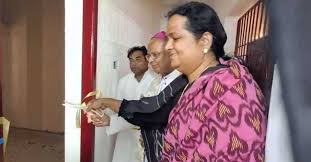
Launched on Feb. 26 by Archbishop George Antonysamy, the desk represents a structured, institutional effort to move beyond sporadic outreach toward a sustained ministry toward this marginalized group.
For Father Leo Joseph, the priest who started the pastoral desk, the initiative is not merely a social project but a direct response to the universal call of the Catholic Church.
“We have started this desk as an answer to a call from the recently held Synod of Synodality, which urges the Church to ‘integrate marginalized communities like transgender people and help them live a dignified life,’” he told UCA News.
The desk’s mandate, however, draws a clear pastoral boundary.
Joseph emphasized that the focus is on holistic care and social integration, clarifying that the ministry is intended to provide “only pastoral care and not sacramental care.”
Ignatius, who runs a non-governmental organization for transgender rights and has collaborated with Joseph for years, sees the pastoral desk as a watershed moment.
“It is a welcome initiative by the archdiocese,” she told UCA News.
Transgenders in Chennai (formerly Madras) — the capital city of Tamil Nadu state, where the archdiocese is based — “need genuine pastoral care, and this pastoral desk can be a big help,” Ignatius noted.
The archdiocese’s pastoral move unfolds against a backdrop of broader societal recognition in Tamil Nadu.
The state government already maintains a special welfare board for transgender persons and has recently announced new schemes for their welfare and development.
Furthermore, Tamil Nadu is home to the annual Koothandavar festival, a major Hindu religious and cultural event that prominently celebrates the transgender community — a testament to the deep cultural roots and visibility of transgender persons in the state’s social fabric.
The Catholic archdiocese’s initiative brings together a small but dedicated team — two other priests and two nuns — with plans to expand by enlisting volunteers from religious congregations and the laity.
The goal, Joseph explained, is to coordinate and amplify the scattered efforts already being undertaken by individuals and religious communities across the archdiocese.
Currently, the team is drafting a formal mandate and action plan, which they hope to present to the Tamil Nadu Bishops Council (TNBC) for adoption.
The vision is to eventually elevate the desk to an archdiocesan commission, creating a model that could be replicated in other dioceses across the southern state.
The scale of the need is significant. Joseph estimates that around 10,000 transgender persons live in Chennai.
Many face stark marginalization. “Most survive by begging near toll roads and indulging in commercial sex work,” he said.
The desk’s immediate strategy focuses on economic empowerment as a way to dignity. Plans are already underway to provide training in employable skills such as tailoring and jewelry making, intending to secure stable jobs.
For Joseph, this work is a continuation of a commitment that began nearly a decade ago, when he first started building relationships with the transgender community in 2015.
Ignatius noted that small but significant steps toward inclusion have paved the path to this moment.
Joseph, she recalled, has long facilitated interactions between transgender persons and seminarians, priests, and nuns, helping to break down misconceptions and foster understanding.
“We were invited to be part of various events like Maundy Thursday celebrations and other church events and festivities,” she said. “Because of the exposure and opportunities we received, we feel now as part of the local Catholic parishes.”
She hopes that the new pastoral desk will build on this foundation, moving from symbolic inclusion to structural integration.
“I believe this pastoral desk can help us become more visible and integrate with the larger mainstream community, especially with the Catholic community in the archdiocese.”
Publisher William J. Grimm M. M.
Courtesy : UCA News
Note: This news is originally published on https:/ucanews.com/bha and is used purely for non-profit/non-commercial purposes, especially human rights