
Non-cognisable complaint lodged against transgender person for assaulting man in local train compartment
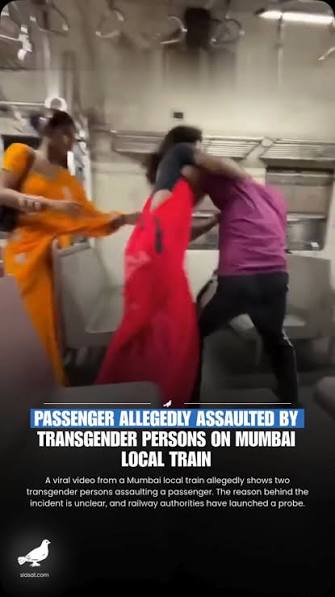
Mumbai: After a video clip capturing two transgender persons beating up a man inside a local train compartment went viral, the Govt Railway Police (GRP) tracked down the duo on Monday. One of them is a minor and was sent back to his guru with a warning. Police registered a non-cognisable complaint against the other and confirmed that preventive action will be taken against him. Elaborating on the incident, police said that the two transpersons were begging in local train compartments recently. When they asked for money from the man (captured in the video), he refused and argued that others had already taken money from him that day. This sparked an altercation, which ended in violence as the two transpersons rained kicks and blows on him. A co-passenger filmed the incident, which occurred on a Western Railway local between Mahim and Bandra stations in the general compartment. After the video was posted online, it came to the attention of the GRP. They tracked down the two and brought them to the Mumbai Central GRP chowky on Monday. “We registered a non-cognisable complaint against one of them and will take preventive action,” confirmed DCP (GRP) Pradnya Jedge. Courtesy : TOI Note: This news is originally published on https:/timesofindia.com/bha and is used purely for non-profit/non-commercial purposes, especially human rights
Karnataka HC questions 12-year delay in education quota for transgender persons

NEW DELHI: The Karnataka high court on July 17 questioned the state government for failing to implement reservation for transgender persons in educational institutions, nearly 12 years after the Supreme Court’s landmark 2014 NALSA ruling directed such action. How did the transgender reservation dispute reach the high court? In 2023, a transgender student filed a case after being denied admission to the National Law School of India University (NLSIU), Bangalore. The student asked the court to direct the university to follow the Karnataka State Policy on Transgenders, 2017, and give 0.5 per cent reservation to transgender persons in admissions, as per the report by LiveLaw. A single judge ruled in the student’s favour and asked NLSIU to give the reservation. NLSIU then challenged this order before a division bench. By the time this order came, the academic year 2023-24 had already started, so NLSIU said it could not admit the student in that batch. The court then asked if the student could instead be given a seat in any law college under the Karnataka State Law University (KSLU), since he had already lost valuable years of study. Earlier, the court had noted that KSLU had agreed to “try to accommodate” the student in one of its affiliated colleges — including BMS College of Law and Seshadripuram Law College — depending on his rank in the merit list and seat availability. Based on the student’s choice, the bench later asked KSLU to keep one seat reserved for him at each of these two colleges. Separately, earlier in the week, the high court had also asked the state government to speed up work on a full reservation policy for transgender persons in education, pointing out that nearly two years had passed since the policy proposal was first sent to different government departments. Why did the high court question the state government? A division bench of Justice Anu Sivaraman and Justice Venkatesh Naik T, while hearing the appeal, asked why the delay had gone on for so long and why the state government had been unable to follow the Supreme Court’s order. “This is the direction of the apex court… It is 12 years in the making now… We feel that it’s about time that positive directions are issued,” the court said. The court also pointed out that Karnataka had already given reservation to transgender persons in government jobs, so there was no reason for education to be left out. “Can the State say that it is still contemplating? It was the first State to implement reservation in the employment sector. Does that mean, the education sector, it can wait?” The court further explained that the state did not need to make a fresh policy decision on this, since the Supreme Court had already given clear directions in the NALSA judgment. The bench said: “There is no policy delay issue, there is a clear direction by the apex court. The apex court judgment has to prevail.” During the hearing, the state government told the court that one seat had already been reserved for the student in a law college affiliated with the Karnataka State Law University (KSLU), and that the formal admission notice would be issued once the degree results are announced. The student, who argued his own case in court without a lawyer, told the bench that even after getting admission, transgender students face many problems because there is no proper reservation policy in place. He said this affects basic things like access to hostels, toilets, documentation requirements, and fee concessions. The bench appreciated the way the student had presented his case, saying: “We want to make sure that his admission fructifies and he is given the benefits mentioned in the NALSA judgment. I am saying this as a person who has been on the Bench for the last 12 years, to someone who is very deserving, as a party-in-person conducting a case with such responsibility, we want to see something is done… The appeal is filed since there is no policy for the State government for reservation.” The court then posted the matter for further hearing. Courtesy : TOI Note: This news is originally published on https:/timesofindia.com/bha and is used purely for non-profit/non-commercial purposes, especially human rights
CM Yogi meets Lalita Gautam’s family, announces financial and other assistance

During his meeting with the victim’s family in Ghaziabad, CM Yogi assured financial assistance and a house each for the deceased’s father and uncle under the Chief Minister’s Housing Scheme. He also directed the family to receive priority benefits under the Ayushman Bharat Scheme, ration cards, and other eligible welfare schemes. The Chief Minister also assured the family of strictest legal action against the culprits. Ghaziabad. Chief Minister Yogi Adityanath met with the family of Lalita Gautam, a Dalit student from Meerut, at the PWD Guest House in Ghaziabad on Saturday, expressing his condolences and offering condolences. The Chief Minister announced immediate financial assistance of ₹5 lakh from the Chief Minister’s Discretionary Fund. During his meeting with the victim’s family in Ghaziabad, CM Yogi assured financial assistance and a house each for the deceased’s father and uncle under the Chief Minister’s Housing Scheme. CM Yogi has also directed that the family be given priority access to the benefits of the Ayushman Bharat Scheme, ration cards, and other eligible welfare schemes. Furthermore, the Chief Minister has assured the family of strict legal action against the culprits. After meeting the Chief Minister, the deceased’s father, Ved Prakash, and brother, Prashant, expressed confidence in receiving justice. They said that the Chief Minister listened to their plight with utmost patience and affection and assured them that not a single culprit involved in this heinous crime will be spared. They said that the meeting with the Chief Minister further strengthened the family’s confidence in receiving justice. Senior administrative and police officials, including Social Welfare Minister and Meerut District In-charge Minister Asim Arun, were present on the occasion. After the victims met with the Chief Minister and received financial and other support, the Samajwadi Party has now backtracked on this issue. The SP had been raising the issue repeatedly, and Akhilesh Yadav even met with the victim’s family in Lucknow. However, after CM Yogi’s meeting with the victim’s family and the family’s expression of satisfaction, there is hope that the politicizing of this matter will end. Courtesy: Hindi News
CasteWhy Should Readers Across the World Care About Dalit Literature?

This article is a lightly edited version of the introduction to Touchable/Untouchable: Dalit Literature from India in Translation, edited by K. Satyanarayana and S. Shankar. Touchable/Untouchable is a special issue of the journal Mānoa: A Pacific Journal of International Writing, and also a standalone volume published by University of Hawai`i Press. The volume can be accessed on Project Muse here and ordered here. The journal can be subscribed to here. Why should readers across the world care about Dalit literature? For one thing, contemporary Dalit literature is among the most interesting, the most vibrant, of literary enterprises currently underway in India. Contemporary Dalit literature has borne gripping witness to the centuries-old atrocious institution of exclusion and oppression known as caste – at the bottom of which Dalits are located as the most excluded – and broken invigorating new literary ground. For these reasons alone, the value of reading Dalit literature should be evident. Dalit literature deserves a global audience, which it has begun to receive in recent years. What does it mean to say Dalit works constitute a literature of witnessing? Not surprisingly – and here one might draw comparisons to slave narratives in the African American tradition – many early works of the contemporary boom in Dalit literature are testimonies, autobiographies and memoirs. These works can certainly be read as testifying to the oppressive conditions under which Dalits and other “lower castes” live. As Omprakash Valmiki, celebrated Dalit author of the Hindi-language Joothan, declared in the preface to his autobiography: “After a long period of procrastination, I started to write. Once again, I had to relive all those miseries, torments, neglects, admonitions. I suffered a deep mental anguish while writing this book. How terribly painful was this unraveling of my self, layer upon layer”. Excerpts from Tulsiram’s Hindi autobiography Murdaihya as well as Pradnya Daya Pawar’s poem, a kind of biography-in-verse of a famous Dalit folk singer, both of which appear in Touchable/Untouchable, provide fine examples of this kind of witnessing. On the other hand, literary critics have wondered whether the view of Dalit works as a literature of witnessing diminishes their aesthetic value. These critics have called their colleagues to account for having a unidimensional approach to Dalit literature – for essentially shoehorning Dalit works into a “witnessing” function. Because of the dangers of such shoehorning, it is important to recognise the many ways in which the literature produced by Dalits in the last 50 years challenges established literary conventions. For example, many Dalit writers eschew a high literary style, deliberately adopting in its place a vernacular/spoken one. The veteran Tamil writer Bama, an influence on the poet Sukirtharani, included in Touchable/Untouchable, is a case in point. Translator Lakshmi Holmstrom notes of her: “Bama is doing something completely new in using the demotic and the colloquial regularly…. She uses a Dalit style of language which overturns the decorum and aesthetics of received upper-class, upper-caste Tamil”. Linguistically as well as formally, Dalit writers challenge contemporary Indian literature, as Baburao Bagul’s essay in Touchable/Untouchable ruminating on the aesthetics of Dalit literature suggests. In the end, both when it bears witness and when it innovates, Dalit literature presents a human story of struggle as well as triumph in startlingly powerful ways. This struggle is vividly brought out in the excerpts included in Touchable/Untouchable from Bojja Tharakam’s Telugu novel narrating the lives of a family of Dalit bonded labourers across generations. Of course, the same human story of struggle is found in different ways in all the pieces included. These human stories are also deeply Indian, as much Indian as the more celebrated Indian writing in English, largely “upper caste,” well known to global readers. The picture of India in Dalit literature may very well be familiar to readers in some respects. In others, to readers not familiar with Dalit literature, it will certainly be startling, evocative, shocking, moving, and more. Origins of the term The term “Dalit literature” was coined in the first Dalit Literary Conference held in Mumbai (then Bombay) in 1958. Marathi Dalit writers created history by publishing several collections of poetry, short stories and autobiographical narratives and critical essays in the 1960s and 1970s. Poisoned Bread, a classic anthology of these writings in English translation, was published in 1992. Marathi Dalit literature was widely translated into several Indian languages and served as an inspiration to Dalit writers in other Indian languages. Contemporary Dalit literature emerged as a powerful literary movement in Kannada, Telugu, Tamil and Malayalam from the 1970s to the 1990s (see No Alphabet in Sight and Steel Nibs, co-edited by K. Satyanarayana). It became a pan Indian phenomenon with the rise of Dalit literatures in Hindi, Bengali and other Indian languages after the 1990s. Dalit literature in English translation acquired national and global visibility with the publication of autobiographies, novels, poetry and essays by mainstream publishers. Dalit literature is not simply a literary trend but a literary movement for social change. It describes and analyses Dalit life worlds and struggles based on first-hand lived experience. The distinctive term “Dalit” (literally “crushed down” or “broken”) is both identity and perspective. The Dalit Panthers, a group of insurgent intellectuals, popularized “Dalit” as a term to claim a dignified identity for “untouchables,” while rejecting demeaning caste/jati names. They used the term to broadly refer to “untouchable” caste groups, Adivasis (aka “tribals”), and other minorities. In the course of history, “Dalit” became synonymous with the “untouchable” (also known as “scheduled caste”) groups. Dalit critics theorised “Dalit” as a collective identity based on self-respect and human dignity. Dalit is a revolutionary term born out of anti-caste struggles and has shaped a Dalit perspective. In this sense, Dalit literature invents a canon and a normative Dalit character, and inaugurates a shift from the old understanding of caste as a feudal relic to a contemporary form of power. It contests the view that untouchability is a cultural practice based on religious notions of “purity” and “impurity” and suggests that untouchability is a
Woman who went to worship at temple accused of assault: Case filed under various sections including SC/ST Act

A Dalit woman who went to worship at a temple in Harchandpur village, under the Subeha police station area of Barabanki district, has accused some villagers of assaulting her and using casteist slurs. The woman’s son was also allegedly assaulted. Based on the victim’s complaint, police have registered a case under various sections including the SC/ST Act and have begun an investigation. Harchandpur resident Sant Dulari Rawat, wife of Raj Bahadur Rawat, stated in her complaint to the police that the incident occurred on July 19, 2026, at around 9 a.m. She had gone to worship at a temple near her home. It is alleged that Raghav Ram Mishra, Rajit Ram Mishra, Avadharam Mishra, Sahaj Ram Mishra (sons of Ram Shankar Mishra), and Mansha Devi Mishra, daughter of Ram Shankar Mishra, arrived at the scene and attempted to remove Sant Dulari’s worship materials kept near the temple. According to the victim, when she protested, the accused abused her, used casteist slurs, and began assaulting her. Hearing the commotion, her son, Diwakar, rushed to her rescue, but the accused assaulted him as well. Both the woman and her son are reported to have sustained injuries in the incident. The woman also stated that during the assault, her mangalsutra, weighing approximately two tolas, fell somewhere and was not found despite extensive searching. Based on the victim’s complaint, the police have registered a case under the SC/ST Act and other relevant sections. Inspector-in-Charge Bechu Singh stated that a case has been registered and the matter is being investigated. Further legal action will be taken based on the facts that emerge from the investigation. Idrish | Haidergarh Courtesy: Hindi News
Kerala Crime Branch Arrests Absconding Dental College Professor From Karnataka In Student’s Death Case

Police said the accused avoided using mobile phones and frequently changed locations across different states before he was finally tracked down in Kodagu. Kannur: The Kerala Crime Branch has arrested the absconding prime accused in the death case of first-year BDS student R L Nithinraj of Anjarakandy Dental College in Kannur district in Kerala. Dr M K Ram, a faculty member of the college, was taken into custody from a hideout in Kodagu, Karnataka, after being on the run for several months. The accused was apprehended late on Sunday and brought to Kannur on Monday, where he is being interrogated by the Crime Branch. Dr Ram’s anticipatory bail plea was rejected by the Supreme Court on July 13. Earlier, the Kerala High Court had also dismissed his bail application on June 19. Following the high court order, the Crime Branch had attempted to arrest him in Andhra Pradesh, but he allegedly managed to evade the police before approaching the apex court. After the Supreme Court refused him anticipatory bail, a special team led by Crime Branch Inspector Sreejith Koderi intensified the search. Investigators said the accused avoided using mobile phones and frequently changed locations across different states before he was finally tracked down in Kodagu. Reacting to the arrest, Nithinraj’s father Y Rajan, a daily wager, said the family welcomed the development but maintained that complete justice would be achieved only after all those allegedly responsible were brought to book. “We will get justice only when every accused in the case is arrested and punished,” Rajan told reporters. Nithinraj, a resident of Aryanad in Thiruvananthapuram district, died by suicide after jumping from the medical college building on April 10. His family alleged that the Dalit student had been subjected to sustained harassment by faculty members over his caste and skin colour. Fellow students also alleged that he faced repeated body shaming and mental harassment. Based on the complaint, police registered a case against Dr Ram and others under charges including abetment of suicide and provisions of the Scheduled Castes and Scheduled Tribes (Prevention of Atrocities) Act. Following protests by students, the college management dismissed Dr Ram from service. The investigation is now being conducted by a special Crime Branch team under the supervision of State Crime Branch SP K V Venugopal. While Crime Branch DySP Sudheer Kallan is probing the circumstances leading to Nithinraj’s death, DySP Jeevan George is investigating another angle involving alleged harassment by online loan recovery agents. According to investigators, Nithinraj had borrowed money through a loan app to meet educational expenses and fund his mother’s medical treatment. When he defaulted on repayments, recovery agents allegedly threatened him and contacted his teachers and others, causing severe mental distress. The case was initially investigated by the local police before being transferred to a special investigation team headed by the City Police Commissioner. Following objections raised by the family over the probe, the investigation was later handed over to the Crime Branch. Officials said the custodial interrogation of Dr Ram is expected to provide further clarity on the circumstances that led to the student’s death. Courtesy : ETV Bharat Note: This news is originally published on https:/etvbharat.com/bha and is used purely for non-profit/non-commercial purposes, especially human rights
Dalit Christian teacher buried after 3-day standoff over cemetery rights

Trichy: The body of an 89-year-old retired Dalit Christian teacher was laid to rest in a common cemetery near Thuraiyur on Sunday, three days after his death, after officials brokered a settlement between rival groups locked in a dispute over burial rights. A Raju, a retired government schoolteacher from Kottapalayam village, died of age-related ailments on July 17. His family sought to bury him in the common cemetery attached to St Mary Magdalene Church, but members of other Christian communities objected, claiming that dalit Christians should use a separate cemetery affiliated with St Sebastian’s Church. The dispute is rooted in a long-standing row over burial rights. In 2014, Raju and four others moved the Thuraiyur civil court seeking equal access to the common cemetery for Scheduled Caste Christians. In 2024, the court ruled that the St Mary Magdalene Church cemetery is open to all Christians, irrespective of caste. Despite the court order, opposition from non-dalit Christian groups delayed the burial, forcing Raju’s family to keep his body at home for three days. The standoff heightened tensions in the village, prompting police deployment. Sub-collector Sushree Suvangi Khuntia, additional superintendent of police R Dhanarasu and DSP N Muthumar held marathon talks with representatives of both sides. After nearly nine hours of negotiations at the Musiri sub-collector‘s office, an agreement was reached late on Sunday, following which Raju’s body was buried in the common cemetery around 1am on Monday. Courtesy : TOI Note: This news is originally published on https:/timesofindia.com/bha and is used purely for non-profit/non-commercial purposes, especially human rights
Dalit man laid to rest after 3-day standoff over cemetery rights in TN
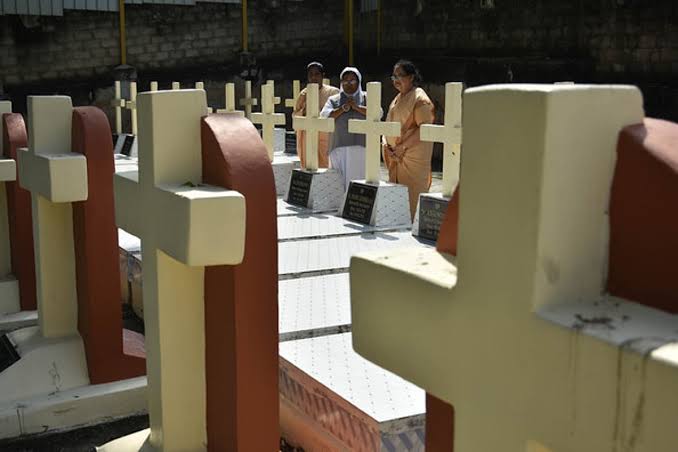
Dispute arose after A Raju, a retired government school teacher and Dalit Christian, died of age-related illness on July 17. His family sought to bury him in the common cemetery, citing the civil court decree. TIRUCHY: A Dalit Christian, whose body remained at his residence for three days allegedly over a dispute on burial rights at a common cemetery in Kottapalayam near Thuraiyur, was laid to rest in the early hours of Monday after district officials brokered a peace agreement between representatives of Dalit Christian and non-Dalit Christian communities. The burial was carried out with police protection following the peace meeting chaired by Musiri Sub-Collector Sushree Suvangi Khuntia. According to officials, Dalit Christians are allowed to use the village’s 0.55-acre common cemetery in line with a 2024 decree of the Thuraiyur District Munsif Court. The minutes of the Sunday meeting said both communities should continue to abide by the court’s order. Officials also decided the funeral mass should be conducted at St Sebastian’s Church, while the burial would take place under the supervision of the parish priest. Dispute arose after A Raju, a retired government school teacher and Dalit Christian, died of age-related illness on July 17. His family sought to bury him in the common cemetery, citing the civil court decree. However, non-Dalit Christians opposed the move, contending that Dalit Christians already had a separate burial ground, leaving the body at the family’s residence for three days. Revenue and police officials held talks with both communities for nearly five hours on Sunday, but failed to break the deadlock. Fresh negotiations on Monday resulted in an agreement, paving the way for the burial. J Doss Prakash, a resident of Kottapalayam, said Dalit Christians had fought for several decades to secure equal burial rights in the common cemetery, which is over 100 years old. He alleged that Dalit Christians were denied access because of caste-based discrimination and said Monday’s burial was carried out by enforcing the civil court’s order. “Several members of the non-Dalit Christian community also stood with us and extended their support during the peace talks. It is only a few groups that continue to raise objections and create divisions within the village,” he said. Pearson Lenekar SR Courtesy : TNIE Note: This news is originally published on https:/thenewindianexpress.com/bha and is used purely for non-profit/non-commercial purposes, especially human rights
‘Power does not last forever’: Rahul Gandhi’s warning to police after tear gas, lathicharge on student protesters

NEW DELHI: Congress MP and Leader of Opposition in the Lok Sabha Rahul Gandhi on Monday warned police officers that ‘power does not last forever’ and ‘accountability will certainly be enforced’, saying the Constitution, not the government is their ‘master’. His remarks came after police used tear gas and lathi-charged protesters during the Cockroach Janata Party’s (CJP) march towards Parliament over the alleged NEET-UG 2026 paper leak. In a post on X, Rahul said peaceful protest was a fundamental right and warned officials against ‘blindly following orders’ to act against students. Delhi Police used tear gas and mild force to disperse protesters who attempted to march from Jantar Mantar to Parliament on the opening day of the Monsoon Session. The protest was organised by the CJP, which has been demanding accountability over the alleged examination irregularities and the resignation of Union education minister Dharmendra Pradhan. In his post on X, Congress MP wrote, “Peaceful protest is an inviolable and fundamental right.” Addressing police personnel and government officials, he added, “Every police officer and government employee blindly following orders to attack India’s innocent students should keep this in mind: The Constitution is your master. Power does not last forever. Accountability will certainly be enforced.” Earlier in the day, Lok Sabha LoP also shared a video message in which he criticised the police action against the protesters and accused Prime Minister Narendra Modi of being ‘the most anti-youth Prime Minister in India’s history.’ He said the students protesting in Delhi were not criminals but were demanding a fair and functioning education system. “Tear-gassing students, lathi-charging students is not democratic. It’s not India’s way and it is not the way this should be done. They have legitimate demands. The prime minister should accept these demands and do something about it,” Rahul said in the video. He also alleged that repeated paper leaks had affected millions of students and claimed the government had failed to hold those responsible accountable. The remarks came after police cleared the month-long protest site at Jantar Mantar by Monday evening following clashes during the march towards Parliament. The stage, tents and other structures at the site were dismantled, while police and paramilitary personnel remained deployed in the area. Despite the crackdown, protesters continued gathering on nearby roads and said the agitation would continue until their demands, including the resignation of the education minister, were met. Several protesters alleged they were injured in the police action, while others claimed they were briefly held inside Metro stations and faced restrictions on access to water during the protest. The protest was launched by the CJP over the alleged NEET-UG 2026 paper leak and examination irregularities. Thousands of demonstrators attempted to march towards Parliament on Monday, but security personnel stopped them near Parliament Street, leading to clashes and the use of tear gas and lathi-charge to disperse the crowd. Courtesy : TOI Note: This news is originally published on https:/timesofindia.com/bha and is used purely for non-profit/non-commercial purposes, especially human rights
HC resumes hearing on plea against Rahul Gandhi’s ‘illegal’ assets
Lucknow: A Lucknow bench of Allahabad high court on Monday conducted two-hour long hearing in the chamber on a plea seeking CBI and ED inquiry into the allegations that Congress MP and Leader of Opposition in Lok Sabha Rahul Gandhi has amassed disproportionate assets. The order was not available on the high court website till filing of the story, but the website showed the case was listed for next hearing on Aug 20. A bench of Justice RS Chauhan and Justice BR Singh passed the order on a criminal writ petition moved by a Karnataka BJP worker S. Vignesh Shishir. The petitioner has accused Rahul of accumulating disproportionate assets. During the previous hearing in the case on May 12, the bench had observed that “if complaint of the petitioner Shishir was received, the allegations of the complaints may be verified as per law. It is needless to say that the CBI or ED may take appropriate steps which are permissible under the law.” Besides CBI and ED, the bench had directed the Department of Personnel and Training (DoPT) , the revenue department, ministry of finance, ministry of corporate affairs and the Director of Serious Fraud Investigation Office to file their responses to the allegations levelled by the petitioner against Rahul within eight weeks . The bench had conducted the previous hearing too in the chamber. The order had stated that the CBI informed the bench that the agency had received the petitioner’s complaint and would file its response within 8 weeks. Similarly, the ED had informed the bench that it had received the complaint and might verify the allegations and apprise the court on July 20 . While seeking replies from several govt agencies, the bench said, “By filing response in form of counter-affidavit, the progress in respect of complaint submitted by the petitioner to the aforesaid agencies may be apprised to the court.” To a query whether the petition was maintainable, the bench said this submission would be tested after receiving the counter-affidavits of the respective parties and the rejoinder affidavits thereof. Furthermore, the court had ordered its senior registrar that the paper-book and the loose documents provided by the petitioner be kept in a sealed cover to be opened on July 20. Courtesy : TOI Note: This news is originally published on https:/timesofindia.com/bha and is used purely for non-profit/non-commercial purposes, especially human rights