
Akhilesh Yadav focus on price rise, Dalits ahead of 2027 Uttar Pradesh Assembly polls
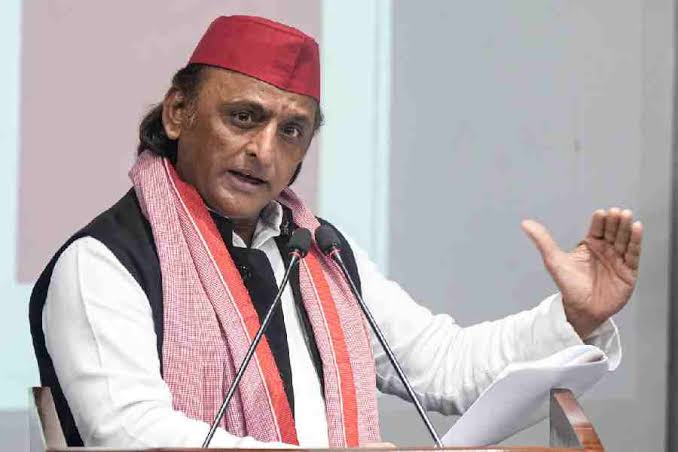
Samajwadi Party chief alleges attacks on Ambedkar statues, paper leaks and stalled investments while promising to restore Dalit dignity after returning to power Samajwadi Party chief Akhilesh Yadav said on Sunday that the BJP was “not only anti-Constitution but also anti-Ambedkar”, setting the tone for his cadres for the Uttar Pradesh Assembly election campaign. At a meeting of the SP state executive committee, former chief minister Akhilesh said: “The BJP is not only an enemy of the Constitution, but also of the poor. They don’t respect his (Ambedkar’s) people (Dalits). That is the reason that right from diesel and petrol, the prices of all essential items are going up. They do it to increase their own income and at the same time block the supply of essential commodities in the market to create the perception of a crisis.” “On an average, 15 statues of Babasaheb Bhimrao Ambedkar have been damaged under BJP rule every year. We have documented it and found that 151 statues (of Ambedkar) were desecrated. The most cases are reported from Ballia, Azamgarh, Mathura and Gorakhpur,” Akhilesh added. “Many such attacks in Gorakhpur couldn’t be listed,” he said, referring to chief minister Yogi Adityanath’s constituency. “The Samajwadi Party will restore the honour of Babasaheb after forming the government in 2027.” “Uttar Pradesh reported the most number of paper leaks. They (the BJP) had shown us the dream of investments, but it didn’t happen. They took land from farmers without giving them adequate compensation, but industries didn’t come up here,” Akhilesh said. The Samajwadi Party is focusing on PDA (Peechchra-OBC, Dalit and Alpsankhyak-Muslim) votes as Uttar Pradesh gears up for Assembly elections next year. Courtesy : Telangana Today Note: This news is originally published on https:/telanganatoday.com/bha and is used purely for non-profit/non-commercial purposes, especially human rights
Bihar Cong demands Bharat Ratna for state’s ‘first Dalit CM’ Bhola Paswan Shastri
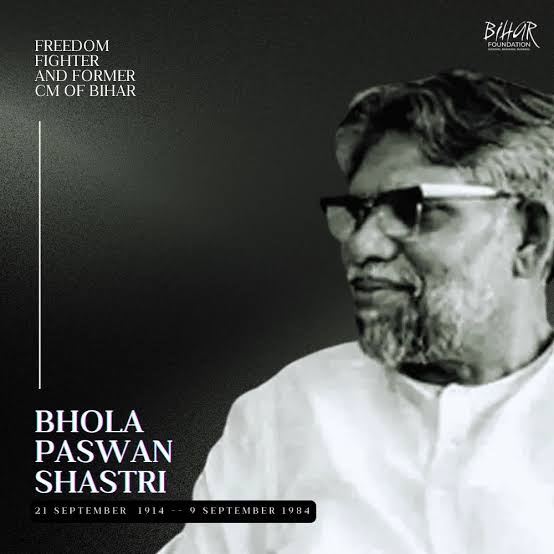
Patna, The Congress in Bihar on Sunday demanded Bharat Ratna for Bhola Paswan Shastri, the state’s “first Dalit chief minister”, whose final tenure was marked by the setting up of the Mungeri Lal Commission, which recommended quotas for the numerically powerful backward classes. The demand was raised at a press conference by Ravindra Paswan, chairman of the Bihar Pradesh Congress Committee’s Scheduled Castes cell. Paswan said the birth anniversary celebrations at Sadaqat Ashram, the BPCC headquarters, on Monday would be attended by AICC Scheduled Castes cell chairman Rajendra Pal Gautam and around 5,000 dele gates from across the state. Seeking the highest civilian honour for Shastri, Paswan highlighted that he served as CM three times and also held the posts of Union minister and Leader of the Opposition in the Rajya Sabha. He also pointed out that the Mungeri Lal Commission was set up during Shastri’s final tenure as chief minister in 1971-72. The commission submitted its report in 1977, during the chief ministership of socialist leader Karpoori Thakur, who was awarded the Bharat Ratna in 2024. Implementation of the commission’s recommendations by Thakur, which faced opposition from sections of the upper castes, was seen as a turning point in Bihar’s politics, with Other Backward Classes (OBCs) gaining greater political prominence following the Mandal movement of the 1990s. This report is auto-generated from PTI news service. ThePrint holds no responsibility for its content. Courtesy : The Print Note: This news is originally published on https:/theprint.com/bha and is used purely for non-profit/non-commercial purposes, especially human rights
Cong to protect land rights of Dalits, tribals: Ponguleti
Hyderabad: Revenue and housing minister Ponguleti Srinivas Reddy on Sunday assured Dalits and tribals that Telangana govt would not take even an inch of their land and urged them not to believe in what he termed as malicious propaganda by the opposition, aimed at creating fear over land rights. In a statement, the minister said the Congress-led govt had no policy of snatching land from the communities and would instead provide complete protection to their land rights. He said Congress had historically worked for the landless and weaker sections through land reforms and distribution of land. Ponguleti said Congress govts in the past had distributed around 25 lakh acres to Dalits in the Telangana region, especially during the Indira Gandhi-led govt and had also granted rights over nearly two lakh acres of Podu land to tribal communities. He said the ongoing verification of land records, surveys and resolution of land disputes should not be misconstrued as attempts to acquire land. The objective, he said, was to establish ownership, resolve disputes and protect existing rights. The minister alleged that certain “feudal elements” were deliberately spreading misinformation to create unrest among Dalits for political gains. He urged people to verify facts before believing such claims. He said re-surveys were being undertaken to identify the actual status of lands and grant rights to eligible Dalits and tribals. Long-pending land issues had been resolved in 15 revenue villages in Nutanakal and Maddirala areas of Suryapet district and in Narayanapuram village of Kesamudram mandal in Mahabubabad district, he added. Ponguleti said securing land rights would enable beneficiaries to access govt schemes and other benefits, reiterating that govt led by chief minister A Revanth Reddy stood firmly with the Dalit and tribal families. Courtesy : TOI Note: This news is originally published on https:/timesofindia.com/bha and is used purely for non-profit/non-commercial purposes, especially human rights
Mamata’s backing of Congress in Nandigram bypoll signals possible reset in Bengal opposition politics
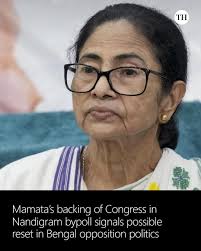
Banerjee backed Milan Pradhan hours after her nominee Sanchita Pradhan Dey withdrew from the October 6 contest following a meeting with Adhikari. KOLKATA: Former West Bengal chief minister’s support to the Congress candidate in the Nandigram assembly bypoll is a striking reversal of decades of political rivalry, observers feel, signalling a possible recalibration of opposition politics in the state at a time when the TMC is battling its deepest organisational crisis. Banerjee’s decision to back Milan Pradhan came hours after her faction’s nominee, Sanchita Pradhan Dey, withdrew from the October 6 contest following a meeting with Chief Minister Suvendu Adhikari in Kolkata. The Election Commission had, meanwhile, frozen the Trinamool Congress’ traditional name and ‘Jora Ghash Phul’ symbol amid an internal party dispute, allotting Banerjee’s faction and her dissidents separate names and symbols for the upcoming bypolls in Nandigram and Rejinagar. Announcing support for Pradhan on September 18, Banerjee had described Congress as a “sister party” and a “natural ally”, saying the decision was taken in the larger interest of the country and to strengthen the INDIA bloc. Banerjee had also said that she wanted to send a message about the future of the opposition alliance beginning from Bengal. Former West Bengal chief minister Mamata Banerjee TMC split, candidate arrests and last-minute U-turns reshape Nandigram, Rejinagar bypolls The timing of this extension of olive branch, however, gives the move a distinctly tactical dimension. Banerjee’s camp had initially fielded a candidate in Nandigram and only withdrew from the contest after the nominee pulled out. Her support for the Congress therefore represents both an attempt to prevent division of the anti-BJP vote and a political response to an unusually difficult moment for her faction, say observers. The development has acquired further resonance after Pradhan was arrested in connection with a case linked to the 2007 Nandigram land agitation, shortly after Banerjee’s announcement, and jailed. The irony, however, is difficult to miss. Banerjee herself emerged from the Congress, breaking away in the late 1990s to establish the TMC as a vehicle to challenge the Left Front, and what she regarded as the Congress’ inadequate opposition to the CPI(M). Yet, the two parties have periodically returned to each other when confronted by a larger political adversary. They fought the 2001 Bengal assembly election together after Banerjee severed ties with the NDA, and later joined hands again during the 2009 Lok Sabha polls. The alliance reached its high point in 2011, when Congress and TMC jointly ended the Left Front’s 34-year rule in Bengal. But, the partnership subsequently collapsed as differences over policy, seat-sharing and the functioning of the state government intensified. The relationship became particularly acrimonious during Banerjee’s 15-year rule. Congress leaders have repeatedly accused the TMC of politically marginalising their organisation, while the Trinamool Congress portrayed Congress as an ineffective force whose decline benefited the BJP and the Left. The latest gesture, observers say, amounts to more than routine bypoll arithmetic; it marks an unusual moment in which Banerjee has publicly placed Congress at the centre of an anti-BJP electoral strategy in Bengal. Congress veteran Adhir Ranjan Chowdhury, however, sought to downplay any suggestion of an immediate political rapprochement. Reacting to Banerjee’s move, he said she should support the Congress “not as a fallen leaf but by holding the hand of the banyan tree”, asserting that the party’s revival under Rahul Gandhi should be recognised. “One should note the timing of the support. It happened after her candidate withdrew from the race. She how has the ‘football player’ symbol, but she has no player left to play her game,” Chowdhury said, referring to the EC’s temporarily allotted electoral symbol in the wake of the bitter intra-party factional rivalry for name, symbol and assets. “That’s why she has come to us, knowing we are the only third force that has the ability to take on the BJP,” he said. Bengal Pradesh Congress president Subhankar Sarkar, though, hummed a different tune. “The Congress welcomes any support coming from the anti-BJP and secular political repository of the state, which will recognise our party’s fight against the saffron conglomerate with Rahul Gandhi leading it from the front,” he said. “One never knows this development in Bengal may open up a new political path facilitating a separate cementing factor for the opposition,” Sarkar said. Congress leaders have slammed Pradhan’s arrest, with Gandhi describing it as political vendetta, and vowing that the party would “fight and win”. BJP state president Samik Bhattacharya, however, dismissed the proposed opposition understanding, saying: “Adding zero to zero will only result in zero.” He argued that both the Congress and TMC were seeking political survival, and that an alliance would not revive either party. For Banerjee and her faction, the Nandigram decision could be an attempt to preserve a broader anti-BJP constituency, while its own organisational identity is under unprecedented pressure. Supporting the Congress also allows Banerjee to project herself as a national opposition leader rather than merely the head of a faction fighting over the Trinamool’s name and symbol, say observers. “There is no love lost between the two sides, but Banerjee seems to be clutching at straws,” senior journalist Biswajit Bhattacharya said. “But since both sides are struggling for political foothold, this arrangement could benefit both for the time being, with the Congress hoping to gain from some of Banerjee’s remaining popularity,” he added. The larger question concerns the INDIA bloc. Banerjee’s language, particularly her reference to Congress as a “natural ally” and her call for the opposition to fight together, could be an effort to revive coordination at a time when differences among the bloc constituents have repeatedly weakened the anti-BJP campaign. But Nandigram is unlikely, by itself, to erase years of rivalry and the existing lack of trust between the two sides. The Congress remains determined to rebuild independently in Bengal, while Banerjee has historically resisted arrangements that could dilute TMC’s primacy in the state. Courtesy : TNIE Note: This news is originally published on https:/thenewindianexpress.com/bha and is used
BJP-RSS hollowed out education system, Rahul standing with students, says Congress
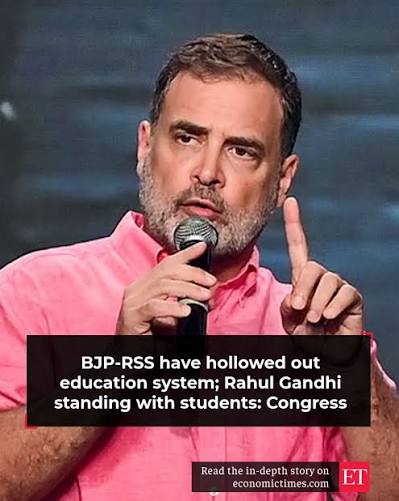
The party’s remarks came a day after Gandhi alleged that a “rotten system” had taken control of the country, particularly the education sector, and did not want students to question it. The Congress on Sunday alleged that the BJP-RSS had “hollowed out and corrupted” the education system, asserting that Leader of Opposition in the Lok Sabha Rahul Gandhi was standing with students demanding accountability. The party’s remarks came a day after Gandhi, speaking at the fifth edition of his youth outreach programme ‘Chhatron Ki Goonj’ in Indore, alleged that a “rotten system” had taken control of the country, particularly the education sector, and did not want students to question it. Congress general secretary in-charge communications Jairam Ramesh, sharing Gandhi’s post on X, said, “Yesterday, Rahul Gandhi ji revealed the secret of this system that has been suppressing students. Who is this system? The people of BJP-RSS who have seized control over the entire country. On education, on the economy, on politics, on every institution.” “They have hollowed out and corrupted the education system. Because this system fears students. They ask questions, demand accountability,” Ramesh said in a post in Hindi. “Now Rahul ji stands with them, the fear among students has ended. Their voice is echoing across the entire country,” he added. At the Indore event, Gandhi spoke on the theme ‘system versus students’ and interacted with Gen Z participants on education, recruitment and employment. “The system is afraid of students because students ask questions. The system does not want students; it wants ‘andhbhakts’,” Gandhi said. Congress leader Rahul Gandhi along with party general secretary-in-charge communications Jairam Ramesh. Rahul Gandhi says system wants ‘andhbhakts’ who don’t question, calls them antithesis of students He said students were curious, questioned authority and sought answers on the functioning of institutions, recruitment, examinations and opportunities, while alleging that “andhbhakts” instead spread hatred. Gandhi also alleged that the “system” had multiple layers and named Prime Minister Narendra Modi, Union Home Minister Amit Shah, National Security Advisor Ajit Doval, RSS chief Mohan Bhagwat and industrialists Gautam Adani and Mukesh Ambani, alleging that they exercised influence over different aspects of the country’s political, institutional and economic life. His visit to Indore came a day after Bhagwat interacted with around 1,700 Gen Z participants at the ‘Yuva Dharma Sansad’ in Ujjain. Two days earlier, BJP president Nitin Nabin had visited Indore and launched a government scheme. Gandhi said students posed a challenge to the “system” because they remained curious and questioned what was happening around them. Courtesy : TNIE Note: This news is originally published on https:/thenewindianexpress.com/bha and is used purely for non-profit/non-commercial purposes, especially human rights
Satya Niketan building collapse: ‘Why no new hostels, why force students into PGs?’ Rahul Gandhi asks govt
NEW DELHI: A day after he addressed the fifth edition of his youth outreach programme ‘Chhatron Ki Goonj’ in Indore, Congress MP Rahul Gandhi Sunday asked govt why there weren’t adequate hostel facilities for students and sought the status of the investigation into the Satya Niketan building collapse. In a post in Hindi on X, the leader of the opposition said that the family which lost its son, Arpit Jaj, in the Satya Niketan tragedy is demanding accountability, as is the entire country, so no parent ever has to endure what they are facing. “I have a direct question for the system: Why aren’t new, safe hostels being built? Why are students being forced to live in unsafe PGs? How far has the investigation into the Satya Niketan incident progressed?” Gandhi asked. In another post, he said, “‘Govt has money to light diyas – why not for our hostels?’ This question was asked of me yesterday by a female student in Indore.” Courtesy : TOI Note: This news is originally published on https:/timesofindia.com/bha and is used purely for non-profit/non-commercial purposes, especially human rights
‘The Trans Act has made my life hell’: How India’s trans community is navigating daily life since the change
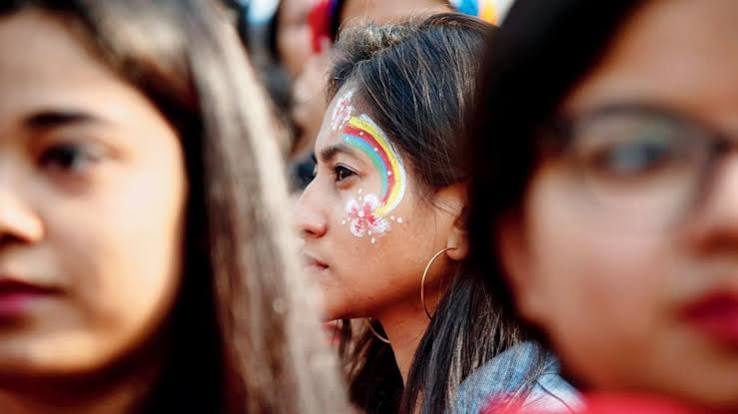
This month-end will mark six months since the Transgender (Protection of Rights) Amendment Bill 2026 became an Act. We trace the trail of devastation it has wrought by making gender-affirming care a humiliation ritual for many Back in July, Anaya Bangar, daughter of cricketer Sanjay Bangar, made a video talking about the toll it had taken on her to legally transition to a woman after the Transgender (Protection of Rights) Amendment Act, 2026, came into force. “I was asked to undress and have my whole body assessed in a room full of doctors that included men and… an invasive gynecological exam was also performed. I remember lying there thinking, ‘Why do I have to prove that body, to be recognised as who I am on paper?’” she asks. Her video came at a time when most of the country — and even a section of the trans community — had no idea how things were going to change with the amendment. “I am sharing this because not all of us know what this process can involve, and I hope we can all agree that legal recognition should respect people’s dignity,” Bangar says in the clip. Despite this paper’s sustained reportage on the Act, the protests against it, and the emotional and psychological toll it has taken on queer folk, even we had to brace ourselves while hearing the stories that have emerged from the trans community. Under the guise of making the process more structured, what has unfolded is multiple stories of trans persons being told to run from pillar to post for their documentation, arguing in one government office after another with babus who are too scared to give approvals, leaving them no choice but to stand in front of a medical panel that has little to no context of the trans experience. ‘I do not exist on paper’ Vibhu’s life is stuck in red tape as he starts the process for legal recognition as a trans man again Vibhu is 25 years old and works in United Kingdom as diversity, equity, and inclusion (DEI) advisor. He underwent gender-affirming surgery on June 15. The process is designed to humiliate and force you to give up, he says. “I started planning to get my surgery done in India in January-February, and then the Act came into effect.” Amid stress over the cost of the surgery, and rising airfares, his doctor in India told him that his surgeries had been suspended. “I panicked. I had been saving up for all this. Then a day later, the doctor texted back saying they are doing it. That was really a horrible day,” he adds. Vibhu’s Transgender (TG) card is now invalid. He wants to be recognised as a man on paper. If cisgender persons think they have it rough at government offices, Vibhu’a account should be eye-opener: “The staff is not trained, so all they say is ‘I don’t know, go to the next guy’, or ‘Yaha nahi, waha daliye [don’t submit the papers here, please go there]’. Most of the employees at the Aadhaar office felt they could announce to other people sitting there that I am trans. Not that I am ashamed of it; I am fine screaming to the world, but a government employee should not be.” “They [government staff] would say ‘Naam aur gender change karna toh hume nahi aata hai [We don’t know how to change your name and gender]’. You cannot change your name and gender at the same time, so you will just have to come back again.. And the way they give you all this information is also in a voice laced with stigma,” he adds. ‘They wouldn’t let me have surgery till my mom spoke up’ Sarvagya, who underwent a hysterectomy on September 7, after weeks of bureaucracy and humiliation Twenty-six-year-old Sarvagya hails from a small town in Rajasthan. He began his hormone therapy in 2022 and was due to transition surgically early this year, but the Trans Act delayed his plans. “I got my gender identity dysphoria certificate and then started my hormone replacement therapy in June 2022. It took me two years to gather Rs 1.5 lakh for the mastectomy [top surgery], which I did in 2024. At the time, it was very easy and seamless. All I had to tell the doctor was ‘This is my issue, and this is what I want to do’. My maternal family was against it, so I did the surgery on my own with the support of two friends,” he recalls. “Next, I was due for a hysterectomy [removal of the uterus]. I had planned to do this last year, but could not save up enough,” he adds. Then, the amendment came into effect in March, and Sarvagya was in a panic. “In August, I was facing some gastric issues, and an ultrasound followed by The PET-CT revealed a massive 30 cm tumour emerging from left ovary and had grown through my abdomen and pelvis, occupying almost the entire space.. I asked the doctor if they could do a hysterectomy while removing the tumour, but then my primary surgeon got a call from the medical staff of the hospital, stating that they cannot perform the surgery without some clearances,” he says. “Then it hit me. I asked my surgeon, ‘Is this regarding the Trans Act?’ A few hours later, they confirmed that it was,” he adds. What followed was a humiliation ritual similar to Bangar’s ordeal. “They made me sit in front of a medical board, which consisted of 10 doctors. Despite the fact that I hold a transgender card from 2023 that I got from the government, despite legally transitioning in 2024, and holding every document. They said they would remove the tumour, but not the uterus,” he recalls. By then, Sarvagya had won the support of his family, and brought his mother to testify before the medical board. “They told my mother that if she agreed to this, her child would be
Allegations of demolition of a Dalit woman’s hut and throwing away of her belongings: Despite numerous complaints, no action was taken, now a petition has been filed at the Tehsil Day.
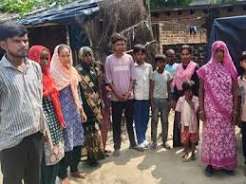
Strongers have vandalized and encroached upon a Dalit woman’s land. Despite numerous complaints, the administration took no action. Following this, the woman submitted a written complaint at the Tehsil Day, demanding action. Anita, a resident of Dhurpur in Simaria village, under the Thathiya police station area, submitted a written petition to officials at the Tirwa Tehsil Day on Saturday. The woman alleges that plot numbers 1376 and 1378 are registered with the Gram Panchayat. Anita stated that the powerful, in collusion with revenue department officials and employees, demolished her hut and kiosk and threw her belongings onto the road. The woman also alleges that the powerful have registered the land in plot number 1377, but with the help of the revenue department, she is being treated unfairly. The woman submitted several petitions to the police and revenue department for action, but no action has been taken. On Saturday, under the leadership of Blue Revolution Bahujan Ekta Organization’s State Secretary Arvind Jatav and District President Karan Kumar, they submitted a written complaint at the Tehsil Day. Regional accountant Ramdas stated that legal action was taken in the presence of a joint team of the Naib Tehsildar and police. Tirwa Sub-District Magistrate Vaishali stated that the matter will be investigated and action will be taken. Bhairav Dutt | Umarda (Kannauj), Kannauj Courtesy: Hindi News
Bihar Family Performs Daughter’s Funeral After Inter-caste Marriage
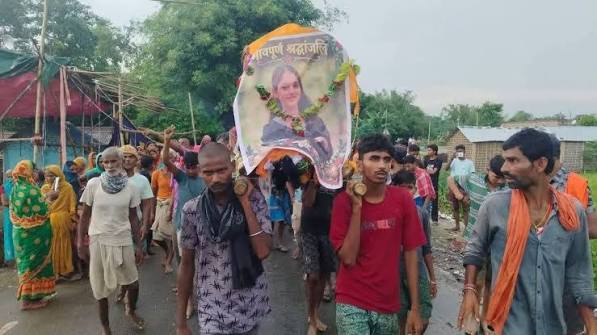
Brahmin girl marries a dailt boy in the Chapay village of Bihar Purnia: Riya Goswami, 18, from Bihar’s Purnia district, wanted to marry a boy of her choice. She had little idea that the family with whom she had spent eighteen years would perform her last rites for marriage outside her caste. “I, too, wanted to marry someone I lived with. But parents often intimidate their children by threatening to kill them if they marry outside their caste. That is why we are forced to take such a step,” said Riya. She entered into an inter-caste marriage with Milan Paswan, 23, evoking resistance from her family, which performed the girl’s last rites. “Parents fight for the sake of caste and society, but they fail to consider their own daughter,” rues Riya. Brahmin Girl Marries Dalit Boy Riya, the Brahmin girl, married Milan from the Paswan community in the Chapay village in the Gangeli Panchayat under the Maranga police station area of Purnia. According to Riya, she and Milan married at the Purnia court on September 9. A few days later, without informing her family, Riya left for her in-laws’ home with the boy and after searching for her, her family filed a complaint with the police. The police subsequently recovered the girl and had her statement recorded in court under Section 183 of the Bharatiya Nagarik Suraksha Sanhita. According to her family, Riya stated in the court that she wished to go with Milan. Family Carries Out Funeral Procession After the marriage of Riya with Milan, villagers convened a Panchayat meeting in the Chapay village, where members of the boy’s side were asked to return the girl. Her family explained that Milan used to visit their home and was a good friend of Riya’s brother. As the boy would visit the family, love developed between the two following which they decided to marry. Following the marriage, the family fashioned an effigy of the daughter, decorated a funeral bier, took out a procession, and performed her last rites. A large number of villagers were present during the proceedings. Riya’s parents also announced throughout the village that their daughter was now dead. “My daughter has left. For us, she is dead now. Her last rites have been performed. We are Brahmins. In our community, accepting water from that household is forbidden. If someone in our society does something like this, this is the inevitable consequence. If we don’t do this, we would have to leave the village. Tell me, how would we live here then?,” asked Raja Ram Goswami, the girl’s grandfather. The girl’s father, Manoj Goswami, stated that on the night of September 9, around midnight, his daughter left home with Milan—who lives about 100 meters away—and contracted a court marriage. He said that they would no longer have any ties with the girl. Subsequent rituals, including the “Nakhabal” (hair and nail trimming), “Dashvi” (tenth-day ritual), and “Terahvi” (thirteenth-day ritual), would be performed in accordance with traditional customs, the family said. Girl Gets Emotional Following the marriage, Riya remains miffed with her parents. “If parents simply asked their children if they liked someone, why would we take such a step? That is why I no longer have any relationship with my parents; my in-laws are my family now, I have no one else in the world,” she said. As she spoke, tears welled up in Riya’s eyes. “I am pursuing a BA degree, and I do not believe in the caste system; casteism does not exist. I am very happy today.” Not Afraid Of Society When asked if he feared society, Milan said, “Society won’t run my household or earn a living to feed me. So, I don’t care what people think.” Milan’s father, Dilip Paswan, said, “The villagers were pressuring us, but both the boy and the girl insisted they wanted to be together. They said they would die if they couldn’t get married. So, we agreed. Now, we will treat Riya as both a daughter-in-law and a daughter.” Courtesy : ETV Bharat Note: This news is originally published on https:/etvbharat.com/bha and is used purely for non-profit/non-commercial purposes, especially human rights
Over 120 Erravalli Dalit farmers receive revenue department notices

The Telangana revenue department has served notices to over 120 Dalit farmers in Erravalli following a land survey after Chief Minister A Revanth Reddy announced plans to take back the lands. Farmers have sought protection of their holdings and livelihoodGeographic Reference Siddipet: After Chief Minister A Revanth Reddy announced in the State Assembly that he would take back the lands in Erravalli and distribute them to other farmers, the revenue department served notices on over 120 Dalit farmers of Erravalli, leaving them in a state of shock. After carrying out surveys of lands in Survey No. 325 for three consecutive days until Saturday, the revenue department served notices on 120 farmers. The revenue department asked them to appear before the authorities with all the documents in their possession regarding the ownership of their lands. Sources in the revenue department said notices would be served on all farmers holding lands in the survey number. The 388 acres and 5 guntas of land were distributed to Dalit farmers in Erravalli and neighbouring villages some 60 years ago. Since then, the farmers had been in possession of the land. However, former Chief Minister K Chandrashekhar Rao had changed their lives considerably by helping them cultivate the fallow lands after 2014. He built a lake close to the lands and helped the farmers get a drip irrigation system and other facilities. Gajwel RDO Chandrakala directed the farmers to appear before the authorities on September 21. The farmers demanded that the government keep their lands intact, as they were their only source of livelihood. Meanwhile, farmers of Sivaru Venkatapur, a neighbouring village to Erravalli, alleged that some 180 acres of land in the survey number belonged to them. They demanded that the government earmark the lands properly, following the old revenue records. Courtesy : Telangana Today Note: This news is originally published on https:/telanganatoday.com/bha and is used purely for non-profit/non-commercial purposes, especially human rights