
HC seeks compliance report from TN on rehabilitation scheme for transgenders
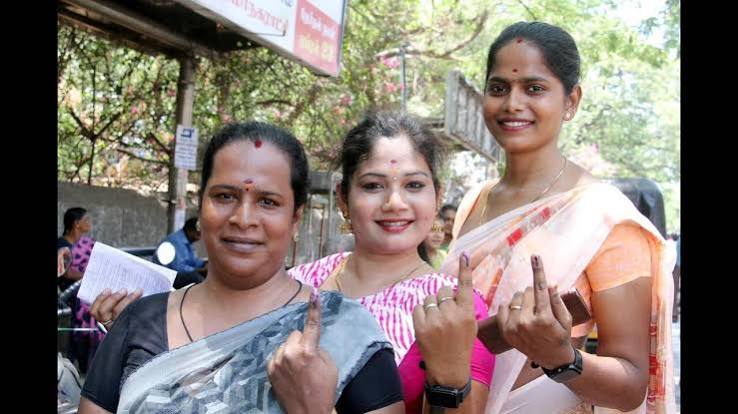
Madurai: Madras high court has directed Tamil Nadu chief secretary to file a compliance report to an order passed by the court directing the state to formulate a comprehensive rehabilitation scheme for transgender persons at the taluk level. In April, the court observed that members of the transgender community continue to face entrenched social stigma, resulting in deprivation of basic dignity and meaningful livelihood opportunities. Hence, the court directed the state to formulate a comprehensive rehabilitation scheme, ensuring avenues for self employment and sustainable livelihood and restoring dignity and ensuring meaningful inclusion of transgender persons in society along with necessary welfare schemes tailored to their specific needs. The court directed the chief secretary to coordinate with all relevant departments to ensure effective and time-bound implementation of the aforesaid measures. The court passed the order while hearing the anticipatory bail petition filed by a YouTuber, V Sarathkumar, who is to have published a video on digital media concerning an incident of self-immolation by a transgender within the precincts of Srivilliputhur Town police station in Virudhunagar district. When the case was listed before the court for reporting compliance, Justice K K Ramakrishnan took note of a status report filed by the state where there was no compliance of the directions issued by the court. Hence, the judge gave the direction to the chief secretary. Courtesy : TOI Note: This news is originally published on https:/timesofindia.com/bha and is used purely for non-profit/non-commercial purposes, especially human rights
Three arrested in linked cases involving Dalit woman in Kollur
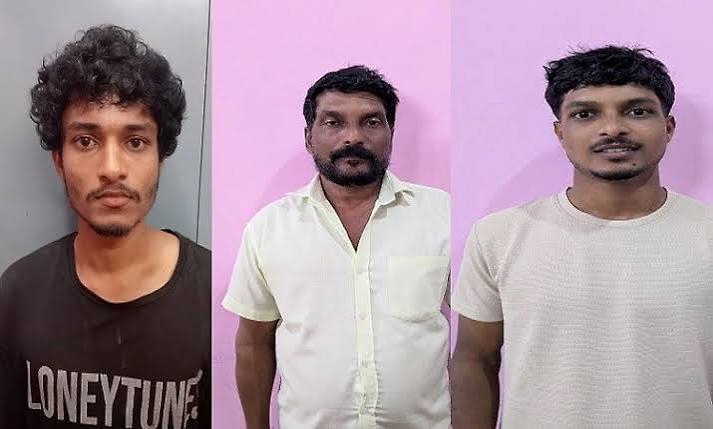
Byndoor: Kollur police have arrested three people in connection with two separate but related cases involving alleged caste-based abuse of a Dalit woman and a subsequent assault on a youth in Bellala village. The incidents reportedly occurred on Thursday, August 6, within the limits of Kollur police station. Police have registered separate cases based on complaints from both sides and are investigating the allegations. Youth arrested under SC/ST Act In the first case, police arrested Sanath Kundapur following a complaint filed by a Dalit woman. According to the complaint, Sanath allegedly approached the woman near her residence and behaved in a manner that outraged her modesty. She also alleged that he verbally abused her using casteist slurs. Based on the complaint, Kollur police registered a case under provisions of the Scheduled Castes and the Scheduled Tribes (Prevention of Atrocities) Act and arrested Sanath in connection with the allegations. Police are examining the circumstances surrounding the alleged incident and recording statements as part of the investigation. Counter-case filed after alleged assault Meanwhile, a counter-case was registered following a complaint filed by Sanath Kundapur. In his complaint, Sanath alleged that after the earlier incident, members of the woman’s family tied him up, assaulted him and attempted to kill him. Acting on his complaint, police registered a separate case under various provisions of the Bharatiya Nyaya Sanhita (BNS), including the section relating to attempt to murder. Following the complaint, police arrested two people identified as Ram Kumar and Nandish Kumar in connection with the alleged assault. The arrests have resulted in three people being taken into custody in the two connected cases. Police investigate both complaints Police are now investigating the allegations made by both parties to establish the sequence of events and determine the circumstances that led to the two incidents. The cases involve serious allegations on both sides, including offences under the SC/ST (Prevention of Atrocities) Act and an alleged attempt to murder. Investigators are expected to examine witness statements and other available evidence before taking further action. Police have stated that the investigation into both cases is currently underway. Officials are also working to identify and apprehend any other people allegedly involved in the incidents. Police said remaining accused persons, if their involvement is established during the investigation, will be apprehended in accordance with the law. Investigation underway The linked cases have drawn attention because of the serious allegations made by both sides. While the first complaint concerns alleged caste-based abuse and behaviour against a Dalit woman, the counter-complaint alleges that the accused in the first case was subsequently assaulted and subjected to an alleged attempt on his life. Police are treating the two complaints separately while examining whether and how the incidents are connected. Further details are expected to emerge as the investigation progresses. Authorities have not yet disclosed additional information regarding the condition of those involved or the specific circumstances surrounding the alleged assault. The Kollur police are continuing their investigation and are expected to take further legal action based on the evidence gathered. Courtesy : News Karnataka Note: This news is originally published on https:/newskarnataka.com/bha and is used purely for non-profit/non-commercial purposes, especially human rights
Health officials wash hands off Dalit girl’s life with Rs 2L
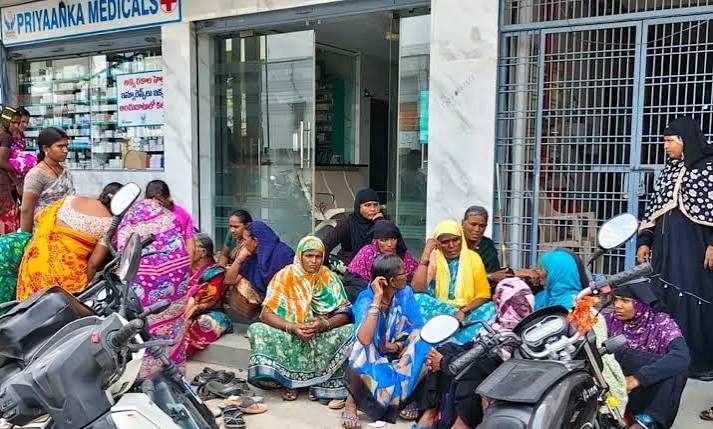
Private hospitals in Pebbair “settling” deaths due to alleged medical negligence Wanaparthy: Recent incidents of deaths resulting from alleged medical complications and negligence at private hospitals in Pebbair have caused public alarm. Allegations are surfacing that settlements regarding the deaths are being negotiated over the bodies in the presence of intermediaries to prevent the matter from becoming public and/or legal. Recounting a horrifying incident that occurred on September 28, 2025, locals informed that a young girl, who visited a private corporate hospital in the municipality with stomach pain, died following a medical complication. This incident occurred near the Subhash Chandra Bose Crossroads. Ramudu and Shirisha, a couple from the Dalit colony in Govardhanagiri village (Veepanagandla mandal), brought their five-year-old daughter, Ramya, to the hospital after she suddenly complained of stomach pain. Without conducting any tests, the doctor allegedly administered two injections; upon noticing foam coming from the child’s mouth, he took an X-ray and administered two more injections. As her condition deteriorated, the doctor advised the parents to take her to Mahbubnagar and sent her there in a private ambulance. However, doctors at the Mahbubnagar hospital examined the child and declared her dead. Alleging that the girl died due to the doctor’s negligence, family members and relatives staged a protest at the hospital. The price of a Dalit girl’s life settled by the hospital was Rs 2 lakhs. When questioned, DMHO Sainath Reddy said, “The medical officer conducted ground-level inspections and submitted a report to the Deputy DMHO who in turn also inspected the hospital. However, the submission of the report was delayed because he fell ill (fever). As there are holidays from tomorrow through Monday, the report is expected to reach me on Tuesday. I will take action once the report is received.” Meanwhile, many such incidents are being revealed by locals, such as the one on July 7 involving Sabera Begum (35) of Etigadda Sagapuram village, who came for delivery of twins after 16 years of marriage but was instead sent to the grave. Doctors had allegedly applied sutures without removing the placenta, which the family says attributed to the complication of her uterus. Residents of the municipality and district are criticising the situation, questioning whether anything can be done when medical officials appear to place a monetary value on human lives. They lament that officials, who ought to ensure such incidents don’t recur, are merely settling for paperwork instead of taking concrete action to prevent future occurrences Courtesy : THI Note: This news is originally published on https:/thehansindia.com/bha and is used purely for non-profit/non-commercial purposes, especially human rights
Cabinet fiasco pushes Congress into a tailspin
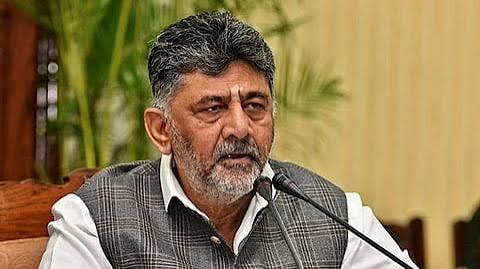
Despite Congress’s claims of rolling out the guarantee schemes in the state to empower women and its stand on the women’s reservation issue, Shivakumar’s cabinet is without a woman minister. Little over two months after the Congress central leaders patted themselves on their own backs for effecting a smooth leadership change in Karnataka, the party now faces intense internal turmoil after the cabinet expansion. Strategic miscalculations have left many of its lawmakers discontented, forcing the party to consider corrective measures. The party has landed itself in such a predicament that any quick-fix solution could be worse than the problem. The party’s top leadership deliberated on the ministry expansion for long, and held several rounds of consultations with Chief Minister DK Shivakumar and former CM Siddaramaiah. Perhaps, after sifting through several lists, it was decided to induct 20 legislators into the ministry. However, only 19 took oath. The plan to induct new faces appears to be in sync with party leader Rahul Gandhi’s broader roadmap of a transition within the party. The plan and its execution seemed wobbly from the start. The list was changed hours before the oath-taking ceremony. Despite Congress’s claims of rolling out the guarantee schemes in the state to empower women and its stand on the women’s reservation issue, Shivakumar’s cabinet is without a woman minister. Many districts are without representation. Even North Karnataka legislators from the Kuruba and minority communities have been left out. Two ministers from the Kuruba community are from South Karnataka. Of the four ministers from the minority community — three Muslims and one Christian — three are from Bengaluru City and one from coastal Karnataka. Siddaramaiah’s conspicuous absence at the ministers’ oath-taking ceremony at Lok Bhavan exposed the fault lines in the party. It also gave a subtle yet clear indication of how the Congress’s internal politics is likely to play out in the days ahead. The Congress workers’ protests at several places in the state, including outside the party head office in Bengaluru, mass resignations by local leaders in districts, and an outpouring of anger by several legislators, have all put the party in hot water. The CM’s initial remarks that “resignations (of those threatening to quit) will be accepted within a few minutes” showed that the party had again failed to read the situation. It was only when things appeared to be getting out of hand – the growing number of disgruntled legislators, and them planning a future course of action – that the CM, State Congress president BK Hariprasad and AICC General Secretary Randeep Singh Surjewala plunged into damage-control mode. During their meetings with the disgruntled MLAs, the leaders are said to have admitted to mistakes being committed and that they would shortly take corrective measures, while the aspirants made it clear that they would settle for nothing less than a cabinet berth. As of now, only one cabinet berth is vacant. It is unclear what corrective measures the party would take at this stage. There is a buzz that a few ministers may be asked to resign to make way for some of those excluded. Some leaders may be accommodated in party positions and some in boards and corporations to assuage their feelings. By all means, the party has found itself in a catch-22 situation. No minister is happy to resign, and such a move will amount to the party admitting that it has erred. The impression that local leaders can compel the high command to change its decision will further vitiate the situation. Also, B Nagendra’s induction has caused a degree of unease within the party. As Scheduled Tribes Welfare Minister in Siddaramaiah’s cabinet, he had resigned in June 2024 after multi-crore financial irregularities in the state-owned Karnataka Maharshi Valmiki Scheduled Tribes Development Corporation Limited surfaced. A case had been registered against him, and he was also arrested. While the CM defended the decision, a three-term Congress MLA questioned what the yardstick was for inducting leaders into the cabinet, as those who went to jail and those who allegedly worked against the party have been made ministers. Nagendra’s induction has also handed a potent issue to the opposition during the upcoming legislative session from August 13. The Congress, downplaying the developments, has taken to oft-repeated remarks that a party with nearly 140 legislators is bound to face such turbulence, as only a limited number of leaders can be accommodated in the cabinet. However, if the ruling party continues to be pulled into a whirlwind of internal politics, it will do no good for its plans for the 2028 assembly polls or for the state administration. The challenge is to overcome party politics and deliver good governance. Unlike Siddaramaiah’s cabinet, the current team at the helm of affairs lacks the luxury of time; their performance would be tested in corporation polls in the Greater Bengaluru Authority and local bodies polls, provided they are held, and in the 2028 assembly polls. For now, the CM faces another immediate challenge, that of allocating portfolios to the new ministers, and preparing his new team for the legislative session starting next week. Ramu Patil Courtesy : TNIE Note: This news is originally published on https:/thenewindianexpress.com/bha and is used purely for non-profit/non-commercial purposes, especially human rights
‘Congress not realising own errors’: Rijiju draws parallel with Indira Gandhi post Emergency

NEW DELHI: Parliamentary affairs minister Kiren Rijiju on Saturday stepped up his attack on Congress, accusing the party of failing to acknowledge its “errors and shortcomings.” In a post on X, Rijiju contrasted the current Congress leadership with former Prime Minister Indira Gandhi, saying she had been “blunt” in admitting the actions she took during the Emergency. Sharing a video of Indira Gandhi, Rijiju wrote, “Although… we do not agree with the policies and the steps taken by the former Prime Minister Smt. Indira Gandhi ji, she was blunt in admitting the actions that she had taken.” — KirenRijiju (@KirenRijiju) “Now, Congress party is not even realising their own errors & shortcomings,” he added. In the video, Indira Gandhi is seen defending the arrest of former deputy prime minister Morarji Desai and other Opposition leaders, alleging that they were “destroying democracy.”Rijiju’s remarks came hours after Congress MP Rahul Gandhi hit back at his challenge to the party to extend “unconditional support” to the Women’s Reservation Bill. Gandhi questioned the Centre’s decision to link implementation of the legislation with the delimitation exercise. Reiterating the Congress’ position, Rahul called for the implementation of the Nari Shakti Vandan Adhiniyam, 2023, “without any conditions.” “Mr Rijiju, who would know better than you, as the Minister of Parliamentary Affairs – that the Women’s Reservation Bill 2023 has already been passed unanimously, with the full support of the Congress,” Rahul posted on X. The question is, why has it still not been implemented even after three years, and why do you now want to unnecessarily link it to delimitation? Implement the 2023 law. Without any conditions,” he added. Earlier in the day, Rijiju had challenged the Congress to support the Women’s Reservation Bill unconditionally after Gandhi called for greater freedom of expression for women. The opposition has demanded that women’s reservation be delinked from the delimitation exercise. The Nari Shakti Vandan Adhiniyam, 2023, was passed by both Houses of Parliament. However, its implementation has not moved forward after the Constitution (131st Amendment) Bill fell in the Lok Sabha on April 17, failing to secure the constitutionally required two-thirds majority of members present and voting. The Bill provided for 33 percent reservation for women in legislatures, along with provisions linked to delimitation of Lok Sabha constituencies. Courtesy : TOI Note: This news is originally published on https:/timesofindia.com/bha and is used purely for non-profit/non-commercial purposes, especially human rights
Youth country’s asset, but system trapping them in ‘chakravyuh’: Rahul

Prayagraj: Congress MP Rahul Gandhi on Saturday said the country’s youth were being trapped in a “chakravyuh”, with youngsters spending lakhs and crores on educational certificates that offered no guarantee of employment. “Today, education certificates have no meaning in India because they cannot give you a job,” he said, adding that only around 12 out of every 1,000 aspirants get permanent employment. Addressing the ‘Chhatron Ki Goonj’ programme at KP College Ground, Rahul cautioned youngsters against getting trapped in the “intoxication” of making Instagram reels, saying social media was being used to keep them occupied as jobs and opportunities shrink. “You make reels and work on Blinkit-like platforms because there is no job for you in this country,” he said, describing the trend as a “dreaded intoxication” and warning that youngsters were being turned into “bandhua mazdoor” (bonded labourers). Referring to AI, Gandhi said the data consumed and generated by young people was helping AI systems develop. Gandhi structured his speech around “dard” (pain), data and “daulat” (wealth). He said the pain and data belonged to the youth, while the wealth generated from them was being concentrated in the hands of a few. He said the youth were the country’s strength and pride. A youth sharing the stage with Gandhi criticised paper leaks and the normalisation formula. Two Allahabad University students also interacted with him and detailed problems at the university and the ongoing agitation.Gandhi said avenues in manufacturing, entrepreneurship, public and private sector jobs, corporate, IT and banking were shrinking, with AI increasingly being used by influential corporate houses, including Adani and Ambani. He also alleged that people associated with RSS ideology had been appointed to head various institutions, affecting the entire system. Despite his criticism, Gandhi said the country’s youth had “lighted the path” towards a promising future. He appealed to them to reject hatred and violence and change the system through love. “You are India, spirit and future, and the most beautiful youngsters of the world. Do not allow hate and violence, but open the Mohabbat Ki Dukaan (shop of love),” Rahul said. He presented his formula for India’s 21st-century economy — “youth plus data”. He said India has around 40 crore young people, one of the country’s greatest strengths, while each youngster consumed around 1GB of data a day. “Youth + data = 21st-century economy,” he said, linking the potential of young Indians and the data they generate to economic growth and AI development. Breaking from his usual white t-shirt, Rahul arrived wearing a pink half-sleeved shirt. He began with “Namaskar. Hello, how are you?” and thanked the gathering for organising the event. “The city belongs to my family, and I’m always happy whenever I come here,” he said, recalling his association with Prayagraj and mentioning Allahabad University, which he described as the best university in the country. The programme drew a large gathering of students and competitive exam aspirants despite waterlogging and muddy patches at the venue. Students raised concerns over hostel facilities and competitive examinations. Dance performances by rappers from Mumbai were staged before his arrival. A day earlier, Congress had taken out a motorcycle rally led by Uttar Pradesh Congress president Ajay Rai. ABVP, BJP activists stage protest ABVP and BJP activists staged a brief protest near Rahul Gandhi’s cavalcade on Saturday, waving saffron flags as he travelled to the ‘Chhatron Ki Goonj’ programme at KP College Ground. Police personnel deployed along the route immediately intervened and cleared the way for the cavalcade. The protest lasted briefly, with security personnel preventing the demonstrators from obstructing the convoy’s movement. The incident occurred amid heightened political activity in the city over Gandhi’s visit and his programme focusing on issues concerning students and youth. Courtesy : TOI Note: This news is originally published on https:/timesofindia.com/bha and is used purely for non-profit/non-commercial purposes, especially human rights
‘Why Prayagraj, not Jharkhand?’ Posters target Rahul ahead of visit

Prayagraj: A poster war erupted in Prayagraj on Saturday ahead of Congress MP Rahul Gandhi’s visit, with posters targeting him over issues concerning students in Jharkhand and his stand on NEET appearing at several locations across the city. The identity of those behind the posters remained unclear, but their appearance pushed up the political temperature ahead of Gandhi’s scheduled ‘Chattron Ki Goonj’ programme. However, the posters were later removed from several locations by his supporters. Among the posters displayed were slogans such as “Kab aaoge mere Rahul, tumhein Jharkhand bulata hai” (When will you come, Rahul? Jharkhand is calling you), “Jo bhaag kar Prayagraj aaye, woh Jharkhand jaane se kyun ghabraye?” (Why is one who ran to Prayagraj afraid of going to Jharkhand?) and “Jab Jharkhand ke chhatra nyay maang rahe hain, Rahul Prayagraj drama karne kyun aaye?” (When students in Jharkhand are demanding justice, why has Rahul come to Prayagraj for a drama?). Another poster targeted Gandhi over the NEET issue, carrying the slogan: “NEET par hypocrisy ki bhi seema hoti hai, Prayagraj wow… Jharkhand chhee.” The posters questioned Gandhi’s political position on student-related issues, NEET and his decision to visit Prayagraj. None of the posters carried the name of any political party, organisation or individual. As a result, it could not be immediately established who had put them up. No person or organisation had claimed responsibility for the posters till Saturday afternoon. The posters surfaced as Congress workers put up their own hoardings and banners across prominent city routes to welcome Gandhi and promote his ‘Students Ki Goonj’ programme at KP College Ground. The programme is scheduled to focus on issues including NEET, alleged irregularities in competitive examinations, paper leaks, unemployment, and concerns of students and youth. Meanwhile, Congress workers have made extensive preparations for Gandhi’s visit, during which he is scheduled to interact with students and young people. With the rival posters appearing just hours before the event, the political contest surrounding the visit has acquired an added edge. Courtesy : TOI Note: This news is originally published on https:/timesofindia.com/bha and is used purely for non-profit/non-commercial purposes, especially human rights
Parliament passes Transgender Persons Amendment Bill, 2026 with Rajya Sabha approving it today
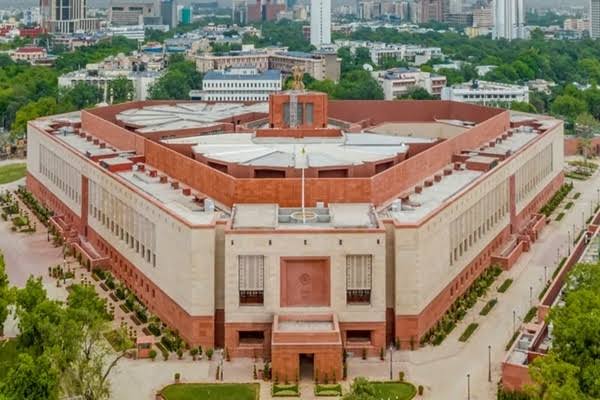
Parliament has passed the Transgender Persons (Protection of Rights) Amendment Bill, 2026, with the Rajya Sabha approving it today. The bill was passed by the Lok Sabha yesterday by a voice vote amid an Opposition-led walkout. The bill seeks to redefine the category of transgender, removes the provision of self-perceived gender identity and excludes several socio-cultural identities as well as transmasculine individuals from its ambit. It also further defines transgender persons within a biological framework, based on intersex variations and differences in sexual development. Replying to the discussion on the Bill in the Rajya Sabha, Social Justice and Empowerment Minister Dr Virendra Kumar said the government is compassionate towards the well-being of the transgender community. He said the Bill has provisions to empower the transgenders and give them dignity. The Minister said that the NDA government has taken several initiatives to bring transgender people to the mainstream and stop discrimination against them. Starting the discussion in the Upper House, Congress MP Renuka Chowdhury said this bill dilutes the privacy of an individual provided under the Constitution. Opposing the Bill, Ms Chowdhury said self-identification cannot be taken away through bureaucratic certification. Criticizing the government, she said that the proposed bill undermines the fundamental rights and dignity of transgender persons. Calling such a move wrong and illegal, she argued that forcing transgender persons to provide their identity through official certificates is against the spirit of equality and dignity guaranteed by the constitution. She also questioned the government’s approach for not properly consulting with the transgender community before bringing the Bill. She also referred to the Supreme Court’s landmark NALSA judgement of 2014, which recognized the right of transgender persons to self-identify their gender. Ms Chowdhury said the proposed Bill violates the principles laid down in that judgement and fails to respect an already established legal framework. DMK MP Tiruchi Shiva also opposed the Bill, saying that even if the Bill is passed in Parliament with a majority, it will be struck down by the Supreme Court. He further added that the Bill violates Articles 14, 15, 19 and 21 of the Constitution and it deprives the community of the right to freedom, dignity and self-determination. Supporting the Bill, BJP MP Medha Vishram Kulkarni said, ” This Bill ensures justice, dignity, protection from criminalisation and legal safeguards for transgender persons. She also thanked Prime Minister Narendra Modi for bringing this bill with certain amendments in order to ensure that the benefits reach the deserving people in a proper manner. She said there is a need for a law that brings justice to real transgender individuals and punishes fake ones. Mrs Kulkarni said the benefits should be extended to those who are transgender by birth. She said that the amendment to extend punishment will bring down the rate of crime and forced identities. TMC’s Saket Gokhale said that 31% of Transgender people in India have attempted suicide because of the discrimination that they are facing. He alleged that now the government is going to start discriminating against them as though social discrimination were not enough. He called it unacceptable. Mr Gokhale expressed concern that gender is going to be decided by the Chief Medical Officer and a District Magistrate, and the bill does not prescribe any qualifications for the Chief Medical Officer. Sanjay Singh of AAP said the Bill is a big let-down for the transgender community. He accused the government of not doing anything for the community. RJD’s Manoj Kr Jha said that prejudices against transgender people should stop, and they should be able to live with dignity. He added that self-determination of gender should not be taken away. CPI(M)’s John Brittas said it is a black-letter day and the Bill is taking India a century back. He pleaded with the government to either withdraw the Bill or refer it to a Select Committee. Jaya Bachchan of the Samajwadi Party also questioned the government over the legislation. She sought to know what the urgency was in bringing the Bill, without examining it with the depth and care that it deserved. Courtesy : NOA Note: This news is originally published on https:/newsonair.com/bha and is used purely for non-profit/non-commercial purposes, especially human rights
Case of Dalit boy beaten for drinking water from a bottle: Police issues notice to teacher, Human Rights Commission also seeks response
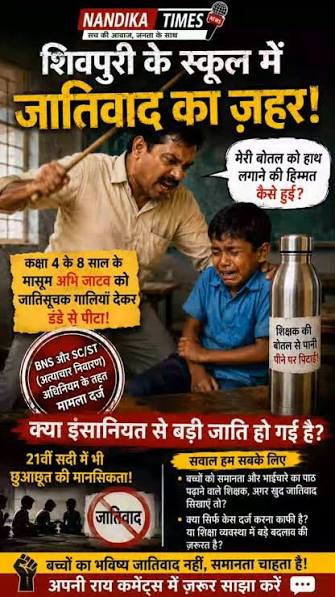
An FIR has been registered against a teacher under various sections of the SC/ST Act, including the SC/ST Act, for allegedly assaulting a Dalit student and making casteist remarks at a government school in Ukawal village, Shivpuri. The National Human Rights Commission has taken suo motu cognizance and sought a detailed report from the Madhya Pradesh government and police within two weeks. A case of alleged assault on a Dalit student at school has come to light in Kolaras, Shivpuri district. The teacher is accused of assaulting and using casteist slurs against the 8-year-old fourth-grade student at the government primary school in Ukawal village. Following the complaint, the police have registered an FIR against the accused teacher under sections of the BNS and the SC/ST Act and have initiated an investigation. The police have issued a notice to the accused teacher. The National Human Rights Commission has also taken cognizance of the matter and requested a report. The incident dates back to July 27th. An 8-year-old Dalit student, studying in the fourth grade at the Government Primary School in Ukawal village, Kolaras tehsil, has been allegedly assaulted. Family members allege that the child was thirsty and drank from the teacher’s water bottle. Angered by this, the teacher beat him with a stick. According to family members, the child returned home crying and informed the family about the entire incident at school. Following this, the family filed a police complaint. Based on the complaint, the Lukwasa police station has registered a case against the accused teacher, Lokesh Sharma. The FIR includes relevant sections of the BNS Act, as well as sections of the SC/ST Act. Following the registration of the case, the police have initiated an investigation. According to Kolaras Police Station Officer Puneet Vajpayee, a notice has been issued to the accused teacher. Police say the investigation is ongoing and further action will be taken based on the facts and evidence that emerge. Only after the police investigation will it be clear what actually happened at the school. Meanwhile, the alleged assault and casteist remarks against a minor student have raised questions about the safety of children in government schools and the conduct of teachers. NHRC seeks report from Madhya Pradesh government and police The National Human Rights Commission has taken suo motu cognizance of the matter. The Commission stated that if the claims made in media reports are true, this constitutes a serious human rights violation. The Commission has issued notices to the Chief Secretary of Madhya Pradesh and the Superintendent of Police of Shivpuri, seeking a detailed report within two weeks. The report should also include details of the legal relief provided to the victim and the action taken in the case. Published by: Dinesh Sharma Courtesy: Hindi News
When Dalits Own Temples: The Politics Behind Rajasthan’s Khakul Dev Dispute
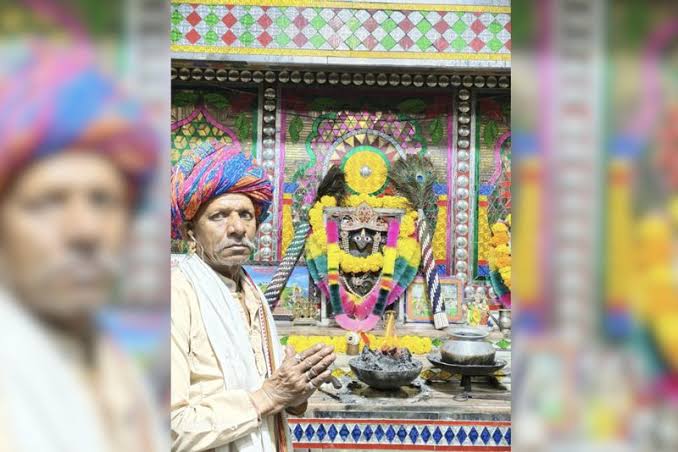
The Balai family is not demanding admission into someone else’s temple. It claims with historical authority that its ancestors established, maintained and served as hereditary priests of the shrine for centuries, and that these rights are now being challenged by people associated with the RSS. Khakul Dev Temple of Barana village in Rajasthan’s Bhilwara district. In frame, a member of the Balai family, who is the acting priest to the temple. Photo: By arrangement When Vishnu Kumar Balai, the hereditary priest of the Khakul Dev Temple of Barana village in Rajasthan’s Bhilwara district, wrote to Rashtriya Swayamsevak Sangh (RSS) chief Mohan Bhagwat in May this year asking, “Are we not Hindus?”, his appeal was widely understood as only an instance of caste discrimination and exploitation. But that reading misses what makes the Barana dispute historically and socially significant. This is not a story about Dalits seeking entry into Brahminical temples or demanding the right to perform rituals in Brahminical spaces. It is about a Dalit family which founded, owned and served as hereditary custodians of a temple for nearly four centuries, and whose assertions whose claims are supported by a body of historical material preserved by the family. Per the evidence furnished by the family, their position as priests and owners was recognised through a tamrapatra (copper-plate grant), issued by Maharana Karan Singh II of Mewar, grandson of Maharana Pratap, in 1624 CE. That historical continuity makes the present controversy all the more remarkable: a custodianship they say was acknowledged under a 17th-century Mewar ruler now finds itself challenged in 21st-century democratic India. The Khakul Dev dispute, therefore, raises a question that extends far beyond one village: why has a centuries-old Dalit temple ownership become the subject of contemporary political contestation? The tradition The Balai priestly family traces its association with Khakul Dev to Ghasiramji Balai, who, according to family tradition, discovered the deity in the early seventeenth century near present-day Hadkiya village. The shrine was subsequently established at Barana and gradually developed into an important regional place of worship. The family preserves a body of historical material – including genealogies, temple records, inscriptions and the 1624 tamrapatra – which it documents uninterrupted hereditary succession. The tamrapatra, as attested by the family, recognises their custodianship and ownership over both the temple and land attached to its maintenance, including their right for hereditary priesthood. Taken together, these records suggest that the family’s claim is rooted in a long tradition of hereditary custodianship rather than being a recent assertion. Rajasthan’s forgotten non-Brahmin religious landscape Many of Rajasthan’s most-revered folk shrines evolved outside the framework of orthodox Brahmanical institutions. Rajputs and Meghwals have historically performed hereditary ritual roles at the shrine of Baba Ramdevji, a 14th century Tomar chief whose cult transcends caste boundaries. In fact, the main temple of Baba Ramdev houses the samadhis of both Ramdevji and Dalibaiji, his Meghwal dharmbehan. Baba Ramdev Tomar, although a Rajput, is viewed as an important figure in the tradition founded by Meghrishi, a Dalit saint. Likewise, the traditions surrounding Pabuji Rathore, another Rajput folk hero, have long depended upon Nayak Bhils and Bhopa communities as hereditary ritual specialists and custodians of oral epics. Most temples dedicated to Gujjar deity Devnarayan are found in Mewar and built by Mewar’s rulers. The current Gogaji shrine at Gogamedi was built by the Bikaner’s rulers, but its tradition of Muslim priests has persisted till the modern era. Seen in this context, Khakul Dev is less an exception than a surviving example of a much older religious tradition. Recent scholarship has also questioned the assumption that Rajasthan’s religious institutions were historically organised according to a single Brahmanical model,showing that many Lok Devta traditions were sustained through the ritual practices of Bhopas, Bhils, Dalits and other non-Brahmin communities . In Merchants of Virtue, historian Divya Cherian shows how the increasing Brahminisation of Rajput courts during the 18th century reshaped social hierarchies and forms of social legitimacy. The persistence of non-Brahmin hereditary priesthoods at shrines such as Khakul Dev, Ramdevji, Gogamedi and Pabuji points to an older and more socially diverse religious landscape. Ownership, not entry Speaking to The Wire over email, social activist and Ambedkarite thinker Bhanwar Meghwanshi, said, “The Khakul Dev temple dispute also brings to light a striking historical irony. The feudal state, notwithstanding its own drawbacks and criticisms, not just recognised Dalits as hereditary priests but also granted them rights over the temples and the land attached to them. Yet, in contemporary democratic India, such hereditary rights are increasingly being challenged. In many places, dominant caste groups, including those classified as OBCs, have sought to wrest control of temples, offerings and attached lands from Dalit custodians, while simultaneously subjecting them to caste-based humiliation and violence.” Much of the discourse on caste and temples has understandably centred on temple entry – the struggle of Dalits to access spaces from which they were historically excluded. Khakul Dev presents an altogether different question. The Balai family is not demanding admission into someone else’s temple. It claims with historical authority that its ancestors established, maintained and served as hereditary priests of the shrine for centuries, and that these rights are now being challenged by people associated with the RSS. The issue, therefore, is not access but owner. It concerns hereditary priesthood, temple management, ritual legitimacy and institutional control. That distinction makes the dispute historically significant. Pamphlet published by the Dalit villagers for mobilisation against forceful takeover of the temple. Amid the ongoing dispute, the local Balai community have published and circulated pamphlets. For instance, this publication by the community was intended both, to mobilise support against what they view as an attempt by dominant castes to take over the temple and to document the historical and legal basis of the family’s claim. Photo: By arrangement The conflict According to Vishnu Kumar Balai, the conflict began in 2023, when influential villagers questioned the family’s exclusive custodianship of the temple. He has alleged that Sampat Jat, along with others, attempted to alter