
Dalit History Month: How Caste Shapes Life After Inclusion

MPP student Tejaswi Singh reflects on Dalit History Month and how caste shapes labour dignity and opportunity in India In India, where one in six individuals is a Scheduled Caste, Dalit History Month offers, at first glance, a moment of remembrance. It also raises a difficult question: one that asks not only what has been corrected in the long arc of caste-based exclusion, but what continues to endure, often less visibly, within the structures of participation, labour, and everyday social life in India? Much like the staggered lanes of a relay track, where each runner begins from a different position not by choice but by design, individuals enter social and economic systems already carrying the weight of histories that determine how far they must travel to arrive at what is considered an equal point. Over time, policies such as reservation and affirmative actions have attempted to reduce these distances, to move starting lines closer together, or at least compensate for their unevenness. In measurable terms, these interventions have produced results. The proportion of Scheduled Castes (SCs) and Scheduled Tribes (STs) in government employment increased from 12.2% in 1990 to 21.9% in 2019. Between 2015 and 2022, enrolment of SC and ST students in higher education rose significantly, with SC students making up 15.3% and ST students 6.3%, together accounting for 21.6% of total enrolment. Female enrolment within the SC category also increased sharply, rising by 51% during this period. For earnings, a report from 2022 indicates that the ‘bottom 50%’ of the Indian population which includes a large share of SC, ST, and OBC groups, has a disproportionately low share of total national income at 13%. Taken together, this evidence shows improved earnings and a gradual, though uneven, entry into the formal sector. Yet, these shifts in access, when observed more closely, do not settle into a story of transformation. They mark an opening, certainly, but do not mean that Scheduled Castes and Scheduled Tribes have an equal position in the system. Representation has expanded, but it remains uneven, often clustering at the lower tiers of institutional and economic hierarchies. Scheduled Castes, for instance, continue to be overrepresented in low-status and low-paying occupations, such as manual labour and scavenging, while being underrepresented in high-status and high-paying occupations, such as professional and managerial jobs. According to the 2011-12 NSSO data, 63% of SC workers are engaged as wage labourers, with 32% in casual labour—double the national average of 16%. This reflects both economic vulnerability and persistent occupational segmentation that policy alone has not addressed. The question that emerges here is less about entry and more about placement. If participation does not change the terms on which individuals are incorporated into systems of work and recognition, it risks reshuffling them without altering the structure itself. It is in this space that caste continues to operate through expectations about where one belongs, what one is expected to do, and how that work is valued. This becomes more legible in moments where formal inclusion meets social resistance. In June 2019, two Scheduled Caste women appointed at an Anganwadi centre in Madurai were transferred shortly after their hiring, following objections from dominant caste groups who claimed that their presence would “pollute the food.” This incident does not reflect a lack of policy; the appointment itself was made possible by it. Rather, it reveals the limits of policy when it encounters forms of social perception that remain largely unaltered. Employment, in this instance, did not secure dignity; it exposed the conditions under which dignity continues to be withheld. Even in the case of tribal communities, inclusion in economic activities often unfolds alongside processes of marginalisation. The Birhor community, classified as a Particularly Vulnerable Tribal Group (PVTG), offers one such case. Their dietary practice of eating monkeys has been met with stigma and exclusion since monkeys are believed to be under the protection of the Hindu God Hanuman. Even as constitutional provisions emphasise their protection and advancement, formal recognition continues to coexist with social distance. These instances begin to suggest that caste persists not only as a structure of access, but as a structure of perception, one that shapes how individuals are seen even after they have entered spaces from which they were historically excluded. The stigma attached to marginalised communities does not disappear with the entry of the State. It often persists, sometimes subtly, sometimes explicitly, influencing both the opportunities available and the terms on which they are offered. As Dr B.R. Ambedkar had argued, restrictions on occupation do not only limit income but also shape whether employment is possible at all. What this indicates is that while affirmative policies (such as reservation, political representation, conditional cash transfers and scholarship) have been necessary and useful to a good extent, they have not been sufficient in altering the deeper social relations that govern inclusion. While economic participation has increased, it has not been accompanied by a proportional shift in dignity or recognition. Therefore, the persistence of caste is not simply a failure of policy, but a reminder that policy operates within a social field that does not change at the same pace. In this context, the ongoing discussions around caste-based enumeration could be seen in a positive light. The absence of updated, disaggregated data has long limited the ability to assess how caste continues to shape outcomes in contemporary India. If conducted with transparency and methodological care, the absence of vote-bank politics, such an exercise could offer a clearer view of not only who participates, but where they are located within systems of work, income, and representation. In doing so, it may allow for a rethinking of policy frameworks that have, over time, become somewhat static, even as the realities they seek to address have evolved. To conclude, the track may have widened, but the lanes remain staggered in ways that are not always immediately visible and not easily corrected through institutional presence alone. Dalit History Month, in this sense, returns not only as a site
Dalit Sena seeks action against Karnataka Minister Boseraju over land ‘encroachment’

In a letter addressed to the CM, Governor and the Forest Minister, Javeed Khan, state organisational secretary of Dalit Sena, alleged that five acres of land recorded as government/reserved forest land were recorded in the name of Boseraju’s wife. Bengaluru: The Dalit Sena has accused Science and Technology Minister N S Boseraju of ‘encroaching’ upon forest and Waqf land and has sought legal action. In a letter addressed to Chief Minister Siddaramaiah, Governor Thaawarchand Gehlot and Forest Minister Eshwar B Khandre, Javeed Khan, state organisational secretary of Dalit Sena, alleged that five acres of land recorded as government/reserved forest land were recorded in the name of Boseraju’s wife. He also alleged that at Manvi town in Raichur district, government land located in the Housing Board Colony was recorded in Boseraju’s name. Khan also noted that after public protests, the district administration and courts had directed that such lands be handed over to the government. He sought legal action against the concerned persons and requested immediate steps to safeguard public property and forest resources. Courtesy : DH Note: This news is originally published on https:/deccanherald.com/bha and is used purely for non-profit/non-commercial purposes, especially human rights
Caste-Based Violence in Gujarat: Sarpanch and his associates brutally beat a Dalit family for requesting them not to damage a drain.

Caste-based individuals attacked a Dalit family, using weapons such as sticks and mace. The attackers also pelted stones and tried to break down the door of the family’s home. Patan – On July 16, a minor dispute escalated into a violent attack on a Dalit family in Datrana village, Santalpur taluka, Patan district, Gujarat, when the village sarpanch and his associates launched a deadly attack on a Dalit family. The incident began when a Dalit man requested them not to damage a drain constructed in front of his house. Enraged by this minor issue, the sarpanch and his associates not only used caste-based slurs but also attacked the family members with weapons such as sticks and mace. This incident is another example of the increasing caste-based violence against the Dalit community in Gujarat, highlighting social inequality and the indifference of the local administration. According to the FIR, on July 16th, at around 6:30 p.m., Datrana village sarpanch Jeevanbhai Savabhai Ahir was removing mud from the road with a JCB machine. During this, Madeobhai Dhawal, a Dalit, requested him not to damage the drain in front of his house to prevent water from spilling onto the road and avoid dirt. This enraged the sarpanch and he began abusing Madeobhai, including caste-based slurs. The sarpanch then attacked Madeobhai with a gadda patu (a type of tool). When Madeobhai’s family members, Muljibhai Danabhai Dhawal, Naranbhai, his wife Upaben, Mayurbhai, and Vinodbhai, intervened to save him, the sarpanch called his companions. These included Kishanbhai Jeevanbhai Ahir, Bhachabhai alias Bhappu Patabhai Ahir, Virambhai Savabhai Ahir, Parbatbhai Lalabhai Ahir, Savabhai Lalabhai Ahir, Dalabhai Lalabhai Ahir, and other unidentified individuals. These individuals attacked the Dalit family in a coordinated manner, using weapons such as sticks and mace. Naranbhai, Upabhen, Muljibhai, Mayurbhai, and Vinodbhai suffered serious injuries, particularly to their backs and heads. The attackers also pelted stones and tried to break down the door of the family’s home. The attackers threatened, “You escaped today, but next time we will kill you.” The injured were taken to the government hospital in Santalpur by 108 ambulance, where they received first aid. Muljibhai Danabhai Dhaval subsequently filed a complaint at the Santalpur police station. The complaint has been filed under sections 3(1)(r) (intentionally insulting a person belonging to a Scheduled Caste/Tribe) and 3(1)(s) (using caste-based slurs against a person belonging to a Scheduled Caste/Tribe) of the Scheduled Castes and Scheduled Tribes (Prevention of Atrocities) Act, 1989 (SC/ST Act), along with sections of the BNS. The FIR names Sarpanch Jivanbhai Savabhai Ahir, Kishanbhai Jivanbhai Ahir, Bhachabhai alias Bhappo Patabhai Ahir, Virambhai Savabhai Ahir, Parbatbhai Lalabhai Ahir, Savabhai Lalabhai Ahir, and Dalabhai Lalabhai Ahir. Social activist Narendrabhai M. Parmar from Patan says that the incident in Datrana village is proof that caste mentality is still deeply rooted in society. Incidents of caste-based violence against Dalits are frequently occurring in Gujarat. According to National Crime Records Bureau (NCRB) data, more than 1,500 cases were registered under the SC/ST Act in Gujarat in 2023, reflecting rising atrocities against the Dalit community. In many cases, especially in rural areas, Dalits are subjected to social exclusion, humiliation, and violence. This violence often stems from minor disputes, such as personal lifestyle or participation in social activities. Geetha Sunil Pillai Courtesy: Hindi News
Gujarat: Dalits invited to the Ram Temple Pran Pratishtha ceremony were told to bring plates and glasses from home!

The community refused to accept this condition, and an FIR was filed at the Visavadar police station. A case of alleged discrimination and disrespectful treatment of members of the Dalit community has come to light during the Pran Pratishtha Mahotsav of the Lord Ram Temple in Bhootdi village, Visavadar taluka, Junagadh district. The organizing committee had invited approximately ten people to the event, but they were asked to arrive after others had finished eating, eat their food separately, and not enter the temple. They were also asked to bring their own plates, bowls, and drinking water from home. Members of the Dalit community allege that separate arrangements for food and water were made for them, which clearly amounted to untouchability and caste-based insults, and therefore, the offended individuals decided not to attend the event. 25-year-old Ajay Chatur Boricha filed a complaint with the Visavadar police station. According to the complaint, around 5 pm on April 27th, five members of the organizing committee came to his neighborhood and invited about 10 Scheduled Caste members present there for the temple’s consecration ceremony. They also imposed the condition that they arrive after other caste members had eaten and that they bring their own plates and bowls. The Dalit community refused to accept this condition. Consequently, the proposed community feast in the village was canceled. However, the temple’s consecration ceremony was completed on the evening of April 29th. Based on this complaint, the police have registered a case against five individuals: Babu Uka Hapani, Narendra Bhanji Siroya, Ramnik Samji Sorathia, Atul Bhikha Siroya, and Phoola Popat Siroya under sections 3(1)(r), 3(1)(za)A, 3(1)(za)C of the SC/ST (Prevention of Atrocities) Act, as well as sections 196(2) and 54 of the Indian Penal Code (IPC). An investigation has been initiated following the FIR lodged at the Visavadar police station. The investigation has been assigned to Raviraj Singh Parmar, DSP of the Junagadh SC/ST Cell. The police have conducted a panchnama of the scene of the incident, recorded witness statements, and issued notices to the accused. The victim Dalit families have demanded a fair investigation and justice. The case is currently under investigation, and further action will be taken based on the investigation report. Casteism Incidents in Gujarat In the past few months, numerous incidents of caste-based discrimination, untouchability, and violence against the Dalit community have been reported in Gujarat. These include restrictions on temple entry, social boycotts, attacks on wedding horse riders, and untouchability in everyday life. Recently, a sensational and heartbreaking incident emerged from Amreli district in which Mahesh Premji Rathod, a 24-year-old man who had come to Shantaba General Hospital for his elderly uncle’s treatment, was beaten to death with plastic pipes for throwing leftover food into a free dining hall on the hospital premises. In March of this year, the Dalit deputy sarpanch of a village in Sabarkantha district filed a serious police complaint against eight people. The dispute is said to be rooted in the village panchayat’s decision to remove an old and dilapidated bird feeder tower (platform). It is alleged that during a meeting convened on this issue, these people threatened the deputy sarpanch and used caste-related slurs against him. Similarly, in February, in Chandrumana village, Patan, when a Dalit groom rode a horse, people with a casteist mindset allegedly resorted to hooliganism, armed with swords. They not only threatened the groom but also assaulted members of the wedding procession. In January of this year, a case of caste-based violence was reported against Tulsi Solanki, a 26-year-old Dalit laborer, in Piprala village, Santalpur tehsil, Patan district. Three men attacked Solanki with sticks, fists, and kicks, hurling casteist slurs, and threatening to kill him after he refused to lend them his glasses. In 2025, a case was filed against four women for verbally and physically abusing a Dalit woman during a Garba event in a village in Mahisagar district. The victim filed an FIR at the Virpur police station, alleging that she was subjected to caste-based abuse and physical assault after attempting to participate in a traditional dance festival with a friend. Geetha Sunil Pillai Courtesy: Hindi News
Obscenity against Dalit girl in Kannauj: Accused sentenced to 5 years in prison, fined ₹10,000 under the POCSO Act

The court has sentenced the accused to 5 years in prison for sexually assaulting a Dalit girl in Kannauj district. A fine of ₹10,000 has also been imposed on the accused, which will be given as compensation to the victim. This incident occurred in Rooppur village, under the jurisdiction of the Saurikh police station. On September 10, 2020, Pappu Sharma, a resident of the village, lured a Dalit girl to his home. The accused stripped naked in front of the girl and sexually assaulted her. When the girl screamed, her mother arrived and managed to get him out. When she protested, the accused also abused her mother. Subsequently, the victim’s mother filed a complaint against Pappu Sharma at the Saurikh police station under sections of the POCSO and SC/ST Acts. During the court hearing, accused Pappu Sharma defended himself, saying that he had not stripped naked in front of the girl, but that his towel had come loose. Government advocate Brijesh Shukla stated that based on the evidence and witness statements, Special Judge Ram Gopal Singh sentenced Pappu Sharma to five years’ imprisonment and a fine of 10,000 rupees. However, due to a lack of evidence, he was acquitted under the SC/ST Act. Vikas Awasthi | Kannauj Courtesy: Hindi News
Police launch probe into death of Dalit youth in Pudukottai
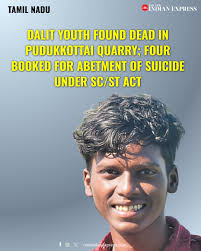
Police have launched an investigation into the death of a 20-year Dalit youth, whose body was found in a non-functional stone quarry in Pudukottai district a few days ago, after his parents raised suspicion of foul play. The victim, whose identity was established as R. Hariharan of Keelapatti village, had left home on April 21 and did not return. His body was found in a non-functional quarry in Vellanur police station limits on April 23. Acting on a complaint from the victim’s father Rajkumar, the Vellanur police initially registered a case under section 194 of Bharatiya Nagarik Suraksha Sanhita (BNSS). The body was sent to Pudukottai Government Medical College Hospital for a postmortem examination. But the youth’s parents refused to accept the body after completion of the post-mortem on April 24. They suspected that their son had been killed by family members of the girl with whom he was in love with earlier. The Vellanur police subsequently altered the case to section 108 of the BNS (abetment of suicide) read with section 3 (2) (va) of The SC / ST (Prevention of Atrocities) Act naming the girl, her father and her brothers as the accused. The victim’s parents received the body on April 27 and it was buried thereafter. Police sources said the youth and the girl were in love had loved each other and had allegedly run away from their homes a few months ago. They were traced and the girl was handed over to her parents. Arrangements were said to have been made for the marriage of the girl. The case was being investigated by the Deputy Superintendent of Police, Pudukottai. The sources said the final report of the post-mortem was awaited. Assistance for overcoming suicidal thoughts is available on the State’s health helpline 104, Tele-MANAS 14416, and Sneha’s suicide prevention helpline 044-24640050. The Hindu Bureau Courtesy : The Hindu Note: This news is originally published on https:/thehindu.com/bha and is used purely for non-profit/non-commercial purposes, especially human rights
‘Great Nicobar Project is destruction disguised as development,’ Rahul Gandhi blasts the Centre
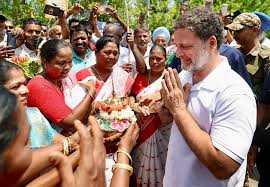
Rahul Gandhi has slammed the central government, calling the Andaman and Nicobar Project “destruction disguised as development.” New Delhi. Although the National Green Tribunal has approved the Andaman and Nicobar Project, Rahul Gandhi, Leader of the Opposition in the Lok Sabha, has alleged that the project is one of the biggest scams and most serious crimes against the country’s natural and tribal heritage. Rahul said that millions of trees will be cut down in the 160 square kilometer rainforest of the islands. Calling it “destruction disguised as development,” he announced that he would raise the issue in Parliament and appealed to the public to view the project in the same light. In a post on Instagram on Wednesday, after concluding his three-day visit to the Andaman and Nicobar Islands, Rahul Gandhi said that during his visit to Great Nicobar, he had seen the most extraordinary forest of his life, with trees that are older than we can remember. Forests that took generations to grow. The people of the island are equally beautiful, whether they are tribal communities or settlers. In a video shared on social media, Rahul Gandhi claimed that everyone on the island is against the project and that people have not forgotten what compensation they will receive for their land. The Leader of the Opposition said that after visiting the island, he finally understood why the government had been preventing him from visiting, and after much effort, he was finally able to travel. Edited by Sanjay Mishra: Deepak Gupta Courtesy: Hindi News
Manipur peace can be restored in five minutes if government decides, says Rahul Gandhi
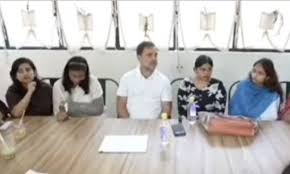
Imphal: Congress leader Rahul Gandhi has said that much-needed peace in Manipur could be restored through dialogue between the two communities, which he described as the ultimate solution to the current crisis. Interacting with young women from Gargi College and Delhi University on Tuesday, he stated that if the Government of India decided to restore peace in Manipur, it could be achieved within five minutes. “If the United Progressive Alliance (UPA) were in power, it could be settled within hours,” he said, adding that both communities need to build bridges for the restoration of peace. The UPA was a coalition of centre-left political parties in India, primarily led by the Indian National Congress (INC), which governed the country from 2004 to 2014. He added that the Indian Army is supposed to stop people from fighting each other. Reiterating his point, Gandhi said both communities need to build bridges for lasting peace in the state. He accused the ruling government of lacking the intention to end the violence, noting that the Prime Minister has not visited conflict-hit Manipur in recent months. He further expressed hope that if the UPA were in power, the situation would be resolved within hours. Gandhi emphasised that Manipur deserves peace and said that families who have lost loved ones must be taken care of. He advocated a bottom-up approach to peacebuilding, suggesting that educated youth and civil society can help bridge divides. Gandhi said Manipur is going through a “very difficult time” and encouraged young people to stand against injustice and empathise with the suffering of the people. He argued that peacebuilding must emerge from the middle and grassroots levels, suggesting that educated groups from both sides should organise workshops and peace initiatives. Notably, Rahul Gandhi made multiple visits to Manipur, including relief camps in Churachandpur, Moirang, and Jiribam in 2024, where he met victims of ethnic violence. He focused on listening to the grievances of displaced people, including women and children, and called for peace and central intervention. By Bit Irom Courtesy : North East Now Note: This news is originally published on https:/northeastnow.com/bha and is used purely for non-profit/non-commercial purposes, especially human rights
From ‘reluctant prince’ to assertive challenger
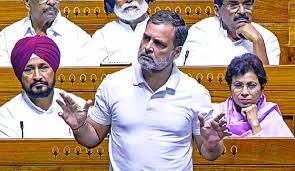
Has Rahul Gandhi become a credible Leader of the Opposition in the Lok Sabha since his appointment in June 2024? With nearly two years having passed, how effective has he been? Has he held the government accountable and changed his party’s approach to budget reviews? Has he demonstrated leadership qualities such as strategic communication and coalition-building during this time? These questions are essential for evaluating his influence and effectiveness. Rahul began his political career in 2004 and has faced both successes, challenges, and failures. He has worked behind the scenes, guiding the party through victories and defeats, while choosing not to take a ministerial role in the Manmohan Singh government from 2004 to 2014. Gandhi’s rise to a prominent position within the Congress Party was largely expected, reflecting his positioning within the party. He has the final say in party appointments. While many party members viewed his leadership as a positive development, others expressed concern that it highlighted the party’s lack of alternatives and its dependence on the Nehru-Gandhi family. Ultimately, he resigned, and senior leader Mallikarjun Kharge became the party president. Rahul’s role as LOP has included pointing out the government’s mistakes in Parliament and outside on behalf of the Opposition and his own party. However, there have been important occasions when he was not present. Rahul has taken on a more assertive, visible role, focusing on defending the Constitution, addressing income inequality, and challenging the BJP-led government on various issues. He has rebranded his image to align with the formal role, focusing on job creation, safety for marginalised groups, and the rights of farmers. This is the first time in a decade that a cabinet-level position has been filled. Since 2014, no opposition party has achieved the 10% of 543 seats needed to be recognised as the Leader of the Opposition. This presents a significant opportunity for the Opposition to challenge the Narendra Modi government. On his first day in the Lok Sabha as LOP, Rahul Gandhi stressed the need for the ruling coalition to uphold the rule of law and for the Opposition to address issues such as the economic downturn, unemployment, a caste census, and the farmers’ crisis. As the Leader of the Opposition, he participates in selecting key officials, such as the Chief Election Commissioner and the CBI Chief, to ensure that the Opposition has a say in these appointments. Rahul’s presence in Parliament has become more confrontational and assertive, reflecting his strategic shift to challenge the government directly. With the ruling party loudly defending the Modi government, noisy scenes have ensued in Parliament. Still, it has also enabled the Opposition to oppose key bills, such as the Women’s Reservation Bill and the farmers’ bills. His active participation in legislative debates and initiatives demonstrates his growing influence and impact as Leader of the Opposition, consistently challenging the Modi government on multiple issues. One successful step was his Bharat Jodo Yatra, which boosted his image by allowing him to mingle with the public and learn about their problems firsthand. Educated at some of India’s most prestigious schools, he went on to study economics in the United States and gain international experience working in London before returning to Mumbai in 2002. Gandhi is often referred to as the “reluctant prince” by his critics, who believe he is hesitant to fully embrace the responsibilities that accompany his significant influence. However, many consider him to have been the unofficial number two in the party for a long time. However, some were worried about the party’s continued reliance on the Nehru-Gandhi family for leadership. Rahul decided to enter politics and won a seat in 2004 from Amethi. In September 2007, he became the party’s secretary-general while his mother, Sonia Gandhi, remained president. By January 2013, he had risen to Vice-President of Congress, highlighting his growing influence. Critics say that even though he is more visible now, the party lost key state assembly elections in late 2024 and 2025. This raises doubts about his ability to turn popularity into votes. Rahul became the Leader of the Opposition in the Lok Sabha in June 2024. As time passes, he could lose support if he fails to secure the backing of regional allies and continues to struggle in local politics. The Opposition created the INDIA bloc and worked together in the 2024 General Election. As a result, the Opposition won more seats. The Congress Party doubled its number of seats. Additionally, there has been feedback regarding his attendance at key events and his focus on topics that some critics view as less significant. He is trying to be more approachable by engaging in activities that demonstrate his commitment to ordinary people’s concerns. Different groups view his performance differently. During Rahul Gandhi’s tenure as Leader of the Opposition, he has become a more focused and articulate leader. However, whether he has gained “credibility” is subjective. Supporters see improvement, while opponents argue his style remains unchanged. By Kalyani Shankar Courtesy : The Pioneer Note: This news is originally published on https:/thepioneer.com/bha and is used purely for non-profit/non-commercial purposes, especially human rights
Indian archdiocese launches pastoral care for transgender people
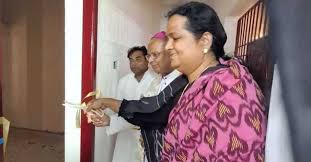
Move inspired by synodal call to ‘integrate marginalized communities, help them live a dignified life,’ priest says For years, Inba Ignatius, a Catholic transgender leader in the southern Indian city of Chennai, felt like a visitor in her own church — welcomed at the altar on special occasions but largely invisible in the daily life of the parish. Today, she feels the beginnings of a permanent home. Her sense of belonging is being fostered by a pioneering initiative of Madras-Mylapore archdiocese: a dedicated pastoral care desk for transgender persons. Launched on Feb. 26 by Archbishop George Antonysamy, the desk represents a structured, institutional effort to move beyond sporadic outreach toward a sustained ministry toward this marginalized group. For Father Leo Joseph, the priest who started the pastoral desk, the initiative is not merely a social project but a direct response to the universal call of the Catholic Church. “We have started this desk as an answer to a call from the recently held Synod of Synodality, which urges the Church to ‘integrate marginalized communities like transgender people and help them live a dignified life,’” he told UCA News. The desk’s mandate, however, draws a clear pastoral boundary. Joseph emphasized that the focus is on holistic care and social integration, clarifying that the ministry is intended to provide “only pastoral care and not sacramental care.” Ignatius, who runs a non-governmental organization for transgender rights and has collaborated with Joseph for years, sees the pastoral desk as a watershed moment. “It is a welcome initiative by the archdiocese,” she told UCA News. Transgenders in Chennai (formerly Madras) — the capital city of Tamil Nadu state, where the archdiocese is based — “need genuine pastoral care, and this pastoral desk can be a big help,” Ignatius noted. The archdiocese’s pastoral move unfolds against a backdrop of broader societal recognition in Tamil Nadu. The state government already maintains a special welfare board for transgender persons and has recently announced new schemes for their welfare and development. Furthermore, Tamil Nadu is home to the annual Koothandavar festival, a major Hindu religious and cultural event that prominently celebrates the transgender community — a testament to the deep cultural roots and visibility of transgender persons in the state’s social fabric. The Catholic archdiocese’s initiative brings together a small but dedicated team — two other priests and two nuns — with plans to expand by enlisting volunteers from religious congregations and the laity. The goal, Joseph explained, is to coordinate and amplify the scattered efforts already being undertaken by individuals and religious communities across the archdiocese. Currently, the team is drafting a formal mandate and action plan, which they hope to present to the Tamil Nadu Bishops Council (TNBC) for adoption. The vision is to eventually elevate the desk to an archdiocesan commission, creating a model that could be replicated in other dioceses across the southern state. The scale of the need is significant. Joseph estimates that around 10,000 transgender persons live in Chennai. Many face stark marginalization. “Most survive by begging near toll roads and indulging in commercial sex work,” he said. The desk’s immediate strategy focuses on economic empowerment as a way to dignity. Plans are already underway to provide training in employable skills such as tailoring and jewelry making, intending to secure stable jobs. For Joseph, this work is a continuation of a commitment that began nearly a decade ago, when he first started building relationships with the transgender community in 2015. Ignatius noted that small but significant steps toward inclusion have paved the path to this moment. Joseph, she recalled, has long facilitated interactions between transgender persons and seminarians, priests, and nuns, helping to break down misconceptions and foster understanding. “We were invited to be part of various events like Maundy Thursday celebrations and other church events and festivities,” she said. “Because of the exposure and opportunities we received, we feel now as part of the local Catholic parishes.” She hopes that the new pastoral desk will build on this foundation, moving from symbolic inclusion to structural integration. “I believe this pastoral desk can help us become more visible and integrate with the larger mainstream community, especially with the Catholic community in the archdiocese.” Publisher William J. Grimm M. M. Courtesy : UCA News Note: This news is originally published on https:/ucanews.com/bha and is used purely for non-profit/non-commercial purposes, especially human rights