
This book examines the interplay between Christianity and caste, especially for Dalit women
An excerpt from ‘Dalit Women and the Fullness of Life’, by Christina Dhanuja. Christianity’s advent in India is a hotly debated topic. But the widely held – and disputed – belief is that it started with the arrival of St Thomas the Apostle on Kerala’s Malabar coast in 52 CE. The popular claim is that the apostle converted the Namboodiri Brahmins of Kerala, giving rise to the present-day Nasranis or Syrian Christians. This was followed by the arrival of Pantaenus, a missionary from Alexandria, in 189 CE, and later, a group of Christians, led by Thomas Cana, from the Middle East in 345 CE. The Christian missions took off only with the arrival of the Portuguese missionary St Francis Xavier in 1542 and the Italian Jesuit Robert de Nobili in 1605 in Goa, followed by the German Pietists (Lutheran missionaries) Bartholomäus Ziegenbalg and Heinrich Plütschau in 1706 in Tranquebar. The Tranquebar missions were responsible for instating the printing press and the first ever print of the Tamil Bible – evidence of which one can still see at the Ziegenbalg House in Tranquebar. At the turn of the eighteenth century, the establishment of British rule in the presidencies of Bengal, Madras, and Bombay, and the subsequent amendment of the East India Company’s charter in 1813, gave way to the great expansion of the Protestant missions. Another revision of the charter in 1833 allowed for a full entry of missionaries, including those from the United States and Europe. This led to the Basel Mission in South Kanara, Gossner’s Evangelical Lutheran Mission in Bihar, the Leipzig Lutheran Mission in Tamil Nadu, the Marathi Mission in Ahmednagar and the Madura Mission in South India. Other American missions include those of the Presbyterians in Punjab, the American Baptists in Nellore and Assam, and the American Lutherans in the Northern Circars. The second half of the 19th century, post the Sepoy Mutiny of 1857, saw new missions and societies from the United States, Ireland and Canada. This in turn led to conversions within the Indian educated classes, including those who followed Hinduism, Zoroastrianism and Islam. Cyril Bruce Firth, in his comprehensive account of Indian Christian history, says that “whether by open conversion or secret discipleship, it did seem as if Christianity were making headway among people who counted.” This trend was, however, cut short by the growth of Hindu reform movements such as the Brahmo Samaj, the Prarthana Samaj, the Ramakrishna Mission and the Arya Samaj. According to Firth, this meant that, for the educated classes who became dissatisfied with orthodox Hinduism, there was now an “abundant choice of alternatives”, as opposed to Christianity. Dalits weren’t as fortunate – neither to become dissatisfied with Hinduism (they weren’t allowed to profess its mainstream versions anyway) nor to have abundant choices during that period. Thus began an unexpected, unprecedented surge of lower-caste conversions in different parts of India. Various Adivasi groups and Shudra castes also participated in these conversions. Jarrell Waskom Pickett, in his book, Christian Mass Movements in India, details that between 1875 and 1879, nearly 9000 persons became Christians in the Travancore district, and by 1900, the number rose to 63,152. This group included the Sambavars (a sub-sect of the Paraiyars) but was dominated by the Nadars, a Shudra caste. Likewise, in Punjab, by 1868, there were more than 10,000 baptised Christians, which included the Chuhras (also known as the Balmikis), the Oraons and the Mundas. Today, there are approximately 27.8 million followers of Christianity, which corresponds to 2.8% of India’s population. Most of them reside in the states of Kerala, Tamil Nadu, the Northeast, Odisha, Karnataka and Andhra Pradesh. Significant percentages also reside in Goa, the Andaman and Nicobar Islands, and Puducherry. Like the rest of the world, Christians in India belong to multiple denominations, not all of which are doctrinally different, but most of which are shaped by caste. The largest of the denominations is the Catholic Church, followed by the Assemblies of God, a relatively new charismatic tradition. The Church of South India – the church I was born into – and the Lutheran Church – the one I married into – are two of the other largest denominations in India. Apart from these, there are a number of charismatic and Pentecostal traditions. There is also a small percentage of Christians who are members of the Church of Jesus Christ of Latter-day Saints, popularly known as the Mormon church. Depending upon the region, conversion histories, and inter-state migratory patterns, each denomination and subdenomination, as well as individual pastorates and parishes, have their own caste constitutions. Owing to its incredible complexity, there is no one source that has attempted to map out the entire landscape of Christian denominations along caste. In general, it suffices to say that a large percentage of the Indian Christian population, thanks to mass conversions of the late 19th century, is made up of Dalit and Adivasi communities. And privileged castes such as the Syrian Christians of Kerala, the Nadars and Vellalars of Tamil Nadu, the Bammons and Chardos of the Konkan coast, and several other privileged minorities like them continue to hold immense power within and outside their churches. Of particular interest to me, owing to my own caste and religious location, are the conversion histories of the Paraiyars (and other Dalits), and the role they play – or fail to – in contemporary faith narratives. My motivation is not simply to justify our conversions but to become unapologetic in the face of baseless criticisms stemming from both caste Hindu and anti-caste locations. It is to reclaim the Dalit Christian identity that is consistently being denied to the likes of me, in the name of many things but mostly, the “lack of lived experience” and “the absence of radical potential”. It is to resurrect a liberative strand of faith that has the potential to offer a more empowered strategy towards fullness. Sunday schools taught me about Christian missionaries, emphasising the many sacrifices and tribulations they encountered during their
Dalit assault case: Andhra Pradesh HC seeks police explanation
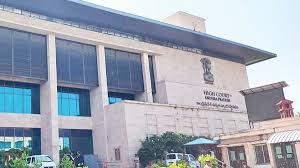
The court stated that these documents substantiate claims of custodial violence at the Gudur Rural Police Station. VIJAYAWADA: The Andhra Pradesh High Court has taken serious note of allegations that police in Nellore district brutally assaulted a Dalit man after failing to apprehend his son, who was an accused in a case. The bench of Justice Y Lakshmana Rao observed that there are prima facie records — including medical reports and photographs — confirming the injuries sustained by Polayya, a daily wage worker from Manglapuram village in Chennur mandal. The court stated that these documents substantiate claims of custodial violence at the Gudur Rural Police Station. According to the petition, Polayya was taken into custody on April 18 after his son, an accused in a case, was unavailable. He was allegedly beaten severely between 4 pm and 10 pm, resulting in his hospitalisation. His counsel, advocate V Surendra Reddy, submitted medical records and newspaper reports, and requested preservation of CCTV footage from the police station. The High Court directed Nellore SP, Gudur Rural Inspector Kishore Babu, SI Tirupatiah, and constables Das and Chinnala to appear personally before the court on May 14 Courtesy : TNIE Note: This news is originally published on https:/thenewindianexpress.com/bha and is used purely for non-profit/non-commercial purposes, especially human rights
‘It’s like a trans-Barbie world!’: the Indian festival where transgender women can celebrate without fear
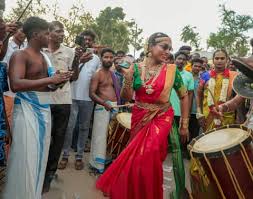
The annual gathering at Koovagam is rooted in an ancient poem. Five trans attendees talk about what the event means to them in light of a controversial change to the country’s gender recognition law The summer air is thick with dust, sweat and the scent of jasmine. In Koovagam, in southern Tamil Nadu, more than 100,000 people have gathered for one of India’s most distinctive festivals. Transgender women from across India, arrive in bright silk saris and gold temple jewellery, their hair oiled and braided with flowers. For nearly 18 days, the little town swells into a city of devotion, culminating in rituals that blur the boundaries between myth and reality. Closeup of a woman’s hands clasped in front of her pageant winner’s sash. She is wearing green glass bangles and jewellery, yellow nail polish and has henna on her hands The Koovagam festival pageant winner displays her rings The annual festival centres on the Koothandavar Temple and the story of Aravan, a figure from the Mahabharata, one of India’s most revered epic poems. According to the story, Aravan agrees to be sacrificed before a decisive battle, but asks for one final wish: to be married before he dies. When no woman is willing to wed a man fated to die the next day, the god Krishna assumes the female form of Mohini to fulfil his desire. By morning, Aravan is sacrificed, and Mohini, now widowed, mourns him – her grief forming the core of the festival that unfolds each year in Koovagam. This retelling has come to hold deep significance for trans women, who come to Koovagam to “marry Aravan” on the penultimate day of the festival. The next morning, the mourning is re-enacted: bangles are broken; vermilion powder wiped from hair partings; and white saris donned as they grieve his death. Festival goers walk past fruit stalls towards a display of neon light decorations at dusk For nearly 18 days, Koovagam swells into a temporary city of devotion as more than 100,000 people gather Two women, seen from behind, with intricate jasmine garlands wound into their hair and wearing silk saris Devotees wear a sacred thread or thali (mangalasutra) dyed in turmeric that symbolises the marriage between transgender women and Aravan. Jasmine garlands are worn in participants’ hair to signify their status as ‘brides’ This year, the festival took place against the background of a shifting legal landscape in India. An amendment to the Transgender Persons (Protection of Rights) Act 2019, passed in March, has scrapped the right to self-identify gender and introduced medical scrutiny into the legal recognition process. It also narrows the scope of who qualifies as “transgender”, privileging more fixed, state-recognisable categories while pushing trans men, and many non-binary identities, into a grey zone. Critics have called the new law regressive and an affront to human rights and dignity. For the trans women who gathered in Koovagam, the festival offered a temporary escape from the scrutiny. The Guardian spoke to some of the attendees about their lives and asked what the festival meant to them. Prazzi adjusts her sari as she stands outside the Aravan temple. This is her second time at the festival, and the joyfulness, she says, has not dulled. “You know what this is?” she says. “This is the only time of the year when we are not a minority. It’s like a trans-Barbie world.” A fashion designer and university tutor in Chennai, Tamil Nadu, Prazzi spends most of her year navigating spaces where she is, as she puts it, “a minuscule minority – someone whose presence or absence doesn’t even matter”. “People assume fashion is inclusive. It’s not,” she says. “Queer people maybe, but trans women? We are still not welcomed.” In Koovagam, that sense of isolation disappears. “For once, we are the majority. We are everywhere – in the streets, in the shops, in each other’s lives. I can just exist with my trans sisters without explaining myself.” She had more than 50 rejections before securing her teaching position. “Your CV gets you in; your identity gets you rejected,” she says. “They call you for an interview because your work and portfolio is good. But the moment you walk in, everything changes. You can see it in their faces – they’ve already decided.” What often goes unseen is how discrimination is built into paperwork. “They’ll say, ‘Your name doesn’t match across your ID proofs,’ or ‘you don’t have an address on your name. These become easy ways to exclude you,” she says. “It is not always said out loud, but you know why.” Prazzi is concerned about how the new Transgender Act deepens this. “When the state itself questions your identity unless you fit into its narrow definitions of ‘trans’, the whole issue of documentation becomes even more fraught,” she says. “It gives the state the power to decide – almost arbitrarily – whether to issue these documents to us or not. Without documents, you don’t exist,” she says. “And if you don’t exist, you can’t rent a house, you can’t move freely, work is even a distant possibility” “For many trans women,” she says, these “rejections decide our entire life. Most are pushed into begging or sex work. I was lucky – I have a job that gives me some stability. But that is not the reality for most of us.” Akshaya in sari and gold jewellery standing in front of police officers at Koovagam festival Akshaya, 29: ‘Our bodies are treated as illegal’View image in fullscreen Akshaya is at the edge of a brightly lit stretch of mud road, scanning the crowd, as the Miss Koovagam pageant takes place on the stage. Around her, her six “daughters” and two “sisters” chat and laugh. “This is my family,” she says. “Not by blood – but this is who I live for.” She has come to Koovagam to seek the blessings of Aravan, but her real wait, she says, is for the night. When the state looks away we
Tamil Nadu-born trans politician is now in Scottish Parliament. They went there on student visa
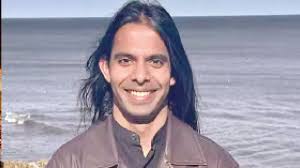
Q Manivannan hails from a lower-caste family in Tamil Nadu. They studied at OP Jindal Global University and completed their master’s degree in international peace studies in Dublin. New Delhi: Q Manivannan, a Tamil Nadu-born trans person, has been elected to the Scottish Parliament from the Scottish Green Party in the recent elections held on 7 May. Manivannan’s election marks a historic moment for representation in Scotland’s political landscape, particularly for the LGBTQ+ and immigrant communities, reported The Sunday Guardian. Mannivannan was also active in local Edinburgh politics before being elected to Holyrood as a Member of the Scottish Parliament (MSP). Their election is drawing attention since they have a student visa and were reportedly trying to raise £2,089 for a temporary graduate visa. Once they save up from their MSP salary of £77,711 per annum, they plan to apply for a global talent visa, which the UK offers to promising individuals. From India to Scotland Mannivannan studied at OP Jindal Global University, completed their master’s degree in international peace studies at Trinity College Dublin, and moved to Scotland in 2021 for doctoral research at the University of St Andrews. “I am a transgender Tamil immigrant, my pronouns are they/them. I am to some in this country everything that the hateful despise, and I am standing here as your MSP now with care,” Mannivan told the crowds at Edinburgh, reported The Telegraph. They added that they come from a lower-caste family in Tamil Nadu and had seen similar movements of resistance in Scotland. They said that they felt a strong connection with the region’s history of social and ecological justice. “I want to continue standing unwaveringly for solidarity for oppressed communities – whether its immigrants or asylum-seekers in Edinburgh… or suffering Palestinians,” Manivannan added. Manivannan’s election was only possible after the Scottish National Parliament relaxed the rules around who could be a Holyrood candidate. Earlier, foreigners could become MSPs only if they were allowed to remain indefinitely in the UK. However, with the recent change in legislation, candidates can qualify for MSPs even with short-term visas, such as those of a student. “Q is on a valid visa with the right to work and live in Scotland, and is a Commonwealth citizen. The UK’s visa system is needlessly expensive and hostile, and we are determined to replace it with one that welcomes people with care rather than throwing up hurdles and barriers,” a Scottish Greens spokesperson told The Telegraph. Janaki Pande (Edited by Prasanna Bachchhav) Courtesy : The Print Note: This news is originally published on https:/theprint.com/bha and is used purely for non-profit/non-commercial purposes, especially human rights
IMD forecasts on time onset of Southwest monsoon over Andaman Sea
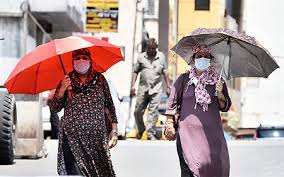
The forecast suggests that monsoon rainfall may reach only 92 per cent of the long-period average. NEW DELHI: The Indian Meteorological Department (IMD) has predicted that the monsoon is likely to begin over parts of the south Bay of Bengal, the Andaman Sea, and the Andaman and Nicobar Islands towards the end of this week (May 16-17). “Conditions are turning favourable for the onset of the southwest monsoon over parts of the south Bay of Bengal, Andaman Sea, and Andaman and Nicobar Islands by the end of this week,” stated the IMD in its daily weather forecast. The traditional schedule for the arrival of the Southwest Monsoon in the Nicobar Islands is May 15, with coverage of the entire Andaman Sea typically by May 20. This year, the expected arrival of the SWM aligns with this timeline. “It appears that the onset of the monsoon over the South Andaman Sea is nearly on schedule,” said Dr Mrutyunjay Mohapatra, Director General of Meteorology at the IMD, in an interview with TNIE. Last year, the SWM reached the South Andaman Sea, parts of the southeast Bay of Bengal, and the Nicobar Islands by May 13, arriving earlier than the normal schedule. Climatologically, the SWM covers the Andaman Sea by May 20 and reaches the coast of Kerala by June 1. Earlier predictions by the IMD indicated a below-normal SWM season for 2026 (June to September), which poses challenges for Indian agriculture amid an energy crisis. The forecast suggests that monsoon rainfall may reach only 92 per cent of the long-period average (LPA), with a model error margin of ±5%, marking one of the lowest predictions in recent years. The LPA for seasonal rainfall across the country is based on data from 1971 to 2020, which amounts to 870 mm. This year, anticipated rainfall is expected to be around 800 mm. The low rainfall forecast is primarily attributed to the emergence of strong El Niño conditions. The El Niño-Southern Oscillation (ENSO) is a natural climate phenomenon characterised by abnormal warming in the Central and Eastern Pacific Ocean. El Niño is often associated with a weaker and more erratic monsoon in India. According to the IMD, since 1951, there have been 16 recorded El Niño years, of which only six contradicted the expectations of a weaker monsoon. Out of the 10 years that recorded deficient or below-normal rainfall, the patterns were consistent with El Niño effects. Additionally, reduced snow cover in the Northern Hemisphere over the last three months has also contributed to expectations of a weaker monsoon. Last year, India experienced above-normal monsoon rainfall, with the season concluding at 108 per cent of expected levels. Furthermore, the private weather agency Skymet has also predicted below-normal rainfall at 94 per cent of the LPA. Jitendra Choubey Courtesy : TNIE Note: This news is originally published on https:/thenewindianexpress.com/bha and is used purely for non-profit/non-commercial purposes, especially human rights
‘Crime against future of youth’: Congress slams BJP government over NEET UG cancellation
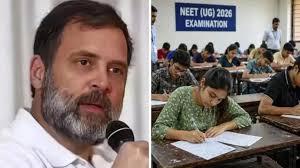
Slamming PM Modi over the exam cancellation, Rahul Gandhi said the hard work, sacrifices, and dreams of more than 22 lakh students have been “crushed by this corrupt BJP regime.” The Congress on Tuesday launched a scathing attack on the Prime Minister Narendra Modi-led BJP government over the question paper leak allegations and the subsequent cancellation of the NEET (UG) 2026 examination. Slamming PM Modi over the exam cancellation, Leader of Opposition in Lok Sabha Rahul Gandhi said the hard work, sacrifices, and dreams of more than 22 lakh students have been “crushed by this corrupt BJP regime.” “The NEET 2026 examination has been cancelled. The hard work, sacrifices, and dreams of more than 22 lakh students have been crushed by this corrupt BJP regime. Some fathers took loans, some mothers sold their jewellery, lakhs of children stayed up all night studying, and in return, they got paper leaks, government negligence, and organised corruption in education,” Gandhi said in a post on X. “This is not just a failure-it’s a crime against the future of the youth,” the Congress leader said. Every time, the paper mafia gets away scot-free, while honest students bear the punishment, Gandhi said, adding that now lakhs of students will once have to endure the same mental stress, financial burden, and uncertainty. If one’s destiny is determined not by hard work but by money and connections, then what meaning will education hold, he asked. “The Prime Minister’s so-called amrit kaal has turned into a ‘vish kaal (poison-filled era)’ for the country,” Gandhi said. The NEET UG 2026 examination held on May 3 was cancelled by the National Testing Agency (NTA) on Tuesday amid allegations of question paper leak and other irregularities in parts of Rajasthan. The NTA announced that the test would be conducted again on dates that would be announced separately. Meanwhile, the Union Government has ordered a CBI investigation into the matter. Targeting the Rajasthan government for allegedly suppressing the complaints over question paper leak for two weeks, former chief minister and Congress leader Ashok Gehlot claimed the cancellation of the exam indicated large-scale irregularities. The government had “played with the future of the youth” by attempting to hide information related to the alleged paper leak, Gehlot alleged, while lauding the NTA’s decision to conduct a retest. “The BJP government in Rajasthan had earlier tried to conceal the OMR sheet scam in the Rajasthan Staff Selection Board to avoid embarrassment. Weak legal representation in the case resulted in the accused securing bail,” he claimed. “Information related to the NEET-UG paper leak was also suppressed, and no FIR was registered initially,” he added. Gehlot said the truth has come out now, and the real face of the BJP government has been exposed. Seconding Gehlot’s remarks, Leader of Opposition Tikaram Jully alleged that the NEET-UG cancellation was proof of organised irregularities in the conduct of the test. Jully said the NTA’s decision to cancel the examination and hand over the investigation to the CBI reflected the seriousness and scale of the matter and termed it a betrayal of lakhs of hardworking students. “Eighty-nine paper leak cases had taken place during the BJP’s 10-year tenure in power. Despite repeated promises and claims of action, the government plays with the future of youths,” he said. Instead of exposing the truth, Jully said, the Rajasthan government tried to suppress the matter for two weeks and put the future of students at stake. “This reflected not only an administrative failure but also irresponsibility and insensitivity,” he alleged. Vishal Bansal, Additional Director General of the Rajasthan Police’s Special Operations Group, had on Monday said that the probe is currently focused on a “guess paper” that was allegedly circulated among students ahead of the examination. “Regarding the various misconceptions surrounding the NEET examination, let me clarify one specific point: there is a guess paper containing approximately 410 questions that has been circulating among students. Out of these, it is alleged that roughly 120 questions appeared in Chemistry,” Bansal had said. While the Chemistry paper carries 45 questions, the test used four sets of question papers. “It is reported that this guess paper had been circulating among the students well in advance; it began reaching them as early as 15 days to a month prior to the actual examination. We are investigating this guess paper, which is available in the open domain,” he had said. Courtesy : TNIE Note: This news is originally published on https:/thenewindianexpress.com/bha and is used purely for non-profit/non-commercial purposes, especially human rights
TVK worker dies two days after self-immolation attempt demanding Vijay be made CM
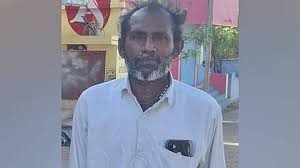
V Esakkiappan (43), a hardcore Vijay fan and village party branch secretary, suffered 90% burns and remained critical after an attempt. in hospital TIRUNELVELI: A TVK functionary of Chettikulam village, who attempted self-immolation on May 9 demanding that his party president C Joseph Vijay be made Chief Minister of Tamil Nadu, died in Kanniyakumari Government Medical College Hospital on Tuesday morning after not responding to treatment. The deceased, identified as V Esakkiappan (43), was a hardcore fan of Vijay and became the branch secretary of his village when the actor floated his party. He remained critical since the attempt with over 90 % of burn injury. Four months ago, Esakkiappan performed Vel Kuthuthal (piercing with a sacred spear on cheeks) for Tiruchendur Murugan praying for his leader to become Chief Minister. According to the villagers, on Saturday, he was upset because his leader was facing hurdles in securing a majority to form the government. The police said that in an inebriated state, he attempted self-immolation demanding that his leader be made Chief Minister. “When we inquired with him, he was so drunk that he could not realise what was happening,” a police official said. Soon after the incident, Esakkiappan’s relatives admitted him to the hospital where he remained critical in the Intensive Care Unit. He died on Tuesday morning, not responding to treatment. (Assistance for those having suicidal thoughts is available on the Tamil Nadu health department’s helpline 104 and Sneha’s suicide prevention helpline 044-24640050) Courtesy : TNIE Note: This news is originally published on https:/thenewindianexpress.com/bha and is used purely for non-profit/non-commercial purposes, especially human rights
Rahul Gandhi alleges BJP-EC ‘collusion’ over key West Bengal appointments

In a post on X written in Hindi, Gandhi said, “In the BJP-EC’s ‘chor bazaar’, the bigger the theft, the bigger the reward.” Congress leader Rahul Gandhi on Tuesday criticised the appointment of former Chief Electoral Officer Manoj Agarwal as West Bengal’s new chief secretary and Subrata Gupta as adviser to Chief Minister Suvendu Adhikari, alleging collusion between the BJP and the Election Commission. The Congress has claimed that the appointments reflected the “brazen collusion and connivance” between the Election Commission and the BJP. In a post on X written in Hindi, Gandhi said, “In the BJP-EC’s ‘chor bazaar’, the bigger the theft, the bigger the reward.” The opposition party had on Monday said that there is not even an attempt to keep the collusion discrete or concealed. Congress general secretary in charge of communications, Jairam Ramesh, had said the BJP-led West Bengal government has appointed the erstwhile chief election officer Agarwal, a 1990-batch IAS officer responsible for overseeing the recent Assembly elections in the state, as the new chief secretary. Similarly, Gupta, also a 1990-batch IAS officer who oversaw the SIR deletions in Bengal as the special roll observer, has been appointed the chief advisor to the Chief Minister, Ramesh pointed out. “These appointments reflect the brazen collusion and connivance between the ECI and the BJP. There is no longer even an attempt to keep the collusion discrete or concealed,” Ramesh said. The appointments are a testimony that the ECI was not impartial and acted exclusively to benefit the BJP, he alleged. An entire state went to the election with 27 lakh people being debarred from voting. This was tactfully executed by the ECI to create an electoral advantage for the BJP, Ramesh said. Agarwal, a West Bengal cadre officer, helmed the EC-mandated Special Intensive Revision (SIR) of electoral rolls in Bengal in the run-up to the Assembly polls, in which around 91 lakh voters were removed from the voter list. The West Bengal government on Sunday carried out a bureaucratic reshuffle, appointing two IAS officers and seven WBCS (executive) officers in the chief minister’s office (CMO), according to official notifications. Gupta was appointed advisor to the chief minister, hours after he was sworn in, while Shantanu Bala was named his private secretary. Courtesy : TNIE Note: This news is originally published on https:/thenewindianexpress.com/bha and is used purely for non-profit/non-commercial purposes, especially human rights
Bail Condition for Dalit and Tribal Accused to Clean Police Stations: Supreme Court Says Our Comments Are Not Against Any Judge

The Supreme Court has clarified that its previous comments should not be construed as an adverse comment against any High Court judge or judicial officer, in a case involving Odisha courts directing Dalit and Tribal accused to clean police stations as a bail condition. A division bench of Chief Justice Surya Kant and Justice Joymalya Bagchi stated that if interpreted in this way, it could demoralize judicial officers. The court made this comment while hearing a compliance report filed by the Registrar General of the Odisha High Court. The Supreme Court took up this matter suo motu after reports emerged that Odisha courts had imposed conditions such as cleaning police stations for two months while granting bail to Dalit and Tribal accused. According to reports, these orders were issued in cases related to anti-mining protests in Odisha. Eight such orders were passed between May 2025 and January 2026, seven of which were passed by courts in Rayagada district and one by the High Court. In the eight cases, six accused were from the Dalit community and two from the Adivasi community. On May 4, the Supreme Court expressed strong displeasure over these bail conditions. Calling them “obnoxious,” the court stated that they reflected caste bias in the state judiciary. The court stated that such derogatory and derogatory conditions, instead of advancing the ends of justice, attack the dignity of the accused and amount to a pre-judgment of guilt, which is completely unacceptable under the law. Declaring these bail conditions “void and illegal,” the Supreme Court directed all courts in Odisha to immediately revoke such orders. It also directed courts not to re-impose any similar conditions. The Supreme Court also directed that courts outside Odisha should not impose such “caste-based and oppressive” bail conditions in the future. The court stated that such conditions could create social tension. To this end, the Supreme Court directed that a copy of its order be sent to all High Courts to inform every judicial officer that such bail conditions should not be imposed under any circumstances. Praveen Mishra Courtesy: Hindi News
Three arrested for murder of Dalit youth in Peddapalli

Police arrested three persons in connection with the murder of Dalit youth Jula Vamshi, a private security guard who went missing on April 29. Investigators said the accused lured him to Hyderabad, killed him and dumped the body near GudulagandiCity & Local Guides Peddapalli: Godavarikhani Town-II police arrested three persons in connection with the murder of a Dalit youth, Jula Vamshi. Vamshi, a private security guard, was missing from April 29 and his decomposed body was found near Gudulagandi of Manthani on Sunday. Godavarikhani ACP Madata Ramesh said Vamshi had fallen in love with a woman during his school days. The woman, Alekya, was in love with another man, Neelam Naveen, whom she later married and was staying in Hyderabad. Vamshi and Alekya met again during an SSC batch reunion held in February 2025 and reportedly exchanged phone numbers. Later, he began messaging and calling her. He had also reportedly visited Alekya’s residence in Hyderabad on three occasions, leading to arguments between them. Unable to tolerate his harassment, Alekya and her husband Naveen allegedly decided to kill Vamshi, and hatched a plan along with one Burra Bhaskar. As part of their plan, Alekya invited Vamshi to her residence in Hyderabad. On April 30, he visited her home. Later, they went to Bhaskar’s home in Shamshabad. While consuming liquor, Bhaskar picked up an argument with Vamshi. As the argument turned serious, Bhaskar stabbed Vamshi on his chest and neck indiscriminately with a knife. The latter died on the spot with severe bleeding injuries. The accused then wrapped the body in a mat and plastic covers. Bhaskar allegedly shifted the body in his car and dumped it in a gorge near Gudulagandi. Based on a complaint by the deceased’s mother, Shankaramma, the police registered a missing case and began investigation. They traced the accused with the help of CDR and mobile call details. A car and five mobile phones were recovered from the accused. Courtesy : Telangana Today Note: This news is originally published on https:/telanganatoday.com/bha and is used purely for non-profit/non-commercial purposes, especially human rights