
‘Honor Killing’ in Tamil Nadu: A 23-year-old Dalit youth died due to the gap between wealth and poverty, TVK leader accused
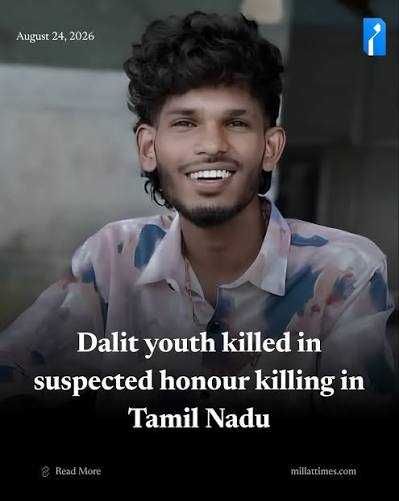
An ‘honor killing’ case in Chengalpattu, Tamil Nadu: A ruling party leader is accused of brutally murdering a 23-year-old Dalit youth due to economic inequality. Tamil Nadu: A heartbreaking incident has occurred in Chengalpattu district. A 23-year-old Dalit youth was brutally murdered on suspicion of honor killing. This horrific incident has shocked the entire area. The deceased youth was Praveen, a resident of Kelambakkam, Chengalpattu. On the night of August 16th, Praveen was attacked with sharp-edged weapons by assailants. He was seriously injured in the violent incident. He was subsequently admitted to the Rajiv Gandhi Government General Hospital in Chennai, where he succumbed to his injuries on August 20th. The police acted swiftly and arrested four of the accused in the murder. They were identified as Manikandan, Ezhumalai, Nandish, and Gautam. All were remanded to judicial custody on August 17th. The administration and police are currently searching for the fifth absconding accused. According to several media reports, the main accused, Ezhumalai, is a member of the ruling Tamil Nadu Vetri Kazhagam (TVK). It is reported that Ezhumalai’s daughter, Aswathy, and Praveen were in a love affair. Satish Kumar, a neighbor of the deceased, stated that Praveen and Ezhumalai both belonged to the Scheduled Caste (Adi Dravidar) community. However, Praveen’s family was financially weak, and this perceived poverty-wealth gap was the primary reason for the murder. Caste and Identity Groups This attack was not a random incident. Aswathy’s family had previously threatened Praveen with death several times. According to neighbor Satish, a relative of Aswathi once came to Praveen’s house armed with a weapon. He tried to attack Praveen with a knife and left, screaming and shouting threats. Not only this, Praveen was also brutally assaulted about six months ago. At that time, Ezhumalai and other accused tied Praveen with ropes and beat him severely. However, fearing the dispute, Praveen’s family decided not to file a police complaint at that time. It is alleged that this brutal murder was carried out as part of a well-planned conspiracy. One of the accused, Manikandan, had befriended Praveen about three months earlier. On the day of the murder, August 16, Praveen had gone to meet Manikandan. He was abducted in a car, taken to another location, and fatally attacked. This incident has once again intensified the demand for stricter laws against honor killings in the state. Anti-caste activists report shocking statistics. In Tamil Nadu alone, 59 cases of honor killings were reported between January and March 2026. Activists believe that the Scheduled Castes and Scheduled Tribes (Prevention of Atrocities) Act is insufficient to address such cases. Social activists say that not only caste superiority, but also class, religion, and gender identity play a significant role in honor killings. As in Praveen’s case, when both the killer and the victim belong to the same Dalit community, enforcing the SC/ST Act becomes legally difficult. Furthermore, activists point out that Christian or Muslim Dalits are also not protected under this law because they are not recognized as Scheduled Castes. People and Society Anti-caste activist and author Shalin Maria Lawrence has expressed deep concern over this incident. She argues that honor killings within Dalit communities are mostly based on economic status or class. She emphasizes the need to understand these attacks from the perspective of Dr. B.R. Ambedkar’s concept of “graded inequality.” Discrimination and Identity Relations He wrote on the social media platform ‘X’ that Praveen’s murder demonstrates how caste, class, and patriarchy intersect even within oppressed communities. Two people may belong to the same caste, but their social or economic status may differ. In such a situation, the claim to family ‘honor’ becomes a weapon against those who try to cross these boundaries. He explained that Praveen was killed because someone felt that his family’s honor outweighed the young man’s right to live and love. This represents the most horrific manifestation of the deeply ingrained inequality and cruelty in society. Rajan Chaudhary Courtesy: Hindi News
Dalit man attempts suicide, alleges caste-based harassment
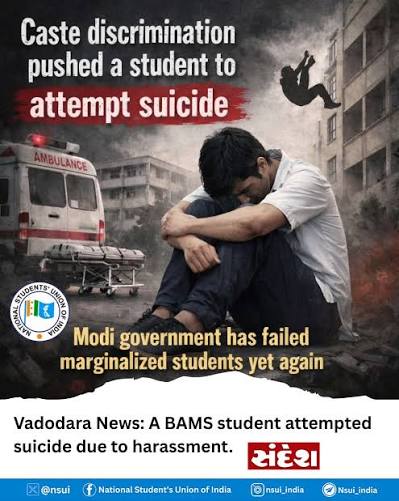
Kanpur: A 30-year-old Dalit man allegedly attempted suicide in Gram Nyauri village under the Maharajpur police station area on Tuesday morning, accusing a few villagers of harassment and alleging police inaction despite repeated complaints. The man, identified as Shyam Sundar Kori, allegedly attempted to hang himself from a railing at his house using a noose. According to police, Shyam had earlier submitted a complaint to the SC/ST Commission, levelling serious allegations against several people, including the village head. Shyam alleged that he was being harassed for getting the Kali Maa temple in the village renovated and for refusing to perform unpaid labour for certain individuals. He further alleged that an attempt was made on his life on Nov 22, 2025. He claimed that when he approached the local police station to lodge a complaint, he was arrested, assaulted and challaned instead. In his complaint, Shyam stated that if any untoward incident were to happen to him or his family, the accused persons should be held responsible. ACP Ghatampur Krishnakant Yadav said, “An FIR has been registered at Sen Paschim Para police station on the basis of a written complaint against the village head and his associates. Further legal proceedings are underway.” Courtesy : TOI Note: This news is originally published on https:/timesofindia.com/bha and is used purely for non-profit/non-commercial purposes, especially human rights
Dalit youth beaten in Govardhan temple: Beaten with sticks upon entering Shiva temple
A Dalit youth and his companion were allegedly beaten with sticks upon entering a Shiva temple in Ading village, Govardhan, Mathura district, Uttar Pradesh, during a program organized at a Shiva temple. It is alleged that they were beaten with sticks upon entering the temple. The victims allege that the temple operator and his associates baselessly accused them of desecrating the temple. They were subjected to casteist slurs and brutally beaten with sticks. The victims claim that the local police, under political pressure, are colluding with the accused instead of taking action against them. Despite video evidence of the assault, no action is being taken by the police. After the video of the incident surfaced, the victim’s family directly approached the office of the SSP, Mathura, seeking justice. The victims have appealed for strict action and the registration of an FIR against five named accused, including Kanhaiya Thakur and Vipin, and five to seven unidentified accused. Raju | Son (Govardhan), Courtesy: Hindi News
Allahabad High Court refuses to allow hijab in schools, says uniform rules must be followed
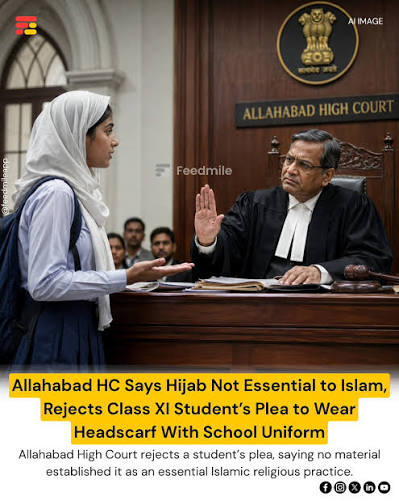
The petitioner argued that wearing a hijab was linked to her religious belief. Wearing it granted her fundamental rights such as privacy, personal liberty, and freedom of speech. LUCKNOW: The Allahabad High Court, on Monday, refused to allow students to wear hijab in schools. The court said that following the school uniform rules was mandatory as it helped promote a sense of equality among children and also gave the school its own identity. The High Court said uniforms helped maintain an environment free from religious discrimination. Therefore, no student could insist on changing the dress code prescribed by the school. “Permission to wear a hijab on an individual basis cannot be granted. This would be against the very concept of a uniform. It would shift the authority to determine school discipline from the institution to individual students,” observed the court. A division bench, comprising Justice JJ Munir and Justice Inderjeet Singh, made those remarks while dismissing the petition of a minor student, Sukaina Rizvi, who had sought permission to attend classes wearing a hijab along with the school’s prescribed dress code. Petitioner Sukaina Rizvi is an 11th-grade student at Tagore Public School in Attarsuiya, Prayagraj. She filed a petition in the High Court through her mother. The student argued that she had been attending school wearing a hijab from classes 6 to 10, and no objections were ever raised. The student also attached her old identity card and a group photo from the school with the petition. The student stated that she now wanted to attend school in the 11th grade wearing a hijab, but was not being granted permission. “We also complained to the DM, upon which the District Inspector of Schools (DIOS) sought a report. The school principal clarified that this is an educational institution where there is a uniform dress code for all students. Granting a special exemption to one student would disrupt the school’s system,” the petitioner told the court. The petitioner argued that wearing a hijab was linked to her religious belief. Wearing it granted her fundamental rights such as privacy, personal liberty, and freedom of speech. In such a situation, the school should be directed not to stop her from wearing a hijab. The court said: “Only the school administration has the complete right to decide the dress code.” The court stated that as long as the school’s dress code for all children was framed with the right intent and did not discriminate against anyone, the school administration had the absolute right to decide what the dress would be. The bench added that even if the school had previously allowed the scarf (hijab), it did not mean that it had become a permanent right of the students forever. The school administration was free to change its rules. It was not compelled to continue with old exemptions, observed the bench. The court stated: “Wearing hijab is not an essential part of the Islamic religion. Wherever this issue has been raised, the High Court’s opinion has been consistent that wearing a headscarf (hijab) for women is not an essential part of the Islamic religion.” It is not as if the religion would be in danger without it, or that a woman would be excluded from the religion if she did not wear it. No facts or evidence had been presented to prove this either, said the court. In its verdict, the Allahabad High Court referred to an old judgment of the Kerala, Bombay, and Karnataka High Courts. In the case of ‘Fatima Tasneem vs State of Kerala’, the court had stated that while on the one hand, a student had the right to wear clothes of their choice, on the other hand, a school or institution had the right to enforce its own rules and regulations. It added that when there was a conflict or dispute between these two rights, the larger interest and discipline of the institution would be given more importance than individual preference. The court stated that the school was not imposing any restrictions on the student’s faith, but was merely expecting adherence to institutional discipline and uniforms. Following this, the court dismissed the petition. Namita Bajpai Courtesy : TNIE Note: This news is originally published on https:/thenewindianexpress.com/bha and is used purely for non-profit/non-commercial purposes, especially human rights
Telangana Congress working chief Jagga Reddy questions Modi’s 2015 visit to Pakistan
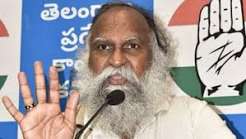
Jagga Reddy urged people, students and intellectuals in Telangana to question the reasons for the Centre blocking the chief minister’s US visit. HYDERABAD: Defending Chief Minister A Revanth Reddy over his proposed US visit, Congress working president T Jayaprakash Reddy, alias Jagga Reddy, on Tuesday questioned Prime Minister Narendra Modi’s visit to Pakistan to attend former prime minister Nawaz Sharif’s birthday celebrations. Addressing a press conference at Gandhi Bhavan, Jagga Reddy alleged that the BJP-led Union government had obstructed Revanth’s US tour and questioned why he had been allowed to travel to London but prevented from visiting the US. Responding to BJP MP Eatala Rajender’s criticism that Revanth was seeking to meet people allegedly opposed to India, Jagga Reddy questioned Modi’s Pakistan visit. “Modi is the prime minister and is under a strict security protocol. Even when he travels from his bedroom to his office, security checks are conducted. How did he go to Pakistan without prior information? The prime minister should first explain why he went to an enemy country and then speak about Revanth Reddy,” he said. Add as a preferred source on Google Jagga Reddy urged people, students and intellectuals in Telangana to question the reasons for the Centre blocking the chief minister’s US visit. On reports of an “August crisis” in the Telangana Congress, Jagga Reddy said there was no crisis in either the party or the government. “There is no August crisis in the Congress. It is a TDP issue. The chief minister here is from the Congress and there is no doubt about the Congress government,” he said. He said Revanth remained committed to Rahul Gandhi’s leadership and had maintained a “neutral” and “balanced” position. Courtesy : TNIE Note: This news is originally published on https:/thenewindianexpress.com/bha and is used purely for non-profit/non-commercial purposes, especially human rights
Rahul Gandhi’s Letter to Fadnavis Sparks Fresh BJP-Cong Clash Over Tribal Students
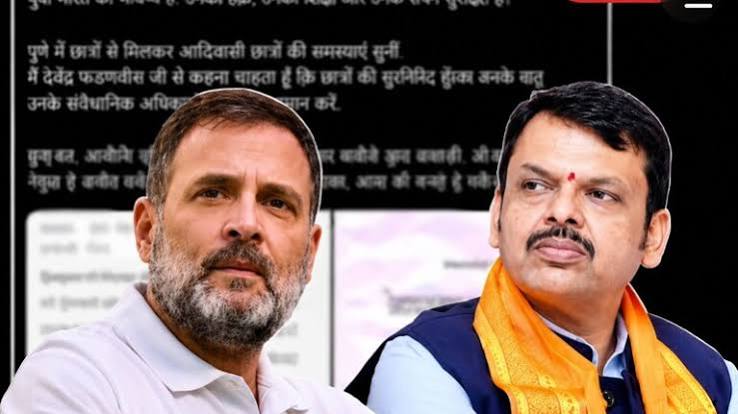
Nagpur: A fresh political confrontation erupted in Maharashtra on Tuesday after Leader of Opposition in Lok Sabha Rahul Gandhi wrote to chief minister Devendra Fadnavis seeking his intervention in the grievances of tribal students protesting over hostel rules and facilities. The protests are underway in Nagpur and Pune. Tribal Development minister Ashok Uike hit back, accusing Gandhi of arriving late to the issue and alleging that Congress functionaries had failed to brief him about developments. Gandhi wrote to Fadnavis on Monday after meeting tribal students during his ‘Chhatron Ki Goonj’ interaction in Pune. He said students from across Maharashtra had been on hunger strike for more than 10 days and urged CM to meet their representatives and resolve their grievances immediately. Uike, however, disputed Gandhi’s account. In a post on X, he said the tribal students from Nagpur and Pune had withdrawn their hunger strike before Gandhi’s visit. “Rahulji, you always arrive late!” he wrote, accusing Gandhi of holding a “paid PR programme”. He said govt has raised the age limit for hostel intake to 30 years in response to students’ demands. In his letter, Gandhi said many tribal students from remote villages depend on govt hostels to pursue higher education in cities. He criticised the revised age limit of 30 years for hostel accommodation, saying it could exclude students still completing their studies or preparing for competitive examinations. Govt had initially fixed the age limit at 26 through an Aug 4 GR before revising it to 30 on Aug 14 following protests. Students, however, are demanding withdrawal of the provision. Gandhi also highlighted complaints about inadequate food, sanitation and medical facilities in hostels, as well as reports of injuries and deaths linked to snakebites. His strongest criticism concerned an alleged requirement for female students returning after an extended absence to undergo pregnancy and other medical tests. “I was shocked to learn that female students returning after an extended absence must undergo pregnancy tests and a range of other medical tests, to prove their ‘fitness’,” Gandhi said in the letter, describing the alleged practice as “an attack on their dignity and their humanity.” He stressed that the protesters were “not asking for charity” but demanding what they considered their rightful entitlements, and asked Fadnavis to meet them personally. Uike rejected Gandhi’s allegation regarding pregnancy tests. “The talk of pregnancy testing is completely false; no such test exists,” he said, adding that students returning after a month-long absence were asked for a fitness certificate concerning their health. The minister further sought to turn the criticism back on Congress, referring to complaints from tribal residential schools and alleging that some facilities were associated with former Congress functionaries. “Several hostels are run by Congress people, from where complaints have been received. We will make sure that all the complaints are thoroughly investigated and anyone found guilty will be dealt with the strictest action,” he said. Courtesy : TOI Note: This news is originally published on https:/timesofindia.com/bha and is used purely for non-profit/non-commercial purposes, especially human rights
‘They opposed Ambedkar’s Constitution, wanted Manusmriti’: Owaisi targets RSS, BJP
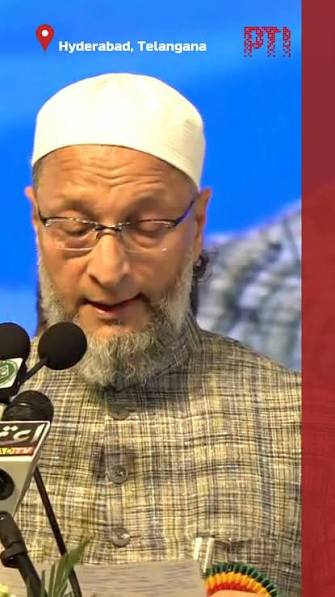
NEW DELHI: AIMIM president Asaduddin Owaisi has launched a sharp attack on the RSS and BJP over the Manusmriti, questioning their commitment to the Indian Constitution. He accused them of historically favouring the ancient text over the document adopted by the country. Owaisi made the remarks during his address at the Jalsa-e-Rahmatul-lil-Alameen at Darussalam .n Hyderabad on the occasion of the 1501st Eid Milad-un-Nabi. He targeted the RSS over its reported opposition to the Constitution drafted by Dr BR Ambedkar and contrasted the organisation’s position with that of Muslim freedom fighters during British rule. “I am asking those associated with the RSS about Manusmriti. Is it not true that on November 26, 1949, we adopted the Constitution? Yet, four days later, on November 30, a mouthpiece of the RSS published a complaint against it, stating that it wasn’t a constitution at all and that it should have been the Manusmriti. They had issues with the Constitution drafted by Babasaheb Ambedkar,” Owaisi said. The AIMIM chief also attacked Hindutva ideologue VD Savarkar, referring to his correspondence with the British during his imprisonment in the Andaman cellular jail. “Savarkar was in support of Manusmriti. While he was in Andaman jail, he was writing letters to the British, saying, ‘I am with you, please release me.’ But what were we doing? Allama Fazl-e-Haq Khairabadi was also in jail; he endured hardships but never wrote a ‘love letter’ to the British. Instead, he issued a fatwa for Jihad against them. Even today, his grave stands in the Andaman as a testament,” he asserted. Owaisi further sought to highlight the role of Muslim figures in India’s freedom struggle. He claimed that the first prisoner sent to the Andaman Islands was Maulvi Alauddin, the Imam of Hyderabad’s Mecca Masjid. “Listen, BJP and RSS people, who was the first prisoner in Andaman? It was not your father, grandfather, or ancestor. It was Hyderabad’s Maulvi Alauddin, the Imam of Mecca Masjid. He was the first prisoner,” Owaisi told the gathering. His remarks come amid an intensifying political confrontation between the BJP and Congress over the Manusmriti and its place in India’s social and constitutional discourse. The BJP has recently targeted Congress leader and Lok Sabha leader of opposition Rahul Gandhi over his criticism of the Manusmriti. It accused Rahul of making statements that undermine India’s traditions, cultural heritage and democratic institutions. Several BJP leaders, including chief ministers, have alleged that Rahul Gandhi’s remarks sought to “belittle” India’s civilisational values. At an event titled ‘Chhatron ki Goonj’ in Pune, Rahul Gandhi criticised a passage attributed to the Manusmriti concerning women’s independence. “This is a direct quote from the Manusmriti, and these words are a shame, because these words should never ever have been spoken,” Gandhi said after quoting the passage: “In childhood, a female belongs to her father. In youth, she belongs to her husband. When her lord is dead, she belongs to her sons. A woman must never be independent.” Rahul also called for an end to patriarchal structures, telling female students that the country needs to “smash the prevailing patriarchy” to achieve genuine empowerment for women. The exchange has brought the Manusmriti back into the centre of a wider political debate over constitutional values, social equality and competing interpretations of India’s cultural and political history. Courtesy : TOI Note: This news is originally published on https:/timesofindia.com/bha and is used purely for non-profit/non-commercial purposes, especially human rights
Baghel meets Rahul, Priyanka amid Punjab Congress infighting
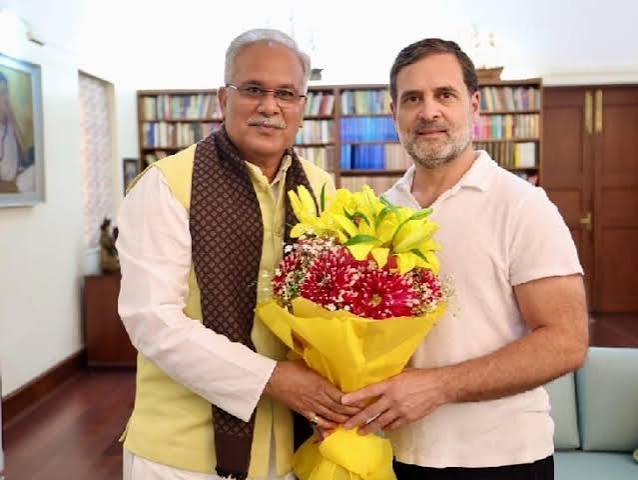
Chandigarh: Bhupesh Baghel, the AICC general secretary and in charge for Punjab, met the leader of the opposition in the Lok Sabha, Rahul Gandhi, and Congress MP Priyanka Gandhi Vadra in Delhi on Monday. During the meeting, issues relating to the continuing differences within the Punjab Congress and Rahul Gandhi’s proposed bus journey in the poll-bound state were discussed. The trio also discussed possible ways of addressing the differences within the state unit. Baghel, however, did not disclose details of the discussions on organisational issues after the meeting. The meeting comes amid continuing differences within the Punjab Congress, particularly between a group of leaders associated with the former chief minister and Congress MP, Charanjit Singh Channi, and the camp led by Punjab Pradesh Congress Committee president Amrinder Singh Raja Warring. The Channi camp has been pressing for the removal of Warring from the post of president. Last week, Baghel ruled out any change in the state unit’s existing organisational structure and said the focus would be on expanding the announced committees and bringing more functionaries into the party’s election preparations. “There will be no changes now. Only expansion will take place,” Baghel had said, indicating that the existing committees would be enlarged by adding more members, and that new committees could also be constituted as part of the party’s organisational preparations. After Monday’s meeting, Baghel said the expansion of the committees would take place shortly. However, he did not give details of the discussions on internal issues in Punjab. He said the primary focus of the meeting was Rahul Gandhi’s proposed bus journey in Punjab and related preparations. “I met both Rahul Gandhi and Priyanka Gandhi. The main topic was the bus journey planned for Punjab. I wanted to seek permission for the tour, specifically regarding the journey Rahul Gandhi is to undertake. They granted me time and asked me to submit a proposal outlining the schedule for the week, after which they will finalise the timing,” Baghel said. The former Chhattisgarh chief minister indicated that the proposed programme would not take place this week. He also hinted at a major tour covering Punjab. Baghel said a detailed programme would be prepared and shared with the party leadership before the schedule and timing were finalised. The proposed bus journey is being planned as part of the Congress’s preparations for the 2027 Punjab assembly elections. According to party sources, Rahul Gandhi is likely to begin the programme from Amritsar after paying obeisance at the Golden Temple. The tentative plan is for the first phase to cover the Amritsar-Hussainiwala stretch. Baghel also indicated that the proposed yatra would involve party functionaries from across Punjab. He said all party representatives would join the yatra, and national leaders would also participate in the programme. The proposed bus journey is likely to bring senior Punjab Congress functionaries together on a common platform as the party intensifies its preparations for the 2027 elections. AICC secretary and Punjab co-in charge Suraj Singh Thakur, who was also present at the meeting, said, “This is our family, and within a family, there has always been a good relationship between the younger and elder brothers. There are discussions over certain issues, and that is a matter within our party. We will resolve it by working together with everyone and taking everyone along, as has always been the Congress party’s approach and our principle. We will contest the Punjab elections together with everyone,” he said. Courtesy : TOI Note: This news is originally published on https:/timesofindia.com/bha and is used purely for non-profit/non-commercial purposes, especially human rights
Surprise protests, GenZ outreach: Rahul Gandhi’s new playbook after CJP’s success
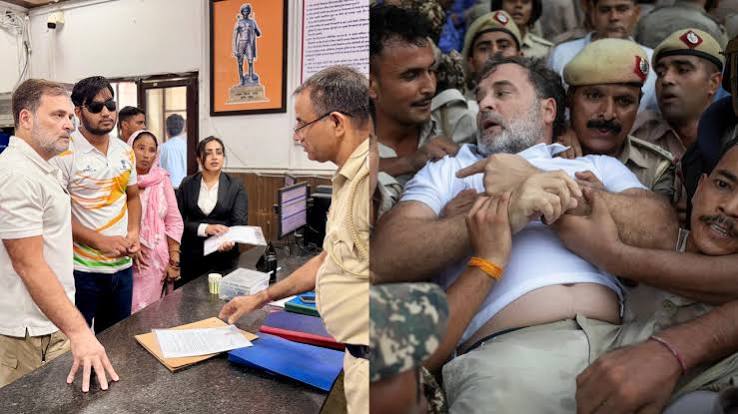
NEW DELHI: “I will not leave till you lodge an FIR. He has pellet injuries on his body, has lost his eye, and we are demanding an FIR for this… I will go outside and sit there until you lodge an FIR. I will sit for 10 days, 20 days, 30 days, 50 days, six months. Your government will have a problem.” There is a visible change in how Rahul Gandhi pushes through issues now. The leader of the opposition in Lok Sabha has a new weapon in his political arsenal: impromptu protests. For the second time in a month, the Congress leader caught the authorities and, to some extent, even his own party, off guard by taking to the streets of the national capital without prior warning. When Rahul reached the DCP office in Delhi on August 21 demanding an FIR for Sahil Lohchab, who sustained pellet injuries during the July 20 student protest, it was Act 2 of his new playbook of street protest politics. When the cops dilly-dallied, Rahul refused to budge and staged a sit-in protest outside the police station. Priyanka Gandhi Vadra joined him. Congress leaders began arriving. Rapid Action Force personnel were deployed outside. A visit to a police office turned into a high-voltage political stand-off and, after six hours of dharna, Delhi Police registered an FIR over the pellet firing. The BJP reacted sharply, calling Rahul’s sit-in the ‘politics of anarchy’. It argued that an FIR relating to the wider July 20 incident already existed, an investigation was under way and the Congress leader was turning police procedure into a political spectacle. For Lohchab, however, there was a sense of relief. His family had been trying to get his complaint registered since August 14, shuttling between police stations. The 19-year-old, who underwent surgery after pellets struck his right eye, finally had an FIR registered after Rahul’s intervention. For years, opponents have labelled Rahul Gandhi a ‘part-time politician’ who would raise an issue and then disappear. But this incident reinforced something that has changed about Rahul’s tactics over the past year. He is no longer content merely to raise an issue. He increasingly wants to enter it, stay with it and, if necessary, physically occupy the space. Rahul’s new playbook The first display of this surprise street-politics instinct had come a month earlier during the NEET student protests. On July 21, a day after police used force to stop thousands of students attempting a ‘Sansad Chalo’ march over exam irregularities, Rahul suddenly headed towards Prime Minister Narendra Modi’s residence and staged a sit-in. Police had reportedly made arrangements anticipating a Congress protest at Vijay Chowk. Rahul went to Lok Kalyan Marg instead. The move caught security officials by surprise. Rahul, Priyanka and several other opposition leaders were later detained. The visual that immediately took over the news was hard to ignore: the leader of opposition physically struggling with police officers, being dragged away and getting a nosebleed in the chaos. It came at a time when the Congress was desperately trying to make its presence felt, with Abhijeet Dipke’s Cockroach Janata Party and climate activist Sonam Wangchuk already leading a massive student protest against the NEET paper leak. Congress had initially kept its distance, preferring to run its own youth outreach campaign, ‘Chhatron Ki Goonj’. But people asked a simple question: If Congress claimed to support student issues, why was it missing from the biggest student movement in Delhi? When the July 20 Jantar Mantar protest took place and massive outrage erupted over police action against the student protesters, Rahul’s approach changed. The very next day, he moved to the front lines. He stood outside the Prime Minister’s house, Congress leaders visited injured students, and police action became a major national debate. Rahul took the issue to Parliament and continued raising the pitch over injuries suffered by students. And when the larger protest began to recede from the headlines, Rahul stayed with one part of it: the use of pellet guns. He has affirmed that his party will keep raising the issue and demand accountability. Rahul’s changing style The first major image makeover was when Rahul Gandhi embarked on the ‘Bharat Jodo Yatra’ from Kanyakumari to Kashmir in 2022. Sceptics and rivals wondered if he would complete the journey. By the time he reached Kashmir months later, after walking thousands of kilometres in his now-signature white T-shirt, one charge had become considerably harder to make: that Rahul was unwilling to put in the physical grind that it takes in politics. The yatra, on its own, did not help the Congress much. What it did was change the way Rahul himself was seen as a politician. For months, people saw him walking with the common public rather than delivering a scripted speech from a podium. He met farmers, labourers and students, stopped for conversations, entered homes and sat and ate with people. The yatra experience also laid the foundation for his growing social media popularity. His online presence today increasingly relies on short, conversational exchanges that can easily travel as reels and clips. The second shift came in 2024, when he became the leader of the opposition. Since then, we have seen a more combative Rahul Gandhi. Whether one agrees with his politics or the issues he raises, he appears considerably more comfortable with confrontation than he once did. Congress’s protests in the Parliament complex have also become more visual and experimental under Rahul. He repeatedly joined opposition MPs at Makar Dwar over the Election Commission’s SIR exercise in Bihar, with MPs carrying ‘vote chori’ placards and demanding its rollback. The protest later moved beyond the Parliament gates, with Rahul and other opposition leaders marching towards the Election Commission before being stopped and detained. Rahul provokes ministers across the aisle and stays for the response. He takes an argument from the street into Parliament and, increasingly, carries it back outside again. This is also a part of his renewed Gen Z outreach. Rahul’s GenZ
Transgender Police Trainee Found Hanging In Bathroom In Bihar

The victim, identified as Avanthika Sindhu, was a resident of West Champaran district. She was among a batch of 500 trainees sent from Patna Police Lines to Jamalpur for training. Transgender Police Trainee Found Hanging In Bathroom In BiharThe body has been sent for postmortem examination.Munger: A transgender woman constable undergoing police training in Bihar’s Munger district was found hanging in a bathroom on Sunday, prompting an investigation into the circumstances surrounding her death. The constable, Avanthika Sindhu, had reportedly been unwell for the past few days and was alone in the barracks when the incident occurred. Sindhu was a resident of West Champaran district. She was among a batch of 500 trainees sent from Patna Police Lines to Jamalpur for training. The batch includes 16 transgender personnel. The incident took place at the BSAP-9 camp in Jamalpur. According to colleagues, Avanthika had been unwell for the past few days and had not been taking part in training activities. On Sunday, the entire batch had gone to the training ground, while Avanthika remained in the barracks due to her poor health. When fellow trainees returned in the evening and began looking for her, they found her hanging in the bathroom. She was immediately taken to a primary health centre, where she was declared dead. Mithilesh Kumar, Commandant, BSAP Camp told the reporters, “It appears to be a case of suicide. The woman was found in the bathroom with a cloth towel tied around her neck.” Soon after receiving information about the incident, BSAP-9 Commandant Mithilesh Kumar, DSP Dr Arjun Kumar Gupta and Jamalpur Station House Officer Pankaj Kumar Paswan reached the camp and began an inquiry. Officials also questioned personnel staying in the barracks. Police are probing the case from multiple angles, including the circumstances inside the camp and the constable’s health condition. Investigators are also examining her personal life and external contacts to determine if any other factors may have contributed to her death. According to police sources, her mobile phone and personal contacts are also being subjected to technical examination to determine whether any pressure, dispute or other factor may have been involved. However, police said no conclusions can be drawn until the investigation is completed. The body has been sent for postmortem examination. Commandant Mithilesh Kumar said the constable’s family had been informed about the incident. Station House Officer Pankaj Kumar Paswan said the exact cause of death would be known only after the postmortem report and technical investigation are completed. Edited by: Anwesha Singh Courtesy : NDTV Note: This news is originally published on https:/ndtv.com/bha and is used purely for non-profit/non-commercial purposes, especially human rights