
Even before independence and the formation of the Constitution, the Scindia dynasty began the upliftment of Dalits… with provisions for punishment for those who discriminated.
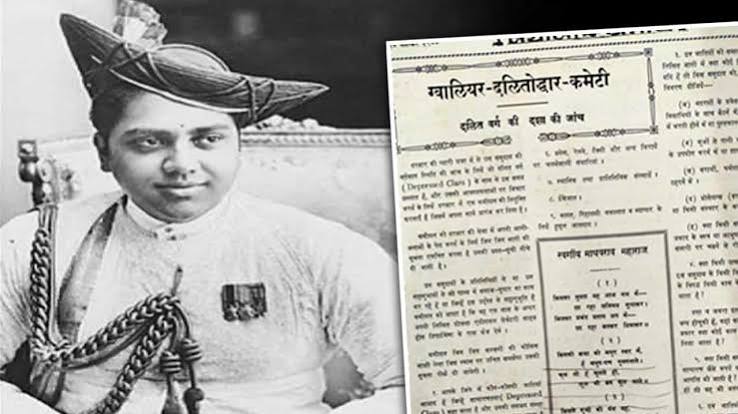
Before independence, the Scindia dynasty of Gwalior granted Dalits equal rights to temples, schools, wells, and public ghats. The 1945 order provided for action against those who discriminated. Before India’s independence and the formation of the Constitution, many princely states across the country undertook social reform initiatives that transcended their time and laid the foundation for equality and social justice. Among these, the Scindia dynasty of Gwalior’s contribution is particularly noteworthy. The Scindia dynasty not only took important decisions to free the Dalit community from social discrimination, but also took steps to ensure equal rights in education, entry to religious sites, and the use of public facilities. Dalits were granted equal access to temples, schools, wells, and public ghats, including the right to ride horses and palanquins, and to wear whatever clothing they desired. 11 schools and three free hostels were established for the education of tribal children, and special schemes were also launched for the upliftment of the Bhil and Bhilala communities. On May 4, 1945, the then Maharaja of Gwalior State, Jivajirao Madhavrao Scindia, issued a historic declaration explicitly recognizing the rights of the Dalit community. This declaration stated that those considered untouchables or Harijans in the then social system, like other citizens, were entitled to all the fundamental rights to which they were born. The significance of this decree is further enhanced because at that time, in many parts of the country, the Dalit community was denied basic social rights such as entry into temples, drawing water from public wells, studying in schools, and even riding a horse or palanquin. Equal rights from temples to schools, with penalties for discriminators Maharaja Jivajirao Scindia’s May 4, 1945, proclamation granted the Dalit community the freedom to wear clothing and jewelry, use modes of transportation of their choice, follow marriage customs, and access public spaces. The proclamation clarified that Dalits would be able to use wells, canals, river ghats, and state-run educational institutions. Furthermore, they were also granted the right to enter and worship in state-owned or state-managed temples, like other Hindus. The most significant aspect of this proclamation was that it provided for punitive action under existing state laws against those who obstructed the exercise of these rights. This meant that social equality was not limited to mere ideals or preaching, but rather an attempt was made to link it with administrative orders and legal action. 11 schools and three free hostels for the education of tribal children The contribution of the Scindia dynasty was not limited to Dalit upliftment. Significant efforts were also made for the education and social development of tribal communities. According to available historical records, by 1938, 11 schools and three free hostels operated for Bhil and Bhilala tribal children in the Gwalior State. In the Sheopur region, there were also schools and three free hostels for children from the Sahariya community. In addition to connecting tribal children to education, plans were also developed to teach them practical and employable skills. Initiatives were taken to train Bhil and Bhilala children in handicrafts and crafts that would improve their daily lives and livelihoods. Hostels were built for tribal children in Tanda and Bagh. A model school for tribal children was established on Pandav Gufa mountain in the Bagh area of Manawar Pargana under the supervision of the Forest Department. Scholarships were also provided to students. Furthermore, efforts were made to understand the problems of communities through tribal conferences and to establish a Panchayat system in villages. Formation of a Commission for Social Reform There is also historical mention of the formation of a commission to study the conditions of backward and disadvantaged communities in the Gwalior State. Its objective was to assess the actual circumstances, problems, and needs of these communities. The commission sought suggestions from representatives of the concerned communities and those involved in social reform work. They were invited to submit their written proposals to the Additional Secretary of the Home Department. This initiative demonstrates an effort to advance social reform at an institutional and administrative level, rather than solely through individual efforts. The Gaekwad Maharaja of Baroda assisted Baba Saheb Ambedkar in higher education. While discussing the social reforms of the Scindia dynasty, the contributions of other Maratha princely states are also noteworthy. Maharaja Sayajirao Gaekwad of Baroda provided significant support to social reform pioneers like Mahatma Jyotiba Phule and Dr. Bhimrao Ambedkar. On April 4, 1913, Maharaja Sayajirao Gaekwad and the young Bhimrao Ambedkar had a very close relationship. Ambedkar was provided financial assistance and scholarships for higher education. With this support, he pursued further studies at Columbia University in the United States. This support is an important example for understanding the importance of social justice and education in Indian history. The Legacy of the Maratha Princely States in the Advancement of Social Equality At various times, the princely states of Maratha rulers such as the Scindias of Gwalior, the Gaekwads of Baroda, and the Bhonsles of Kolhapur spearheaded efforts for social reform and the upliftment of marginalized communities. These initiatives must be viewed in the context of the prevailing social conditions, when caste discrimination was a significant challenge in Indian society. The 1945 declaration of the Gwalior princely state is particularly significant because it explicitly recognized the rights of Dalits in religious, educational, and public life. The provision of schools, hostels, and scholarships for tribal children also paved the way for social empowerment through education. The Indian Constitution later established equality, freedom, and social justice as the foundation of the country’s democratic structure. However, such initiatives undertaken in various princely states before independence bear witness to the growing awareness of social change even before the Constitution was enacted. This historical chapter of the Scindia dynasty not only chronicles the achievements of a dynasty, but also commemorates the efforts made during that period for social equality, education, and human dignity. Edited By: Varun Chauhan Courtesy: Scindia Research Centre
RIMS- Adilabad doctor, nurse, two constables booked for abetment of Dalit youngster’s suicide
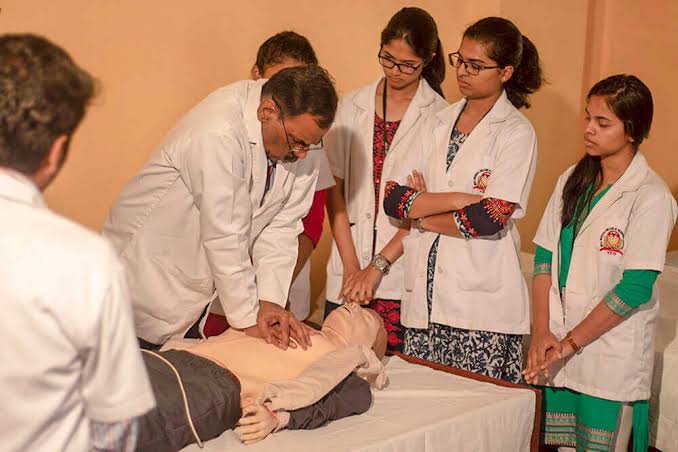
A doctor, nurse and police constable were booked in Adilabad following the death by suicide of 26-year-old Rahul Kamble. His family alleged harassment and caste-based abuse, while a suicide note reportedly accused RIMS doctors and police of torture. Adilabad: A doctor, and nurse from RIMS and a constable were booked on charges of abetting a youngster from the town to die by suicide and abusing him using his caste name here on Thursday. Adilabad DSP L Jeevan Reddy said that a case was registered against Dr Sourabh, staff nurse Mamatha, II town head constable Fateh Singh under the Section 108 (abetment of suicide) of BNSS and relevant sections of the SC, ST Prevention of Atrocities Act, based on a complaint received from the father of Rahul Kamble (26) father on Thursday evening. Earlier in the morning on Thursday, Rahul died allegedly by suicide by hanging after feeling humiliated when he was allegedly reprimanded and harassed by doctors and police for video-recording negligence of staffers in providing treatment to him at RIMS on his mobile phone. He was admitted to RIMS after being bitten by a scorpion on Wednesday. A suicide note purportedly written by Rahul was recovered. In the suicide note, Rahul alleged that he was subjected to torture by police as per instructions of doctors from RIMS. Following his suicide, his family members and Dalit organizations staged a protest seeking justice and demanding action against the staffers and police at RIMS on Thursday. This protest prompted to register a case against those who allegedly drove the youngster to die by suicide. Courtesy : Telangana Today Note: This news is originally published on https:/telanganatoday.com/bha and is used purely for non-profit/non-commercial purposes, especially human rights
Rahul Gandhi says ‘Chalo Dilli’ march a singular protest for nation; urges people to join to save democracy
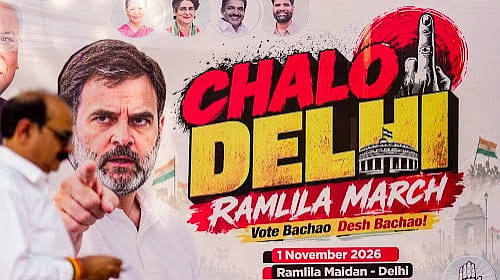
In a video on X, Rahul Gandhi said it is a singular protest for the nation, urging student groups, regardless of their political affiliations, to join the march. Congress leader Rahul Gandhi on Thursday urged student groups, regardless of their political affiliations, to join the INDIA bloc’s November 1 march in Delhi to save democracy, stop “vote theft” and protect the Constitution. In a video on X, Gandhi said it is a singular protest for the nation. “The ‘Chalo Delhi’ Ramlila March is a march to save democracy, to put an end to the theft of votes, and to protect the Constitution,” the leader of opposition in the Lok Sabha said. This is not a march for any single political party; it is a march for the very soul of India, he asserted. “To all those who are fed up with Narendra Modi, Amit Shah and Gyanesh Kumar, and everyone who wishes to save democracy and defend the Constitution, I invite you all to join,” Gandhi said. Don’t worry about police, don’t worry about lathis. The BJP will not have the guts to try any of their antics, he said. “Come march with us – we will walk together to protect the Constitution, to protect the Indian nation,” he said. “I urge all student groups, regardless of your political affiliation – if you feel that India is under attack, if you feel you are under attack, your expression, your ideas, your way of thinking is under attack, come and join us,” he said. “It will be a fantastic march, and it’s a march for the soul of this country,” Gandhi said. “Looking forward to seeing all of you there,” he added. The INDIA bloc will be holding a “public impeachment” proceeding against Chief Election Commissioner Gyanesh Kumar on October 30 at Congress president Mallikarjun Kharge’s 10, Rajaji Marg residence, over alleged irregularities in the Special Intensive Revision of electoral rolls. After the public impeachment, there will be ‘Dilli Chalo March’ against “vote chori” culminating at Ramlila Maidan on November 1, and a rally will be held there. Courtesy : TNIE Note: This news is originally published on https:/thenewindianexpress.com/bha and is used purely for non-profit/non-commercial purposes, especially human rights
“Banks were created during the Congress regime, but are sold during Modi’s rule,” Rahul Gandhi lashed out at IDBI Bank’s privatization, offering support to employees.
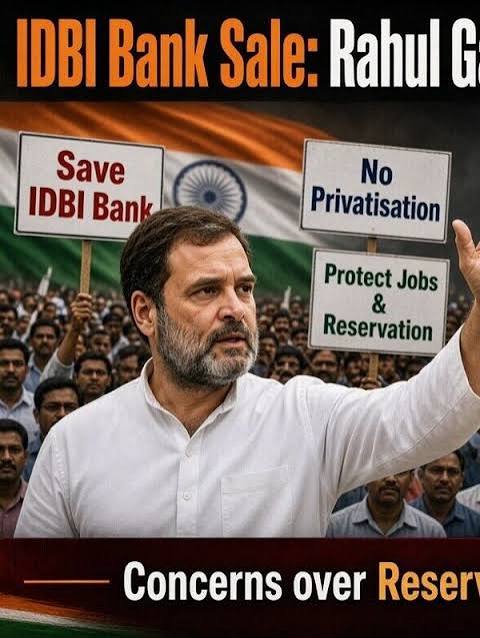
Congress MP Rahul Gandhi has targeted the central government over the privatization of IDBI Bank. He sarcastically said, “Banks were created during the Congress regime, but are sold during Modi’s rule.” He also expressed support for the bank employees’ protest and pledged his support. New Delhi: Congress MP and Leader of the Opposition in the Lok Sabha, Rahul Gandhi, has targeted the Narendra Modi government over the privatization of IDBI Bank. He alleged that the government first called for bids to purchase the bank and then fixed its price. Rahul Gandhi said that during the Congress regime, banks were created for the country’s industrial development, whereas under the Modi government, public sector banks are being sold. He has pledged his support for IDBI Bank employees. On Friday, Rahul Gandhi posted on the social media platform X, writing, “IDBI was created during the Congress regime to build the country’s industry.” During Modi’s tenure, bids were first reviewed, then the price was finalized. Banks were created during Congress’s tenure. They are sold during Modi’s tenure. I stand with the employees of IDBI Bank. Rahul Gandhi writes a letter to IDBI employees Rahul Gandhi has written a letter addressing the employees of IDBI Bank. In the letter, Rahul Gandhi explained that in March last year, a delegation of bank employees met him in Parliament. The employees questioned why the government was selling the bank he had brought to profit. According to Rahul Gandhi, “He raised this issue in the Lok Sabha, asking the government why a profitable public sector bank needed to be sold and how the interests of its employees and depositors would be protected. He alleged that the government failed to provide a satisfactory answer to this question. Now, the decision has been made to sell the bank to the Canadian company Fairfax.” ‘The bank went from losses to profits of ₹9,000 crore in 7 years’ Rahul Gandhi, in his letter, highlighted IDBI Bank’s performance, saying it began as a development bank. The subsequent transition to a commercial bank wasn’t easy, but the employees overcame the challenges. He claimed that about seven years ago, IDBI Bank was incurring losses, but last year, the bank earned profits of over ₹9,000 crore. Rahul Gandhi credited the bank’s employees for this turnaround, saying it was the result of their hard work. Objection raised to the reduction of government stake The Congress MP also questioned the change in the bank’s ownership. He said that currently, the government and LIC hold approximately 95% of IDBI Bank. After privatization, this stake will be reduced to approximately 34%. Rahul Gandhi also referred to the promise made in Parliament in 2003, in which the government had pledged to retain at least a 51% stake in IDBI Bank. He said that even if this promise is not enshrined in law, a promise made in Parliament is a promise made to the people of the country. He expressed concern that reservations for SC, ST, and OBC categories could be eliminated after the bank goes into private hands. He assured IDBI Bank employees that he stands with them in their struggle and fully supports all their legitimate demands. Why is IDBI Bank in the news? The IDBI Bank privatization issue involves selling the government’s stake and transferring control of the bank to a private foreign company. The central government has approved the sale of 60.72% of IDBI Bank’s stake to Canadian company Fairfax. This deal is worth approximately ₹52,878 crore. When was IDBI Bank established? IDBI Bank was established in 1964 to boost the country’s industrial development. Its purpose was to provide loans to companies and large projects. The bank was established in 1964 when it was formerly owned by the RBI. Its ownership was transferred to the Central Government in 1976. Why are bank employees protesting? Reservation issue: Whether the reservation system for SC, ST, and OBC categories in public sector banks will continue after becoming private banks is a major question. Employees are vocal about this issue. Job security: There is a fear that service conditions, promotions, and job security will be affected after private management comes into place. Public control: Employees believe that public sector control should remain over banks built with public money. Authored by: Abhishek Pandey About the author Abhishek Pandey is a digital journalist at Navbharat Times. He joined Navbharat Times, the digital wing of the Times of India Group, in July 2025. He currently covers news for the National and Delhi desks. I have 4 years of experience in journalism, working as a reporter and on the desk. Courtesy: Hindi News
Supreme Court cancels bail of expelled JD(U) leader Anant Singh in Dularchand Yadav murder case
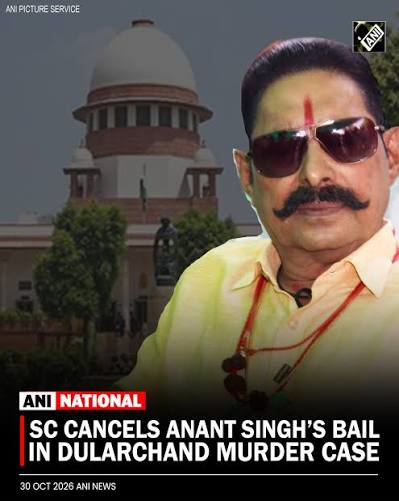
NEW DELHI: The Supreme Court on Friday cancelled the bail granted to expelled JD(U) leader Anant Singh in the murder case of Dularchand Yadav and directed him to surrender before the authorities on or before December 1, 2026. A bench of Justices MM Sundresh and PV Varale observed that the Patna high court had erred in granting bail to Singh without considering the nature of the offence and his criminal antecedents. The Supreme Court suspended the high court’s order and cancelled the bail granted to Singh, directing him to surrender within the stipulated deadline. Courtesy : TOI Note: This news is originally published on https:/timesofindia.com/bha and is used purely for non-profit/non-commercial purposes, especially human rights
In SC, biological women oppose equal rights for transgender women

NEW DELHI: Striking a discordant note among a clutch of petitions challenging the Transgender Amendment Act for denying right to gender self-determination, an all-women NGO Wednesday appealed to the Supreme Court not to confer trans-women, biological males identifying as females, the spectrum of constitutional rights guaranteed to biological women. ‘Women’s Declaration International India’ through senior advocate Amit Sibal told a bench of CJI Surya Kant and Justices Joymalya Bagchi and V Mohana that “self-professed or socio-cultural gender identity or certificate or document cannot change a person’s biological sex or enable a biological male to access the entire spectrum of rights, protections and entitlements created specifically for biological females.” Differentiating between sex and gender, the petitioner said, “Sex and gender identity are distinct; gender identity concerns a person’s deeply felt internal experience, while sex is the stable immutable biological category on which numerous constitutional and statutory protections for women are premised.” SC asked Centre to respond to the petition with a comprehensive affidavit that also dealt with the other petitions challenging the Transgender Persons (Protection of Rights) Amendment Act, 2026. SG Tushar Mehta said a comprehensive affidavit is being drafted but gave an indication of what would be govt’s stand in defence of the erasure of gender self-determination clause, which was replaced by medically determined gender. He asked: “Can a transwoman be permitted to compete in a sporting event for women? Should a policewoman conduct physical search of a person with male genitals but perceives himself to be a woman? If a biologically male criminal perceives himself to be a woman, should police be barred from arresting him after sunset?” Drawing the court’s attention to a recent incident in the US relating to a transgender inmate, who perceives himself to be a woman but impregnated two women inmates, Mehta said several aspects needed to be kept in mind while adjudicating the petitions. A male becoming a trans-woman will violate affirmative measures for women under the Constitution, equal opportunity to women in employment, women’s bodily privacy and personal security in sex-segregated spaces and criminal law safeguards, the petitioner said. Courtesy : TOI Note: This news is originally published on https:/timesofindia.com/bha and is used purely for non-profit/non-commercial purposes, especially human rights
Coimbatore: CB-CID begins probe in Dalit student’s death
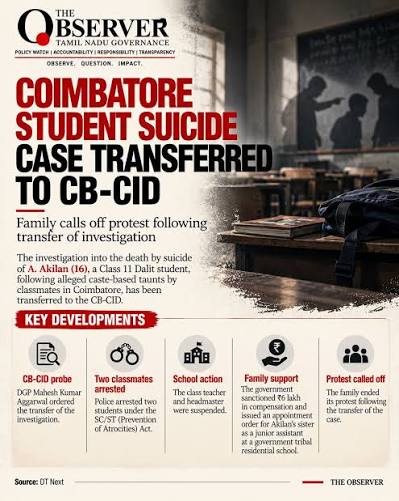
The Peelamedu police initially arrested two of his classmates under the SC/ST (Prevention of Atrocities) Act COIMBATORE: The CB-CID has commenced a probe into the death of A Akilan, a Dalit student who had ended his life over caste-based taunts from his classmates. The Peelamedu police initially arrested two of his classmates under the SC/ST (Prevention of Atrocities) Act. Akilan was in Class 11 at a government-aided school in Coimbatore. The class teacher and headmaster were suspended. The CB-CID registered a case and initiated a preliminary inquiry. A team led by SP Sri Devi questioned Akilan’s parents at their house regarding the circumstances of his death. The team also inspected the school and records of the Peelamedu police’s probe. The arrested students are likely to be questioned. Courtesy : DT Next Note: This news is originally published on https:/dtnext.com/bha and is used purely for non-profit/non-commercial purposes, especially human rights
Dalit Man Allegedly Killed by Wife’s Family in UP’s Muzaffarnagar Over Inter-Caste Marriage
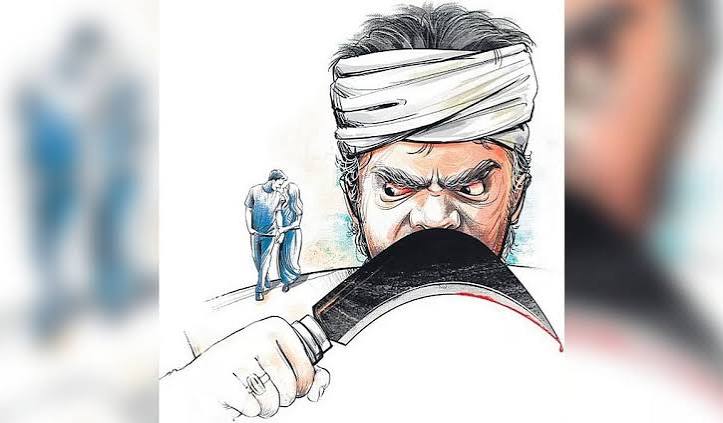
A 23-year-old Dalit man was allegedly beaten to death with bricks in Uttar Pradesh’s Muzaffarnagar, more than a year after he eloped with and married a woman against her family’s wishes. ExploreDiversity Akshay and his 20-year-old wife, Ridhima, had been living in Noida since their marriage. Akshay returned to Muzaffarnagar on Monday and was attacked that evening. He died in hospital on Tuesday. Police arrested two people on Wednesday in connection with the killing, including Ridhima’s elder brother, Vasu, said Dinesh Baghel, Station House Officer of Khatauli police station. Police suspect the murder was premeditated and are investigating whether several people were involved in planning the attack. Police Suspect Akshay’s Movements Were Shared With Attackers According to police, Akshay, a resident of Biharipur village, returned to Muzaffarnagar on Monday morning. Later that evening, he left home on his motorcycle with a man identified as Akash, telling his family that he was going to buy medicines. The two stopped at a shop on Jansath Road in the Khatauli area. Police said three masked men arrived on a motorcycle and confronted Akshay. One of them allegedly struck him with a brick, knocking him to the ground, before the attackers repeatedly hit him on the head with bricks. Akshay’s family alleged that he was left bleeding heavily as the assailants fled. Police suspect that Akash, who was with Akshay during the attack, shared information about his movements with the assailants. He is among those detained as investigators examine the circumstances leading up to the killing. Couple Had Moved to Noida After Marriage Akshay first met Ridhima while visiting his uncle, who lived in Sarai village, around six kilometres from his home. The two developed a relationship, but their families opposed it, according to the police account. About a year and a half ago, the couple eloped. Ridhima’s family subsequently filed a kidnapping complaint, police said. The couple later married in court and moved to Noida, where Akshay found work. A police officer said Ridhima’s family allegedly continued to resent Akshay despite the marriage and the couple’s move away from Muzaffarnagar. Courtesy : TOP Note: This news is originally published on https:/theobserverpost.com/bha and is used purely for non-profit/non-commercial purposes, especially human rights
A dead body on the road, a wooden pyre, and a six-hour traffic jam… Why did anger erupt after the death of a Dalit youth in Chhatarpur?
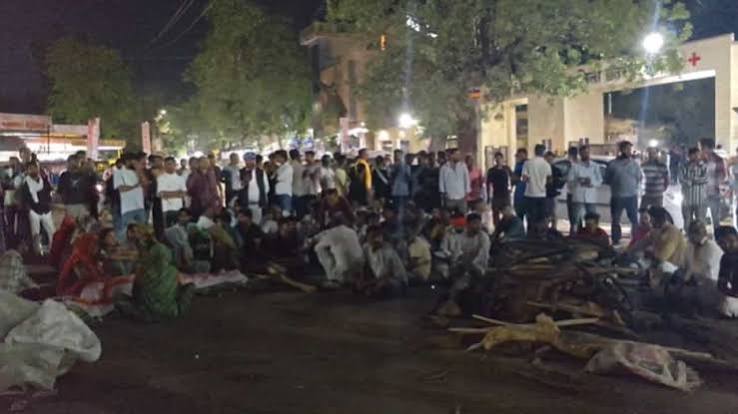
Following the death of a Dalit youth in Chhatarpur, his family members blocked the Tehsil intersection by placing his body there. The protesters created a pyre by placing wood on the road and demanded the arrest of the accused. Chhatarpur News: A massive uproar erupted in Naugaon town of Chhatarpur district after the death of a Dalit youth under suspicious circumstances. Angry family members and locals protested by placing his body at the Tehsil intersection on Wednesday evening. The protesters created a pyre by placing wood on the road and blocked the road. This disrupted traffic on the main road and caused long queues of vehicles on both sides. The traffic jam continued for more than six hours, causing inconvenience to the public. The family members of the deceased have accused some people of beating him and forcibly administering a poisonous substance to him. They demand that the accused be immediately arrested and a murder case be registered against them. There was a dispute over wages. The deceased has been identified as Dharampal Ahirwar. He was a resident of Naya Mohalla, Ward No. 18, Naugaon, and worked as a laborer in the local vegetable market. His wife, Usha Ahirwar, stated in a police complaint that a dispute arose on October 22, 2026, over wages. According to the complaint, when Dharampal asked Jitu, alias Jitendra Sahu, and his parents for his wages, they refused. It is alleged that Dharampal was subsequently assaulted with sticks and rods, sustaining serious injuries. Dharampal then went to the Naugaon police station and filed a complaint against the accused for assault. Allegations of Pressure to Withdraw the Case According to family members, after the assault case was filed, the accused party was pressuring Dharampal to reach a compromise. On October 27, Dharampal was called to a shop under the pretext of a discussion. There, he was asked to withdraw the case. The family claims that Dharampal refused to withdraw the case. He was then again abused and beaten. It is alleged that he was forcibly administered a poisonous substance during this time. Death during hospital treatment After being administered the poisonous substance, Dharampal’s health deteriorated. He was taken to the Naugaon Community Health Center in critical condition. Doctors there, finding his condition critical, referred him to the Chhatarpur District Hospital. Dharampal died while undergoing treatment at the district hospital on the night of October 27th. Upon receiving the news of his death, the family was plunged into mourning. Upon the arrival of his body in Naugaon, anger spread among the family and local residents. They launched a protest demanding strict action against the accused. Blockade at Tehsil Square On Wednesday evening, family members, residents of the neighborhood, and other members of the community arrived at the Tehsil Square with Dharampal’s body. They placed the body in the middle of the road and protested. The angry people also built a pyre by placing wood on the road. The protesters demanded the immediate arrest of the main accused, Jeetu Sahu, and his associates and the registration of a murder case. The traffic jam disrupted traffic on the Jhansi-Khajuraho route and other connecting roads. Long queues of vehicles caused significant inconvenience to pedestrians and other travelers. Given the seriousness of the situation, Naugaon police station and additional police force were deployed to the scene. Administrative and police officials continuously engaged with the protesting family members, attempting to pacify them. Officials assured a fair investigation and action based on available evidence. Further legal action was stated to be taken based on the post-mortem report and investigation findings. However, the family members remained adamant on their demand for immediate arrest and the registration of a murder case. Pawan Bidua | Edited By: Ashish Kumar Mishra | Pawan Bidua’s journalistic journey began in 2018 with V News Cable Network in Chhatarpur. He subsequently held consecutive positions as a district bureau chief for India News National and MP-CG. He covered the sensitive and risky reporting of the COVID period on the ground. Pawan Bidua completed his B.J.M.C. from Dr. Harisingh Gour University and his LLB from Pt. Motilal Nehru Law College. Courtesy: Hindi News
Man sentenced to life imprisonment for raping Dalit minor in Barabanki
Lucknow: A special Pocso court in Barabanki sentenced a man to life imprisonment for raping a 13-year-old Dalit girl who later became pregnant. The judgment was delivered on Wednesday, nearly five years and 11 months after the case was registered. Special Judge Pran Vijay Singh convicted Lallu alias Wasim, also imposing a fine of Rs 60,000 and directing that the full amount be paid to the survivor. According to the prosecution, the girl’s mother, a resident of a village under Asandra police station limits, filed a complaint on Nov 18, 2020. She alleged the assault occurred around 10 months earlier when her daughter had gone out to graze goats. The accused, a resident of the same village, allegedly raped the minor and threatened her into silence, preventing disclosure to family members. The case surfaced after the girl became pregnant. The prosecution said the accused later gave her medication to terminate the pregnancy. Her health reportedly worsened at home, after which the family came to know about the alleged assault. Police investigated the complaint and filed a charge sheetunder relevant provisions of the Protection of Children from Sexual Offences (Pocso) Act and the Scheduled Castes and Scheduled Tribes (Prevention of Atrocities) Act. During trial, the court recorded the victim’s statement and heard testimony from seven prosecution witnesses. After hearing both sides and examining evidence, the court held the accused guilty and ordered life imprisonment along with the compensation fine forame to the survivor. Courtesy : TOI Note: This news is originally published on https:/timesofindia.com/bha and is used purely for non-profit/non-commercial purposes, especially human rights