
NGO urges TN CM to take steps to end caste discrimination in churches, cemeteries
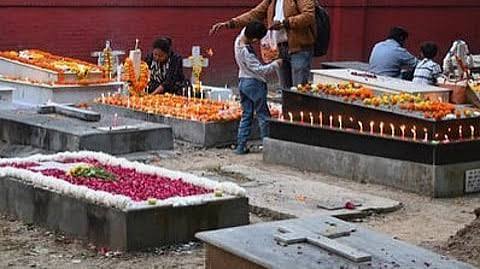
The NGO appealed to the Catholic church leadership to implement a uniform policy of common churches, cemeteries, and equal worship practices, irrespective of caste. MADURAI: Evidence, an NGO working for Dalit rights, urged Chief Minister C Joseph Vijay to ensure that there is no caste discrimination in churches, cemeteries, and other Christian places of worship in Tamil Nadu. It also appealed to the Catholic church leadership to implement a uniform policy of common churches, cemeteries, and equal worship practices, irrespective of caste. Evidence executive director A Kathir on Wednesday released its fact-finding report on the alleged denial of burial rights to Raju (89), a Dalit Christian, whose body was initially not allowed to be buried in the common cemetery at Thuraiyur in Tiruchy. He alleged that Kottappalayam in Thuraiyur continues to have separate churches and burial grounds for caste Christians and Dalit Christians. The Dalit Christian cemetery, measuring about 10 cents, has been in use for over a century and faces severe space constraints, while the common cemetery is much larger, around three acres, and better maintained. “A peace meeting chaired by the Musiri RDO Sushree Suvangi Khuntia on July 19 resulted in an agreement that Raju would be buried in the common cemetery. Officials also decided that funeral prayers should be conducted only at St. Sebastian’s Church in the Dalit Christian locality instead of the village’s St. Mary Magdalene Shrine, describing the arrangement as another instance of caste-based discrimination,” he pointed out. He also reiterated its demand that the state government urge the Union government to include Dalit Christians in the Scheduled Caste list, stating that the denial of constitutional benefits to Dalit Christians remains a longstanding issue. Courtesy : TNIE Note: This news is originally published on https:/thenewindianexpress.com/bha and is used purely for non-profit/non-commercial purposes, especially human rights
‘Are we not Hindus?’: Dalit priest in Rajasthan allegedly attacked twice in a year, sought help from Mohan Bhagwat

Balai told The Wire, “I donated 5,100 rupees for the Ram Temple, I used to attend RSS shakhas as a child, and during the RSS centenary celebrations, my family showered volunteers with flowers.” In May of this year, Vishnu Balai, a 40-year-old Dalit from Rajasthan’s Bhilwara district, wrote a letter to Rashtriya Swayamsevak Sangh (RSS) chief Mohan Bhagwat, seeking his help, alleging that anti-Dalit elements and some associated with the RSS had tried to prevent him from working as a priest at a temple in his village. According to The Wire, Balai wrote to Bhagwat in a letter, “You talk about the entire Hindu society and mutual brotherhood. You are against caste discrimination, and the Rashtriya Swayamsevak Sangh is running a campaign for ‘one well, one crematorium, one temple.’ Yet, RSS volunteers have snatched my temple from me—a Dalit priest.” He further said, “And now they want to implicate me and my family in false cases, send us to jail, and even kill us. Your volunteers are doing exactly the opposite of what you say.” ‘You are a low-caste man, we will make you drink dirty urine’ On July 16, Balai was allegedly attacked a second time near the Khakhul Dev temple while he was preparing for a puja. The FIR, lodged at the Asind police station on July 16 based on the complaint of Balai’s wife, Sita Devi, states, “…they came with weapons, iron rods, iron pipes, and sticks and illegally entered the Khakhul Dev temple. They told my husband, ‘You are a low caste man, we will make you drink dirty urine and throw you out of the temple.’” Balai says he was first taken to the Asind health center and then referred to the Bhilwara district hospital, where he was admitted for a day and discharged on July 17. Speaking to The Wire, Balai alleged, “I was assaulted and suffered injuries to my body and ear. This was the second time I was attacked. I was attacked on August 14th last year, and I filed an FIR. My family has been serving as priests at the Khakhul Dev Temple for the past 400 years. But some people in our village, patronized by Asind MLA Jabbar Singh Sankhla and affiliated with the RSS, want to remove me from the position of temple priest.” The FIR filed at the Asind police station on July 16th names six accused: Ramprasad Vaishnav, Govind Vaishnav, Bhagwan Lal Vaishnav, Ratan Lal Vaishnav, Sammu Jat, and Norat Vaishnav. A case has been registered against them under sections 189(2) (unlawful assembly), 115(2) (voluntarily causing hurt), 126(2) (wrongful restraint), and 352 (intentional insult with intent to provoke breach of the peace) of the Indian Penal Code (IPC) and relevant provisions of the Scheduled Castes and Scheduled Tribes (Prevention of Atrocities) Act, 1989. ‘They don’t want a Dalit as a priest’ Balai further stated that this is his second FIR in this matter. He added that the Rajasthan High Court had previously stayed the arrest of the accused in the FIR filed by Balai in August last year. Balai told The Wire, “They don’t want a Dalit to become a priest. The temple receives significant donations from devotees. The accused tried to create a trust and remove me from the priest’s position to seize the temple’s funds. I had previously sought help from Mohan Bhagwat. I donated 5,100 rupees for the Ram temple. I used to attend RSS shakhas as a child, and during the RSS centenary celebrations, my family showered flowers on volunteers. Am I not a Hindu? Am I being targeted just because I am a Dalit? Is this the Hindu unity the RSS talks about?” Officials said the case is still in court, so the government has appointed a receiver for the Khakhul Dev Temple. After Balai’s wife filed an FIR on July 16 regarding the alleged assault, the accused also filed a counter-FIR against Balai, alleging that he had attacked her. Bhilwara Superintendent of Police Sagar told The Wire, “Both parties have filed FIRs against each other, and the investigation is ongoing. We are also examining CCTV footage. Any decision on arrests will be taken only after further investigation.” Activists have criticized the Bharatiya Janata Party (BJP) government in Rajasthan over the incident. Activist Bhanwar Meghvanshi said, “If the case is in court and the government has appointed a receiver for the temple, how can a mob interfere and attack a Dalit man? What right do the villagers have to attack a Dalit priest? We demand strict action against the accused named in the FIR filed by Balai’s wife. Furthermore, the counter-FIR filed by the accused should also be quashed. This is an attempt to prevent a Dalit man from becoming a priest in the temple.” BJP MLA denies allegations When contacted, Jabbar Singh Sankhla, BJP MLA from Asind, denied the allegations made by Balai. Sankhla said, “About 90% of the people in Barana village are RSS supporters. Balai’s family has traditionally been the priest of the Khakhul Dev Ji temple. Some educated villagers felt that this is such a popular temple, where thousands of quintals of grain are offered and lakhs of rupees are received from donations, yet there has been no development there. Even toilets for women are not built. They asked Balai to build toilets to stop open defecation and ensure cleanliness, which led to this controversy.” Sankhla further said that the villagers formed a committee and decided that the money and grain received as offerings during religious rituals would belong to the priest, but a separate donation box (Daana Patra) was kept, the money from which would be used for the development of the temple. He said, “The controversy escalated when Balai refused to install a new donation box or hand over its keys to the villagers. The allegations against me are false, and it is completely wrong to say that Balai was targeted because he is a priest. There is no truth in this. Priests do not
Administration Removes Illegal Encroachment in Sahajanwa Chandbari: Dalit Leaseholders Regain Rights to Their Allotted Land After 30 Years
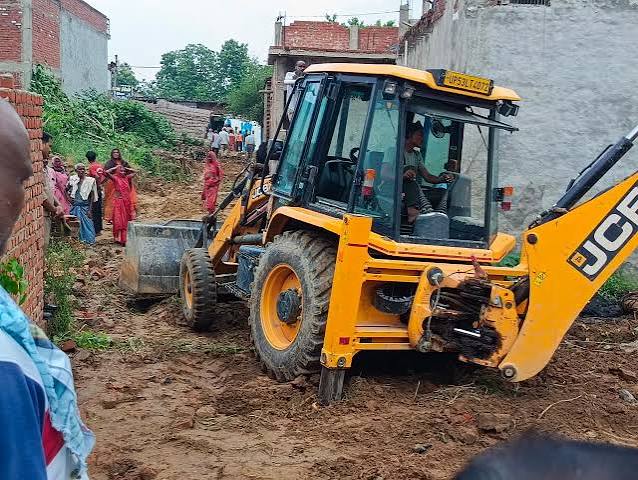
On Tuesday, the administration took major action in Chandbari Gram Panchayat, located in the Pali Block of Sahajanwa Tehsil in Gorakhpur district. A team from the Revenue Department removed years-old illegal encroachments from government land in Naveen Pariti. This action restored rights to Dalit leaseholders who had been waiting for their land for 30 years. The matter began with a complaint from Village Head Pradeep Srivastava. He submitted a written complaint to officials at the Sampoorna Samadhan Diwas. The complaint stated that in the 1990s, under a government scheme, Naveen Pariti land was allotted to poor Dalit families in the village for housing construction. However, it is alleged that in 1995, a villager illegally occupied this land. As a result, eligible families were deprived of their legitimate land and right to build homes for nearly three decades. The Sub-Divisional Magistrate (SDM) took the complaint seriously and ordered an immediate investigation and strict action. Following these instructions, a joint team of the Revenue Department and police, led by Tehsildar RK Kannaujiya, arrived in Chandbari village on Tuesday. The team thoroughly verified revenue records on the spot. Upon confirming illegal occupation, the illegal construction and encroachment were demolished with the help of a JCB. Several officers and employees, including Revenue Inspector Buddhiram Chaudhary, Law Officer Satish Tiwari, Accountant Sujit Dwivedi, Satendra Pratap, and Ashish Singh, were present during the operation. Vishnu Dutt Shukla | Sahajanwan Courtesy: Hindi News
Casteist attacks on CJP protesters flood social media, ‘General Category’ told to stay away
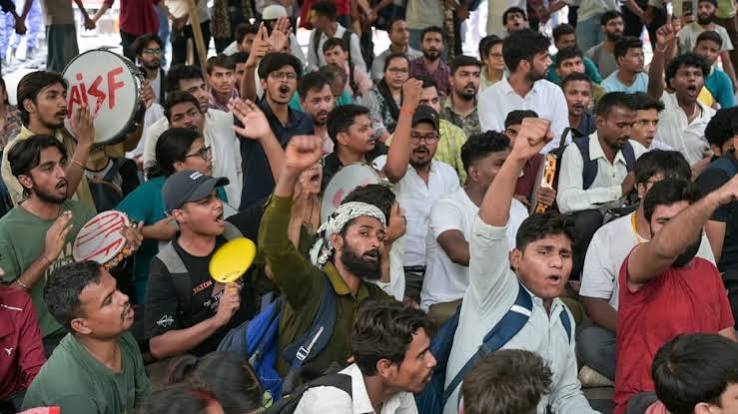
While several Right-wing accounts on X targeted the Jantar Mantar protesters with casteist slurs like ‘Bhimta’, many other users cried hoarse against the reservation system itself. New Delhi: A day after a protest march organised by the Cockroach Janta Party turned violent in Delhi, several accounts on X launched casteist attacks, claiming the demonstration was “rooted in Ambedkarism” and warning “general category people” to stay away from the party. On Monday, thousands of students took to the streets of Delhi against the NEET paper leak, and demanded the resignation of Union Education Minister Dharmendra Pradhan. In the afternoon, the protests turned violent, when the police lathi charged and shot tear gas shells at the protesting students. An account on X, with the username ‘Nyaksha’, wrote that the government and CJP is not on the “GC (general category)” side. “As for CJP, its core ideology is rooted in Ambedkarism, so it will always work against GC interests,” it wrote. Commenting on the tweets, Subhajit Naskar, a Dalit professor at Jadavpur University, said, “Two things are very difficult for the casteist campaigners against reservation and affirmative policies to digest. One, that the Cockroach Janata Party has been conceptualised by a Dalit young man. And second, that this movement is spreading across the youth, cutting across caste, privilege and age”. On the casteist remarks on X, Bhim Army chief Chandrashekhar Azad refused to comment, saying, “I don’t want to give importance to them”. ‘CJP protesters are Ambedkarites’ An X account, ‘Wokeflix’, with more than a lakh followers, called the protesters “Bhimtas”. The account posted a video on X claiming that there were “zero“ NEET aspirants in the protest. The post has about 1.6 lakh views and nearly 10 thousand likes. Another X account claimed, “It is a Universal Truth that where there are Ambedkarites, there is violence, unrest, and anti-national activities.“ Some accounts started claiming that most protesters were Dalit, just after the demonstration turned violent. An X account, ‘Alpakanya’, with nearly 30,000 followers, wrote, “‘Reservation was Ambedkar’s biggest mistake’ – she is stating pure facts, fully agree,” the account wrote alongside a video of an old lady talking about reservation. A protest spearheaded by a Dalit The Cockroach Janta Party led a street protest on 6 June in Delhi after Abhijeet Dipke came back from the US. A week later, since 13 June, they have been protesting at Delhi’s Jantar Mantar. “Abhijeet Dipke has been very clear that he is a Dalit and that he has high regard for Dr Ambedkar. They have consistently carried Dr Ambedkar’s image to assert that this is a constitutional and democratic protest–perhaps a more democratic response than what the government is giving,” said Naskar. Calling it an “organic movement”, Naskar said the movement has received support from influencers, actors, and politicians. “The response from these casteist accounts, under the garb of being anti-Modi or anti-government, is absolute hogwash. These are actually right-wing Brahminical accounts, but they are camouflaging themselves as people who simply want an equal society by removing reservation,” he said. Vaibhav Wankhede, a Dalit writer, told ThePrint that this is an attempt to reduce every public protest to “only Ambedkarites”. “[Asking] general category citizens to stay away is nothing but casteism dressed up as a political strategy. it only serves one purpose: to divide people who should be asking harder questions about unemployment, paper leaks, student suicides, shrinking opportunities, and the steady erosion of public institutions as an Ambedkarite,” Wankhede said. Dipke had also faced casteism on X after revealing his Dalit identity. Nikhil Sanjay-Rekha Adsule, a senior research scholar at IIT-Delhi and John Dewey Emerging Scholar, US, told ThePrint that such comments are made to “delegitimize the protest”. “It shifts the public debate away from state accountability and forces people back into their traditional social silos. It allows critics to dismiss an urgent, material crisis as a ‘fringe, motivated agenda’ rather than addressing the structural rot in our educational system,” he said. Manisha Mondal (Edited by Aamaan Alam Khan) Courtesy : The Print Note: This news is originally published on https:/theprint.com/bha and is used purely for non-profit/non-commercial purposes, especially human rights
Man gets life term for raping Dalit woman on false marriage promise in Vizag

Visakhapatnam: A court in Visakhapatnam has sentenced Ch Jagadeeswara Rao (32) to rigorous life imprisonment for raping a Dalit woman under the false pretext of marriage. The court also fined him Rs 2.5 lakh on the convict. The court also sentenced Ch Prabhavati to six months sentence and slapped a fine for insulting the victim woman on caste basis and the court also slapped a fine of Rs 10,000 on P Triveni, a relative of Jagadeeswara Rao, for threatening the victim woman over phone. The police said Jagadeeswara Rao repeatedly sexually assaulted the 22-year-old woman with false pretext of marriage. Based on the complaint, the MR Peta police registered a case in 2019 and arrested Rao. After regular trials, the court sentenced Rao and the government to pay Rs two lakh as compensation to the victim woman. TNN Courtesy : TOI Note: This news is originally published on https:/timesofindia.com/bha and is used purely for non-profit/non-commercial purposes, especially human rights
Welfare Minister consoles slain Dalit woman’s family, hands over ex gratia

Social Welfare Minister Adluri Laxman Kumar on Tuesday handed over a cheque for ₹4.12 lakh as ex gratia to the bereaved family of slain Dalit woman Karre Sunitha at Chintalapet village in Jagtial district. Sources said that Sunitha was allegedly murdered by an assailant in Metpalli a week ago. The Minister consoled the bereaved family and handed over the cheque to the victim’s grandmother. Her said the second instalment of the compensation would be released as per government norms. He assured the bereaved family of justice and stringent action against those responsible for the gruesome murder. The Minister said the government would take full responsibility for the education of Sunitha’s two sons. The Hindu Bureau Courtesy : The Hindu Note: This news is originally published on https:/thehindu.com/bha and is used purely for non-profit/non-commercial purposes, especially human rights
Meerut Dalit protest: Non-bailable charges against protesters dropped
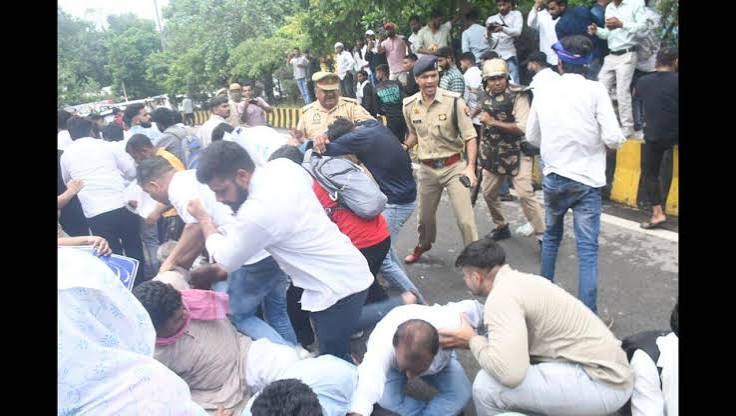
Meerut: Days after UP CM Yogi Adityanath met the family of murdered Dalit student Lalita Gautam, 20, in Ghaziabad on Saturday, police have now dropped serious, non-bailable charges against protesters arrested during the July 8 demonstrations in Meerut.The action came after several meetings between UP govt representatives and the family, which has been demanding justice for the dead student. Last week, the state govt sprang into action to contain the fallout of growing Dalit protests in the district by deputing Asim Arun, minister in charge of Meerut and former IPS officer and prominent Dalit face himself in the BJP, to “personally intervene” in the case. Advocate Anil Pradhan, representing the eight accused, said that it was the court that intervened directly. “The court of additional chief judicial magistrate found the charges frivolous and ordered their withdrawal from the FIR,” Pradhan said. Pradhan said legal steps are underway to hold the law enforcement officers accountable, stating his team is preparing a formal application to press charges against SSP Avinash Pandey “for thrashing protesters and physically assaulting a defense lawyer inside a police van”. A video of the SSP’s action drew condemnation across the political spectrum. Samajwadi Party chief Akhilesh Yadav and BSP chief Mayawati criticised the administration’s high-handedness. The authorities had then also barred prominent Dalit leaders, including Nagina MP Chandrashekhar Azad, from entering the city. Gautam, a final-year BA student, was allegedly abducted and murdered on May 15, and her body was recovered from a sugarcane field two days later. Police subsequently arrested her acquaintance, Ankush Kumar, alleging he murdered her after she refused a marriage proposal to protect her family’s honor. His brother, Ankit, and an associate, Adesh, were also named in that case. Outrage over the murder boiled over on July 8 when demonstrators blocked the Meerut Collectorate gate for nearly three hours, demanding Ankit’s immediate arrest. Clashes erupted after police launched a baton charge. Authorities claimed 11 police personnel were injured in the melee. Police then booked 63 protesters—13 named and 50 unidentified—under various BNS sections, including 109 (attempt to murder), which provides over seven years of imprisonment. Under Supreme Court guidelines, automatic arrests are generally prohibited for offenses carrying sentences of seven years or less—making the addition of severe non-bailable charges pivotal to keeping the protesters detained. Yogi had earlier directed that strict legal action be taken against every person involved in the crime and ordered action against any officer or personnel found negligent. Adityanath announced financial assistance of Rs 5 lakh from the CM’s discretionary fund, and directed officials to provide a house for the victim’s father and another eligible family member under the Mukhayamantri Awas Yojana. The CM also instructed officials to extend benefits under all eligible govt welfare schemes to the family. Courtesy : TOI Note: This news is originally published on https:/timesofindia.com/bha and is used purely for non-profit/non-commercial purposes, especially human rights
Karnataka to fill SC/ST backlog vacancies, says Dy CM Parameshwara

On some DSS leaders’ statements that the Dalit community is not benefiting from the five guarantee schemes, Dr Parameshwara said people from the community who are not receiving the benefits of the guarantees will be identified soon. BENGALURU: Karnataka Deputy Chief Minister G Parameshwara, who also holds the revenue portfolio, on Tuesday promised a delegation of Dalits that steps will be taken to fill backlog vacancies reserved for the SCs and STs in universities and other government departments soon. “Our government will fill 72,000 vacant posts in various departments. The SCs and STs will be recruited as per reservation. In addition, several posts reserved for various categories remain vacant. These backlog vacancies, including those in universities and some major departments, will be filled. The matter will be discussed with the chief minister,” he told reporters after meeting the delegation. Stating that the PTCL Act has been amended, Dr Parameshwara said provision D has been removed to facilitate transfer of land granted to Dalits to others. However, there are concerns that its implementation has been delayed. “I assured the delegation that the government will take an appropriate decision in this regard soon,” he added. On some DSS leaders’ statement that the Dalit community is not benefiting from the five guarantee schemes, Dr Parameshwara said people from the community, who are not receiving the benefits of the guarantees, will be identified soon. Steps will be taken to reach the benefits to them. On the demand to increase the post-matric scholarship of Rs 1,800 per student, he said it should be hiked to Rs 3,000. He promised that it will be revised after talks with the CM. This will be included in the next budget. Dr Parameshwara said the fees of SC/ST students studying abroad will be paid by the government. Neelavva Ningavva Harijan, member of the Indian squad that won the World Cup cricket for persons with disabilities last year, was living in a shed. The government provided her Rs 5 lakh last year. She will soon be allotted a residential site, he added. Dalit leaders Mavalli Shankar, Prof Indira Krishnappa, M Venkataswamy, Sridhar Kaliveera and Subbu Holeyar, Revenue Additional Chief Secretary Rajendra Kumar Kataria, Revenue Commissioner Meena Nagaraj, and Social Welfare Principal Secretary Mohan Raj were present. Courtesy : TNIE Note: This news is originally published on https:/thenewindianexpress.com/bha and is used purely for non-profit/non-commercial purposes, especially human rights
CM Yogi meets Lalita Gautam’s family, announces financial and other assistance

During his meeting with the victim’s family in Ghaziabad, CM Yogi assured financial assistance and a house each for the deceased’s father and uncle under the Chief Minister’s Housing Scheme. He also directed the family to receive priority benefits under the Ayushman Bharat Scheme, ration cards, and other eligible welfare schemes. The Chief Minister also assured the family of strictest legal action against the culprits. Ghaziabad. Chief Minister Yogi Adityanath met with the family of Lalita Gautam, a Dalit student from Meerut, at the PWD Guest House in Ghaziabad on Saturday, expressing his condolences and offering condolences. The Chief Minister announced immediate financial assistance of ₹5 lakh from the Chief Minister’s Discretionary Fund. During his meeting with the victim’s family in Ghaziabad, CM Yogi assured financial assistance and a house each for the deceased’s father and uncle under the Chief Minister’s Housing Scheme. CM Yogi has also directed that the family be given priority access to the benefits of the Ayushman Bharat Scheme, ration cards, and other eligible welfare schemes. Furthermore, the Chief Minister has assured the family of strict legal action against the culprits. After meeting the Chief Minister, the deceased’s father, Ved Prakash, and brother, Prashant, expressed confidence in receiving justice. They said that the Chief Minister listened to their plight with utmost patience and affection and assured them that not a single culprit involved in this heinous crime will be spared. They said that the meeting with the Chief Minister further strengthened the family’s confidence in receiving justice. Senior administrative and police officials, including Social Welfare Minister and Meerut District In-charge Minister Asim Arun, were present on the occasion. After the victims met with the Chief Minister and received financial and other support, the Samajwadi Party has now backtracked on this issue. The SP had been raising the issue repeatedly, and Akhilesh Yadav even met with the victim’s family in Lucknow. However, after CM Yogi’s meeting with the victim’s family and the family’s expression of satisfaction, there is hope that the politicizing of this matter will end. Courtesy: Hindi News
CasteWhy Should Readers Across the World Care About Dalit Literature?

This article is a lightly edited version of the introduction to Touchable/Untouchable: Dalit Literature from India in Translation, edited by K. Satyanarayana and S. Shankar. Touchable/Untouchable is a special issue of the journal Mānoa: A Pacific Journal of International Writing, and also a standalone volume published by University of Hawai`i Press. The volume can be accessed on Project Muse here and ordered here. The journal can be subscribed to here. Why should readers across the world care about Dalit literature? For one thing, contemporary Dalit literature is among the most interesting, the most vibrant, of literary enterprises currently underway in India. Contemporary Dalit literature has borne gripping witness to the centuries-old atrocious institution of exclusion and oppression known as caste – at the bottom of which Dalits are located as the most excluded – and broken invigorating new literary ground. For these reasons alone, the value of reading Dalit literature should be evident. Dalit literature deserves a global audience, which it has begun to receive in recent years. What does it mean to say Dalit works constitute a literature of witnessing? Not surprisingly – and here one might draw comparisons to slave narratives in the African American tradition – many early works of the contemporary boom in Dalit literature are testimonies, autobiographies and memoirs. These works can certainly be read as testifying to the oppressive conditions under which Dalits and other “lower castes” live. As Omprakash Valmiki, celebrated Dalit author of the Hindi-language Joothan, declared in the preface to his autobiography: “After a long period of procrastination, I started to write. Once again, I had to relive all those miseries, torments, neglects, admonitions. I suffered a deep mental anguish while writing this book. How terribly painful was this unraveling of my self, layer upon layer”. Excerpts from Tulsiram’s Hindi autobiography Murdaihya as well as Pradnya Daya Pawar’s poem, a kind of biography-in-verse of a famous Dalit folk singer, both of which appear in Touchable/Untouchable, provide fine examples of this kind of witnessing. On the other hand, literary critics have wondered whether the view of Dalit works as a literature of witnessing diminishes their aesthetic value. These critics have called their colleagues to account for having a unidimensional approach to Dalit literature – for essentially shoehorning Dalit works into a “witnessing” function. Because of the dangers of such shoehorning, it is important to recognise the many ways in which the literature produced by Dalits in the last 50 years challenges established literary conventions. For example, many Dalit writers eschew a high literary style, deliberately adopting in its place a vernacular/spoken one. The veteran Tamil writer Bama, an influence on the poet Sukirtharani, included in Touchable/Untouchable, is a case in point. Translator Lakshmi Holmstrom notes of her: “Bama is doing something completely new in using the demotic and the colloquial regularly…. She uses a Dalit style of language which overturns the decorum and aesthetics of received upper-class, upper-caste Tamil”. Linguistically as well as formally, Dalit writers challenge contemporary Indian literature, as Baburao Bagul’s essay in Touchable/Untouchable ruminating on the aesthetics of Dalit literature suggests. In the end, both when it bears witness and when it innovates, Dalit literature presents a human story of struggle as well as triumph in startlingly powerful ways. This struggle is vividly brought out in the excerpts included in Touchable/Untouchable from Bojja Tharakam’s Telugu novel narrating the lives of a family of Dalit bonded labourers across generations. Of course, the same human story of struggle is found in different ways in all the pieces included. These human stories are also deeply Indian, as much Indian as the more celebrated Indian writing in English, largely “upper caste,” well known to global readers. The picture of India in Dalit literature may very well be familiar to readers in some respects. In others, to readers not familiar with Dalit literature, it will certainly be startling, evocative, shocking, moving, and more. Origins of the term The term “Dalit literature” was coined in the first Dalit Literary Conference held in Mumbai (then Bombay) in 1958. Marathi Dalit writers created history by publishing several collections of poetry, short stories and autobiographical narratives and critical essays in the 1960s and 1970s. Poisoned Bread, a classic anthology of these writings in English translation, was published in 1992. Marathi Dalit literature was widely translated into several Indian languages and served as an inspiration to Dalit writers in other Indian languages. Contemporary Dalit literature emerged as a powerful literary movement in Kannada, Telugu, Tamil and Malayalam from the 1970s to the 1990s (see No Alphabet in Sight and Steel Nibs, co-edited by K. Satyanarayana). It became a pan Indian phenomenon with the rise of Dalit literatures in Hindi, Bengali and other Indian languages after the 1990s. Dalit literature in English translation acquired national and global visibility with the publication of autobiographies, novels, poetry and essays by mainstream publishers. Dalit literature is not simply a literary trend but a literary movement for social change. It describes and analyses Dalit life worlds and struggles based on first-hand lived experience. The distinctive term “Dalit” (literally “crushed down” or “broken”) is both identity and perspective. The Dalit Panthers, a group of insurgent intellectuals, popularized “Dalit” as a term to claim a dignified identity for “untouchables,” while rejecting demeaning caste/jati names. They used the term to broadly refer to “untouchable” caste groups, Adivasis (aka “tribals”), and other minorities. In the course of history, “Dalit” became synonymous with the “untouchable” (also known as “scheduled caste”) groups. Dalit critics theorised “Dalit” as a collective identity based on self-respect and human dignity. Dalit is a revolutionary term born out of anti-caste struggles and has shaped a Dalit perspective. In this sense, Dalit literature invents a canon and a normative Dalit character, and inaugurates a shift from the old understanding of caste as a feudal relic to a contemporary form of power. It contests the view that untouchability is a cultural practice based on religious notions of “purity” and “impurity” and suggests that untouchability is a