
Social Workers in Bulandshahr Arrange Marriage of Dalit Girl: Setting an Example of Humanity in Sunpeda Village of Kakod, Many People Present

In Sunpeda village of Kakod police station area in Bulandshahr, social workers have set an example of social unity by arranging the marriage of a Dalit girl according to Hindu rituals. According to the information, the girl belongs to a Dalit family. Her father, the late Indrapal Jatav, passed away several years ago. Her mother supports the family by working as a laborer, due to which the family’s financial condition was weak. Bearing the expenses of their daughter’s marriage was a major challenge for the family. When village social worker Sheel Pradhan learned of this situation, he immediately took the initiative. He organized his associates, including Rinku Bhati, Krishna Sharma, Krishna Mistry, Yogesh God, Jitendra, Shekhar Dabar, Kalua Bhati, and Sarjeet, to arrange the marriage. All the social workers together assured the family, saying, “She is not just your daughter, she is our daughter too. Her marriage will be celebrated with great pomp and show.” They then took full responsibility for the wedding and conducted the marriage according to Hindu rituals. This noble act is being widely appreciated in the area. Villagers say that the social workers not only supported a family but also gave a message of unity, humanity, and mutual cooperation to society. There is an atmosphere of joy in the village because of this initiative, and people are praising the social workers. Mohit Bhati Courtesy: Hindi News
Untouchable Goa by Dadu Mandrekar (1997) – A Review by Sampurna Dutta

Dadu Mandrekar’s Untouchable Goa (published in Marathi in 1997), rendered into English through Nikhil Baisane’s (published by Panther’s Paw Publication in 2025) layered and attentive translation, is a powerful sociological archive that exposes caste in a region often reduced to the postcard image of beaches and heritage-rich towns. Across eighteen essays that traverse the maharwadas of Goa’s villages, Mandrekar—writer, journalist, and Ambedkarite activist—constructs a counter-map of the state, highlighting some of its most invisibilised spaces. I approach Untouchable Goa through three interlinked pillars: the maharwadas as infrastructures of caste, death as a mechanism of Brahminical control, and superstition as a material and moral economy. Mandrekar maps the state’s maharwadas—Dalit settlements pushed to the village outskirts, often bordering forests or water bodies that swell dangerously during the monsoon, and typically beyond the reach of the state’s infrastructural gaze. He renders each dwelling an index of economic neglect and a site of endurance. Government housing schemes surface as 1,200–2,000-rupee grants intended to fund entire homes in contexts where installing a functional toilet alone might cost 10,000. In a rare instance, they appear as a failed experiment in socialist “uniformity”. Units are childishly conceived to erase caste boundaries. They are crumbling and ill-maintained, yet statistically “complete.” A passage from this chapter describes a tap installed in a tattered village; a lone functioning emblem of “development”- capturing this paradox with devastating precision. These homes, like their inhabitants, are barely built to survive, let alone live. Subsidies exist largely as bureaucratic data points, disbursed without provisions for repair or maintenance. The Dalits who inhabit maharwadas do not own the land it stands on, nor the land where they will one day be buried—an unbroken circle of dispossession that renders their bodies “owned” by Brahminism in living labour and in death. In the chapter “365 Devchaar”, Mandrekar visits a maharwada in Dhargal, where an old man narrates what begins as ancestral history but gradually reveals itself as myth. He speaks of devchaars, betaals, and a god who, aided by a man, banishes Vetal from his throne. When the protagonist, Pavne, receives water from a Mahar, he loses his caste. Pavne is rewarded with land for banishing Vetal, which, according to local lore, explains why some Mahars in Dhargal still nominally possess land. Mandrekar reads these mythic residues not as distortions of history but as evidence of how ownership itself is shaped by caste memory. He situates the story within a reality where, even when bahujans legally own land, they must still seek permission from the original Brahmin proprietors to build on it—a spiritual and social contract that lays bare the feudal motivations of Brahminism. If home marks the beginning of Mandrekar’s sociological map, death forms its moral and material core. In the second chapter, “Desecrating the Dead,” he examines a grotesque ritual of exhumation in which lower-caste men are bound to dig up graves and participate as drum-beaters in the procession. These bodies are then dismembered and paraded through the night before being discarded. Mandrekar analyses this hideous practice not as a cultural aberration, but as violence enforced through faith. The Brahminical logic of untouchability, Mandrekar observes, seeps even into mahar households. Among Dalits themselves, contact with a menstruating woman demands purification through gomutra, tulsi water, bathing, and changing clothes—rituals that are unmistakably Brahminical in form. The burden of humiliation trails bahujan women intimately. When menstruating or pregnant women die, their corpses are buried without ceremony, often in unmarked places, their faces turned groundwards to prevent them from returning as “vengeful spirits.” Mandrekar intuits an economic ‘fear’ behind this superstition: these rituals are meant to guard family wealth from women who, in death, might return to claim property once denied to them in life. Mandrekar expands the idea of ritual as a sociological archive, tracing the “traditions of death” where the humiliation and economic dispossession of Dalits are most visceral. He refuses to dismiss superstition as quaint or irrational, instead locating its persistence in material and political realities. Mandrekar observes that mahar traditions (whether deities or celebrations) are modest, symbolic, and exposed to the elements, much like Dalits themselves. But over time, these have been displaced by Brahminical practices such as angat yene and devdevski. Dalits must now spend heavily during Hindu festivals, sinking into cycles of never-ending debt. “They barely pay off one before another comes,” Mandrekar notes, showing that belief itself becomes a form of bondage. Superstition, Mandrekar shows, is also a survival strategy shaped by precarity. Dalits participate out of belief but also fear of persecution by upper-caste men and the consequences of stepping outside caste-bound occupations such as bamboo work, cleaning, or leatherwork. Mandrekar notes that their modest homes are sometimes targeted for demolition under the rhetoric of modernisation, mirroring the contemporary demolition of Muslim neighbourhoods across India. Untouchable Goa is a vital ethnographic companion to recent scholarship on caste in Goa by Parag Parabo (2023), Kaustubh Naik (2017), and Jason K. Fernandes (2020). Parabo’s 2023 work, which distinguishes between the Old and New Conquests, analyses the latter as being aligned with Brahminical consolidation following a period of colonial Christian influence—a process that Mandrekar charts through his fieldwork. While Portuguese colonisation itself remains largely absent in Mandrekar’s account, his ethnography provides a rich archive that complements studies of Goan temple politics, landholdings under colonial regimes, and the intersection of Christianity and Brahminism in defining the asprushya or untouchable, as explored by Parabo and Fernandes. Mandrekar specifically documents the everyday realities of home, ritual, and death in post-independence Goa, when Brahminical consolidation became increasingly visible. Untouchable Goa transforms accounts of caste abuse into evidence, offering a necessary corrective to Goa’s sanitised public image and an essential resource for students of the political economy of caste in the region. The Deras: Culture, Diversity and Politics by Santosh K. Singh (2025): A Review by Neha Sharma Courtesy : Doing Sociology Note: This news is originally published on https:/doingsociology.com/bha and is used purely for non-profit/non-commercial purposes, especially human rights
Principal beats Dalit student with a bat in Raebareli, child seriously injured with a head injury, allegations of caste discrimination also made

UP News: In Raebareli, the principal of Raghavpur Primary School attacked a Class 1 student, Hrithik, on the head with a cricket bat, causing a severe head injury. Madhav Singh, Raebareli: A serious incident occurred on Tuesday afternoon at Raghavpur Primary School in the Bachhrawan police station area of Raebareli, Uttar Pradesh, involving 6-7-year-old Hrithik, son of Ram Baran, a student of Class 1. It is alleged that the school principal struck the student on the head with a cricket bat over some issue. The blow was so forceful that the child’s head was split open and he started bleeding profusely. Injured student taken to the hospital Immediately after the incident, the student was taken to the hospital in a serious condition for treatment. Upon learning of the incident, the family and villagers became enraged. Family and villagers express outrage The family informed the police by calling 112. The villagers alleged that not only are children subjected to physical abuse, but also untouchability and caste discrimination. In protest, the villagers surrounded the school and demanded action against the principal. Police registered a case The police arrived at the scene, calmed the situation, and asked the family to file a complaint at the police station. On Wednesday, the family filed a complaint at the police station, seeking justice. Edited by: Devesh Pandey About the author Devesh Pandey is a consultant at Navbharat Times Online. He has 8 years of experience working in TV channels and digital media. He has experience and interest in politics and sports. He covered several IPL matches and the World Cup 2023 in Lucknow. Courtesy: Hindi News
J&K’s Valmiki Community Added to Scheduled Caste List, Union Govt Informs Parliament

Jammu and Kashmir’s Valmiki community has now been officially added to the Scheduled Caste list, the Union Ministry of Social Justice and Empowerment told Parliament on Wednesday. The announcement was made in a written reply in the Rajya Sabha while listing caste inclusion proposals processed in recent years. Minister of State Ramdas Athawale said that Jammu and Kashmir had sent two proposals in the past four years. One of them, related to the Phalahre community, was sent back to the administration because the Registrar General of India wanted more justification. But the proposal for including the Valmiki community had already been approved. “The Valmiki community has now been added to the Scheduled Caste list,” he said. Athawale explained that State and Union Territory governments regularly submit requests to include or remove communities from the Scheduled Caste list. These proposals are examined under fixed rules and must be cleared by both the Registrar General of India and the National Commission for Scheduled Castes. “Only after both bodies agree can the government begin the legal process under Article 341(2),” he said. He placed data before the House showing that several States have sent similar proposals in the last four years. He noted that each request is examined using demographic information and historical records. “All proposals have been processed according to the laid-down procedures, and the government continues to review the submissions,” Athawale said. Courtesy : TOP Note: This news is originally published on https:/theobserverpost.com/bha and is used purely for non-profit/non-commercial purposes, especially human rights
MP Man Alleges Social Boycott for Eating at Dalit Home; Inquiry Ordered

A man in Madhya Pradesh’s Raisen district has alleged that his village panchayat ordered a social boycott against him and his family after he ate at a Dalit household during a post-death ritual. The incident, which occurred about a month ago in Piparia Puaria village of Udaypura, came to light during a public hearing on Tuesday, prompting officials to initiate an inquiry. According to the complaint, the panchayat reportedly declared a boycott of three upper-caste men for sharing a meal at a Dalit family’s home. It allegedly imposed conditions to avoid ostracism, including organising a village feast. Two of the men agreed, but the third, Bharat Singh Dhakad, refused and instead reported the matter to police. Dhakad said he and his family were being treated as “untouchables” and excluded from community functions. Udaypura tehsildar Dinesh Bargale confirmed that Dhakad has accused the sarpanch, deputy sarpanch, and other panchayat members of passing the boycott order. He said the matter is under investigation and that legal action will be taken if the claims are found true. Courtesy : TOP Note: This news is originally published on https:/theobserverpost.com/bha and is used purely for non-profit/non-commercial purposes, especially human rights
Uttar Pradesh: Seven people barged into a Dalit’s house and attacked them with weapons after an argument; two accused arrested

Uttar Pradesh News: A serious attack has been reported from Mau district of Uttar Pradesh. Late Sunday night, seven people stormed into a house in the Mauaima area. The attackers entered the house armed with sharp weapons and sticks. They launched a deadly attack on two people in the house, leaving them seriously injured. The incident took place at the house of Kalawati Devi, a resident of Katra Dayaram Panpati Chauraha. The attackers targeted her brother-in-law Jiyalal and her husband’s elder brother Ramabhilash. The attack was so brutal that both were left covered in blood. The victim’s family alleges that the attackers were hurling abuses and also threatening to kill them. Villagers apprehended two attackers Hearing the commotion during the attack, villagers from the surrounding area rushed to the scene. Seeing the villagers approaching, the attackers started to flee. They left their bikes and scooters behind. While fleeing, the villagers managed to catch two of the attackers. The remaining five accused managed to escape. The villagers handed over the apprehended accused to the police. The two arrested accused have been identified as Shiva DJ and Rajaram. The police immediately arrested both of them. The arrested accused were produced in court on Tuesday. The court has sent both of them to judicial custody. The police are now searching for the remaining attackers. The injured were admitted to the hospital Jiyalal and Ram Abhilash, who were seriously injured in the attack, were immediately taken for treatment. They have been admitted to SRN Hospital. According to hospital sources, both are still in critical condition. The police have started an investigation into the incident and action is being taken against all the accused in the case. The victim, Kalawati Devi, has filed a complaint at the Mauaima police station. The complaint names seven people, including Vikas Kumar, Rajaram, and Shiva DJ. The complaint includes charges of attempted murder as well as other serious allegations. The police have registered a case on this basis. Case registered under the SC/ST Act The police have also applied the provisions of the SC/ST Act in this incident. This law provides protection to the weaker sections of society. Cases registered under this act are dealt with promptly. The police say they are trying to arrest all the accused as soon as possible. Local people are shocked by this incident. They say that such incidents are a challenge to law and order. The police administration has taken cognizance of the matter and taken swift action. Now the focus is on the arrest of the remaining accused. Police teams are searching for them. Courtesy: Hindi News
Khandwa Incident: Salman Blackmailed and Repeatedly Raped Dalit Woman; Victim Also Alleges Pressure to Convert Religion

Madhya Pradesh News: A shocking case has come to light in Khandwa, Madhya Pradesh. A Dalit woman has accused a young man named Salman of trapping her by using a Hindu name and then blackmailing and repeatedly raping her. The accused is also charged with attempting to forcibly convert the woman’s religion and having ill intentions towards her minor daughter. The victim has filed a complaint with the police. She stated that the accused, Salman, befriended her by introducing himself as Sanjay. Later, he took her pictures from social media and edited them into obscene images. He then started blackmailing the woman by threatening to make these edited pictures go viral. Through this blackmail, the accused repeatedly raped the victim. The woman alleged that Salman pressured her to convert her religion. He also threatened her and forced her to be raped by his brother-in-law, Shahrukh. This continued for a long time. Accused also had ill intentions towards the woman’s daughter The victim told the police that the accused Salman would often enter her house. He also had his eyes on the woman’s minor daughter. The accused attempted to sexually assault the girl as well. This is why the woman finally filed a police complaint. The victim’s family was initially silent due to fear of social stigma. The victim’s husband told the police that the accused demanded money. They even had to take out a loan to pay the accused. In total, the family paid up to two and a half lakh rupees. Friendship began during a bus journey Police investigation revealed that the victim previously lived in Piplod. She commuted to the city daily by bus. During this time, the accused Salman contacted her. Salman worked as an agent on the bus. He obtained the woman’s mobile number and started talking to her. Gradually, he targeted the woman. He introduced himself with a false Hindu name. After gaining her trust, he found the woman’s pictures on social media. Then he edited those pictures and made them obscene. Case registered under serious sections Police have arrested the accused, Salman. CSP Abhinav Barange said that a case has been registered against Salman, a resident of Singot, under serious sections. He has been charged with rape. A case has also been registered under the Religious Freedom Act 2021. Sections of the SC-ST Act have also been applied against the accused. Police said that currently, the complaint is only against Salman. A thorough investigation of the case is underway. Other potential accused are also being investigated. The police investigation revealed that the accused first pretended to befriend the woman to trap her. Then he resorted to blackmail. In this entire incident, he tried to take advantage of the woman’s religion and social status. The case falls under the jurisdiction of the local Padam Nagar police station. Police have started questioning the accused. Further action will be taken based on the victim’s statement and evidence. This case has become a topic of discussion in the state. Courtesy: Hindi News
False Case: Dalit Woman Filed Fake Rape and SC-ST Act Charges After Relationship Ended, Court Sends Victim to Jail

Uttar Pradesh News: A court in Lucknow has delivered a shocking verdict. A Dalit woman had falsely accused a man of rape and under the SC-ST Act. The court has now sentenced the woman herself to three years in prison. The court termed it a conspiracy to misuse the law. A woman named Rinki had leveled allegations against a young man named Deepak Gupta. In her complaint, she alleged that Deepak had established physical relations with her on the pretext of marriage. Later, Deepak married someone else. Based on this, Rinki filed a case under the charges of rape and the SC-ST Act. The Innocent Man Became the Accused After this complaint, Deepak Gupta’s life changed completely. He had to go to jail. His family was on the verge of breaking apart. He was humiliated in society. Deepak, a resident of Mohanlalganj, had been in a relationship with Rinki for five years. These sudden allegations were nothing short of a shock for him. But the court hearing turned the whole case around. The investigation revealed that Rinki’s allegations were false. She had fabricated the case against Deepak out of revenge. The news of Deepak’s marriage had emotionally distraught Rinki. Complainant’s Statements Contradicted During Investigation After the case came to light, an investigation was launched. Rinki’s own statements created confusion. She flatly refused to undergo a medical examination. When the court summoned her, she got entangled in her own statements. Several inconsistencies emerged in her statements. The biggest revelation came when it was discovered that on the date Rinki cited for the alleged rape, Deepak was not even there. Deepak was somewhere else on the date of the alleged incident. This made it clear that the incident had not happened at all. Court Pronounces Sentence The judge of the special court under the SC-ST Act sentenced Rinki. She received a sentence of three years of rigorous imprisonment. A fine of thirty thousand rupees was also imposed. The court ordered that half of the fine amount be given to Deepak Gupta as compensation. Special Public Prosecutor Arvind Mishra said that the court considered it a conspiracy. The court said that Rinki deliberately tried to send Deepak to jail. She misused the law. If she received any government assistance in this case, it will be withdrawn. Police investigation had also started The police had also started an investigation in the case. The then ACP Rajneesh Verma was preparing the charge sheet. Before that, the court took cognizance of the matter. All the facts came to light during the court’s investigation. This also clarified the direction of the police investigation. After the case came to light, discussions intensified at the local level. People have expressed concern over the misuse of the law. This decision has come as a ray of hope for those who are falsely implicated in cases. This case has been recorded as an example in legal history. Courtesy: Hindi News
Professors arrested for sexually harassing Dalit student in Andhra; protest rages
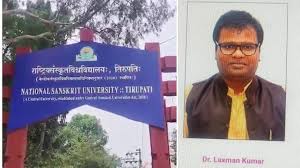
A serious allegation of sexual exploitation at National Sanskrit University in Tirupati has triggered widespread protests and demands for justice. The case involves a Dalit B.Ed student accusing two assistant professors of harassment and coercion. A case of alleged sexual harassment has come to light at the National Sanskrit University in Andhra Pradesh’s Tirupati, after a first-year B.Ed Dalit student accused two assistant professors, Laxman Kumar and Shekhar Reddy, of sexually harassing her. The incident has sparked widespread outrage on campus, with student unions staging demonstrations demanding immediate suspension of the accused, strict legal action, and stronger safeguards for women on university premises. Acting on a formal complaint filed by the university’s in-charge registrar, the Tirupati West Police registered a case and arrested the accused faculty members, Assistant Professors Laxman Kumar and Shekhar Reddy. Investigators have seized two mobile phones from the accused and sent them for forensic analysis to verify claims of harassment, blackmail, and coercion. YSRCP MP Maddila Gurumoorthy has written to the National Commission for Women (NCW), Union Education Minister Dharmendra Pradhan, and the National Human Rights Commission, urging urgent intervention in the case. In his letters dated December 7, 2025, the MP cited the survivor’s multiple written complaints to university authorities, saying that Dr Laxman Kumar coerced the student using personal photographs and videos, threatened to misuse her images, inflicted severe mental trauma, forcing her to discontinue her studies and subjected her to continuous psychological harassment and intimidation. The MP also called for a fair, transparent, and time-bound investigation, focusing that the safety and dignity of the survivor must be the top priority. He also demanded counselling support, protection for the victim, and swift action against those responsible. “The conduct of the accused demonstrates an alarming abuse of authority, exploiting his position as a faculty member to exert undue influence and cause long-lasting emotional harm,” Gurumoorthy wrote. He further stressed that universities must remain safe spaces for learning and not become centers of fear. Apoorva Jayachandran Courtesy : India Today Note: This news is originally published on https:/indiatoday.com/bha and is used purely for non-profit/non-commercial purposes, especially human rights
Strange Decree: Panchayat bans young man’s social interaction for eating at a Dalit’s house, issues bizarre decree for purification

Raisen Panchayat Strange Decree: Bharat Raj Dhakad, a resident of Pipliya Puaria village, committed the “crime” of eating food at a Dalit family’s house. A video of him eating at the Dalit’s house went viral. The panchayat learned about it and socially boycotted the young man. Untouchability: In Raisen district, a panchayat has banned a young man’s social interaction for eating at a Dalit’s house. This decree issued by the panchayat regarding untouchability in the age of Digital India has become a topic of discussion. This shocking decree was issued by the panchayat of Udaipura, the constituency of Minister of State (Independent Charge) Narendra Shivaji Patel. Bharat Raj Dhakad, a resident of Pipliya Puaria village, committed the “crime” of eating food at a Dalit family’s house. A video of him eating at the Dalit’s house went viral. The panchayat learned about it and socially boycotted the young man. Panchayat orders young man to host a feast for the entire village for ‘purification’ According to the report, the panchayat has banned Bharat Raj Dhakad’s family from social interaction for eating at a Dalit’s house and has ordered him to perform a Ganga Jal puja (ritual with Ganges water) and host a feast for the entire village for ‘purification’. Interestingly, the regional MLA and Minister Narendra Shivaji Patel had given a message of harmony by eating at a Dalit family’s house a few days ago. Victim reaches District Collector’s office against the panchayat’s decree The victim reached the District Collector’s office against the panchayat’s bizarre decree. Bharat Raj Dhakad, a worker of the Rashtriya Swayamsevak Sangh, narrated his ordeal to Collector Arun Kumar Vishwakarma. The Collector objected to the panchayat’s decisions and said that social evils will not be tolerated at any cost. Interestingly, the regional MLA and Minister Narendra Shivaji Patel had given a message of harmony by eating at a Dalit family’s house a few days ago. The village council, which had ordered a social boycott of the young man, also decreed that he undergo a purification ritual with Ganges water and host a feast for the entire village. Society is still unable to break free from the shackles of casteism and untouchability. It is noteworthy that arrests have been made in similar cases in the past, but society is still unable to break free from the shackles of casteism and untouchability. The question is, are we truly living in the 21st century? Has society still not been able to move beyond feudal thinking even after decades? Courtesy: Hindi News