
‘Forced to Beg, Beaten with Sticks’: Dalit Student Attacked Near Hostel in Gujarat’s Mehsana
Dalit Student Beaten Near Hostel in Gujarat’s Mehsana An incident of alleged caste-based violence has been reported from Mehsana in north Gujarat, an area known as an educational hub. A Dalit student living in the hostel of a BBA BCA college was allegedly assaulted by four men following a minor argument. News subscription service The victim, who is originally from Porbandar and currently studying in Mehsana, said the incident began with a small verbal altercation on February 3 inside the hostel. He alleged that a fellow hostel resident, Mitesh Purohit, abused him during a casual exchange. When the student objected to the abuse, Mitesh allegedly threatened him with consequences the next day. According to the complaint, on the morning of February 4, when the student was leaving for college, Mitesh Purohit and three of his friends stopped him near a Hanuman temple close to the hostel. The accused allegedly pressured the student to fall at their feet and apologise. When he refused, they allegedly used caste-based slurs and assaulted him with wooden sticks and belts. “Their words were more painful than the beating. They abused me using my caste name and tried to humiliate me by forcing me to beg for forgiveness,” the victim told the police. The student suffered serious injuries in the attack. He first took primary treatment at a university hospital but was later shifted to Mehsana Civil Hospital by ambulance after his condition worsened. The victim later approached the Mehsana A Division police station along with his mother and filed a formal complaint. Police have registered a case under the Atrocities Act along with sections related to assault and criminal intimidation. Efforts are underway to trace and arrest the accused, who are currently absconding. A police official said, “A case has been registered under the SC ST Atrocities Act and other relevant sections. We are conducting raids to locate the accused.” The college administration has also taken action following the incident. Vice Principal V K Patel said the main accused student has been suspended from the hostel with immediate effect. “Considering the seriousness of the matter, the college committee has taken strict action. Further disciplinary steps will be decided after internal review,” he said. Courtesy : TOP Note: This news is originally published on https:/theobserverpost.com/bha and is used purely for non-profit/non-commercial purposes, especially human rights
Dalit woman alleges rape in Inayatnagar: Exploited for six months on the pretext of getting a job, case registered
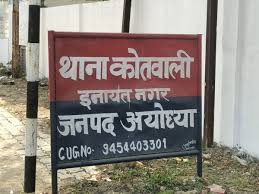
A Dalit woman from a village in the Inayatnagar police station area has accused a young man of rape, prolonged exploitation, assault, and death threats on the pretext of getting her a job. Based on the victim’s complaint, the police have registered a case against the accused under various sections and have started an investigation. In her complaint to the police, the victim stated that about six months ago, Ram Avtar, a resident of Mukimpur village, promised to get her a job. On this pretext, he took her to his house, where he allegedly drugged her and raped her. The woman alleges that the accused threatened to defame her by making the pictures of the incident public, due to which she continued to be exploited for six months. According to the victim, on Wednesday, the accused again called her to his room and tried to force her into an illegal relationship. When the woman resisted, the accused abused her with casteist slurs, brutally assaulted her, and threatened to kill her. Due to fear, the victim did not inform her husband about the incident at that time. The woman later reached the Inayatnagar police station and filed a complaint. Considering the seriousness of the matter, the police have registered a case against the accused under sections related to rape, assault, threats, and the Scheduled Castes and Scheduled Tribes (Prevention of Atrocities) Act, among other relevant sections. In this regard, Inayatnagar Station House Officer Ratan Kumar Sharma said that a case has been registered based on the victim’s complaint. The matter is being investigated thoroughly, and further legal action will be taken based on the evidence. Shiv Kumar Pandey | Milkipur Courtesy: Hindi News
Liquor shops around Dalit bastis are not a coincidence. It’s trauma seeking an outlet
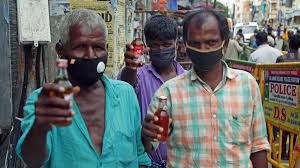
Markets follow vulnerability and the state taxes the bottle, while condemning the drinker. I’m not an F-up,” she always says. But little did Apurva know, it takes more than having a stable job to shake that label. She started smoking weed while studying at IIT-Kanpur. It quickly spiralled into owning a bong, grinders, rolling paper, and knowing how to score in every city—this 420 fascination became a lifestyle. Having no father figure and an emotionally absent mom, this neo-Buddhist Dalit girl slowly turned into a self-proclaimed “girl who likes to smoke up”. A one-dimensional personality. Across societies, substance abuse has long followed the fault lines of oppression. Native American communities in the United States struggle with alcoholism rooted in dispossession and cultural erasure. African Americans face higher rates of drug criminalisation and addiction shaped by slavery, segregation and systemic racism. These patterns are now widely understood as outcomes of historical trauma, not individual weakness. India, however, remains reluctant to apply the same lens to caste. When Dalits drink, smoke, or spiral into addiction, the dominant explanation is moral failure. Rarely do we ask what centuries of humiliation, violence and exclusion do to the human psyche and body over generations. Data already tells us what public discourse refuses to admit. National surveys consistently show that alcohol and tobacco use are higher among Scheduled Castes than among upper-caste groups. The National Family Health Survey (NFHS-5) records a higher prevalence of alcohol consumption among Scheduled Caste and Scheduled Tribe men compared to forward castes, a pattern mirrored in tobacco use among both men and women. Maharashtra, often projected as a progressive state, is no exception. Studies by Oxfam and state public health departments show disproportionate substance dependence in Dalit-dominated rural belts and urban slums, particularly among men engaged in informal, hazardous labour. Yet numbers alone do not explain why these patterns persist across generations. To understand this, one must confront inter-generational trauma—a concept still treated with suspicion in India, as if acknowledging psychological inheritance weakens personal responsibility. Trauma does not vanish with time; it embeds itself. When a community lives for centuries under graded inequality, is denied dignity, pushed into stigmatised labour, subjected to routine violence, and told repeatedly that they are less than human, the stress response becomes chronic. Cortisol levels remain elevated. Anxiety becomes an inherited behaviour. Silence becomes survival. Substance use, then, is not indulgence; it is regulation. In Maharashtra, the geography of addiction often overlaps with the geography of caste. Sugarcane cutters, sanitation workers, tannery labourers, construction hands, many from Dalit communities, operate in physically brutal environments with little job security and no mental health support. Alcohol becomes a painkiller, antidepressant, and social glue. Country liquor shops cluster around labour camps and Dalit bastis not by coincidence, but because markets follow vulnerability. The state taxes the bottle, while condemning the drinker. Moralising language, invisible struggle What makes caste trauma distinct from other forms of deprivation is its inescapability. Poverty can change; caste sticks. A Dalit child may grow up watching a parent humiliated at work, addressed by caste name, or denied basic respect. These experiences shape self-perception long before adulthood. Research in social neuroscience increasingly shows that chronic social stress alters neural pathways related to impulse control and reward. Addiction, in this sense, is not merely learned behaviour; it is embodied memory. Mental healthcare systems in India are neither equipped nor inclined to recognise this. Public de-addiction programmes focus on abstinence without addressing the cause. Counselling frameworks imported from Western psychology speak of “individual triggers”, while ignoring structural violence. For a Dalit man in a Maharashtra village, therapy that refuses to name caste is not neutral; it is erasure. As one Dalit rights activist from Marathwada puts it, “You cannot heal a wound while pretending the knife does not exist.” Women in Dalit communities carry a different, quieter burden. NFHS data shows lower alcohol consumption among Dalit women compared to men, but significantly higher tobacco use than upper-caste women. Chewing tobacco becomes a socially permissible coping mechanism in lives defined by unpaid labour, domestic violence, and economic precarity. Yet policy discourse rarely recognises this as addiction at all. Dalit women’s suffering is normalised to the point of invisibility. The moralising language around addiction also does real damage. When substance use is framed as a lack of willpower, the solution offered is punishment or shame. Families internalise blame. Communities fragment. Meanwhile, the structural conditions remain untouched. Contrast this with how addiction among urban, upper-caste youth is discussed—as stress, burnout, or existential crisis. Same substance. Different sympathy. There is also an uncomfortable political economy at work. The Indian state profits enormously from alcohol revenue, much of it extracted from marginalised communities. In Maharashtra, excise duty constitutes a significant portion of state income, even as alcoholism devastates Dalit households. Welfare schemes address the symptoms ie. hospitalisation, malnutrition, domestic violence, but never the root. It is easier to police bodies than to dismantle caste. Not a personal vice Breaking this cycle requires a shift from moral judgement to public health and social justice. Trauma-informed policy must recognise caste as a determinant of mental health. De-addiction programmes need to be community-based, culturally grounded, and explicitly caste-aware. Mental health workers must be trained to understand how humiliation, exclusion and inherited stigma shape behaviour. Employment, dignity, and psychological safety are as essential to recovery as sobriety. Most importantly, India must abandon the convenient fiction that caste no longer matters. Addiction in Dalit communities is not a personal collapse; it is a social indictment. It reflects what happens when a civilisation normalises inequality for centuries and then feigns surprise at its consequences. Until caste oppression is addressed as a lived, embodied trauma and not a historical footnote, the bottle will remain both refuge and ruin. Apurva has attended vipassana meditation course twice, even helping as a server. But addiction is hard to shake off when it becomes a personality trait and an escape mechanism. India likes to speak of addiction as a personal vice because that
Dalit teenage girl kidnapped in Ayodhya: Went missing from a wedding ceremony, accused arrested, case registered under POCSO Act

A case of kidnapping and rape of a Dalit teenage girl has come to light in the Inayat Nagar police station area of Ayodhya. The girl had gone to attend a wedding ceremony at a relative’s house, from where she suddenly went missing. Upon receiving the information, the police initiated action and arrested the accused young man within 24 hours and sent him to jail. Went missing late at night: According to the information, the teenage girl had gone to attend a wedding. Late at night, she disappeared under suspicious circumstances. The family members searched extensively in the surrounding area, but found no trace. They then informed the local police. Clue from the girl who accompanied her: The police, who arrived at the scene, questioned the girl who had accompanied the victim to the restroom. The girl said that a young man known to her came there and took the victim with him. Following this, the police intensified the search with the help of surveillance. Recovery and medical examination: The police recovered the accused along with the girl within 24 hours. The victim underwent a medical examination, and her statement was recorded in court. Further action was taken based on the report and statements. Case registered under POCSO and SC/ST Act: Police area officer Ajay Kumar Singh said that based on the complaint from the family members, a case has been registered against the accused under several sections, including rape, POCSO Act, and SC/ST Act. The accused was produced before the court and sent to jail. Vijay Pathak | Ayodhya Courtesy: Hindi News
Allegations of betrayal against a young woman in Khutar: After living together for 4 years, the young man refused to accept her

A case of betrayal against a Dalit woman has come to light from a village in the Khutar area of Shahjahanpur. The woman alleges that after living together for four years, the young man has refused to accept her as his wife. The victim says that four years ago, she was married to a young man from the same village in a temple. After that, they were living together as husband and wife. The woman trusted the young man and spent her life with him. The woman alleges that the young man, along with his family, is now flatly refusing to accept her. She said that he maintained a relationship with her for years on the promise of marriage, and now he has left her helpless. Distraught by this incident, the victim reached the Khutar police station. She has filed a complaint against the young man and his family, demanding action. Station House Officer Shyamveer Singh said that the matter is being investigated. Further legal action will be taken based on the facts. Devnarayan | Chandpur (Khutar), Shahjahanpur Courtesy: Hindi News
Ranchi Ward 7: Drainage, Water, Roads & Safety Issues Plague Tribal & Dalit Colonies

Ranchi: Ward No 7, comprising predominantly scheduled tribes and scheduled castes, is marred by drainage breakdown, drinking water woes, potholed roads, non-functional streetlights that provide a safe haven for drug addicts after dusk. Lohra Toli Nayak Colony, Khoratoli, Sadan Mohalla, Hotwar, Khatal, and Mahuatoli are among the areas that reel under these issues. A resident of Lorha Toli, Mahavir Lohra, said, “Cases of youngsters gathering in the locality in the evening to take drugs are regularly reported. Locals informed the police, but the miscreants, mostly teenagers, are let off with a warning and a beating on their legs.” Former ward councillor Sujata Kachaap said, “Drug addicts damage the street lights in the areas, where they resort to antisocial or criminal activities. Anand Smriti Nagar, New Birsa Nagar, and Pahan Tola do not have street lights, though the poles have been erected.” Paved roads were laid in their colonies a decade ago, but potholes have formed on many stretches in the absence of maintenance, they said. Moreover, the agency concerned do a shoddy job in filling up the ditches after laying potable water supply pipeline, turning the roads into a bumpy ride for commuters, locals added. Beena Devi said, “Maintenance of public services is poor. Local people contributed and got the deep bore well repaired after seven days.” Another area resident said that if the drinking water supply is disrupted, it takes almost 10 days to repair the amenities. The ward has only one school and no public toilet. Drain water and sewage overflows on to roads. Officer in-charge of the Khelgoan police station, Chandrashekhar Singh, said, “We take action in drug abuse and its related cases whenever we receive complaints. Police patrolling is conducted in the area.” Courtesy : TOI Note: This news is originally published on https:/timesofindia.com/bha and is used purely for non-profit/non-commercial purposes, especially human rights
Dalit youth makes offensive remarks against Brahmin community: Posts VIDEO on social media in Bulandshahr, police claim a compromise has been reached
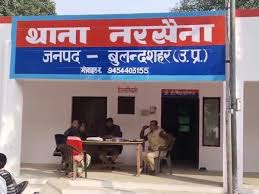
A Dalit youth in Bulandshahr has made offensive remarks against the Brahmin community on social media. The incident is from Kalyanpur village in the Narsena police station area, and the video is rapidly going viral. The youth, while showing a statue of Dr. Bhimrao Ambedkar on his social media account, used casteist slurs against the Brahmin community and insulted them. This video is being circulated on various social media platforms. Following this comment, members of the Brahmin community have filed a complaint against the accused youth at the Narsena police station. They have demanded strict action against the youth. However, the police claim that people from both communities have reached a mutual agreement after a meeting in the village. Station House Officer Ramkishore Gautam said that a compromise was brokered between both parties by prominent citizens of the village. The Station House Officer also stated that an appeal has been made to maintain mutual harmony and brotherhood in the village. He warned that strict action would be taken against anyone who makes offensive remarks about any religion or caste. Aman Tyagi | Syana (Bulandshahr), Courtesy: Hindi News
Dalit Groom Rides Horse Holding Constitution in MP Village, First Such Wedding Procession in 75 Years
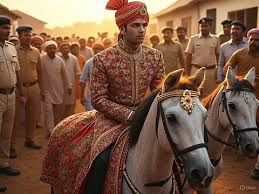
A Dalit groom in Madhya Pradesh’s Damoh district took out a horse-mounted wedding procession for the first time in 75 years in his village. The incident took place in Kuankheda village of Patera tehsil, where Nandu Bansal from the Bansal community rode a horse through the village streets amid music, dancing and celebrations.Photo journalism course What made the procession even more symbolic was that the groom was holding a copy of the Constitution of India in his hands while riding the horse. As drums played and relatives danced, the moment turned into a powerful assertion of equality, dignity and constitutional rights. Community members said the procession was not just a wedding ritual but a matter of self-respect. “This was about our dignity. Holding the Constitution showed that we are equal citizens of this country,” a member of the Bansal community said. They also thanked the police and local administration for ensuring that the procession passed peacefully without any trouble. The groom’s family had earlier expressed fear of possible opposition from influential villagers. On Wednesday, members of the Bansal community, along with the SC Mahasabha, submitted an application to Superintendent of Police Shrut Kirti Somvanshi, seeking protection for the horse-mounted procession. They said there was apprehension that some people might try to create disturbances. Taking the request seriously, the SP directed the Hata police station to maintain law and order. On Wednesday night, Patera Tehsildar Umesh Tiwari and police personnel reached the village and held talks with the groom’s family and other villagers. During the discussions, villagers from other communities assured the administration that they had no objection to the Dalit groom taking out the procession.Women’s sports merchandise Following this, the wedding procession went ahead smoothly on Thursday. Groom Nandu Bansal performed rituals with his family before mounting the horse, after which the procession moved through the village under police presence. SC Mahasabha president Akash Bharti said, “The SP extended full support, due to which the procession was conducted peacefully. The police and administration cooperated at every step.” The groom’s brother, Jeevan Bansal, said the event should become an example for the future. “Such harmony and brotherhood should always remain in the village so that everyone can live with dignity and mutual respect,” he said. Courtesy : TOP Note: This news is originally published on https:/theobserverpost.com/bha and is used purely for non-profit/non-commercial purposes, especially human rights
Dalit woman’s suspicious death aparks allegations of caste, dowry abuse

According to her family, the marriage was conducted in the presence of the groom’s family and was kept undisclosed from Priya’s relatives. VILLUPURAM; A 22-year-old Dalit Christian woman died under suspicious circumstances at Soranavur village in Villupuram district on Monday, with her family alleging dowry harassment and caste-based abuse by her husband and in-laws. The deceased, A Devajessi Priya, had allegedly married her long-time college friend M Vasantha Kumar (24), who belongs to the Hindu Vanniyar community, around three months ago. The couple had been living in Soranavur village near Valavanur in Villupuram district. According to her family, the marriage was conducted in the presence of the groom’s family and was kept undisclosed from Priya’s relatives. Based on a complaint lodged by her elder brother A Richard (26), Priya was allegedly subjected to continuous mental and physical harassment by her husband, his parents Murugan and Lakshmi, and his elder brother Bhakthavachalam. On January 31, Priya allegedly called her aunt and said she was being assaulted and harassed for dowry. About an hour later, her husband informed the family that she had died. Richard has alleged that his sister was murdered and that the incident was made to appear as a suicide, claiming that injuries were found on her body. Speaking to TNIE, Richard said, “We want the police to investigate the case with due sensitivity to caste discrimination and dowry harassment. My sister was subjected to severe torture and was killed.” Priya, a Christian convert, was a native of Alagappa Samuthiram in Panruti taluk of Cuddalore district. She lost her parents at a young age and was brought up by her elder brother with the support of their grandmother Josephina Mary and aunts at Madampattu village near Thiruvennainallur in Villupuram district. She had completed a BSc in Microbiology from Periyar Government Arts College, Cuddalore, and was employed with a private firm in Sunguvarchatram near Chennai. Family sources said she had been in a relationship with Kumar since her college days. Though Kumar later dropped out of college, the relationship continued, culminating in their marriage three months ago. Despite the complaint seeking action for dowry harassment and caste abuse, Valavanur police registered a case only under Section 194 (3) of BNSS and arrested Kumar on Tuesday. Family members of the deceased have refused to receive Priya’s body, demanding the arrest of Kumar’s parents and other relatives. The body has been kept at the Government Medical College Hospital in Mundiyambakkam, where an autopsy was conducted. Krithika Srinivasan Courtesy : TNIE Note: This news is originally published on https:/thenewindianexpress.com/bha and is used purely for non-profit/non-commercial purposes, especially human rights
Video of inhumane treatment of a Dalit youth goes viral in Morena; accused Dharmendra Tomar arrested in 7-month-old case
7-month-old video exposes the truth: Dalit youth forced to perform obscene acts under the influence of alcohol; Amba police arrest accused Dharmendra Tomar Morena (Madhya Pradesh): A case that shames humanity has come to light in Morena district of Madhya Pradesh. Police immediately swung into action after a video of a Dalit youth being assaulted and subjected to abusive behavior went viral on social media. Acting swiftly, the police arrested the 30-year-old accused on Tuesday. According to police officials, this incident is not recent, but about seven months old. The arrested accused has been identified as Dharmendra Singh Tomar, a resident of Amba. What is the whole matter? Morena Superintendent of Police (SP) Sameer Saurabh, while providing information about the incident, said that the accused Dharmendra and the 20-year-old victim were part of the same friend circle and often spent time together. The Hindu quoted the SP as saying, “These two people used to drink alcohol together, and this incident occurred while they were drunk. A third friend present there recorded the entire incident on his mobile phone. Later, when that third friend had an argument with the accused, Dharmendra, he circulated these videos on social media to take revenge.” Brutality shown in the videos Two videos that went viral on social media have shocked people. In one video, the accused, Dharmendra, is seen forcing the victim to squat and questioning him about the return of his money. In the second video, the accused is seen crossing all limits, slapping the victim and pressuring him to perform obscene acts. Swift police action SP Sameer Saurabh stated that a minor financial transaction has also emerged in the case, although it does not appear to be the main reason for the incident. He said, “The victim also denied that the assault was solely for money. He was so scared that he neither told his family nor mustered the courage to file a police complaint. Even when the police contacted him, he was unwilling to file a complaint.” Despite this, given the seriousness of the video, the police took cognizance and registered a case. Within just two hours of the case being registered, the police arrested the accused. Case registered under these sections Ambah Sub-Divisional Police Officer (SDPO) Ravi Singh Bhadoria, providing details of the legal proceedings, said that an FIR has been registered against the accused at the Ambah police station under Section 296 of the Indian Penal Code (IPC) and Section 3(1)(e) of the Scheduled Castes and Scheduled Tribes (Prevention of Atrocities) Act. Bhadauria also informed that the victim previously lived in a rented house in the same street as the accused Tomar, but after this humiliating incident, he left that house and moved to another location. Rajan Chaudhary Courtesy: Hindi News