
Youth country’s asset, but system trapping them in ‘chakravyuh’: Rahul

Prayagraj: Congress MP Rahul Gandhi on Saturday said the country’s youth were being trapped in a “chakravyuh”, with youngsters spending lakhs and crores on educational certificates that offered no guarantee of employment. “Today, education certificates have no meaning in India because they cannot give you a job,” he said, adding that only around 12 out of every 1,000 aspirants get permanent employment. Addressing the ‘Chhatron Ki Goonj’ programme at KP College Ground, Rahul cautioned youngsters against getting trapped in the “intoxication” of making Instagram reels, saying social media was being used to keep them occupied as jobs and opportunities shrink. “You make reels and work on Blinkit-like platforms because there is no job for you in this country,” he said, describing the trend as a “dreaded intoxication” and warning that youngsters were being turned into “bandhua mazdoor” (bonded labourers). Referring to AI, Gandhi said the data consumed and generated by young people was helping AI systems develop. Gandhi structured his speech around “dard” (pain), data and “daulat” (wealth). He said the pain and data belonged to the youth, while the wealth generated from them was being concentrated in the hands of a few. He said the youth were the country’s strength and pride. A youth sharing the stage with Gandhi criticised paper leaks and the normalisation formula. Two Allahabad University students also interacted with him and detailed problems at the university and the ongoing agitation.Gandhi said avenues in manufacturing, entrepreneurship, public and private sector jobs, corporate, IT and banking were shrinking, with AI increasingly being used by influential corporate houses, including Adani and Ambani. He also alleged that people associated with RSS ideology had been appointed to head various institutions, affecting the entire system. Despite his criticism, Gandhi said the country’s youth had “lighted the path” towards a promising future. He appealed to them to reject hatred and violence and change the system through love. “You are India, spirit and future, and the most beautiful youngsters of the world. Do not allow hate and violence, but open the Mohabbat Ki Dukaan (shop of love),” Rahul said. He presented his formula for India’s 21st-century economy — “youth plus data”. He said India has around 40 crore young people, one of the country’s greatest strengths, while each youngster consumed around 1GB of data a day. “Youth + data = 21st-century economy,” he said, linking the potential of young Indians and the data they generate to economic growth and AI development. Breaking from his usual white t-shirt, Rahul arrived wearing a pink half-sleeved shirt. He began with “Namaskar. Hello, how are you?” and thanked the gathering for organising the event. “The city belongs to my family, and I’m always happy whenever I come here,” he said, recalling his association with Prayagraj and mentioning Allahabad University, which he described as the best university in the country. The programme drew a large gathering of students and competitive exam aspirants despite waterlogging and muddy patches at the venue. Students raised concerns over hostel facilities and competitive examinations. Dance performances by rappers from Mumbai were staged before his arrival. A day earlier, Congress had taken out a motorcycle rally led by Uttar Pradesh Congress president Ajay Rai. ABVP, BJP activists stage protest ABVP and BJP activists staged a brief protest near Rahul Gandhi’s cavalcade on Saturday, waving saffron flags as he travelled to the ‘Chhatron Ki Goonj’ programme at KP College Ground. Police personnel deployed along the route immediately intervened and cleared the way for the cavalcade. The protest lasted briefly, with security personnel preventing the demonstrators from obstructing the convoy’s movement. The incident occurred amid heightened political activity in the city over Gandhi’s visit and his programme focusing on issues concerning students and youth. Courtesy : TOI Note: This news is originally published on https:/timesofindia.com/bha and is used purely for non-profit/non-commercial purposes, especially human rights
‘Why Prayagraj, not Jharkhand?’ Posters target Rahul ahead of visit

Prayagraj: A poster war erupted in Prayagraj on Saturday ahead of Congress MP Rahul Gandhi’s visit, with posters targeting him over issues concerning students in Jharkhand and his stand on NEET appearing at several locations across the city. The identity of those behind the posters remained unclear, but their appearance pushed up the political temperature ahead of Gandhi’s scheduled ‘Chattron Ki Goonj’ programme. However, the posters were later removed from several locations by his supporters. Among the posters displayed were slogans such as “Kab aaoge mere Rahul, tumhein Jharkhand bulata hai” (When will you come, Rahul? Jharkhand is calling you), “Jo bhaag kar Prayagraj aaye, woh Jharkhand jaane se kyun ghabraye?” (Why is one who ran to Prayagraj afraid of going to Jharkhand?) and “Jab Jharkhand ke chhatra nyay maang rahe hain, Rahul Prayagraj drama karne kyun aaye?” (When students in Jharkhand are demanding justice, why has Rahul come to Prayagraj for a drama?). Another poster targeted Gandhi over the NEET issue, carrying the slogan: “NEET par hypocrisy ki bhi seema hoti hai, Prayagraj wow… Jharkhand chhee.” The posters questioned Gandhi’s political position on student-related issues, NEET and his decision to visit Prayagraj. None of the posters carried the name of any political party, organisation or individual. As a result, it could not be immediately established who had put them up. No person or organisation had claimed responsibility for the posters till Saturday afternoon. The posters surfaced as Congress workers put up their own hoardings and banners across prominent city routes to welcome Gandhi and promote his ‘Students Ki Goonj’ programme at KP College Ground. The programme is scheduled to focus on issues including NEET, alleged irregularities in competitive examinations, paper leaks, unemployment, and concerns of students and youth. Meanwhile, Congress workers have made extensive preparations for Gandhi’s visit, during which he is scheduled to interact with students and young people. With the rival posters appearing just hours before the event, the political contest surrounding the visit has acquired an added edge. Courtesy : TOI Note: This news is originally published on https:/timesofindia.com/bha and is used purely for non-profit/non-commercial purposes, especially human rights
Parliament passes Transgender Persons Amendment Bill, 2026 with Rajya Sabha approving it today
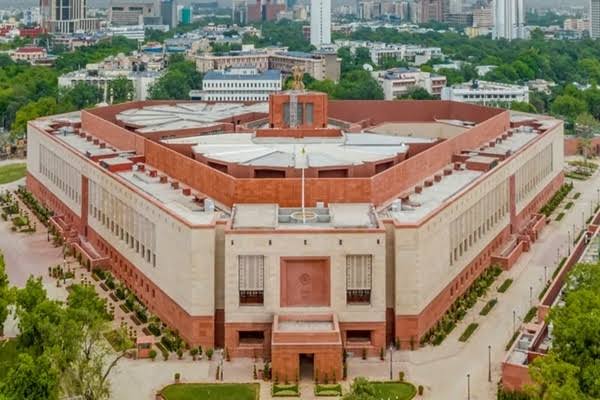
Parliament has passed the Transgender Persons (Protection of Rights) Amendment Bill, 2026, with the Rajya Sabha approving it today. The bill was passed by the Lok Sabha yesterday by a voice vote amid an Opposition-led walkout. The bill seeks to redefine the category of transgender, removes the provision of self-perceived gender identity and excludes several socio-cultural identities as well as transmasculine individuals from its ambit. It also further defines transgender persons within a biological framework, based on intersex variations and differences in sexual development. Replying to the discussion on the Bill in the Rajya Sabha, Social Justice and Empowerment Minister Dr Virendra Kumar said the government is compassionate towards the well-being of the transgender community. He said the Bill has provisions to empower the transgenders and give them dignity. The Minister said that the NDA government has taken several initiatives to bring transgender people to the mainstream and stop discrimination against them. Starting the discussion in the Upper House, Congress MP Renuka Chowdhury said this bill dilutes the privacy of an individual provided under the Constitution. Opposing the Bill, Ms Chowdhury said self-identification cannot be taken away through bureaucratic certification. Criticizing the government, she said that the proposed bill undermines the fundamental rights and dignity of transgender persons. Calling such a move wrong and illegal, she argued that forcing transgender persons to provide their identity through official certificates is against the spirit of equality and dignity guaranteed by the constitution. She also questioned the government’s approach for not properly consulting with the transgender community before bringing the Bill. She also referred to the Supreme Court’s landmark NALSA judgement of 2014, which recognized the right of transgender persons to self-identify their gender. Ms Chowdhury said the proposed Bill violates the principles laid down in that judgement and fails to respect an already established legal framework. DMK MP Tiruchi Shiva also opposed the Bill, saying that even if the Bill is passed in Parliament with a majority, it will be struck down by the Supreme Court. He further added that the Bill violates Articles 14, 15, 19 and 21 of the Constitution and it deprives the community of the right to freedom, dignity and self-determination. Supporting the Bill, BJP MP Medha Vishram Kulkarni said, ” This Bill ensures justice, dignity, protection from criminalisation and legal safeguards for transgender persons. She also thanked Prime Minister Narendra Modi for bringing this bill with certain amendments in order to ensure that the benefits reach the deserving people in a proper manner. She said there is a need for a law that brings justice to real transgender individuals and punishes fake ones. Mrs Kulkarni said the benefits should be extended to those who are transgender by birth. She said that the amendment to extend punishment will bring down the rate of crime and forced identities. TMC’s Saket Gokhale said that 31% of Transgender people in India have attempted suicide because of the discrimination that they are facing. He alleged that now the government is going to start discriminating against them as though social discrimination were not enough. He called it unacceptable. Mr Gokhale expressed concern that gender is going to be decided by the Chief Medical Officer and a District Magistrate, and the bill does not prescribe any qualifications for the Chief Medical Officer. Sanjay Singh of AAP said the Bill is a big let-down for the transgender community. He accused the government of not doing anything for the community. RJD’s Manoj Kr Jha said that prejudices against transgender people should stop, and they should be able to live with dignity. He added that self-determination of gender should not be taken away. CPI(M)’s John Brittas said it is a black-letter day and the Bill is taking India a century back. He pleaded with the government to either withdraw the Bill or refer it to a Select Committee. Jaya Bachchan of the Samajwadi Party also questioned the government over the legislation. She sought to know what the urgency was in bringing the Bill, without examining it with the depth and care that it deserved. Courtesy : NOA Note: This news is originally published on https:/newsonair.com/bha and is used purely for non-profit/non-commercial purposes, especially human rights
Case of Dalit boy beaten for drinking water from a bottle: Police issues notice to teacher, Human Rights Commission also seeks response
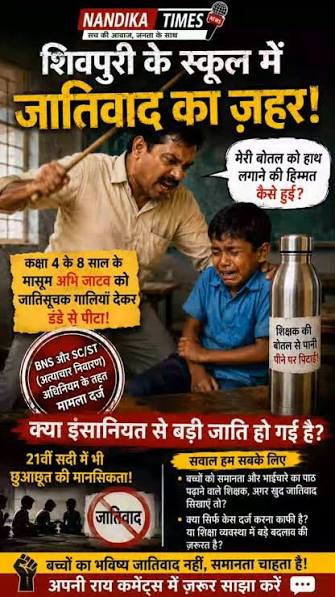
An FIR has been registered against a teacher under various sections of the SC/ST Act, including the SC/ST Act, for allegedly assaulting a Dalit student and making casteist remarks at a government school in Ukawal village, Shivpuri. The National Human Rights Commission has taken suo motu cognizance and sought a detailed report from the Madhya Pradesh government and police within two weeks. A case of alleged assault on a Dalit student at school has come to light in Kolaras, Shivpuri district. The teacher is accused of assaulting and using casteist slurs against the 8-year-old fourth-grade student at the government primary school in Ukawal village. Following the complaint, the police have registered an FIR against the accused teacher under sections of the BNS and the SC/ST Act and have initiated an investigation. The police have issued a notice to the accused teacher. The National Human Rights Commission has also taken cognizance of the matter and requested a report. The incident dates back to July 27th. An 8-year-old Dalit student, studying in the fourth grade at the Government Primary School in Ukawal village, Kolaras tehsil, has been allegedly assaulted. Family members allege that the child was thirsty and drank from the teacher’s water bottle. Angered by this, the teacher beat him with a stick. According to family members, the child returned home crying and informed the family about the entire incident at school. Following this, the family filed a police complaint. Based on the complaint, the Lukwasa police station has registered a case against the accused teacher, Lokesh Sharma. The FIR includes relevant sections of the BNS Act, as well as sections of the SC/ST Act. Following the registration of the case, the police have initiated an investigation. According to Kolaras Police Station Officer Puneet Vajpayee, a notice has been issued to the accused teacher. Police say the investigation is ongoing and further action will be taken based on the facts and evidence that emerge. Only after the police investigation will it be clear what actually happened at the school. Meanwhile, the alleged assault and casteist remarks against a minor student have raised questions about the safety of children in government schools and the conduct of teachers. NHRC seeks report from Madhya Pradesh government and police The National Human Rights Commission has taken suo motu cognizance of the matter. The Commission stated that if the claims made in media reports are true, this constitutes a serious human rights violation. The Commission has issued notices to the Chief Secretary of Madhya Pradesh and the Superintendent of Police of Shivpuri, seeking a detailed report within two weeks. The report should also include details of the legal relief provided to the victim and the action taken in the case. Published by: Dinesh Sharma Courtesy: Hindi News
When Dalits Own Temples: The Politics Behind Rajasthan’s Khakul Dev Dispute
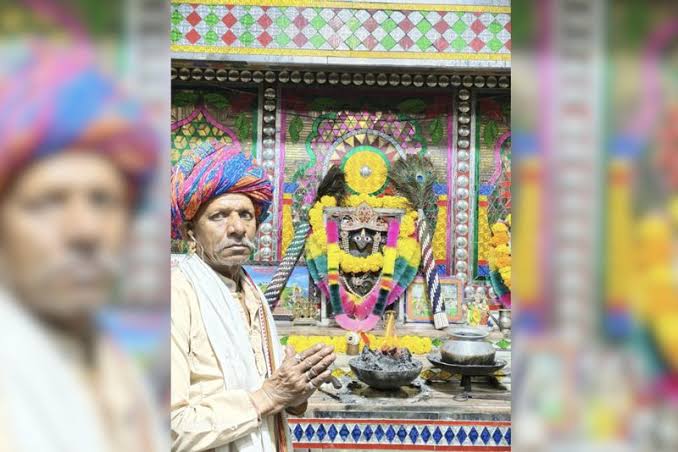
The Balai family is not demanding admission into someone else’s temple. It claims with historical authority that its ancestors established, maintained and served as hereditary priests of the shrine for centuries, and that these rights are now being challenged by people associated with the RSS. Khakul Dev Temple of Barana village in Rajasthan’s Bhilwara district. In frame, a member of the Balai family, who is the acting priest to the temple. Photo: By arrangement When Vishnu Kumar Balai, the hereditary priest of the Khakul Dev Temple of Barana village in Rajasthan’s Bhilwara district, wrote to Rashtriya Swayamsevak Sangh (RSS) chief Mohan Bhagwat in May this year asking, “Are we not Hindus?”, his appeal was widely understood as only an instance of caste discrimination and exploitation. But that reading misses what makes the Barana dispute historically and socially significant. This is not a story about Dalits seeking entry into Brahminical temples or demanding the right to perform rituals in Brahminical spaces. It is about a Dalit family which founded, owned and served as hereditary custodians of a temple for nearly four centuries, and whose assertions whose claims are supported by a body of historical material preserved by the family. Per the evidence furnished by the family, their position as priests and owners was recognised through a tamrapatra (copper-plate grant), issued by Maharana Karan Singh II of Mewar, grandson of Maharana Pratap, in 1624 CE. That historical continuity makes the present controversy all the more remarkable: a custodianship they say was acknowledged under a 17th-century Mewar ruler now finds itself challenged in 21st-century democratic India. The Khakul Dev dispute, therefore, raises a question that extends far beyond one village: why has a centuries-old Dalit temple ownership become the subject of contemporary political contestation? The tradition The Balai priestly family traces its association with Khakul Dev to Ghasiramji Balai, who, according to family tradition, discovered the deity in the early seventeenth century near present-day Hadkiya village. The shrine was subsequently established at Barana and gradually developed into an important regional place of worship. The family preserves a body of historical material – including genealogies, temple records, inscriptions and the 1624 tamrapatra – which it documents uninterrupted hereditary succession. The tamrapatra, as attested by the family, recognises their custodianship and ownership over both the temple and land attached to its maintenance, including their right for hereditary priesthood. Taken together, these records suggest that the family’s claim is rooted in a long tradition of hereditary custodianship rather than being a recent assertion. Rajasthan’s forgotten non-Brahmin religious landscape Many of Rajasthan’s most-revered folk shrines evolved outside the framework of orthodox Brahmanical institutions. Rajputs and Meghwals have historically performed hereditary ritual roles at the shrine of Baba Ramdevji, a 14th century Tomar chief whose cult transcends caste boundaries. In fact, the main temple of Baba Ramdev houses the samadhis of both Ramdevji and Dalibaiji, his Meghwal dharmbehan. Baba Ramdev Tomar, although a Rajput, is viewed as an important figure in the tradition founded by Meghrishi, a Dalit saint. Likewise, the traditions surrounding Pabuji Rathore, another Rajput folk hero, have long depended upon Nayak Bhils and Bhopa communities as hereditary ritual specialists and custodians of oral epics. Most temples dedicated to Gujjar deity Devnarayan are found in Mewar and built by Mewar’s rulers. The current Gogaji shrine at Gogamedi was built by the Bikaner’s rulers, but its tradition of Muslim priests has persisted till the modern era. Seen in this context, Khakul Dev is less an exception than a surviving example of a much older religious tradition. Recent scholarship has also questioned the assumption that Rajasthan’s religious institutions were historically organised according to a single Brahmanical model,showing that many Lok Devta traditions were sustained through the ritual practices of Bhopas, Bhils, Dalits and other non-Brahmin communities . In Merchants of Virtue, historian Divya Cherian shows how the increasing Brahminisation of Rajput courts during the 18th century reshaped social hierarchies and forms of social legitimacy. The persistence of non-Brahmin hereditary priesthoods at shrines such as Khakul Dev, Ramdevji, Gogamedi and Pabuji points to an older and more socially diverse religious landscape. Ownership, not entry Speaking to The Wire over email, social activist and Ambedkarite thinker Bhanwar Meghwanshi, said, “The Khakul Dev temple dispute also brings to light a striking historical irony. The feudal state, notwithstanding its own drawbacks and criticisms, not just recognised Dalits as hereditary priests but also granted them rights over the temples and the land attached to them. Yet, in contemporary democratic India, such hereditary rights are increasingly being challenged. In many places, dominant caste groups, including those classified as OBCs, have sought to wrest control of temples, offerings and attached lands from Dalit custodians, while simultaneously subjecting them to caste-based humiliation and violence.” Much of the discourse on caste and temples has understandably centred on temple entry – the struggle of Dalits to access spaces from which they were historically excluded. Khakul Dev presents an altogether different question. The Balai family is not demanding admission into someone else’s temple. It claims with historical authority that its ancestors established, maintained and served as hereditary priests of the shrine for centuries, and that these rights are now being challenged by people associated with the RSS. The issue, therefore, is not access but owner. It concerns hereditary priesthood, temple management, ritual legitimacy and institutional control. That distinction makes the dispute historically significant. Pamphlet published by the Dalit villagers for mobilisation against forceful takeover of the temple. Amid the ongoing dispute, the local Balai community have published and circulated pamphlets. For instance, this publication by the community was intended both, to mobilise support against what they view as an attempt by dominant castes to take over the temple and to document the historical and legal basis of the family’s claim. Photo: By arrangement The conflict According to Vishnu Kumar Balai, the conflict began in 2023, when influential villagers questioned the family’s exclusive custodianship of the temple. He has alleged that Sampat Jat, along with others, attempted to alter
‘Who Killed My Family?’: Rajasthan Court Acquits All 40 Accused in 2015 Dangawas Dalit Massacre, Cites Police and CBI Probe Failures
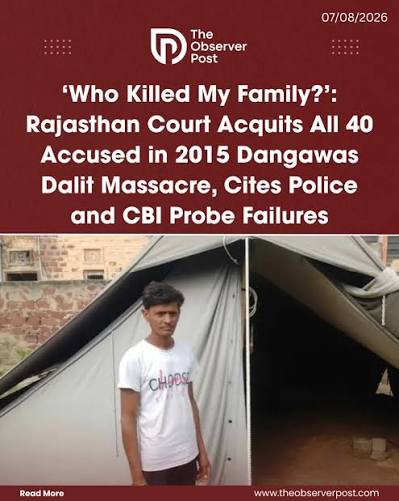
A special court in Rajasthan’s Merta has acquitted all 40 accused in the 2015 Dangawas massacre case, in which six people, including five Dalits, were killed, citing serious lapses in the police and CBI investigation. The court held that while the massacre was proven, the prosecution failed to establish the involvement of any particular accused beyond reasonable doubt. Court Says Investigation Failed to Link Accused to Crime Delivering its verdict after an 11-year trial, the Special Court for SC/ST (Prevention of Atrocities) Act cases observed that investigators failed to conduct a Test Identification Parade (TIP) after the arrests and did not collect DNA samples from the accused to match blood recovered from the crime scene. The court also noted delays in forensic examination and said investigators could not establish any forensic connection between the recovered weapons and the accused. Although forensic reports confirmed the presence of human blood on some seized weapons, the blood groups could not be conclusively matched with the deceased or injured victims. “It is not proved which party initiated the incident… The prosecution failed to prove beyond reasonable doubt the absence of the right of private defence,” the court said, adding that the evidence did not meet the required legal standard for conviction. 2015 Dangawas Massacre The violence took place on May 14, 2015, in Dangawas village of Rajasthan’s Nagaur district over a decades-old land dispute. According to the CBI charge sheet, nearly 200 people travelling on tractors and motorcycles allegedly attacked members of the Dalit Meghwal community who had set up a camp on disputed agricultural land. Five Dalits — Ratnaram, Pokharram, Pancharam, Khemaram and Ganpatram Meghwal — were killed, while 11 others, including five women, sustained injuries. Another man, Rampal Goswami, also died during the violence in a separate incident that remains subject to a different criminal case. The dispute centred around a 23-bigha plot of land allotted to Dalit farmer Bastaram Meghwal in 1961. The ownership was later transferred to his adopted son Ratnaram. The CBI alleged that tensions escalated after Ratnaram attempted to reclaim possession of the land, culminating in the deadly attack. Court Highlights Multiple Procedural Lapses The court pointed to several deficiencies in the investigation, including the failure to conduct identification parades, recover weapons from the accused, and seize or forensically examine tractors allegedly used during the attack. It also noted that no witness identified all 40 accused and that several witnesses admitted they knew only a few members of the alleged mob. The Central Forensic Science Laboratory visited the crime scene 21 days after the incident, by which time no weapons were recovered. In its judgment, the court remarked that the incident itself was beyond dispute but the prosecution failed to legally establish who was responsible. “What occurred on 14.05.2015… was beyond any doubt a heinous and heart-wrenching mass violence. What has not been proven is the connection, beyond reasonable doubt, of any particular accused to that violence,” the court observed. It further clarified that the acquittal did not mean the crime never occurred, but only that the perpetrators could not be identified through admissible evidence. Victims’ Families Question Verdict Speaking to The Wire after the verdict, Arjunram Meghwal, whose father Ratnaram was among those killed, said he was devastated by the acquittal and questioned how no one could be held responsible for the massacre. “I had hoped that those who murdered my father and other relatives would be punished. But today, after the court’s decision, I don’t know what to do. If nobody is guilty, then who killed my family? Did they die themselves?” he said. Arjunram, who was also injured in the attack, said he witnessed the killings and could not understand how the accused had been acquitted. His family has said it will challenge the verdict before the Rajasthan High Court. Victims’ counsel Abdul Salim Ansari alleged that the investigation had been weak from the beginning, claiming that the police omitted names mentioned by eyewitnesses in the FIR and later added others, creating inconsistencies that persisted throughout the trial. Activists, Congress Criticise Verdict Dalit rights activist Bhanwar Meghvanshi told The Wire that the acquittal exposed the difficulties Dalits face in securing justice. He argued that despite the CBI filing chargesheets, the prosecution failed to establish the case in court. “This shows how difficult it is for Dalits to get justice. This is eroding trust in the justice system and the constitutional guarantee of justice,” he said, urging the Rajasthan government to challenge the trial court’s judgment before the High Court. Congress leader and former Rajasthan Chief Minister Ashok Gehlot also criticised the verdict, questioning how all 40 accused could be acquitted when six people had lost their lives. He said the outcome highlighted serious shortcomings in the investigation and prosecution and demanded accountability from the BJP government. Meanwhile, counsel for the accused welcomed the verdict, maintaining that the investigation had not been fair and asserting that the accused had no role in the violence. The defence also claimed the disputed land belonged to their clients and rejected allegations that a large armed mob had gathered before the incident. Courtesy : TOP Note: This news is originally published on https:/theobserverpost.com/bha and is used purely for non-profit/non-commercial purposes, especially human rights
Rahul Gandhi steps in to pacify disgruntled Karnataka Congress MLA M Krishnappa
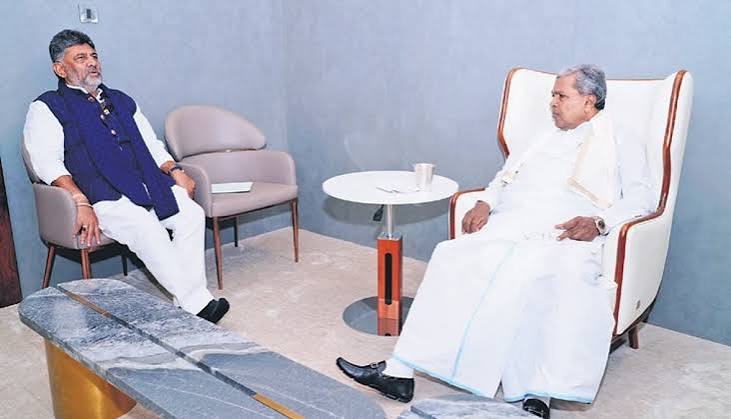
Supporters of Krishnappa and his son and Govindraj Nagar MLA Priya Krishna have been protesting after the duo was denied a place in the Shivakumar cabinet. BENGALURU: The Congress state leadership, led by state unit chief BK Hariprasad and Chief Minister DK Shivakumar, appears to have, to some extent, pacified the disgruntled legislators who were denied cabinet berths. But it looks like the Leader of the Opposition in the Lok Sabha, Rahul Gandhi, is being forced to deal with Vijayanagar MLA M Krishnappa, who has made it clear that he is unwilling to accept anything less than a ministerial post. Supporters of Krishnappa and his son and Govindraj Nagar MLA Priya Krishna have been protesting after the duo was denied a place in the Shivakumar cabinet. According to Congress sources, Priya Krishna was in New Delhi to meet Rahul and, in all probability, his father is likely to be inducted into the cabinet. “Politics is a game of possibilities. Nobody knows what will happen,” remarked KPCC president BK Hariprasad, who met Krishnappa in Bengaluru on Friday. Hariprasad confirmed that Krishnappa’s “pain” has been conveyed to Rahul and the latter will speak to the former soon. Shivakumar had earlier sent ministers HC Balakrishna and N Cheluvarayaswamy, both Vokkaligas, to pacify Krishnappa. AICC General Secretary and Karnataka in-charge Randeep Singh Surjewala, while reaching out to the upset MLAs, also met Krishnappa on Wednesday. Shivakumar, too, was present at the meeting. “Krishnappa, a five-time MLA, is an influential leader in Bengaluru and the Congress leadership does not want to ignore him ahead of the crucial polls to the Greater Bengaluru Authority,” said a political analyst. Krishnappa hails from the influential Vokkaliga community. Meanwhile, Karnataka Home Minister Priyank Kharge echoed Hariprasad. “We need Krishnappa sir’s experience as well as Priya Krishna’s youthful energy. Not only them… but we need hundreds of them to join hands together… only then can we build the party,” Priyank told reporters. Meanwhile, Shivakumar is also likely to visit Delhi on Saturday to discuss political developments in the party after the cabinet expansion and to conduct a “minor surgery” by dropping ministers to placate unhappy legislators, sources said. Magadi MLA HC Balakrishna, also a Vokkaliga, may have to sacrifice his ministerial post to help the Congress douse the fire for the smooth sailing of the State Government, sources said. Meanwhile, the allotment of portfolios to the newly appointed ministers is likely to be completed before the commencement of the monsoon session of the legislature on August 13. “When the Chief Minister is our man, why should I ask for a portfolio?… What should I do with it? What is paramount for me is the work I do in my constituency and my district. Even with sleepy eyes, I will go and get the necessary work done (by the CM),” Balakrishna said, hinting that he is ready for any consequence. It remains to be seen whether the Congress high command will drop some ministers to make room for disgruntled legislators, ensuring adequate representation for different castes, communities and regions. The leadership will also have to address the lack of women’s representation, as the cabinet currently has no woman minister and one berth is still vacant. Ready to resign if top brass asks me to: Priyank Home Minister Priyank Kharge said he is ready to resign as a minister if the Congress high command asks him to and will work for the party. “There are close to 140 Congress MLAs in Karnataka and 33 ministerial posts. Satisfying everyone is a difficult job. Even though there are challenges in ensuring social justice and regional representation, party leadership has made an honest effort,” Priyank Kharge told reporters, adding that he will always abide by the decision of the high command. Meanwhile, speaking to reporters in Vijayapura, minister BZ Zameer Ahmed also said he is ready to quit the cabinet and work for the party. Later, in Chitradurga, he said the recent cabinet expansion was based on the findings of an internal survey, which suggested that giving cabinet berths to leaders with a strong influence in their respective communities would benefit the party. CM answers political questions with sarcasm CM DK Shivakumar on Friday responded with a pinch of sarcasm to a series of questions on the issues related to the recent cabinet expansion and political developments, brushing aside concerns over internal discontent and portfolio allocation delays. When asked about Vijayanagar MLA M Krishnappa seeking a ministerial berth, Shivakumar said, “There is nothing wrong, everyone asks.” On reports that he had called Chintamani MLA MC Sudhakar and other leaders to his office to pacify them, he denied any unrest, stating, “No one is upset. There are some senior leaders. They will have to be given responsibility. We will sort everything out.” Responding to a question on when the possibility of the cabinet having women ministers, he said, “They will be sworn in after informing you (media).” When asked about speculation of a “minor surgery” in the cabinet, Shivakumar retorted, “We thought the media should have a surgery”. On delays in portfolio allocation, he drew comparisons with previous governments, saying, “How long did Yediyurappa run the government alone? How long did the government run in Delhi?” To a question on whether bringing the party back to power in 2028 was the agenda, he countered, “Everyone has agreed, have you (the media) agreed?” Not resigning, want portfolio changed: Muniyappa Food, Civil Supplies and Consumer Affairs Minister KH Muniyappa on Friday has dismissed reports claiming that he will resign from the cabinet and pave the way for his daughter, KGF MLA, Roopakala Shashidhar, to become a minister. In a statement, Muniyappa’s office said the senior Congress leader remains committed to the party and has served it loyally for over five decades. It highlighted his political career, including seven consecutive terms as MP from the Kolar Lok Sabha constituency and three terms as a Union Minister. The statement clarified that Muniyappa has only sought a change of portfolio
‘Govt stealing money, destroying lives’: Rahul Gandhi vows campaign against E20

NEW DELHI: Leader of opposition in the Lok Sabha Rahul Gandhi on Friday said Congress will soon take up the issue of the Centre’s E20 ethanol-blended fuel programme. In a social media post on X, Rahul shared a video and accused the government of “stealing directly out of people’s pockets”. “This E20 issue is a very serious matter. Usually, we say, ‘Daal mein kuch kaala hai.’ But here, the whole daal is black,” the Congress leader said. “Brothers and sisters, this is a matter of priorities. In any campaign, we have to decide the order in which issues are taken up. The problem right now is that there is so much corruption that there is a long list of issues we have to prioritise. But don’t worry. We will take up the E20 issue in a big way because it is damaging people’s cars and scooters and their lives and is, quite literally, stealing money directly out of their pockets,” he added. The remarks came days after Congress alleged that the Centre’s push for E20 petrol had increased fuel costs for consumers while primarily benefiting ethanol producers, claiming motorists were paying more despite assurances of cheaper fuel. Congress leader Jairam Ramesh said that since March 2025, regular fuel stations across the country had been supplying “practically only E20 petrol”. Referring to earlier statements by Union road transport and highways minister Nitin Gadkari, he said the government had claimed ethanol blending would bring the price of diesel down to Rs 50 per litre and provide a petrol alternative at Rs 55 per litre, but no such reduction had materialised. “On the contrary, according to an independent analysis, between April 2023 and March 2026, consumers collectively spent an additional approximately Rs 88,234 crore to compensate for the lower mileage from ethanol-blended fuel,” he wrote in a post on X. He further claimed that the Centre could have reduced the retail price of E20 petrol to offset the lower fuel efficiency and noted that NITI Aayog’s Ethanol Roadmap had recommended financial and tax incentives for E10 and E20 fuels to compensate consumers. “E20 has stripped the average middle-class Indian of options, imposed higher fuel costs on them, and placed an extra burden on the very vehicle they saved for years to buy. If any segment has benefited the most from E20, it is the ethanol producers,” Ramesh said. However, the Centre has maintained that ethanol blending helps reduce India’s dependence on imported crude oil and supports farmers by creating demand. Courtesy : TOI Note: This news is originally published on https:/timesofindia.com/bha and is used purely for non-profit/non-commercial purposes, especially human rights
Cong mobilises students ahead of Rahul’s Prayagraj event

Prayagraj: A day after the Kayastha Pathshala (KP) authorities restored permission for Rahul Gandhi’s “Chhatron Ki Goonj” programme, preparations gathered pace across Sangam City on Friday, with senior Congress leaders camping in the city and youth workers reaching out to students to ensure a large turnout. The Congress MP is scheduled to interact with students at KP Ground on Saturday evening on issues related to education, employment and recruitment. While the state and district Congress leadership is leaving no stone unturned to ensure the participation of the maximum number of youths from Prayagraj and adjoining districts, the entire city has been flooded with posters and banners of “Chhatron Ki Goonj”. The event in Prayagraj, often referred to as the students’ hub of eastern UP, will be the third in the country after Kota and Dehradun, as the Congress campaign focuses on the future of the youth, transparency in recruitment examinations, employment and reforms in the education system. Rahul is scheduled to reach Prayagraj around 3.15 pm on Saturday and will head to Swaraj Bhawan, where he will meet people, including senior leaders and party workers. He will interact with students at KP Ground between 5 pm and 7.30 pm and later leave for Delhi around 10 pm. Mohd Farhan, organiser of the “Chhatron Ki Goonj” event, told TOI, “Over 1.74 lakh students have registered for the event.” He added that senior Congress functionaries, including Aradhana Mishra (member of the UP Legislative Assembly), Rajendra Pal Gautam (AICC in-charge for UP), UPCC chief Ajay Rai and others, are camping in the city to make the event a grand success. Rai said that Rahul is visiting Prayagraj to stand in solidarity with the students. He clarified that it is not a political event and that there will be no party flags or political activities, but only discussions on issues concerning students. The Kayastha Pathshala authorities had cancelled the venue for Rahul Gandhi’s event on Wednesday. However, KP president Chaudhary Jitendra Nath Singh, in response to an undertaking submitted by UPCC chief Ajay Rai, revoked the earlier decision and permitted the event at KP Ground with a seven-point directive. The Kayastha Pathshala granted permission after taking note of the approval issued by the district administration. The Indian Youth Congress on Friday announced that it will set up ‘Students Goonj Parks’ at more than 250 locations across the country on August 8, where students will gather to watch Congress leader Rahul Gandhi’s interaction with students in Uttar Pradesh’s Prayagraj live. According to an official statement, large LED screens will be installed at designated student hubs and other high-footfall locations to livestream Gandhi’s interaction, with the initiative aimed at taking the conversation beyond Prayagraj and creating spaces for students to discuss issues related to education and examinations. Courtesy : TOI Note: This news is originally published on https:/timesofindia.com/bha and is used purely for non-profit/non-commercial purposes, especially human rights
‘Visible change of heart’: Rijiju challenges Rahul Gandhi to support women’s quota Bill
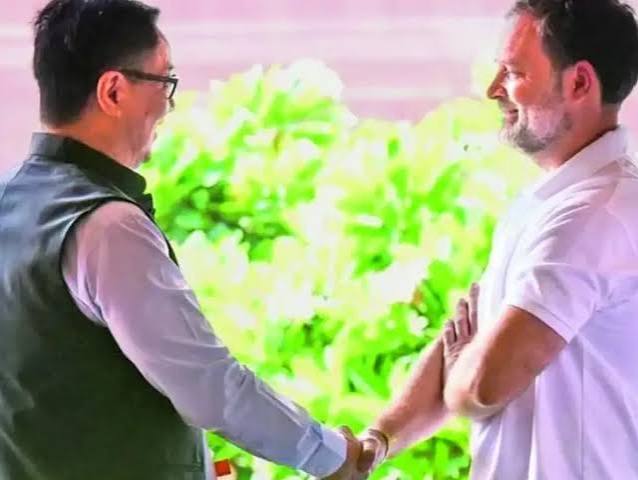
NEW DELHI: Parliamentary affairs minister Kiren Rijiju on Saturday targeted Lok Sabha leader of opposition Rahul Gandhi over his recent remarks on women’s freedom of expression and challenged him to support the BJP-backed Women’s Reservation Bill “unconditionally”. Rijiju’s remarks came after Rahul Gandhi posted a video calling for greater freedom of expression for women and arguing that India cannot fully develop without women being able to express themselves freely. Responding to the senior Congress leader, Rijiju said Rahul Gandhi’s message appeared to be a positive change and urged the Congress to support the Women’s Reservation Bill without conditions. “This seems to be a positive message from the Congress Party. There’s a visible change of heart in Shri Rahul Gandhi Ji about the Women. Now, I hope the Congress Party will support the Women’s Reservation Bill unconditionally,” the Union minister posted on X. The Congress and other opposition parties have supported the Women’s Reservation Bill but have opposed linking its implementation to the delimitation exercise. The opposition has demanded that women’s reservation be delinked from delimitation, which would determine the number of Lok Sabha seats. The Nari Shakti Vandan Adhiniyam, 2023, was passed by both Houses of Parliament. However, its implementation did not move forward after the Constitution (131st Amendment) Bill failed to secure the required two-thirds majority of members present and voting in the Lok Sabha on April 17. The legislation provides for 33% reservation for women in the Lok Sabha and state legislative assemblies and links its implementation to delimitation. Earlier, Rahul said in a social media video that women in India should be given greater freedom to express themselves in all areas of life. He said, “The energy of India’s women is trapped. It is not allowed to express itself. It is not allowed to imagine. For me, no country can be successful if its women are not expressing themselves. And I think a lot of my politics, and a lot of what politics should be in this country, is about making people understand that our country is stunted and incomplete without the expression of women.” Rahul further said, “It’s not just them doing well in business or politics, but being able to express in their houses, walk the streets comfortably, them putting a point of view that many don’t agree with, questioning their parents, husbands, brothers.” “A certain amount of freedom from patriarchy and the rigid control men put on women is required if India wants to develop. It has been assaulted and put in the back seat, and we have to bring back women into conversation and allow them to express,” the Congress leader added. Rahul posted his message on women’s freedom after meeting Gen Z protesters and highlighting the repercussions they have faced following their protests amid the crackdown. Courtesy : TOI Note: This news is originally published on https:/timesofindia.com/bha and is used purely for non-profit/non-commercial purposes, especially human rights