
Parliament passes Transgender Persons Amendment Bill, 2026 with Rajya Sabha approving it today
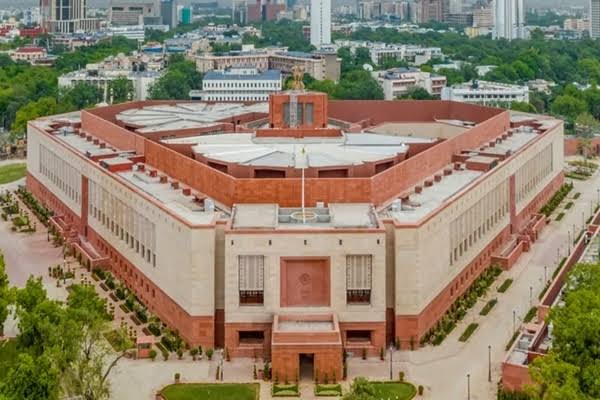
Parliament has passed the Transgender Persons (Protection of Rights) Amendment Bill, 2026, with the Rajya Sabha approving it today. The bill was passed by the Lok Sabha yesterday by a voice vote amid an Opposition-led walkout. The bill seeks to redefine the category of transgender, removes the provision of self-perceived gender identity and excludes several socio-cultural identities as well as transmasculine individuals from its ambit. It also further defines transgender persons within a biological framework, based on intersex variations and differences in sexual development. Replying to the discussion on the Bill in the Rajya Sabha, Social Justice and Empowerment Minister Dr Virendra Kumar said the government is compassionate towards the well-being of the transgender community. He said the Bill has provisions to empower the transgenders and give them dignity. The Minister said that the NDA government has taken several initiatives to bring transgender people to the mainstream and stop discrimination against them. Starting the discussion in the Upper House, Congress MP Renuka Chowdhury said this bill dilutes the privacy of an individual provided under the Constitution. Opposing the Bill, Ms Chowdhury said self-identification cannot be taken away through bureaucratic certification. Criticizing the government, she said that the proposed bill undermines the fundamental rights and dignity of transgender persons. Calling such a move wrong and illegal, she argued that forcing transgender persons to provide their identity through official certificates is against the spirit of equality and dignity guaranteed by the constitution. She also questioned the government’s approach for not properly consulting with the transgender community before bringing the Bill. She also referred to the Supreme Court’s landmark NALSA judgement of 2014, which recognized the right of transgender persons to self-identify their gender. Ms Chowdhury said the proposed Bill violates the principles laid down in that judgement and fails to respect an already established legal framework. DMK MP Tiruchi Shiva also opposed the Bill, saying that even if the Bill is passed in Parliament with a majority, it will be struck down by the Supreme Court. He further added that the Bill violates Articles 14, 15, 19 and 21 of the Constitution and it deprives the community of the right to freedom, dignity and self-determination. Supporting the Bill, BJP MP Medha Vishram Kulkarni said, ” This Bill ensures justice, dignity, protection from criminalisation and legal safeguards for transgender persons. She also thanked Prime Minister Narendra Modi for bringing this bill with certain amendments in order to ensure that the benefits reach the deserving people in a proper manner. She said there is a need for a law that brings justice to real transgender individuals and punishes fake ones. Mrs Kulkarni said the benefits should be extended to those who are transgender by birth. She said that the amendment to extend punishment will bring down the rate of crime and forced identities TMC’s Saket Gokhale said that 31% of Transgender people in India have attempted suicide because of the discrimination that they are facing. He alleged that now the government is going to start discriminating against them as though social discrimination were not enough. He called it unacceptable. Mr Gokhale expressed concern that gender is going to be decided by the Chief Medical Officer and a District Magistrate, and the bill does not prescribe any qualifications for the Chief Medical Officer. Sanjay Singh of AAP said the Bill is a big let-down for the transgender community. He accused the government of not doing anything for the community. RJD’s Manoj Kr Jha said that prejudices against transgender people should stop, and they should be able to live with dignity. He added that self-determination of gender should not be taken away. CPI(M)’s John Brittas said it is a black-letter day and the Bill is taking India a century back. He pleaded with the government to either withdraw the Bill or refer it to a Select Committee. Jaya Bachchan of the Samajwadi Party also questioned the government over the legislation. She sought to know what the urgency was in bringing the Bill, without examining it with the depth and care that it deserved. Courtesy : NOA Note: This news is originally published on https:/newsonair.com/bha and is used purely for non-profit/non-commercial purposes, especially human rights
The high cost of being trans in India, and how a new law could add to it

Although the 2026 amendment does not explicitly make gender-affirming surgery mandatory for all applicants of the transgender identity card, the requirement for a medical board review has created confusion and concern within the transgender community. Illustration showing transgender people alongside a medical board certificate, hospital bill, medicines and transgender identity card, highlighting the costs of legal recognition and healthcare. Megha*, a transgender woman from northern Kerala, got her transgender ID card in 2020, five years before undergoing gender affirmation surgery. Esha Kishore, another trans activist based in Kerala, got hers in 2015, also before undergoing gender-affirming procedures. The card is the legal document that certifies an individual’s gender identity under the Transgender Persons (Protection of Rights) Act, 2019, and neither had to undergo surgery to get it. They could apply based on their self-identification, with any medical procedures they choose to undergo coming later. Megha spent roughly Rs 3-4 lakh on her gender-affirming care, including surgery, hormone therapy, doctors’ fees, tests, travel, accommodation, food, and medication. She still spends over Rs 2,000 a month on medicines, a cost she will have to shell out for decades to come, since doctors advise most trans individuals to stay on hormone therapy until their 50s. Esha too spent a comparable amount on gender affirmation procedures, which she began a decade earlier than Megha. For many like them, legal recognition did not depend on whether, when, or how they chose to medically transition. But that has now changed. The Transgender Persons (Protection of Rights) Amendment Act, 2026, which came into force in May, removes statutory recognition of self-identification and requires a medical board to certify a person’s transgender identity. It also narrows the definition of who can be legally recognised as transgender, covering certain socio-cultural identities such as kinner, hijra, aravani, and jogta, as well as people with specified intersex variations. A heavily criticised provision also includes a separate category of people whom the law says have been compelled to adopt or present a transgender identity “by force, allurement, inducement, deceit or undue influence.” The amendment effectively excludes people whose identities are based solely on self-perception, including self-perceived trans-masculine, trans-feminine, and gender-non-binary identities. The change has left transgender persons, activists, and lawyers concerned about who will now be able to obtain legal recognition, and what the new medical-board process will require. For those who already have ID cards, however, there is some clarity. During a hearing on August 17, the Union government told the Supreme Court that transgender identity cards issued before the 2026 amendment would continue to remain operational, subject to the outcome of the petitions challenging the law. But for those seeking an ID card under the new system, the process could carry a significant medical and financial burden. Experts told TNM that requiring certification by a medical board could function as a surgery mandate in practice, even if the amendment does not explicitly say that surgery is compulsory. That could make expensive medical procedures and the costs of follow-up care a barrier to obtaining legal recognition, marking a significant departure from the earlier system, under which self-identification was enough to apply for a transgender ID card. What the amendment changed The Transgender Persons (Protection of Rights) Amendment Bill, 2026, was introduced in the Lok Sabha on March 13 and passed by the Lok Sabha on March 24 and the Rajya Sabha on March 25. It received presidential assent on March 30. The amendment makes three significant changes to the process of legal recognition. It removes the statutory right to self-identification, narrows the definition of a transgender person, and introduces a medical board as the authority responsible for certification. To understand why these changes matter, it helps to look at how the process worked earlier. Under the 2019 Act and the 2020 Rules, a person could apply to the District Magistrate for a certificate of identity as a transgender person by submitting an affidavit declaring their gender identity. The Rules specifically said the application was to be processed without a medical or physical examination. Surgery was therefore not required to obtain an initial transgender certificate. Medical intervention came into play if a person who already had a transgender certificate subsequently underwent surgery to change their gender to male or female and sought a revised certificate under Section 7 of the 2019 Act. Rule 6 of the 2020 Rules used the broader term “medical intervention” for this process, defining it to include counselling, hormone therapy, and surgical intervention, if any. The 2026 amendment changes the process for obtaining the initial certificate. The District Magistrate must now examine the recommendation of a designated medical board before issuing a certificate, although the amendment itself does not specify what medical tests, examinations, or criteria the board must use. A Tamil Nadu-based lawyer, who wishes to remain anonymous, told TNM that the new system could function as a surgery mandate in practice, even if the law does not explicitly say that every applicant must undergo surgery. “Until we get the rules under the amendment, we won’t be sure. But so far, surgery is mandatory. The 2019 Act also said surgery is mandatory, but the rules watered it down to ‘medical intervention’. The 2020 rule said the same. But now, with the 2026 amendment, they’ve restored the language of surgery.” While the lawyer’s interpretation goes beyond what the amended law expressly states, it points to the central concern raised by activists: a process that once began with an individual’s own declaration of their gender identity will now involve medical scrutiny by a state-appointed body. “What this amendment essentially does is shift that power into the hands of the government,” the lawyer said. That shift is significant in light of the Supreme Court’s 2014 landmark National Legal Services Authority (NALSA) judgement, which recognised transgender people’s right to self-identify their gender without making medical or surgical intervention a prerequisite. The 2019 Act subsequently gave statutory recognition to this principle. Section 4 recognised a transgender person’s right to be recognised
Dalit man dies after police detention, family alleges custodial torture

Meerut: A 28-year-old Dalit man allegedly died in police custody in Budaun, sparking controversy over the circumstances surrounding his death. Police claimed on Saturday that he fell ill at the station and subsequently died at a hospital, while his family alleged that he died due to custodial torture. A purported video showing Rajesh Kumar, who had been detained at Dataganj police station following a violent clash during a community feast that left two-three people injured, lying unconscious on the station floor surfaced on social media on Saturday. In the purported one-minute video, two policemen can be seen supporting Kumar and attempting to administer water to him. Budaun SSP Ankita Sharma said, “Rajesh was detained on Friday night. His health deteriorated after he returned from the toilet and he collapsed soon afterwards. He was taken to a community health centre and later referred to Budaun district hospital, where he died during treatment.” The SSP added, “CCTV footage showed no assault on Kumar. A medical panel conducted the postmortem and attributed his death to cardiogenic shock. An inquiry is underway.” Dr Ritesh Bhasin, a doctor at the local community health centre, said, “Rajesh was brought to the facility in a serious condition with breathing difficulties. Given his condition, he was referred to the district hospital for specialised treatment. No apparent external injuries were found on his body.” Kumar’s brother, Viresh, disputed the police account, saying Rajesh had no known history of heart disease. “Rajesh was taken to the police station and kept there overnight. He died at the station while in custody,” he alleged. Courtesy : TOI Note: This news is originally published on https:/timesofindia.com/bha and is used purely for non-profit/non-commercial purposes, especially human rights
BJP SC Morcha slams Keralam CM over remarks on dalit Christians quota
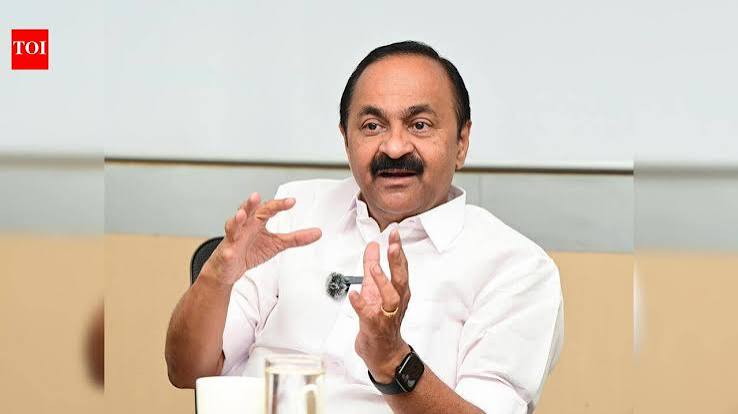
T’puram: BJP Scheduled Caste (SC) Morcha has demanded that chief minister V D Satheesan withdraw his statement regarding the state govt according top priority to providing reservation to dalit Christians. Morcha state president Shajumon Vattekkad said it was inappropriate for the CM to refer to reservation for dalit Christians in his speech while inaugurating the Mahatma Ayyankali Jayanti conference. “The CM’s policy of appeasing religious minorities has once again come to light through the statement,“ he alleged. Shajumon added that while the CM was unwilling to address the pressing issues faced by lakhs of SC community people in Keralam, he was adopting such a stand because he was “held captive by religious minority communalists”. He accused the CM of pursuing a politics of appeasement and double standards. Reservation provided to the SC community under the Constitution is not a concession granted by anyone but a right of the SCs, Shajumon said. BJP SC Morcha will mobilise the SC community in Keralam and launch a strong agitation against the govt to protect this right, he added. He also urged all SC organisations in Keralam to come out in protest against the CM’s statement. Courtesy : TOI Note: This news is originally published on https:/timesofindia.com/bha and is used purely for non-profit/non-commercial purposes, especially human rights
‘Each word she said cost my daughter her life’: TN Dalit mother on teen’s suicide

Speaking to TNM, the family of 16-year-old Dalit girl P Nishanthi solely blamed the allegedly casteist treatment she received from Vimala Devi, a government school headmistress, for her death. “I felt very hurt that she asked about my daughter’s character. I continued standing there with my hands folded, requesting them to somehow admit her,” P Thavamani (40) told TNM, recounting the incidents of the day before her 16-year-old daughter P Nishanthi died by suicide. Thavamani had taken Nishanthi to meet Vimala Devi, headmistress of the Government Model Higher Secondary School in Usilampatti, Madurai, on August 24 to apply for admission to class 11. Instead, Vimala Devi allegedly humiliated the girl for leaving her previous school, and her ‘character’ was scrutinised. “Seeing my folded hands, my daughter tapped my hand to ask me to lower it,” Thavamani continued. This triggered a sharp reaction from Vimala Devi, who allegedly asked, “Can’t you fold your hands in front of me? Are you that arrogant?” “She repeatedly shouted at my daughter, calling her arrogant and questioning what she had done at the previous school. Unable to tolerate the berating, my daughter started crying. [Vimala devi] then told her, ‘Get out. Leave the school.’ Those words affected my daughter deeply. She immediately ran out,” Thavamani recounted. Nishanthi’s family alleged that the incident caused her deep distress. Speaking to TNM four days after her death, the family solely blamed the allegedly casteist treatment she received from Vimala Devi for her death. Police have registered a case of abetment of suicide based on her mother’s complaint, naming headmistress Vimala Devi. The headmistress has denied the allegations, including any casteist remarks. ‘Character’ questioned Nishanthi hailed from Usilampatti in Tamil Nadu’s Madurai district and belonged to the Hindu Paraiyar community, which is classified under Scheduled Castes (SC). She was the second of three children born to Thavamani, a tailor in a garments factory, and Palaniswamy, a daily wage labourer. “She was very attached to us and was highly inclined towards studies. She would not even waste time enjoying festivals,” her family remembered. After completing class 10 from a government school in Thottappanayakkanur, she joined the Government Kallar Higher Secondary School (GKHSS) in Poochipatti for class 11 in June this year. Nishanthi had joined the Biology-Mathematics stream with ambitions of becoming a nurse, her sister Nikila told TNM. But when she struggled with some of the subjects, she wished to join the Commerce stream. However, the school refused to let her change the stream. “My daughter went to school unwillingly for some time. After that, she stopped going to school and stayed at home. She kept saying, ‘I don’t like it. I don’t want to go. Please put me in another school’,” Thavamani said. On August 24, Thavamani took Nishanthi to the Government Model Higher Secondary School in Usilampatti, where they met the headmistress Vimala Devi, who belongs to the Hindu Kallar community, which is classified as Other Backward Class. According to Thavamani, the headmistress questioned them over why they had come there after Nishanthi had already joined another school. “She asked, ‘What mistake did you commit there? You come here after having joined another school and we have to admit you? Don’t we have any other job?’” Vimala Devi then allegedly tried to contact the Government Kallar Higher Secondary School that Nishanthi had previously joined, in order to know about her ‘conduct’. When there was no response, she called the Thottappanayakkanur school where Nishanthi studied class 10. “She put the call on speaker phone. The teacher from Thottappanayakkanur said my daughter was a good student,” Thavamani said. Vimala Devi then allegedly asked, “How is her character?” This question about her daughter’s character hurt her deeply, Thavamani said. That was when she requested the headmistress with folded hands to admit her daughter to the school, prompting Nishanthi to gesture to her to not fold her hands. ‘She was emotionally drained’ After Vimala Devi asked her to “get out” of the school, Nishanthi walked for around five kilometres towards Nallamalpatti. When Thavamani found her, she brought her home in an autorickshaw. “When we got home, she lay down. I asked her to eat, but she refused. I don’t know whether she slept properly that night. She was emotionally exhausted,” Thavamani told TNM. The next day, August 25, Thavamani left for work, telling Nishanthi that she would return later to take her to the Kallar school to get her transfer certificate (TC). “I rarely get leave so I managed to get a 10 minute break to go get the TC,” she said. There, she was asked to wait for some more time. “I told the teacher, Manikkyan, that my daughter stopped going to school because he said she couldn’t be reassigned to the Commerce stream and told her to go to another school. He replied that they have to discipline students, and asked if that is reason enough to stop coming to school,” Thavamani alleged. “After some argument, we finally received the TC,” she said. She then returned to work, while Nishanthi went home, where she was alone. When Thavamani reached home that evening, she couldn’t initially find Nishanthi. “I searched the house, only to find her dead,” she said, breaking into tears. “While I was away, my daughter must have been thinking about everything that had happened. There was nobody at home to talk to her. I had gone to work, while she kept thinking about everything, and it caused her tremendous mental distress,” Thavamani said. ‘Each word headmistress said cost my daughter’s life’ For Thavamani, there is grief over losing her daughter, as well as anger over how Nishanthi was treated. She alleged that the headmistress Vimala Devi is solely responsible for her daughter’s death, and demanded legal action against her. “The headmistress is well educated and is in a higher position, administering a school. Wouldn’t she know how to speak to a common person like us?” she asked, adding, “Each word she said cost my daughter her life.
Dalit Mahapanchayat in Meerut today: Call for protest against beating of protesters in Lalita Gautam murder case
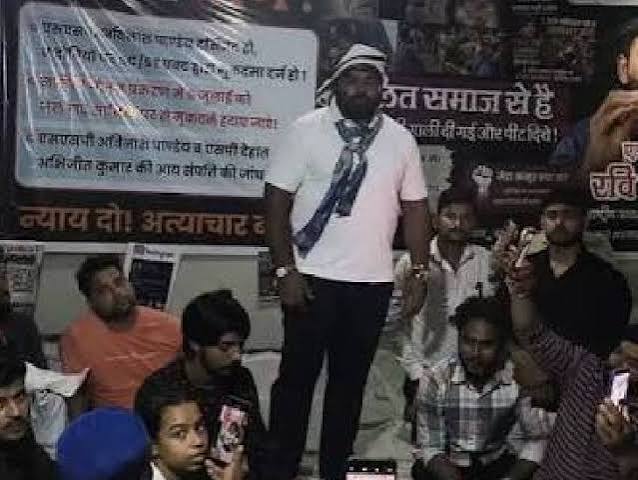
A Dalit Mahapanchayat has been called in Meerut today, Sunday. The Mahapanchayat will be held in the Commissioner’s Park. The Mahapanchayat is regarding the kidnapping and murder of Lalita Gautam, a BA student from the Scheduled Castes, resident of the Rohta police station area. On July 8th, the victim’s family, along with the National President of the Yuva Shakti Dal, Ravi Gautam, protested at the Collectorate gate. The National President of the Yuva Shakti Dal has launched a protest against the then SSP Avinash Pandey, accusing him of assaulting protesters. He has been sitting on a dharna at Chaudhary Charan Singh Park for ten days. A Mahapanchayat is being held at the Commissioner’s Park today, Sunday, regarding this matter. Meerut Police and the Intelligence Department have become active in connection with the Mahapanchayat. Barricades have been erected at the district’s borders, and security has been increased since night. On Saturday night, SSP BBGTS Murthy held a video conference with police officers to brief them on the security plan for the Mahapanchayat. Following this, ADG Bhanu Bhaskar himself addressed police officers via video conference late at night. Police teams were deployed at all district borders late at night. Police teams are continuously patrolling. All COs have been deployed in the field since last night to prevent outsiders from coming and disrupting the district’s atmosphere. Intelligence, LIU, and police teams have also been deployed around the Commissioner’s Park to ensure that the Mahapanchayat does not disrupt the district’s atmosphere and prevent political interference. The police administration is fully committed to ensuring that the Mahapanchayat does not take place. Ravi Gautam, Protesting in the Commissioner’s Park Yuva Shakti Dal National President Ravi Gautam stated that he and his family were protesting on the road outside the Collectorate on July 8th in connection with the case of a BA student from the Dalit community. It is alleged that during this time, the then SSP, Avinash Pandey, assaulted the protesters. The SSP detained the National President and slapped him. The matter escalated after a video of the incident went viral on social media. Following this, the police filed an FIR against Ravi Gautam and several others and sent them to jail. Since his release on bail, Ravi Gautam has been staging a protest at Chaudhary Charan Singh Park, demanding action against the then SSP and Rural Superintendent of Police (SP) Abhijeet Kumar. Leaders under house arrest since morning National President Ravi Gautam stated that the police are placing his colleagues attending the Mahapanchayat scheduled for Sunday under house arrest. According to him, the police are preventing his supporters from attending the Mahapanchayat in Hapur and Bulandshahr. Hunger strike and foot march to demand euthanasia Ravi Gautam stated that his fight will continue until justice is achieved. If he is denied justice, he will go on a hunger strike and will also march to Delhi, demanding euthanasia from the President. A large number of people are expected to attend the Mahapanchayat scheduled for today, Sunday. In view of this, the police and intelligence department have also begun preparations. Police officers will be monitoring the people associated with the Mahapanchayat and the expected crowd. The student’s family refused to attend the Mahapanchayat. Ahead of the Dalit Mahapanchayat, a video of the deceased’s father, Vedprakash, surfaced on social media. In the video, Vedprakash stated that politics is being played over his daughter’s murder and that he has nothing to do with the proposed Mahapanchayat. Vedprakash clarified through the video that Lalita Gautam’s murder is a serious incident for his family, but that no politics should be played in his daughter’s name. He denied any consent or involvement in the Mahapanchayat. Courtesy: Hindi News
Chirag Paswan, Jitan Manjhi clash over Dalit quota, seek resignations
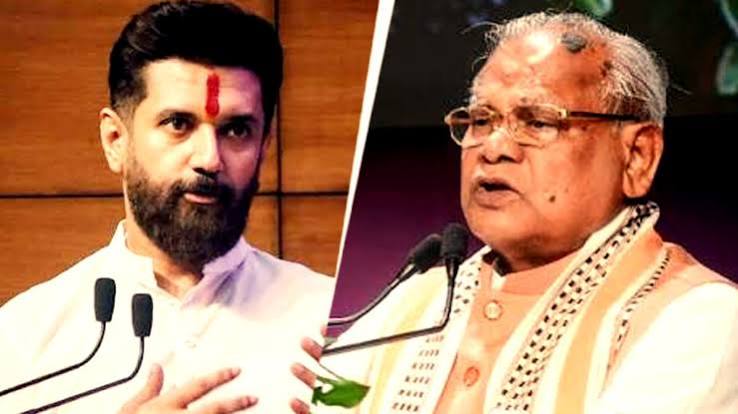
Union ministers Chirag Paswan and Jitan Ram Manjhi clash over a proposed Dalit sub-quota, with both sides demanding resignations.APN Exclusive content Union ministers Chirag Paswan and Jitan Ram Manjhi have clashed over the demand for a separate sub-category within the Scheduled Caste quota, with the disagreement escalating into calls for each other’s resignation.Online news platform The dispute began after Manjhi and his son, Bihar minister Santosh Kumar Suman, backed the idea of a sub-quota aimed at the most deprived sections among Dalits. Paswan, who heads the Lok Janshakti Party (Ram Vilas), opposed the proposal, arguing that it could create divisions within the community. Chirag Paswan opposes sub-quota Responding to questions about Manjhi and Suman’s position, Paswan said a separate sub-category would create a division within the Dalit community. He also linked the issue to the debate over the creamy layer and said those supporting the concept should give up their respective posts. Paswan’s position is also consistent with the stand taken by his late father, Ram Vilas Paswan, who had opposed the creation of a separate “Mahadalit” category in Bihar during Nitish Kumar’s tenure as chief minister. Jitan Manjhi demands Paswan’s resignation Manjhi rejected Paswan’s criticism and said it was Chirag Paswan who should resign. The former Bihar chief minister argued that some Dalit communities are more vulnerable than others and therefore require targeted welfare measures through a separate sub-category. Manjhi also questioned the relevance of the creamy-layer issue to the demand for a sub-quota. Santosh Suman backs father Santosh Kumar Suman also entered the dispute through posts on X. Without naming Paswan directly, he referred to him as his “younger brother” and said he would resign alongside Paswan if the latter took the lead. Suman maintained that his position was neither against reservations nor in favour of introducing a creamy layer. He argued that a quota within the existing quota system was different from the creamy-layer concept. He also cited communities including Musahar, Bhuia, Nat and Dom, saying they continue to face discrimination even within the Scheduled Castes. JD(U) seeks to end quota controversy The Janata Dal (United), the second-largest NDA constituent in Bihar after the BJP, sought to defuse the dispute. JD(U) legislature party leader and state minister Shrawon Kumar said reservations were introduced through the Constitution and that there should be no dispute over quotas. The disagreement between the two Union ministers comes amid a wider political debate over the distribution of reservation benefits among different Dalit communities Courtesy : APN News Note: This news is originally published on https:/apnnews.com/bha and is used purely for non-profit/non-commercial purposes, especially human rights
‘No interest in that right now’: Rahul Gandhi on Sonia Gandhi memoir row, cites ‘crime’ against Kharge
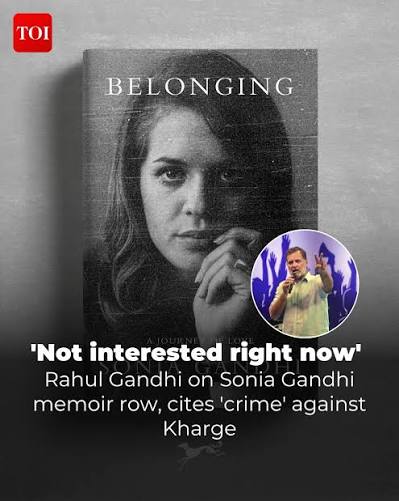
NEW DELHI: Congress leader Rahul Gandhi on Saturday said he had “no interest” in the controversy surrounding the upcoming memoir of his mother and former Congress president Sonia Gandhi, saying his sole focus at present was the “crime” committed against party chief Mallikarjun Kharge. The Lok Sabha leader of opposition was responding to a reporter’s question at his press conference on the “purification” ritual conducted after Kharge’s rally in Haldwani, Uttarakhand, earlier this month. “I call it a digression strategy. I have absolutely no interest in that right now. My interest lies in the crime that has been committed against Kharge ji,” Rahul Gandhi said, demanding “justice” for the veteran politican. The controversy surrounding Sonia Gandhi’s biography, titled “Belonging: A Journey Of Love,” arose from reports that publisher Penguin Random House India had declined to publish the book after she rejected proposed editorial changes. However, Penguin Random House India clarified in a statement on Friday that it was not the publisher of “Belonging” in India. “Any suggestion that Penguin Random House India decided not to publish ‘Belonging’ because the author declined editorial changes does not accurately reflect the circumstances,” the publisher said in a statement. However, it acknowledged that it remained “keen to publish the book”, while stressing that fact-checking and recommending editorial changes were part of its responsibility as a publisher. “As a publisher, it is both our prerogative and our responsibility to fact check and provide authors with recommendations that are in the best interests of their books. This is a normal part of the publishing process. Throughout the relevant discussions, Penguin Random House India’s position was that we remained willing and keen to publish the book. We will not comment further on confidential discussions with the author,” the statement added. On August 20, the birth anniversary of his father and former Prime Minister Rajiv Gandhi, Rahul Gandhi expressed his excitement over Sonia Gandhi’s biography. “I am happy, and so proud, that your story—‘Belonging: A Journey of Love’—will finally be read by the millions of people who love you. I know how hard it was for someone as private as you to tell the world your beautiful story. Today, on his birthday, I can see Papa smiling and looking down proudly at his beautiful Sonia,” the Congress MP wrote on X. The book is scheduled to be published on November 10. Courtesy : TOI Note: This news is originally published on https:/timesofindia.com/bha and is used purely for non-profit/non-commercial purposes, especially human rights
UP Cong reshuffle: From Priyanka’s circle to Rahul’s camp?
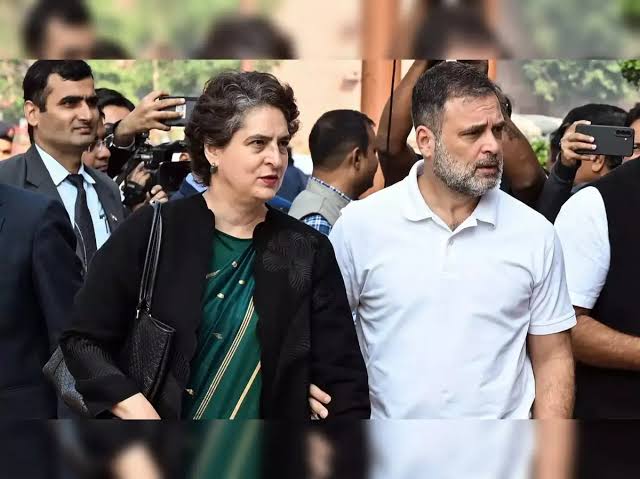
Lucknow: The recent organisational rejig in UP Congress is more than a routine change of roles, believe party insiders. To some of them, the changes speak for ‘the party moving towards a new set of leaders, seen as closer to Rahul Gandhi, to steer the UP unit ahead of the 2027 Assembly elections.’ “While the meteoric rise of new in charge Rajendra Pal Gautam – who left AAP to join Congress – is already a talking point among old-timers with references to Gautam’s proximity with Rahul, murmurs that newly appointed deputies given to him are handpicked by the Rae Bareli MP are doing the rounds,” a senior organisational member told TOI. To note, on Aug 6, All India Congress Committee general secretary appointed Abhishek Dutt, Kunal Choudhary, Jagdish Chander Jangid, Sanjeev Arya, Varun Choudhary and Abdul Hannan as AICC secretaries attached to AICC in charge. The party also appreciated the outgoing in-charges – Dheeraj Gurjar, Nilanshu Chaturvedi, Pradeep Narwal, Rajesh Tiwari, Satyanarayan Patel and Tauquir Alam. “All the six co-in-charges given a role in UP were groomed by Rahul under the Youth Congress Transformation Programme. Launched in 2006 from Punjab, this programme aimed to raise young leadership in the grand old party,” said a functionary, adding, “This exercise was based on performance… Those who do well grow up the ranks in the Congress organization. And all the co-in-charges for UP have walked past this route.” During the 2022 state elections, Priyanka Gandhi and her team were at the helm of affairs in UP though her journey began in 2019 with the role of general secretary in charge of eastern UP. With her came a group of young leaders who over time became an important and effective link between Priyanka and UP. The main man in Team Priyanka was Sandeep Singh – former Jawaharlal Nehru University Students’ Union president. “As personal secretary to Priyanka, Sandeep exuded influence and controlled matters in ways which upset scores of old-timers besides turning certain functionaries virtually redundant,” said a former departmental head in UPCC, adding that the new appointments have edged Team Priyanka out. Adding that two of Singh’s associates – Pradeep Narwal and Tauqeer Alam – were also from JNU and were later appointed as AICC secretaries along with Dheeraj Gurjar, he further said, “Together they completed the coterie (that also had Mohit Pandey and Anil Yadav in the wider team) which became involved in all the key decisions and was accused of causing infighting and factionalism inside India’s politically significant state unit.” Brushing this debate aside, UP Congress in charge Rajendra Pal Gautam said, “All this is bogus. There are no camps. Congress is one party. Those saying this are peddling propaganda.” UP Congress president Ajay Rai said, “These so-called interpretations appear to be manufactured propaganda planted by BJP to dampen our high spirits ahead of the 2027 elections. They have failed on all fronts and are now using rumour mills to create confusion in our base. But they will not succeed.” Courtesy : TOI Note: This news is originally published on https:/timesofindia.com/bha and is used purely for non-profit/non-commercial purposes, especially human rights
Congress & BJP clash over Haldwani ‘purification’ row, Rahul seeks FIR
NEW DELHI: BJP and Congress clashed Saturday over the opposition party’s allegation that the venue of its rally in Uttarakhand’s Haldwani was “purified” because of the presence of its president Mallikarjun Kharge, with Rahul Gandhi demanding an FIR as he linked it to the unconstitutional practice of untouchability. BJP slammed Rahul’s comments as his usual bid to divide Hindus on different grounds, including caste, and played videos of some of the organisers of the so-called purification exercise to rebut his charge. It also questioned Rahul for raising the issue so many days after the alleged purification on Aug 10. One of the organisers, Ankit Pal, said he was himself a dalit and that a ‘hawan’ was held after the venue was cleaned for Ramlila. The organisers have said they have no link with BJP. At a news conference, Rahul targeted the BJP and RSS over the “purification” and demanded that PM Narendra Modi order an FIR under SC/ST (Prevention of Atrocities) Act against all those involved in the matter. “We are demanding justice for the Congress president and it is the duty of central and state govt to ensure that Kharge ji gets justice in Uttarakhand. Every dalit faces humiliation from birth to death, everywhere, at every step,” he alleged. “Now the ball is in BJP’s court – an FIR must be filed under the SC/ST Act at the earliest, action must be taken, and justice must be served – otherwise, Congress knows very well how to secure justice,” Rahul warned. “If they take action, good. If they don’t take it, then there will be some reaction. These days, inaction has a much bigger reaction,” he said. “We will ensure action is taken against the culprits. Even if BJP fails to act, the entire Congress party will not let them escape…I guarantee it,” he added. BJP fielded its dalit spokesperson Guru Prakash Paswan and Sudhanshu Trivedi to counter Rahul. “Rahul always supports forces working to divide society and uses lies to set the narrative,” Paswan said. “The Congress MP jumps from one issue to another but the one theme that runs constantly is his tendency to put Hindus against each other,” Trivedi said. He cited a string of cases of violence against dalits, including in Rajasthan, Haryana and Karnataka, when Congress was in office in these states and accused the party of maintaining silence in incidents where aggressors were members of a particular community. Rahul, in reality, works to strengthen the agenda of Macaulay, Marx and ‘maulana’, he alleged Courtesy : TOI Note: This news is originally published on https:/timesofindia.com/bha and is used purely for non-profit/non-commercial purposes, especially human rights