
Eyewitness to Dalit youth murder case in Tehri arrested on rape charges

New Tehri, Diwakar Dimri, an eyewitness to the murder of Dalit youth Ketan Lal in Uttarakhand’s Tehri district, has been arrested on rape charges. Police announced this on Thursday. Police said Dimri was arrested on Tuesday evening on charges of raping a minor girl involved in the case. According to a police complaint filed by Dhanpal Lal, father of Ketan (18), a resident of Dewal village, at 11 pm on June 7, his son, along with his friend Dimri, arrived at the minor girl’s house in Kholgarh village at her call, where the girl’s family locked them in a room and severely beat them. The next morning, the minor girl’s father called Ketan’s family and asked them to take his son away. According to the complaint, when they reached Kholgarh, Ketan was found bleeding and died on the way to be taken for treatment. The injured Dimri was admitted to the district hospital for treatment. Now, with Dimri’s arrest, the incident that occurred last month in Kholgarh village in the Pratapnagar area has once again gained momentum, where the family members of the deceased staged a protest at the Collectorate on Thursday demanding the release of Dimri and the arrest of his alleged co-accused. However, Ketan’s family and villagers later ended the protest after District Magistrate Nitika Khandelwal assured them of a fair investigation. Earlier, the family members of the minor girl and the people of the area, who had long threatened to protest after Dimri’s arrest, postponed a planned protest and siege of the District Magistrate’s office on Wednesday. According to the police, a case of alleged rape was registered against Dimri on July 11 at the Lambgaon police station under various sections, including the Protection of Children from Sexual Offences (POCSO) Act, based on the complaint of the minor girl’s mother. During the investigation, he was arrested based on the victim’s statement and other evidence. Meanwhile, the deceased’s father, Dhanpal Lal, mother, Rukma Devi, along with other family members and villagers staged a sit-in protest at the Collectorate on Thursday, demanding the arrest of alleged co-accused in the Ketan murder case. The protesters alleged that other individuals were also involved in Ketan’s murder, against whom no action has yet been taken. They also claimed that the minor girl’s mother and others also played a role in Ketan’s beating. The protesters demanded that the case be heard in a fast-track court, all co-accused be arrested, the Forensic Science Laboratory (FSL) report be made public, and the arrest of arrested eyewitness Dimri. Investigating officer and Police Circle Officer Chandramohan Singh stated that the investigation is ongoing and four individuals have been arrested so far in connection with Ketan’s murder. He added that further action will be taken based on whatever facts and evidence emerge from the investigation. Deepti Shafiq This story has been auto-fed from Bhasha news agency. ThePrint is not responsible for its content. Courtesy: Hindi News
Tehri Dalit Teen Death Case: Fugitive Accused Arrested in POCSO Case

The people of Pratap Nagar had repeatedly appealed to the district administration to arrest the accused. Tehri: The death of a Dalit teen in the Lambgaon area is once again in the news. Based on the complaint filed by the minor victim’s mother, a case was registered at the Lambgaon police station under sections of the BNS and POCSO Acts. Following this, the Dalit teen’s friend was arrested today. During the investigation, based on the victim’s statements under sections 180 and 183 of the BNSS and other evidence, the absconding accused was arrested. The accused was produced in court today. The people of Pratap Nagar had repeatedly appealed to the district administration to arrest the accused. Following this, the police conducted raids at various locations to arrest the accused, and finally, the accused has been arrested. The Dalit teen was friends (or in a love affair) with a girl. On the night of June 7-8, after receiving a call from the girl, he and his friend went to meet her on a bike. The girl’s family members intercepted him there. They then took the Dalit teenager and his friend hostage. They reportedly assaulted them, resulting in serious injuries. The Dalit teenager died. After the Dalit teenager’s death, the case became a high-profile one. There was a huge uproar. Following this, Chandrashekhar Azad, MP from the Nagina parliamentary constituency in Uttar Pradesh, visited the Dalit teenager’s home. He met with the Dalit teenager’s family and assured them of his support. He also demanded a CBI investigation into the matter. Following this, several other revelations emerged regarding the case. The other party also demanded the arrest of the Dalit teenager’s friend, who was arrested today. Courtesy: Hindi News
BJP’s new strategy ahead of the 2027 Uttarakhand Assembly elections, attempts to garner the Dalit vote

BJP’s ‘Harmony Mission’ in Uttarakhand, using Saint Ravidas as a vehicle, new strategy for the 2027 Assembly elections, politics intensifies, report by Dheeraj Sajwan Dehradun: Ahead of the 2027 Uttarakhand Assembly elections, the BJP has decided to embark on its most significant social and political mission. To expand its reach among the Dalit vote bank in Uttarakhand, the BJP has launched a “Harmony Resolution Campaign” centered on the 650th birth anniversary of Saint Ravidas. The party aims to further strengthen its hold on the state’s approximately 17% Dalit vote bank. To achieve this, the Samrasata Sankalp Abhiyan will be launched in Uttarakhand, along with the entire country, in February next year, centering on the 650th birth anniversary of Saint Ravidas. The BJP is describing this campaign as a program of social harmony and cultural awakening. However, the opposition is calling it an electoral strategy to garner Dalit votes. According to political analysts, this campaign is not merely a religious or social event, but also a major political exercise to shift social equations in its favor ahead of the 2027 elections. 107 Ravidas temples will be the focus of the campaign, with the BJP reaching the booth level: Prime Minister Narendra Modi recently flagged off the Sant Ravidas Express from Jalandhar. Following this, the BJP is now launching a national-level “Samrasata Sankalp Abhiyan” leading up to the 650th birth anniversary of Sant Ravidas. The campaign will begin with the lighting of lamps on Guru Parva on July 29th, and various programs will be organized across the country until February 20, 2027. Crucially, election-bound states, including Uttarakhand, have been given special focus. 107 temples dedicated to Sant Ravidas in the state have been designated as the focus of the campaign. From Seer Govardhanpur in Varanasi, urns containing sacred soil from the birthplace of Sant Ravidas will be delivered to several states, including Uttarakhand. Following this, Kalash Yatras, social dialogues, seminars, and booth-level programs will be organized. The party’s objective is to spread the message of social harmony among the Dalit community while also strengthening its organizational base. BJP state spokesperson Mathura Dutt Joshi said, Congress attacks, saying, “The campaign is not about harmony, it’s an election stunt.” Congress has reacted sharply to the BJP’s campaign. Congress state spokesperson Pratima Singh called it an election stunt to influence the Dalit community. She said, “How can a party that has been accused of ignoring the ideas of Constitution maker Baba Saheb Dr. Bhimrao Ambedkar and weakening the spirit of the Constitution, talk about harmony?” Congress state spokesperson Pratima Singh said, “Large leaders like Lalu and Mulayam are the products of Lohia’s non-Congressism: Political analysts believe that the social and political structure of Uttarakhand is quite different from that of states like Uttar Pradesh. The Dalit community here has its own social history, local leadership, and distinct political behavior.” Senior political analyst Ravindra Nath Kaushik explains that, Furthermore, senior political analyst Ravindra Nath Kaushik further adds that, Caste equations are nothing new in Indian politics: Ravindra Nath Kaushik explains that caste equations are nothing new in Indian politics. Dr. Ram Manohar Lohia’s non-Congressism movement gave a new direction to backward class politics, which later led to the emergence of leaders like Lalu Prasad Yadav and Mulayam Singh Yadav. He says that the BJP has also been conveying political messages from time to time through social representation. The recent appointment of Babita Sahotra to the Child Welfare Committee can also be considered part of this broader social strategy. According to him, the purpose of starting the campaign now is to ensure that this message continues to resonate with the society until the elections. Haridwar and Terai are the most focused areas, with the Bhim Army and BSP also a challenge: Senior journalist Bhagirath Sharma believes that the BJP’s entire strategy in Uttarakhand has been designed with Haridwar and the Terai region in mind. According to him, the BJP did not achieve the expected success in the Haridwar district in the last assembly elections. In the 2022 elections, out of the 11 assembly seats in the district, the BJP was able to win only three: Haridwar, Roorkee, and BHEL Ranipur. The remaining seats were won by Congress, BSP, and independent candidates. Dalit voters played a decisive role in most of these areas. Senior journalist Bhagirath Sharma says, Dalit voters are in a position to influence election results in many assembly seats: According to Bhagirath Sharma, Dalit voters are in a position to influence election results not only in Haridwar, but also in several assembly seats in the Pachhadun region of Dehradun, Doiwala, Rishikesh, Udham Singh Nagar, and Nainital districts. This is why the party is already developing a network of social dialogue down to the booth level. Political experts believe that an important aspect of Uttarakhand politics is that the Dalit community has been deeply connected not only to national symbols but also to its local social leaders. Devbhoomi has given birth to numerous Dalit leaders and social reformers like Jayanand Bharti, Hari Prasad Tamta, and Khushi Ram Arya, whose social acceptance remains intact in many areas. In such a situation, the biggest question will be whether the national-level harmony campaign in the name of Saint Ravidas will be able to influence Uttarakhand’s local social symbols, or will the state’s politics continue to revolve around local social identities. However, it is certain that political parties’ activism and social campaigns aimed at the Dalit vote bank will intensify in the coming months ahead of the 2027 assembly elections. The Dalit community can play a decisive role in Uttarakhand’s electoral politics: While the BJP is striving for social expansion through harmony, the Congress, BSP, and Bhim Army are facing the challenge of maintaining this same social base in their own ways. In such a situation, the Dalit community may once again play a decisive role in Uttarakhand’s electoral politics. Courtesy: Hindi News
‘7.5 crore students affected in 10 years’: Rahul Gandhi calls paper leaks the ‘norm’ at Chhatron Ki Goonj programme in Dehradun
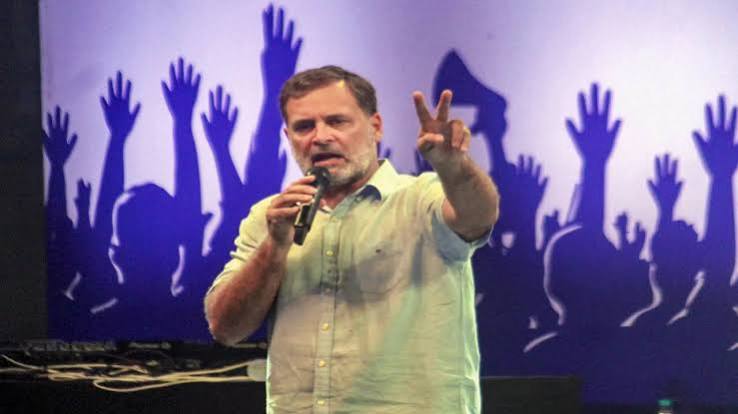
NEW DELHI: Congress leader Rahul Gandhi on Friday said India’s education system has reached a stage where paper leaks have become “the norm”, alleging that the issue affects millions of students and requires a political consensus to resolve. Addressing a student outreach programme, “Chhatron Ki Goonj,” in Uttarakhand’s Dehradun, he clarified that the event was not a political meeting but focused on the concerns, struggles and future of the youth. “This is not a political meet; it’s about youth, their future, struggles and difficulties,” PTI quoted the Lok Sabha leader of opposition as saying. The Raebareli MP further said that more than 7.5 crore students had been affected by paper leaks over the past 10 years, with 152 cases reported but no convictions recorded. “From top to bottom, the entire education system is involved in paper leaks,” he claimed, adding that “advanced technology” was being used to carry out such frauds. “If you have crores, you can select from a menu card of paper leaks,” the Congress leader stated. Rahul Gandhi also called for a political consensus to end paper leaks, stressing that all parties must implement measures to protect students. “There can be political consensus on ending paper leaks which everyone must implement,” he added. Calling for reforms in the examination system, he argued that the existing model was “outdated” and needed to evolve. “The current exam testing system is of the 19th century; we must evolve a 21st-century system,” the asserted. He proposed shifting from a government-centric to a student-centric examination framework, with secure question banks and randomised question papers to prevent leaks. “Today’s exam system is government-centric; we want a student-centric system,” he maintained. Rahul Gandhi also demanded protection and compensation for students affected by paper leaks, along with immediate re-examinations for those impacted by compromised tests. On educational institutions, he argued that political organisations should not control campuses and that vice-chancellors should not be appointed from a single organisation. “No political party or organisation should have a hold on any educational institution; VCs shouldn’t be from one organisation,” Rahul Gandhi stated. He further claimed that the current system benefits a small section while harming honest students. “One per cent uses the system, follows the path of paper leaks and hurts the 99 per cent others who are honest and poor,” he concluded. Courtesy : TOI Note: This news is originally published on https:/timesofindia.com/bha and is used purely for non-profit/non-commercial purposes, especially human rights
Tehri Dalit Teen Murder Case: Case Registered Based on a Complaint from the Girl’s Mother
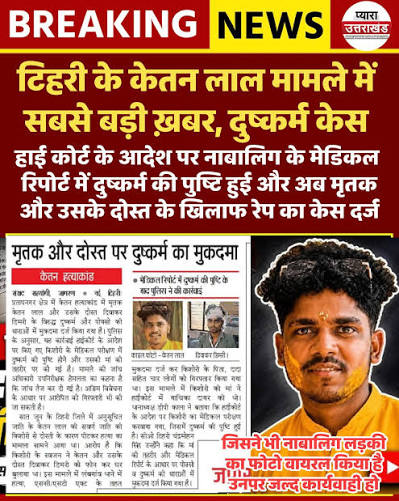
New information has emerged in the Tehri Dalit teen murder case. A case has been filed based on the girl’s mother’s complaint. Tehri: A new twist has emerged in the recent murder of a Dalit teen in Tehri district, Uttarakhand. According to the police, after the minor girl’s medical examination, a case has been registered at Lambgaon police station based on the girl’s mother’s complaint. A case has been filed under various sections, including the POCSO Act. The investigation will be conducted by female SI Hemlata. In fact, around 11 pm on the night of June 7-8, a minor teen from a village in the Lambgaon police station area went with his friend to a nearby village to meet his friend (a love affair case). The girl’s family members apprehended the two boys. It is alleged that the girl’s family members assaulted the two boys, leaving them seriously injured. Both were subsequently admitted to the hospital, where the minor girl’s friend (boyfriend) died. Based on a complaint filed by the deceased boy’s family, the police arrested four people, including the girl’s father and grandfather. The deceased minor boy’s friend is an eyewitness to the incident, and the police have now filed a case under the POCSO Act. The minor girl’s mother also filed a complaint with the police station, but the police did not register a case. However, the High Court later ordered the police to hear the minor girl’s side of the story. Following this, on July 11, the Lambgaon police station filed a case under the POCSO Act against the deceased’s friend, who was also an eyewitness to the incident. Investigating officer and CO Chandramohan stated that female SI Hemlata has been authorized for this purpose. Led by the former village head of the minor girl, people also met with Tehri SSP Shweta Choubey, demanding harsh punishment for the culprits and a change in the investigating officer. Courtesy: Hindi News
Rape case filed against ‘murdered’ Dalit youth after HC prod
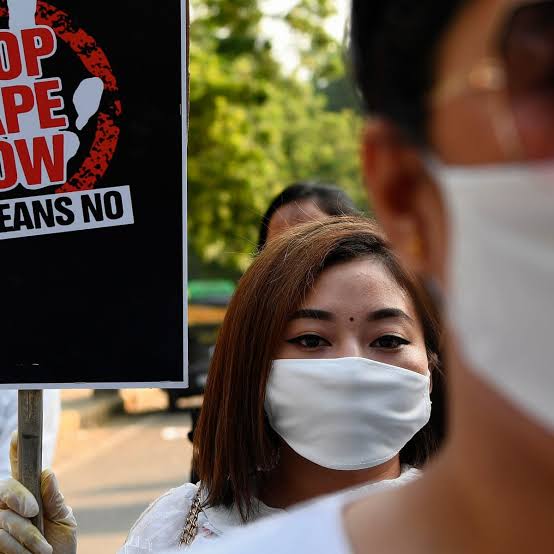
Dehradun: In a fresh turn of events in the Tehri Garhwal suspected “honour killing” case, Uttarakhand police have registered a case of gang-rape against the deceased 16-year-old Dalit youth and his friend. The action follows a directive from the high court after the parents of the minor upper-caste girl presented a medical examination report suggesting sexual assault. The FIR was registered on Sunday after the direction of the court following a formal complaint by the girl’s mother. Tehri Garhwal SSP Shweta Chaubey confirmed to TOI that a case of gang-rape has been filed under BNS Section 70 alongside relevant sections of the Pocso Act. “On the basis of the complaint, the minor deceased youth and his friend were named in the case. However, as the minor is no more, we have taken appropriate legal action under relevant provisions while considering the medical examination report. A probe is ongoing,” said SSP Chaubey. The case dates to June 7, when the 16-year-old Dalit boy was allegedly beaten to death by the minor girl’s family members. According to the initial police investigation, the boy and his friend had gone to the girl’s house late at night after receiving a phone call from her. The girl’s family allegedly caught them, leading to the fatal physical assault. Following the teenager’s death, police had registered a case of murder and physical assault, subsequently arresting four accused individuals, including the girl’s father and grandfather. The investigations into both the murder and the subsequent sexual assault allegations are currently underway. Courtesy : TOI Note: This news is originally published on https:/timesofindia.com/bha and is used purely for non-profit/non-commercial purposes, especially human rights
Uttarakhand Dalit Boy Murder: FIR Filed Against Deceased’s Friend Based On Girl’s Mother Complaint
Four people, including the father and grandfather of the girl, were arrested based on a complaint lodged by the family of the deceased boy. Tehri: The police in Uttarakhand have registered a case in the killing of a Dalit minor boy based on a formal complaint filed by the minor girl’s mother. Charges under the POCSO Act and other sections have been filed at the Lambgaon police station. After the killing of a Dalit minor boy in Tehri district, the police have filed a case under the POCSO Act on July 11 against the deceased’s friend, who is an eyewitness in this case. The incident took place on the night between June 7 and 8, when the Dalit minor boy, along with his friend, went to the nearest village around 11 pm to visit a minor girl with whom he had a romantic affair. However, the family of the minor girl found the boys and assaulted them brutally. The victims were taken to a hospital, and later, the boyfriend of the girl died due to injuries sustained. Four people, including the father and grandfather of the girl, were arrested based on a complaint lodged by the family of the deceased boy. The mother of the minor girl had also complained to the police at the time, but no case was registered immediately. The turning point arrived when the High Court directed the police to listen to the side of the minor girl. According to the investigating officer and CO Chandramohan, Hemlata, a sub-inspector, has been given the responsibility of investigating this aspect of the case. In the meantime, there have been tensions both politically and locally due to the case. A delegation visited Tehri SSP Shweta Chaubey demanding severe action against the accused as well as a replacement of the investigating officer. Previously, protestors belonging to the Bhim Army, along with MP Chandrashekhar Azad and MLA Umesh Kumar, went on a hunger strike following their interception by the police in Haridwar while trying to proceed towards Tehri. Courtesy : ETV Bharat Note: This news is originally published on https:/etvbharat.com/bha and is used purely for non-profit/non-commercial purposes, especially human rights
‘System failed our children’: Congress holds candle march in Dehradun over paper leaks
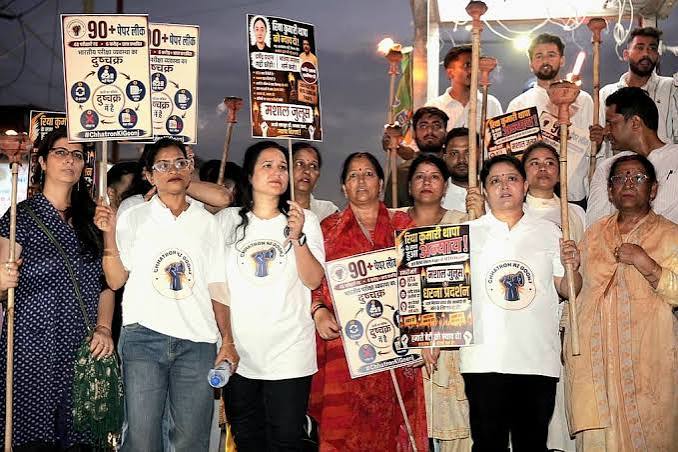
The march began from the residence of 23-year-old Riya Thapa in Pooja Vihar. Riya, a resident of Dehradun, was found dead at her home a few days ago. DEHRADUN: Congress workers took out a candle march in Dehradun on Saturday to protest recurring paper leaks, corruption and mismanagement in competitive examinations across the country. The march began from the residence of 23-year-old Riya Thapa in Pooja Vihar. Riya, a resident of Dehradun, was found dead at her home a few days ago. A Class 12 topper with 97.6% marks, she was preparing for NEET after completing school. Family members, relatives, local residents and Congress workers paid tribute to her and observed a two-minute silence for the peace of her soul. Party leaders said the protest was held both to demand justice for Riya and to highlight the plight of lakhs of aspirants facing uncertainty in national examinations. Congress leader Vaibhav Walia said Riya’s death reflects a larger crisis in the education system. “Riya Thapa’s untimely death is not just the tragedy of one family. It is a symbol of the failure of the country’s education system,” Walia said. He alleged that repeated paper leaks in NEET and other examinations, along with corruption and administrative negligence, have pushed the future of millions of students into darkness. “Students who work for years have lost faith in the government’s system. Their dreams are being toyed with again and again,” he said. “The government has completely failed to secure the future of the country’s youth.” The Congress organised a torchlight procession in Dehradun, led by State Mahila Congress president Jyoti Rautela. Students, parents, youth and citizens joined the march to demand accountability and a fair examination system. Rautela said the participation showed that young people will no longer accept any tampering with their future. “By joining this people’s movement, the youth have sent a clear message that they will not accept any kind of manipulation with their future,” she said. She added that the student campaign being led by Leader of Opposition Rahul Gandhi has now become the voice of the common people. “This is not just a fight for justice for Riya Thapa. It is a fight for a fair and transparent examination system, for accountability, and for the dignity of every student in the country,” Rautela said. The Congress said similar protests will be held in other districts to press for strict laws against paper leaks and for the protection of students appearing in competitive examinations. Narendra Sethi Courtesy : TNIE Note: This news is originally published on https:/thenewindianexpress.com/bha and is used purely for non-profit/non-commercial purposes, especially human rights
Thirty years on, justice remains elusive for Dalits in Uttar Pradesh, Uttarakhand and Haryana
A chapter in a major 30-year review of the PoA Act argues that institutional failures, rather than legislative gaps, remain the biggest obstacle to justice Thirty years after Parliament enacted the Scheduled Castes and Scheduled Tribes (Prevention of Atrocities) Act, 1989, a landmark review of the law has concluded that the promise of justice for Dalits and Adivasis remains far from realised. Published by the Human Rights Advocacy and Research Foundation (HRF), The Elusive Search for Justice: 30 Year Review of the SCs & STs (PoA) Act brings together the work of former civil servants, lawyers, academics, human rights defenders and Dalit rights activists to assess how India’s principal anti-atrocities legislation has functioned over three decades. Across its chapters, the report paints a troubling picture of rising atrocities, persistently low conviction rates, and poor implementation of victim compensation schemes, weak monitoring mechanisms, and widespread institutional failures that continue to undermine access to justice. The report’s central conclusion is that while Parliament has repeatedly strengthened the law through amendments and expanded protections for victims, the institutions responsible for implementing these safeguards have largely failed to match the law’s ambition. Among the most revealing contributions to the volume is a chapter by activist, writer and human rights defender Vidya Bhushan Rawat, who examines the functioning of the Act in Uttar Pradesh, Uttarakhand and Haryana. While the broader report identifies national trends of weak implementation and institutional apathy, Rawat’s chapter shows how these failures manifest on the ground, in police stations, district administrations, courts and villages across northern India. Unlike chapters that focus on legislative history or national statistics, Rawat’s contribution is rooted in lived experiences. Drawing on field investigations, case studies, Right to Information disclosures and years of engagement with Dalit communities, he examines the obstacles faced by survivors seeking justice under the PoA Act. Rawat’s account suggests that the greatest barriers often emerge not in the courtroom but much earlier, at the stages of complaint registration, investigation and administrative response. Rawat’s central argument is that the crisis confronting the PoA Act is no longer one of legislative inadequacy. Over three decades, Parliament has progressively strengthened the law, expanded the list of recognised offences, enhanced victim protections and introduced new accountability mechanisms. Yet the effectiveness of these provisions ultimately depends upon the willingness of police officers, prosecutors, district administrations and local governments to enforce them. It is at this level, he argues, that the law repeatedly breaks down. The result is a system in which the formal existence of legal rights often bears little resemblance to the realities experienced by Dalit survivors attempting to access protection, accountability and justice. The hidden crisis behind atrocity statistics Rawat begins by challenging a common assumption that official crime statistics adequately capture the scale of caste violence. For many observers, NCRB data provides the principal measure of atrocities committed against Scheduled Castes and Scheduled Tribes. Rawat argues that these figures reveal only a fraction of the reality. The larger problem, he suggests, lies in the vast number of incidents that never enter official records at all. Across Uttar Pradesh and neighbouring states, Dalit complainants frequently encounter resistance at the very first stage of the criminal justice process. Police officials may refuse to register FIRs under the PoA Act, dilute charges, classify incidents as ordinary criminal disputes, or encourage parties to arrive at informal compromises. In many villages, survivors must navigate local power structures before they can even reach a police station. The consequence is that official statistics may reflect only those cases that successfully overcome multiple layers of institutional resistance. Rawat argues that any assessment of the PoA Act that relies exclusively on registered cases risks overlooking the structural barriers that prevent countless incidents from being formally recognised as atrocities in the first place. Uttar Pradesh: The limits of legal protection Among the three states examined, Uttar Pradesh occupies a central place in Rawat’s analysis. The state has long recorded some of the highest numbers of crimes against Scheduled Castes in the country. Yet Rawat contends that these figures tell only part of the story. The deeper problem lies in the persistent inability of victims to secure meaningful justice after a case is reported. According to the chapter, many police officials continue to approach caste atrocities through the lens of local disputes rather than recognising them as manifestations of entrenched social discrimination. Complaints are often discouraged, investigations delayed, and statutory provisions under the PoA Act either ignored or improperly applied. Rawat argues that this administrative response reflects a broader reluctance within state institutions to confront caste power directly. Rather than functioning as neutral enforcers of the law, institutions frequently mirror the social hierarchies that the legislation was intended to challenge. The Case of Shivam: A child, a crushed arm, and a system that failed To illustrate these dynamics, Rawat recounts the case of Shivam, an eight-year-old Dalit child from Jaunpur district whose arm was allegedly crushed in a sugarcane-crushing machine owned by an upper-caste family in December 2015. The incident should have triggered an immediate legal response. Instead, according to the account presented in the chapter, the family encountered resistance from law-enforcement authorities when they sought to pursue the matter. Efforts to register a complaint were allegedly met with indifference, while those assisting the family reportedly faced hostility from officials. What makes the case particularly significant for Rawat is not merely the injury itself but the social environment surrounding it. The family belonged to a community economically dependent upon dominant-caste landowners. Villagers were reportedly unwilling to speak openly about the incident, fearing repercussions. The imbalance of power was such that even seeking justice carried social and economic risks. Ultimately, concerns for safety and survival reportedly forced the family to leave the village. For Rawat, the episode demonstrates how caste violence cannot be understood solely as a criminal act. It is sustained by relationships of economic dependence, social exclusion and institutional indifference that make accountability exceptionally difficult to achieve. Hundreds of cases, no convictions Perhaps the
Uttarakhand: Dalit taxi driver humiliated by garlanding him with shoes for picking up passengers at a lower fare, video also filmed!

The accused allegedly abused, used casteist slurs, assaulted him, and demanded 50,000 rupees for charging a lower fare. When Prem Ram protested, they put a garland of shoes around his neck, snatched his mobile phone, and uploaded a video of the incident to social media. Champawat – A shameful incident involving a Dalit taxi driver has occurred in the Lohaghat area of Champawat district, Uttarakhand, following a dispute over carrying passengers at a lower fare. The victim driver was allegedly assaulted and publicly humiliated by other taxi drivers by garlanding him with shoes. After the video of the incident went viral on social media, police took immediate action and filed a case against four accused under the SC/ST Act. On June 10, Prem Ram was carrying passengers from Lohaghat to Delhi at the old fare rate when other taxi drivers stopped his vehicle near Devradi Band. The accused allegedly abused Prem Ram, used casteist slurs, assaulted him, and demanded 50,000 rupees for charging a lower fare. When he resisted, they put a garland of shoes around his neck, snatched his mobile phone, and uploaded a video of the incident on social media. The victim has filed a complaint at the Lohaghat police station. The family stated that they are deeply hurt by the incident. Prem Ram is currently in Delhi. Lohaghat police have registered a case against four accused: Sohan Singh, Harish Bohra, Virendra Singh, and Mohan Chandra. The case has been registered under various sections of the SC/ST Act, the IT Act, and the BNS, including sections 352, 351(3), 133, 126, 308(2), 309(3), 356, and 152(2). Champawat SP Rekha Yadav has personally monitored the case. CO Niharika is investigating. The search for the accused is ongoing. On June 13, the victim’s side submitted a memorandum to District Magistrate Manish Kumar. The District Magistrate assured strict action and directed the Transport Department to investigate fares on the Delhi-Dehradun route. Meanwhile, a large crowd gathered at the Lohaghat police station and demanded strict punishment for the accused. The SC community called it “inhumane.” Geetha Sunil Pillai Courtesy: Hindi News