
15 killed, including two children, in Kolkata hotel fire; several injured critical, SIT formed

Blaze breaks out at Mechuapatti hotel with 88 boarders; fire contained after hours, cause still under investigation. KOLKATA: Fifteen people, including a woman and two children, were killed in a devastating fire at a hotel in the Mechuapatti area of central Kolkata, police said on Wednesday. Thirteen others were also injured in the fire that broke out on Tuesday evening, a senior police officer said. Prime Minister Narendra Modi expressed anguish over the loss of lives in the fire incident, and announced ex gratia of Rs 2 lakh to the next of kin of each deceased. “Anguished by the loss of lives due to a fire mishap in Kolkata. Condolences to those who lost their loved ones. May the injured recover soon. An ex-gratia of Rs 2 lakh from PMNRF would be given to the next of kin of each deceased. The injured would be given Rs. 50,000,” the prime minister’s office said on X. According to the Kolkata Police officer, the deceased include 11 men, eight of whom have been identified so far. The condition of several of the injured is said to be critical, he said. “There were 88 guests in 42 rooms at the time of the incident. A boy, a girl and a woman are among the dead. The cause of the fire is yet to be ascertained. Our forensic team will examine the site, which has been cordoned off,” the officer said. The fire at the low-cost Rituraj Hotel was first reported around 7:30 PM on Tuesday. Ten fire tenders were pressed into service, and the blaze was brought under control, after nearly 10 hours, this morning on Wednesday, a fire and emergency services official said. “There were 15 fatalities in last night’s fire. Eight of the deceased have been identified,” state minister Sujit Bose told PTI. In the wake of the tragedy, the Kolkata Police has constituted a Special Investigation Team (SIT) to probe the incident. West Bengal BJP president Sukanta Majumdar lashed out at Chief Minister Mamata Banerjee, accusing her of “insensitivity” for attending a day-long inauguration programme of Jagannath Dham in Digha while the fire tragedy was unfolding in the state capital. “Yesterday, a devastating fire in the Mechhua area of Burrabazar claimed the lives of more than 14 innocent people. Many more are battling for their lives. Yet, the chief minister chose to remain silent and continued with her religious event in Digha,” Majumdar said in a strongly worded statement. “This exposes her lack of empathy and the failure of her administration. While helpless citizens were trapped in flames and dying in pain, the CM was busy exploiting religion for political gain. Her year-round appeasement and election-time religious posturing have once again taken precedence over governance,” he alleged Majumdar called upon BJP workers across the state to immediately mobilise relief efforts and extend support to the victims’ families. “I will personally stand by the affected families and oversee our party’s involvement in the rescue and relief operations,” he said. Courtesy : TNIE Note: This news is originally published on https://thenewindianexpress.com and is for use by the non-military/non-commercial community, especially those in the human rights sector.
Dalit settlements no longer colonies: Stalin
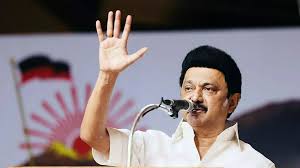
Chennai: Chief minister M K Stalin on Tuesday announced that the word ‘colony’ will be removed from all govt records and public usage. He described it as a symbol of discrimination against the indigenous people of the land and a term now associated with untouchability. Colonies refer to segregated residential areas in villages inhabited by dalits. The announcement came during Stalin’s speech during the debate on demand for grants for the home department in the assembly. He said the govt decided to act because the word was now being used in a derogatory sense. Stalin further stated that Sept 6 will be observed as ‘Police Day’ in Tamil Nadu. Responding to opposition criticism of the law-and-order situation in the state, Stalin issued a sharp rebuttal. “This is not Manipur, this is not Kashmir. There are no deaths like the UP Kumbh Mela. This is Tamil Nadu. Don’t forget that,” he said. Stalin said Tamil Nadu’s overall growth was rooted in its peaceful atmosphere, crediting the police force for maintaining law and order. He said while ministers and officials contribute to progress, the state’s development is built on the foundation of peace. “A peaceful state supports industrial growth, education, empowerment of women and youth, sports, and increased production,” Stalin said, commending the police for helping the state avoid major riots, violence, and unrest. He urged the police force not only to reduce crime but also to work towards preventing it. “Preventing crime is not the responsibility of the police alone. It requires the cooperation of the public,” he said. Calling on citizens to respect the law and practise self-discipline, Stalin said the public must avoid negligence and take active steps to prevent crime. He reminded police officers to treat people with respect and avoid letting personal biases affect their conduct. “Police and public must function as partners to maintain peace,” he said. Stalin went on to list several achievements of his govt, including the elimination of dropouts in middle schools and a 9.69% growth rate projected for 2024–25. Comparing govt’s challenges to a person trapped from all sides, the chief minister said, “Like a man with a snake above, foxes below, a moat if he jumps, and a wall if he runs, the state govt has achieved progress by overcoming Union govt on one side, governor on another and financial crunch on another side. “This is not the achievement of one person named Stalin. This is the result of the efforts of my cabinet and officials,” he said. “This is not a party’s govt. It is a govt based on a philosophy.” He ended his speech by saying, “Whatever achievement was witnessed so far is only Part-I of the Dravidian model govt. Version 2.0 is loading for 2026. We will create more records then,” he said. Courtesy : TOI Note: This news is originally published on https://timesofindia.com and is for use by the non-military/non-commercial community, especially those in the human rights sector.
‘INDI’s hand with Pakistan’: Posters target Rahul Gandhi ahead of visit to former constituency Amethi
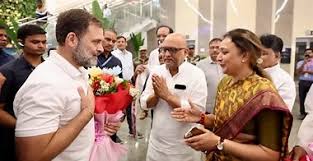
NEW DELHI: Ahead of Rahul Gandhi’s Amethi visit on Wednesday, posters were put up in the Congress MP’s former Lok Sabha constituency targeting him and leaders of the party-led INDIA bloc for taking a “pro-Pakistan” stand amid escalating tensions with the neighbouring country over last week’s terrorist attack in Jammu and Kashmir’s Pahalgam. Gandhi is on a two-day visit to Rae Bareli, which he currently represents in the Lok Sabha, and Amethi. He visited Rae Bareli on Tuesday. “INDI’s hand is with Pakistan,” one of the posters read. Hand is the Congress’ symbol. The poster had comments from National Conference supremo Farooq Abdullah and Congress leader Vijay Wadettiwar. It called Gandhi a “sympathiser” of terrorism (“Aatank ka saathi”). Similar banners were put up across the Uttar Pradesh town targeting the opposition INDIA group leaders for making statements “favouring” Pakistan. The Congress and other opposition parties have declared their complete support to the government as it plans India’s response for the Pahalgam attack, carried out by Pakistan-backed terrorists. However, stray remarks from its leaders forced the grand old party to distance itself from their comments. “Some Congress leaders have been speaking to the media. They speak for themselves and do not reflect the Congress’ views. There should be absolutely no doubt whatsoever at this most sensitive of times that the CWC resolution, the views expressed by (Congress president) Mallikarjun Kharge and Rahul Gandhi and the views of authorised AICC office-bearers ALONE represent the position of the Congress (sic),” Congress general secretary in-charge of communications Jairam Ramesh said in a post on X. Last night, after much outrage, the party deleted a social media post in which it accused Prime Minister Narendra Modi of going “missing” during the crisis. The image, which showed a headless PM, was captioned “Gayab” (missing). Courtesy : TOI Note: This news is originally published on https://timesofindia.com and is for use by the non-military/non-commercial community, especially those in the human rights sector.
Rahul visits MCF in Rae Bareli

Lucknow: Local MP and leader of opposition, Rahul Gandhi, visited the Modern Coach Factory in Rae Bareli on Tuesday alongside Amethi MP Kishori Lal Sharma. MCF General Manager Prashant Kumar Mishra and other senior officials welcomed them and provided detailed information about the factory’s operations and products. During his visit, Gandhi examined various railway coaches and wheels produced at the facility. The inspection included different types of coaches such as Sleeper, AC 3-Tier Economy, AC Pantry Car, Non-AC Chair Car, Tejas, Rajdhani, Bharat Gaurav and Vande Bharat (prototype shell items) trains. He expressed contentment with the manufacturing process and coach quality. The officials demonstrated the features of General (Deen Dayalu) and Sleeper coaches, which are commonly used by the public. They showcased various passenger comfort enhancements, including improved seats and berths, sliding window doors, mobile charging points, cushioned luggage racks that double as additional seating, FRP panels, and modular toilets. Lucknow: Local MP and leader of opposition, Rahul Gandhi, visited the Modern Coach Factory in Rae Bareli on Tuesday alongside Amethi MP Kishori Lal Sharma. MCF General Manager Prashant Kumar Mishra and other senior officials welcomed them and provided detailed information about the factory’s operations and products. During his visit, Gandhi examined various railway coaches and wheels produced at the facility. The inspection included different types of coaches such as Sleeper, AC 3-Tier Economy, AC Pantry Car, Non-AC Chair Car, Tejas, Rajdhani, Bharat Gaurav and Vande Bharat (prototype shell items) trains. He expressed contentment with the manufacturing process and coach quality. The officials demonstrated the features of General (Deen Dayalu) and Sleeper coaches, which are commonly used by the public. They showcased various passenger comfort enhancements, including improved seats and berths, sliding window doors, mobile charging points, cushioned luggage racks that double as additional seating, FRP panels, and modular toilets. Courtesy : TOI Note: This news is originally published on https://timesofindia.com and is for use by the non-military/non-commercial community, especially those in the human rights sector.
Daughter and son-in-law were forced to drink poison for marrying a Dalit: What did the Supreme Court say about ‘casteism’ in the famous 2003 honor killing case of Tamil Nadu?
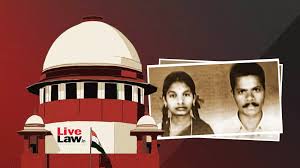
The case in which Kannagi, a young woman from the Vanniyar community and Murugesan, a Dalit, were murdered because of their inter-caste marriage is considered to be the first recorded honor killing case in Tamil Nadu. New Delhi- The Supreme Court upheld the sentence of 11 convicts in the famous 2003 honor killing case of Tamil Nadu and said that casteism, which has penetrated deep into Indian society, is the root cause of this heinous crime. This case, in which Kannagi, a young woman from the Vanniyar community and Murugesan, a Dalit, were murdered because of their inter-caste marriage, is considered to be the first recorded honor killing case in Tamil Nadu. Terming it as the “cruel reality of caste hierarchy”, a bench of Justices Sudhanshu Dhulia and Prashant Kumar Mishra, in a hearing held on 28 April 2025, said, “Such crimes, ironically called honour killings, require severe punishment. Case Details This heartbreaking crime took place on 7-8 July 2003 in Pudukorapettai village in Cuddalore district of Tamil Nadu. Kannagi (Vanniyar community) and Murugesan (Dalit community), both 20 years old, were in love with each other. Murugesan had completed his B.E. in Chemical Engineering from Chidambaram and was working in Bengaluru, while Kannagi was pursuing B.Com. Knowing Kannagi’s family’s disapproval, the two secretly got married on 5 May 2003 before the Registrar of Marriages in Cuddalore. In July 2003, when the two secretly left the village, the accused were arrested and the accused was arrested. Moved away, Kannagi’s brother Maruthupandiyan threatened Murugesan’s father Samikannu to bring Murugesan back. Maruthupandiyan falsely claimed that Murugesan had not returned the money he had borrowed from him. On 7 July, Murugesan was brought to the village, where he was stripped naked, tied to a pole and brutally beaten to reveal Kannagi’s whereabouts. This brutality took place in the presence of many people from the village, but no one tried to stop it. Murugesan eventually revealed the whereabouts of Kannagi, who was in Moongilthuraipattu village. Kannagi was brought to the village, and on the morning of 8 July, both were taken to a cashew orchard and forcibly administered the pesticide Nuvacron (monocrotophos). Kannagi’s father Duraisamy gave this poison to Maruthupandiyan, who first administered the poison to his sister and then to Murugesan. Murugesan’s stepmother Chinnapillai, who was an eyewitness to the horrific incident, confirmed this in court. Both died within minutes, and their bodies were burnt at different places. Two officers of Virudhachalam police station, Sub-Inspector K.P. Tamilmaran and Inspector M. Selamuthu, were accused of not registering an FIR immediately despite knowing about the crime. Chinnapillai tried to lodge a complaint on July 8, but was chased away from the police station with caste-related insults. The court said, “It is difficult to believe that such a heinous double murder could take place in the village and the in-charge of the police station was not aware of it.” The FIR was registered nine days later, on July 17, 2003, following media and political pressure. In the initial investigation, Sellamuthu falsely accused four Dalit members of Murugesan’s family, including his father Samikannu. The Supreme Court termed the investigation as “motivated and totally dishonest” which sought to “save the culprits and implicate the innocent”. The case was handed over to the CBI in 2004 on the direction of the Madras High Court, which filed a chargesheet against 15 accused in 2005. The trial court convicted 13 accused in 2021, awarding life imprisonment to 11 for murder and 2 under the SC/ST Act. Maruthupandian was awarded the death sentence, which was commuted to life imprisonment by the High Court in 2022. Supreme Court’s verdict and comments on casteism The Supreme Court upheld the Madras High Court’s verdict and upheld the conviction of 11 convicts. The sentence of one was limited to two years of rigorous imprisonment, while the life sentence of another accused was upheld as he was the “main architect of fabricating false evidence and implicating Dalits”. The court said, “At the root of this crime is India’s deeply ingrained caste hierarchy, and this most immoral act is termed as honour killing!” The court also commented on the witnesses being “hostile” and the delay tactics, stating, “The long and unreasonable delay… reflects the gross incompetence of the prosecution and the delay tactics of the defence.” While holding Chinnapillai’s testimony credible, the court clarified that “close relatives who are natural witnesses cannot be rejected merely on the ground that they are willing witnesses.” The Supreme Court ordered Samikannu and Chinnapillai to jointly pay a compensation of Rs 5 lakh, which will be paid by the Tamil Nadu government. This amount will be in addition to the compensation awarded by lower courts. The court said, “Such a wicked and heinous crime requires severe punishment and victim compensation.” All the convicts out on bail were directed to surrender within two weeks. Courtesy : Geetha Sunil Pillai, Hindi News
Ostracized and Deprived: 70 Dalit Families in Haryana Village Pay Heavy Price for Not Supporting Upper Caste Candidate in 2024 Assembly Elections
Will SC Rights Be Upheld? — Here’s Why AJAK Rajasthan Presses Justice Balakrishnan Commission to Block New Groups in Scheduled Caste List

The letter strongly opposes the inclusion of new groups, such as Dalit Christians or Muslims, in the SC list, arguing that it could harm existing SC communities’ rights. Jaipur-The Dr. Ambedkar Anusuchit Jati Adhikari-Karmchari Association (AJAK Rajasthan) has taken a significant step to safeguard the interests of Scheduled Caste (SC) communities by submitting a detailed letter to the Justice K.G. Balakrishnan Commission. The letter expresses serious concerns over potential changes to the Scheduled Caste list under Article 341 of the Constitution and strongly opposes the inclusion of new groups, such as Dalit Christians or Muslims, which the organization believes could jeopardize the rights and benefits of existing SC communities. Representing SC employees’ communities, AJAK Rajasthan highlighted the daily struggles of caste-based discrimination and hardships faced by its members. The organization urged the Commission to protect the constitutional rights of existing SC communities and ensure that no amendments to the SC list are made for political reasons. The letter emphasizes preserving the sanctity of Article 341 and preventing religion-based restrictions on SC rights. Key Points Raised in the Letter The list of SC/ST citizens in India was prepared on the basis of historical facts of economic, educational and caste discrimination. The Constitution of India is the supreme law of India. Public servants posted in the legislature, judiciary and constitutional institutions take an oath to work according to the Constitution of India. According to Article 51 (a) of the Constitution of India, it is the constitutional duty of every citizen to obey the Constitution of India and behave accordingly. Thus contempt/violation of the Constitution of India falls under the category of punishable offence under Section 2 of the National Dishonour Act 1971. According to the law made by the Ministry of DOPT of the Government of India, the caste of any citizen in India is inherited from his/her father on the basis of birth. The caste of the father is inherited by the son/daughter on the basis of birth. The children of a Scheduled Caste/Scheduled Tribe father get the caste of their father i.e. Scheduled Caste. People belonging to Scheduled Caste are discriminated against on the basis of caste. Similarly, their children also face caste discrimination. Even if the citizens of Scheduled Caste/Scheduled Tribe change their religion, then on the basis of the caste acquired on the basis of birth, they continue to face discrimination on the basis of social, economic, educational and caste in other religions as well. Citizens get their caste from their father, so their caste remains with them till their death and there is always discrimination against them. To solve the social, economic, educational and caste discrimination, the Constitution of India has given the Scheduled Caste / Scheduled Tribe citizens the right to constitutional representation on the basis of caste in Articles 14, 15, 16, 335, 330, 332, 243D and 243T and has tried to reduce their social, economic, educational and caste discrimination. In India, representation in government services to SC/ST citizens in proportion to their population has been given by the Constitution of India on the basis of their social, economic and educational status. On the basis of Articles 15, 16 and 335 of the Constitution of India, the people of Scheduled Castes and Scheduled Tribes have got the constitutional right of representation in educational institutions and government services in proportion to their population. In Articles 15, 16 and 335, the constitutional right of representation has been given on the basis of caste. Neither in government services nor in politics, the constitutional right of representation has been given on the basis of religion. Therefore, the right to representation of Scheduled Castes cannot be restricted on the basis of religion. The Constitution of India does not impose any restriction on the citizens of SC/ST on the basis of religion even in Articles 15, 16 and 335. If the constitutional right of SC/ST citizens to government services and political representation is restricted on the basis of religion, then it would be a violation of Articles 14, 15, 16 and 335 of the Indian Constitution. Ostracized and Deprived: 70 Dalit Families in Haryana Village Pay Heavy Price for Not Supporting Upper Caste Candidate in 2024 Assembly Elections The Constitution of India provides the SC/ST citizens the constitutional right to representation in proportion to their population in Panchayats, Municipal Bodies, Legislative Assemblies and Lok Sabha. The Constitution of India, Article 243(d) provides the Scheduled Caste and Scheduled Tribe citizens the constitutional right to representation in proportion to their population in Gram Panchayats, 243T in Municipal Bodies, 332 in Legislative Assemblies and Article 330 in Lok Sabha. None of the articles providing the constitutional right to representation imposes any restriction on the basis of religion for giving representation in proportion to their population in Gram Panchayats, Municipal Bodies, Legislative Assemblies and Lok Sabha. The right to political representation has been given to socially, economically and educationally backward castes on the basis of caste and historical facts and evidence. Neither the right to representation has been given on the basis of religion nor can any restriction be imposed on it on the basis of religion. On the basis of social, educational and economic and historical facts, the Government of India has made a law for the SC/ST citizens belonging to the castes listed in the Constitution of India that the caste of any citizen is determined by the caste of his father. The father of a citizen naturally determines his caste. The SC/ST citizens have got the constitutional right to representation in government services in proportion to their population under Articles 15, 16 and 335 of the Constitution of India. They have got the constitutional right to representation on the basis of their caste in proportion to their population through Articles 2430, 243T, 330 and 332. There is no restriction on giving representation to Scheduled Caste and Scheduled Tribe citizens on the basis of religion in any of the above articles. The right to representation of Scheduled Caste and Scheduled Tribe has
Rajasthan BJP expels ex-MLA who ‘purified’ temple after Dalit Congress leader’s visit
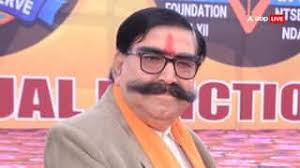
Gyandev Ahuja had carried out the ritual at a temple in Alwar after Tika Ram Jully, the leader of Opposition in the Rajasthan Assembly, visited it. The Bharatiya Janata Party on Sunday expelled former MLA Gyandev Ahuja after he conducted a “purification” ritual at a temple in Rajasthan’s Alwar following a visit by Dalit Congress leader Tika Ram Jully, The Indian Express reported. Jully, who is the leader of the Opposition in the Rajasthan Assembly, had visited the temple on the Hindu festival of Ram Navami earlier this month to attend a consecration ceremony, PTI reported. Before you scroll further… Following Jully’s visit, Ahuja performed a “purification” ritual at the temple on April 7, claiming that the Congress leader was “anti-Hindutva” and “anti-Sanatan”. Sanatana Dharma is a term some people use as a synonym for Hinduism. “This is a Lord Shri Ram temple at whose feet I have sprinkled Gangajal [water from the Ganga river],” the former MLA from Ramgarh was quoted as saying by The Indian Express. “Why Gangajal? Because some impure people came.” In response to his actions, the BJP on Sunday said that its state president Madan Rathore had “given an order to terminate the primary membership of former MLA Gyandev Ahuja after indiscipline was proved against him”. The BJP added that its state disciplinary committee had submitted a report about the incident to Rathore, The Indian Express reported. Ahuja had appeared before the committee on Sunday. Jully is the first Dalit politician in the state to become the leader of the Opposition in the Assembly. In response to Ahuja conducting the “purification” ritual, Congress leader Rahul Gandhi on April 9 had accused the BJP of “continuously insulting Dalits” and “attacking the Constitution”. “[Prime Minister Narendra] Modi ji, the country will be run by the Constitution and its ideals, not by Manusmriti, which considers Bahujans as second-class citizens,” the leader of the Opposition in the Lok Sabha had said. The Manusmriti is a Hindu scripture authored by an ascetic named Manu. The text has been widely criticised for its gender and caste-based codes. Former Chief Minister Ashok Gehlot also said that the incident showed “the ill-will of BJP towards Dalits”. “Such narrow-mindedness is not acceptable in a civilised society in the 21st century,” the Congress leader had said on X. “It cannot be condemned in the strongest words possible.” Jully too had called Ahuja’s actions as indicative of the BJP’s mentality towards Dalits, according to PTI. Ahuja, however, had said that he done nothing wrong and that his actions were against the Congress party, The Indian Express reported. “If there is even an iota of evidence that I have done something wrong, then… I am ready to shave my moustache,” The Indian Express had quoted him as saying. After his expulsion, Ahuja claimed that the BJP had been misled by Congress propaganda. Courtesy : Scroll Note: This news is originally published on https://scroll.in/na and is used purely for non-profit/non-commercial purposes, especially human rights.
Youths stripped and beaten by mob in Aligarh: Community said they were beaten for chanting ‘Jai Bhim’, police said—a case of molestation, no caste angle!
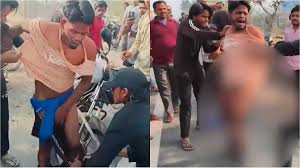
Some people from the Dalit community have alleged that the youths were targeted because of their caste. According to some reports, the victim youths had chanted “Jai Bhim”, after which the mob attacked them. Aligarh/ Uttar Pradesh- Three youths were stripped and brutally beaten by a mob in Chikavati village of Lodha police station area of Aligarh for making obscene comments to a school girl. The incident took place on April 26, a video of which is going viral on social media, showing that the youths of the Dalit community were allegedly targeted for chanting “Jai Bhim”. The viral video shows that the attackers stripped the youths naked on the road and beat them with sticks. However, the police rejected these claims and said that it was a normal dispute and there is no caste angle in it. The police say that people have beaten these youths for making obscene comments and lewd remarks at a school girl. It is alleged that three youths made obscene comments and harassed a minor girl student. The girl raised an alarm, after which the people around surrounded the three youths and stripped them and beat them with sticks. In the viral video, it can be seen that the mob surrounded the youths on the road and beat them up. The Lodha police station administration has registered an FIR in this case and legal action is being taken against the accused. Area Officer Gabhana, Sanjeev Kumar Tomar said that “the incident is limited only to making obscene comments with the girl student. No caste matter has come to light in the investigation so far.” However, some people from the local Dalit community have alleged that the youths were targeted because of their caste. According to some reports, the victims were shouting “Jai Bhim” following which the mob attacked them. The incident has sparked tension locally, with some in the Dalit community linking it to caste violence. However, the police have registered the case as a normal dispute and have not confirmed the caste angle. Courtesy : Geetha Sunil Pillai, Hindi News
From monuments to settlements: Mayawati seeks a way back to Dalit politics in UP
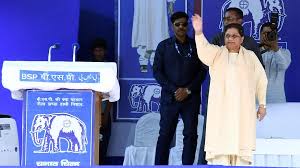
From Congress to BJP, all parties are competing to woo Dalits, but will SP-BSP be able to restore their ground hold and trust or will Hindutva get an open field? What is happening in Uttar Pradesh, is it what the Dalits of Uttar Pradesh want or are political parties expecting Dalits to transform their political aspirations into power? This question is related to the recent political events in Uttar Pradesh. The first incident is of February 20, when Rahul Gandhi was on his tour of his parliamentary constituency Rae Bareilly. Where Rahul Gandhi, while addressing the gathering, put the question before the Dalits that why does Mayawati (Behenji) not participate in the elections in her old style? She should be a part of the Indian National Development Inclusive Alliance (INDIA). Congress is organizing many programs across the state to unite the Dalit community before the assembly elections to be held in 2027. The second incident is of a seminar organised by BJP in Gomtinagar, Lucknow in February itself. BJP has organised a seminar named “Samajik Nyay” on a mission to connect with Dalit youth and intellectuals against PDA (Backward, Dalit and Tribal) by Samajwadi Party, to shape the thinking of the community and change voting behaviour. This event has been organised under the patronage of BJP state secretary Dharampal Singh. Dalit students, teachers, professors were invited to this seminar. Through this, BJP wants to draw the educated Dalit community to its side. To counter the campaign of rival parties to make inroads among Dalits, Mayawati warned her supporters that the conduct, character and face of BJP, SP and Congress have always been staunchly opposed to Dr. Ambedkar. BSP’s UP unit president Vishwanath Pal said, “Cadre camps” are being organised in assembly constituencies to tell party supporters about the tactics of BJP, SP and Congress as well as the ideals of BSP. Senior party leaders and youth have been directed to participate in the camps to make them aware of the struggle of party founder Kanshi Ram and the party chief. Mayawati’s challenges Now the question is whether this strategy of BSP will be able to bring to the ground the political memory of Dalits which started from BS-4 and came to the fore in 2007 in the form of BSP government. An old BSP worker believes that BSP does not need to change the strategy to decorate the political game but there is a need to re-look and understand the old strategy. Because even today the influence of Mayawati’s political power can change the political meaning of Uttar Pradesh. Mayawati’s work still has a deep impact on Uttar Pradesh. For example, the grand memorial in Lucknow, party office, Ambedkar memorial, parks, gardens, roads and bridges etc. Obviously, this The works are still alive in the political memory of Dalits. But how to convert this memory into political practicality? This will be a tough challenge for Mayawati. According to the Lokniti-CSDS (Centre for the Study of Developing Societies) post-poll survey (Provide the Link), the party retained only 44 percent of its traditional Jatav vote, down from 68 percent in 2014, besides retaining only 15 percent of the non-Jatav Dalit vote, compared to 30 percent a decade ago. To change this political equation once again, it is necessary that Mayawati herself addresses political meetings and strengthens her reach among the youth. An ideological change has also been seen in the BSP after Kanshi Ram. The party which has come up with ‘Tilak Tarazu Aur Talwar Inko Maaro Joote Chaar’ and ‘Haathi Nahin Ganesh Hai Brahma Vishnu Mahesh Hai’ will have to visit those localities once again to gain political trust among Dalits and backward castes which used to be inhabited during the BSP government. In their survey titled ‘Political Participation of Dalits’, Dalit women believe that one day Behenji will definitely come among us and she will rule Uttar Pradesh. Despite all this, the regional parties of Uttar Pradesh do not have any political language that can agitate the common people there. For example, during the tenure of Mulayam Singh Yadav, Mayawati and Akhilesh as Chief Ministers in Uttar Pradesh, it was almost assumed that the credit for becoming the Chief Minister of Uttar Pradesh will go to the backward castes or Dalits. The political mood of the public was also based on these wishes. After the arrival of BJP, this story started turning upside down. A Dalit worker of BSP believes that the BJP government sees Dalits and backward castes only as votes. Political paradox in UP There are two reasons for this political paradox in Uttar Pradesh. First, there has been a change in the top leadership of regional parties, be it Samajwadi Party or Bahujan Samaj Party. Now the matter has gone beyond the image of ‘neta ji’ and ‘chacha ji’ of Mulayam Singh Yadav. Now the command has come in the hands of Akhilesh ji or Bhaiya. Who, instead of speaking the political language of the rural environment, started talking about political strategy based on the wisdom of foreign education. One result of this was that Shivpal had to form a separate party. On the other hand, SP considered its caste mobilization as its vote base. Samajwadi Party does not seem to have any strategy yet to regain its lost vote base among non-Yadavs. But the SP-Congress alliance had made a significant dent in the Dalit vote bank, which takes the party beyond the old Muslim-Yadav equation. According to the post-election survey of Lokniti-CSDS, India Block has secured 56 percent of non-Jatav Dalit votes and 25 percent of Jatav votes. The SP, traditionally seen as a party of Muslims and Yadavs, actually managed to win seven out of the 17 constituencies reserved for Scheduled Castes. Whereas in the last Lok Sabha elections, it did not get any seat. But if the political assessment of SP is done independently, then due to the lack of any political base, its position does not look better in the 2027 assembly