
BSP Plans Muslim-Dalit Outreach in Western UP, Mayawati to Address Noida Rally on December 6

Two months after holding a major rally in Lucknow that stirred political activity across Uttar Pradesh, the Bahujan Samaj Party (BSP) is now focusing on specific regions and voter groups where it hopes to regain lost ground. The party is planning to begin its Muslim Dalit outreach in western UP, with a public meeting likely to be held in Noida on December 6. Party sources said BSP chief Mayawati will attend the event as the main speaker. Senior party leaders visited the Rashtriya Dalit Prerna Sthal in Noida on Wednesday to review preparations. While officials avoided sharing details, they confirmed that planning for the event is underway. According to insiders, the gathering is designed to reconnect with Dalit and Muslim voters, two communities that have historically formed a crucial support base for the BSP. Party workers and supporters from eight divisions of western Uttar Pradesh are expected to attend. Mayawati is likely to give them directions on how to win back voters the BSP lost after 2012, when its political decline in the state began. The Dalit and Muslim bhaichara (brotherhood) committees, formed to strengthen ties between the two communities, are expected to play a key role in this campaign. Western UP has long been significant for the BSP because it has a strong presence of Jatav Dalits, the party’s core supporters, and a large Muslim population. The success of the BSP SP alliance in the 2019 Lok Sabha elections also reflected this. Out of the 10 seats BSP won in that election, four were in western UP, including Nagina, Saharanpur, Amroha, and Bijnor, all constituencies with a strong Muslim Dalit voter mix. The date of the upcoming event, December 6, marks the death anniversary of Dr. B.R. Ambedkar, which the BSP observes nationwide as one of its three key annual events. The other two are Ambedkar’s birth anniversary on April 14 and the death anniversary of BSP founder Kanshiram on October 9. Starting from December 6, the party is expected to hold a series of public meetings in different parts of Uttar Pradesh to assess its electoral prospects and strengthen its grassroots network. Courtesy : TOP Note: This news is originally published on https:/theobserverpost.com/bha and is used purely for non-profit/non-commercial purposes, especially human rights
Hinduism is bad, Muslimism is good… and then the miscreants abducted a Dalit girl from outside her school…

Hardoi News: In Hardoi, Uttar Pradesh, boys from another community kidnapped a Dalit girl from outside her school as part of a well-planned conspiracy. It is being reported that they had been harassing her previously. Read the full story. Ashish Dwivedi/Hardoi: A daylight kidnapping in Hardoi, Uttar Pradesh, caused a sensation. A 14-year-old Dalit girl was abducted from outside her school by four young men in a car. The police acted swiftly and rescued the girl safely from the clutches of the kidnappers and seized their car. However, the kidnappers escaped and police teams are searching for them. Edited By: Preeti Chauhan Courtesy: Hindi News
Cong stages protest in Ambala against ‘vote theft’
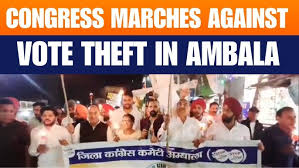
Ambala: Former chief minister and Leader of Opposition (LoP) Bhupinder Singh Hooda, along with Haryana Congress chief Rao Narendra Singh, led a protest in Ambala on Thursday against alleged large-scale vote theft in Haryana. A large number of Congress leaders, workers, and citizens gathered in the city, voicing strong anger and outrage over what they termed as a “theft of democracy.” The protesters later submitted a memorandum to the Ambala deputy commissioner’s office, addressed to the President of India. Addressing the gathering, Hooda said that LoP in Lok Sabha Rahul Gandhi exposed massive vote rigging across several states, including Karnataka, Maharashtra, and Haryana. “His revelations raised serious questions about the impartiality of the Election Commission. In some areas, 501 votes were registered from a single house, in others, 223 votes were recorded in the name of one woman, and even 22 votes were cast using the photo of a foreign woman,” Hooda claimed. He alleged that the actual scale of the fraud runs into lakhs of votes. “Rigging happened not only in constituencies where the Congress lost but even in those where it won. If the voting was fair, Congress MLAs would have won by far larger margins,” he added. Citing past electoral trends, Hooda said that the party leading in postal ballots always formed the govt in Haryana. “This time, Congress was leading in 73 out of 90 seats in the postal ballot count, but lost in the EVM count. On the night of the 5th, the Election Commission reported a 61.19% voter turnout; the next day, it increased to 65.65%, which mysteriously rose to 67.9% by the 7th — just before counting. Such discrepancies are beyond comprehension,” he said. Hooda termed the developments as an “open theft of not just votes, but the entire govt.” He asserted that the incident amounts to tampering with the country’s democracy, constitution, and the hard-earned freedom achieved through countless sacrifices. “Congress will launch state-wide and nationwide protests against vote theft and will not allow the BJP to undermine the Constitution,” he declared. Echoing Hooda’s sentiments, Congress state president Rao Narendra Singh said Rahul Gandhi’s disclosures revealed the “truth of machine manipulation.” “In the assembly polls, Congress received 39.5% votes against the BJP’s 39.9%. Yet, despite leading in 73 postal ballot seats, Congress was denied power. In the Lok Sabha polls, Congress got 47.6% votes — two and a half percent more than the BJP. This is a direct assault on Dr B R Ambedkar’s Constitution,” Rao said, vowing to take the battle to the streets to defend democracy and the people’s mandate. Courtesy : TOI Note: This news is originally published on https:/timesofindia.com/bha and is used purely for non-profit/non-commercial purposes, especially human rights
Wardha University: Dalit and backward class students suspended for chanting “Sorry Savarkar,” administration says disrespecting “great men”

Following the Left Unity victory in the JNU Students’ Union elections, ten students who chanted slogans at Mahatma Gandhi International Hindi University have been suspended from the hostel. According to the administration, these students chanted “Sorry-sorry Savarkar, RSS’s little monkey, run Narendra run Narendra,” while the students said they chanted “Bal Narendra-Bal Narendra.” New Delhi: Mahatma Gandhi International Hindi University is once again embroiled in controversy. Ten students have been suspended from the hostel for chanting derogatory slogans against Prime Minister Narendra Modi and Vinayak Damodar Savarkar. All of these students belong to Dalit and backward classes. According to the university, these slogans “degraded the dignity of great men.” The matter began when, following the defeat of the ABVP (Akhil Bharatiya Vidyarthi Parishad) and the victory of the Left alliance in the JNU student union elections on November 6, some students of Wardha University protested on campus, chanting “Sorry, sorry Savarkar” and “Run Narendra.” Chandan Saroj, a PhD student at the university and associated with the AISF (All India Students Federation), says, “The slogan ‘Sorry, sorry Savarkar’ proved unbearable for the ABVP, which believes in Savarkar’s principles.” The very next day, the ABVP surrounded the university’s administrative building, alleging that a “great man” like Savarkar had been insulted. On November 7, the administration issued show-cause notices to six students (Kaushal Kumar, Karanveer Singh, Brijesh Sonkar, Rakesh Ahirwar, Ashwini Sonkar, and Dhananjay Singh). These students included four Scheduled Caste (SC) and two Other Backward Class (OBC) students. The notice states, “It has come to the notice of the university administration that on the night of November 6, 2025, you unauthorizedly and without informing the administration, gathered students in the university hostel premises, took out a procession, and raised slogans, including slogans derogatory to the dignity of great men. Your actions have affected the academic and peaceful environment of the university and created an atmosphere of unnecessary tension on the campus.” The notice sought an explanation from these students within three days. In a conversation with The Wire Hindi, Dhananjay, associated with the Congress student wing, NSUI, said, “We did not take out a procession. We were just out for a walk. There must have been ten or fifteen of us.” During this, we raised slogans like Inquilab Zindabad, Bhagat Singh Zindabad, Jai Bhim.’ In response to the notice, the students wrote to the Proctor on November 10, ‘With regard to the points mentioned by you, we wish to clarify that we have neither insulted any great man, nor raised any derogatory slogans, nor organised any gathering; the word ‘gathering’ is wrong because we were just a few people walking around.’ But the university administration was not satisfied with this response, and on November 11th, it suspended these six students, along with four others (Dharmendra Kumar, Manish Chaudhary, Satyendra Rai, and Abhijeet Kumar), from their hostel for 14 days. All ten students belong to Dalit and backward communities. The order, issued by Proctor Rakesh Kumar Mishra, states, “These students will be completely prohibited from entering the hostel premises during the period of their suspension.” Even before this order, the university administration had filed an NCR (non-cognizable report) against the six students at the Ramnagar police station on November 10th and demanded police action. The report shows that on November 6th, the university’s Board of Proctors met and reviewed the CCTV footage. The report states, “In the video, some students were heard shouting slogans such as ‘Sorry-Sorry Savarkar, RSS’s little monkey, run Narendra-run Narendra.’” The university has told the police that the students had “insulted and damaged the reputation” of “respectable individuals” by raising slogans against them. However, the suspended students told The Wire Hindi that they did not shout “Bhaag Narendra, Bhaag Narendra,” but “Bal Narendra, Bal Narendra.” To hear ABVP’s side, we contacted Vedika Mishra, the organization’s university unit secretary, but she declined to comment. Speaking to The Wire Hindi, the university’s Registrar, Kader Nawaz Khan, said, “We had to go to the police. The students forced us to. Look at the language of the slogans. Secondly, by shouting slogans until midnight, they spoiled the atmosphere of the hostel. They had not obtained any permission to hold such a rally. An attempt is being made to spoil the atmosphere here.” This action has been taken to stop this very thing.’ When asked whether the slogan ‘Sorry, Sorry Savarkar’ was sufficient for such action, the Registrar said, ‘You must have read the slogan that followed it.’ Does the university administration have any objection to ‘Bhaag Narendra, Bhaag Narendra’? On this issue, the Registrar said, ‘It’s not a matter of liking it or not. It’s a matter of spoiling the academic environment of the university.’ Chandan Saroj says, ‘A repressive atmosphere has developed in the university where no slogan other than ‘Jai Shri Ram’ is tolerated. If a student chants “Jai Bhim,” “Lal Salaam,” or “Jai Samvidhan,” they immediately become the target of the administration. He further adds, “The RSS holds regular shakhas on the Wardha University campus.” While the Registrar claims, “No student organization, regardless of its ideology, can hold rallies, processions, etc. without permission.” When asked whether the RSS holds shakhas on the university campus, the Registrar said, “I will have to verify. I will have to check the records.” When we asked if the university administration was unaware of the RSS shakhas being held on campus, the Registrar said, “I am not saying that… I am not saying whether (the administration) is aware or not. I will have to check the records.” Students explained that the university is located near Nagpur, and the Sangh Parivar’s ideology is dominant in this area. As a result, many students are facing pressure and action. Courtesy: Hindi News
Maharashtra: Dalit Mahasangh chief murdered in Sangli home; eight booked

The incident occurred on Tuesday at midnight when Mohite was celebrating his birthday in his home near Garpir Dargah Chowk area, police said. A group of men armed with knives, iron rods, and sticks started hurling abuses at Mohite after guests left the spot and arrangements were being wrapped up. The founder president of a Dalit outfit was allegedly stabbed to death by eight men in Sangli city when he was celebrating his birthday in his home, a crime suspected to be the fallout of a dispute, police said on Wednesday. The slain leader, identified as Uttam Mohite, 38, was the founder of Dalit Mahasangh. One of the attackers, identified as Shahrukh Rafiq Shaikh (26), suffered a severe injury during the scuffle, leading to his death on Wednesday morning at a hospital, according to police. The incident occurred on Tuesday at midnight when Mohite was celebrating his birthday in his home near Garpir Dargah Chowk area, police said. A group of men armed with knives, iron rods, and sticks started hurling abuses at Mohite after guests left the spot and arrangements were being wrapped up. Sensing danger to his life, Mohite ran inside his home while being chased by attackers. They stabbed Mohite multiple times in the stomach and chest, and hit him on his head and arms with iron rods and sticks. During the scuffle, one of the attackers, Shaikh, sustained a severe stab injury on his thigh, apparently by mistake, police said. Mohite was rushed to the Sangli Civil Hospital by his nephew, where doctors declared him dead on arrival. Meanwhile, the attackers carried severely injured Khan to the hospital, where he succumbed to his injuries on Wednesday morning, police said. A police official said on Wednesday that Mohite and one of the accused, Ganesh More, had a brief argument during the birthday celebration. Before leaving the venue, More reportedly warned Mohite that he “would not spare” him. Police have registered a case of murder against eight persons, identified as Ganesh More, Satish Lokhande, Shahrukh Shaikh (deceased), Banya alias Yash Londhe, Ajay Ghadge, Jitendra Londhe, Yogesh Shinde, and Sameer Dhole, who are residents of the Indiranagar area, based on a complaint lodged by Mohite’s wife, Jyoti. Edited By: Abhishek Sheoran Courtesy : India TV Note: This news is originally published on https:/indiatv.com/bha and is used purely for non-profit/non-commercial purposes, especially human rights
BSP plans to woo Dalit-Muslim with public meeting in Noida

Lucknow: Two months into holding a state-level rally in Lucknow on Oct 9 and creating political waves, the Bahujan Samaj Party (BSP) has now set its eyes on specific combinations of voters and regions where these combinations dominate politics. The party will start with an outreach of Muslim-Dalit (M-D) voters in west UP and may hold a public meeting in Noida on Dec 6 to tap into the vote base. Sources in the party said that party national president Mayawati will be the chief guest at the event. Senior party leaders on Wednesday visited the Rashtriya Dalit Prerna Sthal in Noida for inspection. Though some of them whom TOI contacted did not divulge much, they agreed that the planning is underway, thus lending credence to the information shared by insiders that the event has been designed to specifically reach out to Dalit and Muslim voters. Party cadres and supporters from eight divisions of west UP may be present at the gathering. They will get directions from Mayawati on how to bring back the voters that the party lost in the region after 2012, since when its downfall in UP began. The Dalit and Muslim bhaichara committees, which the party formed to woo Muslims and Dalits in UP to its side, are also relevant in west UP. Jatav, the most dominant sub-caste of Dalits, and BSP’s core voters, are also concentrated in west UP. Evidence of this was the 2019 Lok Sabha elections when BSP contested in alliance with the Samajwadi Party in UP and won 10 seats. Four of these seats were in west UP, which were Nagina, Saharanpur, Amroha, and Bijnor. Each has a formidable combination of Dalit and Muslim voters. The party has scheduled the event for Dec 6 as it is the death anniversary of Dr BR Ambedkar and one of the three annual events observed by the party nationally. The other two occasions are the birth anniversary of BR Ambedkar on April 14, and death anniversary of BSP founder Kanshiram on Oct 9. Beginning Dec 6, there may be a series of public meetings by the party in different regions of UP. These events will help the party analyse possibilities in different regions. Courtesy : TOI Note: This news is originally published on https:/timesofindia.com/bha and is used purely for non-profit/non-commercial purposes, especially human rights
Journalist stops transgender protester from jumping off bridge in Tamil Nadu
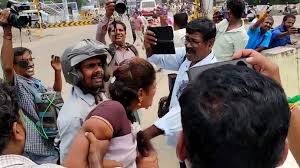
Transgender persons in Tamil Nadu’s Tirunelveli staged a protest demanding free house-site pattas or government housing. One protester attempted to jump off a bridge but was stopped by journalists. The District Collector assured action, and protesters dispersed. A tense moment unfolded in Tamil Nadu’s Tirunelveli on Wednesday when journalists intervened and stopped a transgender protester from jumping off a bridge during a demonstration demanding free house-site pattas or government houses. A group of transgender persons had gathered outside the Tirunelveli District Collector’s office, sitting on the Tirunelveli–Thiruvananthapuram Highway and blocking traffic. They held placards and raised slogans, alleging that despite submitting petitions several times, including during Chief Minister MK Stalin’s special grievance redressal camp, no action had been taken on their request for land pattas or housing. During the protest, one of the participants suddenly ran towards the Thamirabarani river bridge and attempted to jump. Journalists covering the protest chased after her and managed to pull her back, preventing a tragedy. Officials on the spot attempted to negotiate with the protesters. As District Collector’s convoy was exiting the premises, demonstrators blocked the vehicle, forcing the Collector to step out and speak to them. Surrounded by authorities, the Collector assured that steps would be taken to address their housing demands. Following the assurance, the protesters dispersed. Courtesy : India Today Note: This news is originally published on https:/indiatoday.com/bha and is used purely for non-profit/non-commercial purposes, especially human rights
Congress’s youth push in Gujarat, Rahul Gandhi’s ‘Mr. Trustworthy’ given major responsibility, could see BJP’s stronghold crumble
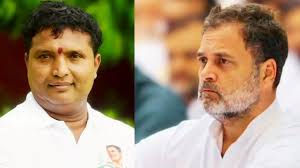
Gujarat Politics News: Gujarat Assembly elections will be held in 2027, but these elections will be a direct test of Rahul Gandhi’s leadership, as Rahul Gandhi had declared the BJP’s defeat in Gujarat after the Lok Sabha elections. Now, the Congress leadership has deployed Rahul Gandhi’s ‘Mr. Trustworthy’, B.V. Srinivas, to PM Modi’s home state of Gujarat. Ahmedabad/New Delhi: Ahead of the Bihar Assembly elections, the Congress has announced the deployment of Srinivas B.V. in the politically crucial state of Gujarat. As the Youth Congress President, Srinivas B.V. earned the title of ‘Oxygen Man’ by helping people extensively during the COVID-19 pandemic. Srinivas B.V. has been appointed the new co-in-charge by the Congress. Mukul Wasnik is the state in-charge. Srinivas B.V.’s appointment in Gujarat has sparked debate about whether Rahul Gandhi will intensify his Mission Gujarat campaign after the Bihar election results, as the AAP has been the focus of more attention in Gujarat than the Congress in recent months. Kejriwal, during his Gujarat visit, launched a scathing attack, saying that the Congress and BJP are husband and wife. It’s unclear who is the husband and who is the wife in this relationship, but there’s certainly collusion. Kejriwal asked why AAP MLAs go to jail, not Congress MLAs. AAP is in the news more than Congress. In Gujarat, Congress appointed Amit Chavda as the state chief in place of Shakti Singh Gohil. In his second term, Amit Chavda isn’t garnering the attention he expected. AAP leaders are in the news more than Congress. Leaders like Gopal Italia, Chatur Vasava, Isudan Gadhvi, Raju Karpada, and Praveen Ram have built their own fan followings, while Congress appears to be fragmented. Now, it remains to be seen what Srinivas BV, former head of the Congress Youth Wing, can do as co-in-charge, as Congress leader Rahul Gandhi’s reputation is at stake in Gujarat. It’s believed in political circles that the party is concerned about the attention AAP is receiving. Punjab is also due to have elections in 2027 before Gujarat. Therefore, the party has carefully deployed Srinivas BV to the Gujarat front. Rahul has challenged the BJP. After assuming the position of Leader of the Opposition in the Lok Sabha, he challenged the BJP to defeat the BJP in Gujarat. Therefore, even though the Gujarat elections are still far away, they are considered very important. Last month, the BJP conducted a major cabinet reshuffle in Gujarat, but the Congress was unable to claim any anti-incumbency against the government. Therefore, Usha Naidu, who was posted in Gujarat, has been sent to Madhya Pradesh. In the last Gujarat elections, the Congress was reduced to 17 seats. The party’s MLA strength has now dwindled to 12. Five more MLAs have joined the BJP. The AAP, which had five MLAs, has been expelled from the party. Consequently, it has four MLAs, while the BJP has 161 MLAs in the 182-member assembly. BV Srinivas is a former cricketer. He hails from Karnataka. Written by: Achalendra Katiyar About the Author Achalendra Kumar Katiyar works for Navbharat Times Online. He began his career with DLA in 2008. During his 17-year career, he has worked for iNext, Aaj Samaj, and Dainik Hindustan. He closely monitors developments in western states, including Gujarat and Maharashtra. He has a keen understanding of politics. Courtesy: Hindi News
BJP alleges vote theft worth eight crore in the Youth Congress elections

MP Youth Congress Election: The BJP has alleged vote theft in the Madhya Pradesh Youth Congress elections. Minister Vishwas Sarang has stated that eight crore votes were stolen in the election, and that Rahul Gandhi is solely responsible for this. Bhopal: The election for the Youth Congress President has been held in Madhya Pradesh. Yash Ghanghoria, son of a senior Congress leader, has become the Youth Congress President. The BJP has made a serious allegation regarding this. Minister Vishwas Sarang has alleged that Abhishek Parmar, son of a farmer, was defeated by vote theft. He said that 1.5 million youth were registered in MP. A fee of 50 rupees was charged for this. Eight crore rupees collected Vishwas Sarang said that adding up this total, it comes to seven and a half crore rupees. The hard-earned money of the parents of the youth was collected. There was also a fee for contesting the elections, which amounted to one crore rupees. He further stated that eight and a half lakh votes were held or rejected in the Youth Congress elections. Vishwas Sarang alleged that Rahul Gandhi stole these votes. Congress votes were stolen. Vote Theft Within Congress Citing some examples, the minister said that youth between the ages of 18 and 35 could participate in the Youth Congress elections. Santosh Singh, a 44-year-old resident of Vidisha district, has committed this act of vote theft. Similarly, Anjum Khan, whose membership is listed as 36 years old according to her voter card, questioned whether this vote theft occurred within Congress. Will Rahul Gandhi answer for this? Rahul Gandhi Making False Allegations Rahul Gandhi is leading a campaign to create news by making false allegations against the democratic system in the country. He said that ever since Rahul Gandhi became the face of the party, Congress has been losing elections. Rahul Gandhi is making baseless allegations to save face. He is making false allegations of vote theft, which he has been unable to prove anywhere. Curated by: Muneshwar Kumar About the Author Muneshwar Kumar is Principal Correspondent at Navbharat Times Online. He has 14 years of experience in journalism. He has a special interest in politics, crime, current affairs, and off-beat news in Madhya Pradesh. He also has experience reporting on the ground for several elections. He has been with Navbharat Times Online since 2020. Courtesy: Hindi News
Crime Without Punishment
The system protects those who commit caste violence while blaming victims for asserting dignity Two back-to-back incidents, a shoe attack on Dalit CJI B.R. Gavai and the suicide of Dalit ADGP Y. Puran Kumar, expose how caste violence and humiliation persist even at the highest levels of India’s institutions. Both cases highlight growing impunity under the Hindutva regime, where perpetrators invoking “Sanatan Dharma” face little accountability, while Dalits remain vulnerable despite rank, merit, or office. The events illustrate how token representation fails to protect Dalits, revealing a systemic, Brahmanical power structure that normalizes caste supremacy and shields upper-caste offenders. Within the span of days, two incidents have laid bare the entrenched caste realities of contemporary India and the impunity that the Hindutva regime has institutionalised. On October 6, 2025 a 71-year-old lawyer hurled a shoe at Chief Justice of India B.R. Gavai, a Dalit, inside the Supreme Court, defiantly shouting “Sanatan ka apmaan nahi sahega Hindustan” (India will not tolerate insult to Sanatan Dharma). He was released without charges, his shoe returned, facing no consequences for attacking the country’s highest judicial authority. The very next day, October 7, Additional Director General of Police Y. Puran Kumar, also a Dalit, died by suicide at his Chandigarh residence, leaving an eight-page note describing years of caste humiliation and harassment by senior officers. Despite huge public outrage, nothing has been done to the perpetrators. These two events, occurring within 24 hours, are not aberrations but revelations of a deeper malaise—the normalisation of caste violence and Brahminical supremacy under a majoritarian Hindutva order that has erased accountability for crimes committed in the name of Sanatan Dharma or Hindu honour. One incident reflects physical assault on a Dalit constitutional authority without reprisal; the other, psychological persecution that drove a senior officer to death. Together, they expose an ecosystem where Dalits—irrespective of office, achievement, or rank—remain vulnerable to humiliation and violence sanctioned by ideological impunity. These are not isolated tragedies but logical outcomes of the Hindutva project that the ruling regime has consolidated over the past decade—an order that weaponises religion to defend caste and punishes dignity itself. The Shoe That Revealed Everything The attack on Chief Justice B.R. Gavai was unprecedented in audacity and deeply revealing in consequence. In a packed Supreme Court room, a lawyer hurled his shoe at the bench headed by CJI Gavai, defiantly shouting a slogan sourced from the Hindutva playbook. He later claimed he was enraged by the CJI’s quip—“ask the deity itself to do something”—while dismissing a frivolous plea to restore a Vishnu idol at Khajuraho. Such verbal retorts by judges, right or wrong, are not uncommon. However, the Hindutva networks seized on the remark as an “insult to Sanatan Dharma”, manufacturing the outrage that fuelled the assault. What followed laid bare the regime’s moral collapse. The assailant was released within hours. He boasted to the press, “I have no regrets…I was hurt.” The Prime Minister’s bland condemnation avoided any commitment to legal action. The Bar remained silent; the media soon moved on. By contrast, when a Mumbai lawyer threw a shoe at CJI A.S. Anand in 1999, aggrieved by the verdict in his property matter, he was convicted of contempt and sentenced to four months imprisonment and a fine. Kishore’s act was graver because it was ideological. His slogan invoked Sanatan Dharma—a euphemism for Brahminism that sanctifies caste hierarchy—asserting that religious sentiment trumps constitutional authority. It claimed the right to assault a Dalit Chief Justice in defence of “Hindu honour,” confident that society would understand, perhaps even celebrate, the act. This confidence of impunity is no accident. It is the product of a decade-long Hindutva campaign that has normalised upper-caste violence under the banner of faith. When cow vigilantes lynch Muslims, interfaith couples are attacked, or homes are bulldozed without due process, the same message resounds: violence in the name of Sanatan Dharma enjoys state protection. The online abuse of CJI Gavai was overtly casteist, mocking his intelligence and legitimacy. The hate spewed against him as a Dalit on social media is criminal, but the entire state machinery has been silent. The outrage over “insult to Sanatan” was merely a polite mask for fury at a Dalit occupying the highest judicial office and dismissing an upper-caste petitioner. In the Brahminical logic encoded in Sanatan Dharma, a Dalit exercising authority represents an inversion of the natural order that must be violently corrected. Kishore’s attack—and the regime’s indulgence—thus revealed everything about Hindutva’s compact with caste: that in the new India, religious offence is punishable, but caste violence is not. The Suicide Note That Indicts a System On October 7, 2025, Additional Director General of Police Y. Puran Kumar, a 2001-batch Dalit IPS officer from Andhra Pradesh serving in Haryana, shot himself at his Chandigarh residence. In his suicide note, he named several IPS and IAS officers, accusing them of sustained mental harassment, humiliation, and caste-based discrimination. Kumar detailed how he was sidelined despite seniority, denied postings he deserved, and targeted through fabricated charges. His note spoke of a systematic campaign of humiliation, including attempts to implicate him in a fake bribery case. His wife, Amneet Kumar, an IAS officer, filed a complaint holding the named officials responsible for his death and demanding their suspension and arrest. What has emerged from Kumar’s note reveals the pervasive caste bias that Dalit officers continue to face in “meritocratic” institutions. Kumar wrote of years of “mental harassment and humiliation”, of being denied recognition and opportunities his upper-caste peers enjoyed. His decision to end his life after naming his tormentors was both an act of despair and an indictment—a demand that the system confront its casteist rot. Kumar’s death demolishes the myth that rank or merit protects Dalits from caste oppression. Here was an officer one step below the state’s top cop, yet, even his uniform and authority could not shield him from institutionalised caste prejudice. If an ADGP could be hounded to suicide, what hope remains for Dalit constables or sub-inspectors, not to