
The Forgotten Assam Freedom Fighter Who Fought Untouchability, Marched With Gandhi, Opened Schools For Dalits And Challenged British Rule

Krishna Nath Sharma, a forgotten Assamese freedom fighter, challenged caste barriers long before it was fashionable. In 1934, he opened his namghar to Dalits alongside Gandhi, enduring a decade of social boycott. From fighting Assam’s opium crisis to supporting the Dandi March and opening schools for Dalit children, his life was a relentless struggle for dignity, equality, and justice. Every so often, history surprises us with a character whose bravery is so understated, so disarmingly gentle, that it almost slips through the cracks of our noisy national memory. Assam, with its floodplains, fierce revolutions, tea gardens and unhurried rivers, has produced several such rebels—people who fought with conviction instead of microphones, with defiance rather than spectacle. Among them stands a man who, despite having walked beside Mahatma Gandhi, challenged caste superstition head-on, opened his sacred space to those the world refused to touch, and still somehow remained a footnote. His name was Krishna Nath Sharma, fondly known across his community as Krishna Mama, and his story begins in a simple prayer house tucked away in Jorhat. Picture this: it is 18 April 1934 in Sabaibandha, a quiet neighbourhood in Upper Assam. A namghar—a traditional Assamese prayer hall—breathes gently in the morning air. It is much like any other, except for one extraordinary detail. Mahatma Gandhi is standing at its entrance, ready to walk inside. Beside him stands the owner, Sharma, a man from a conservative Brahmin family, fully aware that what he is about to do will turn his own community against him. Yet his eyes are fixed ahead. Because for him, the opening of this prayer house to Dalits—sweepers, manual scavengers, ordinary people denied dignity—wasn’t merely symbolic. It was a necessary rebellion against a cruel social order. What followed next was a decade of isolation for his family, a lifetime of activism for him, and the opening of a chapter that deserves a place in every history classroom. This is the story of the man who walked the Dandi March, fought opium addiction, opened schools for Dalit children, challenged untouchability, and still died before seeing the freedom he fought for. The Namghar That Became a Battlefield of Beliefs The Sabaibandha namghar might look unassuming to a passing visitor today, but in 1934 it became a site of remarkable dissent. Gandhi had been travelling across India campaigning against untouchability, and Sharma—who had already begun pushing back against caste barriers in Assam—invited him to inaugurate his prayer house Gandhi accepted. And that decision ruffled more feathers than any of them could imagine. When Dalits stepped inside the namghar that day, they crossed not just a doorway, but a century-old threshold of exclusion. Gandhi lauded Sharma’s courage publicly, telling local media (credit: contemporary press reports): “Valiant soldiers like Krishnanath Sharma never care to face any odds. The temple entry movement will lead the rest of India to remove social evils.” But while Gandhi praised him, Sharma’s own community punished him. Ostracised is too mild a word—his family was shunned into social invisibility. At weddings, guests would walk out if he entered. When his wife, Swarnalata Devi, stepped into a temple, women fled as though her presence would contaminate stone. Yet they persevered. Fun fact: Assam had seen efforts toward egalitarian worship before, courtesy of the neo-Vaishnavite movement of Srimanta Sankardev. But never before had a mainstream Brahmin family taken such a bold stand in the early 20th century—making Sharma’s defiance quietly revolutionary. Meet Krishna Mama: Scholar, Lawyer, Rebel in Cotton Khadi Born in 1887, Krishna Nath Sharma was academically gifted. He completed degrees in science and law—an unusual combination in those days—and launched a successful legal career in 1917. But the courtroom couldn’t hold him for long. Gandhi’s arrival on the national stage changed the rhythm of his life. Soon enough, Sharma abandoned his practice, embraced the Gandhian ethos, and joined the freedom movement. His nickname Krishna Mama originated much earlier, during his student years. Friends found his calm maturity and independent thinking far beyond his age. The name stuck, and soon he became “Mama” not just to friends but to entire communities who admired his guidance. His First Fight: Crushing Assam’s Deadly Opium Addiction Before Sharma battled caste prejudice, he fought a quieter war—against the opium crisis devouring Assamese society. Opium, introduced by East India Company soldiers in the 18th century, had become a widespread menace by the early 1900s. Sharma partnered with Kuladhar Chaliha and Rohini Kumar Chaudhuri, two prominent Assamese freedom fighters, gathering data, interviewing addicts, and documenting the scale of the damage. His conviction was crystal clear: “To save a nation from a ruinous habit, no effort should be spared. The only way is total prohibition.” And astonishingly, he succeeded. Through relentless advocacy, public meetings, and political pressure, he helped shape the movement that pushed Assam towards opium prohibition. Fun fact: Assam was one of the earliest regions in India to enforce large-scale opium restrictions—thanks largely to grassroots activists like Sharma. The Gandhi Connection: From Temple Doors to the Dandi Salt Wind Sharma’s activism stretched far beyond his town. When Gandhi began his anti-untouchability drive in 1933—opening temples like the one in Selu, near Wardha—Sharma recognised it as a moment for Assam to step forward. He invited the Mahatma to his namghar. But that wasn’t their only intersection. Sharma also walked with Gandhi during the historic Dandi March. He became deeply involved in promoting khadi, sometimes cycling through villages with bundles of homespun cloth under his arm, urging people to discard British textiles. And even when British officials repeatedly arrested him, he remained unflinching. The 1942 Garlanding Incident: A Moment So Daring It Feels Almost Cinematic One of Sharma’s most remarkable confrontations with colonial authority occurred on 2 October 1942—‘Soldier’s Day’. His mission was bold: persuade Indian soldiers to support the Quit India movement. According to historian Anil Kumar Sharma (credit: Quit India Movement in Assam), Sharma led a massive procession into Jorhat with a garland in his hand. When armed American military personnel blocked them, he
HC asks govt to implement quota in jobs for transgenders with 6 months
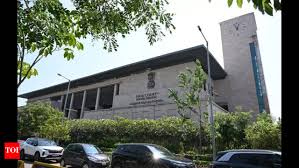
Vijayawada: Andhra Pradesh high court has directed the state govt to introduce reservation for transgender persons in all govt recruitments within six months, marking a major push towards inclusive governance. Justice Nyapathy Vijay issued the orders while hearing a petition filed by a transgender applicant who was denied consideration in the recent mega DSC recruitment. The HC observed that transgender community remains “one of the most marginalised groups in the country”, suffering long-standing social, economic, cultural, and political exclusion. Though the Supreme Court’s historic NALSA judgment and the Transgender Rights Protection Act of 2019 mandate equal opportunities, Andhra Pradesh has yet to implement reservations for the community, unlike states such as Karnataka, Kerala, Tamil Nadu, Telangana, and West Bengal. The judgement stressed on the constitutional obligation under Articles 14, 15, and 16(4) to uplift backward and disadvantaged groups. It noted that reservation is essential to ensure equal access to jobs and to integrate transgender persons into mainstream society. The court issued specific directions in the case of K Rekha from Eluru district, who secured 671st rank in the mega DSC but was not considered due to the absence of a transgender quota. The authorities were asked to consider her for the post of school assistant. Courtesy : TOI Note: This news is originally published on https:/timesofindia.com/bha and is used purely for non-profit/non-commercial purposes, especially human rights
Bihar election results: Rahul Gandhi walked 1,300 km but Congress still went downhill
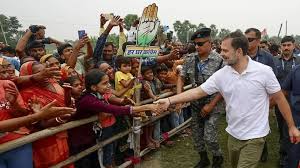
1,300 kilometres, 25 districts, 110 seats. Rahul Gandhi marched through Bihar echoing “vote chor, gaddi chhod,” but voters clearly took a different route – straight to the polling booth, but away from him. The gamcha, the Bhojpuri, the makhana, the fishing and the bike rides – the Nehru-Gandhi scion threw in every flavour of Bihari charm he could muster. But the performance fell flat. Once again, his attempt to slip into the state’s cultural skin didn’t quite land, and the Congress now finds itself staring at one of its bleakest showings, with the party struggling to even hit double digits. Back in 2020, Congress bagged 19 seats. This time, the slide has only steepened. Despite hammering national narratives, the party’s messaging was drowned out by local realities that it failed to read, let alone ride. Why Voter Adhikar Yatra failed to garner votes for Congress? The Voter Adhikar Yatra began with strong crowds and genuine enthusiasm, briefly hinting at a revival for the Congress. But as the campaign moved forward, that initial spark faded. The party leaned too heavily on the yatra’s symbolism while offering little sustained presence on the ground. With only scattered appearances from senior leaders, Congress couldn’t maintain momentum or build a deeper connection with voters. This slowdown was worsened by the MGB’s internal rifts and muddled coordination. Resentment within the RJD, confused candidate choices, and weak organisational synergy blunted whatever gains the yatra had created. At the same time, shifting local dynamics, such as the BSP’s rise and the NDA’s strategic recalibration, cut further into Congress’s appeal. In the end, local realities overpowered the early hype, leaving the yatra unable to pull voters towards the party. The road well walked: Three yatras, one message Rahul Gandhi’s three nationwide yatras — Bharat Jodo (2022–23), Bharat Jodo Nyay (2024), and Vote Adhikar (2025) — were crafted to reposition him as a people’s politician. Each march carried a distinct political thesis: the first called for unity against divisive politics, the second championed justice through caste census and welfare, and the third sought to reform electoral practices and mobilize allies under the Mahagathbandhan banner. While the yatras succeeded in transforming Rahul’s image from a detached leader to an engaged campaigner, they also revealed the limits of symbolic politics. They revived enthusiasm among cadres and built narrative energy, but translating that emotional momentum into votes has remained elusive. The high points: South and the hills If the yatras gave Rahul a platform, victories in Himachal Pradesh, Karnataka, and Telangana gave him proof of concept. In Himachal, the Congress’s return to power followed a textbook anti-incumbency swing backed by the Old Pension Scheme. In Karnataka, anti-corruption sentiment and strong local leadership under Siddaramaiah and DK Shivakumar delivered a resounding 136-seat win. And in Telangana, Revanth Reddy’s aggressive campaign unseated KCR after a decade in power. These wins established Congress as a southern powerhouse and briefly revived its national narrative. The results helped restore morale, re-energize its workers, and suggested that Rahul’s “connect with the people” strategy could still pay dividends — at least in states with strong regional leaders and disciplined organization. The flat roads: Hindi heartland woes Beyond those isolated victories, Congress’s struggles in the Hindi belt continue. Despite a promising 2024 Lok Sabha performance, the 2025 assembly results in Haryana, Maharashtra, Madhya Pradesh, Rajasthan, and Delhi exposed deep organizational decay. In Haryana, the Congress came agonizingly close but fell short due to factionalism and lack of a decisive local face. In Maharashtra, alliance fatigue within the MVA cost it dearly. In Madhya Pradesh and Rajasthan, BJP’s disciplined machinery and Modi’s enduring appeal crushed Congress’s hopes. And in Delhi, the party failed yet again to open its account. The only exception was Jharkhand, where the Congress-JMM alliance retained power by focusing on welfare delivery and regional identity politics — proof that Congress still performs best when piggybacking on strong local allies. Walking, talking, but still searching Rahul Gandhi’s press conferences over the past year, from alleging “vote chori” in Haryana to calling out “hydrogen bomb” voter fraud, have ensured constant media attention. But critics argue that they’ve done little to change electoral outcomes. His messaging resonates with idealists, yet Congress’s electoral machinery remains sluggish, fragmented, and overly dependent on his charisma. Five years, three yatras, and multiple campaigns later, Rahul has successfully crafted a new moral vocabulary for Indian politics — but not yet a winning formula. His journey across India has earned him empathy and visibility, but politics demands more than footprints and soundbites. Unless Congress learns to turn Rahul’s moral momentum into organizational muscle, his yatras may remain grand spectacles of purpose without political payoff. Courtesy : TOI Note: This news is originally published on https:/timesofindia.com/bha and is used purely for non-profit/non-commercial purposes, especially human rights
‘Election not fair from beginning’: Rahul Gandhi’s first reaction to Cong’s dismal show in Bihar polls
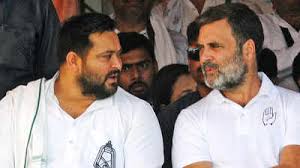
NEW DELHI: Congress leader Rahul Gandhi delivered his first response to the Congress Party’s poor performance in the Bihar assembly election, describing the contest as “unfair from the very outset” and insisting that the party, along with the wider INDIA alliance, will undertake a detailed review of what went wrong. In a post on X, he wrote: “I express my heartfelt gratitude to those millions of voters in Bihar who placed their trust in the Mahagathbandhan. This result in Bihar is truly astonishing. We could not secure victory in an election that was unfair from the very outset. This battle is for the protection of the Constitution and democracy. The Congress Party and the INDIA alliance will thoroughly review this outcome and make their efforts to save democracy even more effective.” His remarks came as the NDA surged to a historic victory, securing over 200 seats, while the Mahagathbandhan registered just 33. The Congress won only six of the 61 seats it contested, prompting sharp internal and public reactions from party leaders. Rahul Gandhi repeated his accusation that the electoral process was compromised, saying the party “could not achieve victory in an election that was not fair from the very beginning.” Congress President Mallikarjun Kharge also expressed deep disappointment but urged party workers not to lose heart. In his post on X, he wrote: “We respect the decision of the people of Bihar and shall continue our fight against those forces that are engaged in weakening democracy by misusing constitutional institutions. We shall study the election results in depth and shall present a detailed account after understanding the reasons for the outcomes. To those voters in Bihar who have supported the Mahagathbandhan, we are deeply grateful from the bottom of our hearts. I wish to tell every Congress worker that there is no need for you to feel disheartened. You are our pride, honour, and glory. Your hard work is our strength.” He added that the party would “continue the struggle to protect the Constitution and democracy by staying among the people,” describing it as a long fight to be waged with “complete dedication, courage, and truth.” The NDA’s emphatic win has strengthened Prime Minister Narendra Modi and chief minister Nitish Kumar, with the BJP emerging as the single largest party, followed closely by JD(U). For the Mahagathbandhan, the result marks a significant setback, particularly for the RJD, which won just 24 seats. As the political dust settles, the Congress leadership appears unified on one point: the Bihar result will be contested politically and organisationally, and the party intends to return to the electorate with renewed resolve. Courtesy : TOI Note: This news is originally published on https:/timesofindia.com/bha and is used purely for non-profit/non-commercial purposes, especially human rights
Bihar shattered the nation’s biggest myth, turning it upside down.
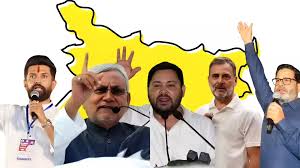
The mandate delivered by Bihar voters shattered the prevailing belief of the past decade and a half that record voter turnout signaled anti-incumbency. However, this time’s results clearly demonstrate that there was no widespread dissatisfaction with the government at the state level. The Bihar election results have surprised everyone this time. Bihar voters delivered a unanimous mandate. The notion that record voter turnout signified anti-incumbency has been shattered over the past decade and a half. The unprecedented 66.91% voter turnout in Bihar has proven this once again. This election result will only have shocked those who lived in a fantasy world or were unaware of the reality despite knowing it. The Congress, under Rahul Gandhi’s leadership, is now unwilling to accept the defeat. It saw vote theft in Maharashtra, Haryana, and even Karnataka, and the same will happen in Bihar. No Mass Discontent: In fact, speaking to people during the election, it was clear that there was no mass discontent at the state level with the Nitish Kumar government. Jan Suraj, which was trying to emerge as a third force, was well-known even in villages, but it lacked direct voter turnout as a party. Women’s turnout, outnumbering men, was a significant indicator of the election results. Lack of Coordination: In coalitional electoral contests, performance depends on how well they speak with one voice and demonstrate consistency on issues, statements, and strategies. The NDA appeared united from day one. Despite minor differences, the NDA publicly announced the seat-sharing arrangement. No public meeting of the Grand Alliance was seen. Everyone fielded their own candidates. There was also a considerable delay in announcing Tejashwi Yadav as the leader. The message that emerged was that they were united only to defeat the BJP, but there was no unity among them. LJP+RLM: The opposition alliance benefited from Chirag Paswan’s rebellion against the LJP (R) in the last election. This time, it is in the NDA. Upendra Kushwaha’s RLM was also in a different alliance last time. Consequently, the NDA brought together leaders with two social bases. On the other hand, there was only Mukesh Sahni’s VIP. Vote theft not an issue: The Congress’s entire strategy was limited to campaigns against vote theft and the Election Commission. No one in Bihar accused anyone of deliberately deleting names from the voter list. Therefore, this was not an issue on the ground, but rather a reaction to it. What will be the result if you campaign by making something that doesn’t exist a major issue? Women’s participation: For whom did women turn out to vote in greater numbers? Women’s participation was 71.6%. A total of 25.1 million women cast their votes, compared to 24.7 million male voters. Women’s turnout was 43.4 million more than men. In 2020, 20.8 million women voted. Compared to this, women’s turnout was 4.3 million more. This didn’t happen without reason. The government under Nitish Kumar’s leadership has done unprecedented work since its inception to bring women into the mainstream of society. Solid Hindutva Support Base: When assessing any election result in India, we must keep in mind that the BJP has a strong support base across the country, based on Hindutva and nationalism. Such BJP voters emerged from all castes in Bihar. There was a time when Bihar was divided between backward and forward castes. This time, too, it seemed as if Bihar was so divided along caste lines that it was now impossible to break free. The election results are a promising sign in this regard. Caste Stiffness Broken: Leaders of all parties should understand that no matter what caste we belong to, we don’t always have a caste-based mindset. From Panchayat to Lok Sabha elections, we work for each other and vote for each other. Inter-caste interactions have also increased significantly. The election results have proven that if gender equality is central to political principles and government policies, and a national spirit is integrated with social justice, development, law and order, and Hindutva, then the majority community can gradually break the caste barrier and move forward. Author: Awadhesh Kumar, Edited by: NBT Desk (The author is a senior journalist and thinker) About the author Whether it’s national, international, sports news, or the inside story of politics, NBT News Desk brings you every news.
Bihar poll results: Rahul Gandhi calls verdict ‘shocking’ as Congress sinks to historic low; wins just 6 of 61 seats
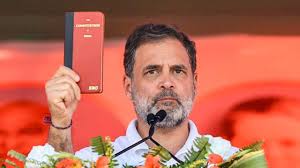
PATNA: Congress leader Rahul Gandhi on Friday said he was shocked at the outcome of Bihar poll as the Grand Old Party witnessed its worst ever performance in an assembly election in the state. The party, which is a part of the Grand Alliance, contested in 61 seats but won only six (strike rate of 9.83%). In 2020, the party contested 70 seats and won 19 (with a strike rate of 27.14%). All its prominent leaders, including state president Rajesh Kumar, Congress legislative party (CLP) leader Shakeel Ahmad Khan and former CLP leader Ajit Sharma, lost the election. In a post on social media, Gandhi alleged the election was not fair from the start. He wrote, “I express my heartfelt gratitude to the millions of voters in Bihar who placed their faith in the Grand Alliance. This result in Bihar is truly shocking. We failed to win an election that was not fair from the start. This fight is to protect the Constitution and democracy.” Party national president Mallikarjun Kharge said the Congress would study the election results in depth and, after understanding the reasons, would present a detailed account. Of the six seats it won, two were by very narrow margins. In Chanpatia, party candidate Abhishek Ranjan prevailed by 602 votes, securing 87 538 votes against BJP’s Umakant Singh who got 86,936. In Forbesganj, party candidate Manoj Biswas defeated BJP’s Vidya Sagar Keshri by 221 votes. Besides Chanpatia and Forbesganj, Congress registered victories in Valmiki Nagar (Surendra Prasad), Araria (Abidur Rahman), Kishanganj (Md Qamrul Hoda) and Manihari (Manohar Prasad Singh) Khan, who lost his sitting Kadwa seat to JD(U)’s Dulal Chandra Goswami by 18 368 votes, said the party would gracefully accept the mandate. He however alleged that the result reflected the effect of Rs 10,000 credited to the accounts of women before the election rather than the people’s mandate. Courtesy : TOI Note: This news is originally published on https:/timesofindia.com/bha and is used purely for non-profit/non-commercial purposes, especially human rights
Bihar election results: NDA stuns Mahagathbandhan in Muslim dominated seats; JD(U) surges
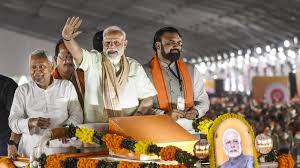
NEW DELHI: Early trends of the Bihar assembly election results on Friday indicated significant gains for the National Democratic Alliance (NDA) in several Muslim-dominated seats. According to the initial trends, the NDA appears on track to secure at least 16 such seats. Chief minister Nitish Kumar’s Janata Dal (United) seems to have benefited the most within the alliance, gaining around eight more seats compared to the 2020 assembly polls. Additionally, Chirag Paswan’s LJP (RV) is leading in six seats with sizeable Muslim voter populations. On the other hand, the Mahagathbandhan has struggled to convert votes despite campaigning heavily on employment and a new chief ministerial face. As per the latest trends, the RJD is losing at least seven Muslim-dominated seats it had won in the 2020 assembly elections, while Congress is trailing in four such seats it previously held. In 2020, the RJD had won 18 of these seats, and Congress had secured six. Historically, Muslims have supported secular alliances. They ensure community members vote for parties claiming to be inclusive. The 2022 Bihar survey showed Muslims make up 17.7% of population and nearly 80% Muslim votes went to MGB in 2015 and 77% in 2020. Meanwhile, the NDA alliance has taken decisive leads across the state, with the Mahagathbandhan trailing. According to the latest numbers, the NDA crossed the majority mark early in the day, with both the BJP and JD(U) delivering strong performances. The Mahagathbandhan (MGB) remains behind, with the RJD performing better than its ally Congress, though still unable to match the NDA’s spread. The RJD, despite the MGB’s overall deficit, continues to rank among the top individual parties in several seats. Jan Suraaj, however, is not appearing prominently in the early seat trends, and its vote share—where visible—remains marginal, having little impact on close contests. The counting operations are being supervised by 243 Returning Officers and an equal number of Counting Observers appointed by the Election Commission. More than 18,000 counting agents representing various candidates are present at the centres to monitor the process closely. Entry into counting centres is strictly limited to individuals with valid passes, and the use of mobile phones inside counting halls is fully prohibited. The election saw participation from over 7 crore voters who cast their ballots to decide the fate of both the ruling NDA and the Mahagathbandhan. Polling was held in two phases, on November 6 and 11. Courtesy : TOI Note: This news is originally published on https:/timesofindia.com/bha and is used purely for non-profit/non-commercial purposes, especially human rights
Madras HC Seeks Centre’s Reply on Transgender Exclusion in Adoption Rules by Dec 4
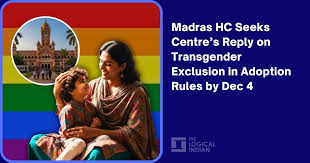
Despite the 2019 law guaranteeing equality, transgender persons in India remain excluded from adoption, prompting the Madras High Court to seek immediate government clarification. The Madras High Court has directed the Union government to clarify why current adoption rules under the Central Adoption Resource Authority (CARA) still exclude transgender persons, despite the 2019 Transgender Persons Act mandating non-discrimination and equal rights. The move follows a petition by a transgender individual challenging the validity of restrictive adoption laws, with the Centre now required to respond by December 4, 2025. This judicial intervention could mark a turning point in legal recognition and the rights of transgender persons to adopt children in India. Judicial Intervention: Challenging Exclusion In a landmark hearing on November 3, 2025, the Madras High Court’s division bench, comprising Chief Justice Manindra Mohan Shrivastava and Justice G. Arul Murugan, asked the central government to provide written clarification as to why CARA guidelines remain untouched by the principles of equality codified in the Transgender Persons (Protection of Rights) Act, 2019. The court’s involvement was prompted by a petition filed by B. Shama, a transgender plaintiff who highlighted the ongoing discrimination in India’s adoption laws-specifically, that CARA’s registration forms on its website exclude transgender individuals from even applying as prospective adoptive parents. Advocate Karthikaa Ashok, representing Shama, argued that CARA’s reference to “male” and “female” should now be interpreted to cover “transgender” applicants as well, reflecting the requirement in the 2019 law for equal treatment. According to the petition, the denial of adoption rights based on gender identity not only violates the 2019 Act but also Articles 14 and 21 of the Indian Constitution, which guarantee equality and life with dignity. During proceedings, the court remarked that CARA functions under the Ministry of Women and Child Development and therefore it is incumbent on the central government to clarify in detail the reasons for the lack of reform. The Additional Solicitor General, A.R.L. Sundaresan, asked for additional time to prepare the government’s reply, resulting in an adjournment of the case to December 4, 2025. Legal Precedents: Barriers and Advocacy This hearing was not the first time the exclusion of transgender persons from adoption had come before the judiciary. In October 2025, Justice M. Dhandapani of the same court dismissed a similar petition by K. Prithika Yashini, India’s first transgender police officer. Justice Dhandapani stated that without explicit legislative amendments, his “hands were tied” since adoption regulations currently classify applicants strictly as male or female, with no mention of non-binary or transgender identities. This legal binary leaves India’s transgender citizens with no official route to adopting under existing frameworks. The recent intervention by the Madras High Court’s division bench moves away from a narrow reading of the law and places the onus on the Union Ministry of Women and Child Development to justify the delay in compliance with Section 8 of the 2019 Act, which explicitly obligates the government to institute transgender-inclusive welfare schemes and rules. Advocates, including Ms. Ashok, have called for an “inclusive interpretation” of existing laws. They underline that parenthood is a fundamental human dignity and that exclusion based on gender is contrary to the spirit of constitutional rights and previous Supreme Court pronouncements, most notably the NALSA judgment establishing equality for transgender persons. National Impact: Law, Families, and Social Change With India’s adoption framework still essentially referencing a binary understanding of gender, the implications extend far beyond legal technicalities. The judiciary’s increasing engagement with the shifting definition of “family” reflects a broader movement in society, where diverse family units are increasingly recognised but not yet enshrined in central legal policy. Recently, the Supreme Court’s split verdict in 2023 around joint adoption by unmarried and queer couples highlighted both progress and persisting barriers within the system. For the transgender community, legal recognition through adoption rights is about more than bureaucracy-it is about dignity, family, and their place in Indian society. Experts caution that continued exclusion keeps “equality trapped in rhetoric,” and that law reform should not lag behind constitutional commitments. The ongoing proceedings and mandated government reply could offer vital clarity and possibly set a precedent affecting thousands seeking to realise their parental aspirations. The Logical Indian’s Perspective The Madras High Court’s proactive intervention reinforces that Indian law must reflect empathy, inclusiveness, and justice. Every citizen, regardless of gender identity, deserves equal opportunity to experience parenthood and familial joy. By amending CARA guidelines and strictly implementing the 2019 Act, the government can move closer to building a truly inclusive society where respect and kindness override stereotypes. Syed Muskan Shafiq Courtesy : TLI Note: This news is originally published on https:/thelogicalindian.com/bha and is used purely for non-profit/non-commercial purposes, especially human rights
A 150-year-old evil tradition was broken after 150 years! A Dalit groom rode a horse for the first time in Rewari, with the wedding procession escorted by police.
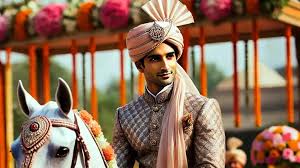
A 150-year-old evil tradition was broken in Khedi Dalu Singh village in Haryana’s Rewari district when a Scheduled Caste groom rode a horse for the first time. However, the family had sought security from the police and administration as a precaution, fearing untoward incidents. The procession proceeded peacefully under the presence of a police force. In Khedi Dalu Singh village, located in the Bawal area of Rewari, Haryana, a Scheduled Caste man’s wedding procession rode a horse for the first time in 150 years. The procession departed on Thursday, November 13th. Police forces from three police stations were deployed, supervised by the DSP. The procession departed from the village for Ateli. According to reports, a horse-riding procession for a young man had never been carried out in this village in history. This evil practice had been prevalent for years. The groom’s family feared an untoward incident. Due to this, they requested police protection. The family expressed gratitude to the police and administration. Ankit, the groom, who works in the Animal Husbandry Department, explained that this evil practice had been prevalent since the village was formed. He said that many people had tried before, but were unsuccessful. Fearing something untoward, the family filed a complaint with the Human Rights Commission, Rewari police, and the administration. The family appealed for protection from the Rewari police, administration, and the National Human Rights Commission. Following this, the wedding procession proceeded peacefully in the presence of police from three police stations and the duty magistrate. Following the incident, the family expressed gratitude to the police and administration. There was no tension in the village. Bawal DSP Surendra Sheoran stated that there was no tension in the village. He stated that police were present as a precaution, and the wedding procession proceeded peacefully. Meanwhile, Nepal Singh, the Sarpanch representative of Khedi Dalu Singh village, stated that there was no tension in the village, nor did anyone protest. He added that everyone in the village wants peace. The family had filed a complaint with the police administration, which led to precautionary measures being taken, and the horse-riding ceremony passed off peacefully. In many areas of Haryana, disputes have previously arisen over Scheduled Caste grooms riding horses, so as a precaution, the horse-riding ceremony was conducted under police protection. Authored by: Manoj Kumar Courtesy: Hindi News
Dalit leader murdered in Sangli, Maharashtra; accused attacked with knife and rod during birthday celebration

Uttam Mohite, president of the Dalit Mahasangh in Sangli, Maharashtra, was stabbed and killed with a knife and rod while celebrating his birthday. One of the attackers also died during the scuffle. Police have registered a murder case and launched an investigation. Digital Desk, New Delhi. Uttam Mohite, president of the Dalit Mahasangh in Sangli, Maharashtra, was stabbed and killed with a knife and rod while celebrating his birthday at his home. According to police, Mohite had a fight with the accused, Ganesh More, before the attack. In fact, the founder of the Dalit Mahasangh in Sangli, Maharashtra, was celebrating his birthday on Tuesday night. Mohite was celebrating his birthday at his home near the Garpir Dargah Chowk area. He was murdered during the celebration. One attacker also died One attacker also died during the incident. According to police, one of the attackers, Shahrukh Rafiq Shaikh (26), was seriously injured during the scuffle. During the scuffle, one of the attackers, Shaikh, sustained a serious knife injury to his thigh, possibly accidentally. He died at a hospital on Wednesday morning. Attack with knives and rods After the guests had left and preparations were complete, some men armed with knives, iron rods, and sticks began abusing Mohite. Fearing for his life, Mohite fled inside his house while being chased by the attackers. The attackers stabbed Mohite multiple times in the stomach and chest and hit him on the head and hands with iron rods and sticks. Mohite was rushed to Sangli Civil Hospital by his nephew, where doctors declared him dead. A police officer said on Wednesday that Mohite and one of the accused, Ganesh More, had a brief altercation during the birthday celebration. Before leaving the venue, More allegedly warned Mohite that he “won’t spare him.” Murder case filed against 8 people Based on a complaint by Mohite’s wife, Jyoti, police have filed a murder case against Indiranagar residents Ganesh More, Satish Lokhande, Shahrukh Shaikh (deceased), Banya alias Yash Londhe, Ajay Ghadge, Jitendra Londhe, Yogesh Shinde, and Sameer Dhole. (With inputs from news agency PTI) BY SHUBHAM TIWARI EDITED BY: SHUBHAM TIWARI Courtesy: Hindi News