
Protest against playing Baba Bhimrao Ambedkar songs: Violence in Dalit girl’s wedding procession, 5 booked, wedding held under police protection

In Sambhal, people protested against the playing of Baba Bhimrao Ambedkar songs during the wedding procession of a Dalit girl. An altercation broke out between the two parties, which later escalated into a physical altercation. Eight to ten people from the bride’s side were injured in the incident. The incident occurred in Allipur Buzurg village, located in the Baniyatheer police station area of Chandausi tehsil in Sambhal district. The wedding procession of Tejpal, son of Lakhan, a resident of the village, arrived in Allipur Buzurg from Akbarpur Chitauri village at around 5:30 pm on April 29th. The procession was passing by the post office in the village. It is alleged that songs related to Baba Bhimrao Ambedkar were being played on a Tata Magic DJ system, which was objected to by Ram Bahadur, son of Pati, Ajay, son of Khempal, Aman, son of Subhash, Bablu, son of Dinu, and Prempal, son of Jagatpal. They are also accused of assaulting members of the Dalit community. Several videos of the altercation have surfaced, showing a young man standing on the roof holding a stick while people standing below are fighting among themselves. Acting police station in-charge Roshan Singh stated that a named report has been filed against five people based on a complaint from the bride’s father, Tejpal, regarding the altercation during the wedding procession in Allipur Buzurg village. Police are investigating the matter and efforts are being made to arrest the culprits. Tejpal Singh stated that police arrived in the village after the altercation. His daughter’s wedding was conducted under police protection, and the wedding procession departed the next morning. He has demanded strict action against the culprits from the police administration. Sunny Gupta, Sambhal Courtesy: Hindi News
Meet Rithika Sri: Tamil Nadu’s first transgender cricket umpire breaking barriers

Indian cricket is slowly seeing new names and new roles, not just on the pitch but also in decision-making roles like umpiring. These changes may look small at first, but they carry meaning for many people who have long been outside the system. One such story coming from Tamil Nadu is now drawing attention for all the right reasons, where Rithika Sri has stepped into cricket umpiring and created a quiet milestone. Rithika Sri becomes a new name in Tamil Nadu cricket umpiring Rithika Sri, who comes from Salem, has become the first transgender umpire from Tamil Nadu. Her entry into this field is being seen as a notable moment in state cricket, especially in terms of inclusion. A key development that supported this change came from the Tamil Nadu Cricket Association. It introduced an “other” category in the gender section of its State Panel Umpire exams. This change made the application process more open for different candidates. Early life and background of Rithika Sri Rithika Sri was born as R. Muthuraj in Salem, Tamil Nadu. She later transitioned and identifies as a transwoman. She has completed a diploma in Mechanical Engineering. Before entering cricket, she worked at a call centre in Mohali. Her interest in cricket umpiring started while watching the Indian Premier League. What began as casual interest slowly turned into something she wanted to pursue seriously. How her umpiring journey started During the COVID period, she returned to her hometown. This was when she decided to focus on cricket umpiring. From 2021 onwards, she began officiating matches in Salem and Coimbatore. She continued building experience in local matches over time. In 2024, she completed her transition in Coimbatore. She was also involved in discussions that supported the inclusion of the “other” gender category in the TNCA umpire exam system. Difficult moments during her journey Rithika Sri has shared that her path was not easy. She faced difficult situations while trying to establish herself in cricket umpiring. She also recalled an incident in Coimbatore where she was denied entry into a cricket ground. Speaking to The Hindu, she shared her experience in her own words: “The first time in Coimbatore, I went to watch because they wanted me to get familiar with the new district, but I was denied entry, and there were hurtful comments. I went back home crying after an hour, but not before fighting back against them. People often accuse trans people of begging, but then, at the same time, they don’t allow us to pursue a dignified livelihood. Can’t a transperson become an umpire?” Despite such experiences, she continued her journey without stepping away from the sport. Support from cricket associations Along with challenges, she also received support from cricket authorities. The Coimbatore District Cricket Association helped ensure that she was not discriminated against at venues. Officials including R. Chandramouli and K. Mahalingam worked to manage the situation and support fair access. She also mentioned that matches were shifted from a venue that did not allow her entry. Courtesy : TOI Note: This news is originally published on https:/timesofindia.com/bha and is used purely for non-profit/non-commercial purposes, especially human rights
Former Air Chief says Greater Nicobar project important for ‘military footprint’
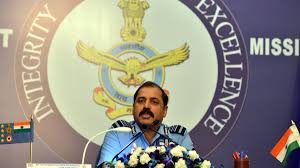
In pushback against Rahul Gandhi’s opposition to the project, retired Air Chief Marshal says ecological concerns will be mitigated; notes that proposed port is 150 km from Malacca Strait, the route for 75% of China’s energy trade The Greater Nicobar project is “important for India’s military footprint” in the area, a former chief of the Indian Air Force said on Thursday (April 30, 2026), as part of the BJP’s pushback against Congress leader Rahul Gandhi’s comments against the project and its harmful ecological footprint. Air Chief Marshal (Retd) R.K.S. Bhadauria, who is now a member of the BJP, pointed to the strategic importance of having a port near the route of China’s energy shipments, with the conflict in West Asia demonstrating the impact of such maritime leverage. Nicobar project largest theft of Indian property to fulfil fantasies of one businessman: Rahul Gandhi He added that environmental concerns are taken on board as a matter of course whenever such projects are mooted. “There are statutory clearances and committees are made. They look at all the factors and all these are mitigated,” he said in a statement. The project, being built at a cost of around ₹81,000 crore, includes a transhipment terminal, a power plant, and a township. The Union government expects it to boost maritime trade, connectivity, and security, and play a key role in promoting India’s geo-strategic and economic interests. The Great Nicobar project | Between the sea and the state Strategic location The retired Air Chief Marshal said that was “surprised” by Mr. Gandhi’s views on the project, noting that it was “important that such a project be understood.” “[The project] is important for India to set a militarily strategic footprint in that region. From a defence and strategic perspective, this development is very crucial. After Strait of Hormuz closure, we have realised the importance of straits and sea route blockades, and such a statement after all this is surprising. If the port is made, it will be only 150 km away from the Malacca Strait, which serves as the route for 75% of China’s energy trade. It will boost India’s maritime and air front dominance to a great extent,” he said. His response on behalf of the BJP came after Mr. Gandhi characterised the project as “one of the biggest scams and gravest crimes against the natural and tribal heritage of the country”. After visiting the area, the Leader of Opposition in the Lok Sabha had said that the project would entail the axing of millions of trees in 160 sq. km of rainforest. Terming it as “destruction dressed in development’s language”, Mr. Gandhi vowed to raise the issue in Parliament. The Hindu Bureau Courtesy : The Hindu Note: This news is originally published on https:/thehindu.com/bha and is used purely for non-profit/non-commercial purposes, especially human rights
Rahul Gandhi Flags Great Nicobar Connectivity Project As ‘Destruction Dressed As Development’ During Island Visit

Rahul Gandhi also mentioned that this project aims at the destruction of enormous ecological properties, and that he would raise this matter in the Parliament Leader of Opposition in the Lok Sabha and Senior Congress leader Rahul Gandhi strongly condemned the Union Government’s proposed infrastructure project on the Great Nicobar islands. He is currently visiting Andaman and Nicobar, where he is assessing the environmental impact the project could have, and talking to indigenous communities about the same. On Wednesday, April 29, 2026, he said: “What is being done in Great Nicobar is one of the biggest scams and gravest crimes against this country’s natural and tribal heritage in our lifetimes.” See Also: Hardoi School Principal Booked Under BNS and SC/ST Act After Viral Video of Her Shouting at Parents Rahul Gandhi: Destruction Dressed In Development’s Language The Rae Bareli MP described the Nicobar islands as one of the most beautiful forests he has seen in his lifetime, hosting a rich flora and fauna. In a post on X (April 29, 2026), Gandhi talked about his visit to the region. He said: “These are the most extraordinary forests I have ever seen in my life. Trees older than memory. Forests that took generations to grow. The people on this island are equally beautiful – both the adivasi communities and the settlers – but they are being robbed of what is rightfully theirs.” Flagging the ecological loss, he mentioned that this project ignores the livelihoods and aspirations of the local tribal communities living in the area. He also visited Campbell Bay on Tuesday, April 28, 2026, to talk to the tribal leaders opposing the project. “This is not development. This is destruction dressed in development’s language,” he added. Targeting Crony Capitalism Highlighting the scale of the deforestation as a major ecological loss for the region’s indigenous communities, the Lok Sabha MP said: “It’s amazing that 160 square kilometres of these forests is being chopped up, so that one businessman, Mr. Adani, can fulfill his fantasies.” The Adani Group has expressed interest in developing a trans-shipment project in the region. Rahul Gandhi has previously, on multiple occasions, targeted Gautam Adani for building projects that would pose harmful disadvantages to local communities. The Opposition recently targeted the BJP government in Assam for handing over a thermal power contract to Adani for procuring 3,200 MW power in the region, a move that could potentially deprive the state exchequer of thousands of crores of rupees. The ₹81,000-Crore Great Nicobar Connectivity Project The Great Nicobar Connectivity Project, officially known as the “Holistic Development of Great Nicobar Island” project, is a massive strategic and commercial initiative piloted by NITI Aayog. Now estimated at over ₹92,000 crores, the ambitious plan aims to transform the southernmost island into a global maritime and defense hub. The development includes the construction of a deep-water International Container Transshipment Terminal (ICTT) at Galathea Bay, a greenfield dual-use international airport, a gas-and-solar power plant, and a new coastal township projected to house over 3,00,000 people. Recent data indicate that the present population of the Great Nicobar Islands is around 8,000. To accommodate this sprawling infrastructure, the project could result in the mass felling of nearly 8.5 lakh trees, clearing approximately 160 square kilometres of pristine rainforests. See Also: Governments Come and Go, But Burari’s Fate Remains Same: Dust All Around, Long Pending Sewer Work and Collapsed Administration, It’s What US President Trump Would Call a HellHole Will Raise The Issue In Parliament, Says Rahul Gandhi Gandhi mentioned that this project aims at the destruction of enormous ecological properties, and also said that he would raise this matter in the Parliament. The project has already seen immense backlash from local tribal communities and environmentalists, who have raised concerns over the lack of transparency of the project, severe environmental risks, and the alleged neglect of tribal rights by the central government. Ultimately, the push for the Great Nicobar project highlights a growing conflict between the government’s aggressive infrastructure ambitions and the urgent need to protect India’s most vulnerable indigenous populations and irreplaceable natural heritage.India travel guides ParliamentAuthor:Gaurav Pandey, Edited by :Dhruv Sharma Courtesy : News Gram Note: This news is originally published on https:/newsgram.com/bha and is used purely for non-profit/non-commercial purposes, especially human rights
Dalit Sena seeks action against Karnataka Minister Boseraju over land ‘encroachment’

In a letter addressed to the CM, Governor and the Forest Minister, Javeed Khan, state organisational secretary of Dalit Sena, alleged that five acres of land recorded as government/reserved forest land were recorded in the name of Boseraju’s wife. Bengaluru: The Dalit Sena has accused Science and Technology Minister N S Boseraju of ‘encroaching’ upon forest and Waqf land and has sought legal action. In a letter addressed to Chief Minister Siddaramaiah, Governor Thaawarchand Gehlot and Forest Minister Eshwar B Khandre, Javeed Khan, state organisational secretary of Dalit Sena, alleged that five acres of land recorded as government/reserved forest land were recorded in the name of Boseraju’s wife. He also alleged that at Manvi town in Raichur district, government land located in the Housing Board Colony was recorded in Boseraju’s name. Khan also noted that after public protests, the district administration and courts had directed that such lands be handed over to the government. He sought legal action against the concerned persons and requested immediate steps to safeguard public property and forest resources. Courtesy : DH Note: This news is originally published on https:/deccanherald.com/bha and is used purely for non-profit/non-commercial purposes, especially human rights
Caste-Based Violence in Gujarat: Sarpanch and his associates brutally beat a Dalit family for requesting them not to damage a drain.

Caste-based individuals attacked a Dalit family, using weapons such as sticks and mace. The attackers also pelted stones and tried to break down the door of the family’s home. Patan – On July 16, a minor dispute escalated into a violent attack on a Dalit family in Datrana village, Santalpur taluka, Patan district, Gujarat, when the village sarpanch and his associates launched a deadly attack on a Dalit family. The incident began when a Dalit man requested them not to damage a drain constructed in front of his house. Enraged by this minor issue, the sarpanch and his associates not only used caste-based slurs but also attacked the family members with weapons such as sticks and mace. This incident is another example of the increasing caste-based violence against the Dalit community in Gujarat, highlighting social inequality and the indifference of the local administration. According to the FIR, on July 16th, at around 6:30 p.m., Datrana village sarpanch Jeevanbhai Savabhai Ahir was removing mud from the road with a JCB machine. During this, Madeobhai Dhawal, a Dalit, requested him not to damage the drain in front of his house to prevent water from spilling onto the road and avoid dirt. This enraged the sarpanch and he began abusing Madeobhai, including caste-based slurs. The sarpanch then attacked Madeobhai with a gadda patu (a type of tool). When Madeobhai’s family members, Muljibhai Danabhai Dhawal, Naranbhai, his wife Upaben, Mayurbhai, and Vinodbhai, intervened to save him, the sarpanch called his companions. These included Kishanbhai Jeevanbhai Ahir, Bhachabhai alias Bhappu Patabhai Ahir, Virambhai Savabhai Ahir, Parbatbhai Lalabhai Ahir, Savabhai Lalabhai Ahir, Dalabhai Lalabhai Ahir, and other unidentified individuals. These individuals attacked the Dalit family in a coordinated manner, using weapons such as sticks and mace. Naranbhai, Upabhen, Muljibhai, Mayurbhai, and Vinodbhai suffered serious injuries, particularly to their backs and heads. The attackers also pelted stones and tried to break down the door of the family’s home. The attackers threatened, “You escaped today, but next time we will kill you.” The injured were taken to the government hospital in Santalpur by 108 ambulance, where they received first aid. Muljibhai Danabhai Dhaval subsequently filed a complaint at the Santalpur police station. The complaint has been filed under sections 3(1)(r) (intentionally insulting a person belonging to a Scheduled Caste/Tribe) and 3(1)(s) (using caste-based slurs against a person belonging to a Scheduled Caste/Tribe) of the Scheduled Castes and Scheduled Tribes (Prevention of Atrocities) Act, 1989 (SC/ST Act), along with sections of the BNS. The FIR names Sarpanch Jivanbhai Savabhai Ahir, Kishanbhai Jivanbhai Ahir, Bhachabhai alias Bhappo Patabhai Ahir, Virambhai Savabhai Ahir, Parbatbhai Lalabhai Ahir, Savabhai Lalabhai Ahir, and Dalabhai Lalabhai Ahir. Social activist Narendrabhai M. Parmar from Patan says that the incident in Datrana village is proof that caste mentality is still deeply rooted in society. Incidents of caste-based violence against Dalits are frequently occurring in Gujarat. According to National Crime Records Bureau (NCRB) data, more than 1,500 cases were registered under the SC/ST Act in Gujarat in 2023, reflecting rising atrocities against the Dalit community. In many cases, especially in rural areas, Dalits are subjected to social exclusion, humiliation, and violence. This violence often stems from minor disputes, such as personal lifestyle or participation in social activities. Geetha Sunil Pillai Courtesy: Hindi News
Gujarat: Dalits invited to the Ram Temple Pran Pratishtha ceremony were told to bring plates and glasses from home!

The community refused to accept this condition, and an FIR was filed at the Visavadar police station. A case of alleged discrimination and disrespectful treatment of members of the Dalit community has come to light during the Pran Pratishtha Mahotsav of the Lord Ram Temple in Bhootdi village, Visavadar taluka, Junagadh district. The organizing committee had invited approximately ten people to the event, but they were asked to arrive after others had finished eating, eat their food separately, and not enter the temple. They were also asked to bring their own plates, bowls, and drinking water from home. Members of the Dalit community allege that separate arrangements for food and water were made for them, which clearly amounted to untouchability and caste-based insults, and therefore, the offended individuals decided not to attend the event. 25-year-old Ajay Chatur Boricha filed a complaint with the Visavadar police station. According to the complaint, around 5 pm on April 27th, five members of the organizing committee came to his neighborhood and invited about 10 Scheduled Caste members present there for the temple’s consecration ceremony. They also imposed the condition that they arrive after other caste members had eaten and that they bring their own plates and bowls. The Dalit community refused to accept this condition. Consequently, the proposed community feast in the village was canceled. However, the temple’s consecration ceremony was completed on the evening of April 29th. Based on this complaint, the police have registered a case against five individuals: Babu Uka Hapani, Narendra Bhanji Siroya, Ramnik Samji Sorathia, Atul Bhikha Siroya, and Phoola Popat Siroya under sections 3(1)(r), 3(1)(za)A, 3(1)(za)C of the SC/ST (Prevention of Atrocities) Act, as well as sections 196(2) and 54 of the Indian Penal Code (IPC). An investigation has been initiated following the FIR lodged at the Visavadar police station. The investigation has been assigned to Raviraj Singh Parmar, DSP of the Junagadh SC/ST Cell. The police have conducted a panchnama of the scene of the incident, recorded witness statements, and issued notices to the accused. The victim Dalit families have demanded a fair investigation and justice. The case is currently under investigation, and further action will be taken based on the investigation report. Casteism Incidents in Gujarat In the past few months, numerous incidents of caste-based discrimination, untouchability, and violence against the Dalit community have been reported in Gujarat. These include restrictions on temple entry, social boycotts, attacks on wedding horse riders, and untouchability in everyday life. Recently, a sensational and heartbreaking incident emerged from Amreli district in which Mahesh Premji Rathod, a 24-year-old man who had come to Shantaba General Hospital for his elderly uncle’s treatment, was beaten to death with plastic pipes for throwing leftover food into a free dining hall on the hospital premises. In March of this year, the Dalit deputy sarpanch of a village in Sabarkantha district filed a serious police complaint against eight people. The dispute is said to be rooted in the village panchayat’s decision to remove an old and dilapidated bird feeder tower (platform). It is alleged that during a meeting convened on this issue, these people threatened the deputy sarpanch and used caste-related slurs against him. Similarly, in February, in Chandrumana village, Patan, when a Dalit groom rode a horse, people with a casteist mindset allegedly resorted to hooliganism, armed with swords. They not only threatened the groom but also assaulted members of the wedding procession. In January of this year, a case of caste-based violence was reported against Tulsi Solanki, a 26-year-old Dalit laborer, in Piprala village, Santalpur tehsil, Patan district. Three men attacked Solanki with sticks, fists, and kicks, hurling casteist slurs, and threatening to kill him after he refused to lend them his glasses. In 2025, a case was filed against four women for verbally and physically abusing a Dalit woman during a Garba event in a village in Mahisagar district. The victim filed an FIR at the Virpur police station, alleging that she was subjected to caste-based abuse and physical assault after attempting to participate in a traditional dance festival with a friend. Geetha Sunil Pillai Courtesy: Hindi News
Obscenity against Dalit girl in Kannauj: Accused sentenced to 5 years in prison, fined ₹10,000 under the POCSO Act

The court has sentenced the accused to 5 years in prison for sexually assaulting a Dalit girl in Kannauj district. A fine of ₹10,000 has also been imposed on the accused, which will be given as compensation to the victim. This incident occurred in Rooppur village, under the jurisdiction of the Saurikh police station. On September 10, 2020, Pappu Sharma, a resident of the village, lured a Dalit girl to his home. The accused stripped naked in front of the girl and sexually assaulted her. When the girl screamed, her mother arrived and managed to get him out. When she protested, the accused also abused her mother. Subsequently, the victim’s mother filed a complaint against Pappu Sharma at the Saurikh police station under sections of the POCSO and SC/ST Acts. During the court hearing, accused Pappu Sharma defended himself, saying that he had not stripped naked in front of the girl, but that his towel had come loose. Government advocate Brijesh Shukla stated that based on the evidence and witness statements, Special Judge Ram Gopal Singh sentenced Pappu Sharma to five years’ imprisonment and a fine of 10,000 rupees. However, due to a lack of evidence, he was acquitted under the SC/ST Act. Vikas Awasthi | Kannauj Courtesy: Hindi News
Police launch probe into death of Dalit youth in Pudukottai
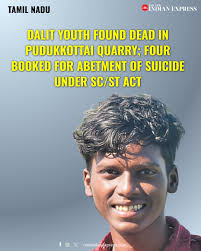
Police have launched an investigation into the death of a 20-year Dalit youth, whose body was found in a non-functional stone quarry in Pudukottai district a few days ago, after his parents raised suspicion of foul play. The victim, whose identity was established as R. Hariharan of Keelapatti village, had left home on April 21 and did not return. His body was found in a non-functional quarry in Vellanur police station limits on April 23. Acting on a complaint from the victim’s father Rajkumar, the Vellanur police initially registered a case under section 194 of Bharatiya Nagarik Suraksha Sanhita (BNSS). The body was sent to Pudukottai Government Medical College Hospital for a postmortem examination. But the youth’s parents refused to accept the body after completion of the post-mortem on April 24. They suspected that their son had been killed by family members of the girl with whom he was in love with earlier. The Vellanur police subsequently altered the case to section 108 of the BNS (abetment of suicide) read with section 3 (2) (va) of The SC / ST (Prevention of Atrocities) Act naming the girl, her father and her brothers as the accused. The victim’s parents received the body on April 27 and it was buried thereafter. Police sources said the youth and the girl were in love had loved each other and had allegedly run away from their homes a few months ago. They were traced and the girl was handed over to her parents. Arrangements were said to have been made for the marriage of the girl. The case was being investigated by the Deputy Superintendent of Police, Pudukottai. The sources said the final report of the post-mortem was awaited. Assistance for overcoming suicidal thoughts is available on the State’s health helpline 104, Tele-MANAS 14416, and Sneha’s suicide prevention helpline 044-24640050. The Hindu Bureau Courtesy : The Hindu Note: This news is originally published on https:/thehindu.com/bha and is used purely for non-profit/non-commercial purposes, especially human rights
Manipur peace can be restored in five minutes if government decides, says Rahul Gandhi
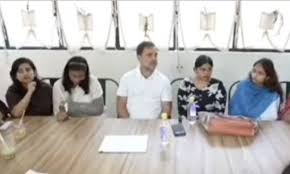
Imphal: Congress leader Rahul Gandhi has said that much-needed peace in Manipur could be restored through dialogue between the two communities, which he described as the ultimate solution to the current crisis. Interacting with young women from Gargi College and Delhi University on Tuesday, he stated that if the Government of India decided to restore peace in Manipur, it could be achieved within five minutes. “If the United Progressive Alliance (UPA) were in power, it could be settled within hours,” he said, adding that both communities need to build bridges for the restoration of peace. The UPA was a coalition of centre-left political parties in India, primarily led by the Indian National Congress (INC), which governed the country from 2004 to 2014. He added that the Indian Army is supposed to stop people from fighting each other. Reiterating his point, Gandhi said both communities need to build bridges for lasting peace in the state. He accused the ruling government of lacking the intention to end the violence, noting that the Prime Minister has not visited conflict-hit Manipur in recent months. He further expressed hope that if the UPA were in power, the situation would be resolved within hours. Gandhi emphasised that Manipur deserves peace and said that families who have lost loved ones must be taken care of. He advocated a bottom-up approach to peacebuilding, suggesting that educated youth and civil society can help bridge divides. Gandhi said Manipur is going through a “very difficult time” and encouraged young people to stand against injustice and empathise with the suffering of the people. He argued that peacebuilding must emerge from the middle and grassroots levels, suggesting that educated groups from both sides should organise workshops and peace initiatives. Notably, Rahul Gandhi made multiple visits to Manipur, including relief camps in Churachandpur, Moirang, and Jiribam in 2024, where he met victims of ethnic violence. He focused on listening to the grievances of displaced people, including women and children, and called for peace and central intervention. By Bit Irom Courtesy : North East Now Note: This news is originally published on https:/northeastnow.com/bha and is used purely for non-profit/non-commercial purposes, especially human rights