
Siddaramaiah informs cabinet colleagues of his decision to step down as Karnataka Chief Minister
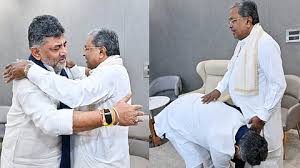
Amid growing speculation over a leadership change in Karnataka, Chief Minister Siddaramaiah, informed his cabinet colleagues of his decision to step down during the breakfast meeting hosted at his official residence on Thursday. His current deputy and possible successor, D K Shivakumar and other cabinet colleagues attended the breakfast meeting. “Congress high command proposed DKS as the next chief minister.I have agreed to this,” he said. Siddaramaiah is likely to formally tender his resignation at 2: 30 Pm. Photos shared by the Chief Minister’s Office showed Siddaramaiah embracing Shivakumar. In another image, Shivakumar was seen seeking Siddaramaiah’s blessings by touching his feet. Ministers including Priyank Kharge, KJ George, MB Patil, Ramalinga Reddy and HK Patil also attended the meeting at the Chief Minister’s residence under heightened security arrangements. According to CMO sources, the CM sought the Governor’s appointment after the party high command apparently asked him to make way for a leadership change in the state. However, Lok Bhavan sources said Siddaramaiah has not yet sought time to meet Governor Thaawarchand Gehlot, who he has left for his native, Indore, for personal reasons. Discussions over a possible transition have periodically surfaced since the Congress government crossed the halfway mark of its tenure in Karnataka. The Congress leadership, including Rahul Gandhi and party president Mallikarjun Kharge, had held several hours of discussions with Siddaramaiah and DK Shivakumar, both jointly and separately in Delhi recently. While some reports claim the Congress high command may be leaning towards a change and has conveyed its position to Siddaramaiah, the party has publicly rejected such suggestions. Meanwhile, the Karnataka State Federation of Backward Class Communities warned the Congress and its high command that the party will face consequences if Siddaramaiah is replaced. Asserting that Congress came to power because of the support of backward class and AHINDA (Kannada acronym for minorities, backward classes and Dalits) communities, federation leaders said there is no other leader of Siddaramaiah’s stature in the Congress party, and warned of agitation if he is made to step down. Shivakumar camp was jubilant, and his supporters broke into celebrations on Wednesday in many parts of the state, including Bengaluru and Ramanagara, amid reports that their leader was all set to become the next CM. Supporters of Siddaramaiah gathered outside his official residence, protesting amid intense speculation that he might step down. Courtesy : TNIE Note: This news is originally published on https:/thenewindianexpress.com/bha and is used purely for non-profit/non-commercial purposes, especially human rights
Vijayan calls ED raids ‘targeted crackdown’ on Opposition, says Rahul may get ‘mental satisfaction’

Former Kerala CM alleged that the BJP has been using central agencies against opposition leaders since it came to power and claimed the action against him was also part of that strategy. Former Kerala Chief Minister Pinarayi Vijayan on Wednesday alleged that Enforcement Directorate (ED) searches at his residence were part of a “targeted crackdown” on opposition leaders across the country. He also claimed the searches may provide “mental satisfaction” to leaders like Rahul Gandhi, alleging that the Congress leader had repeatedly questioned why his residence had not been searched and why he had not been arrested. Speaking to reporters after ED officials concluded hours-long searches at his rented house in Bakery Junction in connection with the alleged CMRL monthly payment case, Vijayan said the action would not weaken him or the CPI(M). “This is only a beginning. Nobody should harbour the illusion that such actions can intimidate or weaken us,” he said. The veteran CPI(M) leader alleged that the BJP-led Centre has been using central agencies against opposition leaders since it came to power, and claimed the action against him was also part of that strategy. Claiming that opposition leaders across the country were facing similar action from central agencies, Vijayan alleged that the Congress was maintaining silence over ED proceedings against leaders of other parties. The ED action is linked to allegations that Cochin Minerals and Rutile Ltd (CMRL) paid Rs 1.72 crore to Exalogic Solutions, owned by Vijayan’s daughter T Veena, between 2018 and 2019, without receiving any services in return. Officials said searches were being conducted at around 10 premises across Kerala under the Prevention of Money Laundering Act (PMLA). The searches came a day after the Kerala High Court dismissed a plea by CMRL seeking to quash the ED proceedings in the case. Courtesy : TNIE Note: This news is originally published on https:/thenewindianexpress.com/bha and is used purely for non-profit/non-commercial purposes, especially human rights
2007 history will be repeated in 2027: Mayawati blows the election bugle, hints at a Dalit-Brahmin alliance

Mayawati’s new strategy to win the 2027 UP Assembly elections, vigorously preparing to return to power using the 2007 ‘social engineering’ formula (Dalit-Brahmin alliance). Uttar Pradesh: Bahujan Samaj Party chief Mayawati has sounded the election bugle for the 2027 Uttar Pradesh Assembly elections, hinting at a strong comeback. Recalling the party’s historic 2007 victory on Sunday, she declared that if BSP workers strengthen their grassroots mobilization and reconnect with the “Sarva Samaj,” the same political model can easily be replicated in 2027. In a clear political message specifically focused on Brahmins and Dalits, the BSP supremo asked her party leaders to remind the public of the 2007 experiment with social alliances. She said that people should be told that during the BSP’s rule, every section of society that felt neglected, insecure, and humiliated, including Brahmins, Dalits, the poor, and backward communities, received power and full respect. Addressing an important meeting of BSP state officials in Lucknow, Mayawati comprehensively reviewed booth-level preparations, candidate selection, and organizational expansion. During the meeting, she sharply attacked opposition parties on issues of inflation, unemployment, law and order, and misleading and divisive politics. In her statement, Mayawati emphasized that the people of Uttar Pradesh must once again fully trust the BSP, just as they did in 2007. She recalled that during that period, the Brahmin community, the weaker sections, and people from all sections of society were rescued from an environment of neglect and insecurity and given full respect and dignity, both in the party and the government, through proper participation. She instructed BSP leaders to reassure the public that, like in 2007, people from all communities can once again unite. Particularly, Brahmins, the marginalized, and the weaker sections can unite to form a government that guarantees respect, better law and order, and a firm guarantee of constitutional rights. The former Chief Minister made serious allegations against her rival parties of resorting to caste and communal polarization before the elections. She clarified that these parties have completely failed to provide good governance to the public after coming to power. She claimed that inflation, unemployment, and increasing oppression and neglect of the weak and marginalized sections of society have caused widespread public disillusionment. Without directly naming the BJP, Mayawati said that current governments are more focused on rhetoric, image management, and divisive politics than on public welfare. She also strongly instructed her workers to be vigilant against attempts to influence voters through emotional and caste-based narratives during the elections. BSP insiders also believe that Mayawati’s strong focus on Brahmins is a significant signal. It’s worth noting that in 2007, the party’s “social engineering” formula helped it reach the pinnacle of power by mobilizing Dalit and Brahmin support. At that time, the BSP won 206 seats and formed a government in Uttar Pradesh with an absolute majority. The Bahujan Samaj Party has struggled significantly on the electoral front in recent years. This new strategy clearly indicates a serious effort to rebuild that broad social alliance before the 2027 elections. Mayawati also emphasized early selection of candidates, strengthening booth management, and expanding the party organization at every level. She stated that the upcoming elections will prove to be both challenging and decisive for the future of Uttar Pradesh politics. Senior BSP officials, district coordinators, and key assembly constituency-level leaders from across the state attended this important party meeting. Rajan Chaudhary Courtesy: Hindi News
Congress workers protest in Hapur: Express outrage over gang rape of Dalit girl in Mahoba, submit memorandum to SDM

Congress party workers staged a protest in Hapur on Monday to protest the alleged gang rape of a Dalit girl in Mahoba district. The workers reached the District Magistrate’s office and submitted a memorandum addressed to the Governor to SDM Sakshi Sharma. Congress District President Rakesh Tyagi stated in the memorandum that a Dalit girl returning from NEET coaching in Mahoba was abducted by miscreants. It is alleged that she was held in Prayagraj for 15 days, drugged, and gang-raped. He also alleged that when State Congress President Ajay Rai visited the victim’s family, the administration did not allow him in. Targeting the BJP government, he said that rape cases against women and girls are continuously increasing in the state. He accused the government of inaction on this issue. City President Irfan Ahmed demanded that the victim’s family be given a compensation of ₹50 lakh and that punitive action be taken against the culprits as soon as possible. He also stated that visiting the victim’s family is not a crime. Present during the meeting were former MLA Gajraj Singh, PCC member and former Dhaulana Assembly candidate Pandit Arvind Sharma, senior Congress leader Dr. VC Sharma, former councilor Aijaz Ahmed, former SC-ST District President Naresh Bhati, City President Pilkhua Rajneesh Tyagi, District Vice President Ravindra Gurjar, District Vice President Mursaleen Chaudhary, District Vice President Lal Bahadur, District President of the Ideology Department Seema Sharma, District President of the Law and Human Rights Department Advocate Raghuveer Singh, State Vice President of the Outreach Committee Kuldeep Atreya, SC-ST State Secretary Vinod Jatav, SC-ST State Secretary Rashmi Chaudhary, District General Secretary Gaurav Garg, District General Secretary Yashpal Dhilor, District General Secretary Kapil Sharma, City President of the OBC Cell Afzal Aadhati, Garh Block President Bijendra Tyagi, Simbhaoli Block President Nafees Khan, Sachin Goyal, Ramlal Arya, and many other activists. Danish, Hapur Courtesy: Hindi News
Punjab Commission Investigates Alleged Anti-Dalit Audio Clip

Punjab State Scheduled Castes Commission investigates an alleged anti-Dalit audio by Congress leader Amrinder Singh Raja Warring, who claims the clip is fake. Warring has requested the police to file an FIR, alleging a smear campaign amid local elections. The Punjab State Scheduled Castes Commission is investigating an audio clip allegedly featuring anti-Dalit remarks by Congress president Amrinder Singh Raja Warring. Warring has denied the authenticity of the clip, claiming it is fabricated and part of a smear campaign against him during local elections. He has called for the Punjab police chief and the State Election Commission to file an FIR against those spreading the alleged false audio. The commission has requested a report from Muktsar police and a forensic analysis of Warring’s voice amid concerns over the timing of the audio’s release. The Punjab State Scheduled Castes Commission, led by Jasvir Singh Garhi, has initiated a probe into a controversial audio clip purportedly featuring anti-Dalit comments by Amrinder Singh Raja Warring, the state Congress president. The audio has led to significant political turmoil, with Warring denying its authenticity and claiming it was fabricated. Warring has urged the Punjab police chief and the State Election Commission to file a First Information Report (FIR) against those circulating the alleged false clip. He asserted that similar attempts to malign his image occurred seven years ago and are resurfacing during ongoing local elections. Garhi has requested a detailed report from the Muktsar police and has called for a forensic analysis of Warring’s voice. Warring expressed his disbelief at the commission’s quick decision to act on the clip without verifying it. He implied that releasing the audio at this crucial election time suggests a deliberate attempt to damage his reputation. Warring stated his commitment to identifying those responsible for what he calls a targeted smear campaign. Courtesy : Devdiscourse Note: This news is originally published on https:/devdiscourse.com/bha and is used purely for non-profit/non-commercial purposes, especially human rights
Vijay’s cabinet and the transformation of social justice politics in Tamil Nadu

By choosing institutional inclusion over mere rhetoric, the TVK-led coalition government breaks the six-decade DMK-AIADMK duopoly to structurally redefine representation and social justice politics in Tamil Nadu The formation of the new Tamil Nadu government under the leadership of C Joseph Vijay marks a significant moment in the political history of the State. For nearly six decades, Tamil Nadu’s political landscape was dominated by the alternating rule of the Dravida Munnetra Kazhagam (DMK) and the All India Anna Dravida Munnetra Kazhagam (AIADMK). Both parties consistently projected themselves as inheritors of the Dravidian movement and champions of social justice. Yet, despite the ideological centrality of equality, anti-caste politics, and representation in Tamil Nadu’s political discourse, the structure of political power often remained limited in its inclusiveness. The emergence of the Tamilaga Vettri Kazhagam (TVK)-led coalition government, therefore, represents more than an electoral transition. It signals an attempt to redefine the grammar of governance through broader social representation, coalition-based participation, and the redistribution of institutional power to historically marginalised communities. A Historic Moment in Dalit Representation : One of the most remarkable aspects of Vijay’s cabinet is the unprecedented representation accorded to Dalit communities. For the first time in Tamil Nadu’s history, the cabinet includes eight ministers from Dalit communities in a 35-member Tamil Nadu Cabinet. This development acquires even greater significance when placed within a historical context. Successive governments led by both the DMK and the AIADMK often projected themselves as defenders of social justice, yet Dalit representation within the cabinet rarely crossed symbolic limits. Even in the outgoing DMK government, the number of Dalit ministers reportedly rose to four only after cabinet reshuffles. By contrast, the present cabinet has elevated Dalit representation to an unprecedented level, not merely numerically but institutionally. Dalit ministers have been entrusted with portfolios that influence education, ideology, social policy, and long-term governance. This shift matters because representation in democratic systems is not only about visibility; it is fundamentally about access to decision-making power. Political theorists of social justice have long argued that meaningful democracy requires historically excluded communities to participate in shaping institutions, rather than merely appearing within them symbolically. In this sense, Vijay’s cabinet marks a transition from token representation toward participatory representation. Education and the Politics of Historical Repair : Among the most symbolically significant appointments in the cabinet are those of Rajmohan and P Viswanathan, leaders from Dalit communities who have been entrusted with the School Education and Higher Education portfolios, respectively. The importance of these appointments cannot be overstated. For centuries, oppressed communities in India were systematically denied access to education, literacy, and intellectual authority under the caste hierarchy. Education functioned not merely as a site of learning, but as a mechanism through which social power was monopolised. The allocation of education ministries to leaders from historically oppressed communities, therefore, carries profound political meaning. It represents a reversal of historical exclusion and a form of democratic correction. These appointments symbolise a structural shift in governance: those who understand the lived experience of exclusion are now responsible for shaping educational policy and institutional access for future generations. Such representation extends beyond electoral arithmetic; it touches the moral foundations of social justice itself. The move also reflects a broader understanding of social justice, one that seeks not merely redistribution of welfare, but redistribution of institutional authority. Women’s Representation and Gender Inclusion : Another major milestone in the new cabinet is the inclusion of four women ministers, the highest number in Tamil Nadu’s history. While four women in a cabinet of thirty-five cannot yet be described as adequate gender parity, the development nevertheless marks an important beginning. Tamil Nadu’s political system has historically witnessed strong women leaders at the top, yet women’s broader participation within executive governance has often remained limited. The inclusion of four women ministers, therefore, represents an institutional acknowledgement that political representation must expand beyond caste inclusion alone. Social Justice also means to address intersections of caste, gender, class, and minority identity. In this respect, the present cabinet attempts to broaden the social composition of governance and establish a precedent that future governments may be compelled to follow. Minority Representation and Inclusive Governance : The cabinet has also ensured representation for religious minorities, reinforcing the coalition’s attempt to present itself as secular and socially inclusive. The induction of representatives from religious minorities group reflects an effort to incorporate minority voices into governance rather than keeping them confined to electoral alliances alone. This approach becomes particularly significant in an era where majoritarian politics increasingly shape national political discourse. By incorporating minorities within executive governance, the coalition signals that democratic legitimacy depends on participation across social and religious communities. Such inclusion also strengthens the idea that secularism is not merely a constitutional principle but an administrative practice. Coalition Politics and the Redistribution of Power : Perhaps the most transformative feature of the present government is its embrace of coalition politics and power-sharing. For decades, Tamil Nadu politics operated through centralised party structures dominated by a single political formation. Alliance partners often remained electorally useful but politically peripheral. While coalition parties contributed to electoral victories, they were rarely given substantial participation in governance. The present government departs from that model. For the first time in fifty-nine years, the Indian National Congress has become part of the Tamil Nadu government through direct power-sharing. This is historically significant not merely because Congress ministers are included, but because it marks the return of coalition governance in a state long characterised by dominant-party politics. The inclusion of alliance partners within the cabinet reflects a broader democratic principle: political support must translate into institutional participation. This development also exposes a long-standing criticism directed at earlier Dravidian governments, namely, that while they relied on coalition arithmetic electorally, they seldom shared governance meaningfully with alliance partners. Vijay’s approach appears to challenge that tradition by institutionalising coalition participation rather than limiting alliances to electoral arrangements. The Significance of VCK’s Inclusion : The inclusion of the Viduthalai Chiruthaigal Katchi (VCK) in the
Congress govt accommodated Dalits in key posts: TPCC chief B Mahesh Kumar Goud

Mahesh Goud said the Chevella Declaration was fully implemented, adding that Dalit leaders were given the Speaker’s post and four Cabinet berths. KAMAREDDY: Hitting back at BRS leader T Harish Rao for claiming injustice was being done to Dalits, TPCC chief B Mahesh Kumar Goud on Tuesday said that the Congress has accommodated leaders from those communities in key posts, including as the Assembly Speaker. Responding to Harish’s statement made earlier in the day that the Congress had deceived the SC and ST communities by failing to fulfil the promises mentioned in its Chevella Declaration, Mahesh Goud said: “It was fully implemented. Besides the Speaker’s post, four Cabinet berths were also allotted to Dalit leaders.” Speaking at a dharna organised by the Lambada Hakkula Porata Samithi (LHPS) at Indira Park in Hyderabad, Harish said that the protest was not just a demonstration but a battle for the self-respect of Lambada and other tribal communities. “Successive Congress governments ignored the demands of Lambadas,” he said. Reacting to this, the TPCC chief said: “It was the previous BRS government which removed a Dalit deputy CM from the state Cabinet. The BRS speaking about Dalits is like the devil preaching gospel.” Courtesy : TNIE Note: This news is originally published on https:/thenewindianexpress.com/bha and is used purely for non-profit/non-commercial purposes, especially human rights
CM Siddaramaiah convenes Cabinet breakfast amid speculation over Karnataka leadership change

Meeting comes after Delhi talks with Congress leadership and reports of a possible transition in Karnataka. Amid mounting speculation over a possible leadership change in Karnataka, Chief Minister Siddaramaiah is likely to convene a breakfast meeting of his Cabinet colleagues at his official residence in Bengaluru on Thursday morning, official sources said. The meeting assumes significance amid reports that Siddaramaiah could step down from the Chief Minister’s post, paving the way for Deputy Chief Minister DK Shivakumar to take over. Shivakumar reportedly altered his travel plans and is expected to return early from Delhi on Thursday morning to attend the meeting. He had earlier been scheduled to return to Bengaluru on Wednesday afternoon. Speculation over a leadership transition gathered pace following reports that the Congress high command had urged a change in leadership in the State and offered Mr. Siddaramaiah a role at the Centre in the party organisation along with a Rajya Sabha berth. Reports suggested that the Chief Minister had not immediately accepted the proposal. According to sources, Siddaramaiah may have decided to step down after receiving a message directly from Rahul Gandhi. The Chief Minister had repeatedly stated that he would relinquish office if asked to do so by the Leader of the Opposition in the Lok Sabha. However, the Congress on Tuesday dismissed reports of a leadership change as “mere speculation” and maintained that discussions between the party’s central and State leadership in Delhi had focused solely on the upcoming Rajya Sabha and Legislative Council elections. Siddaramaiah and Shivakumar had been summoned to Delhi on Tuesday, where they participated in a series of meetings at the Congress headquarters with Mallikarjun Kharge, KC Venugopal and Randeep Singh Surjewala. The Chief Minister returned to Bengaluru late on Tuesday night along with some Cabinet colleagues and is learnt to have held closed-door meetings with Ministers after his arrival. Siddaramaiah is scheduled to attend events in Bengaluru on Wednesday to mark the death anniversary of Jawaharlal Nehru, including a programme at the State Congress office and a tribute at his statue near Vidhana Soudha. No other official engagements are listed in his schedule for the day. There are also reports that Venugopal and Surjewala may travel to Bengaluru shortly. Supporters of Shivakumar have renewed demands for his elevation, citing a reported power-sharing arrangement reached after the Congress secured victory in the 2023 Assembly elections. The leadership question within the ruling party has intensified since the government crossed the halfway mark of its five-year term in November 2025. Following the Congress victory in May 2023, both Siddaramaiah and Shivakumar were contenders for the Chief Minister’s post before the party leadership named the former as Chief Minister and the latter as Deputy Chief Minister. Though reports at the time suggested a “rotational chief minister formula” under which Shivakumar would assume office after two-and-a-half years, the arrangement has never been officially confirmed by the party. Courtesy : TNIE Note: This news is originally published on https:/thenewindianexpress.com/bha and is used purely for non-profit/non-commercial purposes, especially human rights
‘Jana Nayagan’ in capital to meet PM Modi, FM Sitaraman today
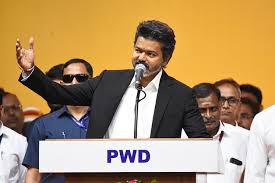
Vijay is scheduled to meet PM Narendra Modi at 4.30 pm to discuss a range of issues concerning the state. NEW DELHI: Tamil Nadu Chief Minister C Joseph Vijay will come to New Delhi on Wednesday in his first trip to the national capital since assuming office earlier this month. Vijay is scheduled to meet PM Narendra Modi at 4.30 pm to discuss a range of issues concerning the state. During the meeting, Vijay is likely to submit a memorandum outlining the state’s demands, including allocation of funds for welfare and infrastructure projects, clearances for developmental initiatives, the Mekedatu issue and implementation of PM Shri scheme. He is also likely to meet Finance Minister Nirmala Sitharaman and seek financial support for ongoing projects and key inter-state issues affecting the state. Vijay is also expected to meet Congress leaders Sonia Gandhi and Rahul Gandhi. According to the tentative schedule, the CM will return to Chennai on May 28. Vijay, founder of the Tamilaga Vettri Kazhagam (TVK), took oath as CM on May 10 after leading his party to victory in the TN polls held on April 23. Satheesan meets Modi in Delhi, seeks package Courtesy : TNIE Note: This news is originally published on https:/thenewindianexpress.com/bha and is used purely for non-profit/non-commercial purposes, especially human rights
Karnataka power tussle: Siddaramaiah agrees to quit

Siddaramaiah seeks Governor’s appointment at 2 pm on Thursday, calls CLP meeting the following day; no clarity yet on successor though Deputy CM Shivakumar is the front-runner. NEW DELHI/BENGALURU: Karnataka Chief Minister Siddaramaiah late on Tuesday night agreed to step down, confirmed sources privy to the marathon meetings held earlier in the day in New Delhi. Although Deputy Chief Minister D K Shivakumar is the front-runner for the CM’s post, no decision has been taken on who would succeed him nor on when Siddaramaiah would tender his resignation as chief minister. But sources said Siddaramaiah has sought time to meet Governor Thawar Chand Gehlot at Lok Bhavan on May 28 at 2 pm, and called for the Congress Legislature Party the following day. AICC General Secretary K C Venugopal and AICC General Secretary in-charge of Karnataka, Randeep Singh Surjewala, are scheduled to arrive in Bengaluru on Wednesday. Sources informed this newspaper that senior Congress leader Rahul Gandhi asked Siddaramaiah to step down to resolve the prolonged tussle between him and Shivakumar. They said the CM agreed after a late evening huddle with MLAs supporting him. Shivakumar had been insisting that the high command hand over the CM’s post to him, based on an agreement of sharing two-and-a-half years that he is said to have struck with Siddaramaiah after the party came to power in the 2023 Assembly polls. The half-way mark arrived in November last year, but Siddaramaiah refused to yield. Siddaramaiah and Shivakumar were summoned to Delhi on Monday, where Rahul is said to have told the CM that the party wanted the transition to take place smoothly. However, Siddaramaiah sought time to respond to the high command’s suggestion that he move to the Rajya Sabha to play a “larger role” at the national level, according to sources. After marathon meetings — from 11.35 am to 6 pm — a visibly upset Siddaramaiah huddled with his coterie of cabinet colleagues at Karnataka Energy Minister K J George’s New Delhi residence and conveyed the message of the high command to them. He agreed to step down after this meeting, sources said. No wonder, Shivakumar and his supporters looked upbeat. Siddaramaiah was carrying a letter of support by 100 party MLAs (Congress has 134 of 224 seats in the assembly) to convince the high command about his support. Sources said he will hold a meeting with all these MLAs at George’s Bengaluru residence on Wednesday. The day saw a series of meetings attended by Rahul, AICC president Mallikarjun Kharge, Venugopal and Surjewala. Siddaramaiah and Shivakumar were consulted separately at the party headquarters. Following the discussions, Rahul and Venugopal are said to have briefed senior leader Sonia Gandhi on the meetings, before having a closed-door meeting with Siddaramaiah where he offered the latter a larger role at the national level, while asking him to step down as CM. For the record, Venugopal dismissed all talk on change in leadership as mere speculation. Asked if there was any discussion on leadership change, Siddaramaiah, too, said “No”. On a possible cabinet reshuffle, the CM said, “It did not come up for discussion.” If not DKS: Who’s in race “The Congress high command could go in for a complete makeover of the party in the state and appoint a young, dynamic leader with a clean image to lead the party in the 2028 assembly elections,” sources said Byre Gowda: Chart topper The name of Revenue Minister Krishna Byre Gowda is on the top, besides Minister for Large & Medium Industries and Infrastructure Development MB Patil. Both have a clean image and are known for their good work Preetha Nair, Bala Chauhan, Naushad Bijapur, Devaraj B Hirehalli Courtesy : TNIE Note: This news is originally published on https:/thenewindianexpress.com/bha and is used purely for non-profit/non-commercial purposes, especially human rights