
Dalits’ resentment in Mangaluru, Karnataka: Allegations of negligence at DCRE station, police warned
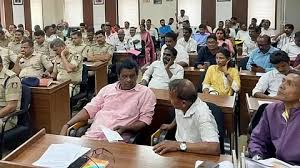
Dalit activists question the functioning of DCRE stations, warn police, prepare for agitation Mangaluru: Despite the establishment of separate Directorate of Civil Rights Enforcement (DCRE) stations in the district to investigate cases of atrocities on Scheduled Castes and Tribes, the victims are not getting justice. Dissatisfied with this situation, Dalit activists of Dakshina Kannada have expressed their resentment. Dalit activists put forth their grievances before police officials at a meeting held at the Mangaluru Police Commissioner’s Office on Sunday. The meeting focused on the grievances of Scheduled Caste and Scheduled Tribe communities and discussed the functioning of the Mangaluru City Police Commissionerate and Dakshina Kannada District Police. The meeting was chaired by DCP (Law and Order) Mithun HN and Additional Superintendent of Police Anil Kumar S. Bhoomaraddi. During the meeting, Jagdish Pandeshwar mentioned a case in which a Dalit woman was sent obscene calls and messages via WhatsApp by a man living abroad. The woman lodged a complaint, but no action was taken. The case was sent to the DCRE police station, but the accused was not arrested. It is alleged that the station in-charge also gave irresponsible answers. The activists warned that if no concrete action is taken on such cases till the next meeting, they will be forced to agitate. They also demanded to make public the complete record of cases of atrocities registered in the DCRE police station. On this, DCP Mithun said that since the DCRE does not come under the jurisdiction of the City Police Commissioner at present, a letter will be sent to the DG of DCRE regarding the complaints of the activists. Other demands of Dalit leaders In the meeting, Dalit leader SP Anand said that the government should restore the old process of selection of self-employment beneficiaries for the Scheduled Caste-Tribe community. Earlier this selection was done by a committee headed by the District Deputy Commissioner, but for the last 15 years this work is in the hands of local MLAs. Due to this, most of the benefits go to the influential class and people close to the MLAs, while the real needy are deprived. Rajan Chaudhary Courtesy : Hindi News
Behind Gender Balance In Karnataka’s Dalit Communities Lies A Story Of Exclusion
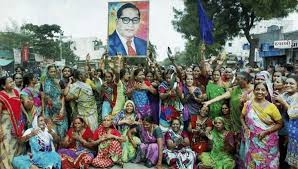
Beneath Karnataka’s recorded gender parity statistics among Scheduled Castes lies a fractured reality of caste hierarchies, poverty, and unequal opportunities for Dalit women. When the Justice H. N. Nagamohan Das Committee submitted its 1,766-page report on Karnataka’s Scheduled Castes earlier this month, one statistic jumped out of the dense pages of charts and tables. For the first time in decades, the state has recorded near gender parity in its Scheduled Caste population. Out of a total of 1.07 crore people surveyed, 53.6 lakh are men and 53.3 lakh are women, making the ratio 50.1 per cent male to 49.8 per cent female. The finding is significant in a country where skewed sex ratios have long symbolised discrimination and neglect. For policymakers in Karnataka, it marks what many are calling a “turning point” in caste and gender politics. ‘It is very rare in India’s caste demographics to see this kind of balance,’ a senior official in the Social Welfare said. ‘For us, this is not just a number; it has to become a foundation for gender-sensitive policy.’ The Committee too has framed this balance as a “positive development” that could shape the state’s future interventions in education, employment, and healthcare for Dalit women. Yet beneath the optimism lies a more complicated story. While parity is visible at the aggregate level, the micro realities of population distribution, poverty, and caste fragmentation raise the question of whether this statistical balance will actually translate into equality on the ground. The hidden divide: small sub-castes left behind The survey shows that 15 of the 101 Scheduled Caste sub-castes in Karnataka now have more women than men. Some of these groups are extremely small. The Lingader, for instance, have only 60 members statewide, but women form 62 per cent of their total population. The Mundala sub-caste, which is the largest among female-majority groups, has 31,726 members and a gender split of 52 per cent women to 48 per cent men. The district-level data also reveal striking variations. In Kodagu, Udupi, Dakshina Kannada, and Mandya, Scheduled Caste women constitute 52 per cent of the sub-caste populations, higher than the state average. ‘This kind of district-level variation is very important,’ said Dr Ramesh Gowda, professor of sociology. ‘It shows that in coastal and hilly districts, migration patterns and male mortality rates create a gendered demographic tilt. These women form the backbone of SC households, but their labour and struggles are often invisible.’ Karnataka’s Scheduled Castes have, for the first time, recorded near gender parity, with almost equal numbers of men and women. But beneath the promising statistic lies a fractured reality of caste hierarchies, poverty, and unequal opportunities for Dalit women. But parity in numbers does not automatically translate into parity in opportunity. The same report underlines that Karnataka’s Scheduled Caste population is far from homogenous. The internal composition is deeply unequal. Seventy-three of the 101 sub-castes have fewer than 10,000 members each. Another twelve fall in the 10,000 to 50,000 range. Only five groups fall between 50,000 and one lakh, while just eleven sub-castes exceed one lakh in population. The implications are clear: almost ninety per cent of Karnataka’s SC sub-castes are numerically small and scattered across the state. Their small numbers mean that even though they are constitutionally entitled to reservations, they do not have the organisational networks, political clout, or critical mass to convert quotas into tangible benefits. The report is frank about this imbalance. It observes that “despite having SC reservation, these groups do not have the numerical strength to compete with stronger communities.” In other words, the communities that are small in number end up being outcompeted by larger sub-castes within the SC umbrella, who are better networked and more visible in state institutions. The consequences of this imbalance are starkest in the area of poverty. The survey notes that many of the smaller sub-castes live in “maximum poverty”, with families struggling even to secure two proper meals a day. Beyond numbers: the politics of internal quotas For activists working in Dalit women’s rights, this gap between numbers and lived experience is painfully familiar. Shanta Devi, women activist in North Karnataka, said that the benefits of state schemes rarely trickle down to the smallest groups. ‘When the government announces scholarships or job quotas, it is usually the bigger sub-castes with hostels, coaching centres, and political leaders who benefit. Smaller communities, especially women among them, remain invisible,’ she said. The Das Committee itself cautions against reading parity as empowerment. While it notes the near-equal numbers of men and women, it also warns that “the smallest sub-castes face the greatest risk of being left out.” Many are not even properly documented in official records. Some sub-castes, like the Lingader or Adi Beda, have populations so tiny that they are easily subsumed within broader categories, erasing their distinct needs. For activists working in Dalit women’s rights, this gap between numbers and lived experience is painfully familiar. Shanta Devi, women activist in North Karnataka, said that the benefits of state schemes rarely trickle down to the smallest groups. ‘When the government announces scholarships or job quotas, it is usually the bigger sub-castes with hostels, coaching centres, and political leaders who benefit. Smaller communities, especially women among them, remain invisible,’ she said. The political backdrop to this survey is Karnataka’s long-running debate over internal reservation among Scheduled Castes. For decades, groups like the Madigas (classified as SC-Left) have argued that the benefits of the 17 per cent SC quota have been disproportionately cornered by the Holeyas or Chalavadis (SC-Right). After years of agitation, the state cabinet recently approved an internal division of the quota: 6 per cent for SC-Left, 6 per cent for SC-Right, and 5 per cent for all other SC groups. Officials described the Cabinet’s decision on internal reservation among SCs as an attempt to ensure ‘equity and social justice’ across all communities within the SC category.” Whether this formula addresses the concerns of the smallest sub-castes remains to be seen. Critics point out that
20-year-old Dalit girl’s charred body found in Karnataka’s Chitradurga, boyfriend held

On Tuesday evening, the mother identified her daughter’s charred body at the mortuary of Chitradurga District Hospital based on a tattoo on her hand. CHITRADURGA: A 20-year-old Dalit college student was allegedly murdered and burnt to death by her boyfriend in Chitradurga. The police have taken the accused, a 21-year-old unemployed school-dropout, into custody for questioning. Various Dalit organisations and ABVP, the student wing of the BJP, alleged the victim was raped and murdered. The police are, however, yet to confirm the charges of rape. Superintendent of Police Ranjit Kumar Bandaru said the body of a young woman was found in a charred state on Tuesday in a vacant plot on NH 48 in Gonur village under Chitradurga Rural Police Station limits. The police suspect the victim was killed and the body burnt using petrol by the accused. The victim was a second year BA student at Government Women’s College in Chitradurga. She stayed at the college hostel and had informed the hostel warden that she will be going to her village at Koverahatti in Hiriyur taluk on August 14. She told her family that she was going out with a friend Chethan. Later when she did not reach home and could not be reached on her mobile phone, the victim’s mother went to the hostel on Tuesday to check her whereabouts. The mother also lodged a complaint with the police. On Tuesday evening, the mother identified her daughter’s charred body at the mortuary of Chitradurga District Hospital based on a tattoo on her hand. ‘Dispute between victim, accused led to murder’ Sources in the police department said the victim and Chethan were in love. The police suspect that there were disagreements between the two and it might have led to the murder. On Wednesday, the body of the victim was handed over to the family after postmortem. The protesters demanded the arrest of the accused and blocked roads in various parts of Chitradurga city. Meanwhile, Planning and Statistics Minister D Sudhakar condemned the murder. The minister handed over a compensation cheque of Rs 5 lakh to the victim’s family, including Rs 2.50 lakh from the district administration and Rs 2.50 lakh by himself. Courtesy : TNIE Note: This news is originally published on https:/thenewindianexpress.com/bha and is used purely for non-profit/non-commercial purposes, especially human rights.
Suspicious death of Dalit youth: Suicide note makes serious allegations including police beating and casteist slurs
Victim made serious allegations of beating, casteist slurs and harassment against constable and PSI before his death, kin demand Rs 50 lakh compensation Chikkamagaluru. A 27-year-old Dalit youth from Samase village in Kalasa taluk of Chikkamagaluru district of Karnataka committed suicide on Wednesday. In his suicide note, the deceased alleged that he was beaten and abused by a Kudremukh police employee. The deceased has been identified as Nagesh, a resident of Bastigadde. According to information, Nagesh had lodged a complaint against constable Siddesh at Kudremukh police station on July 15. The complaint alleged that Siddesh thrashed him and made casteist remarks. According to the complaint, the incident took place around 10:30 pm when Nagesh was returning in his autorickshaw. On the way, he saw Siddesh and two locals standing on the road, whose car was blocking the way. As it was dark, Nagesh moved ahead with his mobile phone torch light. Siddesh suspected that Nagesh was clicking pictures of them while drinking alcohol, following which he allegedly thrashed and abused him. Family members say that instead of taking action on Nagesh’s complaint, the police registered a case against him for obstructing government work. The police had seized his autorickshaw and pesticide spray machine. Though he later got bail, he was unable to release his vehicle due to financial constraints and also feared further police harassment. In the suicide note, Nagesh accused constable Siddesh of torturing him and also named PSI Aadarsh, alleging that they did not take any action on his complaint. Family members and locals staged a protest after Nagesh’s death. They demanded that Siddesh and Aadarsh be dismissed from service and a compensation of Rs 50 lakh be given to the victim’s family. However, the police have started investigating the case. Rajan Chaudhary Courtesy : Hindi News
Revision of report on internal reservation for Scheduled Castes sought; protest staged
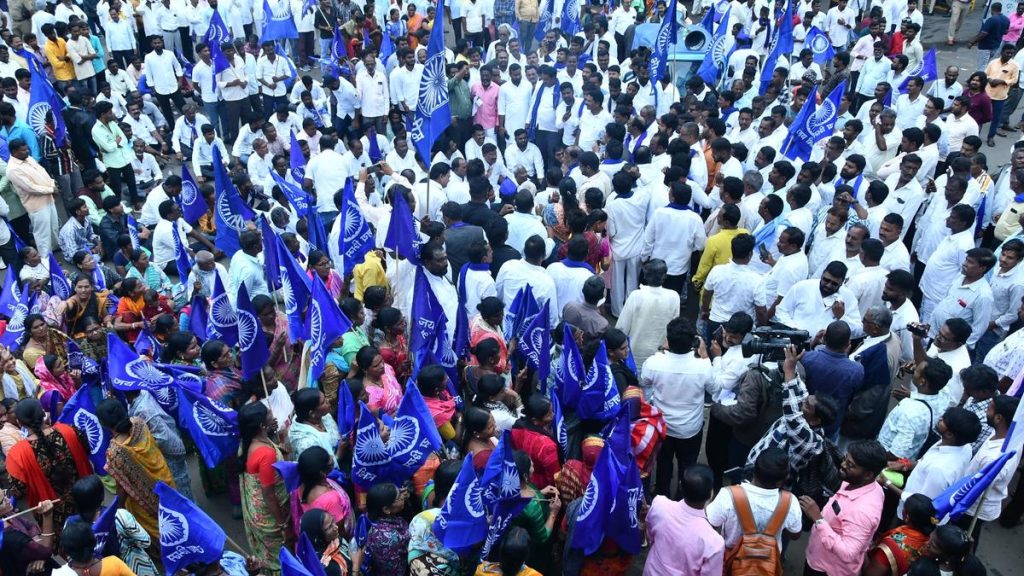
Members of the Dalit Right community take out a procession and stage a demonstration outside the Deputy Commissioner’s office in Kalaburagi Thousands of the Dalit Right community members took out a procession and staged a demonstration outside the Deputy Commissioner’s office in Kalaburagi on Thursday, opposing the H.N. Nagamohan Das Commission report on internal reservation among Scheduled Castes. Organised under the banner of Scheduled Castes Right Community Internal Reservation Protection Committee, community leaders, members of caste-based organisations and supporters gathered at Jagat Circle where they paid floral tributes to B.R. Ambedkar before marching to the Deputy Commissioner’s office. The rally, accompanied by drum beats, echoed with slogans such as Jai Bhim and Down with the biased Nagamohan Das report. Banners emblazoned with Jai Bhim fluttered during the procession. Upon reaching the district administrative complex, the protesters blocked vehicular movement for nearly two hours disrupting traffic movement. As vehicles were diverted to different roads, several narrow streets and circles saw traffic jams and heavy congestion. The agitators, meanwhile, in a symbolic gesture of dissent, burnt copies of the Nagamohan Das Commission report. They said that the Nagamohan Das Commission report is unscientific and the recommendations of the report appear to be highly biased. They also noted that the report wrongly clubbed several sub-castes belonging to the Scheduled Castes Right group under the Scheduled Castes Left thereby affecting the distribution of internal reservation benefits. “There are several flaws in the Nagamohan Das Commission report. Many castes which are part of the Scheduled Castes Right have been brought under Scheduled Castes Left. The Scheduled Castes Right communities population size has also been shown smaller than their actual size,” State vice-president of the BJP’s Scheduled Castes Morcha Ambaraya Ashtagi said during the protest. Clarifying that the protest is not against the Madiga community, which got a relatively greater share in the Scheduled Castes reservation in the commission’s report, another Dalit Right leader Arjun Bhadre said that the Scheduled Castes Right communities did not have an objection to the 6% reservation allocated to Scheduled Castes Left communities which include the Madigas. “This is not a fight against the Madiga community. We have no objection to the 6% reservation they enjoy. This is a struggle to secure a fair share of internal reservation for the Scheduled Castes Right communities based on our actual population,” he said. Mr. Bhadre also noted that most enumerators were instructed to use a specific app for the survey but were not provided equipment/tablets. “Later, the app was uninstalled from their devices resulting in the deletion of thousands of survey entries and a re-survey was conducted for those families. The abrupt shift in survey method from ration card-based to Aadhaar-based resulted in the leaving out of at least eight lakh children who did not have Aadhaar. The enumerators were not provided identity card, leading to unverified surveys and most of the Scheduled Castes population was not covered,” Mr. Bhadre said. Leaders who spoke at the agitation site said that the population size of the Scheduled Castes Right communities was around 40 lakh and criticized the Nagamohan Das Commission for recording it as 30 lakh. “Around 10 lakh-15 lakh Dalit Christians were wrongly included under the Scheduled Castes Left category. These numbers must be corrected and our (Scheduled Castes Right) rightful share in internal reservation ensured. The government should approve the report only after such corrections are made,” Mr. Bhadre insisted. A memorandum, addressed to the Chief Minister, was later submitted to the district administration before the protest concluded. Prominent Scheduled Castes Right leaders including Mariyappa Halli, Vishal Dargi, A.B. Hosamani, Basanna Singe, Dinesh Doddamani, Mallappa Hosamani, Arjun Gobbur, Ramesh Pattedar, Mahantappa Sangavi and Srinivas Khelagi participated in the agitation. Courtesy : The Hindu Note: This news is originally published on https:/thehindu.com/bha and is used purely for non-profit/non-commercial purposes, especially human rights.
Protest held in Mysuru against Nagamohan Das Commission report on internal reservation
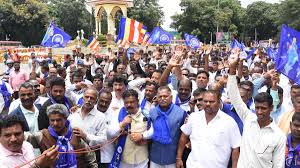
The protest was called by the Karnataka State Federation of Dalit Right Groups, which alleged that their population was undercounted and hence, the quantum of reservation has been reduced. The federation urged the government to reject the report and conduct the survey afresh for providing internal reservations. It alleged that more than 40 lakh people belonging to various sub-castes under Dalit right groups were either kept out of the purview of the survey or were not enumerated at all. Instead of the Dalit right groups, members of other castes have been included in Chitradurga, the federation said. Besides, more than 40% of the people under Bengaluru city limits have not been accounted for, it added. Instead of carrying out the survey for a projected population of 1.47 crore, the survey has been restricted to 1.16 crore people, out of whom, 1.05 crore people were surveyed, according to the leaders of the federation. The report was also faulted for not adhering to the norms stipulated for recommending the reservations based on sub-castes. Community leaders allege that faulty enumeration has led to serious errors in data collection, and hence the recommendations are based on false figures. Urging the State government to reject the report, the federation warned that all elected representatives from the SC community in Congress will have to face the consequences. In case the report was accepted by the government, all MLAs and Ministers belonging to SC right groups should tender their resignation, the federation added. Courtesy : The Hindu Note: This news is originally published on https:/thehindu.com/bha and is used purely for non-profit/non-commercial purposes, especially human rights.
Dalit youth dies by suicide, alleges cop assault, caste abuse in Bengaluru
Relatives said Nagesh was not financially sound enough to retrieve his vehicle and feared further police harassment. CHIKKAMAGALURU : A Dalit youth from Samse village in Kalasa taluk died by suicide after alleging police assault and caste abuse by Kudremukh police personnel. The deceased, Nagesh of Bastigadde, hanged himself on Wednesday. In a complaint filed earlier at Kudremukh police station, Nagesh had accused constable Siddesh of thrashing him and hurling casteist slurs on July 15. According to the complaint, Nagesh was returning in his autorickshaw around 10.30 pm when he saw Siddesh and two locals standing on the road with their vehicle parked across it. Using his mobile phone torch to navigate, Nagesh approached them, prompting Siddesh to suspect he was filming them drinking alcohol. The constable allegedly assaulted and abused him. Instead of acting on his complaint, police registered a counter-case against Nagesh, accusing him of obstructing a public servant on duty. His autorickshaw and pesticide sprayer were seized, though he later secured bail. Relatives said Nagesh was not financially sound enough to retrieve his vehicle and feared further police harassment. In his death note, Nagesh accused Siddesh of torture and named PSI Adarsh for failing to act on his complaint. Following his death, his relatives staged a protest demanding the dismissal of Siddesh and Adarsh and compensation of Rs 50 lakh for the bereaved family. (If you are having suicidal thoughts, or are worried about a friend or need emotional support, someone is always there to listen. Call Sneha Foundation – 04424640050, Tele Manas – 14416 (available 24×7) or iCall, the Tata Institute of Social Sciences’ helpline – 02225521111, which is available Monday to Saturday from 8 am to 10 pm.) Courtesy : TNIE Note: This news is originally published on https:/thenewindianexpress.com/bha and is used purely for non-profit/non-commercial purposes, especially human rights.
Internal quota: Congress’ Dalit leaders resolve to amicably settle issue
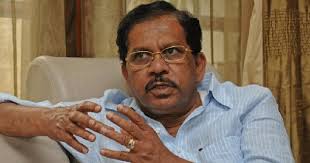
After the session proceedings On Wednesday, the leaders met at Home Minister Parameshwara’s residence to iron out differences that have arisen after the Das Commission decided to divide the 17% reservation for SCs amongst five sub-categories. Bengaluru: Ahead of the special Cabinet meeting on Saturday (August 16) to decide on the Nagamohan Das Commission report on internal reservation for Scheduled Castes (SCs), Dalit ministers and MLAs of the ruling Congress on Wednesday decided to amicably resolve the issue After the session proceedings on Wednesday, the leaders met at Home Minister Parameshwara’s residence to iron out differences that have arisen after the Das Commission decided to divide the 17 per cent reservation for SCs amongst five sub-categories. Since the SC (Left) / Madiga community has been allotted 6 per cent, the SC (Right)/ Holeya (5 per cent) and the Bhovi, Banjara, Korma and Korcha/ ‘touchable’ communities (4.5 per cent) are said to be unsatisfied with the proposals. According to sources, everyone has agreed that no community has to suffer. Social Welfare Minister Dr HC Mahadevappa, Food and Civil Supplies Minister KH Muniyappa, Backward Classes Welfare Minister Shivaraj Tangadagi attended the meeting. IT/BT Minister Priyank Kharge and RB Thimmapur were not present but are said to have conveyed that they will stand by the majority’s decision. Sujay B M Courtesy : DH Note: This news is originally published on https:/deccanherald.com/bha and is used purely for non-profit/non-commercial purposes, especially human rights.
Karnataka: Rajanna’s sacking threatens ‘pro-Dalit’ stance of Congress, credibility of Siddaramaiah
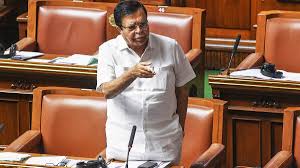
The sacking of Karnataka cooperation minister K.N. Rajanna, a Scheduled Caste leader, has plunged the Siddaramaiah government into a political crisis The sacking of Karnataka cooperation minister K.N. Rajanna, a Scheduled Caste leader from Tumakuru, on the first day of the monsoon session of the state legislature, has the Siddaramaiah government on the back foot as the BJP claimed that the Congress party is showing its “true anti-Dalit” face. The saffron party dubbed the removal of two Dalit ministers—B Nagendra over allegations of corruption in the Valmiki Corporation scam and now Rajanna for refusing to toe the line of the party on the vote theft charges—as “Dalit victimisation”. Chief Minister Siddaramaiah removing Rajanna, one of his close aides, from the cabinet on Monday, reportedly following orders from the party high command, has raised questions over Siddaramaiah’s own position and the stifling of Dalit voices within the party. While Rajanna’s unceremonious removal from the cabinet is being attributed to his recent comments on the voter fraud that directly challenged LOP in Parliament Rahul Gandhi’s claims and narrative on the “vote theft”, Rajanna’s alleging a “conspiracy” against him for his sacking, has put the government and the party in a tight spot. “When was the voter list made? It was made when we (Congress) were in power. What’s the point of discussing it now? It is true that there have been illegalities and we should be ashamed as they took place right before our eyes. We should have examined when the draft electoral rolls were out. There has been voter fraud in Mahadevapura like duplicate voting, bulk voters in a single address. But it was our responsibility as the party and the government to file objections to the draft rolls,” Rajanna had responded on the voter fraud issue, even as the Congress party had launched a national-level “Vote Chori” campaign, squarely accusing the Election Commission of “colluding” with the ruling BJP at the Centre for the vote. After his sacking, Rajanna told the media that there was a “conspiracy” against him and he would reveal everything at an appropriate time. “There has been a misunderstanding, and I will explain it to Rahul Gandhi and K.C. Venugopal. It is the party’s decision and we cannot question it,” said Rajanna, even as his son and MLC Rajendra turned emotional and rushed to meet the chief minister after the sacking was made official by the governor’s office on Monday evening. BJP trains guns on state govt On Tuesday, LOP in Assembly MLA R. Ashok said, “Rajanna has been punished for speaking the truth and busting Rahul Gandhi’s false narrative.” State BJP president B.Y. Vijayendra alleged that the Congress constantly tried to silence the Dalit leaders in the party. “In Congress, truth is treated as a threat, especially when it comes from a leader of a marginalised community whose voice they have long tried to silence. The pattern is clear. In the case of ST Welfare Minister Nagendra, funds earmarked for the development of the community were siphoned off to finance Congress’s election expenses. Instead of holding the CM and DCM D.K. Shivakumar accountable, the blame was placed entirely on Nagendra, and the matter was quietly closed,” said Vijayendra. Referring to the Congress leadership stalling the Dalit ministers’ dinner meeting organised by Home Minister G. Parameshwara recently, Vijayendra accused the Congress high command of “dictating” what the SC/ST ministers could do or not do. “Even when SC/ST MLAs and ministers gather informally for a meal, the high command dictates that such meetings cannot happen without their physical presence, as though leaders from these communities cannot meet independently. This is the true face of Congress—anti-Dalit, anti-ST, anti-democratic and anti-truth,” mocked the BJP leader. The BJP further said Siddaramaiah, who claims to champion the ‘Ahinda’ (minorities, dalit and backward classes) stands exposed. “This has exposed the hollow claims of Siddaramaiah as he has never defended the Ahinda when targeted. Instead, he bows to the diktats of the Delhi High Command to safeguard his own position as the chief minister,” alleged Vijayendra. Interestingly, Congress MLC B.K. Hariprasad, an OBC leader and a vocal critic of Siddaramaiah, said, “When you are in politics, one has to face conspiracies, especially if you are from the SC, ST or OBC communities. This is a lesson for Rajanna. But I am sure he will not remain mum. I have known him since his Youth Congress days.” BJP leader from Valmiki (ST) community B. Sriramulu said Rajanna was dropped from the cabinet for his “straight forward” and “harsh” words. “The CM dropping him from the cabinet, yielding to pressure from some invisible hands, is an insult to the Valmiki community,” he said. In June 2024, Nagendra was forced to resign from the cabinet after the Valmiki Corporation scam—misappropriation (diversion) of Rs 187 crore allegedly to fund the Telangana assembly polls—was exposed. Nagendra was arrested by the Enforcement Directorate in July under money laundering charges and released on bail in October. The BJP has claimed that Nagendra was made the fall guy though the alleged scam was about the diversion of funds for elections. The opposition parties had demanded the chief minister, who is the finance minister, to resign. Following the Stadium stampede incident that claimed 11 lives, the BJP had strongly condemned the suspension of then Bengaluru police commissioner B. Dayananda (also belonging to ST community), and accused the Siddaramaiah government of making the top cops the political “scapegoats”, even as the citizens, retired cops, and Dalit organisations expressed their dismay over the suspension of an efficient and upright officer. Congress: A divided house The removal of both Nagendra and Rajanna from the cabinet, against Siddaramaiah’s will, has exposed the widening rift between the warring factions in the ruling party. The Shivakumar faction seems to have an upper hand. The high command not only stopped the various events organised by Siddaramaiah loyalists meant to bolster the image of the CM, but also stalled the implementation of the old caste survey (Kantharaj Commission report)
Untouchability: A collective failure
Reform must come through education, economic justice, and an overhaul of relevant legal systems. Even 75 years after Independence, a damning truth confronts the country: the chains of caste oppression remain unbroken. The Justice H N Nagamohan Das Commission’s report on internal reservations lays bare an uncomfortable truth – untouchability remains deeply entrenched in our social fabric. This is not merely discrimination; it is a brutal system of oppression that has adapted to modern times while retaining its medieval cruelty. The Commission’s findings shock the conscience: 75 per cent of Scheduled Caste (SC) members still face untouchability, with the Madiga community suffering the worst. The manifestations are barbaric: denial of entry to temples, exclusion from community dining, segregation in schools, separate drinking glasses, and bonded labour. Most shocking are the complaints of sexual violence and forced consumption of human excreta. All 101 SC castes in the state experience some form of discrimination, ranging from severe to moderate oppression, proving that no Dalit community is untouched by this social scourge. The report also flags a disturbing pattern in reporting these atrocities. Only relatively empowered Dalit communities are reported to have filed complaints. While ten communities accounted for more than 100 atrocity cases in the last five years, 45 registered none. This is not because they were spared but due to their dependence on the dominant castes for livelihood, fear of retaliation, and the absence of a supportive environment. The abysmal single-digit conviction rate under the SC/ST (Prevention of Atrocities) Act, caused by police apathy, witness intimidation, and protracted trials, only emboldens perpetrators. Three urgent reforms must guide Karnataka’s response. First, education must be the equaliser. Second, economic empowerment should reach the poorest of Dalits, not just a privileged few within the community. The committee’s identification of the most marginalised subgroups can help targeted welfare policies. Third, the justice system needs an overhaul – exclusive special courts, a witness protection mechanism, and time-bound trials are non-negotiable. The report is not just a document – it is an indictment of our collective failure. Karnataka, which is home to India’s IT revolution, cannot claim progress while such dehumanising practices persist. The state must launch a comprehensive mission that combines education, economic justice, and legal reform. More importantly, civil society and political leadership must demonstrate the courage to confront this shameful reality. Until every Indian can drink from the same well, eat at the same table, and worship in the same temple, our freedom remains incomplete. Only decisive action can redeem the promise of our Constitution. Courtesy : DH Note: This news is originally published on https:/deccanherald.com/bha and is used purely for non-profit/non-commercial purposes, especially human rights.