
In Gujarat’s Sabarkantha, Violence, Discrimination and Social Boycott are Pushing Dalit Families to Flee

Representatives of the community, who submitted a memorandum, alleged that people are being mentally, physically and economically harassed, leaving them with no option but to consider leaving their native village. In Gujarat’s Sabarkantha, Violence, Discrimination and Social Boycott are Pushing Dalit Families to Flee Dalit villagers from Rupal and Prantij gather at the Collector’s office at the district office in Himmatnagar. Photo: Dhiraj Leua New Delhi: An exodus may be imminent in some Gujarat villages, where members of the Dalit community have alleged they are increasingly facing harassment, intimidation and violence at the hands of upper-caste communities and OBC communities. “It will happen, if not today, then very soon,” says Somabhai, a resident of Rupal village in Gujarat’s Sabarkantha district, alleging that the upper-caste communities do not wish to see their community prosper. On May 18, members of the Dalit community from villages in Sabarkantha district submitted a memorandum to the Resident Additional Collector at the district office in Himmatnagar demanding immediate intervention and protection from such atrocities. In it, Dalit villagers from Rupal village have alleged that despite repeated requests and appeals to the local administration, they continue to face harassment at several levels. They feel that the administration has failed to provide justice and a sense of security to the community, which now finds itself facing an effective social boycott within the village. Representatives of the community alleged that people are being mentally, physically and economically harassed, leaving them with no option but to consider leaving their native village. In the memorandum, the community clearly writes that if a lasting resolution is not reached within the next seven days, families from the Scheduled Caste community may be forced to migrate. Dalit leaders submit a memorandum to Krishna A. Vaghela, Resident Additional Collector, at the district office in Himmatnagar seeking protection from atrocities. Photo: Dhiraj Leua The allegations emerging from Rupal village are part of a wider and deeply entrenched pattern of caste violence and discrimination in Gujarat, a state often projected as a ‘model of economic development’, but where Dalit communities continue to report systemic exclusion, intimidation and violence. According to official data, thousands of cases of crimes against Scheduled Castes have been registered in Gujarat over the past decade, ranging from assault and social boycott to rape and murder. While the National Crime Records Bureau (NCRB) data cited in the Gujarat assembly showed that more than 9,000 cases of crimes against Dalits were reported in the state between 2016 and 2022 alone, rights groups and Dalit activists argue that the actual number is likely much higher due to underreporting, pressure on victims to “settle” disputes locally, and fear of retaliation from dominant caste groups. Dhiraj Leua, a teacher and activist from Rupal village, believes that the police and administration have no will to protect them. “Does the government not have mechanisms to ensure our safety? Thakors (an upper-caste community) don’t let us build good homes, they don’t let us sport moustaches, they don’t let us ride motorcycles or cars. Why can’t we be allowed to live?” he asks, speaking to The Wire. Like Leua, others from his community have become accustomed to anti-Dalit slurs, caste based abuse which have become a daily affair. However, what made them write to the Resident Additional Collector, was a recent incident where members of the Thakor community tried to run a Dalit man over with a tractor. Bystanders filmed this, preventing the Thakors from crushing the Dalit man. “After that, we couldn’t take it anymore. We cannot die everyday just because they think we are lesser humans than them,” Leua says. He notes that in several instances when members of the Scheduled Caste community approach police stations to file FIRs against their oppressors, they are instead booked in counter cases themselves. “First we are harassed and when we go to claim our rights, we are slapped with cross FIRs with POCSO Act cases, attempt to murder, attempt to rape to break our spirit” he said. Caste violence in Gujarat has drawn national attention several times in the past, from the flogging of Dalit men by cow vigilantes in Una, 2016, to recurring reports of segregation in villages, denial of access to temples, separate utensils in schools and economic boycotts targeting Dalit families. However, according to data tabled in Rajya Sabha, the conviction rate in cases of atrocities against Scheduled Castes between 2018 and 2021 was a mere 3.065 %, much lower than the national average. According to data reported in response to a query under the Right to Information (RTI) Act, acts of discrimination in urban Gujarat are extremely high as well. Ahmedabad city reported 189 cases – the highest number in the state – of atrocities against SC people in 2022. The state recorded a total of 1,425 such cases. From 2018 to 2021, only 32 cases out of the 5,369 registered cases were proved against the accused. In at least 1,012 registered cases, the accused were acquitted, even when the charges were as serious as murder and rape. Researchers studying caste violence have also linked such attacks to assertions of social and economic mobility among Dalit communities, arguing that upward mobility often triggers backlash from dominant caste groups seeking to preserve traditional hierarchies. In many villages across Gujarat, activists say the threat of social ostracisation, denial of work, and violence continues to function as a mechanism to discipline Dalit assertion and maintain caste control. In nearby Prantij town, too, the Scheduled Caste community is mustering the courage to call out their oppressors. Gujarat MLA from Vadgam and Working President, Gujarat Pradesh Congress Committee, Jignesh Mevani recently took to Instagram to highlight the issue, where he said that the Dalits in Prantij felt below pests and claimed to be treated in an extremely inhuman manner. Mevani, who is also convener of Rashtriya Dalit Adhikar Manch, said that the police and administration just register cases for formality and then forget about the issue and this leaves Dalits in a very
Gujarat: Dalit families in Sabarkantha are considering mass migration due to alleged social discrimination.

Despite filing numerous complaints and applications under the Atrocity Act, villagers claim that no concrete action has been taken, forcing many affected families to threaten mass migration. A serious case of alleged social discrimination and harassment against members of the Scheduled Caste community has emerged from Rupal village in Talod taluka of Sabarkantha district, Gujarat. According to Gujarat Samachar, despite filing numerous complaints and applications under the Atrocity Act, villagers claim that no concrete action has been taken, forcing many affected families to threaten mass migration. According to community members, some anti-social elements in the village are allegedly depriving them of their basic constitutional rights and subjecting them to persistent social, economic, religious, and administrative discrimination. Community leaders claimed that at least six complaints and several written applications under the Atrocity Act have already been submitted to authorities regarding this matter. Villagers reported that attempts were made to resolve the dispute through mutual agreement, but the situation escalated due to alleged non-implementation of assurances, leading to renewed tension in the village. On Sunday, members of the affected community submitted a memorandum to the Resident Additional Collector at the district office in Himmatnagar, demanding immediate intervention and protection. They alleged that despite repeated appeals to the administration, they received neither justice nor protection. Meanwhile, many families are now facing a form of “social boycott” within the village. Community representatives further alleged that people are being mentally and physically tortured, leaving them with no option but to leave their ancestral village. In the memorandum, they warned that if a concrete solution is not found within the next seven days, families from the Scheduled Caste community may be forced to migrate en masse from Rupal village. This incident has once again raised serious questions about caste-based discrimination and the implementation of legal safeguards at the grassroots level. These allegations have also sparked debate over whether authorities have taken adequate action despite repeated complaints filed under stringent social justice laws. At present, there has been no official response from district officials to these allegations or calls for intervention. Courtesy: Hindi News
Dalit Family Allegedly Barred from Public Well in Gujarat’s Surendranagar, Case Filed Under Atrocities Act

A case of alleged caste-based discrimination has surfaced from Metasar village in Patdi taluka of Gujarat’s Surendranagar district, where a Scheduled Caste family has reportedly been socially boycotted and denied access to water from a public well. The incident came to light after a video related to the alleged discrimination circulated in the area, prompting police action and triggering a wider debate on untouchability and caste-based exclusion in rural India. FIR Registered Under SC/ST Atrocities Act Following a complaint, police registered a case under the Scheduled Castes and Scheduled Tribes (Prevention of Atrocities) Act, 1989 against several individuals accused of stopping the family from using the village well and allegedly using caste-based abuse. Those named in the complaint include Kukabhai, Dharmshibhai, Mansukhbhai, Pratapbhai, Somabhai, and two women. Police have begun investigation and initiated legal proceedings. Authorities have also assigned a Deputy Superintendent of Police (DySP)-level officer to probe the matter, considering the seriousness of allegations involving social boycott and denial of access to a public water source. What the Complaint Says According to the complaint filed by Dilipbhai Bhikhabhai Rathod, a resident originally from Metasar who now lives in Rajkot, his family had returned to the village when the incident occurred. During their visit, a woman from the family reportedly went to fetch water from a public well but was stopped by some villagers. The accused allegedly prevented her from drawing water, used casteist slurs, and misbehaved with her. Police said an FIR was registered after preliminary verification of the complaint and available evidence. Police Say Investigation Underway Deputy Superintendent of Police Parth Parmar said that statements and evidence have been collected so far and further investigation is in progress. “All necessary evidence has been collected and further investigation is underway. Steps are being taken to detain the accused and proceed with legal action,” he said, adding that efforts are being made to ensure such incidents do not recur. Allegations of Continued Discrimination in Rural Areas The incident has also drawn reactions from social and religious voices. Buddhist monk Bhante Pathik claimed that caste discrimination remains prevalent in parts of Surendranagar district and continues to affect Scheduled Caste communities. He alleged that in some villages, social restrictions still exist on everyday practices such as grooming styles, mobility, and access to public resources. He further said that discrimination has contributed to religious conversions, claiming that over 380 people in the district have embraced Buddhism in the past decade under his guidance. Courtesy : TOP Note: This news is originally published on https:/theobserverpost.com/bha and is used purely for non-profit/non-commercial purposes, especially human rights
“Horse riding is our right”: Dalit groom attacked, baraat stopped by caste Hindu men in Gujarat

Horse riding during weddings is a common practice across India, yet Dalit grooms repeatedly face opposition from uppercaste people. A Dalit groom’s traditional wedding procession was allegedly stopped midway in Madi village of Gujarat’s Mehsana district after upper-caste men objected to him riding a horse during the ceremony. The incident occurred around 10 am on May 10 near the village dairy and has once again highlighted the continuing resistance to Dalit assertions of cultural equality despite constitutional and legal safeguards. Complainant Bhavik Rawat stated that his younger brother, groom Mayank Rawat, faced abuse from Yuvrajsinh Chauhan and Nikulsinh Chauhan of the Darbar community. The accused allegedly hurled casteist slurs, manhandled the groom and claimed horse mounted processions as an exclusive Darbar right. The accused threatened the family against proceeding, which led to panic among relatives and guests, halting the baraat before it reached Ahmedabad for the ceremony. Ladol police in Vijapur taluka swiftly registered an FIR against the duo under Bharatiya Nyaya Sanhita (BNS) sections and the SC/ST (Prevention of Atrocities) Act. Local activist Kaushik Parmar highlighted this as evidence of persistent discrimination, even amid constitutional protections. Horse riding during weddings is a common practice across India, yet Dalit grooms repeatedly face opposition from uppercaste people. Such violence often erupts over symbolic assertions of dignity, such as a Dalit groom riding a horse, playing music, or passing through dominant-caste localities, practices that challenge entrenched social hierarchies. In April 2026, a 23-year-old physically disabled Dalit groom, Golu Ahirwar, was allegedly dragged off a horse and assaulted during a pre-wedding procession in Madhya Pradesh’s Damoh district after caste-Hindu men objected to him riding through the village. His family members were also allegedly assaulted and robbed when they intervened. In February 2026, armed men from the Thakur community allegedly attacked a Dalit wedding procession in Sunana village of Uttar Pradesh’s Aligarh district using firearms, swords, and sticks, while hurling caste slurs and vandalising the DJ system. In another February 2026 incident in Chandrumana village, Patan district of Gujarat, Dalit groom Vishal Chavda was allegedly attacked with swords and casteist abuse for riding a horse during his wedding procession. In April 2025, a 22-year-old Dalit groom in Agra district, Uttar Pradesh, was allegedly dragged off his mare, beaten, and robbed over objections to loud music near upper-caste houses. Around the same period in Bulandshahr, upper-caste men reportedly stopped a Dalit baraat for playing DJ music, assaulted guests, and forced the procession to turn back. Similar incidents involving violence or intimidation against Dalit wedding processions have also been reported from districts such as Meerut, Etah, Amroha, and Tikamgarh. These recurring attacks continue to highlight the deep-rooted nature of caste discrimination in social and cultural spaces despite constitutional guarantees of equality and the abolition of untouchability. Other incidents in Mehsana district show that caste tensions are recurring. In 2019, a Dalit youth was allegedly assaulted and forced to shave his moustache by dominant caste men, an act seen as humiliation and assertion of social hierarchy. During the 2016 period of Dalit protests in Gujarat, the district also witnessed tensions and demonstrations, reflecting deeper caste divisions. Courtesy : Maktoob Media Note: This news is originally published on https:/maktoobmedia.com/bha and is used purely for non-profit/non-commercial purposes, especially human rights
Gujarat: Dalit groom attacked for riding horse in wedding procession
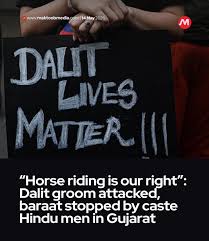
The accused allegedly abused the groom using casteist slurs and claimed the it is not his right to mount a horse for processions. Ahmedabad: A group of upper-caste men allegedly attacked and abused a Dalit groom using casteist slurs over him riding a horse during his wedding procession in Madi village of Gujarat’s Mehsana district. The incident, which occurred on May 10 near the village dairy, marks another instance of resistance to Dalit inclusion and equality in society. Although riding a horse during a wedding procession is customary in most Indian weddings, Dalit grooms are repeatedly targeted for taking part in the tradition. Complaint filed The groom, Mayank Rawat’s brother, Bhavik Rawat, lodged a complaint alleging that Tuvrajsinh Chauhan and Nikulsinh Chauhan of the Darbar community attacked them. The accused allegedly mauled and abused the groom using casteist slurs, and reportedly told him that mounting a horse for processions is the right of a Darbar alone. Panic ensued when the accused threatened the family from continuing the baraat, effectively halting the relatives from proceeding to Ahmedabad for the wedding ceremony. A first information report (FIR) was registered by the Ladol police against the accused Tuvrajsinh and Nikulsinh under relevant sections of the Bharatiya Nyaya Sanhita (BNS) and the Scheduled Caste and Scheduled Tribe Act. According to local activist Kaushik, the attack proves that Dalits continue to face discrimination despite constitutional protections. On April 29, a Dalit bride’s wedding procession in Rajasthan’s Udaipur was targeted as the attackers forced her off the horse while hurling abuses at her family. Days before the previous incident, a physically handicapped Dalit groom in Madhya Pradesh’s capital was similarly dragged off a horse and assaulted during his baraat. Courtesy : TSD Note: This news is originally published on https:/thesiasatdaily.com/bha and is used purely for non-profit/non-commercial purposes, especially human rights
Plates Apart: Junagadh Temple Feast Exposes Gujarat’s Caste Fault Lines

In Gujarat, a 3% conviction rate means that most accused of caste-based crimes walk free; the Bhutdi case is headed into the same odds. Junagadh: Five men walked into Bhutdi village, Junagadh district, on the evening of April 27, 2026. They had an invitation to deliver to the consecration feast of a newly built Ram temple, two days later. However, the Patostav invitation came with conditions. Residents belonging to the Dalit community were told to arrive only after members of other castes had eaten. They were to bring their own plates and bowls and food and water arranged for them would be kept separately. Lastly, they were to stay out of the temple itself. Ajay Chatur Boricha, 25, filed a formal complaint at the Visavadar police station the next morning. By the time the temple was consecrated on April 29, the community feast had been cancelled, five organisers were facing First Information Reports (FIRs) under the Scheduled Caste (SC)/Scheduled Tribe (ST) Prevention of Atrocities Act, and the case had gained the attention of Deputy Superintendent of Police (DySP) Ravirajsinh Parmar of the Junagadh SC/ST Cell, who confirmed that statements had been recorded and notices issued to all accused under Bharatiya Nagarik Suraksha Sanhita (BNSS) 35(3). As we file this news report, investigators are also looking for digital evidence. The fact that a complaint was filed before any violence occurred and the Dalit community chose legal redress over participation on humiliating terms, marks a small but significant assertion of dignity. What happens to that complaint in the Gujarat’s courts is another matter entirely. The temple in Bhutdi where people belonging to the Dalit community were asked to bring their own plates to eat, Photo: By special arrangement, Vibes of India. A grammar of exclusion The conditions imposed on people belonging to the Dalit community in Bhutdi — separate vessels, a later sitting, barred entry to the sanctum — are not inventions of rural backwardness. Dalit manual scavengers in Ahmedabad district, whose testimonies have been documented by civil society organisations, describe the same logic at work in a city setting. Not only are members of SC/ST communities made to clean their own utensils and use separate tea tumblers in canteens, they also struggle to access basic amenities such as water, barred from using “upper-caste” water taps and forced to walk long distances for drinking water. A Dalit man engaged in manual scavenging said that when he and his colleagues demanded their rights from the municipality, officials threatened to fire them. In most so-called “posh” and “high caste” houses in Gujarat, there are two separate sets of utensils, especially tea cups and drinking glasses, which even the non-Dalit domestic workers refuse to touch. In March last year, a Dalit man from the Vadol village in Sabarkantha district was beaten, stripped, and paraded naked through the streets for an alleged extramarital affair with an upper-caste woman. Two Dalit men in Mandal village were assaulted by cow vigilantes for refusing to dispose off a dead animal, a task that caste hierarchy has historically forced upon SC communities. During Navratri, a young Dalit girl was dragged out by her hair as she was participating in a public garba event. Shailesh Solanki, a 38-year-old Dalit labourer, was assaulted and abused with casteist slurs at a crossroads in Sabarkantha, simply for wishing to visit the Kal Bhairav temple in Himatnagar. As recently as February 2026, a Dalit groom’s wedding procession in Patan district was stopped at sword-point by upper-caste men who objected to his riding a horse, a ritual they considered their exclusive right. The video circulated widely. In Banaskantha, a Dalit lawyer named Mukesh Parecha who wanted to arrive at his own wedding on horseback requested police protection. A team of 145 policemen arrived in Gadalvada village to escort him. Although the wedding passed without incident, the spectacle of state force required for a man to exercise a social custom that others take for granted was, in itself, evidence of the distance between constitutional guarantee and ground reality. The conviction rate The Bhutdi FIR, once it travels the familiar path of Gujarat’s criminal justice machinery, will encounter a set of odds that are well-documented. Between 2018 and 2021, the conviction rate in cases reporting atrocities against SCs in Gujarat was 3.06%. Of the 5,369 cases registered during that period, only 32 held the accused guilty. In 1,012 cases, including murder and rape charges registered under the SC/ST Act, the accused were quickly acquitted. A further 1,044 cases were settled out of court. Martin Macwan, veteran activist and founder of the Navsarjan Trust, noted that in the rare cases where conviction has been achieved, it is because non-governmental organisations (NGOs) looking after Dalit rights sustained the case despite the social pressure and threats the complainant and witnesses usually face. Ahmedabad alone recorded 189 cases of atrocities against SC persons in 2022, the highest of any district in the state, out of a state total of 1,425 registered cases. In March 2019, Gujarat’s then-minister for social justice told the state assembly that crimes against Dalit people had risen 32% between 2013 and 2017. The national conviction rate under the Atrocities Act stands at 3-4%. Advocates working in the space have offered a structural explanation: a prejudiced or compromised police officer at the investigation stage, or a biased judge at trial, can ensure that justice is never served while simultaneously encouraging the accused to file counter-complaints against the victim. The acquittal, in this reading, is not a failure of the law but of its gatekeepers. The prosperity paradox Gujarat’s governance record is frequently cited as evidence that development and social order can coexist. The state’s per capita income is among the highest in the country. Its industrial corridors, port infrastructure and export numbers are points of pride in every budget speech. The ‘Gujarat Model’ has been exported as a national template. Against this backdrop, the persistence of caste atrocity is not incidental. Instead it is, as researchers and activists
Plates Apart, Gods Apart: Junagadh Temple Feast Exposes Gujarat’s Caste Fault Lines

Five men walked into the Dalit community’s lane in Bhutdi village, Junagadh district, on the evening of April 27. They had an invitation to deliver —to the consecration feast of a newly built Lord Ram temple scheduled for two days hence. But the Patostav invitation came with conditions. The Dalit residents were told to arrive only after the other castes had eaten. They were to bring their own plates and bowls. Their food and water would be kept separate. And they were to stay out of the temple itself. Ajay Chatur Boricha, 25, filed a complaint at Visavadar police station the next morning. By the time the temple was consecrated on April 29, the community feast had been cancelled, five organisers were facing FIRs under the SC/ST (Prevention of Atrocities) Act, and the case had acquired the attention of DySP Ravirajsinh Parmar of the Junagadh SC/ST Cell, who confirmed that statements have been recorded and notices issued to all accused under BNSS 35(3). As we file this news report, investigators are also searching for digital evidence. That a complaint was filed before any violence occurred — and that the Dalit community chose legal redress over participation on humiliating terms — marks a small but significant assertion of dignity. What happens to that complaint in the courts of Gujarat is another matter entirely. Above: The temple in Bhutdi village where Dalits were asked to bring their own plates. Picture via special arrangement by Vibes of India THE GRAMMAR OF EXCLUSION The conditions imposed on Dalits in Bhutdi — separate vessels, a later sitting, barred entry to the sanctum — are not inventions of rural backwardness. They are a grammar, fluent and consistent across the state. A Dalit manual scavenger from Ahmedabad district, whose testimony has been documented by civil society organisations, described the same logic at work in a city setting: separate tea tumblers at canteens, made to clean them yourself, barred from upper-caste water taps, sometimes forced to walk a kilometre for water. When he and his colleagues asked for their rights from the municipality, officials threatened to fire them. This sounds unbelievable but in most so called posh and high class and caste houses of Gujarat, there are two separate sets of vessels especially tea cups and drinking glasses which even the non Dalit domestic helps refuse to touch. In March last year, a Dalit man in Vadol village in Sabarkantha district was beaten, stripped naked, and paraded through the streets by dominant-caste men — his offence, allegedly entering a temple. Two Dalit men in Mandal village were assaulted by cow vigilantes for refusing to dispose of a dead animal, a task that caste hierarchy has historically pressed their community into. During Navratri, a young Dalit girl was dragged out by her hair from a garba event amid casteist abuse. A 38-year-old Dalit labourer named Shailesh Solanki was assaulted and abused with casteist slurs at a crossroads in Sabarkantha simply for declaring his intent to visit the Kal Bhairav temple in Himatnagar. As recently as February 2026, a Dalit groom’s wedding procession in Patan district was stopped at sword-point by upper-caste men who objected to his riding a horse — a ritual they considered their exclusive preserve. The video circulated widely. Elsewhere in Banaskantha, a Dalit lawyer named Mukesh Parecha wanted to arrive at his own wedding on horseback and requested police protection. A team of 145 policemen arrived in Gadalvada village to escort him. The wedding passed without incident. The spectacle of state force required for a man to exercise a social custom that others take for granted was, in itself, a statement about the distance between constitutional guarantee and ground reality. THE CONVICTION RATE THAT EXPLAINS EVERYTHING The Bhutdi FIR, once it travels the familiar path of Gujarat’s criminal justice machinery, will encounter a set of odds that are well documented. Between 2018 and 2021, the conviction rate in cases of atrocities against Scheduled Castes in Gujarat was 3.065 per cent. Of 5,369 cases registered during that period, only 32 were proven against the accused. In 1,012 cases — including cases of murder and rape registered under the SC/ST Act — the accused were acquitted. A further 1,044 cases were settled out of court. Martin Macwan, veteran activist and founder of Navsarjan Trust, has observed that in the rare cases where conviction has been reached, it is typically because Dalit rights NGOs sustained the case — because the complainant and witnesses face social pressure and threats to withdraw. Ahmedabad city alone reported 189 cases of atrocities against Scheduled Caste persons in 2022, the highest of any district in the state, out of a state total of 1,425 registered cases. In March 2019, Gujarat’s then-minister for social justice told the assembly that crimes against Dalits had risen 32 per cent between 2013 and 2018. The national conviction rate under the Atrocities Act stands at 3-4 per cent. Advocates working in the space have pointed to a structural explanation: a prejudiced or compromised police officer at the investigation stage, or a biased judge at trial, can ensure justice is never served while simultaneously encouraging the accused to file counter-complaints against the victim. The acquittal is, in this reading, not a failure of the law but of its gatekeepers. THE PROSPERITY PARADOX Gujarat’s governance record is frequently cited as evidence that development and social order can coexist. The state’s per capita income is among the highest in the country. Its industrial corridors, port infrastructure, and export numbers are points of pride in every Budget speech. The ‘Gujarat Model’ has been exported as a national template. Against this backdrop, the persistence of caste atrocity is not incidental — it is, researchers and activists argue, structurally connected to the prosperity rather than standing apart from it. A 2014 research paper found that an increase in the consumption expenditure ratio of Scheduled Castes relative to upper castes is associated with an increase in crimes committed by the latter against the former. Dalit
Five booked after dalits allege humiliation at temple event in Gujarat’s Junagadh

According to multiple people, the temple event invitation included a condition requiring them to bring their own plates and bowls if they wished to attend the meal. AHMEDABAD: Dalit residents in Bhutdi village of Visavadar, Junagadh, have alleged humiliating conditions during a temple event. Police have booked five accused under the IPC and the Atrocities Act, while the state government has ordered immediate arrests and protection for the victims. The controversy erupted during the grand consecration of an idol event of a Ramji Temple in Visavadar, where the entire village had gathered for rituals and a community feast. Organisers, who visited the Scheduled Caste locality to extend invitations, allegedly did not offer respect; instead, they delivered terms that triggered outrage. According to multiple people, the invitation came with a clause: “If you wish to attend the meal, bring your own plates and bowls from home.” The victims further claimed they were told that, “You will only be allowed to eat after others in the village have finished.” Local youth Ajay Boricha alleged, “This was not just about utensils, it was about humiliation. Separate seating, separate drinking water arrangements, everything was designed to isolate us”. Boricha described the incident as a systematic attempt to enforce caste segregation even in a temple setting. People filed formal complaints at the Visavadar police station. Local leader Umeshbhai said, “If arrests are not made immediately, we will escalate this to the Superintendent of Police. Such caste-based humiliation cannot be tolerated in independent India,” he said, invoking constitutional rights and equality. With tensions rising and public anger mounting, the police moved in, registering a case against five accused residents of Bhutdi village. The charges include multiple sections of the IPC along with stringent provisions of the Scheduled Castes and Scheduled Tribes (Prevention of Atrocities) Act. Later, the state government stepped in decisively, terming the incident not just discrimination but a case of social boycott. Orders were swiftly issued to the district administration, demanding immediate arrests and strict enforcement of the law. In a parallel move, directives were sent to the District Superintendent of Police and the Deputy Director of the Scheduled Caste Welfare Department calling for urgent action, victim protection, and a high-level, impartial investigation. “Zero tolerance will be maintained in such cases. A detailed report must be submitted immediately, and strictest action ensured,” the directive stated. Meanwhile, on the ground, police surveillance has intensified, and efforts to apprehend the accused have been accelerated. Dilip Singh Kshatriya Courtesy : TNIE Note: This news is originally published on https:/thenewindianexpress.com/bha and is used purely for non-profit/non-commercial purposes, especially human rights
Caste-Based Violence in Gujarat: Sarpanch and his associates brutally beat a Dalit family for requesting them not to damage a drain.

Caste-based individuals attacked a Dalit family, using weapons such as sticks and mace. The attackers also pelted stones and tried to break down the door of the family’s home. Patan – On July 16, a minor dispute escalated into a violent attack on a Dalit family in Datrana village, Santalpur taluka, Patan district, Gujarat, when the village sarpanch and his associates launched a deadly attack on a Dalit family. The incident began when a Dalit man requested them not to damage a drain constructed in front of his house. Enraged by this minor issue, the sarpanch and his associates not only used caste-based slurs but also attacked the family members with weapons such as sticks and mace. This incident is another example of the increasing caste-based violence against the Dalit community in Gujarat, highlighting social inequality and the indifference of the local administration. According to the FIR, on July 16th, at around 6:30 p.m., Datrana village sarpanch Jeevanbhai Savabhai Ahir was removing mud from the road with a JCB machine. During this, Madeobhai Dhawal, a Dalit, requested him not to damage the drain in front of his house to prevent water from spilling onto the road and avoid dirt. This enraged the sarpanch and he began abusing Madeobhai, including caste-based slurs. The sarpanch then attacked Madeobhai with a gadda patu (a type of tool). When Madeobhai’s family members, Muljibhai Danabhai Dhawal, Naranbhai, his wife Upaben, Mayurbhai, and Vinodbhai, intervened to save him, the sarpanch called his companions. These included Kishanbhai Jeevanbhai Ahir, Bhachabhai alias Bhappu Patabhai Ahir, Virambhai Savabhai Ahir, Parbatbhai Lalabhai Ahir, Savabhai Lalabhai Ahir, Dalabhai Lalabhai Ahir, and other unidentified individuals. These individuals attacked the Dalit family in a coordinated manner, using weapons such as sticks and mace. Naranbhai, Upabhen, Muljibhai, Mayurbhai, and Vinodbhai suffered serious injuries, particularly to their backs and heads. The attackers also pelted stones and tried to break down the door of the family’s home. The attackers threatened, “You escaped today, but next time we will kill you.” The injured were taken to the government hospital in Santalpur by 108 ambulance, where they received first aid. Muljibhai Danabhai Dhaval subsequently filed a complaint at the Santalpur police station. The complaint has been filed under sections 3(1)(r) (intentionally insulting a person belonging to a Scheduled Caste/Tribe) and 3(1)(s) (using caste-based slurs against a person belonging to a Scheduled Caste/Tribe) of the Scheduled Castes and Scheduled Tribes (Prevention of Atrocities) Act, 1989 (SC/ST Act), along with sections of the BNS. The FIR names Sarpanch Jivanbhai Savabhai Ahir, Kishanbhai Jivanbhai Ahir, Bhachabhai alias Bhappo Patabhai Ahir, Virambhai Savabhai Ahir, Parbatbhai Lalabhai Ahir, Savabhai Lalabhai Ahir, and Dalabhai Lalabhai Ahir. Social activist Narendrabhai M. Parmar from Patan says that the incident in Datrana village is proof that caste mentality is still deeply rooted in society. Incidents of caste-based violence against Dalits are frequently occurring in Gujarat. According to National Crime Records Bureau (NCRB) data, more than 1,500 cases were registered under the SC/ST Act in Gujarat in 2023, reflecting rising atrocities against the Dalit community. In many cases, especially in rural areas, Dalits are subjected to social exclusion, humiliation, and violence. This violence often stems from minor disputes, such as personal lifestyle or participation in social activities. Geetha Sunil Pillai Courtesy: Hindi News
Gujarat: Dalits invited to the Ram Temple Pran Pratishtha ceremony were told to bring plates and glasses from home!

The community refused to accept this condition, and an FIR was filed at the Visavadar police station. A case of alleged discrimination and disrespectful treatment of members of the Dalit community has come to light during the Pran Pratishtha Mahotsav of the Lord Ram Temple in Bhootdi village, Visavadar taluka, Junagadh district. The organizing committee had invited approximately ten people to the event, but they were asked to arrive after others had finished eating, eat their food separately, and not enter the temple. They were also asked to bring their own plates, bowls, and drinking water from home. Members of the Dalit community allege that separate arrangements for food and water were made for them, which clearly amounted to untouchability and caste-based insults, and therefore, the offended individuals decided not to attend the event. 25-year-old Ajay Chatur Boricha filed a complaint with the Visavadar police station. According to the complaint, around 5 pm on April 27th, five members of the organizing committee came to his neighborhood and invited about 10 Scheduled Caste members present there for the temple’s consecration ceremony. They also imposed the condition that they arrive after other caste members had eaten and that they bring their own plates and bowls. The Dalit community refused to accept this condition. Consequently, the proposed community feast in the village was canceled. However, the temple’s consecration ceremony was completed on the evening of April 29th. Based on this complaint, the police have registered a case against five individuals: Babu Uka Hapani, Narendra Bhanji Siroya, Ramnik Samji Sorathia, Atul Bhikha Siroya, and Phoola Popat Siroya under sections 3(1)(r), 3(1)(za)A, 3(1)(za)C of the SC/ST (Prevention of Atrocities) Act, as well as sections 196(2) and 54 of the Indian Penal Code (IPC). An investigation has been initiated following the FIR lodged at the Visavadar police station. The investigation has been assigned to Raviraj Singh Parmar, DSP of the Junagadh SC/ST Cell. The police have conducted a panchnama of the scene of the incident, recorded witness statements, and issued notices to the accused. The victim Dalit families have demanded a fair investigation and justice. The case is currently under investigation, and further action will be taken based on the investigation report. Casteism Incidents in Gujarat In the past few months, numerous incidents of caste-based discrimination, untouchability, and violence against the Dalit community have been reported in Gujarat. These include restrictions on temple entry, social boycotts, attacks on wedding horse riders, and untouchability in everyday life. Recently, a sensational and heartbreaking incident emerged from Amreli district in which Mahesh Premji Rathod, a 24-year-old man who had come to Shantaba General Hospital for his elderly uncle’s treatment, was beaten to death with plastic pipes for throwing leftover food into a free dining hall on the hospital premises. In March of this year, the Dalit deputy sarpanch of a village in Sabarkantha district filed a serious police complaint against eight people. The dispute is said to be rooted in the village panchayat’s decision to remove an old and dilapidated bird feeder tower (platform). It is alleged that during a meeting convened on this issue, these people threatened the deputy sarpanch and used caste-related slurs against him. Similarly, in February, in Chandrumana village, Patan, when a Dalit groom rode a horse, people with a casteist mindset allegedly resorted to hooliganism, armed with swords. They not only threatened the groom but also assaulted members of the wedding procession. In January of this year, a case of caste-based violence was reported against Tulsi Solanki, a 26-year-old Dalit laborer, in Piprala village, Santalpur tehsil, Patan district. Three men attacked Solanki with sticks, fists, and kicks, hurling casteist slurs, and threatening to kill him after he refused to lend them his glasses. In 2025, a case was filed against four women for verbally and physically abusing a Dalit woman during a Garba event in a village in Mahisagar district. The victim filed an FIR at the Virpur police station, alleging that she was subjected to caste-based abuse and physical assault after attempting to participate in a traditional dance festival with a friend. Geetha Sunil Pillai Courtesy: Hindi News