
Complaints filed against DU prof over ‘Dalit remarks’ during TV debate
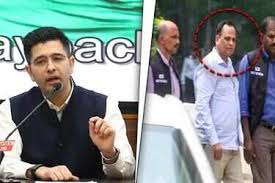
New Delhi: A complaint has been submitted to Delhi University vice-chancellor Yogesh Singh seeking disciplinary action against political science professor Sangeet Ragi over remarks he allegedly made during a television debate Tuesday. Indian National Teachers’ Congress (INTEC), which has filed the complaint, has accused Ragi of making derogatory remarks against the Dalit community and sought strict action, including his expulsion from the university. The remarks were made during the debate in which a video of Congress functionaries, including Sonia and Rahul Gandhi, and party president Mallikarjun Kharge, was played. The video allegedly showed Vande Mataram being stopped midway to arrange a chair for Kharge. Referring to this during the debate, Ragi said, “This is a mentality of slavery, this is a Dalit mentality.” Following immediate objections, Ragi said he was withdrawing the statement, while maintaining that “Dalit” was not a community-related word, but a political term. A complaint has also been filed at Parliament Street police station seeking registration of an FIR under BNS and Scheduled Castes and Scheduled Tribes (Prevention of Atrocities) Act, 1989. Aditya Goswami, former media coordinator of All India Congress Committee, alleged that Ragi’s statement equating “Dalit mentality” with “slave mentality” amounted to an “intentional insult and humiliation” of a member of the scheduled caste community and “promoted or attempted to promote disharmony and feelings of enmity, hatred or ill-will between different castes/communities on grounds of caste”. Goswami has sought that “an FIR be immediately registered”, the matter be investigated, the full video and related material be “seized/preserved” and appropriate action be taken against Ragi. INTEC has complained to the vice-chancellor that the remark was “deeply offensive and derogatory towards the Dalit community” and alleged that it “perpetuates harmful historical prejudices, promotes social division, and flies in the face of our constitutional values of equality, dignity, and social justice”. The teachers’ body demanded that DU initiate strict disciplinary action against him following applicable rules and due process. TOI reached out to the vice-chancellor, who said he had not seen the complaint and would respond after examining it. No response was received from Ragi till the time of going to press. Courtesy : TOI Note: This news is originally published on https:/timesofindia.com/bha and is used purely for non-profit/non-commercial purposes, especially human rights
AAP leader arrested for allegedly encroaching Dalit colleague’s property

New Delhi, Aug 17: Aam Aadmi Party’s National Council Member Sri Chand Vohra was arrested by Delhi Police from Gwalior, Madhya Pradesh, for alleged encroachment of the property of his party’s Dalit worker in south-east Delhi’s Jaitpur Extension, sources said on Monday. Sri Chand Vohra is the husband of AAP Councillor from Jaitpur, Hema Vohra. He has been named in a police complaint filed by AAP Dalit worker Rakesh Kumar over his alleged dispossession from his own property. A police complaint filed by Rakesh Kumar said that around three weeks ago, Vohra allegedly threw his belongings, kept on the first floor of the property, onto the street. Following an investigation, the police added penal sections relating to an alleged conspiracy to take possession of the plot. The penal provisions invoked in the case carry a maximum punishment of 10 years. Earlier, Delhi BJP questioned the silence of AAP leaders Arvind Kejriwal and Saurabh Bharadwaj over the alleged harassment of their own party’s Dalit worker. Delhi BJP Media Head and Spokesperson Praveen Shankar Kapoor condemned Vohra’s alleged injustice against Rakesh Kumar and demanded early police action against him. Kapoor, along with BJP Chief Spokesperson Anil Gupta, asked Kejriwal to immediately ensure justice for the Dalit AAP worker by restoring possession of his plot and expelling Vohra and his wife from the party. The Delhi BJP Media Head said that Vohra has been directly associated with Kejriwal since the party’s formative days and had himself contested the Municipal Corporation election from Jaitpur in 2017. In 2022, his wife Hema contested the election and is currently serving as a Municipal Councillor. In 2019, on the pretext of setting up a private political office, Vohra took a vacant plot belonging to active Dalit AAP worker Rakesh Kumar in Jaitpur Extension. After about a year, Rakesh Kumar began asking for his plot back, but Vohra allegedly kept delaying the matter till 2022. Towards the end of 2022, Vohra’s wife Hema was elected as a Municipal Councillor from Jaitpur. According to the BJP leaders, this was followed by alleged harassment of Dalit worker Rakesh Kumar, which ended only after an FIR was registered at a police station around two weeks ago. Courtesy : TAT Note: This news is originally published on https:/theassamtribune.com/bha and is used purely for non-profit/non-commercial purposes, especially human rights
Delhi BJP wants Kejriwal, Bharadwaj to ensure justice for AAP’s Dalit worker in property dispute
Delhi BJP spokespersons Praveen Shankar Kapoor and Dr. Anil Gupta on Sunday strongly condemned the alleged attempt by an Aam Aadmi Party national council member and Jaitpur councillor spouse, regarding possession of a house built on a plot belonging to his own party’s Dalit worker, Rakesh Kumar.Politics Delhi BJP spokespersons Praveen Shankar Kapoor and Dr. Anil Gupta on Sunday strongly condemned the alleged attempt by an Aam Aadmi Party national council member and Jaitpur councillor spouse, regarding possession of a house built on a plot belonging to his own party’s Dalit worker, Rakesh Kumar. The BJP leaders demanded that AAP leaders, including Arvind Kejriwal and Saurabh Bhardwaj, immediately look into the matter and ensure justice for their party’s Dalit worker by restoring possession of the premises. They also sought the expulsion of the accused and his spouse from the party. According to Kapoor, the AAP leader concerned has been directly associated with Kejriwal since the party’s formative days, contested the MCD election from Jaitpur in 2017, and his wife is currently serving as a municipal councilor. According to the BJP leader, an FIR has also been registered in this connection, wherein the complainant, Kumar has alleged that he had given the premises back in 2019, in view of setting up a private political office, however, when asked to have the premises back, the alleged person was delaying to do so until 2022.Politics As mentioned in the FIR, the accused person was allegedly denying handing over the property back to Rakesh Kumar. As per the BJP leader, the alleged harassment of Dalit worker only stopped after an FIR was registered at a police station around two weeks ago. In July 2026, when Shri Rakesh Kumar sought to have an electricity meter installed on the first floor of his house, Shri Shrichand Vohra allegedly stopped the electricity department from carrying out the installation. Following a police probe, relevant sections of the law relating to an alleged conspiracy to take possession of the premises have been added to the matter. The Delhi BJP leaders said that AAP leaders, including Kejriwal and Bhardwaj, who frequently make strong statements about morality, must now come forward and ensure that their party’s Dalit worker gets justice. Courtesy : The Statesman Note: This news is originally published on https:/thestatesman.com/bha and is used purely for non-profit/non-commercial purposes, especially human rights
‘500 farmers join CJP protest’: Sonam Wangchuk gets support from Rakesh Tikait, Kejriwal at ‘packed’ Jantar Mantar
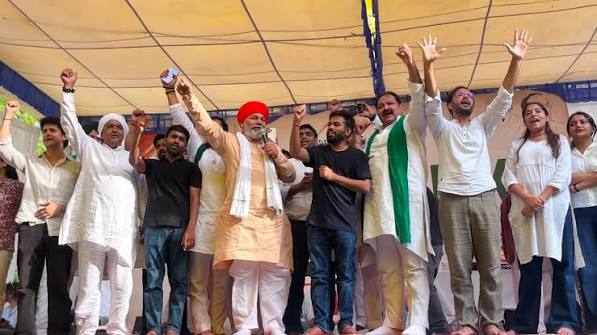
NEW DELHI: Climate activist and educator Sonam Wangchuk’s protest gathered fresh momentum on Thursday as farmer leader Rakesh Tikait reached New Delhi’s Jantar Mantar with around 500 farmers, strengthening the ongoing agitation against the Centre and adding to the demand for Union education minister Dharmendra Pradhan’s removal over the NEET fiasco. The development came as Wangchuk’s indefinite hunger strike entered its 19th day, with doctors warning that his health has become increasingly fragile after he lost more than 9 kg. Welcoming Tikait’s support, the Cockroach Janta Party (CJP) posted on X, “jhukti hai sarkaar, jhukane wala chahiye!” The protest also received backing from several opposition leaders and parties on Thursday. After remaining silent for weeks, the Congress made its first official intervention, reaching out to Wangchuk and urging him to end his indefinite fast while assuring him that the party would continue to demand Dharmendra Pradhan’s removal. The appeal came on the 19th day of Wangchuk’s hunger strike. Congress general secretary K C Venugopal said, “we share the anguish and outrange the Wangchuk feels, especially due to the lack of accountability within the Modi Govt – for the collapse of the examination system in particular.” Congress leader Sachin Pilot also expressed solidarity with the activist and appealed to him to end his fast. Referring to Rahul Gandhi’s stand, Pilot wrote on X, “The ordeal faced by students and their families due to the paper leak and various irregularities has shaken everyone. Rahul Gandhi ji and our party believe — the youth are the future of the country. No injustice of any kind will be tolerated against them. Students must get justice.” Earlier in the day, former Delhi chief minister and AAP supremo Arvind Kejriwal also joined the protest at Jantar Mantar and shared the stage with Wangchuk before a large gathering. Kejriwal demanded the resignation of Dharmendra Pradhan and went a step further by backing Wangchuk as his replacement. He said, “Exam papers are being leaked constantly, day after day. There are irregularities in the papers and flaws in the evaluation process… When the NEET paper leaked, 20 students committed suicide, yet the government took no measures to assure anyone that leaks wouldn’t recur. Further leaks followed the NEET incident, and the CBSE evaluation system was compromised, yet no action was taken against the company involved.” He added, “It appears the government is consumed by arrogance. I want to tell the government: either listen to the voice of the youth, or these very young people will throw you out of power in 2029… I urge the Prime Minister and the country’s 1.4 billion citizens to desire that Sonam Wangchuk be appointed as the education minister in his place.” Earlier in the day, Samajwadi Party MP Dimple Yadav also extended support to Wangchuk’s protest and visited Jantar Mantar. Moreover, apart from several senior opposition leaders, including Arvind Kejriwal, Mamata Banerjee and Akhilesh Yadav, the CJP-led protest has also drawn support from prominent public figures. Stand-up comedian Kunal Kamra and actors Swara Bhaskar and Prakash Raj visited Jantar Mantar to express solidarity with Sonam Wangchuk. Meanwhile, doctors treating Wangchuk warned that his condition continues to worsen as the hunger strike entered its 19th consecutive day. His attending physician, Dr Satish Lamba, cautioned that the activist could face multi-organ complications if the fast continues. Wangchuk began his indefinite hunger strike on June 28 after joining a protest organised by the Cockroach Janta Party (CJP). During a medical briefing, Dr Lamba said Wangchuk has lost more than 9 kg and now weighs 56.9 kg. His condition is being monitored round the clock by a team of doctors. “Today, on the 19th day of hunger strike, his total weight loss exceeds 9 kilograms. His blood sugar today is 80 mg/dL, and his pulse is 72 beats per minute. His blood pressure readings are 105/61 mmHg while lying down and 101/65 mmHg while sitting,” Dr Lamba reported. Doctors said Wangchuk remains hydrated and mentally alert, but medical tests show that his body has entered the second stage of prolonged starvation, significantly increasing the risk of serious health complications if the hunger strike continues. Courtesy : TOI Note: This news is originally published on https:/timesofindia.com/bha and is used purely for non-profit/non-commercial purposes, especially human rights
‘One Sewer Death Every 45 Hours’: Safai Karamchari Abhiyan Asks Prime Minister to Save Dalit Lives

After the law banning manual scavenging was passed, deaths while cleaning sewers and septic tanks rose from 39 in 2016 to 121 in 2025 and the figure is set to jump again in 2026. ‘One Sewer Death Every 45 Hours’: Safai Karamchari Abhiyan Asks Prime Minister to Save Dalit Lives A file photo from May 2019 of Delhi Univesity students and sanitation staff protesting. Credit: Riya Bhardwaj New Delhi: The Safai Karamchari Andolan (SKA) has questioned the government’s silence and delays in ending manual scavenging in India. Highlighting the death of 101 people across the country since January 2026 while engaged in manually cleaning sewers and septic tanks, SKA said that its figure – 121 deaths for the whole of 2025 – showed the situation was worsening. “Needless to say, Dalit lives don’t matter for government and they have turned into a new normal,” Bezwada Wilson, a Magsaysay Prize awardee and head of the SKA, said in a statement. The NGO’s figures show an “alarming” rise in the number of deaths in sewers and septic tanks ever since manual scavenging was banned by the Prohibition of Employment as Manual Scavengers and their Rehabilitation Act, 2013. “In 2016, only 39 deaths were reported, which jumped by 350% next year in 2017 to 137 deaths,” said the statement. It said over 1,726 deaths have been reported across the country since 2013. It said a sanitation worker’s death is being reported while cleaning sewers and septic tanks, on average, “every 45 hours”, while governments choose “shameless” silence. “We demand that our Prime Minister immediately announce a complete stop to deaths inside sewers and septic tanks,” it said. Governments in denial Wilson pointed out that the government has been denying sewer deaths though they were still taking place, more than a decade after the practice was outlawed. “No death has been reported due to manual scavenging, which is lifting of human excreta from insanitary latrines,” the government of India told parliament in 2023. “Further, no report from States/UTs has been received about the inhuman practice of manual scavenging,” Union Minister of State for Social Justice and Empowerment Ramdas Athawale said in parliament. A press release issued by the government based on this parliament (Rajya Sabha) response said in October 2023 that out of 766 districts, only 249 – fewer than 35% – had declared themselves manual scavengers-free “and uploaded the certificate on portal”. At the same time, in 2018, the Delhi government admitted that manual scavenging was ongoing in the capital, while the Superme Court asked the Union government to correctly assess the situation. The SKA statement records 12 deaths in Delhi-NCR, which are part of the “horrific” increase in cases across the country. It said 16 states had reported such deaths so far in 2026, an indication of the spread of the problem. Complete ban on dry toilets and manual cleaning Bezwada Wilson spent four decades battling the practice through SKA’s activism, a social movement and a court case (related to a 1993 law that has also proved ineffective in ending the scourge) before manual scavenging could be outlawed, without exception and across the country, by the 2013 law. Both the 1993 and 2013 laws are in place, seeking to address separate aspects of the practice: employment of people to clean sewers and septic tanks manually as well as building of dry toilets, etc., both of which perpetuate the practice. The statement also criticised state governments for not taking action to prevent manual scavenging and said it had expected better response to the law. Of the 1,726 deaths since 2013, 1,203 were just from Tamil Nadu (332), Gujarat (216), Delhi-NCR (157), Maharashtra (155), Uttar Pradesh (148), Haryana (104) and Bihar (94). “Despite such big numbers, none of these states have taken a single step to stop these deaths,” the statement said. State governments complicit The SKA statement was also critical of the government’s flagship ‘Swachh Bharat‘ scheme to build toilets across the country as well as of the scheme for mechanised cleaning of drainage systems, saying they neither mechanised the sanitation ecosystem nor completely eliminated dry toilets. Wilson said the failure of governments to elimitate the practice showed “how much they value the lives of safai karamcharis, who are still considered to be untouchable”. In 2019, the Supreme Court had come down heavily on the Union government over ambiguity in eradication of manual scavenging and passed an order banning the practice in six metropolitan cities. It had said it was “sick” of trying to get the Union and state governments to implement the 1993 law. India ranks very poorly in terms of its global sanitation status, for which are responsible lack of scientific cleaning methods and planning and caste- and gender-based inequality, as acknowledged by UNICEF, the Indian government’s partner in Swachh Bharat Abhiyan, in 2020. A survey by the Ministry of Social Justice and Empowerment revealed in 2024 that 91.9% of the 38,000 sanitation workers profiled (thus far) belonged to a Scheduled Caste, Scheduled Tribe or Other Backward Classes. Courtesy : The Wire Note: This news is originally published on https:/thewire.com/bha and is used purely for non-profit/non-commercial purposes, especially human rights
Transgender group, family clash over train seats at Old Delhi Railway Station

NEW DELHI: A quarrel between a group of transgender persons and a family over seats in a general coach at Old Delhi Railway Station has gone viral on social media, prompting authorities to take note of the incident. The altercation occurred around 11.30pm on June 30 at Platform 16, where both parties were waiting to board the Brahmaputra Mail with general tickets. Railway Protection Force (RPF) constables Vicky and Chandrakant, who were on patrol duty, intervened, dispersed the crowd and pacified both sides. The family was advised to lodge a complaint but declined and instead boarded the train in another coach. Officials said no PCR call was made and no formal complaint was filed. Courtesy : TOI Note: This news is originally published on https:/timesofindia.com/bha and is used purely for non-profit/non-commercial purposes, especially human rights
Three workers cleaning a septic tank in Delhi died tragically after inhaling toxic gas; three others, including the factory owner, have been arrested.

Three workers died from toxic gas while cleaning a septic tank in Mundka, Delhi; police arrested the factory owner and contractor, raising serious questions about administrative negligence. New Delhi: A tragic and disturbing incident occurred on Friday in the Mundka Industrial Area of the national capital, Delhi. Three workers who had entered a septic tank at a printing press factory lost their lives while cleaning it. Police took swift action and arrested three people, including the factory owner and contractor. Initial police investigations revealed that the three workers entered the tank one after the other and died after inhaling the suffocating and toxic gases present within. According to an official, at 12:03 pm, the police, Delhi Fire Service, and Delhi Disaster Management Authority (DDMA) received an emergency call about people trapped inside the factory in Mundka. The deceased have been identified as 38-year-old Arun, 32-year-old Sandeep, and 42-year-old Chand. All three were residents of the Indira Lake area of Sultanpuri. Following the rescue operation, police pulled out the bodies from the tank and sent them to Sanjay Gandhi Memorial Hospital for post-mortem to confirm the exact cause of death. Outer Delhi Deputy Commissioner of Police (DCP) Vikram Singh, giving details of the case, said that factory owner Suraj Marwah had hired a contractor named Neeraj, a resident of Nangloi, to clean the septic tank. Police have arrested Suraj Marwah, contractor Neeraj, and factory employee Jayant. A case has been registered against them under sections 106 (causing death by negligence) and 3(5) (common intention) of the Indian Penal Code (IPC). They have also been charged under Section 9 of the Prohibition of Employment as Manual Scavengers and their Rehabilitation Act, 2013, and the stringent provisions of Section 3(1)(j) of the SC/ST (Prevention of Atrocities) Act, 1989. Senior government officials say a detailed report will be prepared to ascertain the exact sequence of events and the cause of death. Officials also clarified that the Delhi State Industrial and Infrastructure Development Corporation (DSIIDC) is primarily responsible for cleaning septic tanks in the city’s industrial areas. Following this heartbreaking incident, Bezwada Wilson, national convener of the Safai Karmachari Andolan, met with the families of the victims. He expressed concern that there are approximately 30,000 sanitation workers in Delhi, of whom 10,000 work solely as septic and sewer tank cleaners. He clarified that no worker should be asked to enter the tank, even with safety equipment, and that the work should be done entirely through mechanized methods. Meanwhile, Sucheta Dey, Vice President of the All India Central Council of Trade Unions (AICCTU), claimed that even government departments are sometimes seen employing manual scavengers without any safety gear. The incident has also drawn political backlash. Delhi Congress President Devendra Yadav has termed the incident as a result of gross administrative negligence. He has demanded a thorough investigation into the matter and adequate compensation for the destitute families of the deceased. This is not the first case of deaths during sewer cleaning in the capital. Similar deaths were reported last year in Ashok Vihar, New Friends Colony, and Narela. According to official data shared by the National Commission for Safai Karamcharis (NCSK) in the Lok Sabha in March this year, 62 deaths have occurred in Delhi since 2017 due to hazardous sewer and septic tank cleaning. The Commission’s data also shows that Delhi was one of the first cities to ban the practice, yet among 22 states and two union territories, Delhi recorded the highest number of complaints related to manual scavenging in 2025, at 140. Rajan Chaudhary Courtesy: Hindi News
Solar boom in Gujarat and Tamil Nadu is polluting Delhi-NCR, study says

In Tamil Nadu, the modus operandi involves formal recyclers passing on non-profitable scraps, such as aluminum frames and photovoltaic cells, along with other hazardous materials to Delhi-NCR. NEW DELHI: Solar power development has advanced at an unprecedented pace in Gujarat and Tamil Nadu; however, waste management has not kept up. A significant volume of waste generated in these states is being transported to the Delhi-NCR region, which is already burdened with multiple types of waste affecting air and water quality. A joint report by the Chintan Environmental Research and Action Group and the World Resources Institute reveals that informal waste aggregators are dumping solar waste, including end-of-life solar panels, photovoltaic cells, lithium-ion batteries, and other hazardous electronic waste, into Delhi-NCR. This region is already burdened with excessive waste, contaminating groundwater, other water resources, and air quality. In informal discussions with several waste aggregators in two sates, validated by non-profits, researchers, start-ups, and formal recyclers in Gujarat and Tamil Nadu, the report indicated that there is no reliable quantitative data or traceability mechanism available to determine the proportion of this material that is ultimately processed through informal recycling operations in Delhi-NCR and other northern regions of India. In Tamil Nadu, the modus operandi involves formal recyclers passing on non-profitable scraps, such as aluminum frames and photovoltaic cells, along with other hazardous materials to Delhi-NCR. There is around Delhi-NCR has around 5,000 e-waste processing units that employ more than 50,000 people. Due to a lack of formal recycling capacity and technical knowledge, much of the solar waste ends up in landfills in Delhi-NCR. The report, “More Watts Less Waste,” states that informal recyclers rely on rudimentary dismantling and scrap-recovery techniques. While aluminium frames and external copper wiring or junction boxes are manually removed and sold as scrap, the remaining components of the modules, such as glass, polymer encapsulant, silicon cells, and embedded metals, largely go unrecovered. Often, the panels are crushed or broken, resulting in a mix of glass, polymer, and silicon fragments, which is disposed of as general waste or sent to landfills. The study highlights a critical gap in India’s clean energy transition. While the country is rapidly expanding its renewable energy and electric mobility sectors, systems for managing solar panel and lithium-ion battery waste remain underdeveloped. The report warns that this creates new environmental and public health concerns for Delhi, which is already dealing with legacy waste. Improper handling of solar panels can release hazardous substances into the environment, exposing workers and nearby communities to health risks. As of now, India has generated an estimated 146 kilotonnes of solar PV waste by the end of 2024. By 2047, cumulative solar waste could reach 11,221 kilotonnes, according to the report. The study also raises concerns about the next wave of clean energy waste: lithium-ion batteries. Batteries from consumer electronics are already being processed through informal dismantling channels, while India’s rapidly expanding electric vehicle market is expected to generate large volumes of end-of-life batteries in the coming years. These batteries contain valuable materials but also present risks of fire, explosion, and chemical exposure if handled improperly. The report calls for specific Extended Producer Responsibility (EPR) targets for photovoltaic systems, dedicated recycling infrastructure, financial mechanisms to manage orphan waste, and greater integration of informal workers into formal collection systems. It also urges policymakers to begin planning now for the forthcoming wave of end-of-life electric vehicle batteries. Jitendra Choubey Courtesy : TNIE Note: This news is originally published on https:/thenewindianexpress.com/bha and is used purely for non-profit/non-commercial purposes, especially human rights
Delhi Govt to issue Pink Saheli Smart Cards free of cost to women andtransgenders; how to get your card and which documents are required, explained

The Delhi government recently announced that the old paper Pink Tickets will be completely phased out by the end of July this year. New Delhi: There is great news for the women of Delhi. They will no longer need to stand in long queues or brave crowds to obtain their DTC bus ‘Pink Passes.’ The Delhi government is now transitioning from paper tickets to a ‘Pink Card’ system. Furthermore, starting in August, paper tickets will be completely discontinued. To ensure women do not face hardship when purchasing these Pink Cards, the Rekha Gupta-led Delhi government is set to organise special camps across most of the city’s neighbourhoods and streets. What is Pink Saheli Smart Card? The Pink Saheli Smart Card is a digital initiative launched by the Delhi government on March 2, 2026. With this card, you will no longer need to obtain paper-based pink tickets from the bus conductor repeatedly. The Pink Saheli Smart Card functions as a type of National Common Mobility Card (NCMC); you simply need to ‘tap’ it upon boarding the bus, and your free journey will be automatically registered digitally. Old Paper Tickets to be Discontinued from July If you are still relying on the old paper-based Pink Tickets for your commute, they will be discontinued from July. The Delhi government recently announced that the old paper Pink Tickets will be completely phased out by the end of July this year. Consequently, starting in August, only those possessing a Pink Saheli Smart Card will be eligible to travel for free on DTC buses. When and Where Will Special Camps Be Held? To spare women from having to stand in long queues at SDM offices or DTC depots amidst hot and humid weather, the government is organizing these special camps. Acting under the directives of Delhi Chief Minister Rekha Gupta, the government—in collaboration with Resident Welfare Associations (RWAs)—will set up these camps right within your own neighbourhoods. This initiative is set to launch on Sunday in Central Delhi’s Nabi Karim area and will gradually be expanded to cover all other parts of Delhi as well. Who Is Eligible, And What Are The Criteria? The Pink Digital Smart Card scheme is designed primarily for all women and transgender citizens residing in Delhi. Any woman or girl living in Delhi who is over the age of 12 can obtain her card under this scheme free of cost. This card will not only enable free bus travel but can also be topped up with funds to be used like a standard smart card on the Delhi Metro, Namo Bharat, and other public transport services. Which Documents Are Required For The Pass? To obtain the Pink Digital Smart Card, applicants must possess and produce an Aadhaar card with a Delhi address, an active mobile number, and two passport-sized photographs. Government officials present at the camps will verify these documents, and your Digital Pink Saheli Smart Card will be issued to you on the spot. Written by: Tahir Qureshi Edited by: Tahir Qureshi Courtesy : India.com Note: This news is originally published on https:/india.com/bha and is used purely for non-profit/non-commercial purposes, especially human rights
A massive tribal crowd gathered in Delhi, demanding the removal of converts from the ST list.

A grand conference of millions of tribals was held in Delhi, with a strong demand being raised to exclude converts from the ST quota. New Delhi: A massive gathering of millions of tribals from across the country was witnessed in the national capital, Delhi. The occasion was the “Tribal Cultural Confluence,” where, along with a unique glimpse of indigenous culture, a major demand was also raised. During this, a call was raised to exclude from the Scheduled Tribe (ST) category those who have abandoned their original faith and adopted another religion. This grand event was organized by the “Tribal Security Forum,” affiliated with the Rashtriya Swayamsevak Sangh (RSS). This historic event was held to commemorate the 150th birth anniversary of the great tribal leader Birsa Munda. Representatives from more than 550 tribal groups from various states participated in this massive gathering near Delhi Gate. People wore their traditional costumes and presented captivating cultural performances, conveying a sense of connection to their roots. Along with this, important issues related to tribal identity, constitutional rights, and the protection of indigenous customs were also highlighted through marches and public demonstrations. The most prominent demand during this conference was for an amendment to Article 342 of the Constitution. The protesters stated that the ST status of those who have abandoned traditional tribal beliefs and converted to other religions should be revoked with immediate effect. The protesters argued that such converts are taking double advantage of the system. They are taking full advantage of the benefits provided to minority communities as well as the reservations meant for Scheduled Tribes. Several speakers addressing the gathering expressed deep concern. They stated that conversions are gradually leading to the erosion of tribal traditions, customs, and cultural identity. To address this, they called for an immediate review of the existing constitutional framework governing ST status. The organizers and thousands of participants unanimously clarified that their demand was not aimed at any particular religion. Its sole purpose was to protect their indigenous heritage, community rights, and culture. Overall, the event was a unique confluence of cultural celebration and a strong political message. Tribal groups from across the country united to deliver a strong and clear message demanding policy changes related to their identity and constitutional protection. Rajan Chaudhary Courtesy: Hindi News