
‘SECL Chudi-Sari Pehne Lo’: When tribal women staged a semi-nude protest in Korba, Chhattisgarh!

This is the first time that women have staged a semi-nude protest inside such an office. Korba- A shocking incident came to light in Kusmunda area of Korba district of Chhattisgarh, when about 20-25 land-displaced tribal women staged a semi-nude protest at the main gate of the office of South Eastern Coalfields Limited (SECL). On July 18, the women staged this protest demanding proper compensation, jobs and rehabilitation after the acquisition of their ancestral lands. This is the first time that women have staged a semi-nude protest inside such an office. The women waved their bangles and sarees and shouted slogans- SECL Chudi-Sari Pehne Lo! Seeing this kind of anger and anger among the women, the administration was also shocked and the clips of the protest went viral on social media, after which the Chhattisgarh government was also severely criticized. Korba is a major industrial and mining area of Chhattisgarh, known for coal mines and power generation. SECL’s coal mines in Kusmunda are one of the largest mining projects in India. Large scale land acquisition was done for these projects, which includes ancestral lands of Korwa and other scheduled tribes. These communities were earning their livelihood through farming and forest resources on these lands for generations. Under the Forest Rights Act 2006, they have been given rights over land and forest resources, but these provisions have been violated repeatedly. SECL acquired these lands for coal mining and in return the affected families were promised compensation, jobs and rehabilitation. However, even after many years these promises have not been fulfilled, due to which there is deep disappointment and anger among the tribal communities. The employment case of land-displaced people has been pending for a long time, for which many years have passed since applying, but the land-displaced people could not get employment. The protesting women told that they had demonstrated and struck many times in the mine earlier also. The affected families said that their lands were snatched but they neither got proper compensation, nor jobs, nor rehabilitation facilities. SECL had promised jobs for the land displaced, but in many cases fake appointments were made. Some families alleged that other people were given jobs in their name or their rights were completely ignored. After the land snatching, these families have lost their livelihood and are facing financial difficulties. The protesting women said that their lands were snatched in the name of industrial development, but the big industrialists got the benefit, while the local tribal community was neglected. The president of Bhu-Visthaap Rojgar Ekta Mahila Kisan Kusmunda said that the persons employed fraudulently in place of the real land displaced should be removed. Also, repeated applications were made to keep the real heir. Despite complaining to the local administration and SECL officials several times, no concrete action was taken, which pushed these women to this extreme step. This protest attracted widespread attention at the social and administrative level. The incident was widely discussed on social media, especially on Twitter, and many called it a symbol of the government’s insensitivity. However, no official government statement or action has been confirmed in the matter yet. The protest also reflects the growing threat to the cultural and social identity of tribal communities. After the land was taken away, these communities have not only become economically weak, but their cultural roots are also in danger. Geetha Sunil Pillai Courtesy : Hindi News
Dalit family demolishes temple they built after embracing Christianity in Chhattisgarh; Hindutva brigade protests
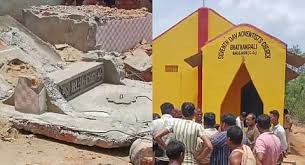
The police arrested five, including three members of the Dalit family after the incident. RAIPUR: Tension prevailed at Bhatanpali after a Dalit family that got converted into Christianity dismantled a temple built by them, leading to a protest by cadres of Bajrang Dal in the outskirts of Chhattisgarh’s Raigarh town. The police arrested five, including three members of the Dalit family after the incident. A senior police officer told TNIE that the Sarthi family had built the temple in 2020 on government land, though there was no idol placed inside and only the structure existed. The family accepted the Christian faith a year ago, and the temple was dismantled by a JCB machine. “As the news spread, a group of Bajrang Dal cadres arrived and, claiming that their religious sentiments were hurt, attempted to reach out to a nearby church to vandalise it in retaliation, but the police intervened and prevented it,” the officer said. The existing church was built on private land some 25 years ago. According to eyewitnesses, some Bajrang Dal protestors managed to enter the church, raised a saffron coloured cloth and tried to remove the cross. “There was a scuffle between the activists of Bajrang Dal and the police, who asked the protestors not to take the law into their hands. We have arrested five persons including three members of the Sarthi family and an operator of a JCB machinery that was used to demolish the temple”, the officer added. The locals close to Nirmal Sarthi claimed that the family was initially taken to a police station to safeguard them from the protestors, and later they were arrested by the police. “The demolished temple was a 6 ft x 6ft structure built by the Sarthi family close to the entrance of their residence. “The Hanuman temple didn’t have any idol installed, nor did anyone ever come to worship there. A Dalit family stands victimised in the incident. While Sarthi, his two sons and Bogilal Sarthi were arrested and sent to jail, no stern action was taken against those who created disharmony and agitation in the name of religion”, said Degree Prasad Chouhan, human rights activist based in Raigarh. Courtesy : Ejaz Kaiser, TNIE Note: This news is originally published on https:/thenewindianexpress.com/ and is for use by the non-military/non-commercial community, especially those in the human rights sector.
CPI’s D Raja condemns ‘cold-blooded killing’ of Maoist leader and Adivasis in Chhattisgarh
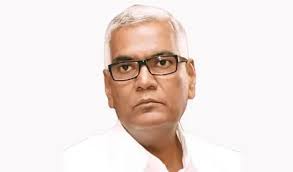
The Communist Party of India said “a democratic society cannot allow the State to become the judge, jury, and executioner.” Synopsis: The Communist Party of India has condemned the killing of senior Maoist leader Nambala Keshava Rao and over two dozen others by Indian security forces in Chhattisgarh’s Abujhmad region, calling it a “cold-blooded” and extrajudicial act. CPI General Secretary D Raja accused the State of bypassing constitutional safeguards and demanded an independent judicial inquiry into the operation. The Communist Party of India (CPI) has strongly criticised the “cold-blooded killing” of senior Maoist leader Nambala Keshava Rao and over two dozen others in Chhattisgarh’s Abujhmad region on 21 May by Indian armed forces. In a strongly worded statement released on Wednesday, CPI General Secretary D Raja accused the state of bypassing constitutional safeguards and engaging in extrajudicial actions that disproportionately affect Adivasi communities. “CPI strongly condemns the cold-blooded killing of a senior Maoist leader along with several Adivasis in Chhattisgarh. It is yet another instance of extrajudicial action carried out under the guise of counterinsurgency operations. The repeated use of lethal force instead of lawful arrest raises serious concerns about the State’s commitment to democratic norms and the rule of law,” the statement read. “If the authorities had credible intelligence about the whereabouts of the leader, why was a legal arrest not pursued? Why was due process – guaranteed by the Constitution – so blatantly ignored?” He further said Adivasi communities have often found themselves caught in military operations without access to justice or protection. “These killings not only point to a dangerous pattern of State violence but also expose the ongoing marginalisation of Adivasi communities in the region. Time and again, these communities are caught in the crossfire of a conflict they did not initiate, and are treated as collateral in operations marked by impunity.” The CPI demanded an independent judicial investigation into the killings. “CPI demands an independent judicial inquiry into this episode and the entire Operation Kagar. The people of Chhattisgarh – and India at large – deserve to know the truth. A democratic society cannot allow the State to become the judge, jury, and executioner. Justice must be served, and the dignity and rights of Adivasi lives must be upheld.” “CPI calls upon all democratic and progressive forces to raise their voices against this injustice and stand in solidarity with the people of Chhattisgarh.” Operation Kagar and the ‘neutralisation’ of over 50 Maoists The CPI’s statement followed soon after Union Home Minister Amit Shah announced the killing of at least 27 Maoist cadres, including senior leader Nambala Keshava Rao, also known as Basavaraj, in an alleged encounter in the Abujhmad forests of Narayanpur district, Chhattisgarh. Basavaraj, 71, was the General Secretary of the Communist Party of India (Maoist), the banned left-wing insurgent group that has operated across large parts of central India for over four decades. The encounter reportedly took place between the Maoists’ Company-7 unit and the District Reserve Guard (DRG), a specialised force raised by the Chhattisgarh police. The gun battle occurred in the dense forests near Maad, a known Maoist stronghold straddling the Narayanpur and Bijapur districts. Union Home Minister Amit Shah called the operation a “landmark achievement,” as part of the Centre’s commitment to eliminating “Naxalism” by 31 March 2026. Since early April, as part of Operation Kagar, a prolonged and expansive counterinsurgency campaign, the Centre has “neutralised” over 50 Maoists, including a previously reported 31 Maoists, among them 16 women, in the Karreguttalu Hills along the Chhattisgarh-Telangana border. That operation involved joint action by the Central Reserve Police Force (CRPF), Special Task Force (STF), DRG, and state police units, and was presented as a decisive shift in the National Democratic Alliance (NDA) government’s battle against left-wing extremism. Yet, activists and political parties like the CPI and the Bharat Rashtra Samithi (BRS) have consistently raised concerns about civilian deaths, lack of transparency, and the targeting of tribal populations. (Edited by Dese Gowda) Courtesy : TSF Note: This news is originally published on https://thesouthfirst.com/ and is for use by the non-military/non-commercial community, especially those in the human rights sector.