
‘All discussions completed’: Congress to announce its CM pick for Kerala on Thursday

The comments came shortly after Congress leader Rahul Gandhi met party president Mallikarjun Kharge and held a final round of discussion at his residence. Congress will announce its chief minister pick for Kerala on Thursday as all discussions by the party high command has been completed, General Secretary in-charge Communications, Jairam Ramesh said on Wednesday. “As authorised by the members of the CLP in Kerala, the high command of the Congress has completed all discussions, and the decision on who the next chief minister of Kerala will be will be announced tomorrow,” Ramesh told reporters outside Kharge’s residence. He declined to comment on whether the announcement would be made in Delhi or Kerala. The statements came shortly after Congress leader Rahul Gandhi met party president Mallikarjun Kharge and held a final round of discussion, even as protests and suspense over the delay in chosing the CM marred the party’s humongous victory in the recently concluded Assembly elections. Rahul Gandhi drove down to Kharge’s residence for the meeting, which lasted about 40 minutes. The former Congress chief had previously met several leaders from Kerala and around eight former state unit chiefs to ascertain the ground situation. The party was expected to make the announcement on Wednesday night. However, according to sources, the decision was reportedly delayed as senior party leader Sonia Gandhi was unwell and had to be taken to Medanta Hospital in Gurugram for “routine check-ups.” The Congress leadership has been unable to decide on a chief ministerial face even after ten days since the results for the Assembly polls were announced, in which the United Democratic Front (UDF) registered a stunning perfomance, winning 102 seats, well over the majority mark. Protests at the ground level by ordinary party workers had prompted the party leadership to hold discussions with state leaders before finalising the next chief minister. The race for the state’s top post started after the powerful AICC general secretary for organisation, K C Venugopal, threw his hat in the ring. He enjoys the support of a majority of Congress MLAs. Leader of Opposition in the outgoing Kerala assembly, V D Satheesan, and senior party leader Ramesh Chennithala are also staking a claim for the post. Congress’s allies in the UDF favour Satheesan, who also enjoys huge support from the public as well as party workers on the ground. Large number of Congress workers have gathered outside the residence of Satheesan on Wednesday, expecting a decision in favour of the leader. Kerala is the fourth southern state where the Congress has come to power, after it won Karnataka and Telangana and shared power in Tamil Nadu with TVK. Courtesy : TNIE Note: This news is originally published on https:/thenewindianexpress.com/bha and is used purely for non-profit/non-commercial purposes, especially human rights
Either I am CM or…: Rebel AIADMK leader claims EPS rejected Dalit CM proposal

AIADMK rebel C Ve Shanmugam claimed the DMK proposed Thol Thirumavalavan as Tamil Nadu Chief Minister. He said the move could have produced the state’s first Dalit Chief Minister, but alleged EPS refused it. A rebel leader of the AIADMK on Wednesday claimed that the DMK had proposed making VCK chief Thol Thirumavalavan the Chief Minister of Tamil Nadu, which would have made him the state’s first Dalit CM, but alleged that AIADMK general secretary Edappadi K Palaniswami rejected the proposal. Speaking after the floor test in the Tamil Nadu Assembly, rebel AIADMK leader and faction head C Ve Shanmugam said Tamil Nadu had got an “extremely rare chance” and an “unimaginable, impossible chance” for “someone from the Scheduled Caste community to become Chief Minister.” Shanmugam claimed that the DMK and Left parties proposed extending support to Thirumavalavan as Chief Minister, with ministers from both the DMK and AIADMK in the government. “We said while we can’t go with DMK, we can do it with Thiruma. But EPS said it cannot be accepted as it would become a VCK government. Either I am CM or I will act as Opposition. Those were the same words he used,” Shanmugam alleged. The rebel leader also defended the faction’s decision to support the TVK government led by actor-turned-politician C Joseph Vijay during the floor test. On Wednesday, 25 AIADMK MLAs backing Shanmugam and senior leader SP Velumani voted in favour of the government, helping the TVK government improve its tally to 144 in the 234-member Assembly. The DMK walked out of the House, the PMK abstained and the lone BJP MLA remained neutral. Twenty-one AIADMK MLAs loyal to Palaniswami, along with the AIADMK chief himself, voted against the government. Shanmugam rejected Palaniswami’s allegation that the rebel MLAs supported the TVK government in return for ministerial berths. “His claim is totally false and there is no truth in it. We supported the government since both AIADMK and TVK have the same ideology; to oppose DMK,” he said. He added that the AIADMK was founded by late chief minister MG Ramachandran to “uproot the DMK.” Questioning Palaniswami’s leadership, Shanmugam said the AIADMK should have convened a legislature party meeting before electing its leader, deputy leader and whip. “Can he show a copy of the resolution of the meeting? Can he provide information about when the legislature party meeting was held and at what time?” he asked. Shanmugam further claimed that Palaniswami visited the Puducherry resort where AIADMK MLAs were staying last week when the TVK was trying to form the government and collected signatures from legislators separately. “He said he had already spoken with the high level and the DMK would extend outside support to our party, that he will be the Chief Minister and our party would get several minister posts,” Shanmugam alleged. He also claimed that two senior DMK ministers contacted Palaniswami over the phone and congratulated him for extending support, while assuring him of a ministerial berth. “I was totally surprised and could not imagine accepting this offer. Even my family will not accept this,” he said. Shanmugam also attacked Palaniswami over the AIADMK’s electoral performance, alleging that the party had lost four consecutive elections under his leadership and that he never took responsibility for the defeats. Senior AIADMK leader SP Velumani echoed similar views and said the rebel faction’s primary objective was to defeat the DMK. “Our motive is to defeat the DMK. Our party and TVK have the same principles. Therefore, we have supported it,” Velumani said. He also denied any split in the AIADMK and called for an immediate general council meeting to decide the party’s future course. “There is no split in the party. We have to convene the party’s general council meeting immediately to decide the future success of the AIADMK,” he added. Pramod Madhav Courtesy : India Today Note: This news is originally published on https:/indiatoday.com/bha and is used purely for non-profit/non-commercial purposes, especially human rights
‘Crime against future of youth’: Congress slams BJP government over NEET UG cancellation
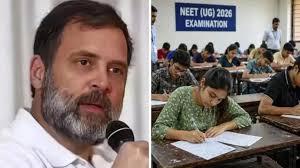
Slamming PM Modi over the exam cancellation, Rahul Gandhi said the hard work, sacrifices, and dreams of more than 22 lakh students have been “crushed by this corrupt BJP regime.” The Congress on Tuesday launched a scathing attack on the Prime Minister Narendra Modi-led BJP government over the question paper leak allegations and the subsequent cancellation of the NEET (UG) 2026 examination. Slamming PM Modi over the exam cancellation, Leader of Opposition in Lok Sabha Rahul Gandhi said the hard work, sacrifices, and dreams of more than 22 lakh students have been “crushed by this corrupt BJP regime.” “The NEET 2026 examination has been cancelled. The hard work, sacrifices, and dreams of more than 22 lakh students have been crushed by this corrupt BJP regime. Some fathers took loans, some mothers sold their jewellery, lakhs of children stayed up all night studying, and in return, they got paper leaks, government negligence, and organised corruption in education,” Gandhi said in a post on X. “This is not just a failure-it’s a crime against the future of the youth,” the Congress leader said. Every time, the paper mafia gets away scot-free, while honest students bear the punishment, Gandhi said, adding that now lakhs of students will once have to endure the same mental stress, financial burden, and uncertainty. If one’s destiny is determined not by hard work but by money and connections, then what meaning will education hold, he asked. “The Prime Minister’s so-called amrit kaal has turned into a ‘vish kaal (poison-filled era)’ for the country,” Gandhi said. The NEET UG 2026 examination held on May 3 was cancelled by the National Testing Agency (NTA) on Tuesday amid allegations of question paper leak and other irregularities in parts of Rajasthan. The NTA announced that the test would be conducted again on dates that would be announced separately. Meanwhile, the Union Government has ordered a CBI investigation into the matter. Targeting the Rajasthan government for allegedly suppressing the complaints over question paper leak for two weeks, former chief minister and Congress leader Ashok Gehlot claimed the cancellation of the exam indicated large-scale irregularities. The government had “played with the future of the youth” by attempting to hide information related to the alleged paper leak, Gehlot alleged, while lauding the NTA’s decision to conduct a retest. “The BJP government in Rajasthan had earlier tried to conceal the OMR sheet scam in the Rajasthan Staff Selection Board to avoid embarrassment. Weak legal representation in the case resulted in the accused securing bail,” he claimed. “Information related to the NEET-UG paper leak was also suppressed, and no FIR was registered initially,” he added. Gehlot said the truth has come out now, and the real face of the BJP government has been exposed. Seconding Gehlot’s remarks, Leader of Opposition Tikaram Jully alleged that the NEET-UG cancellation was proof of organised irregularities in the conduct of the test. Jully said the NTA’s decision to cancel the examination and hand over the investigation to the CBI reflected the seriousness and scale of the matter and termed it a betrayal of lakhs of hardworking students. “Eighty-nine paper leak cases had taken place during the BJP’s 10-year tenure in power. Despite repeated promises and claims of action, the government plays with the future of youths,” he said. Instead of exposing the truth, Jully said, the Rajasthan government tried to suppress the matter for two weeks and put the future of students at stake. “This reflected not only an administrative failure but also irresponsibility and insensitivity,” he alleged. Vishal Bansal, Additional Director General of the Rajasthan Police’s Special Operations Group, had on Monday said that the probe is currently focused on a “guess paper” that was allegedly circulated among students ahead of the examination. “Regarding the various misconceptions surrounding the NEET examination, let me clarify one specific point: there is a guess paper containing approximately 410 questions that has been circulating among students. Out of these, it is alleged that roughly 120 questions appeared in Chemistry,” Bansal had said. While the Chemistry paper carries 45 questions, the test used four sets of question papers. “It is reported that this guess paper had been circulating among the students well in advance; it began reaching them as early as 15 days to a month prior to the actual examination. We are investigating this guess paper, which is available in the open domain,” he had said. Courtesy : TNIE Note: This news is originally published on https:/thenewindianexpress.com/bha and is used purely for non-profit/non-commercial purposes, especially human rights
TVK worker dies two days after self-immolation attempt demanding Vijay be made CM
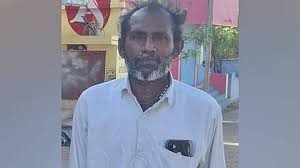
V Esakkiappan (43), a hardcore Vijay fan and village party branch secretary, suffered 90% burns and remained critical after an attempt. in hospital TIRUNELVELI: A TVK functionary of Chettikulam village, who attempted self-immolation on May 9 demanding that his party president C Joseph Vijay be made Chief Minister of Tamil Nadu, died in Kanniyakumari Government Medical College Hospital on Tuesday morning after not responding to treatment. The deceased, identified as V Esakkiappan (43), was a hardcore fan of Vijay and became the branch secretary of his village when the actor floated his party. He remained critical since the attempt with over 90 % of burn injury. Four months ago, Esakkiappan performed Vel Kuthuthal (piercing with a sacred spear on cheeks) for Tiruchendur Murugan praying for his leader to become Chief Minister. According to the villagers, on Saturday, he was upset because his leader was facing hurdles in securing a majority to form the government. The police said that in an inebriated state, he attempted self-immolation demanding that his leader be made Chief Minister. “When we inquired with him, he was so drunk that he could not realise what was happening,” a police official said. Soon after the incident, Esakkiappan’s relatives admitted him to the hospital where he remained critical in the Intensive Care Unit. He died on Tuesday morning, not responding to treatment. (Assistance for those having suicidal thoughts is available on the Tamil Nadu health department’s helpline 104 and Sneha’s suicide prevention helpline 044-24640050) Courtesy : TNIE Note: This news is originally published on https:/thenewindianexpress.com/bha and is used purely for non-profit/non-commercial purposes, especially human rights
Rahul Gandhi alleges BJP-EC ‘collusion’ over key West Bengal appointments

In a post on X written in Hindi, Gandhi said, “In the BJP-EC’s ‘chor bazaar’, the bigger the theft, the bigger the reward.” Congress leader Rahul Gandhi on Tuesday criticised the appointment of former Chief Electoral Officer Manoj Agarwal as West Bengal’s new chief secretary and Subrata Gupta as adviser to Chief Minister Suvendu Adhikari, alleging collusion between the BJP and the Election Commission. The Congress has claimed that the appointments reflected the “brazen collusion and connivance” between the Election Commission and the BJP. In a post on X written in Hindi, Gandhi said, “In the BJP-EC’s ‘chor bazaar’, the bigger the theft, the bigger the reward.” The opposition party had on Monday said that there is not even an attempt to keep the collusion discrete or concealed. Congress general secretary in charge of communications, Jairam Ramesh, had said the BJP-led West Bengal government has appointed the erstwhile chief election officer Agarwal, a 1990-batch IAS officer responsible for overseeing the recent Assembly elections in the state, as the new chief secretary. Similarly, Gupta, also a 1990-batch IAS officer who oversaw the SIR deletions in Bengal as the special roll observer, has been appointed the chief advisor to the Chief Minister, Ramesh pointed out. “These appointments reflect the brazen collusion and connivance between the ECI and the BJP. There is no longer even an attempt to keep the collusion discrete or concealed,” Ramesh said. The appointments are a testimony that the ECI was not impartial and acted exclusively to benefit the BJP, he alleged. An entire state went to the election with 27 lakh people being debarred from voting. This was tactfully executed by the ECI to create an electoral advantage for the BJP, Ramesh said. Agarwal, a West Bengal cadre officer, helmed the EC-mandated Special Intensive Revision (SIR) of electoral rolls in Bengal in the run-up to the Assembly polls, in which around 91 lakh voters were removed from the voter list. The West Bengal government on Sunday carried out a bureaucratic reshuffle, appointing two IAS officers and seven WBCS (executive) officers in the chief minister’s office (CMO), according to official notifications. Gupta was appointed advisor to the chief minister, hours after he was sworn in, while Shantanu Bala was named his private secretary. Courtesy : TNIE Note: This news is originally published on https:/thenewindianexpress.com/bha and is used purely for non-profit/non-commercial purposes, especially human rights
The Dalit clock: From Ambedkar to Thirumavalavan
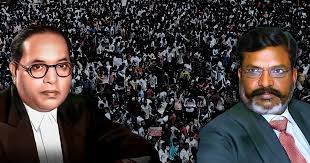
Much like Ambedkar did in his time, the VCK chief has chosen a path of principled pragmatism over moralistic traps set by those who haven’t sufficiently acknowledged his political and intellectual stature, writes V Geetha. How might one engage with the here and now of politics, without getting instrumental and cynical? How might one be productive in the present, without surrendering entirely to what it offers by way of power and self-achievement? The time of politics for India’s Dalits has been one that straddles the present as well as the future; pragmatic concerns, as well as a near-mythic yearning for a new world, and a new life, as Dr Ambedkar put it. At present these questions have come alive for at least one Dalit leader and party – Thol Thirumavalavan and the Viduthalai Chiruthaigal Katchi (VCK). They took their time to extend support to Joseph Vijay’s Tamilaga Vettri Kazhagam (TVK), which had emerged as the single largest party in the elections, but did not have the required majority. The left parties, VCK, and the Indian Union Muslim League decided to support the TVK’s claim to form the government. Meanwhile, speculation was rife as to Thirumavalavan’s intentions: was he demanding to be made deputy chief minister? Is it true that he was offered the Urban Affairs Ministry? How can Thiruma do this? All along he was with the DMK and supported them at every turn, in spite of their dubious record with respect to Dalit rights. So, how could he now endorse Vijay’s candidature? Is this, or is this not betrayal? Apart from such asides, there has been no dearth of advice thrown at him. As a Dalit leader, he was expected to continually affirm his moral credibility and agree to be baptised by the fire of other people’s righteousness. In extending their support to the TVK and Vijay, Thirumavalavan and VCK made it clear that they were doing this in the interests of democracy and in ensuring that a party elected by a majority of the people can take office. Predictably, this earned both leader and party snide asides from a small section of TVK fans who asked him to move on and let their leader take charge, and so on. At the same time, for Thirumavalavan’s constituency, the prospect of him being part of the government must have appeared enticing, considering that both the Dravidian majors have ensured that he remained a ‘junior’ partner within their respective alliances and failed to sufficiently acknowledge his political and intellectual stature. In this context, it is important to understand a dilemma that Dalit parties are forced to reckon with again and again: to respond to the present moment, to explore what it might hold for Dalits, and judge its potential for opening up options to do with rights, and due share in resources, including political power. If this requires a tactical compromise, how might one work with that? Or if it requires political co-option, is that worth risking? In the past too, Thirumavalavan has had to deal with such questions. He (and the VCK) have been responsive to a range of concerns, from the plight of Tamils in Sri Lanka to questions to do with the environment; with the subplan for Scheduled castes to the Hindu right’s affirmation of the Manusmriti and much more. In all this, he has foregrounded a point of view that is anchored in a broad vision of democracy. The challenge has been this: that even when he speaks for the greater common good, he is viewed as a Dalit leader, which he is, but he is seldom seen as one who is capable of and possesses the conceptual clarity and moral credibility to speak for all of us. Veering between being mindful of Dalit concerns and grounding his politics in a democratic vision, Thirumavalavan has found himself caught in uneasy political situations. While he and his party have remained valuable partners within any alliance, he was expected to stay within limits set by the dominant party. Thus, he has not always found it easy to voice his opinion on, say, party policy to do with Dalits, or the working of the criminal justice system when it comes to violence against them. To further understand and interrogate the social and political contexts that hedge Dalit political choices, it is useful to review the ways in which Babasaheb Dr Ambedkar engaged with the promises of the present, without losing sight of his ultimate objective – the annihilation of caste and untouchability and the making of a new social order. The architect of Dalit autonomy Throughout his political life, Ambedkar had to avail of the possibilities presaged by particular moments in time, in the full realisation that these were likely meagre. Yet he did so, responding to the historical hour in order to state and claim a denied right, or to make a case for new rights for Dalits. At the same time, whatever the demand, and however modest, he utilised the occasion to renew and re-state his transformative and imaginative vision for a just, free, fraternal and equal world. The Mahad Satyagraha was a protest against a specific expression of injustice among many others that Dalits endured. As we know, the second phase of the satyagraha did not proceed as planned because the caste Hindus had obtained a court injunction against the Dalits accessing the tank on the argument that it was a private tank. While Ambedkar was initially inclined to go against the injunction, a discussion with the Collector convinced him that to do so would pit them against the local government that was supportive of Dalit claims. This disappointed the satyagrahis, but yet they accepted his argument. On the one hand, this might appear a cautious move, but it is evident that he had made a choice: it was not possible for the Dalits to take on both the government and the caste Hindus. It was important to step back and re-arm oneself. Thus, he utilised
Kerala CM selection: Sonia Gandhi steps in, ex-KPCC chiefs summoned to Delhi

The move comes after former party president Sonia Gandhi and Wayanad MP Priyanka Gandhi Vadra favoured detailed discussions with former KPCC presidents to resolve the deadlock. THIRUVANANTHAPURAM: With the deadlock over the selection of the next Kerala chief minister continuing even a week after the UDF swept the assembly polls, the Congress high command has summoned former Kerala Pradesh Congress Committee (KPCC) presidents to New Delhi for detailed discussions on Tuesday. The high command has also asked party state president Sunny Joseph and working presidents A P Anil Kumar, P C Vishnunadh and Shafi Parambil to be present in Delhi for further deliberations. The three CM contenders — K C Venugopal, Ramesh Chennithala and V D Satheesan — have pinned their hopes on these meetings. The move comes after former party president Sonia Gandhi and Wayanad MP Priyanka Gandhi Vadra favoured detailed discussions with former KPCC presidents to resolve the deadlock. However, there are indications that the move is aimed at warding off criticism that all stakeholders were not taken into confidence. The high command appears to have concluded that detailed deliberations with former KPCC presidents would create an impression that the final decision was taken after considering all factors and consulting leaders at every level. A man rides past posters supporting KC Venugopal and VD Satheesan near the Congress headquarters, in Thiruvananthapuram, Friday, May 8, 2026. Except for Mullappally Ramachandran, former KPCC chiefs V M Sudheeran, K Muraleedharan, K Sudhakaran and M M Hassan are expected to reach Delhi by Tuesday. According to party sources, Rahul had a telephone conversation with Mullappally on Monday after the latter expressed his inability to reach Delhi at a short notice. Sources said the high command is likely to meet the leaders individually. Though former KPCC presidents and other senior leaders had met the two central observers during their visit to Kerala, the latest decision is learnt to have been taken in view of the continuing stalemate over CM selection. Sources said both Rahul and party president Mallikarjun Kharge would meet these leaders and seek their opinion on the choice of the new CM and the overall political atmosphere. After the meetings, the high command may summon the three contenders to Delhi and inform them of the final decision in the presence of both Rahul and Kharge, they said. Meanwhile, the IUML, which had earlier aggressively canvassed for Satheesan, has now reportedly decided to accept the Congress high command’s decision. There is also growing criticism among some newly elected Congress MLAs against what they described as “stage managed protests” organised against them at private functions. A man rides past posters supporting KC Venugopal and VD Satheesan near the Congress headquarters, in Thiruvananthapuram, Friday, May 8, 2026. “There is a concerted effort behind these activities. One or two individuals raise slogans demanding that Satheesan must become the CM, while another group records the scenes on mobile phones and later circulates them on social media,” said a Congress MLA from the Malabar region. Some Congress leaders alleged that certain fringe religious organisations, representing less than 1% of the Muslim community, and their workers were trying to sabotage Congress’ organisational process. They also pointed to the sudden halt in protest marches, after the high command warned of stringent action, as evidence that the campaign was orchestrated. CM announcement likely today? Indicating that the Congress high command may announce the party’s chief minister pick on Tuesday, AICC president Mallikarjun Kharge, who is on a visit to his home state, is returning to Delhi on Tuesday. Kharge, who was scheduled to return on Wednesday, decided to cut short his visit. Meanwhile, there are indications that the central leadership would seek the advice of veteran leader A K Antony too before taking the final decision. K S Sreejith Courtesy : TNIE Note: This news is originally published on https:/thenewindianexpress.com/bha and is used purely for non-profit/non-commercial purposes, especially human rights
IUML expresses displeasure over prolonged delay in choosing next Kerala CM, warns of political ‘repercussions’

The IUML also stated that the party had conveyed its views on the chief ministerial candidate to the Congress leadership and expressed confidence that the Congress would take the ally’s opinion seriously. The Indian Union Muslim League (IUML), a key constituent of the Congress-led UDF in Kerala, on Monday reiterated its displeasure over the delay in deciding the next chief minister, warning that the uncertainty could cause political repercussions. The Congress-led front, which swept the recently concluded Assembly elections in Kerala, winning 102 seats, is yet to decide the CM, even as public protests have erupted projecting support for the contenders, including Leader of the Opposition V D Satheesan, senior party leader Ramesh Chennithala and AICC general secretary (Organisation) K C Venugopal. Stating that the prolonged suspense has already caused dissatisfaction among party workers and the public, IUML Malappuram district general secretary P Abdul Hameed said, “The decision has already been delayed. If it is prolonged further, there will be repercussions. We hope the AICC leadership realises this.” He said people across the state were questioning the delay and claimed that even women voters from the district were calling party leaders to ask why they had been made to vote for the UDF. “There is dissatisfaction everywhere. People are raising only this issue wherever we go, including at marriage functions and funerals,” he said. Hameed said Kerala was politically different from north Indian states and that such prolonged indecision would not be accepted by politically aware voters in the state. He also said the UDF, despite securing a massive mandate, had been unable to properly celebrate its victory due to the uncertainty over the CM’s post. “In many places, victory celebrations are not taking place. There are situations where elected MLAs are being advised not to attend public events because of the growing dissatisfaction,” he said. The IUML leader further said the League had conveyed its views on the chief ministerial candidate to the Congress leadership and expressed confidence that the Congress would take the ally’s opinion seriously. Uncertainty continues within the Congress over the selection of Kerala’s next CM, even two days after Congress president Mallikarjun Kharge and senior leader Rahul Gandhi held discussions in New Delhi with the three contenders for the post. Courtesy : TNIE Note: This news is originally published on https:/thenewindianexpress.com/bha and is used purely for non-profit/non-commercial purposes, especially human rights
CM Revanth Reddy calls PM Modi’s gold remark ‘irresponsible’, seeks all-party meet on West Asia crisis
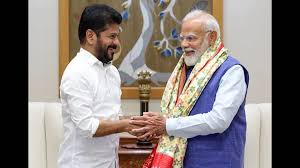
Telangana chief minister said the situation had arisen due to the failure of foreign policy. HYDERABAD: Telangana Chief Minister A Revanth Reddy on Monday termed Prime Minister Narendra Modi’s appeal to avoid buying gold for a year and adopt austerity measures as an “irresponsible call,” saying it reflected the failure of the Central government and amounted to an “undeclared ban” on the people. Speaking to reporters, Revanth Reddy said the situation had arisen due to the failure of foreign policy. He said, Opposition leader Rahul Gandhi had been raising concerns over foreign policy for the last six months and that Modi had now indirectly admitted it. Ridiculing the Prime Minister’s remarks, Revanth Reddy said: “the Prime Minister told the people to survive on air and live in the air”. The Chief Minister demanded that the Centre convene an all-party meeting and consult experts to prepare a roadmap to address the crisis arising from the West Asia conflict. “The US is involved in the war. India is not a part of the war, yet we are facing problems. The Centre should negotiate with other countries to overcome the crisis,” Revanth Reddy said. Clarifying Modi’s “mere se hi judo” remark made during a meeting in Hyderabad on Sunday, Revanth Reddy said it was related to development and not politics. “I suggested at the meeting that the Central and State governments should work in tandem for the development of the country. Modi merely endorsed my statement. The PM’s comment was about development and not politics,” he said. Revanth Reddy said the meeting focused on development and Centre-State relations despite ideological differences between parties. He also said he became Chief Minister after defeating the BJP in Telangana. Responding to Modi’s criticism of the Congress at a BJP meeting in Parade Grounds, Revanth Reddy said: “Modi criticising the Congress in the State means criticising me.” On Modi’s remarks describing the Congress as a “Muslim League-Maoist Congress,” Revanth Reddy said Muslims and Maoists were people of the country. He termed the remarks unfortunate and said while the BJP believed in eliminating Maoists, the Congress aimed to bring them into the mainstream. He said BJP-ruled States resorted to encounter killings, whereas under the Congress government in Telangana, around 818 Maoists had surrendered and joined the mainstream. He added that the Prime Minister should appreciate the Telangana Police. On the Special Intensive Revision (SIR), Revanth Reddy expressed concern over the alleged inclusion and deletion of votes before Assembly elections. He also reiterated his proposal on delimitation, suggesting that 50% of seats should be based on population and the remaining 50% on development. Rejecting claims that the BJP was winning elections across the country, Revanth Reddy pointed to the BJP’s defeats in the Jubilee Hills bypoll, local body elections in Telangana, and Assembly elections in Tamil Nadu and Kerala. The Chief Minister also said he would never indulge in vindictive politics or misuse the powers of his office. Courtesy : TNIE Note: This news is originally published on https:/thenewindianexpress.com/bha and is used purely for non-profit/non-commercial purposes, especially human rights
PM Modi repeats austerity call amid West Asia crisis, urges WFH, fuel savings, reduced gold buys
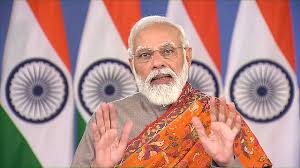
He stressed the need for reduced imports — India heavily relies on West Asia for crude oil and LPG — and avoiding unnecessary expenditure involving foreign currency. Prime Minister Narendra Modi on Monday reiterated his call for austerity measures, urging people to cut fuel consumption, use public transport and electric vehicles more frequently, and defer gold purchases amid disruptions caused by the West Asia crisis. Addressing a gathering in Vadodara after inaugurating the Sardar Dham Hostel built by the Patidar community, Modi also asked citizens to opt for work from home wherever possible and reduce foreign travel. “The West Asia crisis is one of the worst in the decade; just as we overcame the COVID-19 pandemic, we will come out of this also,” he asserted. #WATCH | Gujarat: Prime Minister Narendra Modi says, “… I appeal to every citizen of my country to reduce the use of petrol-diesel as much as possible. Use the metro, make greater use of electric buses and public transport, and promote carpooling. Those who have a car should… pic.twitter.com/85GGOgBh2W Modi noted citizens had always fulfilled their responsibilities whenever the country faced war or any other major crisis. “Whenever India faced war or any other major crisis, citizens fulfilled their responsibilities upon the government’s appeal; we need to do the same today,” the PM told the gathering. Prime Minister Narendra Modi addresses an event in Vadodara on Monday, May 11, 2026. The prime minister stressed the need for reduced imports — India heavily relies on West Asia for crude oil and LPG — and avoid unnecessary expenditure involving foreign currency. “We must make every effort to reduce the use of imported products and avoid personal activities that involve spending foreign currency,” Modi maintained. Calling for fuel conservation measures, he urged people to reduce fuel consumption and shift to public transport or electric vehicles. He appealed to citizens to defer gold buying in view of the prevailing global situation as a significant amount of foreign exchange goes into importing the precious metal. Modi had spoken about these austerity measures for the first time in the backdrop of the West Asia crisis while speaking at an event in Telangana on Sunday and reiterated them in Gujarat a day later. Courtesy : TNIE Note: This news is originally published on https:/thenewindianexpress.com/bha and is used purely for non-profit/non-commercial purposes, especially human rights