
Can’t stop Dalits from joining BJP-RSS, says Siddaramaiah
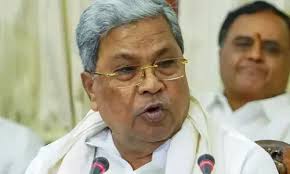
Bengaluru: Chief Minister Siddaramaiah said on Wednesday that Congress cannot stop Dalits from joining the BJP or the RSS, asserting that people from mostly backward communities die in the name of religion. “What can we say if the backward classes and Dalits, who consider the BJP-RSS-ABVP as their adversaries, still join them? Despite knowing that the BJP-RSS ideology is hostile to the backward classes, they still go there. What can we do about it?” he said while addressing the inauguration of the ‘L.G. Havanur Report Golden Jubilee’, organised by the Karnataka State Backward Classes Federation at the Jnanajyothi Auditorium in Bengaluru. Siddaramaiah said that those dying in the name of god and religion are mostly from backward communities, adding that out of self-interest, they join the BJP-RSS and speak more aggressively than even original RSS leaders like Hedgewar. He highlighted that late CM D. Devaraja Urs had called the Havanur Report the “Bible for backward classes” and noted that even the Supreme Court has highly appreciated the report. Siddaramaiah recounted the life of Havanur, born into a common village Scheduled Caste family, adding that Havanur had the habit of protesting even as a student and became the first lawyer from his community. The Chief Minister also recalled a newspaper comment from when he was Finance Minister: “Will this Siddaramaiah be able to count 100 sheep in the budget?” He said he took it as a challenge and presented 16 budgets and is now presenting the 17th. He stressed that it is the opportunity that enables action, and for marginalised communities, access is crucial.He noted that Havanur, born in the Beda caste, showcased his abilities. “Talent belongs to no one; it emerges when given opportunity,” Siddaramaiah said. The Chief Minister also recalled contesting the 1991 Lok Sabha elections and losing. Havanur had supported him in a legal dispute related to the elections, which strengthened their personal bond. Siddaramaiah invoked B.R. Ambedkar, saying that as long as the caste system exists, reservations should exist. “Even though we have 68 per cent of backward communities, the caste system is still deeply entrenched. Those who benefit from the caste system only strengthen it. Many backward communities have not yet shed the mindset of servitude. Calling the upper caste poor in plural and the lower caste rich in singular is a sign of servitude,” he said. He said that even educated individuals from backward communities tend to cling to superstition, believing poverty is fate. “Similarly, educated members of marginalised groups still hold superstitions,” he said. The Chief Minister said that he added that Buddha, Basavanna, and Ambedkar fought against the caste system. “When they fought, it seemed the system loosened, but it later tightened again. The caste system is not disappearing,” he said. Siddaramaiah said his government is ready to implement the reservation based on economic, social, and educational reports and is interested in increasing the reservation limit to 70–75 per cent. Siddaramaiah said that Rahul Gandhi exerted pressure on the central government to conduct a caste census due to his ideological commitment. During his speech, Siddaramaiah also read verses from the Manusmriti that discriminate against the Shudra community. Courtesy : THI Note: This news is originally published on https:/thehansindia.com/bha and is used purely for non-profit/non-commercial purposes, especially human rights
What can Rahul Gandhi do alone? The public will have to take to the streets. Ashok Gehlot launches a major attack on the Election Commission.
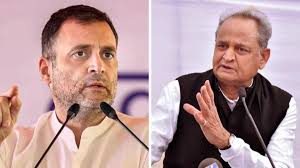
Ashok Gehlot News: Former Rajasthan Chief Minister Ashok Gehlot has leveled serious allegations against the Election Commission over the SIR controversy. Gehlot also questioned what Rahul Gandhi can do alone. Read what else Gehlot said here… Former Rajasthan Chief Minister Ashok Gehlot has leveled serious allegations against the Election Commission over the SIR controversy. Gehlot also questioned what Rahul Gandhi can do alone. Jaipur: Former Chief Minister Ashok Gehlot has criticized the Election Commission over the growing controversy across the country regarding the Special Intensive Revision (SIR). Speaking to the media after paying tribute to Indira Gandhi at the state Congress headquarters on her birth anniversary, Gehlot said that the Election Commission is solely responsible for the situation surrounding the SIR. ‘Controversies have arisen due to the Election Commission’s stupidity’ Gehlot alleged that controversies are arising across the country regarding the SIR process and this is due to the Commission’s “serious negligence.” He said the Commission implemented this process in a hurry, without taking political parties into confidence. Gehlot said, “If the Commission had called all parties and stated that the voter list would be prepared in a transparent manner, that no fake names would be added, and that no genuine voter’s name would be removed, this situation would not have arisen.” He said that initiating the process just before the Bihar elections was itself a step that raised doubts. “What can Rahul Gandhi do alone? The public will have to come forward.” During the conversation, Gehlot stated that a democratic fight cannot be fought solely by political leaders. He said, “Rahul Gandhi is the leader of the opposition; he is playing his role. But the public will also have to come forward. Our path is non-violence, while these people believe in violence. Such a fight can only be fought with the support of the public.” Referring to the Bihar elections, he said that money power was openly used there, and ₹10,000 each was deposited into women’s accounts mid-election, but the Election Commission took no action. Authored by: Sambrat Chaturvedi About the Author Sambrat Chaturvedi is an Assistant News Editor at Navbharat Times Digital. He has over 20 years of experience in journalism. He covers politics, crime, education, arts, and culture in Rajasthan. He has been with NBT (Digital) for the past five years. Courtesy: Hindi News
How Congress has been shrinking state after state! Every move by Rahul Gandhi failed, all political experiments failed, why?
Rahul Gandhi: The Grand Alliance suffered a crushing defeat in the Bihar Assembly elections. Similarly, if we look at the history of other states, Congress has been steadily declining. Bihar, Maharashtra, Haryana, and Gujarat. In these states, Congress’s position has been shrinking. What is the reason for Congress’s continued electoral defeat? Let’s examine the reasons. Congress defeat in four states Patna: In the Bihar Assembly elections, the ruling NDA returned to power by winning 202 out of 243 seats, while the opposition Grand Alliance was reduced to just 35. The BJP led the NDA’s victory, securing 89 seats, followed by Chief Minister Nitish Kumar’s JDU (JDU) with 85 and Chirag Paswan’s LJP (RLD) with 19. The RJD, the dominant party in the Grand Alliance, saw its tally drop to 25, while the Congress managed only six. In the 2024 Lok Sabha elections in Bihar, the NDA won 30 of the 40 seats, with the BJP and JDU winning 12 each. The LJP (RLD) won five seats, while the HAM (S) won one. The Grand Alliance won nine seats, with the RJD winning four, the Congress three, and the CPI (ML) L two. The remaining one was won by an independent. Bihar Situation In addition to Bihar, the BJP has won resounding victories in several elections in recent years, whether alone or with the NDA alliance, defeating the opposition in several states. Let’s take a look at some of these states. In the November 2024 elections for the 288-member Maharashtra Legislative Assembly, the Mahayuti, or NDA, won a landslide victory, winning 232 seats. The BJP topped the polls with 132, followed by the Eknath Shinde-led Shiv Sena with 57 and the Ajit Pawar-led NCP with 41. The opposition Maha Vikas Aghadi (MVA) won only 46 seats, with the Uddhav Thackeray-led Shiv Sena (UBT) winning 20, the Sharad Pawar-led NCP (SP) winning 10, and the Congress winning 16. However, in the Lok Sabha elections held six months before the Assembly elections, the Mahayuti had won only 17 seats (9 from the BJP, 7 from the Shiv Sena, and 1 from the NCP), while the MVA had won 30 seats (13 from the Congress, 9 from the Shiv Sena-UBT, and 8 from the NCP-SP). Odisha Situation In the 2024 Odisha Assembly elections, the BJP came to power in the state on its own for the first time, ending the five-term rule of BJD chief Naveen Patnaik. The BJP won 78 of the state’s 147 seats, while the BJD won 51 and the Congress won 14. In the simultaneous Lok Sabha elections in Odisha, the BJP won 20 of the 21 seats, while the Congress won one. The BJD failed to open its account in this election. In the 2019 Assembly elections, the BJD returned to power in Odisha with a landslide victory, winning 112 seats compared to the BJP’s 23. Andhra Pradesh Situation Andhra Pradesh also held simultaneous Lok Sabha and Assembly elections in 2024. The NDA, which includes the N. Chandrababu Naidu-led TDP and the Pawan Kalyan-led Jana Sena Party (JSP), along with the BJP, won 21 out of 25 seats in the Lok Sabha elections, defeating the ruling BJP. The YSRCP led by Y.S. Jagan Mohan Reddy won 4 seats. Among NDA allies, the TDP won 16, the BJP 3, and the JSP 2. In the Assembly elections, the NDA secured 164 out of 175 seats. The TDP contested 135 of the 144 seats it contested. The JSP won all 21 seats, while the BJP contested 10, winning 8. The YSRCP won only 11 seats. The Congress failed to even open its account. Madhya Pradesh Situation In the November 2023 elections for the 230-member Madhya Pradesh Assembly, the incumbent BJP returned to power by winning 163 seats. The opposition Congress failed to stage a comeback, winning only 66 seats. In the 2024 Lok Sabha elections, the BJP swept the state again, winning all 29 seats. In the Gujarat Assembly elections held in December 2022, the ruling BJP returned to power by winning 156 out of 182 seats. This was the highest number achieved by any party in the state’s electoral history. The Congress suffered its worst defeat, winning only 17 seats, while the Aam Aadmi Party (AAP) won five. In the 2024 Lok Sabha elections, the BJP will win 24 out of 25 seats, while the Congress will win only one. Edited by: Ashutosh Kumar Pandey About the Author Ashutosh Kumar Pandey works for Navbharat Times Online. He has been active in digital, print, and electronic journalism for over 22 years. He specializes in uncovering untold stories from the past, digging into the pages of politics. Presents political stories in a witty manner. Courtesy: Hindi News
‘Venomous rhetoric’: 272 eminent citizens pen letter against Rahul Gandhi; accuse Congress of making unsubstantiated claims
NEW DELHI: A group of 272 eminent citizens, including 16 judges, 123 retired bureaucrats, 14 former ambassadors and 133 retired armed forces officers, issued an open letter accusing leader of opposition Rahul Gandhi and the Congress of trying to erode public faith in the Election Commission and other constitutional institutions. The letter, titled “Assault on National Constitutional Authorities,” alleged that opposition leaders were attempting to manufacture a sense of institutional breakdown through what it described as “venomous rhetoric” and “provocative but unsubstantiated accusations.” The letter said: “Some political leaders, instead of offering genuine policy alternative, resort to provocative but unsubstantiated accusations in their theatrical political strategy. After their attempts to tarnish the Indian Armed Forces by questioning their valour and accomplishments, and the Judiciary by questioning its fairness, Parliament, and its constitutional functionaries, now it is the turn of Election Commission of India to face systematic and conspiratorial attacks on its integrity and reputation.” The signatories singled out Rahul Gandhi for repeatedly alleging vote theft while, they said, failing to file a formal complaint or sworn affidavit to back his claims. They pointed to his assertions that he had “100 per cent proof” and an “atom bomb” against the Commission, alongside accusations of “treason,” and argued that such remarks came “without the prescribed sworn affidavit” required for accountability. The letter also noted that similar accusations had been amplified by Congress leaders, opposition parties and allied NGOs, including claims that the Election Commission had acted like the “B-team of the BJP.” It argued these assertions collapsed under scrutiny, pointing to the ECI’s public release of its methodology and verification done under court oversight. It said, “Moreover, several senior figures of Congress and other political parties, leftist NGOs, ideologically opinionated scholars, and a few attention seekers in other walks of life, have joined in with similarly blistering rhetoric against SIR, even declaring that the Commission has descended into complete shamelessness by acting like the ‘B-team of the BJP.’ Such fiery rhetoric may be emotionally powerful but it collapses under scrutiny, because the ECI has publicly shared its SIR methodology, overseen verification by court-sanctioned means, removed ineligible names in a compliant manner, and added new eligible voters.” The signatories described this pattern of criticism as “impotent rage,” stating that leaders who faced electoral setbacks “lash out at institutions instead of rebuilding their credibility.” The letter said, “This pattern of behaviour reflects what might be called ‘impotent rage’ deep anger born of repeated electoral failure and frustration, without a concrete plan to reconnect with the people. When political leaders lose touch with the aspirations of ordinary citizens, they lash out at institutions instead of rebuilding their credibility. Theatrics replace analysis. Public spectacle takes the place of public service.” Invoking the legacy of former chief election commissioners TN Seshan and N Gopalaswami, the letter said, “Today, thinking of ECI, the country also remembers the likes of TN Seshan and N Gopalaswami, whose unyielding leadership transformed the Election Commission into a formidable constitutional sentinel. They did not court popularity. They did not chase headlines. They enforced the rules fearlessly, impartially, relentlessly.” Calling for transparency, legal accountability and respectful political conduct, the letter concluded by saying, “We call upon the Election Commission to continue its path of transparency and rigour. Publish complete data, defend itself through legal channels when necessary, and reject politics dressed up as victimhood. We call upon political leaders to respect the constitutional process, to compete not through baseless accusation but through policy articulation, and to accept democratic verdicts with grace.” Courtesy : TOI Note: This news is originally published on https:/timesofindia.com/bha and is used purely for non-profit/non-commercial purposes, especially human rights
Dalits, minorities targeted for deletions: VCK chief Thol Thirumavalavan on SIR
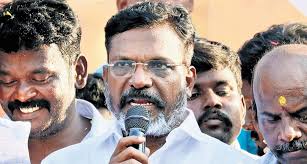
Addressing reporters at the party’s headquarters, he claimed that several constituencies with significant Dalit and minority populations are witnessing “unnatural” levels of voter-list deletions. CHENNAI: Viduthalai Chiruthaigal Katchi (VCK) president Thol Thirumavalavan on Tuesday alleged large-scale irregularities in the ongoing Special Intensive Revision (SIR) of electoral rolls and urged the Election Commission of India (ECI) to immediately intervene to ensure free and fair elections in Tamil Nadu. Addressing reporters at the party’s headquarters in Chennai, he claimed that several constituencies with significant Dalit and minority populations are witnessing “unnatural” levels of voter-list deletions. He said the pattern appears “targeted and deliberate” and warned that such actions could “distort the democratic rights” of marginalised communities. Thirumavalavan alleged that political forces “aligned with the BJP” are attempting to influence the revision process by filing mass objections and facilitating relocation of voters from other states into select constituencies. “These are coordinated attempts to alter voter demographics ahead of the 2026 polls,” he said. The VCK leader also criticised the ECI for what he described as “a lack of adequate monitoring” at the field level. He urged the ECI to deploy special observers, verify deletion requests and publish constituency-wise data on additions and removals to maintain transparency. Stating that TN had always maintained a “high standard of electoral integrity”, he said any deviation would undermine public confidence. He further announced that VCK would submit a detailed memorandum to the chief electoral officer highlighting specific irregularities. Calling for united action, Thirumavalavan appealed to all INDIA bloc parties to remain vigilant and protect the voting rights of all citizens. He further announced a protest against the ongoing SIR, calling to stop the exercise immediately on November 24 in Chennai. Courtesy : TNIE Note: This news is originally published on https:/thenewindianexpress.com/bha and is used purely for non-profit/non-commercial purposes, especially human rights
‘Not the one to blackmail Congress’: DK Shivakumar slams leadership change speculation in Karnataka
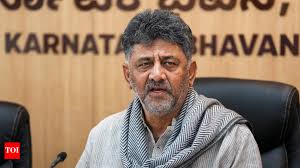
BENGALURU: Karnataka deputy chief minister D K Shivakumar has dimissed speculation that he was preparing to step down as the state Congress president, stressing that he remains a “disciplined soldier” of the party. His remarks came amid renewed chatter about a possible reshuffle in the Siddaramaiah cabinet following the chief minister’s meeting with Rahul Gandhi a day earlier, according to news agency PTI. Shivakumar said that any decision on cabinet changes is entirely up to Siddaramaiah and will be made only after consulting the party’s central leadership. He added that his visit to Delhi was mainly to invite Rahul Gandhi and Congress president Mallikarjun Kharge to the foundation stone ceremony for 100 new Congress office buildings in Karnataka. “There is a foundation-laying ceremony and several other events. Who will handle all of that? I have to do it. Why would I say I will resign (as state Congress president)? That situation hasn’t arisen yet,” he told reporters, rejecting the speculation circulating in political circles. Reaffirming his commitment to the party, he said, “I am dedicated to serving the party as a disciplined soldier, doing whatever tasks are assigned to me.” He also criticised the media for fuelling rumours, saying, “I am not the one to blackmail the Congress. I have built this party and worked tirelessly day and night for it. I will continue to do so in the future. Our party will return to power (in Karnataka) in 2028.” In addition to the office inauguration plans, Shivakumar is set to release his book Gandhi-Bharat, which revisits the historic Belagavi Congress session led by Mahatma Gandhi and the party’s centenary commemoration. Meanwhile, home minister G Parameshwara said the party was considering only a cabinet reshuffle and ruled out any change in leadership. Siddaramaiah, speaking in Delhi, maintained that there had been no discussion on a reshuffle and said his talks with national leaders were focused on the Bihar election results. Courtesy : TOI Note: This news is originally published on https:/timesofindia.com/bha and is used purely for non-profit/non-commercial purposes, especially human rights
Akhilesh Yadav should first lead UP… Imran Masood’s big statement: Rahul Gandhi is no match
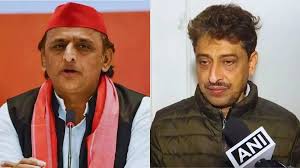
Imran Masood on Akhilesh Yadav: Following the Bihar election results, tensions have escalated among opposition parties. Congress MP Imran Masood has made a significant statement on Akhilesh Yadav. Saharanpur: Congress MP Imran Masood from Saharanpur, Uttar Pradesh, has issued a statement on Akhilesh Yadav’s leadership of the All India Alliance. In fact, following the Bihar Assembly election results, the ongoing tension within the Grand Alliance has now come to the fore. While several constituent parties of the Grand Alliance are reviewing and questioning the leadership after the crushing defeat, Congress MP Imran Masood has also openly expressed his views on this issue. Speaking to the media in Saharanpur on Monday, he made a significant statement regarding Samajwadi Party President Akhilesh Yadav and the alliance leadership. He suggested Akhilesh Yadav lead UP for the 2027 Assembly elections. What did Imran Masood say? Congress MP from Saharanpur, Imran Masood, said that after the Bihar elections, some Samajwadi Party leaders are arguing that Akhilesh Yadav should lead the India Alliance. Responding to this, Imran Masood said that Akhilesh Yadav should first lead Uttar Pradesh. The 2027 elections are coming, so focus on that first. Congress MP Imran Masood also said that no one can match Rahul Gandhi’s leadership. He said that Rahul Gandhi is incomparable, and cannot be compared to anyone. Will Congress split? Following the Bihar results, there have been reports of review and dissatisfaction within the India Alliance. Several parties have raised demands for a review. Responding to this question, Imran Masood said, “I am not the one to make this decision. I am a soldier of the Congress. The decision is for the party to make. My opinion does not matter.” He made it clear that whatever decision the party makes is final, and all leaders must abide by it. Leadership Differences in the Grand Alliance Following the Grand Alliance’s crushing defeat in Bihar, differences over leadership and strategy appear to be growing within the opposition camp. Leaders from different parties are issuing differing statements about the alliance’s direction and future. Imran Masood’s statement indicates that the party is now preparing to respond directly to those questioning the Congress leadership. Curated by: Rahul Parashar About the Author Rahul Parashar is a senior journalist at Navbharat Times Online. He has 20 years of experience in politics, current affairs, development, bureaucracy, education, health, and ground reporting. Early in his career, he covered administration and civic issues. He also learned the ropes of political journalism in Bihar, Jharkhand, and Uttar Pradesh. Courtesy: Hindi News
Will the India Alliance split in UP after the Bihar election results? Will Rahul and Akhilesh’s paths diverge in 2027?
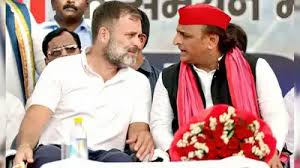
Following the poor performance of the India Alliance in Bihar, questions have arisen. Its impact could be felt in the 2027 UP elections. Discussions are already underway as to whether the India Alliance will break up. Lucknow: Following the landslide victory of the Bharatiya Janata Party (BJP)-led National Democratic Alliance (NDA) in the Bihar Assembly elections, speculation has begun about the future of the “India Alliance,” a group of opposition parties, in view of the 2027 UP Assembly elections. Prime Minister Narendra Modi, calling the Congress “Muslim League” and “Maoist,” has sparked a new debate by saying that “a split in the Congress will soon be seen.” Experts believe that this will spark a debate in UP, and that it will provide a new benchmark for both ruling and opposition party workers seeking future hope. The mental game has already begun. Samajwadi Party (SP) chief Akhilesh Yadav, who was quick to comment on the Bihar election results, called the BJP “not a party, but a fraud” and also acknowledged that there is much to learn from the BJP. Keshav Prasad Maurya took a jab at the opposition. Meanwhile, Uttar Pradesh Deputy Chief Minister Keshav Prasad Maurya, taking a jab at the opposition, said, “After Magadha, now Awadh,” suggesting that the BJP plans to portray the Bihar results as a good omen for Uttar Pradesh. The enthusiasm of NDA leaders in Uttar Pradesh is also at its peak regarding the Bihar election results. The Congress, which has found some new life in UP through its alliance with the SP for the 2024 Lok Sabha elections, is avoiding direct answers to questions about a grand alliance in 2027. Ajay Rai attacks Reacting to Modi’s statement about divisions within the Congress, UP Congress President Ajay Rai, Narendra Modi’s main rival in the Varanasi parliamentary constituency in the Lok Sabha elections, said he should first look at himself. What does he know about the Congress? But beyond claims and counterclaims, the question is being raised: what will be the relationship between the Samajwadi Party (SP) and the Congress, who together won 43 of the state’s 80 Lok Sabha seats in the 2024 Lok Sabha elections, in the 2027 Assembly elections? The fate will depend on the unity of both parties. The entire responsibility of opposition unity in Uttar Pradesh will depend on the unity of these two parties. Apparently, the SP and Congress are currently singing the tune of “all is well.” However, it is also a fact that after the poor results in the 2017 Assembly elections, the relationship between the Congress and the SP broke down, and the two boys (Rahul and Akhilesh) parted ways. Challenging the NDA will not be easy. Since the 2024 Lok Sabha election results, the unity of the Samajwadi Party (SP) and the Congress in Uttar Pradesh has created a new ground for possibilities for the 2027 Assembly elections. Since then, political pundits have begun to see the future of the opposition in the state in 2027. However, they now claim that the recent Bihar election results have sidelined the opposition parties’ Special Intensive Review (SIR) campaign and the issue of “vote theft,” making it difficult to challenge the NDA in Uttar Pradesh. They argue that the Bihar results have dealt a blow to the enthusiasm generated after the Lok Sabha elections. There is no such thing as a shock – Rajendra Chaudhary However, SP’s chief national spokesperson and former Uttar Pradesh government minister Rajendra Chaudhary said that there is no such thing as a shock; they will review the results to see what the reasons are. Chaudhary claimed that the All India Alliance will not be affected and the alliance will remain strong. The SP spokesperson said that they will learn lessons from the Bihar elections and the people of Uttar Pradesh are ready to deal with the rigging of the SIR by the BJP there. Bihar results have alerted us – SP spokesperson It should be noted that the SIR has been launched in Uttar Pradesh, and almost all political parties have alerted their workers to maintain transparency. SP spokesperson Chaudhary also stated that the Bihar results will make their workers more vigilant, more cautious, and work with greater vigor. He claimed that they are going to form a government in Uttar Pradesh in 2027 under the leadership of Akhilesh Yadav. They will perform even better in 2027, as the SP and the All India Alliance have become wary of the BJP’s potential conspiracies. Bhupendra Chaudhary claims victory in 2027 Meanwhile, Bharatiya Janata Party state president Bhupendra Singh Chaudhary attributed the NDA’s landslide victory in the Bihar assembly elections to the excellent development policies of Prime Minister Narendra Modi, including the Antyodaya and Garib Kalyan schemes, and claimed that the National Democratic Alliance will set a new record for victory in Uttar Pradesh in 2027. Edited by: Vivek Mishra About the Author Vivek Kumar Mishra is a Senior Digital Content Producer at Navbharat Times. He focuses on news in Uttar Pradesh and Uttarakhand. He also writes opinion pieces and political analysis. He was born in Barabanki and has worked in several cities across three states. He began his career in print media in 2013. Courtesy: Hindi News
Bihar Election Results 2025: Top 10 winners and losers

Bihar has delievered its verdict. It’s NDA ‘phir ek baar, with 200 paar’. They’re poised to break the 2010 record, when the NDA won 206 seats. The results have given both stunning victories and crushing setbacks. Here’s a look at the biggest winners and losers of Bihar’s high-stakes 2025 election. Bihar Election Results 2025 WINNERS Nitish Kumar Janata Dal (United) chief Nitish Kumar has once again emerged as the biggest winner of the Bihar elections 2025 as he managed to fight the 20 years of anti-incumbency and voter fatigue effectively. Despite nearly two decades in power, Nitish’s JD(U) made a clear gain this elections while leading in over 80 seats with the NDA tally of over 200 in the 243-member assembly. With this, Nitish has also blocked Tejashwi Yadav’s rise (again). Tejashwi had strong momentum in the last election with the RJD emerging as the largest single party and hoped for a full-term run this time. But the results show that the “youth vs experience” narrative has collapsed in Nitish’s favour. PM Modi The Bihar election results have once again proved that Prime Minister Narendra Modi it the GOAT with the NDA’s performance resting heavily on his personal popularity. Despite local anti-incumbency against Nitish Kumar, voters seems to have clearly distinguished state issues from PM Modi’s national leadership and voted in favour of “Modi ki guarantee”. His welfare schemes clearly created a strong beneficiary base that rallied behind the NDA. The results also halt any opposition momentum and reaffirm PM Modi’s unmatched vote-transferability, keeping the BJP firmly positioned for 2029. His BJP emerged as the single largest party by winning 89 seats. In a state defined by caste and shifting alliances, Bihar shows that PM Modi’s appeal still drives the coalition’s success. Chirag Paswan Chirag Paswan has emerged as one of the biggest gainers this Bihar election, marking a sharp turnaround from 2020 when his LJP won just one seat despite securing nearly 6% vote share. This time, his party has converted that scattered support into solid gains by winning 22 seats out of the 29 seats it was contesting. This result proves that Chirag’s personal appeal worked among Dalits and “yuva Biharis”. By distancing himself from the Nitish Kumar-led NDA earlier and then returning as a strengthened ally, he positioned himself as a rising force with independent bargaining power. His improved tally signals the consolidation of the Paswan vote and elevates him from a fringe disruptor in 2020 to a key power player in 2025. Women voters Women were the biggest winners of the Bihar elections, driving historic turnout and decisively shaping the verdict. For the first time, women outvoted men, 72% versus 63%, with many districts seeing a 10–20 point lead in female turnout. Their overwhelming participation tilted the mandate toward the NDA, boosted by welfare schemes like the Rs 10,000 Mukhyamantri Mahila Rozgar Yojana, which resonated with poorer and backward communities. Years of empowerment through panchayati raj reservations and Jeevika self-help groups strengthened mobilisation. Prioritising governance, safety and stability, women voters backed parties promising welfare and security, becoming the true kingmakers of Bihar 2025. Asaduddin Owaisi Owaisi’s AIMIM may not have won a large number of seats in the 2025 Bihar election, but politically, Owaisi walks away as a clear strategic winner. AIMIM was leading in five seats as counting was under way for the Bihar assembly polls, according to the Election Commission. The party, which has significant influence in the Seemanchal region that has a high Muslim population, is contesting 29 of the 243 seats in the assembly. Twenty-four of the seats it is contesting are in the Seemanchal region. His party once again proved its ability to shape tight contests in Muslim-heavy constituencies across Seemanchal, reaffirming his relevance in a state where every percentage point matters. Losers Tejashwi Yadav The Bihar election result marks a major setback for Tejashwi Yadav, who entered the race as the opposition’s CM face and the Mahagathbandhan’s only realistic challenger to the NDA. After leading RJD to 75 seats in 2020, making it the single largest party, Tejashwi was widely expected to build on that momentum in 2025. Instead, Tejashwi failed to convert the momentum and anti-incumbency wave against Nitish Kumar into actual votes. His party is on track to win 25 seats. This would be RJD’s second-worst showing in Bihar election after 2010 polls when theparty had won only 22 seats. This election was a test of whether Tejashwi could break out of RJD’s traditional Muslim–Yadav base and appeal to new generation of voters looking for governance-focused leadership. Despite energetic campaigning and a sharp message against Nitish, the party’s vote share did not see the substantial jump needed to tilt the state’s arithmetic. Most damaging for Tejashwi is the narrative loss. The 2020 result had established him as the emerging face of Bihar politics. This time, however, instead of expanding his political footprint, Tejashwi finds himself stalled and for a leader who hoped to become Bihar’s next CM, that makes him the biggest loser of this election. Rahul Gandhi The Bihar election has dealt a significant blow to Rahul Gandhi, whose Congress once again failed to make any significant gains in the state and was reduced to single digit. Despite efforts from Rahul Gandhi to revive the party’s fortunes in Bihar, which included a series of high-profile campaigns like the “vote chori” allegations against the Centre and the Election Commission, the Special Intensive Revision in Bihar, and the Voter Adhikar Yatra, Congress has failed to make a substantial impact. Although these issues were intended to galvanise voter support, they appear to have fallen flat in comparison to the local issues that resonate more strongly with Bihar’s electorate. In 2020, Congress had contested 70 seats as part of the Mahagathbandhan and won just 19, pulling down the alliance’s overall tally despite Tejashwi Yadav’s strong performance. This election offered an opportunity to correct that trajectory but Congress failed to improve its footprint, reinforcing the perception that it adds little electoral
A tale of three yatras: Why Rahul Gandhi, Tejashwi Yadav and Prashant Kishor failed – and BJP didn’t
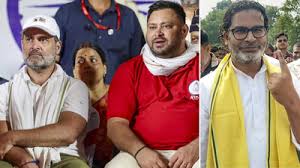
In the lead-up to Bihar’s assembly polls, three major marches: Rahul Gandhi’s Voter Adhikar Yatra, Tejashwi Yadav’s Bihar Adhikar Yatra and Prashant Kishor’s Jan Suraaj Padyatra were expected to energise the opposition and reshape the election narrative. All three drew large crowds and garnered a lot of attention. Yet, when the votes were counted, none of these grand yatras translated into electoral gains. The BJP-led NDA romped home with over 202 seats out of 243, consigning Congress and its allies to a crushing defeat. The INDIA bloc’s ambitious marches proved ineffective: Rahul Gandhi’s Voter Adhikar Yatra did not prove to be a trump card, and its message of “vote theft” remained largely irrelevant in Bihar politics. Likewise, Tejashwi Yadav’s tour failed to expand his party’s base, and Kishor’s two-year-long trek ended without a single Jan Suraaj victory. In short, symbolism could not substitute for organisation in Bihar’s rugged electoral terrain. Yatras: A time-honoured tool of Indian politics Pan-India “padayatra” has long been a favourite strategy for politicians seeking to connect with voters. And they are suddenly all the rage in politics, with leaders across parties taking to the road in dramatic, high-octane treks. Rahul Gandhi helped revive the trend with his Bharat Jodo Yatra in 2022–23, walking nearly 4,000km from Kanyakumari to Srinagar, followed by the far longer Bharat Jodo Nyay Yatra earlier this year. Hot on his heels came Tamil Nadu BJP chief K Annamalai, whose En Mann, En Makkal journey criss-crossed 10,000km and ended with a grand finale attended by the Prime Minister. TDP’s Nara Lokesh completed his own youth-focused Yuva Galam, insisting it was more about listening than winning. Such yatras can energise party cadres and highlight campaign themes. The yatras can be termed as “sanjivani” (life-giving) for parties, refreshing the organisation and giving campaigns a solid foundation. In Bihar, where rural networks and caste ties are crucial, parties often deploy yatras to visit far-flung villages and rural clusters. A well-timed yatra can build momentum by showing unity and giving voters a sense of participation. Yet this year, spectacle without substance was no match for the NDA’s disciplined strategy. Despite the grand fanfare of these three yatras, Bihar’s electorate delivered a very different verdict. Rahul Gandhi’s Voter Adhikar Yatra Rahul Gandhi’s Voter Adhikar Yatra (August–September) was hyped as a campaign to protect voter rights. Covering over 1,300 km across 25 districts and more than 100 constituencies, Rahul donned Bihar’s cultural symbols, the gamcha scarf, a cap and attacked alleged “vote chori” (vote stealing) and the state’s Special Intensive Revision of rolls. The march began with impressive crowds, especially in Sasaram, and projected Congress’s return to rural areas. However, from the very start, it was clear that public enthusiasm would not last. In the ensuing weeks, energy fell sharply. The yatra began with strong crowds, but as the campaign moved forward, the initial spark faded. Congress leaned heavily on the yatra’s symbolism but failed to build an effective ground organisation. Outside of a few big rallies, senior Congress leaders were largely absent, and booth-level mobilisation was weak. Rahul’s strategy focused obsessively on national issues like electoral rolls, which did not strike a chord with most Biharis. Ordinary voters were more concerned with jobs, inflation and local governance than allegations of “voter chori.” Rahul Gandhi and Tejashwi Yadav during Voter Adhikar Yatra Rahul’s campaign squandered precious time attacking the Election Commission, and the shift backfired. After rallying around national narratives, Congress’s messaging was drowned out by local realities it failed to read. By election day, Congress only won 6 seats out of 61 contested: a miserable 10% success rate. Rural crowds did not turn into rural votes. Internal alliance tensions didn’t help either: Rahul kept a distance after the Yatra and reappeared only weeks later, and the absence of sustained leadership further undermined Congress. Meanwhile, Bihar’s ruling BJP and JD(U) gleefully declared Rahul’s march a flop show. Their taunts echoed the ground reality: for all its high production values, the Voter Adhikar Yatra failed to translate into votes for Congress, leaving the party facing one of its worst-ever Bihar results. In short, Rahul’s narrative of “vote chori” and his focus on fighting SIR proved largely irrelevant to the Bihar electorate. His Yatra simply did not prove to be a trump card. Tejashwi Yadav’s Bihar Adhikar Yatra Tejashwi Yadav’s Bihar Adhikar Yatra was launched on September 16, almost immediately after Rahul’s tour. Setting out from Jehanabad, Tejashwi promised to challenge the Nitish Kumar government on unemployment, crime and local grievances. The yatra was partly pitched as filling gaps left by Rahul’s march; RJD officials openly said they covered districts left out of the Voter Adhikar Yatra. By highlighting issues in RJD strongholds: Jehanabad, Nalanda, Supaul, Saharsa and others. Tejashwi aimed to consolidate his party’s core vote and signal that the RJD was the main force in the INDIA bloc. He also used the trip to assert himself: earlier, he had declared he would contest all 243 seats, underlining his claim to be the alliance’s undisputed leader. In theory, Tejashwi’s focused effort should have solidified his social coalition and countered anti-incumbency. In practice, it barely made a dent outside his base. By election day, the RJD had outperformed Congress, but only marginally: the party was on course for about 25 seats, far below its 75 in 2020. Tejashwi failed to convert the momentum and anti-incumbency wave against Nitish Kumar into actual votes, leaving the RJD with its second-worst tally ever. The much-heralded yatra vision of reaching every village did little to overcome the RJD’s narrow caste profile. Most communities beyond the Muslim–Yadav base remained unconvinced, and even within the RJD, ticket distribution caused resentment. Seat-sharing disputes led to friendly fights where opposition partners split the anti-NDA vote. In the end, Tejashwi’s personal crusade could not overcome these structural flaws. The RJD held on to pockets of support but did not expand beyond its traditional base. The youth-versus-experience narrative he touted collapsed under the weight of Nitish Kumar’s intact governance credentials