
‘INDIA Bloc stands united and will move forward collectively….it is not about individual decisions’: Mamata

NEW DELHI: A day after the INDIA Alliance announced a joint agitation to demand the resignation of Gyanesh Kumar over the SIR exercise, Trinamool Congress Chairperson and former West Bengal CM Mamata Banerjee said that for the Opposition this was a “collective” fight and shared that she had promptly responded to CPI(M) general secretary MA Baby last week when he reached out to her over the working of the Election Commission as it was a “national issue”.Reports of the interaction between Baby and Banerjee had attracted much attention last week as it saw two parties with decades-long differences in Bengal coming together on the question of the Election Commission (EC). Banerjee shared details of the interaction and the sentiment behind both sides putting aside their differences and coming together, while responding to questions at a press conference in Delhi. Party national general secretary Abhishek Banerjee and senior party leaders Derek O’ Brien, Dola Sen, Mahua Moitra, Menaka Guruswamy and Saket Gokhale were among those present with Mamata Banerjee at the press conference. “Our position is that when Constitutional institutions and democratic rights are at stake, political parties should examine the issue beyond their individual colours and interests,” Banerjee asserted. When asked about Congress leader Rahul Gandhi, the question of leadership of the opposition alliance and her view on who can be the Bloc’s PM candidate, the TMC Chairperson said, “INDIA Alliance is United and together. It is not about individual decisions. We are like a family, and we will decide collectively on these issues.” “Regional political parties have their own circumstances and compulsions, and we understand that. We maintain good relations with leaders such as Arvind Kejriwal (AAP), Nitish Kumar (JDU) and MK Stalin (DMK), while local political decisions may differ from state to state. Sometimes, INDIA’s alliance partners may not attend a particular programme because of local political considerations, but that does not necessarily mean there is disagreement on broader national issues,” she added. “We are with the INDIA alliance, and whatever decisions the alliance takes, we will respect them like a family and work together with unity. Our priority is to stand together and move forward collectively,” Banerjee said. “2029 is still far away; first, look at what is happening in 2027. “Khela toh ab hoga” — the real political game begins now. You never know what may happen in the next two, three, or six months. Politics can change very quickly, and we will continue to watch the situation, remain united and make decisions together as an alliance,” she emphasised. “It is important for Gyanesh Kumar to go…change is critical at this stage to make way for a free and fair electoral system,” Banerjee said in response to a question about whether the resignation of CEC would help resolve the systemic problems. TMC national general secretary and Lok Sabha MP Abhishek Banerjee lashed out, saying, “When questions are directed at Chief Election Commissioner Gyanesh Kumar or the Election Commission, I believe the answers should come from the Election Commission itself. Instead, we repeatedly see BJP leaders responding to those questions. My point is simple: constitutional authorities must answer legitimate questions themselves and place facts before the public rather than allowing political parties to speak on their behalf.” He called for a thorough investigation to bring out the truth. Courtesy : TOI Note: This news is originally published on https:/timesofindia.com/bha and is used purely for non-profit/non-commercial purposes, especially human rights
Bhatti Vikramarka, enraged by Mallikarjun Kharge’s “insult,” called for a nationwide Dalit-Adivasi movement for self-respect.

Telangana Deputy Chief Minister Bhatti Vikramarka, calling Congress President Mallikarjun Kharge’s insult a direct attack on Dalit self-respect, warned of a nationwide movement. New Delhi: Calling Congress President Mallikarjun Kharge’s alleged insult a symbol of the ongoing discrimination against marginalized communities, Telangana Deputy Chief Minister Bhatti Vikramarka delivered a strong message on Tuesday. He called for a nationwide movement to protect the dignity and self-respect of Dalits and Adivasis. South Asians and Diaspora Addressing the “Dalit-Adivasi Self-Respect Conference” organized by the Congress SC and ST MPs Forum in New Delhi, Vikramarka emphasized that protecting the Constitution and its core values of equality, liberty, fraternity, and social justice is the paramount responsibility of every citizen of the country. During his address, he recalled that the Congress party had passed the first resolution against untouchability and later played a key role in implementing the Constitution. Targeting the BJP-led central government, he alleged that attempts are being made to weaken constitutional values and promote the ideology of Manusmriti in place of the Constitution. Bhatti stated that the Constitution of India binds every citizen of the country in a strong bond, and violating it directly means weakening the foundation of the nation. He expressed concern that although many stringent laws were enacted during the Congress governments to address discrimination against Dalits and tribals, unfortunately, incidents of discrimination continue to surface in society. Referring to Mallikarjun Kharge’s political stature, he clarified that he is not merely a Dalit leader, but a senior national leader who has achieved high constitutional and political positions through decades of public service. He described the alleged “purification” ritual that followed Kharge’s public meeting in Haldwani as a direct attack on Dalit self-respect. He also strongly criticized the action taken against Rahul Gandhi, who had demanded an FIR in the matter. Questioning the functioning of the system, he said that if someone seeks justice for an insulted person or questions the authorities, they are then sued. He believes this situation fully exposes the deep-seated discrimination against Dalits and tribals within the system. Appealing to Dalits, tribals, and minorities to unite against discrimination, Bhatti sternly stated that we cannot accept a situation where millions of people, including Scheduled Castes, tribals, and minorities, are treated as second-class citizens. He strongly urged everyone to come together and fight to protect their self-respect. Rajan Chaudhary Courtesy: Hindi News
Karnataka: Most deleted voters tribals, minorities, Dalits and women, reveals SIR audit

The SIR Opposition Coalition demanded that Chief Election Commissioner Gyanesh Kumar resign, the SIR process be halted and deleted voters be restored to the rolls. BENGALURU: An SIR audit report released by the SIR Opposition Coalition in Bengaluru on Wednesday, alleged that nomadic and tribal communities, minorities, Dalits, extremely backward communities and women accounted for a disproportionately high number of voters deleted from the electoral rolls or served notices during the SIR process. Speaking at the report release programme at Shasakara Bhavan, Eddelu Karnataka office-bearer Noor Sridhar said field verification had shown that constituencies with a high concentration of minorities, Dalits and tribal communities had witnessed higher deletions. He alleged that several voters had been wrongly categorised as shifted, absent or deceased, and questioned the requirement of linking every voter to the 2002 electoral roll. Retired Supreme Court judge Gopal Gowda questioned the legal basis for the exercise, and alleged that the SIR process was being used to exclude sections of voters. Actor Prakash Raj, director B Suresh, Karnataka Sahitya Akademi chairman Prof LN Mukundaraj, former minister Kimmane Rathnakar and activists were among those present. The coalition demanded that Chief Election Commissioner Gyanesh Kumar resign, the SIR process be halted and deleted voters be restored to the rolls. It also sought a constitutional mechanism for appointing election commissioners and a scientific, voter-friendly method of electoral-roll revision. It urged the Union government to initiate removal proceedings against Gyanesh Kumar and sought an apology from Prime Minister Narendra Modi and Union Home Minister Amit Shah over the SIR exercise. It also demanded repolling in Bihar and West Bengal. The coalition urged the Karnataka government to convene a special session to discuss alleged irregularities in the SIR exercise, and pass a resolution rejecting the process and rolls generated through it. It sought a social audit to identify voters wrongly deleted and a campaign to restore them to the electoral rolls, and demanded that SIR rolls not be used for any election until all eligible voters are restored. Courtesy : TNIE Note: This news is originally published on https:/thenewindianexpress.com/bha and is used purely for non-profit/non-commercial purposes, especially human rights
UP: The BJP will have to fight to protect its own vote bank; Akhilesh Yadav’s new caste arithmetic will be a major test.
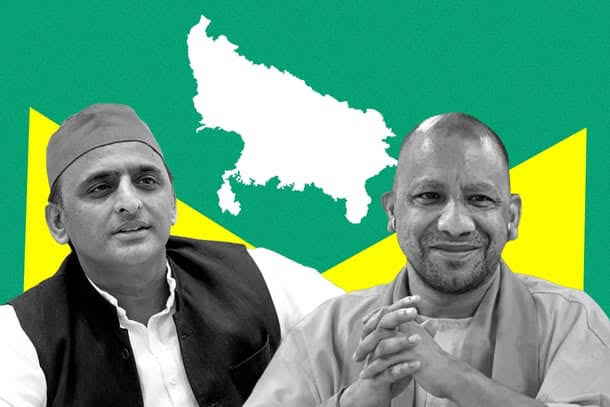
The BJP will have to fight to protect its own vote bank in the UP Assembly elections. Akhilesh Yadav’s new caste arithmetic will be a major test. The SP will target Brahmins, non-Jatav Dalits, and non-Yadav OBCs. This new strategy by the SP has increased the BJP’s concern. The SP’s strategy now aims to break the social alliance that has helped the BJP win election after election in Uttar Pradesh. After the success of the new caste arithmetic in the Lok Sabha elections, the SP’s strategy is to move beyond its image as a Muslim-Yadav party and give more priority to non-Yadav OBCs, non-Jatav Dalits, and Brahmin communities in ticket distribution. If this segment prioritizes caste over party, as in the Lok Sabha elections, the contest will be interesting. The BJP will face the challenge of maintaining its base vote bank and breaking through this SP’s maze. This new strategy by the SP has increased the BJP’s concern. According to a senior state leader and former state president, the party’s biggest challenge is to re-engage the non-Yadav OBCs and non-Jatav Dalits, a large portion of whom sided with the SP in the last Lok Sabha elections. This segment, which supported the BJP in the 2014, 2019, and the last two assembly elections, no longer displayed its previous commitment to the BJP in the last Lok Sabha elections. Since the SP’s ticket distribution formula for 2024 has been successful, it will not only favor the Kurmi, Nishad, Gurjar, Pal, Saini, Prajapati, and Pasi communities among Dalits to deal a blow to the BJP in the assembly elections, but will also woo Brahmins in eastern UP and Awadh. Therefore, to blunt this SP move, the BJP will have to make a major change in its strategy. What is the SP’s strategy? In the last election, the SP alliance distributed approximately 125 tickets among Muslim Yadavs. This made it easier for the BJP to woo the non-Yadav OBCs. This time, the SP plans to limit the number of tickets for Yadavs and Muslims to 80-85 seats. The plan is to field Dalit candidates in some general seats where the combination of Muslim, Yadav, and Dalit voters can create a formidable position. Furthermore, the plan is to provide bulk tickets to Brahmins among the upper castes, Kurmis and Nishads among the OBCs, and to give greater representation to Sainis, Gurjars, Rajbhars, Pals, and Prajapatis. In the Lok Sabha elections, the SP fielded only five candidates from the Yadav community and four from the Muslim community. Last Election Equation The SP alliance fielded approximately 128 Yadav-Muslim candidates, the same number of non-Yadav OBC candidates, 86 Dalits, and approximately 60 upper caste candidates. The NDA fielded approximately 135 non-Yadav OBC candidates, 15 from the Yadav community, approximately 140 from the upper castes, 85 from the Dalit community, and approximately 30 to 35 from the Vaishya community. Law and order will be a key issue for the BJP. A section within the BJP believes that as the elections approach, the contest will become Yogi versus Akhilesh. This will directly benefit the BJP. For example, in Bihar, the initial situation was against the NDA, but as the election approached, when the contest became Nitish versus Tejashwi, the NDA won a landslide victory on the issue of better law and order. In Uttar Pradesh too, there is a general public support for better law and order. Therefore, the BJP will have to find a counter to the SP’s new social equation with law and order and Hindutva. Himanshu Mishra, New Delhi Published by: Sharukh Khan Courtesy: Hindi News
Mamata seeks ‘extraordinary’ Opposition action over SIR, urges parties to set egos aside

The 20-party meeting finalised a joint action plan including rallies and ‘save democracy’ marches, while leaders backed legal action and wider mobilisation over the Election Commission. NEW DELHI: Calling for a broader Opposition mobilisation over the SIR row, TMC chief Mamata Banerjee urged INDIA bloc leaders on Wednesday to set aside their egos, saying extraordinary situations call for extraordinary action to fight the BJP and its machinations. At the meeting, as many as 20 INDIA bloc parties finalised a joint action plan, including rallies and ‘save democracy marches’. Congress president Mallikarjun Kharge said all parties at the meeting agreed that elections should be held through ballot papers instead of EVMs. Referring to her phone conversation with CPI(M) general secretary M A Baby last week, Banerjee stressed the need for parties to put aside their differences. “Mr Baby wrote to me, and I responded positively to him. I have been talking to other leaders also. Yesterday, I spoke to BJD’s Naveen Patnaik,” she is learnt to have told the meeting. Baby wrote to several non-NDA parties last week, seeking a coordinated response to the Election Commission row. His outreach included the BRS, AAP, DMK, BJD and TVK. Responding positively, Banerjee wrote back that the effort should be taken forward to mobilize all Opposition parties. The two subsequently spoke over the phone. Baby said they also recalled their days in Parliament, when Banerjee was in the Lok Sabha, and he was a Rajya Sabha member. At Wednesday’s meeting, Baby called for the entire Opposition to unite on the issue and involve civil society and public intellectuals committed to secular and democratic principles. Speaking towards the end of the meeting, Leader of Opposition Rahul Gandhi urged leaders to believe in themselves, saying panic had set in within the BJP and the “system” was beginning to crumble. “The BJP is in panic mode. Don’t be under any illusion that the BJP is invincible. PM Modi and Amit Shah are aware that the system is crumbling,” Gandhi is learnt to have told the meeting. Independent Rajya Sabha MP Kapil Sibal called for legal action alongside mass protests, sources said. He is learnt to have suggested that Opposition MPs should jointly move the Supreme Court to seek an early hearing of the pending petitions on SIR. The Aam Aadmi Party (AAP) and the Dravida Munnetra Kazhagam (DMK), which have distanced themselves from the INDIA bloc, skipped the meeting but are learnt to have agreed to sign a fresh Opposition notice seeking the removal of the Chief Election Commissioner. CPI(M) general secretary M A Baby met AAP national convenor Arvind Kejriwal on Sunday, while TMC’s Derek O’Brien met AAP Rajya Sabha MP Sanjay Singh on Tuesday morning as Opposition leaders sought wider support for the notice. DMK leader Kanimozhi had also met TMC chief Mamata Banerjee in Kolkata on September 17. Preetha Nair Courtesy : TNIE Note: This news is originally published on https:/thenewindianexpress.com/bha and is used purely for non-profit/non-commercial purposes, especially human rights
‘Were they pressured?’ Rahul Gandhi questions who ‘ordered’ Form 6 changes
NEW DELHI: Leader of Opposition in Lok Sabha and Congress leader Rahul Gandhi has questioned who authorised changes to the online Form 6 for voter registration and whether Tata Consultancy Services (TCS) was pressured to implement them. “The online Form 6 was changed illegally – as the EC’s own Commissioners have recorded. Who at the ECI ordered Tata Consultancy Services to make that change? Who at TCS signed off on it? And were they pressured into doing it?” Rahul said in a post on X. The Election Commission has withdrawn the additional Special Intensive Revision (SIR)-related declaration attached to Form 6 in states where the electoral roll revision exercise has been completed, PTI reported on Wednesday. The declaration has been removed from the ECINET app and portal, as well as the respective Chief Electoral Officer portals, meaning new applicants in these states will only have to submit the regular statutory Form 6 for voter enrolment. In states and Union territories where the SIR exercise is still underway, the additional declaration remains available on the ECINET portal. Under the declaration, new applicants are required to provide details linking themselves, their parents or grandparents to electoral rolls prepared during an earlier SIR. The move follows a September 26 meeting of the full Commission, comprising Chief Election Commissioner Gyanesh Kumar and Election Commissioners Sukhbir Singh Sandhu and Vivek Joshi. After the meeting, the poll panel said the declaration attached to Form 6 was meant “specifically for SIR” and that “for non-SIR period, the Forms applicable as per Rules (the Registration of Electors Rules 1960) will be used.” Courtesy : TOI Note: This news is originally published on https:/timesofindia.com/bha and is used purely for non-profit/non-commercial purposes, especially human rights
PM Modi, Home Minister Shah have ‘destroyed’ Indian democracy: Rahul Gandhi
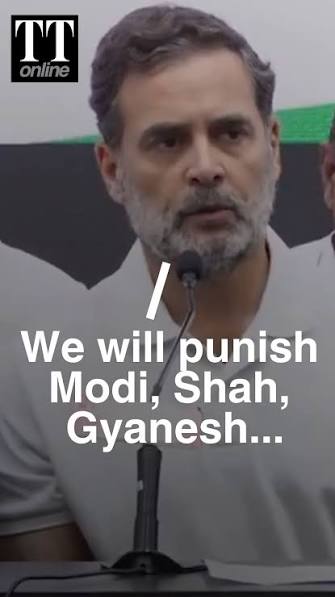
Says Opposition leaders ‘collective defenders’ of Constitution Congress leader Rahul Gandhi on Wednesday told INDIA bloc leaders that they are the ‘collective defenders’ of the Indian Constitution and asserted that it is their ‘personal commitment’ to ensure that those who have ‘destroyed’ Indian democracy are punished. The leader of opposition in the Lok Sabha made the remarks at a joint media briefing of INDIA bloc leaders after their three-and-a-half-hour meeting attended by him and the likes of Congress president Mallikarjun Kharge, former party chief Sonia Gandhi, TMC chief Mamata Banerjee, Jammu and Kashmir Chief Minister Omar Abdullah, RJD’s Tejashwi Yadav and NCP(SP) MP Supriya Sule. “INDIA bloc meeting saw a very good discussion and the main issue was ‘vote chori’. All parties are of the opinion that the democratic system of India has been attacked by Prime Minister Narendra Modi, Home Minister Amit Shad and Chief Election Commissioner Gyanesh Kumar,” Gandhi said. “We are not going to take it lying down. It is a personal commitment of all INDIA bloc leaders, we are going to ensure that people who have destroyed Indian democracy are punished. Doesn’t matter how senior they are, who they are, Indian democracy is bigger than every single person in this country,” he asserted. There was also a feeling that the opposition has been quite successful in putting across to the people of India that elections are ‘stolen’, that PM Modi and Home Minister Shah have ‘destroyed’ Indian democracy and there is a new sense of resistance, particularly among young people, that what is going on in India is wrong and needs to be stopped, Gandhi said. “It is an honour for us to work together and we are confident that, over the next few months, we will make serious changes in the country,” the former Congress chief said. Earlier, INDIA bloc finalised a joint action plan over the SIR row, including holding rallies and ‘save democracy’ marches, with Congress president Kharge asserting that all parties agreed that elections should be held through ballot papers instead of EVMs. Courtesy : The Tribune India Note: This news is originally published on https:/thetribuneindia.com/bha and is used purely for non-profit/non-commercial purposes, especially human rights
The 2017 Shabbirpur violence gave a new direction to Dalit politics in Western UP. Do people still trust the BSP, or are Dalits following a free path?
The 2017 violence in Shabbirpur, Saharanpur, gave a new direction to Dalit politics in Western UP. Does the public still trust Mayawati? Is a section of Dalit youth seeking an “independent” path? Saharanpur: The 2017 Shabbirpur (Saharanpur) violence gave a new direction to Dalit politics in Western UP. Mayawati resigned from the Rajya Sabha, accusing the government of suppressing Dalit voices. Chandrashekhar Azad emerged from this struggle. Nearly a decade later, when we moved from Shabbirpur to Saharanpur, Bijnor, and Meerut, the question had changed: Do we still trust Mayawati, but are we seeking an “independent” path? The answer on the ground was not monotonous, but a fragmented voice. Here is Mohammad Asghar’s ground report. The conductor asked, “Where are you going?” Yes, Shabbirpur. Give me a ticket. The conductor said, “The bus doesn’t go to Shabbirpur. It will drop you off 2-3 kilometers away. How will you get there? Call someone from the village.” I understood the meaning of the conductor’s reply when I got off the roadways bus. The sugarcane fields on both sides of the road to Shabbirpur village were so tall that no one was visible. The silence was frightening. The thought of how difficult it would be to protect myself if an animal or criminal came near me was overwhelming. As I walked a little further, I met a woman mowing grass. She said, “Son, if someone’s bike comes, stop it and get on it.” Shabbirpur Village, Because of Which Mayawati Resigned from the Rajya Sabha After traveling about 30 kilometers from Saharanpur, I somehow reached Shabbirpur. This is the same village because of which Mayawati had resigned from the Rajya Sabha because she was prevented from raising the voice of Dalits. And Chandrashekhar Azad, after founding the Bhim Army, formed the Azad Samaj Party (Kanshi Ram) in protest for this village. Two people were killed in the caste violence and subsequent incidents on May 5, 2017. Even today, lawsuits are ongoing between Dalits and Thakurs in this village. There’s a Ravidas temple, where police officers are on duty. The temple’s walls are narrow. Inside those narrow walls, an unfinished structure is visible, the site of the dispute over the installation of a statue of Baba Saheb Ambedkar. A few steps away from this temple is a small grocery store, where three or four young men were sitting. Shopkeeper Kapil Dev explains, “Our uncle’s son’s wedding was on May 4th. On the morning of the 5th, preparations were underway to serve the guests. Around 10-11 a.m., a mob of two to two and a half thousand people attacked the village. Ours was the first house to be set on fire. And then, one after another, about 56 houses were burned.” Not even a spoon was left in the house. When Mayawati visited Shabbirpur on May 23rd to meet the victims, she visited this very house. Discord in Mayawati’s family over party positions This all happened after the controversy surrounding the Maharana Pratap Jayanti procession. During the procession, there was a clash between the Dalit and Thakur communities over loud music and the route. One death occurred, later determined to be due to suffocation, but the violence escalated further. Talking about the village for which Mayawati resigned, Kapil Dev asked if there was any visible discord in Mayawati’s family over party positions. Kapil Dev replied, “We are blindfolded for Mayawati. We only see the elephant button.” For the older members of society, meaning those who are not part of the new generation, Mayawati remains the same, but the young people now have Chandrashekhar in their hearts. It’s true that if Chandrashekhar hadn’t raised his voice at that time, hadn’t protested from Saharanpur to Jantar Mantar, no leader would have come to listen to us. Just then, a middle-aged man coming to the shop to buy groceries says, “Chandrashekhar shouldn’t have formed a party. He has become an agent of the BJP, which is working to divide the Dalit community. He should have stayed with Mayawati.” Physiotherapist Santar Pal, sitting in the shop, says, “When Mayawati didn’t accept him into the party, he had to do something. When someone is thrown out of their home, they will build a home somewhere. Chandrashekhar did the same. Today, because of Chandrashekhar, the youth of our society are becoming aware.” Jitendra, also sitting in the shop, says, “There was a dispute over the statue of our Baba Saheb, and to this day, it hasn’t been installed. Everyone talks about us, but no one takes action. What would have happened if a statue of Baba Saheb had been installed? He is the architect of the Constitution, why do people of other castes have a problem with him?” Not much has changed. Kapil Dev says, “If Chandrashekhar Azad wants to come to the village, no matter how angry the people here are, he won’t stop him.” However, after becoming an MP, he hasn’t visited here even once. His political journey began by protesting for this village. “We want Rahul Gandhi to come to our village; he is an educated leader. We will do whatever we can.” Three or four young people sitting there agree with him. When the caste conflict erupted, Shivkumar, a Dalit, was the village head. We met his brother, Sudesh Kumar, near the water tank. Sudesh says that even after 2017, the ground situation hasn’t changed much. Some cases are still pending in court. While there may not be any visible tension, caste discrimination is still rampant here, which is why the installation of Baba Saheb’s statue has not been allowed to take place. There was tension surrounding the procession. Both Shivkumar and Sudesh Kumar are facing charges. Shivkumar, Sonu, and Chandrashekhar were booked under the NSA, which was later lifted. Sonu has since passed away. The dispute over the route of the Ambedkar Shobha Yatra continues in the village. Tensions arise every year regarding the procession. Sudesh said that if a community’s procession passes through the Dalit
Ramji Lal Suman arrives in Sambhal: Says, “If we want to defeat the BJP in 2027, the SP is the only option; Dalit convention to be held in Agra on November 15th.”
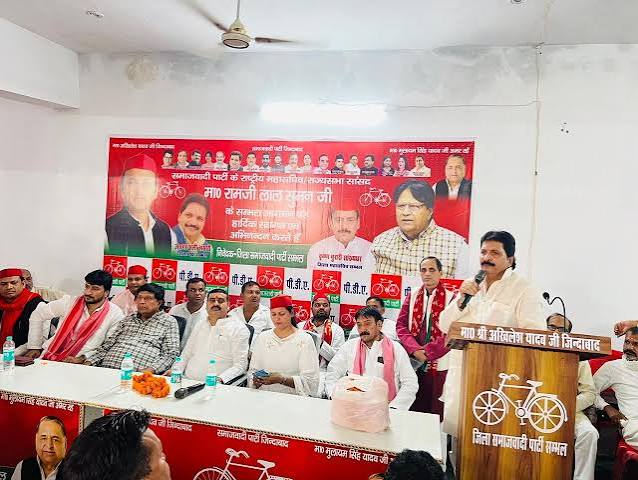
Samajwadi Party National General Secretary and Rajya Sabha MP Ramji Lal Suman arrived in Sambhal on Tuesday afternoon. He held a meeting with party workers at the SP district office located at Chandausi intersection in the Raisatti police station area. The meeting discussed preparations for the Western Uttar Pradesh Dalit convention scheduled for November 15th in Agra. Suman called on party workers to mobilize to make the convention a success. He stated that he is visiting various districts in Western Uttar Pradesh to contact workers. He claims that a climate of excitement is building among the Dalit community regarding the 2027 assembly elections, and the SP is being considered an option to defeat the BJP. Regarding the ongoing rhetoric regarding an alliance between the Congress and the SP for the 2027 assembly elections, Ramji Lal Suman stated that an alliance will be formed. He added that under the current circumstances, both parties should work together. He stated that the Samajwadi Party has authorized National President Akhilesh Yadav to negotiate the alliance. According to him, talks regarding the alliance will take place between Mallikarjun Kharge, Rahul Gandhi, Priyanka Gandhi, and Akhilesh Yadav. Suman appealed to leaders making statements regarding the alliance to exercise restraint. He said that such statements should not be made that could affect the alliance’s position. On the SP’s absence from the India Alliance meeting, he said, “There must have been a reason.” Regarding the SP’s absence from the India Alliance meeting in Delhi, Suman stated that the Samajwadi Party is part of the alliance. He stated that Akhilesh Yadav had stated his busy schedule and that a representative from the party had agreed to attend the meeting. Regarding the question about campaigning with Priyanka Gandhi and Dimple Yadav, he stated that the party leadership would decide where and with whom to campaign. Serious allegations leveled against the Chief Election Commissioner Regarding the question about Chief Election Commissioner Gyanesh Kumar, Ramji Lal Suman questioned the functioning of the Election Commission. He alleged that the Chief Election Commissioner had made decisions in favor of the BJP and said that the Samajwadi Party (SP) has long questioned the Commission’s impartiality. His statement comes amid reports that Election Commissioners Sukhbir Singh Sandhu and Vivek Joshi had raised objections to the Commission’s decisions and procedures at least 14 times in the past 10 months. The Election Commission responded by stating that the Commission’s decisions were made with the consent of all three Election Commissioners. Around 200 workers were present at the meeting. Around 200 workers, including SP District President Asgar Ali Ansari, Sambhal MLA’s son Suhail Iqbal, Gunnaur MLA’s son Akhilesh Yadav, former Chandausi candidate Vimlesh Kumari, District General Secretary Krishnamurari Shankhdhar, Syed Akhtar Israeli, Ajay Kumar, Munshi Wahid, and Councilor Mohammad Rehan, were present at the meeting. Sunny Gupta, Sambhal Courtesy: Hindi News
‘Why did Kumaraswamy’s family acquire land in NICE area?’ asks DK Shivakumar

Shivakumar said the NICE project should serve the interests of Mysuru, Mandya, Ramanagara and Channapatna and promote development in the region. BENGALURU: Karnataka Chief Minister DK Shivakumar on Tuesday launched a blistering attack on Union Minister for Steel and Heavy Industries HD Kumaraswamy over the NICE project, alleging that the latter was now raking up the issue after his own efforts to deal with the project had failed. Speaking to reporters in New Delhi, Shivakumar questioned why Kumaraswamy had remained silent on the NICE project all these years if there were serious irregularities, pointing out that his father, former Prime Minister HD Deve Gowda, had signed the NICE agreement and that Kumaraswamy himself had been CM when attempts were made to resolve issues relating to the project. “He himself tried to get it taken in the name of someone called Gandhi. He got the tender done, and the Supreme Court brought the tender matter to an end,” Shivakumar said, alleging that there had been several dealings connected with the project, including transactions in benami names. “Something went wrong in their dealings with them, and now the father and sons are doing all this,” Shivakumar thundered. Saying that Kumaraswamy was unable to tolerate the popularity of the Congress government, the CM said, “He has become very desperate… there is a big internal fight going on between him and the BJP.” Shivakumar said the NICE project should serve the interests of Mysuru, Mandya, Ramanagara and Channapatna and promote development in the region. Shivakumar also questioned the land holdings of Kumaraswamy’s family members within the NICE’s BMIC planning area. “Then why did all his brothers acquire land in it? Ask him,” he said. On Kumaraswamy’s claim that he could have resolved the NICE issue had his party won 134 seats, Shivakumar said the former CM had an opportunity to act when he was in power. “When he had power in 2007, he auctioned it and gave it to somebody else to acquire. Why couldn’t he do this through Nikhil Gandhi? There is a BJP government (at the Centre) now. Let them acquire it,” the Chief Minister said. On Kumaraswamy’s demand for stopping toll collection, Shivakumar said, “Let him go and tell Modi and stop all tolls in Bengaluru and across the country.” Shivakumar also rejected Kumaraswamy’s challenge to debate the issue on the steps of Vidhana Soudha, saying the matter could be discussed inside the Assembly. “Why settle it there? Ask him to come inside. Ask him to come inside the Assembly. Let us discuss it there. Let anyone resign as an MLC or resign from the Assembly and he come inside the Assembly and debate,” he said. ‘My properties are declared’ CM DK Shivakumar also hit back at allegations concerning his properties, saying their present market value could not be treated as evidence of wrongdoing. “Whether I have property worth Rs 1,400 crore or Rs 40 crore, it is there at today’s value. I am the son of a farmer, and I am a businessman,” Shivakumar said. He said his children also had the legal right to acquire property and conduct business. Shivakumar said all his assets had been declared before the Election Commission and other agencies. “If they want to bring some other big agency and examine it now, let them do so,” he said, questioning if KUmaraswamy is an IT officer. Referring to a site, he said former CM S Bangarappa had allotted to him. Shivakumar said he had purchased it for about Rs 99,000 and its value had now risen to around Rs 20 crore. “Did I take a bribe from anyone? No. Did I get involved in any scandal? Nothing at all. I have every right to do business. I have the capacity to make my children do business, and I have the capacity to acquire more,” Shivakumar said. ‘More stings may come’ On the alleged “AK-DK jugalbandi” narrative and the possibility of further allegations against him, Shivakumar said he expected more videos and audio recordings to surface. “Not Part One. One, two, three, four. There will be more stings, videos, audios, Artificial Intelligence and whatever else they have. I know whatever they have,” he said. On a Lokayukta complaint alleging irregularities of around Rs 444 crore in the allocation of two tenders involving minister Dr Yathindra Siddaramaiah, the CM dismissed the allegations. Courtesy : TNIE Note: This news is originally published on https:/thenewindianexpress.com/bha and is used purely for non-profit/non-commercial purposes, especially human rights