
Get favourable trade deal with US: Rahul to PM

NEW DELHI: Arguing that US tariffs are hurting the job-intensive textile sector and calling Indian economy as “dead”, Congress’ Rahul Gandhi Friday urged PM Modi to show “accountability” and secure a favourable trade deal with US. Posting on X a video of his visit to a textile factory in Haryana, Rahul said, “50% US tariffs are badly hurting India’s textile exporters. Job losses, factory shutdowns and reduced orders are a reality of our ‘Dead Economy’. PM Modi has offered no relief or even spoken about tariffs, even though more than 4.5 crore jobs and lakhs of businesses are at stake (sic).” He posted with the hashtag “TINA – there is no accountability”. Rahul said India has to secure a trade deal with US that puts Indian businesses and workers first, as he asserted that “PM Modi must not allow his ‘own weakness’ to impact the economy any further”. Courtesy : TOI Note: This news is originally published on https:/timesofindia.com/bha and is used purely for non-profit/non-commercial purposes, especially human rights
Upset over Rahul ‘snub’, Tharoor skips poll meet with Cong brass, goes for lit fest instead

NEW DELHI: Congress MP Shashi Tharoor did not attend the meeting of Kerala state leadership with AICC high command Friday amid reports that he is upset over a recent “snub”, even as the party stepped up planning for the upcoming state polls scheduled for mid-2026 and urged netas to put up a united fight. AICC chief Mallikarjun Kharge and Rahul Gandhi met important netas of the Kerala unit for discussion on poll campaign strategy and seat-sharing with allies. Among those who took part in the session were AICC general secretary K C Venugopal, special poll observer Sachin Pilot, senior neta Ramesh Chennithala, state president Sunny Thomas, LoP V D Satheesan, MPs Kodikunnil Suresh, Adoor Prakash, among others. However, Tharoor did not attend despite an invitation. The Thiruvananthapuram MP was in Kozhikode for Kerala Literature Festival where, sources said, he had a lecture scheduled on an important social reformer. Sources said he had informed the party about his inability to attend the meeting. However, Tharoor is said to be upset that Rahul did not acknowledge him while he mentioned other netas on the dais during Kochi “mahapanchayat” organised after UDF’s victory in local body elections. Tharoor is said to have told the party about his unhappiness about the “snub”. To media queries, party’s state incharge Deepa Dasmunshi denied that Tharoor was unhappy with Congress. The events before Kochi had suggested a thaw between Tharoor and the party, after the MP’s repeated statements and political stance over myriad issues had embarrassed the Congress brass. The repeated clashes between him and Congress had even triggered speculations that Tharoor was searching for political space outside Congress. For Kerala polls, Congress is also discussing the return of estranged ally Kerala Congress (Mani). The party has to decide whether MPs will be fielded in state polls, even as it is almost final that most of the MLAs will be repeated. A comfortable victory for UDF alliance over the governing Left bloc in the local body elections last month rekindled hopes about its prospects in the assembly polls. Courtesy : TOI Note: This news is originally published on https:/timesofindia.com/bha and is used purely for non-profit/non-commercial purposes, especially human rights
Congress dismisses defection buzz as state MLAs meet Kharge, Rahul

Patna/New Delhi: The Congress on Friday dismissed reports that its six newly elected MLAs in Bihar were on the verge of deserting the party, even as the legislators attended a closed-door meeting with the party’s top leadership in Delhi and were asked to step up public engagement across the state. The meeting, held at the residence of Congress president Mallikarjun Kharge, was attended by leader of opposition in the Lok Sabha Rahul Gandhi and general secretary (organisation) KC Venugopal, along with the six MLAs and senior leaders from Bihar. The interaction came amid speculation triggered by the delay in the appointment of the Congress legislature party (CLP) leader in the Bihar assembly and rumours of possible defections to the JD(U). After the meeting, Venugopal rubbished the speculation. “There were rumours that all our MLAs are deserting our party. But they were present in the meeting. These are all bogus news. These types of rumours being spread against the Congress are completely baseless,” he said. The high command also directed the MLAs and senior state leaders to actively take up both major and local issues of public concern and carry the party’s ideology directly to the people. This instruction was issued even as the decision on the CLP leader was deferred. “The matter related to the selection of the CLP leader was discussed at the meeting with the high command. It would be announced shortly by the high command,” a senior Congress lawmaker from the state, who attended the meeting, said. He added that the discussions were held in a “very cordial atmosphere”. Another party source said all six MLAs were present and each of them, along with MPs and MLCs, shared their views and concerns about the state unit. “None of the six MLAs absented themselves from the meeting,” the source said. Former state Congress chief Madan Mohan Jha said, “The participants returned happy and satisfied.” According to party sources, the meeting reviewed the assembly election outcome, organisational issues and the delay in naming the CLP leader, even as the budget session of the Bihar assembly is scheduled to begin from Feb 2. Rahul urged leaders to consistently raise people’s issues before the govt and return to the public, while Kharge stressed sustained mobilisation on the streets to rebuild the party in Bihar. Courtesy : TOI Note: This news is originally published on https:/timesofindia.com/bha and is used purely for non-profit/non-commercial purposes, especially human rights
We Must Not Choose Between “Caste” And “Civic sense”

Caste explains the moral history of filth in India; collective-action failure explains its daily reproduction Why are Indian streets so often strewn with litter? Why do so many of us treat public spaces with such complete disregard? I have wrestled with these questions for many years—both as an ordinary citizen and as a Dalit who has studied Indian society academically and also lived within its social hierarchies as a fact of everyday life. Suraj Yengde’s recent piece offers a straightforward answer to this larger question of cleanliness and civic sense—caste. His well-placed assertion is that caste has trained much of Indian society to outsource responsibility to others. Imagine cleaning as the “job” of a designated group of Dalits, and it becomes easier to treat mess as morally weightless and inconsequential. In this arrangement, filth becomes public, but shame becomes privatised—or made invisible altogether—and accountability is shifted to others. I agree with this completely. It explains why most Indians are meticulously clean inside their homes, but readily throw garbage where it doesn’t belong, showing little concern for what happens outside their gates. But my own life experiences push me toward a more complicated picture. Caste is indeed a necessary explanation for India’s sanitation order (or rather, disorder) and civic sense. Who cleans your streets first thing in the morning, whose labour is stigmatized, and who is considered “designated” to clean “our mess”? Caste explains this division of labour and the moral permission it creates. But it does not fully explain why public neglect persists and keeps reproducing itself, even in situations where caste hierarchy is not the immediate or visible operating mechanism. To understand the everyday stability of littering and disregard for public goods, we also need to see sanitation as part of a wider social logic of chalta hai—a low-trust environment in which individuals routinely assume that public rules will not be followed or fairly enforced and therefore feel it is “rational” to break them first. The result is not just a caste problem but a public-goods trap, one whose moral authority draws on caste but whose daily reproduction is driven by collective-action failure. Let me give a concrete example. A few years ago, I attended an Ambedkar Jayanti rally in Delhi. For most Dalits, this day carries the same importance as, if not greater than, a national holiday. It is a day to celebrate hard-earned dignity, equal rights, and an unfinished struggle. The atmosphere was highly charged, with blue flags everywhere, slogans of “educate, agitate, organise,” speeches, songs, and dancing, in an intense sense of community. But as the crowd dispersed toward the end of the day, the pride turned into embarrassment. The road along which the procession had moved was blanketed with trash of pamphlets, plastic water bottles, paper plates, cigarette butts, and everything a large crowd could throw on the street. After the programme concluded, volunteers started cleaning up. However, the irony was sharp enough to hurt. We had spent the day invoking a politics of dignity and ended it by turning a shared public space into a dumping ground. My first instinct was to reach for excuses. The crowd was huge. There were no dustbins. The municipality should have planned better. Where were people expected to dispose of the litter—in their pockets? But these explanations didn’t touch the deeper truth, which is that we had behaved like nearly every other large gathering in India. It was no different from a student political rally I attended at Delhi University, where roads were plastered with posters, or a public roadshow by any politician, big or small. We left the mess for “someone else” to handle. And that “someone else” was a sanitation worker from a Dalit community itself, which made the moment even more bitter. This episode doesn’t disprove Yengde’s point. It revealed something deeper and adjacent to it, and pushed me to extend this narrative further. Even those who don’t believe in any caste hierarchy or champion the cause of Dalits can still fall into the habit of treating public space as morally disposable. Oppression does not automatically produce better public conduct. It produces people living within the same social environment, responding to the same incentives, and absorbing the same norms. I saw the same logic at work in the South Haryana village where I grew up. Everyday life was full of small acts of rule-breaking, routinely justified as necessary or common sense. Until recently, illegal hookups to electric poles (in simple terms, electricity theft) were common to avoid bills, cutting across caste groups. Giving a small bribe, known as ghoos or bakshish, to a traffic constable to avoid receiving a challan was/is a common practice. Calling a “politically connected” person in the tehsil or any government office, for that matter, to get some paperwork done. Finding jugaad for everything, from land registry to marriage certificates to even securing a hospital bed in a big Delhi hospital. Then there were election-time “gifts,” usually liquor or cash, to secure votes. I don’t want to take this piece in the direction of petty corruption—that’s a topic for another day—but these are everyday ‘Indian things’ cutting across caste backgrounds. It is true that those in power are often upper caste, but given the chance, no Dalit is magically immune to this great Indian phenomenon. These examples, among thousands of others, point to something very uncomfortable, that is, public order in India is treated as negotiable across the board, and oftentimes rules are mere suggestions. People curse corruption and rule-breaking, and then participate in it when they benefit from it and the consequences are low. Over time, this arrangement becomes a learned equilibrium. You become part of a large machine whose wheels need constant greasing to keep it moving. Consider a telling parable from North India about a farmer (Annadata Kisaan). He might quietly pull a sugarcane from his neighbour’s field, yet loudly accuse others of stealing from his crop, forgetting that their fields lie just as close to his.
10 Army personnel killed in a heartbreaking accident in Doda… PM Modi, Rahul Gandhi, and Mallikarjun Kharge express grief

Ten soldiers were killed when an army vehicle fell into a deep gorge in Doda district. PM Modi, Leader of the Opposition Rahul Gandhi, Congress President Mallikarjun Kharge, and Priyanka Gandhi expressed their condolences over the accident. New Delhi: Prime Minister Narendra Modi, Leader of the Opposition Rahul Gandhi, Congress President Mallikarjun Kharge, and Priyanka Gandhi on Thursday expressed grief over the death of 10 soldiers in an accident in which an army vehicle fell into a deep gorge in Jammu and Kashmir’s Doda district. Expressing grief over the accident, PM Modi said that we have lost our brave army personnel. Their service to the nation will always be remembered. The PM prayed for the speedy recovery of the injured. He said that all possible help is being provided to those affected. An army vehicle fell into a deep gorge in Jammu and Kashmir’s Doda district on Thursday, killing 10 soldiers and injuring 11 others. Immediate need for road safety measures Congress President Kharge posted on the social media platform ‘X’ that he was deeply saddened by the tragic vehicle accident in Doda, Jammu and Kashmir, in which several army personnel made the supreme sacrifice and many others were injured. My deepest condolences to the bereaved families and loved ones. The nation stands united in profound grief, and we pray for the speedy recovery of the injured. He also said that many such accidents have occurred in the past. There is an urgent need to strengthen road infrastructure, improve mobility in difficult terrains, and implement road safety measures to prevent such heartbreaking losses. Rahul and Priyanka pay tribute to the martyrs Leader of the Opposition in the Lok Sabha, Rahul Gandhi, posted on ‘X’, “The news of the death of several of our soldiers and the injury of many others in the accident where an army vehicle fell into a gorge in Doda, Jammu and Kashmir, is extremely painful. I pay my humble tribute to the martyrs and hope for the speedy recovery of the injured soldiers.” He said, “In this hour of grief, we all stand with the bereaved families of our brave soldiers.” Congress General Secretary Priyanka Gandhi Vadra also expressed grief over the deaths of the soldiers. Priyanka Gandhi posted on ‘X’, “The news of the martyrdom of several soldiers due to the army vehicle falling into a deep gorge in Doda, Jammu and Kashmir, is extremely saddening. May God grant peace to the departed souls. My deepest condolences to the bereaved families. I pray for the speedy recovery of the injured soldiers.” Edited by: Anil Kumar About the Author Anil Kumar is part of the homepage team at Navbharat Times Digital. He has about 16 years of experience in both print and digital media. He has been associated with Navbharat Times Online since January 2021. He writes news and analysis related to politics and current affairs for the India and Delhi sections on the homepage. Courtesy: Hindi News
Follow the path shown by farmers to compel govt to withdraw G RAM G law, Rahul tells MGNREGA workers

New Delhi: Recalling how the “united resistance” mounted by farmer led protests forced the Central govt to roll back the three farm laws, leader of opposition Rahul Gandhi on Thursday called out to MGNREGA workers to take the path shown by the farmers by putting up a united fight to demand the withdrawal of the new law – Viksit Bharat – Guarantee for Rozgar and Ajeevika Mission (Gramin) Act.Referring to the BJP and the Central govt, Gandhi said, “Here is the only way to stop them, workers have been shown the way by farmers. I know these people, they are cowards. If we all stand together, they will be forced to restore MGNREGA,” he said, citing the example of farm laws. He was speaking at the ‘MGNREGA workers convention’ organised by the opposition party at Jawahar Bhawan in Delhi that brought together workers and activists from various states. Gandhi alleged the idea of BJP behind the new law that replaced MGNREGA was to dismantle “the “guaranteed right to work and right to demand work” and enable “centralisation” where the “Central government will decide where the money will be allocated, and naturally, the BJP-ruled states will get more and the Opposition-ruled states less”. “These people want to take India back to pre-independence days where one King used to decide everything,” he alleged. At the meet, Gandhi along with Congress President Mallikarjun Kharge and other senior leaders stood in solidarity with workers who shared their concerns and fears about the new law and raised slogans. Adorning the traditional labourer’s ‘gamchha’ on their head and holding spades on their shoulders, Kharge and Gandhi also posed with workers who in a symbolic gesture brought soil from their respective MGNREGA worksites and added it to tree saplings in what was seen to convey a message of unity and collective struggle. The Congress plans to build on the message by reaching out to gram sabhas and hold larger outreach programmes under its ongoing ‘MGNREGA Bachao Sangram”. Kharge alleged that the dismantling of MGNREGA by the Modi govt was part of a “conspiracy to erase Mahatma Gandhi’s name from public memory”and an attempt to turn the oppressed and downtrodden people of the country into “bonded labourers”. He said the party will raise the issue during the upcoming Budget session of Parliament. Gandhi claimed that scrapping of MGNREGA amounted to an attack on the Constitution, the same way the Modi govt had attacked it by bringing in “three black farm laws, demonetisation and the flawed implementation of the GST” and this new law now. “What is the name of this new law ….I don’t know,” Gandhi said. In response some in the audience spoke out saying “VB-G RAM G”. Courtesy : TOI Note: This news is originally published on https:/timesofindia.com/bha and is used purely for non-profit/non-commercial purposes, especially human rights
Don’t air internal issues in public: Congress warns Punjab leaders; no ‘group activity’ to be tolerated

NEW DELHI: The Congress on Thursday issued a stern warning to its Punjab leaders, asking them to stop airing internal differences in public or fuelling factionalism. The party asked them to instead work together to ensure Congress return to power in the upcoming 2027 assembly elections. The order came during a three-hour meeting convened by Congress president Mallikarjun Kharge at his residence in New Delhi, which was also attended by Rahul Gandhi, amid reports of infighting within the state unit, news agency PTI reported. Punjab goes to the polls in early 2027, and Congress is aiming to reclaim the state from the Aam Aadmi Party (AAP). Party leaders were asked to refrain from making statements against one another and were assured that there would be no immediate change in the state leadership. The high command, they were informed, would take decisions on candidate selection and campaign strategy in due course. AICC general secretary (organisation) KC Venugopal said Kharge and Gandhi reviewed the political situation in Punjab and heard the views of state leaders, describing the discussions as “very fruitful”. “The party has directed all leaders to refrain from making public statements on internal matters. Everyone may have their own views, but these should be raised only within party forums. Going to the media or spreading such issues on social media will not be tolerated,” Venugopal told reporters. He said the leadership had given a “very clear direction” and that all leaders present had unanimously agreed to it. On speculation about a leadership change in Punjab, Venugopal said there was “no question of it at present”. Addressing concerns raised by some leaders over representation of weaker sections, Venugopal said the Congress remained committed to ensuring adequate representation of Scheduled Castes, Scheduled Tribes, OBCs and economically weaker sections, including in Punjab. However, he stressed that such issues must be raised internally. “We have told the state leadership not to make statements in public. From tomorrow onwards, you will see the Congress united. We will fight the elections together and win Punjab,” he said. On reports of some leaders writing jointly to Rahul Gandhi seeking a separate discussion, Venugopal said individual requests were acceptable but “group activities” would not be tolerated. “If anyone wants to meet Rahul ji, they can write individually,” he said, adding that Kharge and Gandhi were planning a visit to Punjab soon. Courtesy : TOI Note: This news is originally published on https:/timesofindia.com/bha and is used purely for non-profit/non-commercial purposes, especially human rights
Kashi court summons Rahul over Sikh remarks

Varanasi: The court of Special Judge (MP-MLA) Yajuvendra Bikram Singh issued a notice to Leader of Opposition (LoP) in the Lok Sabha and Congress MP Rahul Gandhi, asking him to appear before it and record his statement for allegedly tarnishing India’s image with his remarks on freedom of Sikhs in the country, during his visit to the US. The court issued this notice on Tuesday, and it was sent through registered post to him on Wednesday, said Alakh Narain Rai, the lawyer of petitioner Nageshwar Mishra. The latter filed a revision petition before the court for legal action against the Congress MP, alleging that during his past visit to the US, he tried to tarnish India’s image by stating that the Sikh community did not have religious freedom in India. This posed a risk of civil war erupting. Rai said that initially this petition was moved before the court of Additional Chief Judicial Magistrate-IV (MP-MLA), where it was dismissed on Oct 17, 2025. After this, a revision petition was filed. Courtesy : TOI Note: This news is originally published on https:/timesofindia.com/bha and is used purely for non-profit/non-commercial purposes, especially human rights
A Battle for Survival: Rahul Gandhi Takes Charge of Bihar Congress, Creates a 4-Point Formula for Unity

Congress damage control mission – After the disappointing results of the 2025 Bihar Assembly elections, the Congress party has now embarked on a major struggle to save its existence. Amidst growing indiscipline within the party and discussions about all six MLAs switching sides, Congress MP Rahul Gandhi and National President Mallikarjun Kharge have taken charge. Patna: The national party Congress is not only disappointed with its electoral performance in Bihar these days but is also troubled by the extreme indiscipline at the organizational level. Congress leader Rahul Gandhi is going to personally lead the campaign to revitalize the state Congress. According to Congress sources, this is Rahul Gandhi’s damage control mission. This damage control mission, organized in Delhi, will include the six MLAs and some prominent leaders. When and where will it be held? According to information received from party sources, all six MLAs of the state Congress have been called to Delhi on January 23. This meeting has been organized at Indira Bhavan in Delhi. This meeting is considered very important for the Bihar Congress. Rahul Gandhi and Mallikarjun Kharge will be present in this important meeting. This meeting has been called to strengthen the organization in Bihar and to discuss the party’s future strategy. Why was the damage control mission started? In fact, Congress leader Rahul Gandhi had high hopes from Bihar. It was the increasing attraction of the Congress’s core vote base towards the party in Bihar that led the Congress to even claim to contest the elections alone. The results of the 2025 Bihar Assembly elections were shocking. The most disturbing news was that all six Congress MLAs were joining the JDU. In such a situation, the Congress would have no representation in the Bihar Assembly. The Congress, which has been fighting for public interest in the assembly, would then become a party confined to the streets. A lesson in discipline will be taught In this meeting, Rahul Gandhi’s role is going to be crucial. The ideal situation for the Congress and its accountability towards the public in today’s date will be determined. Programs will be planned against Narendra Modi’s government. Currently, the Congress party’s intention is that: 1. The six Congress MLAs remain in the party. 2. They remain united in the upcoming Rajya Sabha and MLC elections and follow the party’s policies. 3. Changing the name of MNREGA is an insult to Mahatma Gandhi. A protest strategy will be devised for both the streets and the legislature with this in mind. 4. In the upcoming session, they should oppose the negative actions of the government along with their Mahagathbandhan (Grand Alliance) partners and ask as many questions as possible. They should corner the government on issues requiring attention. Edited by: Ravi Sinha • Reported by: Ramakant Chandan About the Author Ravi Prakash Sinha is a Senior Journalist (Principal Digital Content Producer) at Navbharat Times Online. He has 25 years of experience in current affairs, Jharkhand-Bihar politics, and ground reporting. Ravi Sinha has been working with NBT (Digital) for the last 3 years. Courtesy: Hindi News
Rahul addresses Congress training camp in Kurukshetra, shares ‘Guru mantra’ with cadres
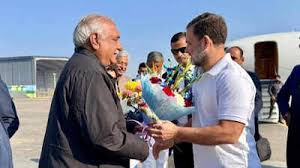
Kurukshetra: Leader of Opposition in Lok Sabha and senior Congress leader Rahul Gandhi on Wednesday addressed an organisation-building training camp of Congress district presidents from Haryana and Uttarakhand, held at Punjabi Dharamshala in Kurukshetra. He gave clear guidance as Guru Mantra (master’s guidance) on strengthening the party organisation in their respective states and enforcing discipline at all levels. Sources said that 33 Congress district presidents from Haryana and 27 from Uttarakhand attended the camp. Rahul stayed in Haryana for nearly 6 hours, from 10:30 am to 5:30 pm. He arrived in Kurukshetra at about 11:20 am from Ambala by road, and took off from Ambala at about 5:30 pm after attending the training camp. As per sources, Rahul Gandhi arrived in Kurukshetra in the same vehicle with former Haryana chief minister Bhupinder Singh Hooda, Rao Narendra Singh and AICC general secretary B K Hariprasad. Earlier, the three leaders, along with MP Deepender Singh Hooda, Ambala City MLA Nirmal Singh, and other senior leaders received Rahul Gandhi at the Ambala airport. On his return from Kurukshetra as well, Rahul Gandhi travelled with Hooda and Rao Narendra Singh. Sources privy to the camp said that during his address, Rahul Gandhi briefed all district presidents in detail about the Congress party’s history, ideology and future strategy. He urged them to work with full dedication, enthusiasm and commitment to strengthen the party, while taking proper guidance from the senior leaders. He also met the family members of the district presidents individually, who were specially invited by the Congress leader to talk to him if they wanted to say something. “Rahul ate lunch with district presidents and held separate discussions with them. Strict discipline was maintained at the training camp, and no media or other people were allowed inside. Rahul Gandhi also held discussions with Bhupinder Singh Hooda, Rao Narendra Singh and B K Hariprasad, during which he took detailed inputs on the political situation and ongoing developments in Haryana. He directed the state leadership to implement discipline within the party and the organisation with seriousness and strictness. He specifically instructed Bhupinder Singh Hooda and the state Congress president to take action against leaders indulging in anti-party statements and activities. In an indirect but clear message, Rahul Gandhi also cautioned those leaders who were not participating wholeheartedly in programmes announced by the party high command,” said a source. The district presidents, in their interaction with Rahul Gandhi, provided feedback regarding state leaders. They pointed out that frequent irresponsible statements by certain leaders damaged the Congress, while benefiting the BJP. The district presidents emphasised that it was essential to curb such statements in the larger interest of the Congress. Sources said that Rahul told district presidents, “The prevailing empire of corrupt power poses a major challenge,” but stressed that party workers must confront these challenges with courage and further reinforce the organisation. “No one can suppress your voice because a strong organisation like the Congress stands with you. You are capable and empowered. There is no need to take decisions under pressure—work independently. We will periodically assess your progress and continue to provide guidance and support whenever required,” Rahul said. A district president who joined the training said, “District presidents of Uttarakhand and Haryana were called for a meeting. Families of district presidents were also called, and Rahul Ji held individual meetings with them. During the training session, we ate lunch together. A group discussion on how to strengthen the party and organisational structure was also held.” “Rahul Ji gave instructions to take forward policies of the party to every household and also to give respect to every party worker. He directed that the district presidents and party workers should hold more meetings with the general public, rather than party leaders,” said a district president. Congress MPs Kumari Selja, Randeep Singh Surjewala, Deepender Hooda, Uttarakhand chief Ganesh Godiyal, co-in-charges Jitendra Baghel and Prafulla Gudde were present. Courtesy : TOI Note: This news is originally published on https:/timesofindia.com/bha and is used purely for non-profit/non-commercial purposes, especially human rights