
Respect the courtesans…because they sacrificed their lives in the freedom struggle.
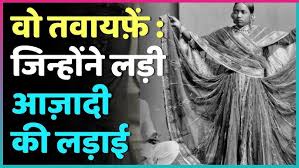
◆ Yesterday, Modi issued a 100₹ coin for the RSS. If the coin had been 60₹, it would have been a tribute to Savarkar. ◆ But those courtesans gave more importance to India’s freedom and sacrifice than gold coins. Husna Bai, Varanasi (1920-22) organized the “Tawaif Sabha” She joined the freedom struggle by making a turban. Azizan Bai fought the British in the 1857 Kanpur revolt, disguised as a man, riding a horse and carrying a gun. Nehru called Azizan Bai a martyr. Gandhi himself gave Gauhar Jahan the task of raising money for the “Swaraj Fund.” Gauhar Jahan donated ₹12,000 for the freedom struggle. Vidyadhar Bai, Varanasi, after meeting Gandhi, began every mujra with patriotic songs. She used to do it… A group of courtesans came to meet Gandhiji in Barishal, Kankinada (Bangladesh) and were inducted into the Congress. They used to take out street protests… ◆ Modi and the RSS will not be able to wash away the stain of treason even in the next 10 million years… Even Lord Ram himself could not erase the stain of Vibhishana’s treachery… ◆ Because Vibhishana was a devotee of Ram, but not a patriot… There is no greater religion than patriotism… and there is no greater sin than betrayal of the country. ◆ As long as the universe exists, the martyrdom of every martyr of India will continue to bear testimony to the treachery of the RSS. Even if millions of coins are issued, it will make no difference. It is impossible to write the entire history of the sacrifices of the courtesans of that era in one post. Today, on the holy day of Vijayadashami, I salute every martyr. Those who sacrificed their lives for India’s independence… Jai Hind, Jai Hind, Jai Hind. Courtesy : Justice News
“One Step with Gandhi”
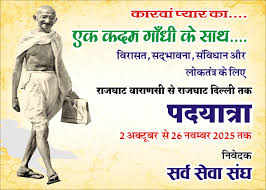
Sarva Seva Sangh’s Padyatra from Varanasi Rajghat to Delhi Rajghat Despite heavy rain, the padyatras continued to move forward, getting drenched. October 3, 2025. Banaras: After a night’s rest at Saraswati Mahila PG College, Banaras, the padyatras departed for their next stop, Nagpur, at 8 a.m. Around 100 padyatras from 16 states marched ahead with songs and slogans. While walking along the highway, they distributed pamphlets and detailed information about the padyatra’s objectives. It had been raining heavily since morning, but the padyatra’s morale remained undeterred. Despite the drenching, they continued to move forward. At 12 noon, the padyatras reached Rohaniya Chowk, where they were given a grand welcome by the locals. Rohaniya Chowk was also home to the famous Gandhi Chabutra, which had been demolished by the government in the name of road expansion and has not been rebuilt yet. The marchers then reached Daudpur village, where a meeting was held, where, in addition to the organizers, several marchers also shared their views. The marchers explained that this march was undertaken with the aim of building a new India and a new world. They said that the values for which our freedom fighters fought are facing numerous challenges today. At such a time, this march is moving forward with a resolve to strengthen democracy, the Constitution, goodwill, and our liberal traditions. Local residents reported that farmers’ land was taken for the international cricket stadium under construction, but they were not given adequate compensation. Now, the government is destroying farmers’ ancestral villages to build a sports village, rendering them homeless, causing anger and ongoing protests. Madhav Bavare, president of the Maharashtra Andhashraddha Nirmulan Samiti, addressed the gathering and provided detailed information about the organization’s work. He explained that the committee has been working for a long time to promote scientific consciousness and combat the hypocrisy spread in the name of religion. He said that there are similarities between the ideas of Gandhi and Dabholkar. A female member of his organization said that superstition has the greatest impact on women. Therefore, his organization is constantly working to spread awareness and empower women. The village women played a significant role in the event. They collected donations to arrange food for the pilgrims. All the local women were honored by the pilgrims. The rain continued, but the pilgrims continued their journey with the slogan, “We will walk with one step of Gandhi, we will walk.” Later that night, the pilgrims arrived at the Lok Samiti Ashram, Nagpur, Raja Talab, where they rested for the night. Pedestrians and associates from 16 states across the country have joined this journey. Fellow padyatris from Tamil Nadu, Kerala, Karnataka, Andhra Pradesh, Telangana, Rajasthan, Uttar Pradesh, Bihar, Odisha, Assam, Tripura, Madhya Pradesh, Gujarat, Jharkhand, Maharashtra, and West Bengal are included in the group. Chandan Pal, President of the Sarva Seva Sangh, Ramdhiraj, President of the Uttar Pradesh Sarvodaya Mandal, Arvind Kushwah and Arvind Anjum, Ministers of the Sarva Seva Sangh, Ashok Bharat, Coordinator of the Sarva Seva Sangh Publications, Bhupesh Bhushan, Coordinator of the Youth Wing, Mihir Pratap Das, President of the Orissa Sarvodaya Mandal, and Nandlal Master, Coordinator of the Padyatra Organizing Committee, Dr. Somnath Rode, former Coordinator of the Sarvodaya Samaj, Sarita Behen of Vinoba Ashram, Gagoda, Shivji Singh of the Bihar Lok Samiti, Sushil Kumar of the Democratic Nation Building Campaign, Sachin of the National Youth Organization, Dr. M.H. Patil from Karnataka, Pavithran, Treasurer of the Kerala Sarvodaya Mandal, Diwakar, Srinivasan and A.R. Palanisamy from Tamil Nadu, Khadar Baig from Telangana, Rashmin Rathod from Gujarat, Jainul from Tripura, Shyamdhar Tiwari of Satyamev Jayate, Jiten Nandi and Kajal Mukherjee from West Bengal, and others participated. Manisha Banerjee, Jagriti Rahi, Anup Shramik, Vidyadhar, Jokhan Yadav, Sister Florine, Nidhi, Siraj Ahmed, Antaryami Baral, Jagdish Kumar, T.K. Sinha, Anokhelal, Chaudhary Rajendra, Suresh Yadav, politicians from the Jai Kisan Andolan, Sanjay Kumar, Rabia Begum, Gaurav Purohit, Priyesh Pandey, Vivek Yadav, Vivek Mishra, Saurabh Tripathi, Indu Pandey, Asma Adivasi, Diwakar Singh, Vikas Kumar, Pankaj Srivastava, Gopal RTI, farmer leader Ishwar Chandra Tripathi, social activist Ishwar Chandra, and others participated. Amit, Ramvachan, Asha, Soni, and Mainav were among those from the Lok Samiti. Courtesy : Justice News
NDA flays Rahul for ‘democracy in danger’ remark in Colombia
Patna: The ruling NDA in Bihar reacted sharply to Congress leader Rahul Gandhi in Colombia that democracy is in danger in India. BJP and JD(U) leaders accused him of being antinational in his lust for power. JD(U) national executive president and MP, Sanjay Kumar Jha, said, “While opposing a party or its leaders, they (Congress) end up opposing the country itself.” Addressing the students at EIA University in Colombia, Rahul Gandhi said the GoI policies of demonetisation and GST were designed to harm medium and small businesses. Uttar Pradesh deputy CM and BJP Bihar election co-incharge, Keshav Prasad Maurya, said Congress has become a psychopathic party with “Modi phobia”. He accused Rahul Gandhi of being desperate for power and making statements at the behest of antinational forces. Patna Sahib MP Ravi Shankar Prasad flayed Rahul for his statement that there is no democracy in India and people don’t have the freedom to speak. “If you go abroad and insult India, the public will not vote for you and you will not win the seats that you won this time. Now you’re praising China, saying India can’t become a major global power, but China can lead the world…Today, India is the world’s fourth largest economy and is on its way to becoming the third. You never miss an opportunity to insult India. We strongly condemn this,” he said. Courtesy : TOI Note: This news is originally published on https:/timesofindia.com/bha and is used purely for non-profit/non-commercial purposes, especially human rights
‘Confiscate diplomatic passport’: Nishikant Dubey hits out at Rahul Gandhi over Colombia speech; calls remarks ‘baseless’
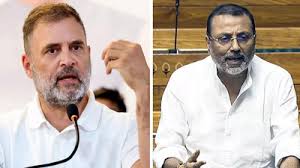
NEW DELHI: BJP MP Nishikant Dubey on Friday demanded that Congress leader Rahul Gandhi’s diplomatic passport should be confiscated and legal action initiated. This comes after Gandhi’s visit to Colombia, where he accused the BJP-led central government of mounting a “wholesale attack on Indian democracy” during an interaction at EIA University. Congress leader claimed that India’s diversity of religions, traditions and languages requires space for dialogue. Gandhi added that the democratic system is the best way to ensure this. According to him, the government’s actions are undermining this system and threatening the democratic fabric of the country. Dubey alleged that Gandhi makes baseless statements abroad criticizing the Indian government. The BJP leader claimed that Gandhi’s speeches on the Constitution and government policies were comparable to remarks made by controversial figures abroad. Speaking to reporters, BJP MP said: “Rahul Gandhi goes abroad and speaks at length about the Constitution and makes baseless statements against the Indian government. This is similar to what Zakir Naik is saying from Malaysia, and Khalistan terrorist Pannu from Canada and the US.” “I think the time has come for his diplomatic passport to be confiscated and legal action should be taken against him,” he added. — ANI (@ANI) Dubey also criticized Congress for opposing the arrest of climate activist Sonam Wangchuk, who was detained under the National Security Act in connection with the recent Leh violence in Ladakh. He alleged involvement of a “foreign power” behind Wangchuk’s activism and highlighted that Prime Minister Narendra Modi had fulfilled Ladakh’s long-standing demand for Union Territory status. The BJP MP further slammed the Congress for historical actions during the Emergency, citing the imprisonment of former BJP leader Rajmata Vijaya Raje Scindia and 82-year-old freedom fighter and former Andhra Pradesh Governor Bhim Sen Sachar. In a post on X, Dubey has also accused the party of hypocrisy. He said that Congress now sheds “crocodile tears” for those arrested in Leh while having previously persecuted political opponents. — nishikant_dubey (@nishikant_dubey) Dubey also pointed out that while Congress speaks about women’s rights and democracy, the party’s actions during the Emergency told a different story. Rajmata Vijaya Raje Scindia and Maharani Gayatri Devi were imprisoned and harassed and 82-year-old Bhim Sen Sachar was also sent to jail. Senior Congress leaders, including Rahul Gandhi, have urged the Centre to hold talks with the people of Ladakh, calling for a fair judicial inquiry into the violence that claimed four lives. Gandhi highlighted the case of a soldier’s son among the victims, demanding justice and condemning the government’s actions. Sonam Wangchuk is currently lodged in Jodhpur Central Jail following his detention under the National Security Act. Courtesy : TOI Note: This news is originally published on https:/timesofindia.com/bha and is used purely for non-profit/non-commercial purposes, especially human rights
Rahul Gandhi is not Ram… What angered Mulayam Singh Yadav’s younger daughter-in-law just after Dussehra?
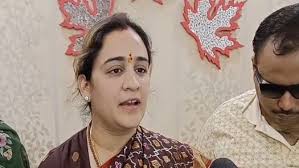
UP News: In Bulandshahr, BJP leader Aparna Yadav called for teaching the history of the RSS in universities. She supported strict action against rioters and Pakistan supporters in the Bareilly violence. She also hit back at a banner depicting Rahul Gandhi as Ram. Varun Sharma, Bulandshahr: A major statement has been made by BJP leader Aparna Yadav in Bulandshahr, Uttar Pradesh. She said that the history of the RSS should be taught in every university in the country so that the new generation can gain accurate knowledge of the organization’s contributions and working methods. Reacting to the Bareilly violence, Aparna Yadav said that the government has taken the right action against the rioters. She sternly stated that those who support Pakistan while living in India will not be spared under any circumstances and that the strictest action will be taken against them. Aparna Yadav also hit back at a banner at the Lucknow Congress office depicting Rahul Gandhi as Ram. Aparna Yadav’s statement Aparna said that Congress leaders consider themselves to be Ram, but in reality, they are making statements against India and tarnishing the country’s image. She sharply stated that Rahul Gandhi is merely engaging in “Pappugiri” and has nothing to do with the ideals of the real Ram. When questioned about the “I love love” slogan, Aparna Yadav clearly stated that it is a religious matter and every person in India has complete freedom to practice their religion. Regarding forming a government She said that our country cannot be run by one religion, because India is a secular country where every religion is respected. Expressing her views on the political future, Aparna Yadav claimed that the BJP will form the government in Uttar Pradesh with an absolute majority in the 2027 assembly elections. Edited by: Vishal Choubey About the author Vishal Choubey is a journalist at Navbharat Times Online. Vishal Choubey covers politics, crime, governance, and other issues in Uttar Pradesh and Uttarakhand. Vishal studied journalism at Lucknow University and has three years of experience in journalism. Courtesy: Hindi News
SC slaps Rs 5 lakh fine on Delhi PWD for engaging manual sewer cleaners, including minor, outside its premises
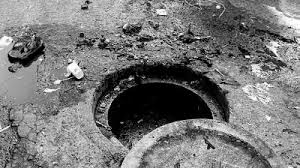
The bench, while observing that its October 2023 directions had been flouted, warned directing FIRs against the erring officials upon future violations. NEW DELHI: The Supreme Court on Thursday imposed a Rs 5 lakh fine on the Delhi government’s Public Works Department (PWD) for engaging manual sewer cleaners, including a minor, right outside the top court in violation of its orders prohibiting the practice. A bench comprising Justices Aravind Kumar and N V Anjaria expressed displeasure at the PWD’s response, following reports that labourers without protective gear were made to manually clean drains outside Gate F of the top court. The bench, while observing that its October 2023 directions had been flouted, warned directing FIRs against the erring officials upon future violations. “It would be reasonable to impose a cost for having undertaken such work as evidenced from the photographs annexed with this application. Hence, we direct PWD to deposit the sum of Rs 5 lakh to the National Commission for Safai Karmacharis within four weeks,” the top court directed. In a word of caution, the top court maintained not only those from the PWD but other officials needed “to wake up from slumber” to ensure compliance of its directions “in letter and spirit”. “We make it clear that in the event of recurring, this court would be compelled to direct registration of FIR under the BNS and the BNSS.” Senior advocate K Parameshwar, assisting the bench as an amicus curiae, said the incident clearly reflected a disregard for the court’s binding directions. He pointed out that video evidence had documented the involvement of a minor and that specific details of those forced into manual work had been provided. “The minor was engaged, and it’s specifically recorded in the video. A police complaint was sought to be lodged at Tilak Marg station but neither the police nor the PWD took appropriate action. This is not merely a labour law violation rather it is a breach of constitutional obligations. Let the fine be recovered from the officers themselves,” he said. The bench, in its order, referred to its directions issued on October 20, 2023 and did not agree to the submissions of the PWD counsel that it was only de-silting the covered drains for the purpose of keeping in mind the ensuing monsoon and the officials were not at fault. The top court, however, said, “In respect of the incident at Gate F and B of the Supreme Court of India, the drains have been constructed, and for desilting the said drain, the PWD has engaged the services of contractors who are said to have acquired labourers without safety gears. There is no doubt that the agreement entered into by the contractor with the PWD would mandate that the contractor should provide safety gears and prohibit the engagement of labourers under 18 years of age.” “The orders issued by this court by order October 20, 2023 seem not to have percolated, in other words, have been consciously ignored,” the top court said. The bench continued, “We have said this for more than one. Firstly, the affidavit in reply filed by PWD does not disclose that there have been serious steps taken either to warn the contractors for undertaking, or having undertaken the work, or entrusting the work without the use of protective gears.” “Secondly, the top court said no steps were taken either to put the contractor under notice or to issue any notice for blacklisting. This clearly indicates that the officials seem to be dragging their feet,” it said. The bench said it had made it explicitly clear that in the event of an untoward incident, the court would direct registration of FIR against the concerned officials. “At this stage, we detest from doing so for a simple reason that no incident has occurred and to ensure that neither the officials nor the contractor appointed by them allow the worker to enter the drain or soft water drain or sewer without protective gear,” it said. The bench had taken note of photographs showing manual scavenging and hazardous cleaning being done at one of the gates of the apex court. The top court was dealing with applications filed in a public interest litigation, which has raised the issue of manual scavenging. Courtesy : TNIE Note: This news is originally published on https:/thenewindianexpress.com/bha and is used purely for non-profit/non-commercial purposes, especially human rights
Odisha Cabinet approves 10-hour shifts; allows night shifts for women
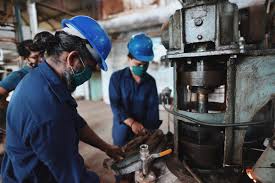
The overtime work limit has been increased from 115 hours to 144 hours every financial quarter. The Odisha government on Monday (September 29, 2025) increased the daily working hours to 10 hours, subject to a 48-hour weekly cap. It also allowed women in private establishments to work night shifts subject to their written consent. The Cabinet, chaired by Chief Minister Mohan Majhi, approved an amendment to the Factories Act, 1948, aimed at promoting industrial investment and creating more employment opportunities. “The State government has extended the total number of hours of work without an interval to six hours and increased the spread over up to 12 hours inclusive of intervals for rest,” read the official statement. “Where a worker works for more than the prescribed hours, they would be entitled to wages at the rate of twice their ordinary rate of wages for overtime work,” it added. Moreover, the overtime work limit has been increased from 115 hours to 144 hours every financial quarter. “Women can be employed in all factories for all types of work. They may also be employed before 6 a.m. and beyond 7 p.m. with their written consent,” the government said. These reforms are expected to attract new investments, enable factories to meet peak demand and increase productivity, the government said. Development of model schools In another significant decision, the Cabinet approved the development of model schools under the Godabarisha Adarsha Vidyalaya (GAV) scheme at the gram panchayat level, with a focus on inclusive and quality education. Aligning with the objectives of the Right to Education (RTE) Act, 2009, the GAV scheme aims to ensure equal access to education and holistic development of the student community. “This initiative is in line with the vision of the National Education Policy (NEP), 2020 and the NIPUN Odisha scheme, and places a special focus on enhancing foundational literacy and numeracy skills to empower children socially and educationally,” the statement added. In the first phase, spanning three years (2025-26 to 2027-28), a total of 2,200 model schools will be constructed with an estimated outlay of ₹12,000 crore. Satyasundar Barik Courtesy : The Hindu Note: This news is originally published on https:/thehindu.com/bha and is used purely for non-profit/non-commercial purposes, especially human rights
Poverty biggest trigger for suicides, lack of education a catalyst – report
There are wide regional variations when it comes to suicides. While Kerala tops the list at 30.6 per lakh population, Bihar has the lowest suicide rate in the country at 0.7.But one factor stands out sharply: income. A vast majority of victims came from households earning less than Rs 1 lakh a year, showing how poverty and financial insecurity push people to the edge. The less educated are also more vulnerable. More than four in five victims had not studied beyond higher secondary school. Men in their 30s and early 40s were the most affected, while among women the highest toll fell on those aged 18 to 30. Strikingly, among children under 18, more girls died by suicide than boys, as opposed to the trend visible in every other age group. Courtesy : The Times of India Note: This news is originally published on https:/timesofindia.com/bha and is used purely for non-profit/non-commercial purposes, especially human rights
Success will come through innovation, not collusion… Rahul Gandhi impressed by ‘Our Bajaj’ in Colombia
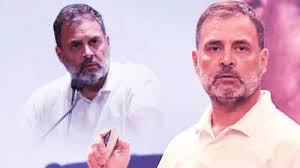
Former Congress President Rahul Gandhi is on a four-nation tour of South America today. He has posted on X-Ray after seeing the charisma of Indian bikes on the streets of Colombia. Rahul Gandhi has been accusing the Modi government of working for a few capitalists. Former Congress President Rahul Gandhi New Delhi: Former Congress President Rahul Gandhi says that Indian companies can achieve success through innovation, not crony capitalism. He made this statement in a post on X-Ray, referring to two-wheelers from some Indian companies on the streets of Colombia. Rahul Gandhi is currently on a four-nation tour of the South American continent. He has been accusing the Modi government of working for a few capitalists. Sharing a photo of a Bajaj Pulsar motorcycle in Colombia on X-Ray, Rahul Gandhi said, “I am proud to see Bajaj, Hero, and TVS performing so well in Colombia.” This demonstrates that Indian companies can achieve success through innovation, not crony capitalism.’ South America is a major market for Indian motorcycles. In 2024, India exported motorcycles worth $1.5 billion there. This represents 46% of India’s total motorcycle exports. The Charm of Indian Bikes After Mexico, Colombia is the second-largest market for Indian motorcycles in South America. Guatemala, Brazil, Argentina, Peru, and Honduras are also important markets for Indian motorcycles. In addition to South America, Indian motorcycle companies have also made a splash in Africa. China and the United States once dominated the region, but Indian companies have now overtaken them. Indian bikes are comparable in quality to American motorcycles, while their prices are comparable to Chinese motorcycles. This is why they are so popular in Africa. Rahul Gandhi, speaking at a dialogue program held at EIA University in Medellin, Colombia, on Thursday, claimed that the democratic system in India is currently under widespread attack, but that this is a significant risk that the country must overcome. He also said that it is important for the country to allow diverse traditions to flourish, as we cannot follow China, where people are oppressed and an authoritarian system is run. Curated by: Dil Prakash About the Author Dil Prakash is an Assistant Editor at Navbharat Times Digital. He has been associated with journalism for over 20 years, covering a wide range of topics, including sports, politics, Parliament, defense, and business. Dil Prakash has been with NBT Digital for over five years. He previously worked at Univarta and Business Standard. He also worked as an outside contributor at the BBC. Dil Prakash holds a PG Diploma in Journalism from the Bharatiya Vidya Bhavan Institute of Journalism in New Delhi. Courtesy: Hindi News
October 2nd Special: Gandhi and Ambedkar’s Clashing Thoughts – Find Out Which Ideas Could Never Be Consensual?
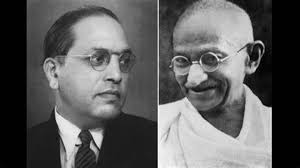
Gandhi and Ambedkar: A Clash of Ideas That Gave a New Direction to Indian Society India’s freedom movement is filled with the ideas and struggles of great leaders. Among them, Mahatma Gandhi and Dr. Bhimrao Ambedkar are two figures whose contributions cannot be forgotten. Gandhiji showed the path to freedom through truth and non-violence. Dr. Ambedkar championed the rights of the weaker sections of society. Both aimed to improve India, but their views differed on many issues. This led to frequent disagreements. Gandhiji is remembered as the “Father of the Nation,” while Dr. Ambedkar is considered the “Father of the Indian Constitution” and the voice of the Dalit community. Their disagreement wasn’t just a personal one; it concerned social order, social justice, and political rights. Today, on October 2nd, as we celebrate Gandhi Jayanti, it’s important to understand the ideas on which Dr. Ambedkar disagreed with Gandhi. Differences on the Caste System Gandhi believed in the fundamental unity of Hindu society. He believed that untouchability and discrimination could be eradicated by reforming Hinduism. Gandhi initiated the Harijan movement and declared that untouchables were also children of God. However, Dr. Ambedkar was not satisfied with this approach. He believed that the caste system was deeply rooted in Hinduism and could not be changed by reforms. Ambedkar wanted complete freedom for Dalits from the caste system. According to him, simply labeling them “Harijans” would not solve the problem. Dalits need equal rights and social justice. Dr. Ambedkar argued that abolishing the caste system was the only solution. Gandhi, on the other hand, emphasized reform and brotherhood. This was a major reason why their paths diverged. Disagreements on Religion and Social Reform Gandhiji sought to bring about social change through religion. For him, Hinduism was a matter of tradition and faith. He carried the messages of the Gita and the Ramayana to the people. He believed that only morality and virtue could reform society. Dr. Ambedkar differed from this thinking. He prioritized reason and social justice. According to him, religion is useful only as long as it promotes equality and freedom. If religion promotes exploitation and discrimination, it should be abandoned. For this reason, he ultimately embraced Buddhism. It is clear here that Gandhiji favored religious reform, while Ambedkar believed in pursuing a religiously distinct path. Untouchability and the Term Harijan Gandhiji began calling the Dalit community “Harijan,” meaning people of God. His intention was to show respect. However, Dr. Ambedkar did not consider this a real solution. He argued that simply changing the name would not solve the problem. Dalits need social, economic, and political equality. Ambedkar wanted Dalits to have the right to their own identity. He considered the term “Harijan” a patronizing approach. It seemed to show pity rather than eliminate discrimination. This very idea led to a deep disagreement between the two. Political Rights and Separate Electorates The biggest conflict between Gandhiji and Dr. Ambedkar occurred in 1932. This is known as the Poona Pact. The British government proposed giving Dalits separate electorates, meaning they could choose their own representatives. Ambedkar was in favor of this decision. He believed that separate representation would ensure the voice of Dalits was heard in politics. However, Gandhiji was against this decision. He felt that it would divide Hindu society. In protest, Gandhiji went on a hunger strike. A compromise was reached with great difficulty. Under the Poona Pact, Dalits were given reserved seats, but not separate electorates. Dr. Ambedkar was unhappy with this compromise, but was forced to accept it. This incident deepened the differences between the two leaders. Differences on Economic Outlook Gandhi believed in simplicity and village self-rule. He believed that if villages were self-reliant, the country would become strong. He did not support big industries. Dr. Ambedkar’s thinking was completely different. He believed that only modern industry and urbanization would lead to social development. According to him, caste-based exploitation and backwardness were only strengthened in villages. Therefore, he emphasized industry, education, and urban infrastructure. Thus, their economic outlook also differed. Differences on the Importance of Education Gandhi valued the spinning wheel, handicrafts, and vocational education. He believed that rural craftsmanship and labor would create a self-reliant society. Ambedkar believed that higher education was the most powerful weapon for achieving social equality for Dalits and backward classes. He advocated, “Educate, organize, and fight.” He wanted the poor and oppressed to rise above modern education. Here too, there was a significant difference in their perspectives. Non-violence vs. Struggle Gandhi’s entire political landscape was based on non-violence and Satyagraha. He believed that only moral strength could change those who perpetrate injustice. But Ambedkar’s thinking was realistic. He believed that eliminating oppression and exploitation through non-violence alone was difficult. Organized struggle for rights was essential. Therefore, Ambedkar created social and political movements. This difference is clearly reflected in their perspectives. Differences on the Definition of Equality Gandhi’s goal was to establish harmony and brotherhood in society. He considered freedom from discrimination a major achievement. For Ambedkar, true equality meant equal participation in education, employment, and politics. He would only be satisfied if the Dalit community received rights and opportunities. Merely demonstrating solidarity would not achieve this objective. What was the outcome of these disagreements? Mahatma Gandhi and Dr. Ambedkar disagreed on many issues. But these disagreements were not detrimental to India. Rather, they strengthened democracy. Gandhiji showed the path of non-violence, morality, and reform. Dr. Ambedkar fought for rights, equality, and justice. Today, independent India stands on a balanced framework because of these two. On one hand, Gandhiji’s spiritual and moral ideology, on the other, Ambedkar’s approach based on logic and justice. The contributions of both are invaluable to Indian society. Remembering Gandhiji on October 2nd, we must also understand the weaknesses that a great man like Dr. Ambedkar pointed out. Disagreement is the true strength of democracy. This legacy of Gandhi and Ambedkar teaches us that despite differing opinions, national interest must be paramount. Rajan Chaudhary Courtesy: Hindi News