
Cong Using Tribal Students’ Stir to ‘Relaunch’ Rahul Gandhi: Bawankule
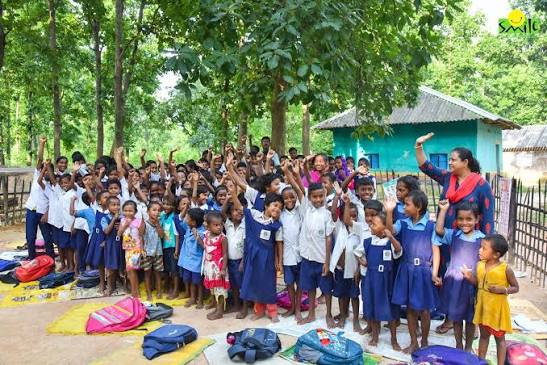
Nagpur: Revenue minister Chandrashekhar Bawankule on Friday accused Congress of attempting to use an agitation by tribal students as a political launchpad for leader of opposition in Lok Sabha Rahul Gandhi in Maharashtra. He alleged that Congress was keeping the protest alive for political reasons even as the govt has given assurances to students over their demands. Gandhi, during his “Chhatron Ki Goonj” interaction in Pune on Aug 22, publicly backed the tribal students’ agitation in Maharashtra. In a letter written to CM Devendra Fadnavis, he raised several of their demands. “The state govt has discussed the issues of students and is ready to engage with them repeatedly, if necessary. But why insist on continuing the agitation when the issues are moving towards resolution?” he said. The minister alleged that Congress was seeking to sustain the agitation until Gandhi’s next tour of Maharashtra, using the students to build a political narrative around their demands. “Maharashtra would not accept tribal students being drawn into such an exercise,” he said. As per Bawankule, political parties should not use educational concerns as a vehicle for political mobilisation. He said the immediate priority should be resolving issues affecting students rather than extending an agitation for partisan purposes. “This is like playing with the future of tribal students,” he said. The Nagpur and Amravati district guardian minister maintained that the administration had already moved beyond assurances by taking decisions on the demands raised by the students. He also sought to draw a political contrast between the govt’s approach and that of Congress. “The administration led by chief minister Devendra Fadnavis was working to expand facilities and educational opportunities for tribal students. Their academic future should remain at the centre of the issue,” he said, adding, “Congress appears more worried about saving the political careers of its leaders than those of students.” Bawankule urged Congress to engage with the govt directly if it wanted to pursue unresolved issues concerning the tribal community. Rather than turning students into participants in a political confrontation, he said, the party should help create conditions for negotiations and resolution. Courtesy : TOI Note: This news is originally published on https:/timesofindia.com/bha and is used purely for non-profit/non-commercial purposes, especially human rights
From India to America: How Caste Discrimination Followed the Diaspora

Jana Eid explores how the Indian diaspora brought caste discrimination to the U.S. and highlights the growing legal and social movement to outlaw it. Caste and caste discrimination are no longer limited to India. The system has followed the Indian diaspora across the globe, including to the United States. Today, Indian Americans represent one of the largest and fastest-growing immigrant communities in the country; in 2022, the U.S. Census Bureau recorded more than 6.5 million people of South Asian descent residing in the U.S. Many Dalits who moved to America to escape persecution found that the very system that caused them to leave was also embedded within various domestic institutions, primarily the workforce. Equality Labs, a South Asian civil rights organization, released a report in 2018 titled Caste in the United States, revealing that 67% of Dalit respondents felt they were treated unfairly at an American workplace due to their caste. Approximately 12,000 Dalits responded to the survey, with 41% stating they experienced discrimination in education and 25% reporting they had been physically assaulted in the U.S. because of their caste. While respondents hailed from an extensive range of fields, the tech industry has garnered the most public outcry. Major technology employers, including Cisco Systems, Inc. in Silicon Valley and Google, have come under scrutiny for enabling discrimination by higher-caste employees who predominantly occupy senior-level, higher-paying positions. In July 2020, the California Civil Rights Department filed a lawsuit against Cisco and two of its managers for discriminating against an engineer on the basis of his Dalit identity, denying him both a raise and promotional opportunities. The engineer worked on a team composed entirely of higher-caste employees who had immigrated to the U.S. from India. The Washington Post reported that after the Cisco lawsuit was announced, Equality Labs received roughly 260 complaints from workers in the tech industry concerning caste bias. The executive director of Equality Labs, Thenmozhi Soundararajan, told The Washington Post that complaints detailed “caste-based slurs and jokes, bullying, discriminatory hiring practices, bias in peer reviews, and sexual harassment.” A member of Google’s Alphabet Workers Union (AWU), speaking under a pseudonym due to fear of workplace retaliation, noted that “companies like Alphabet employ a large number of workers of South Asian origin … via contracting, which strongly intersects with caste” (“In These Times: Meet the Activist Coalition That Outlawed Caste Discrimination in Seattle”). She highlighted how lower-caste individuals are particularly vulnerable to losing their immigration status (as many are on work visas) and to being doxxed or harassed online. AWU is urging Google to add an explicit ban on caste discrimination to its U.S. code of conduct, matching its policy in India, given that there are currently no U.S. federal employment laws that explicitly ban caste discrimination. To date, several jurisdictions and institutions have succeeded in banning caste discrimination, including the Seattle City Council and various universities. In February 2023, Seattle became the first American city to explicitly outlaw caste discrimination. The Seattle City Council voted 6,1 to approve an ordinance adding caste to its municipal anti-discrimination laws, officially banning caste-related discrimination and harassment in employment, public accommodations, and housing. Several years prior, in November 2019, Brandeis University updated its non-discrimination policy to include caste, becoming the first higher education institution to do so. A number of universities followed suit over the next several years, including Colby College, California State University, Brown University, and Rutgers University. Different arguments have been made in favor of addressing caste under existing protected class categories. The New Jersey State Bar Foundation defines a protected class as “a person or group of people who are legally protected from discrimination or harm if they possess certain characteristics.” In terms of caste, the most notable established categories are religion and race. California’s Civil Rights Department has argued that the Hindu caste system falls under the protected class of religion. However, this argument rests on the false premise that caste is practiced exclusively by Hindus; in reality, caste cuts across religious boundaries and is frequently observed among Christians, Muslims, and Sikhs as a deeply ingrained sociocultural practice. While caste is historically rooted in the Hindu varna framework, it cannot be comprehensively regulated through religion alone because of its persistent presence across multiple religious communities. The case for interpreting caste discrimination as a form of racial discrimination involves a rich historical precedent, intersecting with the fight against anti-Black racism in the United States. The caste-race analogy has been drawn repeatedly throughout American history because caste is fundamentally a hierarchical system of social stratification. The Chambers Etymological Dictionary of the English Language (1872) defined caste as “a breed or race; one of the classes into which society in India is divided; a tribe or class of society.” To demonstrate that slavery and segregation ran counter to the core principles of American democracy, abolitionists such as Thomas Dalton, Frederick Douglass, William Lloyd Garrison, and Harriet Beecher Stowe routinely equated the treatment of Black Americans to the caste system of South Asia. The author of an 1833 article in The Abolitionist asserted that members of “the African race are essentially a degraded caste, of inferior rank and condition in society.” Charles Sumner, an American lawyer and U.S. senator, drew a similar comparison: “In India, Brahmins and Sudras, from generation to generation, were kept apart. If a Sudra presumed to sit upon a Brahmin’s carpet his punishment was banishment. With similar inhumanity here, the black child, who goes to sit on the same benches with the white child, is banished, not from the country, but from the school. In both cases it is the triumph of Caste. But the offense is greater with us, because, unlike the Hindoos, we acknowledge that men are born equal” (Brown and Thorat 956). Furthermore, in August 1866, the Republican Party circulated bulletins clarifying that the Fourteenth Amendment, which guarantees U.S. citizenship to everyone born in the country, was created in part to prohibit caste, and class-based discrimination. While the historical connection between race and caste
AAP names Dalit face Garhi as in charge of Channi’s former seat
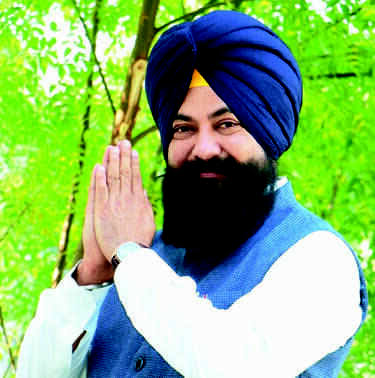
Patiala: The Aam Aadmi Party has appointed Punjab State Scheduled Castes Commission chairperson Jasvir Singh Garhi as its halqa in charge of the SC-reserved Chamkaur Sahib constituency, triggering speculation over a possible candidate change before the 2027 assembly elections. The seat is held by AAP MLA Dr Charanjit Singh, who defeated the then CM, Charanjit Singh Channi, by more than 7,900 votes in 2022. Channi had won the seat in 2007, 2012 and 2017. Party insiders said appointing an outsider as halqa in charge in a constituency represented by a sitting MLA had often preceded a candidate change. Garhi, a prominent Dalit leader with a grassroots network built during his years in the Bahujan Samaj Party (BSP), will now oversee party activities in the constituency. AAP functionaries described the move as a routine organisational exercise to energise workers. Political observers, however, see it as a possible recalibration of the party’s field leadership in a constituency with a substantial Dalit electorate. The appointment assumes significance given Garhi’s political background. A former govt veterinary inspector, he quit service in 2019 and headed the BSP’s Punjab unit for nearly five years. BSP expelled him in Nov 2024 on charges of indiscipline. He joined AAP on Jan 1, 2025, in the presence of CM Bhagwant Mann and became SC commission chairperson two months later. As commission chairperson, Garhi has taken on several Congress and BJP functionaries. He summoned Punjab Congress chief Amrinder Singh Raja Warring over remarks about late former Union minister Buta Singh and sought a written response. He also summoned leader of opposition Partap Singh Bajwa twice, including over alleged casteist remarks against Punjab minister Harbhajan Singh ETO. Garhi also summoned Congress-turned-BJP leader Ravneet Singh Bittu over alleged casteist remarks during a civic poll-related dispute in Dhuri. He rejected Sangrur police’s initial report as unsatisfactory despite Bittu issuing a public apology. MLA Dr Charanjit Singh and AAP media in-charge Baltej Pannu could not be contacted for comment. Courtesy : TOI Note: This news is originally published on https:/timesofindia.com/bha and is used purely for non-profit/non-commercial purposes, especially human rights
Dalit girl taps down mom’s folded hands, faces HM’s ire; found dead next day
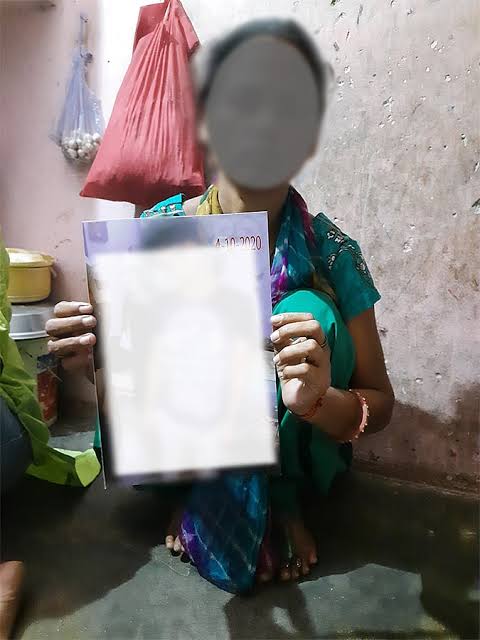
Madurai:: A 16-year-old dalit girl from Madurai was found hanging at her home on Aug 25, a day after a headmistress ordered her out of school for tapping down her mother’s folded hands while she was seeking admission there. Her mother P Thavamani told police that her daughter P Nijanthi was deeply distressed after Vimala, headmistress of Government Model Higher Secondary School in Usilampatti, who belongs to a dominant caste, rebuked her over the gesture. Thavamani, from Ambedkar Nagar, said Nijanthi completed Class X at Thottappanayakkanur before joining a nearby govt school in Poochipatti. She attended the first group there for 20 days but discontinued because she wanted to pursue the nursing group. She remained home for a month. Later, Thavamani took her to TELC Girls’ Higher Secondary School in Usilampatti, where they submitted an admission form. According to the police FIR, the school sought Rs5,000, which Thavamani could not pay immediately. So, they approached Government Model Higher Secondary School in Usilampatti. Its headmistress questioned Nijanthi and telephoned her former headmaster. Speaking over a loudspeaker, the former headmaster described her as disciplined and good at studies. As Thavamani listened with her hands folded, Nijanthi tapped them down. The model school headmistress allegedly questioned the teenager over her action. She accused her of arrogance and claimed such behaviour may have led to her leaving the earlier school, the FIR said. “She made a casteist remark, asking, ‘Why can’t people like you keep your hands folded?’ She then berated the child and ordered her out. The humiliation left her distressed,” said Selvam, a relative of the girl. Nijanthi ran from the campus and walked five kilometres towards Nallamalpatti. Her mother located her and brought her home by autorickshaw. Thavamani said her daughter skipped dinner and remained distressed. Returning from work around 5.30 pm the next day, she found the bedroom locked. A neighbour broke open the door, and Nijanthi was found dead. “She cried throughout the night after the humiliation. Police are refusing to invoke SC/ST Act and appear to be protecting the headmaster, who belongs to the Kallar community,” Selvam said. Courtesy : TOI Note: This news is originally published on https:/timesofindia.com/bha and is used purely for non-profit/non-commercial purposes, especially human rights
Caste-Based Attack on Dalit Youth in Moradabad: Hit on Head with Sharp Weapon for Watching DJ, Case Filed Against Five
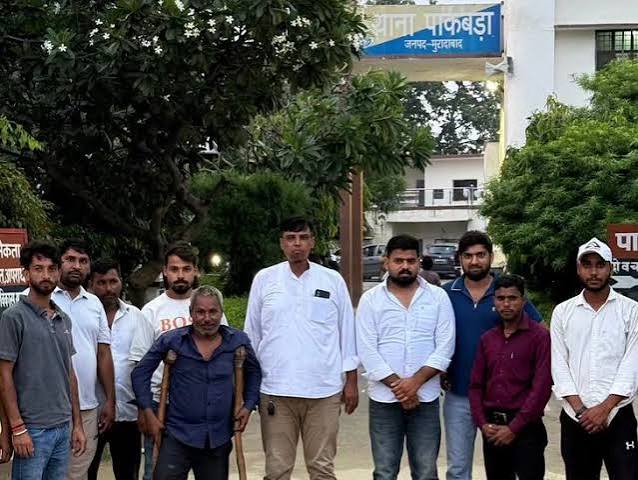
In Sabjipur village, under the Pakbara police station area of Moradabad, a Dalit youth was attacked with a sharp weapon while being hurled caste-based insults. The youth, who had returned from work in Kerala, suffered serious head injuries. Based on the victim’s complaint, police have registered a case against five accused under serious sections and the SC/ST Act. The victim, Ajit Kumar, son of Balram, stated in his complaint to the police that he returned home from Kerala on August 17, 2026, at around 8 p.m. After returning home, he went to a mechanic to pick up his bike, which had been given for service. While returning home, a DJ was playing on the road. Ajit parked his bike to watch the DJ. It is alleged that some boys came from behind the DJ and surrounded him shortly after. According to the victim, the accused used casteist slurs and abused him, saying, “You are a Chamar and a Bhimta, you believe in Bhima, what business do you have here?” They then surrounded him and attacked him with a sharp-edged weapon on his head, causing serious injuries. The accused also said, “Son of a Chamar, what can you do?” In the complaint, the victim named the accused who assaulted him as Bablu, son of Sher Singh, Akash, son of Ramavatar, Akash, son of Prakash, Chandrasen, son of Karan Singh, and Jain, son of Netrapal. Based on Ajit Kumar’s complaint, the Pakbara police station in-charge has registered a case under the SC/ST Act and relevant sections and has begun an investigation. Police say they will investigate the matter and take strict legal action against the culprits. Shrikant Sharma | Moradabad Courtesy: Hindi News
TVK, DMK MLAs trade barbs over social justice

The minister also cited a reported 67% increase in atrocities against SCs in TN between 2019 and 2023, claiming it was the highest in the country. CHENNAI: The Assembly on Thursday witnessed fiery exchanges between members of the ruling coalition and the DMK over Dalit empowerment. PWD Minister Aadhav Arjuna, responding to DMK’s claims of championing Dalits and minorities, questioned its alliance with the BJP between 1994 and 2003. He asked why the DMK did not withdraw support for the BJP after the 2002 Gujarat riots. The minister also cited a reported 67% increase in atrocities against SCs in TN between 2019 and 2023, claiming it was the highest in the country. Referring to CAG observations on SC and ST welfare funds remaining unspent, he said, “BR Ambedkar’s vision was to give authority to Dalits, not stop with providing them houses and water.” Rejecting the criticism, DMK MLA KN Nehru said it was common for governments to leave around 6%-7% of funds unspent and for such amounts to be flagged in CAG reports. He added that the same could happen to the present government “if it lasts for a year”, triggering protests from TVK members. Speaker JCD Prabakar intervened and said the people’s mandate was for five years. DMK MLA Govi Chezhiaan then accused Arjuna of trying to create an impression that the party had done nothing for Dalits. He credited Karunanidhi with introducing concrete houses for Dalits and bringing legislation to enable people from all communities to become temple priests. Arjuna questioned whether the scheme to appoint temple priests had been implemented for the entire five years of DMK rule. Former HR&CE minister PK Sekar Babu said the DMK government had issued appointment orders for 32 people, but the process was halted following a case in the Supreme Court. Arjuna then accused the DMK of taking credit for schemes it could not implement fully. Aadhav also questioned why the DMK had not conducted a caste survey. DMK MLAs responded that the Supreme Court had not permitted the state to conduct one. School Education minister A Rajmohan accused the DMK of portraying Dalit rights as achievements granted by the party rather than rights secured through the Constitution. He also referred to RS Bharathi’s controversial remark that Dalits becoming judges were “alms” granted by the Dravidian movement. DMK members objected to the reference, pointing out that Bharathi had already been reprimanded by the party. Joining the debate, Social Justice Minister Vanni Arasu questioned why the DMK had not shared power with the VCK when the latter had four MLAs supporting the DMK in the previous Assembly. Drawing a parallel with VCK’s representation in the TVK-led government, he said the DMK could not accept a VCK leader becoming a minister. He also took exception to the DMK’s description of the TVK government as a “sofa model government”, saying the remark could be compared to dominant caste people mocking Dalits for wearing good clothes or buying a car. Responding to statements that Dravidian parties had fielded Dalit candidates in general seats, Arasu said the move appeared to have been driven by “pity rather than principle”. ‘Assembly not a forum for political fights’ Chennai: The Assembly is a legislative forum meant to discuss people’s issues, not a battleground for political fighting, DMDK MLA Premalatha Vijayakant said on Thursday, urging the Speaker to given an opportunity for all MLAs to speak. She also singled out Aadhav Arjuna, saying his interventions were prolonging debates. ENS Courtesy : TNIE Note: This news is originally published on https:/thenewindianexpress.com/bha and is used purely for non-profit/non-commercial purposes, especially human rights
A Dalit woman returning home for Rakshabandhan in Firozabad died under suspicious circumstances; murder alleged.

Firozabad (UP), A Dalit woman returning to her village from Gurugram to celebrate Rakshabandhan died under suspicious circumstances. The woman’s body was found in the Shikohabad police station area. Family members suspect murder, police said on Friday. Police said a case has been registered and an investigation has been initiated based on a complaint from the woman’s father. Shikohabad Station House Officer (SHO) Anuj Kumar Singh said Aarti (21), daughter of Rakesh Singh, a resident of Kutukpur village in the Nasirpur police station area, worked as a nurse at a hospital in Gurugram, Haryana. According to family members, she left her village on Wednesday night, August 26, to celebrate Rakshabandhan. During a phone call at around 8 p.m., she told them she was returning with a young man from Vijendra Colony in Shikohabad. Her mobile phone then went off. Meanwhile, police received information about the discovery of a young woman’s body in the Shikohabad area on Thursday. The Inspector-in-Charge arrived at the scene with police force. The body was identified based on documents found near it and the family was informed. The police sent the body for post-mortem and registered a case based on the father’s complaint. Several people are being questioned in connection with the case. The deceased’s elder sister, Lalita, also alleged that upon arriving in Shikohabad, Aarti had told them that since it was night, she was staying with her friend near Pratappur intersection. Police were informed of the incident in the morning, but her friend has been untraceable since then. The family has also expressed doubts about her friend’s role. Courtesy : Hindi News
Akash’s Dalit identity known to cops who tortured and killed him, finds CB-CID
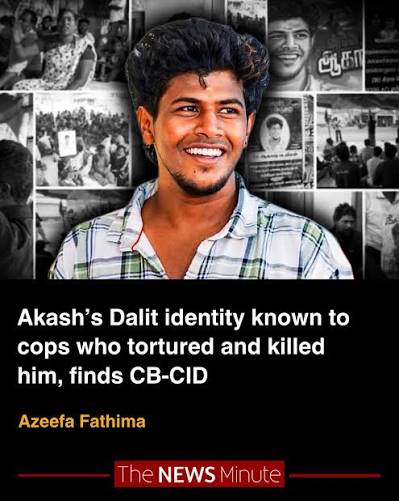
The chargesheet says the six policemen knew Akash Delison belonged to the Scheduled Caste (SC) Devendrakula Velalar community when they took him to a secluded spot and beat him, causing injuries that led to his death. The CB-CID chargesheet in the custodial death of 26-year-old Dalit youth Akash Delison says the six policemen accused in his death knew that he belonged to the Scheduled Caste (SC) Devendrakula Vellalar community and assaulted him with the intention of causing his death. All six have been charged with offences under the Scheduled Castes and Scheduled Tribes (Prevention of Atrocities) Act, along with provisions of the Bharatiya Nyaya Sanhita (BNS). Akash, from Sivaganga district, died on March 8 while under treatment at the Government Rajaji Hospital (GRH) in Madurai, two days after his arrest by the Manamadurai police. Police had arrested Akash and another man, Guna, on March 6, in connection with an attempted murder case. Even though the chargesheet on Akash’s custodial torture and murder was filed before the III Additional District Judge for Protection of Civil Rights (PCR) cases in Madurai on June 18, Akash’s parents received a copy only recently. It names Inspector Dileepan, Sub-Inspector K Guhan, Grade-I Constable S Kaleeswaran, driver constable P Mahendran, constable L Deivendran, and constable B Palaniyappan as accused. The CB-CID has charged all six under section 3(2)(v) of the SC/ST (Prevention of Atrocities) Act, which applies when a person who is not a member of an SC or ST community commits an offence against an SC/ST person knowing their caste or tribal identity, along with the charges of murder and causing disappearance of evidence or giving false information to screen an offender. Dileepan, the first accused, has additionally been charged with knowingly recording or framing an incorrect document or electronic record as a public servant, with the intention of causing injury to another person. The caste identities of both the victim and the accused have been specifically recorded in the chargesheet. Akash is identified as belonging to the Hindu Devendrakula Vellalar community, which comes under the SC category. The chargesheet says Dileepan belongs to the Hindu Piramalai Kallar community, which is classified as Other Backward Class (OBC), and, in specified districts including Sivaganga, also as a Denotified (DNT) community. Guhan belonged to the Hindu Kallar community. Kaleeswaran belonged to the Hindu Tuluva Vellalar community. Mahendran belonged to the Hindu Gounder community and Deivendran and Palaniyappan to the Hindu Agamudayar community. All are categorised as in BC Tamil Nadu. ‘Fully aware that Akash belonged to Scheduled Caste’ The chargesheet explicitly links the alleged assault to the policemen’s knowledge of Akash’s caste identity. “The investigation conducted so far reveals that the accused, fully aware that the deceased Akash Delison belonged to the Hindu Devendrakula Velalar community, took him in a police vehicle on March 6, 2026, around 5.30 pm to a secluded, low-lying area full of eucalyptus trees, off the road to Maanambathi village,” the chargesheet states. It says that the accused took Akash there “with the intention of causing his death” and that all six beat him with an iron rod below his right knee and above his ankle, causing severe fractures. The chargesheet says the injuries resulted in fat embolism, which directly caused Akash’s death. The allegation under the SC/ST Act is significant because section 3(2)(v) applies when a person who is not a member of an SC or ST commits an offence punishable under the IPC/BNS against a person or property knowing that such person is a member of an SC or ST. In this case, the CB-CID has specifically stated that the six policemen were aware of Akash’s SC identity. Chargesheet details alleged plan to break Akash’s leg The chargesheet also gives a detailed account of how Akash was allegedly taken to the location where he was assaulted. According to the chargesheet, Inspector Dileepan told Sub-Inspector Guhan that Akash’s leg had to be broken because he was allegedly involved in criminal cases and instructed him to identify a suitable location. The chargesheet says Guhan, along with constables Deivendran and Palaniyappan, selected a secluded spot near a mud road surrounded by eucalyptus trees on the road from Manamadurai to Maanambathi. Dileepan allegedly then travelled to the location in a police vehicle with Kaleeswaran and Mahendran. Akash, who was allegedly blindfolded, was taken out of another vehicle and placed in Dileepan’s vehicle. The chargesheet says Dileepan, Kaleeswaran, and Mahendran subsequently took Akash to a government eucalyptus grove where Guhan, Deivendran, and Palaniyappan were already waiting. There, according to the CB-CID, all six assaulted Akash on his right leg with an iron rod, causing a fracture. The document says the fracture was so severe that the bone was visible. The injured Akash was then allegedly helped back to the police vehicle by Deivendran, Palaniyappan, Kaleeswaran, and Mahendran, with Dileepan also accompanying them. Police allegedly created false account of injuries The chargesheet also accuses the policemen of concealing the iron rod used in the assault and creating a false account of how Akash sustained his injuries. According to the document, Inspector Dileepan recorded that Akash had sustained the injuries after jumping from the Melappasali bridge near Manamadurai. The CB-CID says Dileepan knew that Akash had not jumped from the bridge but nevertheless recorded the false version in his capacity as a public servant. This allegation forms the basis for the additional charges under sections 201 and 238 of the BNS against Dileepan. Akash was taken to Manamadurai Government Hospital after the alleged assault and later shifted to the Sivaganga Medical College Hospital. He was subsequently admitted to Government Rajaji Hospital in Madurai while in judicial custody. He died on March 8 while undergoing treatment, and Akash’s family had alleged custodial torture. Akash, a resident of Krishnarajapuram near Manamadurai in Sivaganga district, was arrested on March 6 along with another man, Guna, in connection with a case relating to an alleged attack on two men. Police had initially claimed that Akash sustained his injuries after jumping from
Dalit man held hostage, beaten, car snatched in Nawabganj: An additional 50,000 rupees demanded after repaying a loan of 100,000 rupees
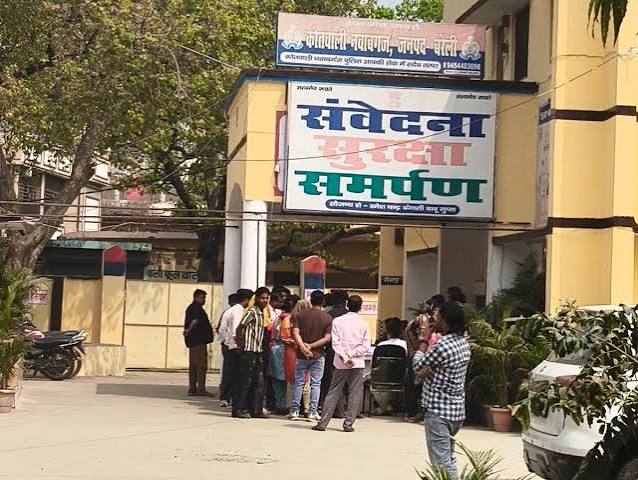
A case has come to light in Gulshan Nagar Basti of Nawabganj where a Dalit man was allegedly held hostage, beaten, and his Eco car snatched. The victim has alleged that an additional 50,000 rupees was demanded from him despite repaying a loan of 100,000 rupees. In a complaint filed with the police, a Dalit man named Shankar Lal has accused a man named Badan Singh of demanding additional money in the name of interest and assaulting him. According to Shankar Lal’s wife, Reena, about six months ago, Shankar Lal borrowed 100,000 rupees from Badan Singh on interest for his Eco car. It is alleged that he has repaid approximately 1.5 lakh rupees including interest. Despite this, Badan Singh is demanding an additional 50,000 rupees. Reena alleged that on August 21st, between 2 and 3 pm, Shankar Lal was repeatedly summoned to Bhagyashree’s house via phone. When Shankar Lal did not return home for a long time, Reena went to look for him. There, she learned that Shankar Lal had allegedly been held hostage and beaten. It is alleged that the miscreants also took possession of Shankar Lal’s Eco car and promised to return it only after paying 50,000 rupees. Reena has filed a complaint with the police, demanding action against the accused and the return of the car. The police are investigating the matter. Station in-charge Arun Kumar Srivastava stated that the complaint has been received and an investigation will be conducted. Further action will be taken based on the investigation. Riyaz Ahmed | Nawabganj, Bareilly Courtesy: Hindi News
The politics of religious ‘purification’

Kharge’s is the latest case in India’s troubling history of ritualistic ‘cleansing’ of places visited by Dalits. It defies the Constitution on untouchability and violates the right to equality. A couple of days after Congress president Mallikarjun Kharge addressed a public gathering at Ramlila Maidan in Haldwani, Uttarakhand, on August 8, members of a right-wing group, reportedly Shri Ram Sena, conducted a ritualistic purification ceremony at the site where Kharge had delivered his speech. The act was widely criticised, with many seeing it as a reminder of the persistence of caste prejudice and notions of ritual purity and pollution. The incident also prompted questions about whether such an act could fall within the scope of laws dealing with untouchability and atrocities against the Scheduled Castes. Whatever its precise legal character, the episode is troubling because it appears to revive a notion that the presence or touch of a person belonging to a historically marginalised caste can render a place impure and in need of purification. The incident, however, should not be viewed in isolation. There have been several instances in the past in which places or objects associated with Dalit leaders or visitors have reportedly been subjected to purification rituals. These include the purification of a statue inaugurated by Union Minister Jagjivan Ram in 1978, a temple purification following a visit by Bihar Chief Minister Jitan Ram Manjhi in 2014, and reported instances involving Munni Devi in Kanpur in 2016 and Manisha Anuragi, a sitting Dalit BJP MLA in Uttar Pradesh, in 2018. The Haldwani incident involving Mallikarjun Kharge, therefore, brings back a question that India has confronted repeatedly: how deeply have notions of ritual purity and pollution associated with caste survived despite the constitutional abolition of untouchability? The cases involving prominent public figures naturally receive attention because they are visible. But similar experiences may be faced by ordinary people in less visible ways. In all, there were as many as 55,865 atrocities registered against members of Scheduled Castes in 2024 alone. The idea of ritual purity and pollution has a long history in parts of the Hindu social order. Ancient dharmashastras and smritis contain several prescriptions concerning contact with those regarded as outside the caste order. The Vishnu Smriti was one of the earliest to refer to the need for purification after contact with a chandala or outcaste (asprushya). The Manusmriti prescribed bath after contact with a chandala, with the touching of food or earthen vessels requiring them to be thrown away and metal vessels scrubbed with ashes. The Apastamba Dharmasutra and Gautama Dharmasutra go beyond touch: if a chandala’s sight falls on another person, that person must look at the sun to purify. If spoken to, the person must converse with a Brahmin or recite a specific Vedic mantra to cleanse themselves. Thus the Kharge incident is not an isolated one, but an inherent outcome of Brahmanical religious, ethical and legal codes, in which high castes are considered victims. Kharge’s case may have been picked up deliberately because he chose egalitarian Buddhist ideology, not iniquitous Brahmanism. It is important to distinguish between the historical existence of such prescriptions and the beliefs and practices of contemporary Hindu society. Hindu traditions have themselves undergone considerable change, and millions of Hindus do not subscribe to notions of untouchability or caste-based exclusion. The Constitution, social reform movements and generations of struggles against discrimination have profoundly altered the social landscape. Yet the persistence of occasional purification rituals suggests that some older ideas have not entirely disappeared. The significance of the Haldwani incident lies precisely here. It raises the uncomfortable question of whether notions that were once embedded in a hierarchical social order continue to influence social behaviour even in a democratic and constitutional India. For B R Ambedkar, the struggle against caste was not merely a struggle for political representation. It was a struggle for equality and human dignity. His advocacy of Buddhism was part of his larger search for a social order based on equality, liberty and fraternity. The construction of a major Buddhist Vihara at Kalaburagi by Kharge can similarly be seen as reflecting his association with an egalitarian social philosophy. The history of India has witnessed a long contest between hierarchical and egalitarian ideas. Buddhism, the Bhakti traditions and later the movements led by social reformers such as Jyotirao Phule, E V Ramasamy Periyar and Ambedkar challenged entrenched forms of social inequality in different ways and in different historical circumstances. These movements did not always share the same philosophy, but they contributed to a continuing debate about social hierarchy, dignity and equality. Independent India ultimately gave this egalitarian principle its strongest institutional expression through the Constitution. Equality, liberty and fraternity became foundational values, while untouchability was expressly abolished under Article 17. The Constitution did not merely prohibit a particular social practice; it sought to fundamentally change the relationship between citizenship and caste. Ambedkar described his struggle as revolution by Buddhism against a counter-revolution by Brahmanism. The final blow to the counter-revolution was the adoption of the Constitution based on equality, liberty and fraternity, and democracy, secularism and socialism. However, the counter-revolutionaries had opposed the Constitution, too. The Shankaracharya of Puri and Hindu Mahasabha had proposed to base the Constitution on Brahmanism and varnashrama. After its adoption in 1950, the Hindu Mahasabha and the RSS had opposed it arguing it did not embody Hindu culture. The continuing appearance of purification rituals, therefore, deserves attention not simply as an isolated religious practice or a political provocation, but as a reminder of the distance that can sometimes remain between constitutional values and social behaviour. It is equally important not to generalise from individual incidents to an entire religious community or tradition. The challenge is to identify and oppose discriminatory practices wherever they occur while recognising the diversity and capacity for reform within Indian society. The Haldwani incident, like earlier episodes, brings an old question into the present. Can a democratic society that guarantees equality to every citizen continue to accommodate practices based