
Shedding old AHINDA allies, Congress leader Siddaramaiah plans to revive ‘HINDA’ with new team
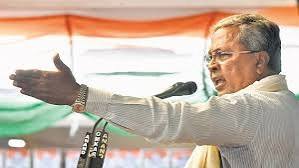
During his recent visit to Siddaramaiah’s Varuna Assembly constituency in Mysuru district, Dr Parameshwara had reportedly suggested that Dalits should groom Yathindra as a future leader. BENGALURU: Former Chief Minister Siddaramaiah and Deputy Chief Minister Dr G Parameshwara appear set to revive the Congress’ HINDA (Kannada acronym for Backward Classes and Dalits) plank to consolidate its Backward Classes and Dalit support base ahead of the 2028 Assembly elections. A Backward Classes Federation rally to felicitate Siddaramaiah at Bengaluru’s Palace Grounds on Sunday is expected to showcase the emerging social coalition, with Dr Parameshwara likely to take centre stage at the event. The rally may pose a subtle political threat to CM DK Shivakumar who is likely to project himself as the Congress’ CM face in 2028. Siddaramaiah had successfully championed the AHINDA (Kannada acronym for minorities, backward classes and Dalits) plank, which played a key role in his becoming CM twice. However, in the changed political scenario, with some of his erstwhile associates, including Public Works Minister Satish Jarkiholi and Housing Minister BZ Zameer Ahmed Khan, seen distancing themselves from him, Siddaramaiah is now expected to focus on rebuilding the HINDA coalition with a new set of leaders, political analysts opine. Siddaramaiah’s son and Urban Development Minister Dr Yathindra could also be projected as his ideological successor at the rally, particularly as sections of the Kuruba community have been keen to see him emerge as a future leader, sources said. During his recent visit to Siddaramaiah’s Varuna Assembly constituency in Mysuru district, Dr Parameshwara had reportedly suggested that Dalits should groom Yathindra as a future leader. The move is being seen as a reciprocal gesture towards Siddaramaiah, who had backed Dr Parameshwara for the CM’s post and later played a role in him getting the DCM position. Siddaramaiah had recently said he lobbied with the Congress high command to restrict the government to a single Deputy CM so that Dr Parameshwara could get the post. Dr Parameshwara, in turn, promptly acknowledged Siddaramaiah’s role. Against this backdrop, Dr Parameshwara is likely to be projected as the prominent Dalit face of the Siddaramaiah camp and potentially as one of the contenders for the CM race ahead of the 2028 polls, analysts said. The guest list for Sunday’s event has also attracted attention. Several prominent leaders associated with Siddaramaiah’s earlier AHINDA campaign, including Satish Jarkiholi, Zameer Ahmed Khan and former minister Dr HC Mahadevappa, have not been invited. In contrast, KPCC president BK Hariprasad and ministers Santhosh Lad, Puttaranga Shetty, Madhu Bangarappa, Byrathi Suresh and Ajay Singh, besides former minister KN Rajanna, have been invited. However, KM Ramachandrappa, president of the Karnataka Rajya Hindulida Jaatigala Okkuta, said there was no political motive behind the guest list. “As the event is being organised to mark the silver jubilee of the Okkuta, only Backward Classes leaders have been invited. We have invited Dr Parameshwara as a representative of the government and will submit certain demands, including implementation of the Backward Classes survey report,” he told The New Sunday Express. Chairman of the Karnataka State Backward Classes Commission Madhusudhan R Nayak and former commission chairpersons Prof Ravivarma Kumar, H Kantharaju and Jayaprakash Hegde have also been invited to the event. Devaraj B Hirehalli Courtesy : TNIE Note: This news is originally published on https:/thenewindianexpress.com/bha and is used purely for non-profit/non-commercial purposes, especially human rights
Dalit youth beaten for protesting the theft of a submersible pump: Caste-related abuses and death threats, FIR filed
A Dalit youth was beaten and subjected to caste-related abuse in Suriyawan, Bhadohi, for protesting the theft of a submersible pump. Following court orders, police have registered a case against the accused, Ajay Shukla, and three unidentified individuals. The victim, Jawahar Lal Gautam, a resident of Mauramshala, stated that on the night of June 12th, he had attended a wedding. During the incident, the submersible pump was stolen from his hand pump. On June 16th, he learned that Ajay Shukla, a resident of Mauramshala (Khanapur), had stolen the submersible pump along with three or four unidentified individuals. The victim alleges that on the evening of June 18th, when he went to the house of the accused, Ajay Shukla, to ask for his submersible pump, Ajay hurled caste-related abuses at him, kicked and punched him, and threatened to shoot him if he returned home. After the incident, the victim filed a complaint with the Bhadohi Superintendent of Police after failing to receive a hearing at the local level. Police have subsequently registered a case under sections 303(2) (theft), 115(2) (voluntarily causing hurt), 352 (insult with intent to provoke breach of the peace), 351(3) (criminal intimidation) of the IPC and sections of the SC/ST Act and have begun an investigation. Shyam Shukla | Masudhi (Bhadohi), Bhadohi (Sant Ravidas Nagar) Courtesy: Hindi News
Mayawati Fires Nephew Akash Anand Again Despite Dalit Bahujan Leadership Vacuum
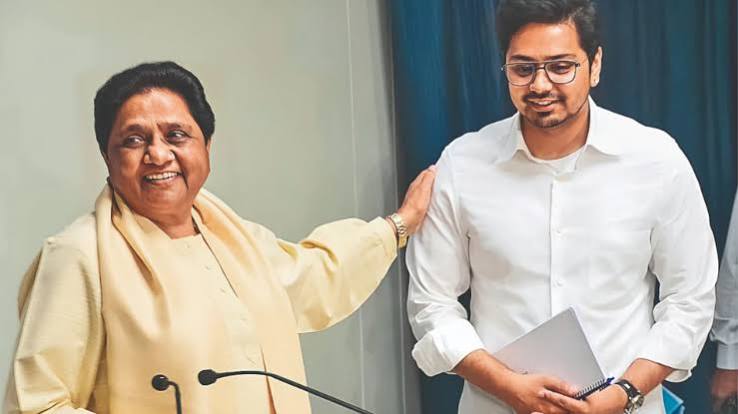
BSP sources claim Mayawati was upset Akash Anand had departed so drastically from her own measured, tame speeches. Mayawati’s repeated sidelining of Akash Anand, reliance on Satish Mishra and outreach to Brahmin, Thakur and Jat leaders reveal deep churn in the BSP and Dalit politics in UP ahead of 2027. Ajoy Bose asks: Can this confused strategy revive her party or speed up its decline? The Bahujan Samaj Party (BSP) supremo Mayawati publicly humiliating her nephew and political heir Akash Anand for the third successive year is a new low even for her erratic eccentricity. Coming as it does just a few months before the crucial Assembly polls in Uttar Pradesh, it is the latest blow to a party desperately struggling to survive in what was considered a decade ago as her political bastion. Anand, 30, had been inducted nearly three years ago by Behenji as her successor, ostensibly to rejuvenate the rapidly declining BSP, abandoned by a growing number of young Dalits in recent years. But she herself has shattered his credibility by forcing him on a bizarre rollercoaster ride, propelling him up and down in rapid succession. The young BSP leader’s fluctuating fortunes have seen him being anointed as her political successor in December 2023, abruptly sacked from his post in the middle of the 2024 Parliamentary poll campaign for harshly criticising the Bharatiya Janata Party (BJP) as “terrorist” and “Taliban”, his power reinstated soon after the elections, thrown out again a year later for anti-party activities along with his father-in-law and veteran BSP leader Ashok Sidharth, reinstalled after an abject apology but now once again stripped of his post for being “politically immature”. A Jibe at BJP Costs Anand His Job Insiders in the BSP revealed that the latest blunder by Anand that cost him his job, was a rousing speech at Jewar in Greater Noida late August that savagely indicted both the BJP state and Central government. Flagging off the 2027 election campaign, announcing the name of the local BSP candidate, the young Dalit leader, much like his aunt in her early activist days, used both rhetorical flourish and sarcastic wit to expose the many unfulfilled promises by the ruling party. Although he also criticised the Congress and the Samajwadi Party, the bulk of the speech was a frontal assault on the BJP which was repeatedly cheered by the sizeable crowd. Sources close to the BSP indicated that Mayawati was upset that nephew and successor had departed so drastically from her own measured and tame speeches. She is also believed to have been influenced by her chief adviser, confidante and lawyer Satish Mishra, who is known to be close to the BJP, that it was unwise for such a senior party leader to upset the state administration at such a sensitive period before the elections. Significantly, Satish Mishra already hugely influential has become even more powerful in recent weeks after the recent expulsion of the other important BSP Brahmin leader Anant Kumar Mishra for anti-party activities. Mayawati last month announced that the lawyer-turned-politician would be assigned more responsibilities in view of the coming elections and would be responsible for dealing with the Election Commission as well as his other responsibilities in managing legal and media matters. A veteran Dalit activist who was earlier close to the BSP supremo lamented, “Behenji has grown increasingly dependent on her lawyer’s advice and nobody else in the party really matters”. There is also talk of a revival of the Dalit-Brahmin alliance supposedly forged by Satish Mishra that swept the BSP to an incredible victory nearly two decades ago. Yet, there appears to be no sign of any surge of fresh support for Mayawati among Brahmins who abandoned her long ago as has other caste groups across the board, along with Muslims ,who now feel that under Satish Mishra’s influence the BSP has become a B-team for the BJP. Interestingly, while Akash Anand was missing from both the party meetings held by Mayawati to discuss Uttar Pradesh and national affairs, the new face that was prominent in the front rows was Prince Yukesh Singh, the son of the late BSP leader Uma Shankar Singh, a Thakur businessman from Ballia in eastern Uttar Pradesh. The recently deceased leader, a wealthy construction magnate who faced corruption charges that were later withdrawn with the help of the Uttar Pradesh government, had won three successive Assembly elections from Rasra constituency. BSP insiders said that Prince Yukesh, who has inherited his father’s business, was being groomed to take over his political mantle. There is also some consternation among Mayawati’s dwindling Dalit supporters about her surprising pursuit for electoral support from communities like Brahmin, Thakurs, and Jats who have traditionally been hostile to them. They were surprised at Mayawati’s open support to Jat leader Jayant Chaudhary in the latter’s recent verbal battle with Samajwadi Party leader Akhilesh Yadav. Indeed, considering the long battle between Dalits and Jats in western Uttar Pradesh, it is baffling how the most important Dalit leader has come out in defence of “the dignity of the Jat community”. This confused strategy by Mayawati not prioritising her goals of getting back her core Jatav base along with other Dalits before thinking of a grander all-caste alliance may cost her in the coming elections. Although the alternative Dalit leader Chandrasekhar Azad does not have either the professional cadre or Mayawati’s vast financial resources, he does have considerable personal charisma and a motivated volunteer force. While this may not be enough to win Azad’s party many seats, unless he comes to a deal or at least an understanding with the INDIA bloc, he is likely to draw away even more of the BSP base which dropped in the last Parliamentary polls to just nine percent. Mayawati could have arrested further decline and even improved her miserable performance in the last Assembly election of just a single seat, had she allowed Akash Anand to at least put up a serious fight as an Opposition party to
Dalit Consciousness and the Crisis of Democracy
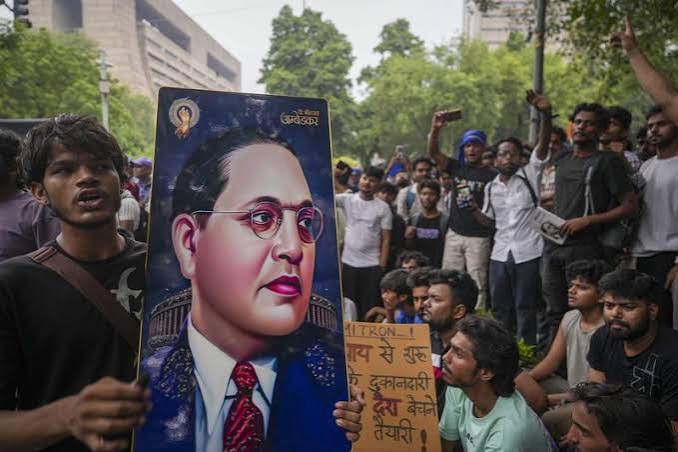
Elections, however regular, cannot sustain democracy if social hierarchies continue to deny dignity and equal opportunity to large sections of society. A Cockroach Janata Party (CJP) supporter holds a portrait of Dr Bhim Rao Ambedkar, as supporters gather during a protest march, at the Jantar Mantar, in New Delhi on July 20, 2026. Photo: PTI/Karma Bhutia. Since the Constitution came into existence, India has experienced a persistent crisis of democracy, irrespective of the political parties in power. One of the deepest structural causes of this crisis is the caste system, historically rooted in the Hindu social milieu, which continues to shape social relations and access to power. Dr. B.R. Ambedkar’s effort to bring justice, liberty, equality and fraternity into the constitution is diametrically opposite to the caste system. The Constitution is an excellent document that could function as a hand book for an elite society. Unfortunately, Hindu India was not prepared to accept the logistics of democracy and undo the inequality built into the caste system. Shudras and Dalits were prohibited from acquiring land, wealth, and education as per Hindu shastras. Therefore, the Constitution did not matter much to their lives. The fundamental rights surely gave rights to the oppressed. Article 14 guarantees equality before law. Article 15 prohibits discrimination on grounds of religion, race, caste, sex, or place of birth. Article 16 ensures equality of opportunity in matters of public employment. These rights, read together with the preamble and the directive principles of state policy, provide a vision of a society free from exploitation and upholding the dignity of every human being. Democracy beyond elections India is frequently celebrated as the world’s largest democracy. Since Independence, it has sustained universal adult franchise, periodic elections, peaceful transfers of power within a constitutional framework. These achievements are no less important in a nation marked by immense linguistic, religious and cultural diversity. Yet, democracy cannot be reduced to elections. Electoral competition is only one dimension of democratic life. Democracy becomes meaningful only when citizens enjoy equal opportunities to participate in public life and influence collective decisions. The distinction between procedural democracy and substantive democracy is therefore crucial. Procedural democracy ensures the right to vote; substantive democracy ensures that every citizen possesses equal dignity, equal opportunity, and equal access to justice. The crisis of Indian democracy emerges precisely from the widening gap between these two ideals. Ambedkar and the democratic revolution India became a republic on January 26, 1950. The written Constitution was adapted and at the implementation level, all the coveted posts were occupied by the privileged caste people. Ambedkar had expressed deep apprehension that political independence, without social transformation, could leave entrenched caste hierarchies substantially intact. Periyar E. V. Ramaswamy said that ‘After India was freed from British rule power was transferred into the hands of Brahmins’. Ambedkar’s campaign for the annihilation of caste did not achieve its intended result. It was his biggest disappointment. By that time, the Shudras, who were in the majority, had acquired some lands and properties and also indulged in some small-scale trading. The Vysyas, being less in number, had parted with their customs to dis-burden themselves. There were agitations and movements by members of the Shudra community in some pockets of the country. But the Dalits, the so-called untouchables, were left in the lurch. Their status quo remained as such intact. Brahmins and members of the dominant caste held power, both at the union and state levels, across the key institutions – the legislature, executive, judiciary and the media. The educational exclusion of Dalits and many other historically disadvantaged communities severely restricted their access to positions of power. The Constitution was limited only to procedural conduct of elections. The rest, like selection of candidates, voting pattern, allocating ministerial berths, all depended on the wishes of the dominant caste and continues to be the case till this day. The most important democratic achievement of the Constitution, in my view, was universal adult franchise – the principle of one person, one vote and one value – to which Ambedkar was deeply committed despite the opposition by many including the unassailable Gandhi. The vote gave Dalits a measure of political identity even when social equality remained absent. Speaking before the Constituent Assembly on November 25, 1949, Ambedkar warned that India was entering a life of contradictions. While there is political equality there is deep social and economic inequality. This contradiction, he argued, would eventually endanger democracy itself unless social democracy accompanied political democracy. Ambedkar recognised caste as the greatest obstacle to democratic citizenship. A society divided into graded inequalities cannot cultivate fraternity, and without fraternity, equality remains fragile and liberty becomes the privilege of the few. The Constitution therefore sought not merely to establish representative institutions but to initiate a social revolution against inherited hierarchies. The crisis of democracy in contemporary India The present democratic crisis in India manifests itself in multiple ways. Democracy has increasingly been equated with electoral victories. Governments derive legitimacy through elections, yet democratic legitimacy also depends upon constitutional morality, institutional autonomy, judicial independence, media freedom, and protection of civil liberties. Elections alone cannot guarantee democratic governance. This aspect needs to be looked into seriously. Especially the post-2014 government that has little respect for democratic norms. Firstly, the composition of the members in the selection committee to appoint the election commission was changed in 2023. The Chief Justice of India (CJI) was removed from the committee which selects the Chief Election Commissioner (CEC) and other members of the Election Commission (EC), thereby denying the participation of the judiciary in the democratic process raising concerns about the independence of the EC. Second, the ownership and editorial independence of sections of the mainstream media have increasingly become subjects of concern, particularly because of their perceived proximity to political and corporate interests. A section of the mainstream media has increasingly been criticised for functioning less as an independent watchdog and more as a supporter of the political establishment. The increasing concentration of media ownership and the
‘Formulate climate policy for marginalised’
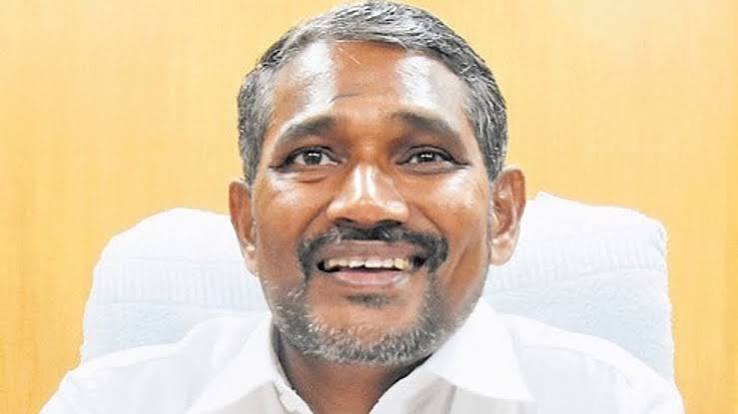
They also highlighted the role of sanitation workers, many of whom belong to Dalit communities, in restoring public spaces after disasters, while lacking adequate occupational safety. CHENNAI: Citing that Dalit and Adivasi settlements in several coastal districts of Tamil Nadu are facing disproportionate risks from floods, cyclones and extreme heat due to poor infrastructure and their location in low-lying areas, activists have sought a dedicated climate-justice policy for the marginalised communities. Following a consultation with activists from across the state, NGOs working in related fields recently submitted a charter of 16 demands to Social Justice Minister Vanni Arasu in this regard. In the charter, Comprehensive Society for Community Development Organisation (COSCO), in collaboration with National Dalit Watch of the National Campaign on Dalit Human Rights, said caste-based spatial segregation had pushed several SC and ST habitations into environmentally fragile areas. The organisations identified vulnerable settlements across Chennai, Cuddalore, Nagapattinam, Pudukkottai, Kancheepuram, Tirunelveli and Kanniyakumari, where they said inadequate drainage, drinking water, sanitation and healthcare infrastructure increased the impact of disasters and worsened inequalities. They also highlighted the role of sanitation workers, many of whom belong to Dalit communities, in restoring public spaces after disasters, while lacking adequate occupational safety. Among their short- and long-term demands is a state-supported programme to train youth in vulnerable coastal settlements in swimming, flood rescue and evacuation. Courtesy : TNIE Note: This news is originally published on https:/thenewindianexpress.com/bha and is used purely for non-profit/non-commercial purposes, especially human rights
Minister promises govt. job, support for Dalit family in Hokrani village
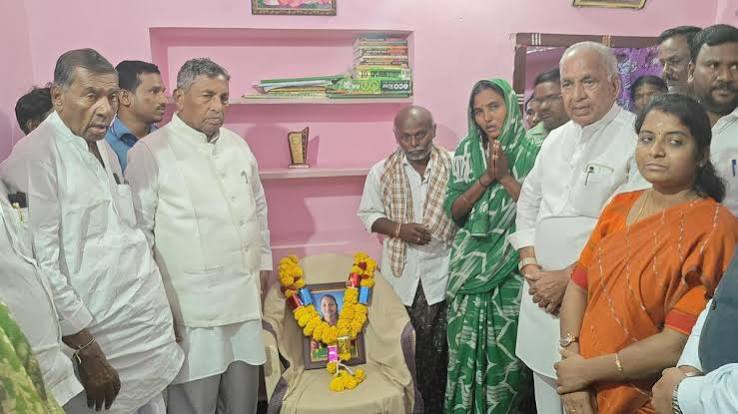
Social Welfare Minister K.H. Muniyappa has promised a government job to the brother of a 22-year-old Dalit woman, who was allegedly gang-raped and brutally murdered at Hokrani village in Raichur district’s Sirwar taluk. Visiting the woman’s grieving family on Friday, Mr. Muniyappa offered his condolences and condemned the heinous crime. In addition to securing employment for the victim’s brother, Mr. Muniyappa pledged all State support for the family and directed officials to take steps to provide irrigation facilities for their dry farmland. The woman’s body was discovered in an open well the day after the incident. Speaking during his visit, Mr. Muniyappa, who also serves as the Bengaluru Rural district in-charge Minister, issued strict instructions to local authorities against tolerating any illegal or unlawful activities in rural areas. ”A spirit of brotherhood must flourish among all communities. Officers must foster such an environment in villages and ensure that every government benefit reaches the doorsteps of the people,” he said. Calling the Hokrani incident deeply “inhuman,” Mr. Muniyappa strongly condemned the perpetrators and emphasised the importance of communal harmony. “Villages can only progress when people live in peace and mutual coordination. I urge everyone to extend their cooperation toward the holistic development of the village,” he added. Deputy Commissioner Poovitha S. directed the CEO of the zilla panchayat, the Superintendent of Police, and other administrative officials to conduct regular village visits to raise awareness regarding various government schemes. During his tour, the Minister also visited the family of another murder victim in nearby Haddinal village to offer his condolences. The Hindu Bureau Courtesy : The Hindu Note: This news is originally published on https:/thehindu.com/bha and is used purely for non-profit/non-commercial purposes, especially human rights
Why Are We Unable to Recognise Untouchability When It Hides Behind the Mask of Purification?
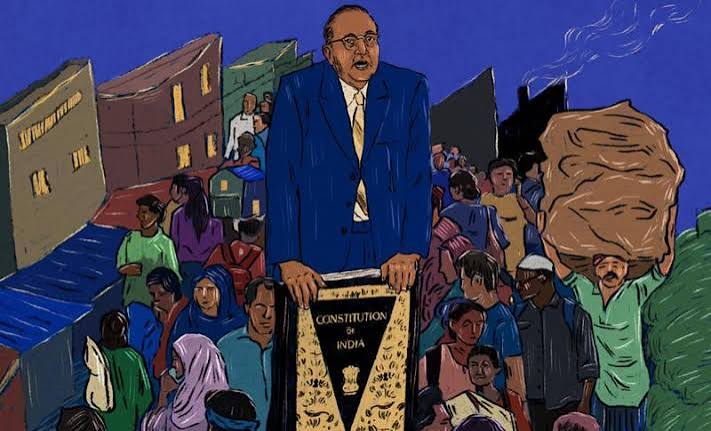
Mallikarjun Kharge said in parliament that he had never sought any special protection because he was a Dalit. But he said that he felt humiliated when a place was considered impure merely because he had touched it. After attacking the mentality represented by the Manusmriti, Rahul Gandhi has now opened a debate on untouchability. In doing so, he is addressing three different constituencies. First, the Hindu society as a whole, and particularly its so-called “upper-caste” communities. Second, the Dalit community. And third, those who occupy positions within the state apparatus – the administrative and police officials whose responsibility it is to enforce the law. He says that the act of purifying the spot where Congress President Mallikarjun Kharge stood is itself an act of untouchability and, therefore, a crime. It is this criminal character of the act that Gandhi is emphasising. Will this benefit Gandhi and his party politically? A considerable section believes that raising the issue of untouchability is a political mistake on his part. After attacking the Manusmriti, they argue that Gandhi is now pushing the “upper castes” further away from the Congress by raising this issue. Dalits, according to this argument, will vote for the Congress anyway. Speaking for them will not add anything to the party’s social base. What the Congress needs today is to bring the “upper-caste” communities closer to itself, especially those who appear to be getting disenchanted with the BJP at this stage. Gandhi’s position, however, will have precisely the opposite effect. But are we now to accept that politicians should never say aloud what they believe to be true because doing so might alienate some of their voters or fracture their base? This is the argument being made in the context of the Cockroach Janta Party (CJP) not taking an explicit stand on the matter of Umar Khalid. We are told that it should not fall into this trap, because taking a stand in favour of Umar might alienate many of its supporters. I am reminded of the first and second general elections of independent India. The Congress’s foremost leader repeatedly told his party: “As far as I am concerned, I am prepared to lose every election in India, but I am not prepared to give any quarter to communalism or casteism.” The Congress was an extraordinarily powerful party in the 1950s, and there is little need to say anything about Nehru’s popularity. Yet, Nehru was saying that if opposing communalism and casteism meant losing an election, he would have no regrets about it. This also meant acknowledging that there was a large section of Hindus who believed in the caste system and might not be happy if it were opposed. Addressing the press in 1954, Nehru said: “We criticise and condemn what we call communalism because it is the very opposite of the conception of broad tolerance of unity of India, that emotional unity, integrated unity which we talk of, because it is separatist, because it disrupts India. But another phase of communalism is casteism. I think that we have not given that intensive thought to the removal of this scourge and curse that we should have done. We have taken it for granted and sometimes I fear we have been afraid of saying much lest we lose an election, lest this group or that caste-group may vote against us. Well, so far as I am concerned, I am prepared to lose every election in India, but I am not prepared to give any quarter to communalism or casteism.” Rahul Gandhi’s predicament, then, is not very different from that of his great-grandfather. Even within the Congress of that time, there were many who feared an active opposition to communalism and casteism because it might cost the party Hindu, especially “upper-caste” Hindu, votes. Yet, throughout the 1950s, Nehru did not miss an opportunity to attack either tendency. It may surprise us that 62 years after Nehru’s death, speaking about these two things should still be considered politically dangerous. When Gandhi called untouchability a crime and drew attention to its seriousness, I was reminded of a speech Nehru made nearly 70 years ago, in which he spoke of waging an uncompromising struggle against untouchability: “We have enshrined the abolition of untouchability in our Constitution and in our laws, but the fact remains that when you go to any of our villages, that old and vicious sentiment is still found prevailing there. Even in regard to such simple matters as drinking water from a well, they have to suffer hardships and difficulties. This is a bad thing, a great evil; and today it must be fought without mercy, without compromise.” There is, however, one significant difference between Nehru’s time and ours. Since untouchability is now a punishable offence, people generally refrain from practising it openly. But it is still sometimes practised publicly. Take the familiar example of villages where so-called “upper-caste” children boycott the midday meal at school because the person cooking it happens to be from the Dalit community. No organisation or political party launches a sustained campaign of social awakening against such practices. Is that because they fear offending the “upper castes”? Untouchability today is practised largely in indirect forms. You cannot openly prevent a Dalit from entering a place, sitting somewhere, or touching an object. But there is another way. If a Dalit has stood at a particular place or used an object, that place or object can subsequently be “purified” and restored to its previous pristine state. After Gandhi’s statement, while many began saying that untouchability was a thing of the past, evidence began appearing – in writing and on video – that untouchability is very much alive. From maintaining physical distance in public spaces to declaring certain places out of bounds for Dalits, untouchability continues in various forms. But perhaps purification is the ‘safest’ form of this discrimination. Purification can take place only after there has been impurity. A place or object becomes impure because a “polluted” body
The university he saw from outside his school in his childhood, earned him a gold medal; a Dalit youth’s story of education, struggle, and dreams.
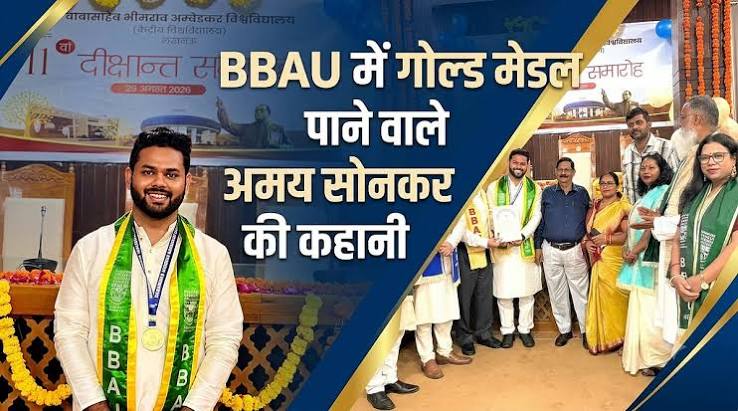
After coming to Baba Saheb Bhimrao Ambedkar University, Amay also understood BBAU’s unique role in social justice. He learned that it is a central university established under a special act and has 50 percent reservation for SC and ST students. Lucknow – The university that a student saw from his school window and path in his childhood, after a few years, was no longer just a place of study for him. He became a student there, studied law, participated in academic and co-curricular activities, raised student issues through student politics, engaged in legal awareness work, and finally received a gold medal at the same university’s convocation. This is the story of Amay Sonkar, who was awarded the gold medal in the Scheduled Caste category at the 11th convocation of Baba Saheb Bhimrao Ambedkar University (BBAU), Lucknow, on August 29th. He completed his BBA LLB (Hons) from BBAU in the 2021-2026 session, securing 82.5 percent marks. But for Amay, this medal isn’t just an academic achievement. According to him, it’s a long journey of family financial challenges, Ambedkarite ideals inherited from his father, personal experiences with caste discrimination, a desire to understand the law, student politics, legal awareness, and a view of education as a social responsibility. Amay was born in 2001 in Rasra, Ballia district, Uttar Pradesh, into an economically struggling Scheduled Caste family. His mother managed the household while his father worked to support the family. Amay explains that despite limited resources, education and social equality were given special importance in his home. His father is a postgraduate in human rights and has been involved in the Ambedkarite movement. He also served as the convener of BAMCEF. According to Amay, his father organized several meetings of Manvendra Kanshi Ram Saheb in Ballia district between 1986 and 2001 and worked to raise awareness among Bahujans about their social and political rights. Amay says that his father was his first teacher. From childhood, he heard his father speak about the struggles, thoughts, and philosophy of Babasaheb Dr. B.R. Ambedkar. His understanding of respect, equality, and social justice developed in this family environment. BBAU was opposite his school, and he dreamed of studying there. Amay completed his primary education at St. Mary’s School in Rasra. After his father’s transfer to Azamgarh, he continued his studies at St. Xavier’s School. Later, the family moved to Lucknow, and he enrolled at The Millennium School, Lucknow. He scored over 75 percent in both grades 10 and 12. Downtown was located right next to his school, Babasaheb Bhimrao Ambedkar University. Amay says that he would gaze at the university every day while going to school. For Amay, who grew up hearing about Babasaheb from his father, seeing a university named after him was not an ordinary experience. Gradually, he began to dream that one day he too would be a student at BBAU. At that time, he couldn’t fully express this connection in words, but the desire to study at this university was clear within him. Law is not just a career choice. According to Amay, during his school days, he experienced some experiences of caste discrimination that changed his way of thinking. He was around 16-17 years old at the time. He says that before this, caste discrimination was primarily a problem he had heard about or learned about. But when he experienced it firsthand, he realized its reality and pain. The question of why a teacher might treat a student differently based on their caste also became important to him. These experiences sparked a desire in him to understand the law. According to Amay, he wanted to understand why this happened to him, how he could question such injustice, and how to effectively stand up for the rights of the Bahujan community. For him, law wasn’t just a career choice. In his words, studying law was the result of a desire, born of his personal experiences, to understand injustice and gain the tools to challenge it. In 2021, Amay took the BBAU entrance exam and secured admission to the BBA LLB program. This was an emotional moment for him, as the university he saw every day from outside his school was now going to be his academic campus for the next five years. After joining the university, he also understood BBAU’s unique role in social justice. According to Amay, he learned that it is a central university established under a special act and has 50 percent reservation for SC and ST students. He also notes that the university’s student community also has a significant number of students from SC and ST backgrounds. This is why Amay saw the university not only as a place to earn a degree. It also became an opportunity for him to work for students and communities who have historically been deprived of equal opportunities. Student Politics, Full Focus on Studies While studying at BBAU, Amay remained active in student politics and other activities, but he believes this did not impact his studies. During his BBA LLB, he participated and achieved success in numerous academic and co-curricular competitions. He served on various legal committees within the university and served as co-convenor and later convenor of the BBA University Moot Court Committee. During this period, he organized the first and second Babasaheb Bhimrao Ambedkar National Moot Court Competitions. He also participated in various national and state-level seminars and academic programs in various capacities. For him, legal education was not limited to classrooms, exams, and competitions. He saw it as deeply rooted in Babasaheb’s legacy and questions of social justice. Amay developed an interest in legal research while still an undergraduate. He wrote and published research papers on topics such as food security and caste discrimination in prisons. Some of his other research papers are currently under review. He also completed internships at several government and legal institutions. These included opportunities to work with High Court judges, internships with state and government authorities, and work with private lawyers practicing in the
Political strife erupts between the BJP and Congress over Dalit Christian reservations in Kerala. Why is the BJP angered by CM Satheesan’s statement?
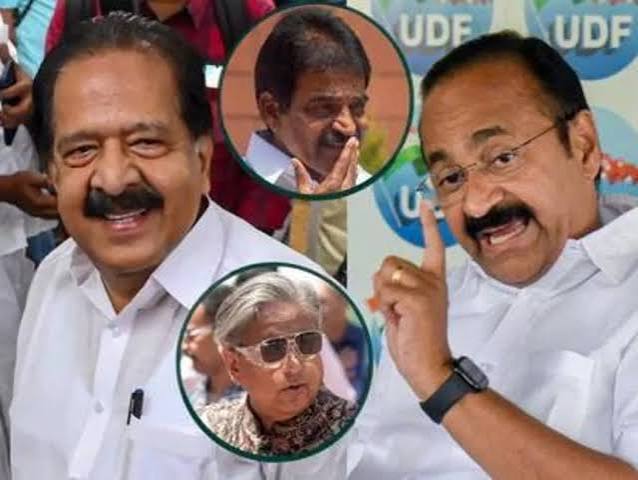
The political conflict between the BJP and Congress over the demand for reservation for Dalit Christians in Kerala has intensified. A statement by Chief Minister V.D. Satheesan has reignited the issue, raising questions about the BJP’s carefully crafted Christian vote bank strategy. Thiruvananthapuram – At an event commemorating the 163rd birth anniversary of social reformer Ayyankali, Chief Minister V.D. Satheesan stated that the Dalit Christian community is not receiving the facilities available to Christians or the benefits afforded to Scheduled Castes (SCs). He assured that his government would study the issue and find ways to address the community’s backwardness. The Chief Minister’s statement drew a sharp reaction from the BJP’s Scheduled Caste (SC) Morcha. State president Shajumon Vattekkad demanded Satheesan retract his statement, alleging that the Chief Minister was engaging in appeasement politics. He warned that extending the reservation for the Scheduled Caste community to Dalit Christians would be like playing with fire. Vattekkad stressed that the quota granted to the Scheduled Caste community by the Constitution is not a charity but their right, and that the BJP’s SC Morcha will mobilize the community and launch a movement against the government. BJP State Vice President K.S. Radhakrishnan also questioned the validity of the demand. In a Facebook post on Tuesday, he argued that if conversion eliminates caste identity and caste-based oppression, then the demand for SC status has no basis. He said that if caste discrimination still persists within the Christian community, they should first acknowledge it and address it. What is the demand of Dalit Christians and how long has it been ongoing? The demand for SC status for Dalit Christians is not new. This demand has long been raised, especially by a section of the Christian community in Kerala and the Catholic Church. Dalit Christians are primarily descendants of Hindu communities who were historically marginalized and later converted to Christianity. Under the Constitution (Scheduled Castes) Order, 1950, SC status is limited to members of the Hindu, Sikh, and Buddhist communities. Various governments have considered proposals to extend this status to Dalits who converted to Christianity or Islam from time to time. Kerala has a large Dalit Christian population, whose ancestors converted generations ago. The community argues that despite conversion, they continue to face social and economic discrimination based on caste and should be granted the same constitutional protections as Dalits of other religions. Dalit Christians affiliated with the Syro-Malabar Catholic Church are primarily concentrated in Kottayam, while non-Catholic communities such as Pentecostals reside in large numbers in Pathanamthitta and Idukki districts. Why is this issue a political dilemma for the BJP? This issue poses a major political dilemma for the BJP. The party has been striving to expand its reach beyond its traditional Hindu base to Kerala’s Christian community over the past few years. The issue of conversion has been a major obstacle to this outreach, although a section of the BJP’s state leadership has tried to downplay it, arguing that the Christian population in Kerala is declining, so conversion should not become a barrier between the party and the Christian community. The party has also tried to portray Hindus and Christians as communities with shared interests, especially on what BJP leaders call “Muslim appeasement.” Despite this, the issue of conversion remains a thorn within the BJP and the broader Sangh Parivar. Last year, the arrest of two Kerala Catholic nuns in Chhattisgarh on charges of forced conversion and human trafficking brought this tension to the fore. Several leaders, including Kerala BJP President Rajeev, rejected allegations of forced conversion and expressed solidarity with the nuns. This stance was criticized by some sections of the Sangh Parivar in Kerala, who cited it as an example of the conversion of members of marginalized Hindu communities. This debate again came to the fore this year regarding the Foreign Contribution (Regulation) Amendment Bill, 2026. The bill, introduced by the central government, was later referred to a joint parliamentary committee. While BJP leaders attempted to allay Christian organizations’ concerns about the proposed changes, some sections of Hindutva organizations in Kerala alleged that this funding could encourage religious conversions and demanded strict scrutiny of foreign donations to churches. R.V. Babu, state president of the Hindu Aikya Vedi, also opposed any move to extend Scheduled Caste reservations to converted Christians, alleging that the government was “promoting religious conversions.” The Vedi is an umbrella organization of several Sangh Parivar-affiliated organizations in Kerala. The BJP inducted Christian leaders into the party to woo the Christian vote and fielded Christian candidates in areas with large Christian populations. However, the party failed to achieve significant success among Christian voters in the 2026 assembly elections. The BJP won three assembly seats—Nemom, Kazhakootam, and Chathannoor—but its victories in these seats were attributed to its traditional Hindu base rather than any major shift in Christian voter sentiment. These limited electoral results have further fueled debate within the BJP about the direction and political benefits of its Christian-centric strategy. In such a situation, Satheesan’s statement is being seen as part of the Congress’s strategy to dent the BJP’s Christian outreach, while some sections within the BJP have become more vocal than ever on the issue of conversion. The issue is also under consideration at the central level. The question of granting SC status to Dalits who convert to Christianity or Islam is also under consideration at the national level. In 2022, the central government constituted a commission headed by former Chief Justice of India K.G. Balakrishnan to investigate this issue. The commission’s work included investigating the demand for SC status for Dalit converts and the discrimination they face. The case for granting SC status to Dalit Muslims and Christians has been pending in the Supreme Court for 20 years. The commission’s tenure was extended several times. After several extensions, the commission finalized its report by the scheduled deadline of June 10. A community grappling with caste discrimination The situation of Dalit Christians in Kerala is socially and economically challenging, where they continue
Meerut: Dalit lawyer on hunger strike lifted overnight, demanding action against former SSP
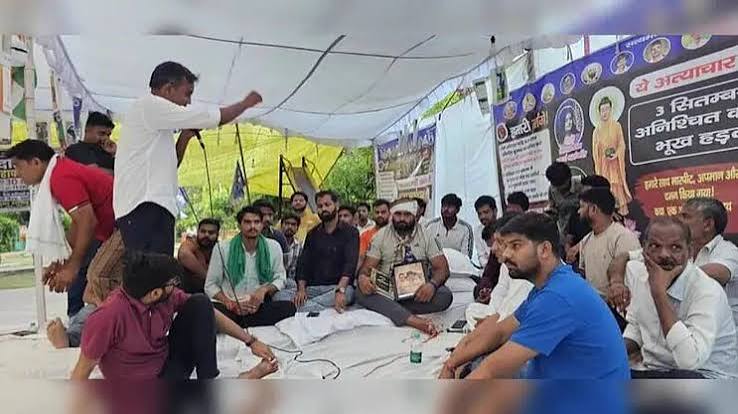
In Meerut, Dalit lawyer Ravi Gautam, who was on hunger strike demanding action against the former SSP, was removed from the protest site overnight by police. Police cited ill health, while the lawyer denied it. Uttar Pradesh: Dalit lawyer Ravi Gautam, who was on hunger strike at Commissioner’s Park in Meerut, was removed from the protest site early Friday morning by police. Ravi had begun his hunger strike on Thursday and was demanding the dismissal of former SSP Avinash Pandey and the registration of an FIR against him in connection with the violence that occurred on July 8th. Police cited the lawyer’s deteriorating health as the reason for this action. Ravi Gautam had been on strike in the same park since August 20th. He alleges that former SSP Pandey severely assaulted him inside a police van. However, a video of Gautam has surfaced after he was removed from the protest site by police. In the video, he is seen claiming that he was in perfect health. His statement directly questions the police’s claim of poor health. Regarding the entire incident, Civil Lines Superintendent of Police (CO) Vishwa Jyoti Rai stated that Ravi Gautam was thoroughly medically examined. The report revealed a significant deterioration in his health. Following the established protocols (SOPs), he was transferred to a higher-level medical center in Ghaziabad for better care. Meanwhile, by Friday morning, the police administration had completely removed the tents at the protest site. Earlier, on Thursday afternoon, when Gautam announced his hunger strike, several Bharatiya Kisan Union (Ambedkar faction) activists had reached Commissioner’s Park in solidarity. During his fast, Gautam made serious allegations against the government and administration of ignoring his legitimate demands. He also appealed to Dalit leaders associated with the BJP to speak out openly on these important issues affecting the community. This entire controversy stems from the death of a student in May. The protesters alleged that the police conducted a highly flawed investigation into the student’s death. On July 8th, a protest by the Dalit community erupted, which later turned violent. Several videos went viral on social media, allegedly showing SSP Pandey beating Gautam inside a police van. Following this incident, an SP official and his Dalit associate also leveled serious allegations of police brutality. As the matter escalated, the then-SSP, Avinash Pandey, was attached to Lucknow headquarters. Rajan Chaudhary Courtesy: Hindi News