
SRFTI Students’ Union Denounces CBFC Decision To Block Appu Soman’s Animated Short ‘Da’Lit Kids’
A Malayalam animated student film confronting caste discrimination was barred by the Central Board of Film Certification, exposing institutional discomfort with anti-caste narratives in emerging Indian cinema. The Central Board of Film Certification denied screening permission to Da’lit Kids without explanation, removing it from Animela’s line-up a day before its Mumbai screening. The Satyajit Ray Film and Television Institute student film’s removal sparked protests and solidarity withdrawals from fellow filmmakers. Its exclusion, despite festival recognition, raises concerns about censorship and shrinking space for caste-critical student cinema in India. The Central Board of Film Certification (CBFC), which functions under the Ministry of Information & Broadcasting, has denied permission for the Malayalam animated short Da’Lit Kids (2025) to be screened at the Animela Animation Film Festival in Mumbai. The film, directed by Appu Soman with sound design by Tony Joppan, emerged from the 17th batch of the Satyajit Ray Film and Television Institute (SRFTI). Its removal came a day before the scheduled screening after the Ministry reportedly withheld the routine exemption granted to student films. No written explanation was provided. In response, fellow SRFTI filmmakers withdrew their works in solidarity, leaving the institute’s programmed slot at the festival deliberately vacant. On 20 February, the SRFTI Students’ Union issued a formal statement condemning the decision. Their objection rested on principle. Its exclusion therefore signals more than administrative caution and reveals institutional discomfort with cinema that documents structural inequality without dilution. The union described the denial as an act of censorship and affirmed solidarity with filmmakers who confront caste through cinematic form. Their position was unequivocal. Cinema must remain a space where dissent can exist without prior permission. Institutional responses exposed internal contradictions SRFTI Vice Chancellor Samiran Datta publicly stated that they did not support censorship and called the festival’s reversal unfortunate. Dhivahar Muthuveeran, president of the SRFTI Students’ Union, drew attention to the structural irony. SRFTI itself operates under the same ministry that oversees certification. When students within such an institution cannot exhibit their work, the constraint extends beyond a single film. It reshapes the conditions under which future filmmakers learn to speak. Amritanshu Singh Yadav, president of the Film and Television Institute of India students’ association, articulated this clearly. Censorship imposed on film schools is censorship imposed on the future tense of Indian cinema. Videos of protests led by Soman, Joppan and alumni circulated widely, transforming institutional restriction into public scrutiny. Audience reception tells a different story The irony deepens when placed against the film’s reception elsewhere. Da’lit Kids was selected at the International Documentary and Short Film Festival of Kerala and the Dharamshala International Film Festival, where it received recognition for both artistic and political clarity. Outlook, too, covered the film within its survey of contemporary anti-caste cinema, situating it within a growing body of work that refuses erasure. Implications of the censorship The film itself is formally restrained and politically precise. It follows Aravind, a Dalit schoolboy humiliated by his teacher for a minor error. Animation becomes a medium capable of rendering memory, humiliation and resistance within the same frame. To prevent such a film from screening is to regulate who may be seen and heard within public culture. India’s Constitution guarantees freedom of expression under Article 19(1)(a), subject to reasonable restrictions. When restriction arrives without reason, it ceases to appear reasonable. It appears disciplinary. The absence of explanation becomes its own statement. The SRFTI Students’ Union concluded their protest with a line that carries both urgency and inheritance: for cinema, for dignity, for liberation. Courtesy : Outlook India Note: This news is originally published on https:/outlookindia.com/bha and is used purely for non-profit/non-commercial purposes, especially human rights
Father, son booked for assaulting Dalit minor in moral policing incident in Mangaluru

The complainant has further alleged that caste-based insults were hurled at the boy and that he was publicly threatened with dire consequences if he returned to the area. MANGALURU: In an alleged case of moral policing, a 14-year-old Dalit boy was assaulted by a father and son near a railway track at Babugudde in Mangaluru city. According to the complaint filed by the boy’s father, his son was sitting and conversing with his female friend near the railway track on February 23 at around 4 pm. At that time, the accused, Stevan Montheiro, approached them while recording a video on his mobile phone, questioned their presence, accused them of inappropriate behaviour, and threatened to upload the footage on social media. When the boy attempted to leave the spot, he was stopped and taken to a nearby road, where he was verbally abused and assaulted by Stevan and his son, Avil. The complainant has further alleged that caste-based insults were hurled at the boy and that he was publicly threatened with dire consequences if he returned to the area. The accused are also alleged to have circulated the video on WhatsApp. Based on the complaint, the police have registered a case under Section 176 of the BNSS. Further inquiry is underway. Vincent D’ Souza Courtesy : TNIE Note: This news is originally published on https:/thenewindianexpress.com/bha and is used purely for non-profit/non-commercial purposes, especially human rights
Dalit Wedding Procession Attacked in Aligarh After Dispute Over Song, FIR Filed

A Dalit wedding procession was allegedly attacked in Sunana village, Aligarh, after a dispute over a DJ song led to stone pelting and vandalism. A Dalit wedding procession was allegedly attacked in Sunana village of Aligarh on Tuesday night after a dispute broke out over a song played during the baraat. The incident led to stone pelting, vandalism and tension in the area under Jawan police station limits. According to police, the clash took place around 9.15 pm when the procession was passing through a locality of another community. Officials said a song perceived as caste-based and objectionable was played on the DJ system, which triggered objections from locals. The situation soon escalated into violence, with members of both sides allegedly attacking each other with sticks and stones. Videos of the clash later went viral on social media. Police Say Song Triggered Dispute Superintendent of Police City Mrigank Shekhar Pathak said a preliminary inquiry suggested that the conflict began after a participant in the procession played a provocative song through a mobile phone connected to the DJ system. “When a member of the baraat played a song intended to stir up caste-based feelings, it was objected to by members present there. Police reached the spot, pacified both sides and provided security to the procession,” Pathak said. He added that the baraat was safely escorted to the wedding venue and no injuries were officially reported. “Peace has been restored in the village. A case has been registered, and those involved are being identified for strict action,” he said. Sub Inspector Ghanshyam Singh, in his complaint, stated that when the procession entered the locality, an unknown baraati played an objectionable song. “People objected, and some unknown persons attacked each other, abused each other and used sticks. Nearby houses were also vandalised. The incident created panic and disturbed law and order,” he said. Police have seized video footage and the audio track for investigation. An FIR has been registered against unidentified persons under several sections of the Bharatiya Nyaya Sanhita, including rioting, voluntarily causing hurt, intentional insult to provoke breach of peace, criminal force and mischief, along with provisions of the Criminal Law Amendment Act. Family Alleges Targeted Attack However, family members of the bride have alleged that the procession was attacked without provocation. Anees Kumar, the bride’s brother, claimed that miscreants armed with sharp-edged weapons targeted the baraat. He said the wedding party could move forward only after police intervention. In another viral video, a participant in the procession accused members of the Thakur community of pelting stones at the Dalit wedding procession. He alleged that the attack reflected growing caste tensions. Political Reactions Chandra Shekhar Azad, chief of the Bhim Army, condemned the incident and termed it serious. He alleged that the procession was attacked with sticks and other weapons, and that casteist slurs were used. Police have deployed additional forces in the village to maintain law and order. Officials said the situation is currently peaceful, and efforts are ongoing to identify those involved in the clash. Courtesy : TOP Note: This news is originally published on https:/theobserverpost.com/bha and is used purely for non-profit/non-commercial purposes, especially human rights
Kharge family has meted out injustice to Dalit leaders, says Chalavadi Narayanaswamy
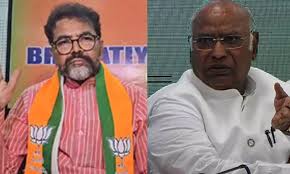
The Leader of Opposition in the Council says the Kharge family has deprived many Dalit leaders, including himself, of opportunities Leader of Opposition in the Legislative Council Chavaladi Narayanaswamy has said that the Kharge family has snatched away opportunities of many Dalit leaders, including himself. Speaking to presspersons in Dharwad on Tuesday, he took exception to Minister Priyank Kharge terming him an opportunist and said that the Kharge family has deprived him of opportunities he deserved after his four decades of service to the Congress. “Your (Priyank Kharge) father has been in politics for six decades and there is no example of him grooming a Dalit leader,” he quipped. Mr. Narayanaswamy also said that several Dalit leaders, including three-time legislators Prasad Abbayya, A. Narayanaswamy, P.M. Narendraswamy and Shivanna, have been sidelined in the Congress. “On other hand, Priyank Kharge, who has won three times, has been made a Minister on all three occasions,” he said. He also said that in Kalaburagi, the former Chief Minister N. Dharam Singh’s son has been politically suppressed by the Kharge family. Mr. Narayanaswamy also sought an answer from Priyank Kharge about allegations of them amassing wealth. The Hindu Bureau Courtesy : The Hindu Note: This news is originally published on https:/thehindu.com/bha and is used purely for non-profit/non-commercial purposes, especially human rights
Former JNUSU president files complaint over VC’s alleged remarks on Dalits
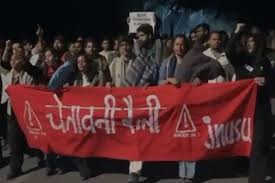
Dhananjay, former President of the Jawaharlal Nehru University Students Union (JNUSU) for 2023-24, has lodged a complaint with the National Commission for Scheduled Castes (NCSC) against JNU Vice Chancellor Santishree D. Pandit regarding allegedly hateful statements made on a public platform. The complaint asserts that the Vice Chancellor’s remarks fostered feelings of enmity, hatred, and ill will towards the Dalit community. The complaint contends that these remarks violate the Scheduled Castes and Scheduled Tribes (Prevention of Atrocities) Act, 1989, which was enacted to prevent atrocities and hate crimes against Scheduled Castes and Scheduled Tribes. The Act criminalises acts that insult, humiliate, or engender social hostility against these communities and includes provisions for immediate investigation and legal recourse to protect their rights and dignity. The petition seeks the NCSC’s immediate intervention for the registration of a case under the SC/ST (Prevention of Atrocities) Act, 1989, the initiation of an investigation by an independent committee, and disciplinary and legal action against the Vice Chancellor, including her removal from office. The complainant stressed that the Vice Chancellor has not issued an apology, reinforcing the view that the remarks were intentional and designed to encourage discrimination. On Sunday, Vice Chancellor Santishree D. Pandit defended her comments concerning Dalits and Blacks, stating that her remarks were taken out of context and misrepresented for “political purposes” by certain groups. Her statement followed protests by student organisations, including the JNUSU, demanding her resignation over comments made during a podcast published on February 16. In a written statement shared with ANI, the Vice Chancellor noted that “a large number of faculty” members expressed their “unwavering support” for her, accusing the JNUSU and the JNU Teachers’ Association (JNUTA) of undermining deliberative discourse on campus through selective framing. The controversy arose from Pandit’s remarks on the podcast while discussing the University Grants Commission’s proposed 2026 Equity (Anti-Discrimination) Regulations aimed at addressing caste-based discrimination in higher education. A clip circulating online records her stating that Dalits and Blacks “cannot progress by being permanently a victim or playing the victim card,” which sparked strong reactions from student groups. Courtesy : The News Mill Note: This news is originally published on https:/thenewsmill.com/bha and is used purely for non-profit/non-commercial purposes, especially human rights
Karnataka: Dalit couple worships at temple after Tehsildar’s intervention
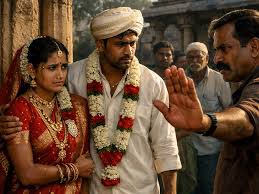
The Tehsildar warned that strict action will be taken if such atrocities occur in the taluk in the future. Tumakuru: A peace meeting was held regarding the incident of a newly married couple from the Dalit community being thrown out of a temple. Following the meeting, Turuvekere Tehsildar M.N. Kum E. Ahmed allowed the abused couple to enter the temple. A peace meeting was held in the village on Tuesday regarding the incident that occurred on February 19th in Goni Tumakuru village of Turuvekere taluk. The peace meeting was successful. Furthermore, Tehsildar Ahmed held the newly married couple’s hand and led them inside the Arasamma Devi temple, putting an end to the conflict between upper castes and Dalits. A Dalit newly married couple visited the village deity amidst police cordon. The Tehsildar warned that strict action will be taken if such atrocities occur in the taluk in the future. The Tehsildar stated that the government temple is not anyone’s property and everyone is allowed to enter the temple without restriction, which belongs to the Muzrai Department. He advised the villagers to maintain harmony among themselves. An awareness program is underway. Strict legal action will be taken against anyone found engaging in foolish rituals or illegal activities. Any kind of untouchability or caste-based abuse is a crime under the law. Everyone should be allowed to enter and exit the temple without restriction. If such incidents occur again in the future, strict action will be taken. We will set up a camp here. As part of the awareness campaign, the district administration will also perform a drama. Several officials, including the District Magistrate, will be present. Please cooperate with the villagers. Tehsildar Ahmed stated that some people have been arrested in connection with the incident, and the police are conducting further investigations. Taluk Panchayat Executive Officer Anantharaju, Conservation Sub-Inspector T. Murthy, Assistant Director of the Social Welfare Department Shivalingaiah, Assistant Engineer of the Public Works Department Kanmani, Panchayat Development Officer Suresh, Revenue Inspector Rangaswamy, Kasaba Hobli Revenue Inspector Jagadeesh, State Intelligence Department Rajkumar, Priest Nanje Gowda, Social Welfare Department employees Dhananjay and Kiran Kumar, Village Administrative Officer Mallick, and other villagers were present on the occasion. What was the matter: A newly married couple from the Dalit community in Goni Tumkur village alleged that they were not only prevented from entering the temple but also subjected to caste-based abuse. Based on a complaint from a person, a case has been registered at the Turuvekere police station under the SC/ST Atrocities Act. The victims stated in their complaint that as soon as they entered the temple, some people insulted them and threw them out. Courtesy: Hindi News
Dalit Couple Faces Humiliation Inside Karnataka Temple, Forced To Leave Premises
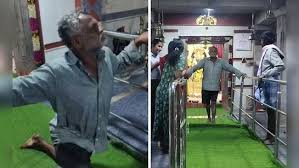
A Dalit couple was humiliated at Arasamma Temple in Tumakuru. An FIR was filed under SC/ST Act. A newly married Dalit couple was allegedly humiliated inside a temple in Karnataka and forced to leave the premises in an apparent case of caste discrimination. The incident took place at Goni village in Tumakuru district on February 19 when the Dalit couple visited the Arasamma Temple. It is learnt that a man belonging to an upper caste, identified as Narayanappa, allegedly pretended to be possessed by a deity and told the couple that they were not allowed inside the temple. Footage from the temple shows Narayanappa blocking the pathway to the deity while kneeling, before standing and shouting at the family, forcing them to get out of the temple. The couple reportedly faced humiliation before leaving the temple. He reportedly shouted, “Dalits cannot enter temple. Leave immediately.” Speaking to news agency ANI, SP Ashok KV said, “…One aged person started shouting at the couple in the name of God. He told them things like ‘you should not enter into the temple’. We received a complaint at the Turuvekere police station in which they mentioned seven people, six named and one unknown person.” Following the incident, the victim, Jagadish, filed a complaint with the Turuvekere Police Station. Authorities have registered a First Information Report (FIR) under the SC/ST (Prevention of Atrocities) Act against Narayanappa and several others present at the temple, including Prabha, Kantanna, Amulya, Puttegowda, and Padma. “We received the complaint and filed an FIR under the SC/ST Act and BNS 190 and 352…. Immediately, we nabbed the person who appeared to be shouting in the video. A peace meeting has been conducted in that village under the joint leadership of the police and the revenue department. We also ensured the temple entry and other rituals of the newlywed couple…,” he added. Narayanappa has been taken into custody and police were working to trace the remaining accused. The investigation into the matter was underway. Courtesy : News18 Note: This news is originally published on https:/news18.com/bha and is used purely for non-profit/non-commercial purposes, especially human rights
Dismissing Dalit Assertion as Victimhood Is an Insult to the Constitution
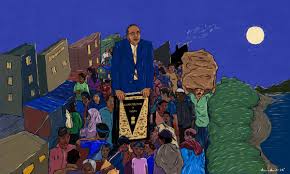
Calling Dalit assertion ‘victimhood’ is not a philosophical position. It is the oldest reflex of every dominant order: discredit the claim before examining its truth. There is a particular kind of violence that never raises its hand. It arrives, instead, in the language of wellness and self-improvement. It does not deny history, it pathologises the act of remembering it. Nowhere is this violence more precisely deployed than in the recurring accusation that Dalits – one-sixth of India’s population, constitutionally recognised as the subjects of the country’s most urgent social justice provisions – ‘play the victim card.’ When that accusation comes from a person occupying a position of institutional authority, it does not merely insult the community, it also rejects the constitutional philosophy of the Republic of India. The ‘victim card’ Let us be precise about what the ‘victim card’ accusation actually claims. It claims that Dalit assertion is not a legitimate constitutional exercise but a psychological performance – that the demand for the implementation of Articles 15, 16, and 17 of the Constitution is not citizens asking for their rights but dependency; that the invocation of the Supreme Court’s jurisprudence on caste discrimination is not law but theatre. It is, in short, a demand that Dalits stop using the Constitution of India in the manner that the Constitution of India was specifically and explicitly designed to be used. Dr. B.R. Ambedkar – the man who designed that Constitution, warned in his closing address that ‘political democracy cannot last unless there lies at the base of it social democracy’. He did not write Articles 17 and 46 as aspirational poetry, but as tools to help dismantle the unequal social order. He knew that a formal constitution in fundamentally unequal society could not produce justice. The reservation system, the anti-atrocity law, the National Commission for Scheduled Castes – these were not gifts from the state to a disadvantaged community. They were constitutional rights, extracted by democratic assertion from a state that would, without them, have perpetuated the very order the Constitution claimed to abolish. Calling Dalit assertion ‘victimhood’ is not a philosophical position. It is the oldest reflex of every dominant order: discredit the claim before examining its truth. What the data shows In 2022, the National Crime Records Bureau recorded 57,582 cases of atrocities against people from Scheduled Caste (SC) communities. That is roughly 157 cases every single day. These were not mere reports of discrimination or allegations of social slights, but registered cases of violence, humiliation, and abuse — everything from murder and rape to the forced drinking of urine, the destruction of homes, and the prevention of access to public water sources. According to the fifth National Family Health Survey, women from SC communities face significantly higher rates of violence than caste Hindu women. According to the 2011 Census, 79.8% of India’s manual scavengers – those who clean human excrement by hand because no one with a choice would do so – belong to SC communities. A landmark 2007 study by economists Sukhdeo Thorat and Paul Attewell found that identical job applications sent to employers with only the applicant’s name changed resulted in 67% fewer callbacks for Dalit names compared to upper-caste ones. Oxfam India’s 2022 Discrimination Report found that SC households earn, on average, 21% less than upper-caste and dominant caste households even in formal, regulated employment, where the law theoretically guarantees equal treatment. CASTE OPPRESSION IN NUMBERS ■ 57,582 registered SC atrocity cases in 2022 alone (NCRB) — 157 every single day ■ 79.8% of manual scavengers belong to Scheduled Caste communities (Census 2011) ■ 67% fewer job callbacks for identical CVs with Dalit names (Thorat & Attewell, 2007) ■ 21% income gap between SC and upper-caste workers in formal employment (Oxfam 2022) ■ 3.6% SC literacy rate at Independence — the direct product of millennia of educational prohibition ■ 20 Dalit student suicides at elite central institutions between 2014 and 2023 These are not the numbers of a community suffering from a psychological addiction to grievance. They are the numbers of a community living inside a system so comprehensively hostile to their existence that the real question is not why they assert their rights, but why they are required, in the face of this evidence, to justify the assertion to anyone at all. The American lesson The comparison to the Black community in the US is frequently used in this debate – usually to suggest that India, like the US, should move beyond race or caste-conscious remediation toward a colour-blind meritocracy. This selective reading of American history is a reversal of what that history actually demonstrates. Martin Luther King Jr., writing from a Birmingham jail cell in 1963, described the greatest obstacle to Black freedom as not the violent racist but the ‘white moderate’ – the liberal who was ‘more devoted to order than to justice,’ who told Black Americans their demands were badly timed, their demonstrations extreme, their sense of urgency unreasonable. King wrote that this moderate preferred a ‘negative peace which is the absence of tension to a positive peace which is the presence of justice.’ The counsel to stop playing the victim card is, in every era and in every country where it has been deployed, the voice of King’s white moderate. The Kerner Commission, appointed by President Lyndon Johnson after the 1967 urban uprisings, concluded with the full authority of the American federal government that the United States was moving toward ‘two societies, one Black, one white – separate and unequal’ and that passive non-discrimination was woefully inadequate to address centuries of structural racism. The US responded with affirmative action. When the US Supreme Court struck down race-conscious university admissions in 2023, Black and Latino enrolment at elite institutions dropped within a single admissions cycle. Evidently, its removal immediately reconstituted the exclusion it had been designed to address. India, with thirty centuries of caste oppression and a SC literacy rate of 3.6% at independence, is in a far more severe position
JNU Student Bodies Clash Amid VC’s ‘Dalit Victimhood’ Remark, Demand Resignation
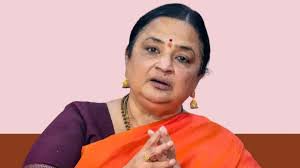
More than 10 students were injured in the clashes that broke out at Jawaharlal Nehru University on Sunday night. Some of them reportedly suffered serious head injuries. Jawaharlal Nehru University (JNU) witnessed another bloody clash at midnight on Sunday night, a fierce clash broke out between the Akhil Bharatiya Vidyarthi Parishad (ABVP) and Left student organisations on the campus. Students affiliated with Left organisations took out a torchlight procession demanding the resignation of VC Shantishree Dhulipudi Pandit. The protesters alleged that ABVP students attacked them, while the ABVP claimed that Left-wing students targeted students studying in the library. Several students were seriously injured amid the lathi-charge and stone-pelting, rekindling the debate on campus about security and freedom of expression. The main root of this entire fight is the recent interview of Vice Chancellor Shantishree Dhulipudi Pandit, in which she made some comments about Dalits and blacks, which the students are considering ‘casteist’ and ‘insulting’. As JNU VC Shanti Shri Dhulipudi Pandit dismisses UGC regulations as “irrational” and “unnecessary,” student union has demand her resignation. The VC, known for her RSS association, labelled Dalits as under “permanent victimhood,” All India Students’ Association (AISA) said in a press release. “AISA extends its solidarity to the students of JNU as well as the rusticated JNUSU Office Bearers and ex-JNUSU President in their fight against the Brahmanical forces in their campus as well against their unjust rustication in an attempt to deprive JNU students of their right to democratic representation,” the students’ union stated. What Happened At The Protest? The Left claimed that while the march was going on peacefully, ABVP members pelted stones at them and attacked them with sticks. While the ABVP said that under the guise of ‘resignation’, Left students entered the library and beat up students who were studying peacefully. More than 10 students were injured in the clashes that broke out at Jawaharlal Nehru University on Sunday night. Some of them reportedly suffered serious head injuries. The injured have been admitted to the AIIMS Trauma Center. Delhi Police remained on alert outside the campus, but due to JNU’s autonomy rules, efforts to control the situation inside were only made after obtaining permission from the police administration. Delhi Police could not enter without the permission of the JNU administration. What JNU Said? Meanwhile, the JNU administration said it has taken note of the matter and will be taking appropriate action against “unruly behaviour on campus” and “repeated destruction of public property. How The Controversy Begun? The latest controversy began with a podcast interview released on February 16, 2026. In it, the Vice Chancellor, while discussing the UGC’s equity regulations, said, “You can’t always progress by playing the victim card. Just as it happened for Black people, the same thing has happened here for Dalits.” Student organisations (SFI, AISA, JNUSU) said that this statement is casteist and an insult to the struggles of Dalits. They called it an attack on constitutional rights in the name of ‘woke culture’ and demanded the Vice Chancellor’s resignation. The VC clarified that her statement had been distorted. She said no one should be permanently categorised as a “victim.” Courtesy : News18 Note: This news is originally published on https:/news18.com/bha and is used purely for non-profit/non-commercial purposes, especially human rights
Dalit man tied to wooden cot, beaten to death in Jharkhand; mob violence suspected over love affair

DALTONGANJ: A 25-year-old Dalit man was lynched allegedly by a mob on the intervening night of Saturday and Sunday at Telyahi village in Palamu district, police said. According to the law enforcers, the lynching could be related to a love angle, but the accused charged him with theft. “We are probing the crime from all angles,” Palamu SP Reeshma Ramesan said. The victim, Pawan Kumar, was tied to a leg of a wooden cot and beaten up. One person has been detained in connection with the crime. Parwa police station officer-in-charge Anchit Kumar said they received a call around midnight alleging that a youth was being beaten up on suspicion of attempting to steal a tractor battery. A patrol team reached the village and found Kumar tied up and surrounded by an aggressive mob. Police rescued him and rushed him to the Medinirai Medical College and Hospital in Daltonganj around 4.06 am, where the doctors declared him dead on arrival. SP Ramesan said no battery was recovered from the victim and described the theft allegation as “unfounded” and a “deception” meant to mislead the police. The investigators are probing a possible “love angle,” as Kumar was allegedly called to the spot by a girl. Police sources suspected the killing may have been linked to a personal relationship and could involve members of the girl’s family and their associates. Kumar, a resident of nearby Kokarsa village, was allegedly lured to Telyahi. An FIR was lodged by the victim’s father, Manoj Ram, with Parwa police station in connection with the incident. The case has been registered under Section 103(2) of the BNS, which pertains to mob lynching. Police have withheld the names of the accused, saying they could abscond. Under the direction of the District Legal Services Authority chairman, Ram Sharma, who is also the principal district and sessions judge, para-legal volunteer Pankaj Pathak will visit the family to initiate and provide interim victim compensation. DLSA secretary Rakesh Ranjan said the family would receive legal assistance.The post-mortem was video-graphed. The victim, Pawan Kumar, was tied to a leg of a wooden cot and beaten up. One person has been detained Courtesy : TOI Note: This news is originally published on https:/timesofindia.com/bha and is used purely for non-profit/non-commercial purposes, especially human rights